
2027 Is an Online Degree Worth It?

Co-Founder and Chief Data Scientist
Choosing an online degree is no longer just a question of convenience. For many adults, working professionals, parents, military-connected learners, career changers, and students outside major college towns, online education may be the most realistic way to earn a credential without pausing work or relocating. The harder question is whether the degree will be respected, affordable, manageable, and useful for your career goals.
This guide explains when an online degree is worth it, when it may not be the best option, and how to compare programs before enrolling. You will learn how employers tend to evaluate online credentials, what affects cost and return on investment, which fields commonly fit online study, and what warning signs to watch for when choosing a school.
Quick answer: Is an online degree worth it?
Yes, an online degree can be worth it when the program is accredited, aligned with your career goals, affordable relative to your expected outcomes, and structured in a way you can realistically complete. Online degrees are especially practical for students who need schedule flexibility, want to keep working while studying, or cannot easily attend classes on campus.
An online degree is not automatically a good investment. The value depends on the institution, program quality, accreditation, student support, career services, transfer credit policies, field of study, and whether the credential is accepted for any licensure or certification you may need.
Key things you should know about online degree programs
- Online degrees can support career mobility, job changes, promotions, and access to roles that require a college credential.
- Online study may reduce total education costs, especially when it eliminates commuting, relocation, campus housing, or meal plan expenses.
- Flexibility is one of the strongest advantages of online learning, but it also requires time management, self-direction, and consistent study habits.
- Only 31% of students favor in-person instruction compared to other teaching methods, while 69% opt for fully online, hybrid, or blended learning alternatives.
- Online programs are more affordable, offering a cost difference of $31,165 in tuition and overall attendance expenses.
Affordable Quick Online Degree Programs With High Acceptance Rates for 2027
The best online degree for you depends on your career target, prior credits, budget, schedule, and whether the field requires clinical hours, field placements, licensure, or supervised practice. The programs below are commonly offered online and may fit students who want flexible, career-focused study options.
Nursing
Online nursing programs are often designed for students who need flexible coursework while completing required clinical or practicum experiences in approved settings. Coursework may cover patient care, health assessment, care coordination, healthcare systems, and evidence-based practice. Graduates may pursue nursing or advanced practice pathways depending on the degree level, prior credentials, and state requirements.
Computer Science
Online computer science programs typically train students in programming, algorithms, software development, databases, cybersecurity fundamentals, and emerging areas such as artificial intelligence. Many programs use coding projects, virtual labs, and portfolio-based assignments to help students show practical technical ability to employers.
Healthcare Administration
Online healthcare administration degrees combine business, policy, finance, operations, and healthcare delivery topics. These programs may suit students who want to work in healthcare leadership, medical office management, hospital administration, compliance, or health services operations rather than direct clinical care.
Management
Online management programs focus on leadership, organizational behavior, communication, human resources, operations, and strategic planning. They can be useful for students who already have work experience and want a broader business credential for supervisory, team lead, nonprofit, operations, or administrative roles.
Management Information Systems
Online management information systems programs connect business decision-making with technology infrastructure. Students may study databases, systems analysis, cybersecurity, enterprise systems, project management, and IT strategy. This path can fit learners who want roles that bridge business teams and technical teams.
Accounting
Online accounting degrees usually cover financial reporting, taxation, auditing, managerial accounting, accounting information systems, and regulatory standards. Students should pay close attention to state CPA education requirements if their long-term goal includes public accounting or professional licensure.
Business Administration
Online business administration programs provide broad preparation in finance, marketing, management, operations, economics, and organizational strategy. This degree can work well for students who want a versatile credential rather than a highly specialized major.
Economics
Online economics degrees teach students to analyze markets, incentives, policy, data, and financial behavior. Depending on electives and quantitative training, graduates may pursue roles in finance, research, consulting, business analysis, public policy, or graduate study.
Social Work
Online social work programs may include virtual coursework along with required in-person field placements. Students should confirm that the program’s accreditation and placement structure match the requirements for their intended state and career path, especially if they plan to pursue licensure.
Special Education
Online special education programs prepare students to support learners with disabilities and diverse educational needs. Coursework may address individualized instruction, behavior support, inclusive classrooms, assessment, assistive technology, and curriculum adaptation. Prospective teachers should verify state certification rules before enrolling.
- Are online degrees easier than campus-based programs?
- How do online degrees serve working adults and nontraditional students?
- Are online degrees cheaper than on-campus degrees?
- Are online degrees respected by employers?
- Can an online degree help you get hired?
- Do online graduates earn as much as campus graduates?
- Should you consider an accelerated online program?
- Can certificates increase the value of an online degree?
- Which industries commonly value online degrees?
- What transferable skills can online students build?
- Online degree fields associated with high-earning graduates for 2027
- How employers evaluate online degrees
- Can fast-track online degrees speed up career progress?
- Are advanced online degrees useful for long-term growth?
- Do online programs offer networking and mentorship?
- Do online programs provide career support?
- Are online degrees adapting to workforce changes?
- How should you evaluate online degree ROI?
- What are the pros and cons of online degrees?
- Key insights before enrolling
Are online degrees easier than on-campus programs?
Online degrees are not necessarily easier than in-person programs. A strong online program should meet the same academic standards as its campus equivalent. The difference is usually in delivery: online students often have more control over when they study, but they also carry more responsibility for managing deadlines, technology, communication, and motivation.
If you are comparing the best online degree programs, do not assume that online means lighter coursework. Instead, ask whether the format fits the way you learn. Some students perform well with asynchronous lectures and independent assignments. Others need live class meetings, frequent instructor interaction, or the structure of a campus schedule.
Available research and survey data show that online learning is now a mainstream part of higher education, but outcomes depend heavily on the student and the program.
- In a study conducted in 2027 investigating the impact of enrolling in a solely online degree program on students’ probability of degree completion, findings indicated that 8.3% of students exclusively enrolled online had a reduced likelihood of completing bachelor’s degrees in comparison to their counterparts in on-campus programs.
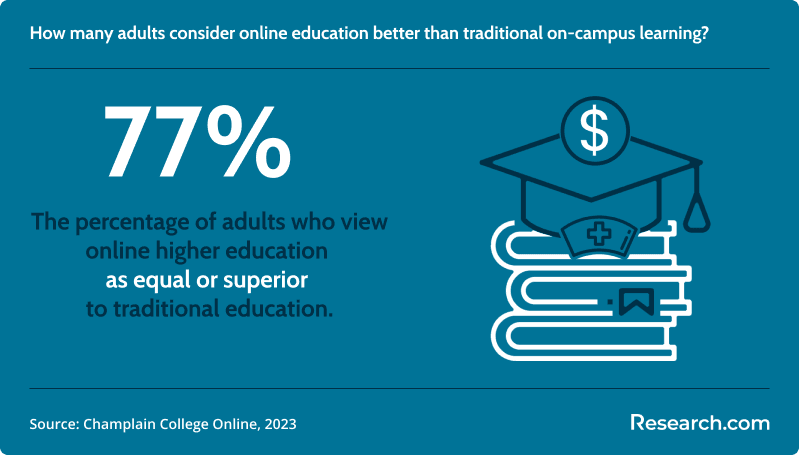
- Approximately 77% of adults believe that online higher education is either equivalent to or superior in fulfilling the requirements of individuals aged 23 and older compared to traditional on-campus higher education.
- According to the National Center for Education Statistics, about 28.2% of students took classes exclusively online in 2021, while another 32.6% had some but not all of their classes online.
- The Time for Class 2023 survey revealed that 31% of students favor in-person instruction compared to other teaching methods, while the remaining 69% opt for fully online, hybrid, or blended learning alternatives.
The practical takeaway is simple: online learning can be effective, but it is not effortless. Students who plan weekly study blocks, use academic support early, and choose a program with clear advising are usually better positioned than students who enroll only because the format looks convenient.
| Distance education participation in 2021 | Percentage of students |
| Students who took classes exclusively online | 28.2% |
| Students with at least one online class | 32.6% |
How do online degrees cater to working professionals and nontraditional students?
Online degrees are often built around students who cannot organize their lives around a traditional campus schedule. That includes full-time employees, parents, caregivers, military learners, rural students, career changers, and adults returning to school after a long break. This is why online learning can be especially relevant for students comparing degrees for stay at home moms or programs for working adults.
| Online learning feature | Why it matters | Best fit |
| Flexible scheduling | Students can often watch lectures, complete assignments, or join discussions outside standard class hours. | Working adults, parents, caregivers, and students with changing schedules |
| Self-paced or competency-based options | Some programs let students move faster through material they already understand. | Experienced professionals and disciplined independent learners |
| Broad program access | Students can compare programs outside their immediate geographic area. | Rural students, relocation-limited learners, and specialized major seekers |
| Stackable credentials | Certificates or micro-credentials may build toward a degree while offering shorter-term milestones. | Career changers and students who want skills they can use quickly |
| Work-school balance | Students may continue earning income while completing coursework. | Learners who cannot afford to stop working |
If your main concern is speed, review how program calendars, transfer credits, and course loads affect completion time. A guide such as how fast can you get a bachelor's degree online can help you understand realistic timelines. If you prefer more control over pacing, compare options from accredited self-paced online colleges. Students balancing work and school may also want to review the best online degree programs for working adults.
According to a 2020 report by Bay Atlantic University, 63% of online students cited flexibility as a primary reason for choosing online education. Flexibility, however, is only valuable if the program also offers clear expectations, responsive instructors, accessible tutoring, and advising that fits adult learners’ schedules.
Are online degrees more affordable than studying on campus?
Online degrees can cost less than campus degrees, but the difference varies by school and program. The biggest savings often come from avoiding relocation, commuting, campus housing, parking, and some campus-based fees. Tuition itself may be lower, equal, or sometimes higher depending on the institution.
According to a comparison of expenses between online and in-person degrees at public four-year colleges, online programs are notably more affordable, offering a cost difference of $31,165 in tuition and overall attendance expenses. In private institutions, the average cost is $60,593 for an online degree, considerably less than the $185,252 charged for an in-person degree. Some students may also look for online colleges that offer free laptops and financial aid, although those benefits should be evaluated alongside total tuition and fees.
Students attending in-person classes face additional annual costs of $1,360 for commuting expenses, an expenditure not incurred by online learners. Those attending classes on campus also spend an extra $600 annually for a meal plan compared to those preparing meals at home.
For public university degrees, an online program typically amounts to around $54,183, compared to the $85,348 expense for the same degree pursued in person. Students seeking lower-cost access may also compare the cheapest open enrollment online colleges and review typical online college cost factors before applying.
Cost factors to compare before choosing an online degree
| Cost factor | Why it matters | Question to ask |
| Tuition rate | Schools may charge per credit, per term, or by program. | Is the online tuition rate different from the campus rate? |
| Fees | Technology, distance learning, graduation, lab, and proctoring fees can increase the total bill. | What mandatory fees are not included in advertised tuition? |
| Transfer credits | Accepted credits can shorten the degree and reduce cost. | How many prior credits will count toward this specific program? |
| Books and course materials | Digital platforms and access codes may add expenses. | Are textbooks, software, or subscriptions included? |
| Clinical or field placement costs | Healthcare, education, counseling, and social work programs may require local placements. | Who arranges placements, and are travel or background-check costs required? |
| Financial aid eligibility | Not every program structure qualifies for the same aid options. | Is the program eligible for federal financial aid? |
Are online degrees respected or taken seriously?
Online degrees are generally taken seriously when they come from accredited institutions with credible academic standards. Employers are usually more concerned with the school’s reputation, accreditation, relevance of the degree, candidate experience, and demonstrated skills than with whether every class was completed online.
In an expert interview conducted by Johnson, Dr. Deb Geller, a higher education and HR specialist, observed that the student experience differs between campus and online learning. Even so, hiring managers rarely make the learning format their primary concern.
The wider normalization of remote work has also changed perceptions. During and after the pandemic, many organizations became more comfortable with virtual collaboration, remote onboarding, online meetings, and digital work tools. That shift made online learning easier for employers to understand, especially when candidates can show strong communication, discipline, and technology skills.
Can online degrees get you a job?
Yes. An online degree can help you qualify for jobs, promotions, career changes, or graduate programs when the credential is relevant and properly accredited. It does not guarantee employment. Your results will also depend on your field, local labor market, experience, internships, portfolio, certifications, networking, and interview performance.
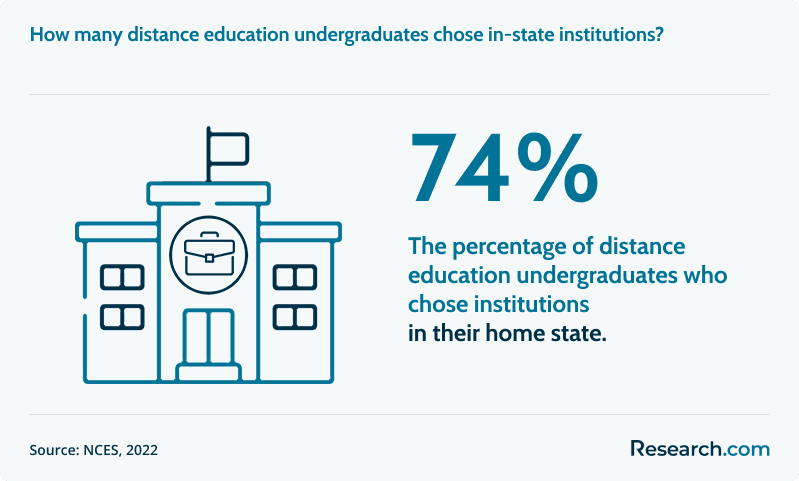
According to NCES (2022), 74% of undergraduate students exclusively engaged in distance education opted for educational institutions within their residing state, while 23% chose institutions located in a different state.
Students who want a faster path may compare online accelerated degree programs, but speed should not come at the expense of accreditation, faculty access, or career preparation. Before enrolling, confirm that the program is one of the accredited online degree programs recognized by employers, graduate schools, and licensing bodies in your field.
If your goal is to enter the workforce quickly, be careful when comparing the easiest college majors. A major that feels easier may not offer the strongest employment path for your target role. Shorter career-focused options, such as medical coding and billing classes online with financial aid, may also make sense if you need a near-term credential while working toward a longer degree.
How does the earning potential of online degree holders compare to traditional degree holders?
Earning potential is usually tied less to the delivery format and more to the degree field, school reputation, accreditation, experience, location, industry, and career path. A respected online degree in a high-demand field may lead to strong earnings, while a weakly aligned degree from a poorly supported program may offer limited return.
Some available examples show that online learners can achieve career progress while studying. During their enrollment in the online Master of Business Administration program at the University of Delaware, 90% of students maintain full-time employment. Additionally, according to The Princeton Review, 30% of these students note experiencing career advancements, leading to an associated salary increase.
The best way to evaluate potential earnings is to compare actual program outcomes, not general claims. Ask schools for graduation rates, job placement information, employer partnerships, internship access, alumni outcomes, and debt levels for students in your program.
Are accelerated online programs a viable option for fast-tracking your career advancement?
Accelerated online programs can be useful for focused students who already have transfer credits, relevant work experience, or the ability to handle heavier course loads. These programs compress the schedule, which may help students finish sooner and apply new skills more quickly. They can also be demanding, especially for learners balancing full-time work and family obligations.
Before choosing an accelerated format, confirm that the program is accredited, that courses are not so compressed that learning suffers, and that advising is available when you need it. Students considering a short associate pathway can compare options such as the best associate degree in 6 months online to understand how fast programs are structured.
Can supplemental certifications amplify your online degree's value?
Certificates can strengthen an online degree when they verify practical skills that employers recognize. They are especially useful in fields where tools, platforms, regulations, or technologies change quickly. A degree may show broad preparation, while a certification can signal current ability in a specific area.
For example, students may use online certificate programs to add focused training in project management, analytics, coding, healthcare administration, cybersecurity, accounting tools, or other specialized areas. The key is to choose certificates that match your target job postings rather than collecting credentials that do not connect to a career plan.
Are there specific industries where online degrees are in high demand in 2024?
Demand for online degrees depends on employer needs, licensing rules, the quality of the program, and whether the field values remote or hybrid work skills. The following areas commonly offer online degree options and may suit students who need flexible study formats.
| Field | Why online study can fit | Important caution |
| Technology and IT | Many skills can be practiced through coding projects, labs, cloud platforms, and digital portfolios. | Employers may expect proof of hands-on ability through projects, internships, certifications, or work samples. |
| Healthcare | Administrative, nursing advancement, public health, and healthcare leadership coursework may be delivered online. | Clinical or practicum requirements may still be in person and must meet state or professional rules. |
| Business and Management | Online formats often work well for working professionals applying coursework to current roles. | Program reputation, networking, and employer connections can affect value. |
| Education | Online programs can support teachers, administrators, and career changers seeking flexible training. | Teacher certification rules vary by state and must be verified before enrollment. |
| Data Science and Analytics | Students can build technical skills through software, datasets, statistics, and applied projects. | A strong portfolio and quantitative preparation may matter as much as the degree title. |
How can online degrees help you build transferable skills?
Online degrees can build more than subject knowledge. Because students often manage coursework through digital platforms and independent schedules, they can develop skills that transfer directly to remote, hybrid, and technology-enabled workplaces.
- Time management: Online learners often coordinate work, family, assignments, exams, and discussion deadlines without the structure of a daily commute to campus.
- Self-discipline: Students must keep moving even when no instructor is physically present to remind them of each task.
- Written communication: Discussion boards, email, shared documents, and online projects require clear, professional communication.
- Digital literacy: Learning management systems, video conferencing, cloud tools, databases, and discipline-specific software can strengthen workplace technology confidence.
- Problem-solving: Online students learn to troubleshoot schedule conflicts, platform issues, research tasks, and independent learning challenges.
- Virtual collaboration: Group projects and online presentations can help students practice teamwork across locations and time zones.
These skills are most valuable when students can explain them with examples. In interviews, be ready to describe how you completed projects, collaborated remotely, managed deadlines, solved problems, and applied coursework to real work situations.
Online Degree Programs Known for Producing High-Earning Graduates for 2027
Some online degree fields are associated with higher earnings because they lead to roles in business leadership, technology, healthcare, analytics, or engineering. Salary outcomes are not guaranteed, and they vary by location, employer, experience, credentials, and specialization. Still, the following fields are commonly considered by students who want strong career potential.
Online MBA
An online MBA can support advancement in management, consulting, entrepreneurship, operations, finance, or executive-track roles, especially for students who already have professional experience. According to a survey by the Graduate Management Admission Council (GMAC), the median salary for MBA graduates worldwide was $115,000 in 2021.
Online Computer Science and IT Degrees
Online degrees in computer science, software engineering, and information technology can lead to careers in software, systems, cybersecurity, cloud computing, data infrastructure, and IT operations. The median annual wage for computer and information technology occupations was $100,530 in May 2022, according to the U.S. Bureau of Labor Statistics (BLS).
Online Nursing and Healthcare Degrees
Online nursing and healthcare programs can support advancement into clinical, administrative, or specialized roles, depending on the degree and licensure requirements. Nurse practitioners, for instance, earned a median annual salary of $125,900 in May 2022, according to the BLS.
Online Data Science and Analytics Degrees
Data science and analytics programs may prepare students for roles using statistical modeling, databases, visualization, and business intelligence. BLS says that data scientists and statisticians had a median annual wage of $103,500 in May 2022.
Online Engineering Degrees
Online engineering degrees may be available in fields such as computer engineering, systems engineering, industrial engineering, or engineering management. Students interested in industrial engineering can compare options such as an online industrial engineering masters. The BLS reported that the median annual wage for all engineers was $87,700 in May 2022.
How Employers View Online Degrees
Employers do not all evaluate online degrees the same way. Some focus heavily on the institution and accreditation. Others care more about experience, technical skills, internships, portfolios, references, and whether the candidate can perform the job. In many hiring processes, the degree format matters less than the credibility and relevance of the credential.
Increased Acceptance
The expansion of remote work, digital collaboration tools, and online education has made virtual learning more familiar to employers. As online programs became more common, many hiring managers became less likely to treat online study as unusual.
Diverse Employer Views
Some fields and employers still place strong weight on institutional prestige or program reputation. This can be more visible in highly selective industries. In many broader workforce areas, including careers related to a social worker degree, employers may focus more on licensure eligibility, field placement quality, and applied experience.
Significance of Accreditation
Accreditation is one of the most important signals of legitimacy. It shows that an institution or program has gone through external review and meets defined academic standards. Students should understand what is the best accreditation for online colleges before applying, especially in fields tied to licensure, certification, or graduate school admission.
Preference for Nonprofit Programs
Some employers may be cautious about certain for-profit online programs because of historical concerns about student outcomes, recruiting practices, or public reputation. That does not mean every for-profit program lacks value, but students should review accreditation, graduation rates, debt levels, student complaints, and employer recognition carefully.
Focus on Real Skills
Employers often evaluate whether a candidate can solve problems, communicate well, use relevant tools, and contribute quickly. A degree can help open the door, but work samples, internships, projects, certifications, and prior experience can make the credential more persuasive.
Value in Competency-Based Learning
Competency-based learning can appeal to students who want to prove mastery and move efficiently through material they already know. Employers may value this format when graduates can clearly connect competencies to workplace skills.
Lack of Instant Recognition
Not every employer will immediately recognize every online institution. If your school is not widely known, be prepared to explain accreditation, curriculum quality, major projects, internships, and relevant outcomes.
Understanding Circumstances
Many employers understand why students choose online learning. Completing a degree while working, caring for family, or managing financial constraints can demonstrate persistence and maturity.
Appreciation for Time Management
Online students often develop strong planning habits because they must balance school with other obligations. Employers may see that as evidence of reliability, especially if the candidate completed the program while employed.
Curiosity About Collaboration Skills
Because remote and hybrid work remain common in many organizations, employers may value candidates who can collaborate digitally. This can matter in business, technology, healthcare administration, and degrees in education, where communication and coordination are central to the work.
Holistic Evaluation
A degree is only one part of a candidate’s profile. Employers also review experience, skills, references, communication, adaptability, professionalism, and fit for the role. Online graduates should present the full picture, not only the credential.
Can accelerated online degree programs offer faster career advancement?
Fast-track online degrees can help motivated students reach credential requirements sooner, but they are not right for everyone. Condensed courses require steady attention, fewer breaks, and strong organization. The benefit is speed; the risk is overload.
Before enrolling, review accreditation, faculty access, workload expectations, tutoring, advising, and career services. If you are comparing accelerated options, review what colleges offer accelerated programs? to understand how different schools structure faster pathways.
Do advanced online degrees offer strategic benefits for long-term career growth?
Advanced online degrees can be valuable for professionals aiming for leadership, specialized practice, research, teaching, consulting, or executive roles. They may also help students build expertise without leaving the workforce. However, the return depends on whether the credential is expected in your field and whether the program has strong academic and professional support.
Students considering doctoral or terminal credentials should compare admission standards, dissertation or capstone requirements, faculty mentorship, completion support, and career outcomes. An online doctorate degree may be attractive for flexibility, but speed should not outweigh quality, fit, or long-term credibility.
Do online degree programs offer robust networking and mentorship opportunities?
Strong online programs now often include virtual networking, alumni panels, online student organizations, mentoring, career fairs, employer sessions, and group projects. These opportunities matter because online students do not automatically benefit from the casual campus interactions that can lead to referrals or professional contacts.
When comparing schools, ask how online students meet faculty, alumni, employers, and peers. Some learners also add an online course with certificate to build targeted skills and expand professional visibility.
Do online degree programs offer dedicated career support to enhance job placement?
Career support can make a major difference in the value of an online degree. Look for programs that provide resume reviews, interview preparation, internship support, employer connections, portfolio guidance, career coaching, and access to job platforms. Do not assume online students receive the same career services as campus students; ask directly.
If your priority is entering a field quickly, compare degree and non-degree pathways carefully. Some students may benefit from reviewing quick schooling high paying jobs to understand which credentials can lead to faster workforce entry.
Are online degrees evolving to meet future workforce demands?
Many online programs are changing to reflect employer expectations for digital fluency, data literacy, remote collaboration, applied projects, and industry-aligned skills. Some programs update curricula through advisory boards, employer partnerships, simulations, virtual labs, and project-based assignments.
Affordability is also a major concern as students weigh whether a degree is worth the cost. Comparing options such as the most affordable online bachelor's can help students identify lower-cost pathways, but price should always be considered alongside accreditation, student support, completion rates, and career relevance.
What is the return on investment of an online degree?
The return on investment of an online degree depends on what you pay, how much debt you take on, whether you finish, how the credential affects your career, and whether it qualifies you for roles with better pay or stability. A lower-cost program with strong completion support may offer better value than a prestigious program that leaves you with high debt and limited career improvement.
To evaluate ROI, compare tuition, fees, lost income, transfer credits, time to completion, expected career outcomes, and the value of staying employed while studying. Supplemental credentials can also affect ROI if they align with employer needs. For example, researching what certification pays the most may help you decide whether a certificate should complement your degree.
| ROI question | Why it matters |
| Will this degree qualify me for my target job? | A degree has limited value if it does not match employer or licensing requirements. |
| How much will I pay after grants, scholarships, employer aid, and transfer credits? | Net cost is more important than advertised tuition. |
| Can I keep working while enrolled? | Maintaining income can reduce the opportunity cost of college. |
| What support is available if I struggle? | Tutoring, advising, and instructor access can affect completion. |
| What career outcomes do graduates report? | Program-specific outcomes are more useful than broad salary claims. |
What are the pros and cons of online degrees?
Online degrees can be practical, respected, and cost-effective, but they also carry risks. This is especially true in fields with hands-on requirements, such as online nursing school programs, where clinical placement quality and state approval are critical.
Pros of Online Degree Programs
- Lower total cost potential: Affordable online degrees may reduce tuition, commuting, relocation, housing, or meal expenses.
- Work-school flexibility: Students may continue earning income while completing coursework.
- Immediate skill application: Working students can often use assignments, projects, and new concepts in their current jobs.
- Stronger digital work habits: Online learning can build comfort with virtual meetings, online collaboration, and digital communication.
- Broader program access: Students can compare schools beyond commuting distance.
- More diverse classmates: Online cohorts may include students from different regions, industries, and career stages.
- Reduced commuting time: Students can redirect time spent traveling toward study, work, or family responsibilities. Some may also compare online schools that provide laptops, but technology benefits should be weighed against total cost.
Cons of Online Degree Programs
- Quality varies widely: Some online programs have stronger faculty, advising, and outcomes than others.
- Accreditation mistakes can be costly: Enrolling in the wrong program can affect financial aid, transfer credits, graduate school admission, licensure, or employer acceptance.
- Less built-in structure: Students who need frequent face-to-face reminders may struggle in asynchronous formats.
- Isolation can occur: Programs with limited interaction may make it harder to build relationships with classmates and faculty.
- Student support may be uneven: Tutoring, advising, library access, disability services, and career coaching can differ significantly across schools.
- Licensure requirements may be complicated: Education, nursing, counseling, social work, and other regulated fields may require state-specific approval, exams, or supervised hours.
Common mistakes to avoid before enrolling
| Mistake | Better approach |
| Choosing a school based only on convenience | Compare accreditation, outcomes, support, cost, and employer recognition. |
| Looking only at tuition | Calculate total cost, including fees, books, technology, travel, and time to completion. |
| Assuming all online programs meet licensure rules | Confirm state requirements before enrolling in nursing, education, counseling, social work, or similar fields. |
| Ignoring transfer credit policies | Request a formal transfer evaluation before committing. |
| Relying only on rankings | Use rankings as one input, then verify fit, cost, curriculum, and outcomes. |
| Believing salary outcomes are guaranteed | Review labor market demand, your experience level, internships, certifications, and local hiring conditions. |
Key Insights
- An online degree is worth it when it is accredited, affordable, career-aligned, and realistic for your schedule and learning style.
- Online programs are not automatically easier. They often require more self-direction, planning, and independent follow-through than campus programs.
- Employers generally care most about accreditation, school credibility, relevant skills, work experience, and whether the degree fits the role.
- Cost savings can be significant, but students should compare total cost rather than tuition alone.
- Fields such as technology, healthcare, business, education, analytics, and engineering commonly offer online pathways, but licensure and hands-on requirements must be checked carefully.
- Accelerated degrees and certificates can improve value when they match a clear career goal, but they can also create workload or quality risks if chosen carelessly.
- The strongest online programs provide advising, tutoring, career support, networking, faculty access, and transparent outcomes for online students.
References:
- Bay Atlantic University. (2023, October 18). Online Learning statistics: Is online education the future? Bay Atlantic University Washington, D.C. Bay Atlantic University Washington, D.C. https://bau.edu/blog/online-learning-statistics
- BLS. (2023a, September 6). Architecture and Engineering Occupations: Occupational Outlook Handbook:: U.S. Bureau of Labor Statistics. https://www.bls.gov/ooh/architecture-and-engineering/home.htm
- BLS. (2023b, September 6). Computer and Information Technology Occupations: Occupational Outlook Handbook:: U.S. Bureau of Labor Statistics. https://www.bls.gov/ooh/computer-and-information-technology/home.htm
- BLS. (2023c, September 6). Data Scientists: Occupational Outlook Handbook:: U.S. Bureau of Labor Statistics. https://www.bls.gov/ooh/math/data-scientists.htm
- BLS. (2023d, September 6). Nurse Anesthetists, Nurse Midwives, and Nurse Practitioners: Occupational Outlook Handbook:: U.S. Bureau of Labor Statistics. https://www.bls.gov/ooh/healthcare/nurse-anesthetists-nurse-midwives-and-nurse-practitioners.htm
- Champlain College Online. (2023, November 9). Data Reveals New Insights on Online Higher Education Post-Pandemic. Champlain College Online. https://online.champlain.edu/blog/data-reveals-new-insights-online-higher-education-post-pandemic
- GMAC. (2021). Survey projects demand for business school graduates to rebound in Post-Pandemic era. Graduate Management Admission Council. https://www.gmac.com/news-center/gmac-press-releases/survey-projects-demand-for-business-school-graduates-to-rebound-in-post-pandemic-era
- Hanson, M. (2023, August 23). Cost of Online Education vs. Traditional Education [2023]: Comparison. Education Data Initiative. https://educationdata.org/cost-of-online-education-vs-traditional-education
- Johnson, H. (2022). Is an Online Degree Respected? https://www.onlineu.com/resources/college-planning/online-degree-respected
- NCES. (2022a). Fast Facts: Distance learning (80). https://nces.ed.gov/fastfacts/display.asp?id=80
- NCES. (2022b). Number and percentage of students enrolled in degree-granting postsecondary institutions, by distance education participation, location of student, level of enrollment, and control and level of institution: Fall 2020 and fall 2021. https://nces.ed.gov/programs/digest/d22/tables/dt22_311.15.asp
- Ortagus, J., Hughes, R., & Allchin, H. (2023). The role and influence of exclusively online degree programs in higher education. EdWorkingPapers. https://edworkingpapers.com/ai23-879
- The Princeton Review. (2022). Best Online MBA Programs 2022. https://www.princetonreview.com/business-school-rankings?rankings=best-online-mba-programs&page=6
Other Things You Should Know About Online Degrees
Yes. Many U.S. employers use the National Student Clearinghouse to confirm enrollment and graduation data for accredited colleges. Verification usually requires the school name, student name, and dates attended. For licensed fields, employers may also check the state licensing board or the program’s accreditor.
To assess the credibility of an online university in 2027, check for accreditation from recognized bodies, read reviews from alumni, and examine the faculty's qualifications. Additionally, consider if the university has a physical campus, their partnerships with industries, and the presence of any admission criteria or selective processes.


