
2027 Fastest Online Bachelor's Degree Programs

Co-Founder and Chief Data Scientist
Choosing the fastest online bachelor’s degree is usually a practical decision, not just an academic one. You may already have college credits, military training, professional experience, or an associate degree, and you want a credible path to finish a bachelor’s without pausing your career or taking on unnecessary costs. At the same time, speed can create risks if a program lacks accreditation, does not accept enough transfer credits, or moves too quickly for your schedule.
This guide explains how accelerated online bachelor’s degrees work, which fields commonly offer faster completion options, how to compare programs, and what to ask before enrolling. It also highlights accredited program examples, transfer-credit strategies, financial aid considerations, employer recognition, and the biggest mistakes to avoid when choosing a fast-track online degree.
Quick Answer: What Is the Fastest Online Bachelor’s Degree?
The fastest online bachelor’s degrees are usually completion programs designed for students who already have transferable college credits. Many can be finished in one to three years, and some students with 60 or 90 accepted transfer credits may finish in about 12 to 18 months. Common accelerated online bachelor’s fields include business administration, nursing completion programs, computer science, healthcare administration, management, accounting, management information systems, psychology, social work, economics, and special education.
The fastest option is not always the best option. A strong accelerated program should be accredited, transparent about total cost, generous but clear about transfer credits, realistic about workload, and aligned with your career or graduate-school goals.
Key Benefits of Pursuing the Fastest Online Bachelor’s Degree Programs
- Accelerated online bachelor’s programs often shorten the path to graduation by accepting previous college coursework, placement exams, military training, professional learning, and other approved credit sources.
- On average, Bachelor’s degree holders have 75% higher lifetime earnings than high school diploma holders.
- A bachelor’s degree may improve employment stability; bachelor’s degree holders have lower unemployment rates (3.5%) than high school graduates (9%).
Best Fast Online Bachelor’s Degree Fields to Consider
The most practical quick online bachelor’s degrees are usually in fields where schools offer degree-completion formats, year-round terms, asynchronous coursework, or generous transfer-credit policies. The options below are not “easy” degrees. They are fields where online and accelerated pathways are commonly available and where a bachelor’s credential can support career movement.
| Degree Field | Best Fit For | Important Caution |
| Nursing | Licensed RNs who want a BSN completion pathway | Licensure, clinical expectations, and state authorization must be checked carefully |
| Computer Science | Students pursuing software, cybersecurity, data, or AI-related work | Expect rigorous math, programming, and project-based coursework |
| Healthcare Administration | Students interested in healthcare operations, compliance, and leadership | Clinical roles usually require separate licenses or clinical degrees |
| Management and Business Administration | Working adults seeking broad business, operations, or leadership skills | Compare concentrations, employer reputation, and career services |
| Management Information Systems | Students who want a bridge between business and technology | Do not confuse MIS with a pure computer science degree |
| Accounting | Students interested in financial reporting, auditing, analysis, or advising | CPA eligibility rules vary and may require additional credits |
| Economics | Students interested in markets, policy, finance, analytics, or business strategy | Career paths often depend on quantitative skills and internships |
| Social Work | Students drawn to human services, community support, and advocacy | Licensed clinical practice usually requires graduate education and licensure |
| Special Education | Future educators interested in high-need student populations | Teacher certification requirements vary by state |
1. Nursing
Nursing is one of the strongest accelerated online options for students who are already registered nurses or are completing an approved RN pathway. RN to BSN programs are built for licensed nurses who want to strengthen their knowledge of evidence-based care, leadership, community health, quality improvement, and patient outcomes. Graduates may work in hospitals, specialty clinics, public health agencies, private practices, research settings, and community health organizations.
2. Computer Science
An accelerated online bachelor’s in computer science can be a strong choice for students who want technical roles in software development, cybersecurity, data science, artificial intelligence, systems design, or related fields. These programs typically require discipline because the curriculum often includes programming, algorithms, data structures, databases, security, and computing theory.
3. Healthcare Administration
A healthcare administration bachelor’s degree focuses on the business, policy, operations, and leadership side of healthcare. Students learn how healthcare organizations manage staffing, compliance, patient services, finance, quality, and organizational change. It can lead to administrative, consulting, or coordinator roles in hospitals, public health organizations, health service companies, and related settings.
4. Management
Accelerated online management degrees are designed for students who want practical business and leadership training without committing to a narrow specialization too early. Coursework often covers organizational behavior, supervision, strategy, operations, communication, finance, and decision-making. This path can fit aspiring managers, entrepreneurs, team leads, and working adults who want to qualify for broader advancement opportunities.
5. Management Information Systems
Management information systems, or MIS, combines business problem-solving with technology. Students learn how organizations use databases, applications, information security, analytics, networks, and IT project management to support operations and strategy. While MIS and computer science can overlap, MIS usually places more emphasis on business systems, data use, systems administration, and technology management.
6. Accounting
Accounting remains a practical accelerated online option because nearly every organization needs accurate financial records, compliance processes, budgeting, and reporting. A bachelor’s in accounting can support careers in public accounting, forensic accounting, financial analysis, personal financial advising, management accounting, or long-term pathways toward senior finance roles such as chief financial officer.
7. Business Administration
Business administration is a broad degree for students who want transferable skills in management, finance, marketing, human resources, operations, strategy, and organizational leadership. Many online programs allow concentrations in areas such as human resources, healthcare administration, operations management, technology management, or related business fields.
8. Economics
An economics degree examines how people, firms, governments, and regions make decisions about resources, incentives, markets, money, and policy. It can prepare students for roles or further study connected to investment analysis, compliance, financial services, policy analysis, business strategy, stock brokerage, accounting-related work, and other data-informed career paths.
9. Social Work
An accelerated online social work degree can help students move toward careers in human services, community programs, advocacy, case support, policy, rehabilitation, and social service agencies. Students who want to become licensed clinical social workers, counselors, social work faculty, or nonprofit executives should plan ahead for graduate education and state-specific licensure requirements.
10. Special Education
Special education can be a meaningful path for students who want to support learners with disabilities and diverse educational needs. A bachelor’s degree may lead to teacher-preparation routes, but state licensure rules matter. Students interested in specialized roles such as autism support, speech-language pathology, audiology, or advanced educational specialist positions may need graduate study, certification, or additional licensing.
- Fastest Online Bachelor’s Programs for 2027
- Typical completion time for accelerated online bachelor’s degrees
- Advantages and drawbacks of accelerated online study
- How transfer credits can shorten your degree
- Why accreditation matters for online bachelor’s programs
- Working full-time while earning a fast online bachelor’s degree
- Taking breaks or extending an accelerated timeline
- Admission differences between accelerated and traditional programs
- Financial aid options for accelerated online students
- Employer recognition of accelerated online bachelor’s degrees
- Graduate school after an accelerated online bachelor’s program
- How to choose the right fast online bachelor’s degree
- Return on investment for accelerated online bachelor’s degrees
- Using an accelerated associate degree as a bachelor’s pathway
- Advanced degree options after a fast online bachelor’s program
- Common challenges in accelerated online bachelor’s programs
- Technology trends shaping accelerated online learning
- How to succeed in a fast-track bachelor’s program
- Long-term career outcomes to consider
- Career support resources for online bachelor’s students
- How accelerated degrees support lifelong learning
- Academic rigor in accelerated online bachelor’s programs
- Experiential learning in accelerated online degrees
- Who should choose an accelerated online bachelor’s degree
- Who may be better served by a traditional or slower pathway
List of Fastest Online Bachelor’s Programs for 2027
How do we rank schools?
Choosing a fast bachelor’s program should never mean choosing a weak academic program. For this list, the Research.com team reviewed online bachelor’s options with attention to speed, affordability, accreditation, transfer-credit opportunities, and practical student support. Data were gathered from credible education sources, including the College Scorecard database, the IPEDS database, the National Center for Education Statistics (NCES), and Peterson’s database, including the Distance Learning Licensed Data Set. You can review the broader Research.com ranking methodology for more detail.
1. Indiana Wesleyan University BS in Business Administration
Indiana Wesleyan University (IWU) offers a Bachelor of Science in Business Administration for online and on-campus students. IWU is a Christian university, so its academic environment reflects biblical perspectives along with professional business training. Students can access support such as counseling, tutoring, technology help, and related services. The university also offers locked-in tuition rates after students begin classes. Applicants to this accelerated bachelor’s program must have at least 60 transferable credit hours before applying.
- Program Length: As little as 18 months
- Tracks/concentrations: Accelerated BS in Business Administration
- Cost per Credit: $455 per credit hour
- Required Credits to Graduate: 42 credit hours for the core bachelor’s program (120 credits total)
- Accreditation: Accreditation Council for Business Schools and Programs (ACBSP), Higher Learning Commission (HLC)
2. Regis University BS in Computer Science
Regis University has a long history in online education and offers an accelerated Bachelor of Science in Computer Science. The curriculum covers computing fundamentals such as algorithms, data structures, database applications, programming, security systems, and related topics. Courses run in 8-week formats, and students may start in January, March, May, July, August, or October. Students can also choose a combined BS and MS pathway by completing an additional 24 credit hours for the master’s degree.
- Program Length: Approximately two years
- Tracks/concentrations:
- Accelerated BS in Computer Science
- Combined BS and MS in Computer Science
- Cost per Credit: $589 per credit hour
- Required Credits to Graduate: 117-121 total credits with 45-46 credits required for core studies in the BS program (Regis accepts up to 66 transfer credits)
- Accreditation: Computing Accreditation Commission of The Accreditation Board for Engineering and Technology, Inc. (ABET), Higher Learning Commission (HLC)
3. University of Saint Mary BA in Psychology
The University of Saint Mary (USM) in Kansas offers an accelerated online Bachelor of Arts in Psychology. The program is designed to build both career-ready skills and a broader understanding of human behavior. Students may choose full-time or part-time formats, and the program offers up to five start dates per year. An optional internship or practicum can help students connect coursework with human services or mental health settings. Many graduates move directly into human services or mental health roles after completing the program.
- Program Length: Approximately 18 months (for enrollees who already have 60 general education transfer credits)
- Tracks/concentrations: BA in Psychology
- Cost per Credit: $415 per credit hour
- Required Credits to Graduate: 120 credits that include 60 credits from the BA in Psychology program and transfer credits from prior college coursework (USM accepts up to 90 transfer credits)
- Accreditation: Higher Learning Commission (HLC)
4. Western Governors University BS in Computer Science
Western Governors University (WGU) is an online university known for flexible, competency-based programs. Its Bachelor of Science in Computer Science includes 38 courses and selected industry certifications that can strengthen a student’s resume before graduation. Students study topics such as AI, architecture and systems, computer theory, data structures, logic, Linux, version control, and related technical areas. Courses are asynchronous, and students move ahead when they demonstrate mastery. Tuition is charged by six-month term, which may benefit students who can progress quickly.
- Program Length: WGU claims that 60% of graduates finish within 25 months
- Tracks/concentrations:
- BS in Computer Science
- AXELOS ITIL®*^ Foundation Certification
- Linux Essentials Certification
- Cost per Credit: WGU provides an estimate of $3,920 per term
- Required Credits to Graduate: 123 credits
- Accreditation: The Accreditation Board for Engineering and Technology, Inc. (ABET), Higher Learning Commission (HLC)
5. University of Arkansas at Little Rock RN to BSN
The University of Arkansas at Little Rock (UA Little Rock) offers an accelerated online RN to BSN completion program for registered nurses and recent graduates of associate or diploma RN programs. Applications are accepted year-round, and students may choose a 12-month or 18-month plan. The program is intended for nurses who want to remain employed while completing a bachelor’s degree. Students must finish the program within three years after initial enrollment in Professional Role Development, an upper-level nursing course taken during the first term of the first semester.
- Program Length: 12 or 18 months
- Tracks/concentrations: Bachelor of Science in Nursing (RN to BSN)
- Cost per Credit: $292 per credit hour
- Required Credits to Graduate: 120 credits
- Accreditation: Accreditation Commission for Education in Nursing (ACEN), Higher Learning Commission (HLC)
Students comparing nursing completion pathways can also review easy online RN to BSN programs and related nursing options before applying.
Key Findings About Fast Online Bachelor’s Degrees
- An accelerated online bachelor’s degree program can be completed in one to three years.
- Many accredited online colleges accept up to 60 or 90 credits out of the 120 required for a bachelor's degree.
- Faster completion times, accreditation, and lower tuition costs are the top features online students look for when choosing a degree program.
- Wiley Inc. reports that 57% of online college students preferred asynchronous learning in 2023.
- Data from a 2024 EducationDynamics survey reveals that 45% of undergraduate online students enroll in online programs to start a new career and earn more money.
- According to 2023 data from the Education Data Initiative, an online degree at a public four-year college is $31,165 cheaper than an in-person degree.
How long does it typically take to complete an accelerated online bachelor's degree program?
Most accelerated online bachelor’s programs take about one and a half to three years, but the real timeline depends on how many credits you bring in, how many courses you can handle each term, and whether the program runs year-round.
| Factor | How It Can Speed Up or Slow Down Graduation |
| Full-time enrollment | Students who take a heavier course load may finish in about 18 months to two years, depending on transfer credits and program rules. |
| Prior credits | Previous college coursework, Advanced Placement (AP) exams, and approved professional learning can reduce the number of remaining credits. |
| Short terms | Many accelerated programs use six- to eight-week courses instead of traditional 16-week semesters. |
| Year-round enrollment | Programs with summer and winter terms allow students to keep progressing instead of waiting for fall or spring. |
| Self-paced design | Competency-based or self-paced formats may help motivated students finish faster, but they require strong independence. |
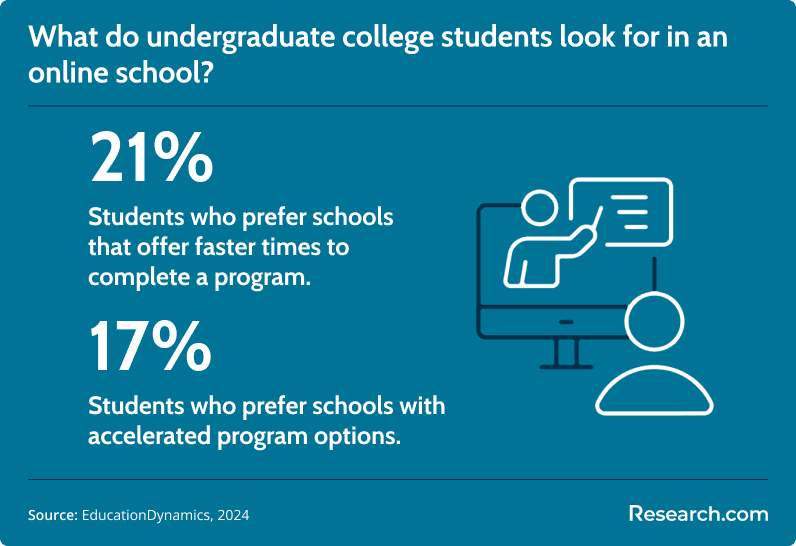
A 2024 EducationDynamics report found that 21% of online undergraduate college students prefer a school that offers a faster time to complete a program. Another 17% said accelerated program options make a college or university more attractive.
The same report identified these preferred online delivery formats:
- Preferred asynchronous learning - 57%
- Preferred synchronous learning - 21%
- Preferred a combination of asynchronous and synchronous learning - 23%
For many students, the best format is the one that fits their actual schedule. A working adult may prefer asynchronous courses, while a student who needs live accountability may benefit from scheduled online sessions. This applies across majors, whether you are considering business, computer science, nursing, or an accounting bachelor degree online.
What are the advantages and disadvantages of accelerated online programs?
Accelerated online bachelor’s programs can save time and sometimes money, but they are not automatically easier or lower-risk. They compress the same degree goal into a shorter schedule, which means students need to be honest about workload, motivation, and support.
| Potential Advantage | Why It Matters | Potential Trade-Off |
| Faster graduation | You may qualify for new roles, promotions, or graduate programs sooner. | The pace can be demanding, especially with work or family responsibilities. |
| Career mobility | A completed bachelor’s degree can support advancement or a career change. | A degree alone does not guarantee a job; skills, experience, and networking still matter. |
| Flexible online format | Many programs allow students to study around work schedules. | Flexibility requires self-management and consistent weekly effort. |
| Potential cost savings | Finishing faster can reduce time-related costs, and online study may reduce relocation or commuting expenses. | Per-credit costs, fees, technology costs, and transfer-credit limits still affect total price. |
Advantages
- Shorter path to a degree. Students do not necessarily need four years to finish a bachelor’s degree. A faster bachelor’s can also shorten the timeline for graduate options such as an online doctorate in psychology, a Doctor of Nursing Practice (DNP), or an MBA.
- Quicker professional advancement. Completing a degree sooner can help working adults pursue promotions, change fields, or meet employer education requirements more quickly.
- More scheduling flexibility. Online accelerated programs often allow students to keep working, manage family responsibilities, and study outside standard classroom hours.
- Possible cost efficiency. A shorter timeline can reduce total education-related costs. According to 2023 data from the Education Data Initiative, an online degree at a public four-year college is $31,165 cheaper than an in-person degree.
Disadvantages
- Heavy academic pace. Accelerated programs usually require students to complete more work in less time, which can be difficult for those with unpredictable schedules.
- Less time to process material. Short terms may leave fewer days for review, practice, reflection, and deep learning.
- Burnout risk. Year-round terms and limited breaks can make it harder to recover between courses.
- Reduced time for enrichment. Students may not use tutoring, study groups, networking events, or extracurricular opportunities if they are focused only on keeping up.
When an Accelerated Program Makes Sense
An accelerated online bachelor’s degree is most suitable for students who are organized, self-directed, and clear about why they need the credential. It works especially well for adult learners with transfer credits, working professionals seeking advancement, and students who can commit regular weekly study time.
It may be less suitable for students who need extensive labs, clinical hours, field placements, or a slower learning pace. Before asking only questions such as “How much does an online psychology degree cost?” or “Which program is fastest?,” students should also ask whether the format supports how they learn best.
How many credits can I transfer to my accelerated online bachelor's degree?
Many accredited online colleges accept a large number of transfer credits, often up to 60 or 90 credits out of the 120 required for a bachelor's degree. Schools such as Purdue Global, Liberty University, University of Saint Mary, Pennsylvania State University, and Southern New Hampshire University allow students to transfer up to 75 or 90 credits toward a bachelor's degree.
Transfer credit is often the biggest factor in how quickly you can finish. A program advertised as “fast” may still take several years if few of your previous credits apply.
- Students with an associate degree from a regionally accredited institution often have a stronger chance of transferring a large block of credits.
- Credits may also be awarded through exams, military training, professional certifications, workplace learning, or life experience, depending on school policy.
- A 2023 Wiley Inc. survey of online college students found that 17% of undergraduate respondents said transferring previous credits was the hardest part of the online admission process.
- Before enrolling, ask for an official or preliminary transfer-credit evaluation rather than relying on a general transfer estimate.
- Common accelerated online programs that accept transfer credits include accounting, business, communications, criminal justice, and cybersecurity. Students focused on accounting can compare best online bachelor degree in accounting options.
Questions to Ask About Transfer Credits
- How many of my credits will apply to general education, major, and elective requirements?
- Is there a maximum number of credits I can transfer?
- Do any credits expire, especially in technology, nursing, or science courses?
- Will my associate degree transfer as a block, or will each course be reviewed separately?
- Does the school award credit for military service, professional certifications, exams, or prior learning?
- Can I get the transfer-credit decision in writing before I commit?
How does accreditation affect the quality of an online degree program?
Accreditation is one of the most important safeguards when choosing an accelerated online bachelor’s degree. It indicates that a college or program has been reviewed against recognized academic standards. Accreditation can affect credit transfer, financial aid eligibility, employer acceptance, graduate-school admission, and licensure or certification pathways.
Research has also examined the impact accreditation has on the quality and excellence of higher education. For students, the practical value of accreditation includes:
- Faculty standards. Accredited institutions must show that instructors are qualified for the subjects they teach.
- Credit transfer. Credits from accredited institutions are generally more likely to be considered by other accredited colleges, which matters if you later pursue an online MBA no GMAT required or a graduate degree in another field.
- Licensure and certification readiness. In fields such as nursing, teaching, accounting, counseling, and social work, accreditation can be tied to professional eligibility.
- Relevant curriculum. Accreditation reviews whether programs maintain appropriate learning outcomes and academic content.
- Student support. Accredited schools are expected to provide resources such as advising, library access, and career or academic support.
- Technology and infrastructure. Online programs must show that their systems and learning resources can support students effectively.
- Outcome review. Accreditation may examine retention, graduation, job placement, and other educational outcomes.
- Recognition beyond one region. Accreditation can improve the portability and credibility of a degree, especially for students who may move, apply to graduate school, or work internationally.
Accreditation is also a major factor for online students. Wiley’s 2023 Voice of Online Learners report found that 28% of students named institutional or program accreditation as a top factor in deciding to apply.
Is it possible to work full-time while pursuing an accelerated online bachelor's degree?
Yes, it is possible to work full-time while earning an accelerated online bachelor’s degree, but it requires realistic planning. Students should expect a faster pace, frequent deadlines, and a sustained weekly workload. Depending on course load, students may need to dedicate 20-30 hours per week to their studies.
Many online students continue working because they need income, want to keep employer benefits, are supporting a family, or cannot leave a current career track. Even cheap online nursing programs and other lower-cost online degrees can still cost several thousands of dollars per term, making employment necessary for many students.
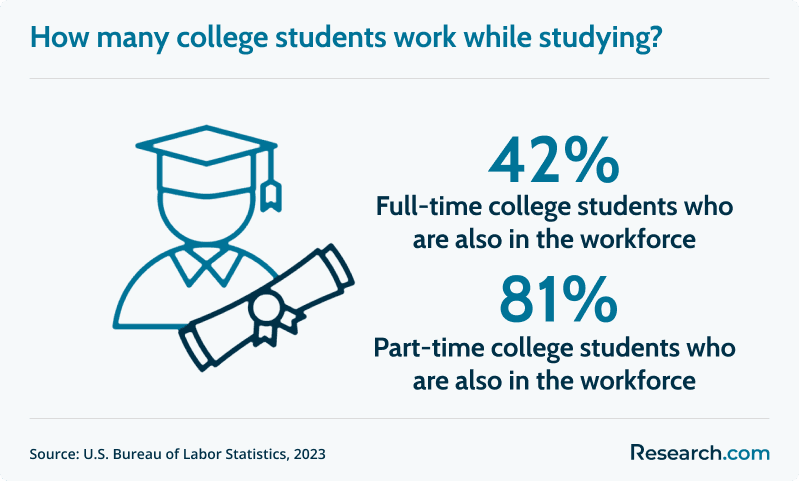
According to a 2023 report from the U.S. BLS, full-time students were much less likely to participate in the labor force than part-time students. That does not mean full-time work and full-time study are impossible, but it does mean students should plan carefully before choosing the most aggressive timeline.
How to Balance Full-Time Work and a Fast Online Degree
- Build a weekly calendar that includes work shifts, study blocks, assignment deadlines, family obligations, and rest.
- Break major projects into smaller tasks so deadlines do not pile up at the end of each course.
- Use digital calendars, project-management apps, or school learning-management reminders to track due dates.
- Ask your employer whether flexible scheduling, tuition reimbursement, or temporary workload adjustments are possible.
- Protect sleep, meals, exercise, and downtime to reduce burnout risk.
- Use tutoring, advising, writing centers, technology support, and discussion boards early rather than waiting until you are behind.
- Tell family or close friends what support you may need during intensive terms.
Online study can be especially useful for working adults in fields that require travel, irregular schedules, or cross-border work. Students interested in global business roles may also want to understand what can you do with an international business major before choosing a concentration.
Can I take breaks or extend my timeline in an accelerated online program?
Most accelerated online bachelor’s programs allow some flexibility, but policies vary by school. Students may be able to take a leave of absence, reduce their course load, switch from full-time to part-time study, or restart during a later term. Before making changes, review how the decision affects tuition, financial aid, satisfactory academic progress, course sequencing, and graduation timing.
- A leave of absence is often approved for one term or semester at a time, with extensions depending on institutional policy.
- Reducing your course load may help you stay enrolled without fully pausing your program.
- Part-time enrollment can be a better fit if work, caregiving, health, or finances change.
- Self-paced courses may give students more control over timing, although deadlines and maximum completion windows may still apply.
- Programs with multiple start dates can make it easier to return after a break without waiting for a new academic year.
Taking a break may delay graduation, but it can be the better decision if continuing would harm your health or academic performance. It should be noted that 64% of students considered stopping and leaving their program due to mental health concerns and emotional stress.
If you need a pause, contact your academic advisor, financial aid office, and instructors before you stop attending. A planned break is usually easier to manage than withdrawing after missed deadlines or unpaid balances.
Is there a difference in admission criteria between accelerated and traditional programs?
Accelerated bachelor’s programs may use different admission criteria because they are designed for students who can handle a faster academic schedule. Some are open to first-time bachelor’s students, but many are degree-completion programs for applicants with prior college credit.
- Some accelerated programs require a higher minimum GPA because the pace is more demanding.
- Many programs prefer or require previous college coursework, an associate degree, or specific prerequisites.
- Work experience may matter, especially in programs built for adult learners or working professionals.
- Personal statements may be used to evaluate motivation, discipline, time management, and readiness for intensive coursework.
- Standardized tests may be waived for adult learners, students with transfer credits, or applicants with significant professional experience.
Students should begin gathering transcripts, recommendation letters, test records, military documentation, certification records, and transfer-credit materials early. Delays in credit evaluation can delay admission or change the expected graduation timeline.
According to data from a Pew Research Center survey of 1,550 four-year higher learning institutions (HEIs), 56.5% of schools have an admission rate of 79.99% or below. The admission-rate distribution was:
- Fewer than 10% - 2.0%
- 10%-19.9% - 2.5%
- 10%-29.99% - 1.7%
- 30%-39.99% - 2.6%
- 40%-49.99% - 4.1%
- 50%-59.99% - 9.0%
- 60%-69.99% - 14.2%
- 70%-79.99% - 20.4%
- 80%-89.99% - 22%
- 90%-100% - 21.5%
Are there financial aid options available for students in accelerated online programs?
Students in accredited accelerated online bachelor’s programs may qualify for federal financial aid, state aid, institutional aid, scholarships, military benefits, employer tuition assistance, and payment plans. The first step for many students is completing the Free Application for Federal Aid (FAFSA®).
| Aid Type | Who It May Help | What to Confirm |
| Pell Grants | Undergraduate students with significant financial need | Grant eligibility, enrollment intensity, and annual limits |
| Federal Student Loans | Students who need loan funding after grants and scholarships | Subsidized versus unsubsidized terms and repayment obligations |
| Federal Work-Study Program | Students with financial need who can work part-time | Whether online students can access eligible positions |
| State grants and scholarships | Students who meet state-specific requirements | Residency, GPA, major, and enrollment rules |
| Institutional scholarships and grants | Students who meet school-specific merit, need, or program criteria | Application deadlines and renewal requirements |
| Employer tuition reimbursement | Working students whose employers support education | Grade requirements, repayment clauses, and covered programs |
| Private scholarships and grants | Students who match demographic, field, employer, or community criteria | Deadlines, eligibility, and whether awards are renewable |
| GI Bill and military benefits | Veterans, active-duty service members, and eligible family members | Program approval, tuition coverage, housing, and book benefits |
| Payment plans | Students who need to spread tuition payments across a term | Fees, due dates, and consequences of missed payments |
According to the EducationDynamics 2024 report, 40% of employed students had access to tuition reimbursement, and 75% of them used it for their undergraduate online studies. In AY 2021-2022, 87.3% of first-time, full-time undergraduate students received financial aid.
Apply early. Accelerated programs move quickly, and waiting until the first week of class to resolve aid issues can create unnecessary stress or registration holds.
Are accelerated online bachelor's programs recognized and respected by employers?
Employers generally recognize online bachelor’s degrees when they come from accredited institutions and align with the skills required for the role. A 2023 Champlain College survey found that 84% of adults agree that employers are now more accepting of online degrees.
Employer expectations are also becoming more skills-focused. McKinsey has discussed how employers put more emphasis on a candidate’s specific skills, educational background, or job-relevant credentials. For applicants, that means the degree format matters less than accreditation, demonstrated skills, projects, experience, and professional readiness.
- Choose an accredited program, even if you are comparing lower-cost options such as the cheapest online business management degree programs.
- Review graduate outcomes, employer partnerships, internship options, capstone projects, and career-service support.
- Ask professionals in your target industry whether they recognize the institution or program.
- Prioritize programs with current curriculum, applied projects, and relevant software or technical training.
- Remember that a degree is one part of employability; experience, networking, interview preparation, and portfolio evidence also matter.
Can I pursue further education or graduate studies with a degree from an accelerated online program?
Yes, graduates of accredited accelerated online bachelor’s programs can pursue graduate school, professional programs, and other advanced credentials. The key is making sure the undergraduate program is properly accredited and that you meet the prerequisites for your target graduate program.
- Some schools offer combined bachelor’s/master’s options that allow students to move more quickly into graduate coursework.
- Certain accelerated bachelor’s programs include professional certifications that can strengthen graduate-school or employment applications.
- Many programs are designed as preparation for graduate study in the same or a related field.
- Students can improve graduate admission prospects through strong grades, prerequisite planning, test preparation when required, and strong recommendation letters.
- Academic advising, career counseling, and faculty mentoring can help students identify realistic graduate pathways.
Stackable credentials are also becoming more common. A 2023 Wiley report shows that two-thirds of online learners are interested in industry certifications, trade skills certificates, and non-credit certificates.
Graduate enrollment also remains active. The Current Term Enrollment Estimates Report for Spring 2024 from the National Student Clearinghouse® Research Center shows that full-time enrollment in graduate programs in private non-profit institutions grew by 3%, while private for-profit schools increased by 9.4% in 2024.
How do I choose the right accelerated online bachelor's degree program?
The right accelerated online bachelor’s degree is the one that balances speed, credibility, cost, support, and career fit. Do not choose based only on the shortest advertised timeline.
| Selection Factor | What to Check Before Enrolling |
| Accreditation | Confirm institutional accreditation and, when relevant, programmatic accreditation for fields such as nursing, business, education, computing, or social work. |
| Transfer-credit policy | Ask how many credits will apply to your exact degree plan, not just how many the school theoretically accepts. |
| Total cost | Compare tuition, fees, books, technology charges, proctoring fees, and the cost of credits that do not transfer. |
| Program format | Decide whether asynchronous, synchronous, hybrid, self-paced, or competency-based learning fits your schedule. |
| Curriculum | Match required courses, concentrations, certifications, and capstones to your career or graduate-school goals. |
| Student support | Look for academic advising, tutoring, writing help, library access, technology support, and disability services. |
| Career support | Review resume help, employer connections, alumni networks, internship support, and job-search resources. |
| Licensure alignment | For teaching, nursing, counseling, accounting, and social work, confirm state-specific eligibility before enrolling. |
Questions to Ask an Admissions Advisor
- What is the fastest realistic timeline for a student with my exact credits?
- Can I see a degree audit before I enroll?
- Are courses always available when I need them, or can sequencing delay graduation?
- What happens if I need to reduce my course load?
- How many hours per week should I expect per course?
- Are exams proctored, and are there additional fees?
- Does this program meet licensure or certification requirements in my state?
- What percentage of online students graduate, transfer, or stop out?
Do accelerated online bachelor's degrees deliver a strong return on investment?
An accelerated online bachelor’s degree can produce a strong return on investment when it reduces time to graduation, accepts substantial transfer credits, avoids unnecessary debt, and leads to a credential valued in your target career. ROI is weaker when students overpay, lose credits during transfer, enroll in a program that does not meet licensure rules, or choose a degree without a clear career plan.
To evaluate ROI, compare the total price of finishing, the time you will spend out of the workforce or balancing work and study, expected career mobility, employer tuition benefits, and whether a lower-cost path would achieve the same goal. Ranking and comparison resources such as easy degrees can be useful starting points, but they should not replace program-level research.
Can an accelerated associate degree pave the way to a fast-track bachelor’s degree?
Yes. An accelerated online associate degree can be a smart first step if the credits transfer cleanly into a bachelor’s program. This path can lower upfront cost, help students build academic momentum, and reduce the number of credits remaining for a bachelor’s degree. The best approach is to choose an associate program with clear articulation agreements or transfer pathways into your intended bachelor’s major.
Students considering this route can compare 1 year associate degree programs online and confirm whether credits will transfer into a fast-track bachelor’s completion program.
What advanced degree opportunities can follow an accelerated online bachelor's degree?
After earning an accelerated online bachelor’s degree, students may pursue master’s degrees, doctoral programs, graduate certificates, professional certifications, or combined bachelor’s/master’s pathways. The best next step depends on the field. For example, social work, counseling, nursing practice, education leadership, accounting, psychology, and advanced business roles may require or strongly benefit from graduate-level study.
Students who want a shorter graduate route can explore one year online master programs, but they should confirm prerequisites, accreditation, licensure alignment, and workload before applying.
What are the challenges of pursuing accelerated online bachelor’s degree programs?
The biggest challenge is intensity. Accelerated programs cover bachelor’s-level material in compressed terms, so students often face overlapping readings, assignments, discussions, projects, and exams. A six- or eight-week course can feel manageable at first, but deadlines arrive quickly.
Time management is another major hurdle. Online students do not always have the built-in structure of campus classes, so they must create their own routines. Falling behind for even one week can be difficult to recover from in a short course.
Some students also experience isolation. Online programs may offer discussion boards, group projects, virtual office hours, and video sessions, but students who learn best through in-person conversation may need to be more intentional about building connections.
Limited breaks can add pressure. Many accelerated programs run year-round, which helps students finish faster but can reduce recovery time between courses. Students with demanding jobs or caregiving responsibilities should be especially careful about taking too many courses at once.
These challenges can be managed with planning, but they should not be ignored. Students comparing bachelor’s programs and associates degrees online accredited options should choose a pace that supports completion, not just enrollment.
How will emerging technologies transform accelerated online bachelor's programs?
Technology is changing how accelerated online programs deliver instruction, measure progress, and support students. Adaptive learning platforms, AI-supported tutoring tools, learning analytics, virtual simulations, remote labs, and secure online proctoring can make online learning more personalized and interactive. These tools may help students identify weak areas earlier and receive feedback faster.
Technology also raises new questions. Students should ask how AI tools are used, what academic integrity policies apply, whether software access is included in tuition, and whether virtual labs or simulations meet professional expectations. Programs that connect technology skills with career pathways, including advanced study in areas such as the best masters for high paying jobs, may be especially useful for students planning long-term advancement.
How can students succeed in a fast-track bachelor’s degree program?
Fast track college programs reward consistency. Students who succeed usually plan each week carefully, ask for help early, and avoid taking on more courses than they can realistically complete.
- Create a fixed study routine. Reserve regular blocks of time each week rather than waiting for free time to appear.
- Use school resources immediately. Tutoring, advising, library help, tech support, and writing centers are most useful before problems become emergencies.
- Track every deadline. Use a planner or digital system for assignments, exams, group projects, discussion posts, and financial aid tasks.
- Stay visible in class. Participate in discussions, contact instructors, and join study groups when available.
- Protect your health. Sleep, movement, food, and downtime are not optional in a year-round accelerated schedule.
- Limit course overload. Finishing slightly later is better than failing or withdrawing because the pace was unrealistic.
What are the long-term career outcomes of accelerated online bachelor's degrees?
The long-term outcome of an accelerated online bachelor’s degree depends on the field, the school, the student’s prior experience, and how the credential is used. A faster degree can help students qualify for roles sooner, apply for promotions earlier, or move into graduate education without waiting through a four-year timeline.
However, students should avoid assuming that accelerated automatically means higher earnings. Career outcomes are shaped by industry demand, location, work experience, internships, certifications, portfolios, networking, and interview performance. Students who stack credentials strategically, such as beginning with an easiest online associates degree pathway and then completing a bachelor’s, may create a more affordable and flexible route to advancement.
What career support resources are available for online bachelor’s students?
Strong online bachelor’s programs usually provide career support, but students must actively use it. Career services can help online learners translate coursework into job-search materials, connect with employers, and prepare for advancement.
Career Counseling and Advising
Career advisors can help students identify realistic roles, choose electives or concentrations, plan certifications, and map a path from current experience to future goals.
Resume and Cover Letter Support
Many schools offer resume reviews, cover letter feedback, job-application workshops, and guidance on explaining online or accelerated education confidently.
Job Search and Placement Resources
Some institutions provide job boards, employer partnerships, recruitment events, and internship listings. Students should ask whether these resources are available to online learners, not only campus students.
Networking Opportunities
Virtual career fairs, alumni communities, professional webinars, and student groups can help online students build connections in their target industries.
Mock Interviews and Coaching
Interview preparation can be especially valuable for career changers who need to connect previous work experience with a new degree field.
Career Portals
Online portals may include internship listings, job openings, employer profiles, salary information, and industry research tools.
Certifications and Skills Development
Some accelerated programs embed software training, industry certifications, project management tools, analytics skills, or technical credentials that can strengthen a student’s employability.
How do accelerated online bachelor’s programs support lifelong learning?
Accelerated online bachelor’s programs can help students build habits that support lifelong learning: self-direction, digital research, time management, online collaboration, and continuous skill development. These habits matter in fields where technology, regulations, and employer expectations change quickly.
Flexible Skill Building
Because students often balance school with work and family, they learn how to add new skills without stepping away from professional life.
Digital Literacy
Online learning requires students to use learning platforms, collaboration tools, databases, research resources, and digital communication systems.
Specialized Credentials
Programs that include certifications or stackable credentials can encourage students to keep updating skills after graduation.
Diverse Online Classrooms
Online students often interact with classmates from different locations, industries, and professional backgrounds, which can broaden their perspective.
Alumni and Professional Networks
Alumni communities and professional associations can provide ongoing learning, mentoring, and career-development opportunities.
Pathways to Advanced Education
A bachelor’s degree can become the foundation for master’s programs, doctoral study, graduate certificates, or professional licensure routes.
Do accelerated online bachelor's programs maintain rigorous academic standards?
Accelerated online bachelor’s programs can be rigorous when they are properly designed, accredited, and supported. A compressed calendar should not mean reduced learning outcomes. Instead, strong programs use focused curricula, clear assessments, faculty interaction, academic support, and quality review to maintain standards.
Students should be cautious of programs that promise extreme speed without explaining transfer credits, competency requirements, accreditation, or academic expectations. Resources on 6 month bachelor degrees online can help students understand the difference between legitimate acceleration and unrealistic marketing claims.
How do accelerated online bachelor's programs incorporate experiential learning opportunities?
Many accelerated online bachelor’s programs now include applied projects, capstones, virtual simulations, remote labs, case studies, practicums, internships, or employer-connected assignments. These experiences help students show what they can do, not just what courses they completed.
Experiential learning is especially important in fields such as healthcare administration, business, information systems, computer science, education, and social services. Students planning advanced study, including options such as the cheapest doctorate degree online, can also benefit from a portfolio of research, projects, and applied work.
Is an accelerated online bachelor's degree right for everyone?
An accelerated online bachelor’s degree is best for students who want speed, have strong time-management skills, can study independently, and understand their career or graduate-school target. Students comparing accelerated online bachelor degree programs accredited by recognized institutions should evaluate fit before focusing on speed.
This path may be right for you if you already have transfer credits, can commit consistent weekly study time, prefer online learning, and need a faster route to career advancement. It may not be ideal if you need extensive in-person support, want a slower exploratory college experience, or are entering a field where clinical, lab, or licensure requirements cannot be accelerated easily.
Common Mistakes to Avoid When Choosing a Fast Online Bachelor’s Degree
- Choosing speed over accreditation. A fast degree from the wrong institution can create problems with employers, graduate schools, financial aid, and licensure.
- Assuming all credits will transfer. Always request a written transfer evaluation before committing.
- Looking only at tuition. Fees, books, technology costs, lost transfer credits, and repeated courses can change the real price.
- Ignoring licensure rules. Nursing, teaching, accounting, social work, and counseling pathways may have state-specific requirements.
- Taking too many courses at once. An overloaded schedule can lead to withdrawals, lower grades, and burnout.
- Relying only on rankings. Rankings can help you build a shortlist, but your final decision should be based on fit, cost, accreditation, support, and outcomes.
- Assuming salary results are guaranteed. A degree can improve opportunities, but earnings depend on role, location, experience, field, and labor-market conditions.
Key Insights
- The fastest online bachelor’s degrees are usually completion programs for students with prior college credits; transfer policy often matters more than advertised program length.
- Many accelerated programs can be completed in one to three years, while students with substantial accepted transfer credits may finish in about 12 to 18 months.
- Accreditation is nonnegotiable. It affects financial aid, credit transfer, employer recognition, graduate admission, and licensure pathways.
- Online acceleration works best for disciplined students who can manage compressed deadlines, independent study, and consistent weekly coursework.
- Fields such as nursing completion, business, computer science, accounting, healthcare administration, MIS, psychology, social work, economics, and special education commonly offer accelerated online options.
- The best program is not simply the fastest. It is the program that accepts your credits, fits your schedule, supports your goals, and provides a credible credential at a cost you can justify.
References:
- Aslanian, C.B., Fischer, S. (2024). Online College Students 2024, 13th Annual Report on the Demands and Preferences of Online College Students. EducationDynamics. https://insights.educationdynamics.com/rs/183-YME-928/images/EDDY-Online-College-Students-2024.pdf
- Capranos, D., Dyers, L., Magda, A. J. (June 2023). Voice of the online learner 2023: Responding to students’ evolving preferences and concerns. Wiley Inc. https://universityservices.wiley.com/wp-content/uploads/2023/06/202306-VOL2023-report-WUNI-final.pdf
- Champlain College (November 2023). 2023 Survey Shows Online Degrees are More Accepted and Respected Than Ever. https://online.champlain.edu/blog/data-reveals-new-insights-online-higher-education-post-pandemic
- Desilver, D. (July 2023). Private, selective colleges are most likely to use race, ethnicity as a factor in admissions decisions. Pew Research Center. https://www.pewresearch.org/short-reads/2023/07/14/private-selective-colleges-are-most-likely-to-use-race-ethnicity-as-a-factor-in-admissions-decisions
- Finley, A. (2023). THE CAREER-READY GRADUATE, WHAT EMPLOYERS SAY ABOUT THE DIFFERENCE COLLEGE MAKES. American Association of Colleges and Universities. https://dgmg81phhvh63.cloudfront.net/content/user-photos/Research/PDFs/AACU-2023-Employer-Report.pdf
- Gonzalez, et al. (April 2023). Fulfilling the potential of US higher education. McKinsey & Company. https://www.mckinsey.com/~/media/mckinsey/industries/education/our%20insights/fulfilling%20the%20potential%20of%20us%20higher%20education/fulfilling-the-potential-of-us-higher-education.pdf
- Hanson, M. (August 2023). Cost of Online Education vs. Traditional Education. Education Data Initiative. https://educationdata.org/cost-of-online-education-vs-traditional-education
- National Center for Education Statistics (August 2023). Sources of Financial Aid. https://nces.ed.gov/programs/coe/indicator/cba
- National Center for Education Statistics (November 2023). Table 331.20. First-time, full-time degree/certificate-seeking undergraduate students enrolled in degree-granting postsecondary institutions, by participation and average amount awarded in financial aid programs, and control and level of institution: Academic years 2000-01 through 2021-22. https://nces.ed.gov/programs/digest/d23/tables/dt23_331.20.asp?current=yes
- National Student Clearinghouse® Research Center (May 2024). Current Term Enrollment Estimates: Spring 2024. https://nscresearchcenter.org/current-term-enrollment-estimates
- U.S. Bureau of Labor Statistics (May 2023). The Economics Daily, Labor force participation rates of college students differ by enrollment status and type of college. https://www.bls.gov/opub/ted/2023/labor-force-participation-rates-of-college-students-differ-by-enrollment-status-and-type-of-college.htm
Other Things You Should Know About the Fastest Online Bachelor’s Programs
Many fastest online bachelor's degree programs in 2027 accept transfer credits, allowing students to complete degrees faster. Policies vary by institution, but typically up to 50% of credits can be transferred, depending on accreditation and relevance to the degree program.
Yes, the fastest online bachelor’s programs should hold regional accreditation from agencies recognized by the U.S. Department of Education or the Council for Higher Education Accreditation. For fields tied to licensure, programmatic accreditation may also be required by bodies such as ABET, CCNE, or CAEP.


