
2027 What Does a Policy Analyst Do: Responsibilities, Requirements, and Salary

Co-Founder and Chief Data Scientist
Becoming a policy analyst is a good fit if you want a career that turns evidence into better decisions. Policy analysts study public problems, compare possible solutions, estimate trade-offs, and explain what decision-makers should do next. Their work can shape laws, budgets, regulations, programs, and organizational strategy across government, nonprofits, research organizations, and the private sector.
The field matters because policy choices are becoming more data-intensive and more visible. Governments and organizations need professionals who can interpret research, understand political and budget realities, and communicate recommendations clearly. According to the U.S. Bureau of Labor Statistics, employment for policy analysts and related roles in political science is projected to grow 7% through 2034, faster than the average for all occupations.
This guide explains what policy analysts do, what skills and education they need, where they work, how salaries vary, which specializations are in demand, and how to decide whether this career matches your strengths and goals.
Key Things You Should Know About What a Policy Analyst Does
- A policy analyst's work directly contributes to solving significant societal challenges, allowing them to see the tangible results of their analysis in the world.
- Policy analysts earn a median annual wage of $139,380 and an average yearly salary of $137,600, making them well-paid professionals.
- The core competencies of a policy analyst—critical thinking, data analysis, and persuasive communication—are highly valued across virtually every professional sector.
What are the core responsibilities of a policy analyst?
A policy analyst’s core responsibility is to help decision-makers understand a public issue and choose among realistic policy options. That work usually begins with research: defining the problem, gathering evidence, identifying who is affected, and evaluating whether current policies are working.
The role is not just academic. A strong policy analyst must turn complex findings into practical recommendations that can be used by lawmakers, agency leaders, nonprofit executives, business leaders, or community stakeholders. The best analysts explain not only what the evidence shows, but also what each option may cost, who benefits, who may be harmed, and what implementation challenges are likely.
Common responsibilities
- Researching policy problems: Reviewing laws, regulations, program data, academic studies, budgets, demographic trends, and prior evaluations to understand the issue.
- Collecting and analyzing data: Using surveys, administrative datasets, interviews, public records, and statistical tools to build an evidence base.
- Evaluating existing policies: Assessing whether a program or regulation is meeting its goals, reaching the intended population, and using resources efficiently.
- Comparing policy options: Weighing alternatives based on effectiveness, cost, equity, feasibility, legal constraints, and political support.
- Consulting stakeholders: Interviewing subject-matter experts, community leaders, practitioners, advocacy groups, and affected populations to understand real-world impacts.
- Forecasting outcomes: Estimating the economic, social, environmental, health, or operational effects of a proposed policy change.
- Writing policy briefs and reports: Translating technical findings into concise recommendations for busy decision-makers.
- Presenting findings: Briefing policymakers, agency teams, legislative committees, executives, funders, or the public in clear and credible language.
In practice, policy analysts often balance precision with urgency. They may not always have perfect data or unlimited time, so they must make careful judgments, disclose limitations, and avoid overstating what the evidence can prove.
What are the essential skills needed by policy analysts?
Policy analysts need a mix of research ability, technical fluency, subject-matter knowledge, and communication skill. The job is built around judgment: knowing which evidence is reliable, which assumptions are weak, which trade-offs matter, and how to explain a recommendation without hiding uncertainty.
The strongest candidates are not only good with data. They can also write for nontechnical audiences, understand institutional constraints, and maintain objectivity when working on controversial issues.
Technical skills
- Quantitative analysis: Ability to work with statistics, public datasets, cost estimates, performance metrics, and trend data.
- Qualitative analysis: Skill in interpreting interviews, focus groups, case studies, public comments, and stakeholder feedback.
- Statistical software: Familiarity with tools such as Stata, R, SPSS, or Python, especially for modeling, visualization, and forecasting.
- Research design: Understanding how to structure a study, avoid bias, define variables, and produce valid and reliable findings.
- Program evaluation: Ability to assess whether a policy or program is effective, efficient, equitable, and scalable.
- Budget and cost analysis: Skill in reading budgets, estimating fiscal impacts, and explaining resource trade-offs.
- Subject-matter expertise: Deeper knowledge in an area such as health, education, housing, labor, energy, technology, criminal justice, or economic policy.
Professional and communication skills
- Critical thinking: Ability to identify weak evidence, hidden assumptions, causal gaps, and unintended consequences.
- Clear writing: Capacity to produce policy briefs, memos, reports, testimony, and executive summaries that busy readers can use quickly.
- Verbal communication: Confidence presenting findings, answering questions, and explaining technical results to nonexperts.
- Objectivity: Commitment to evidence-based analysis, even when findings challenge a preferred position.
- Political and institutional awareness: Understanding how agencies, legislatures, courts, budgets, elections, and interest groups affect what is feasible.
- Project management: Ability to manage deadlines, coordinate contributors, track sources, and deliver usable work under pressure.
A common mistake is focusing only on policy knowledge while neglecting writing. In many policy roles, the final product is a memo, brief, or presentation. If the analysis is strong but the explanation is unclear, the work is less likely to influence decisions.
What educational path should an aspiring policy analyst pursue?
Most policy analysts begin with a bachelor’s degree in a field that develops research, writing, and analytical thinking. Common undergraduate majors include political science, public administration, economics, sociology, public policy, statistics, international relations, environmental studies, and public health.
A bachelor’s degree can qualify candidates for entry-level research assistant, legislative aide, program assistant, data analyst, or junior policy roles. To be competitive, students should pair coursework with practical experience, such as internships in government agencies, legislative offices, think tanks, advocacy organizations, consulting firms, or nonprofits.
Recommended undergraduate preparation
- Research methods: Courses in statistics, qualitative methods, survey design, econometrics, or program evaluation.
- Writing-intensive coursework: Classes that require policy memos, research papers, literature reviews, or briefing materials.
- Economics and budgeting: Training in microeconomics, public finance, cost-benefit analysis, and budget analysis.
- Government and law: Courses on legislative processes, administrative law, regulation, constitutional systems, and public administration.
- Specialized policy electives: Classes in health, education, environment, labor, housing, energy, technology, or security policy.
For many mid-level and senior policy analyst roles, a graduate degree is strongly preferred or required. A Master of Public Policy (MPP) is typically focused on policy analysis, economics, quantitative methods, and program evaluation. A Master of Public Administration (MPA) often emphasizes management, budgeting, leadership, and public-sector operations. Both can lead to policy careers, but the better choice depends on whether you want to focus more on analysis or administration.
Specialized graduate programs can also be useful when you want to work in a specific policy area. For example, a master’s in higher education online may help candidates build the subject-matter expertise needed for education policy roles.
How to decide whether graduate school is worth it
- Choose graduate school if: You want senior analyst roles, research leadership, federal policy work, consulting, or specialized positions that require advanced quantitative and evaluation skills.
- Consider working first if: You are unsure which policy area interests you, need practical experience, or want an employer to help fund future study.
- Look closely at curriculum: Strong programs should include statistics, economics, policy analysis, evaluation, writing, and applied projects.
- Prioritize experience: Capstones, internships, fellowships, assistantships, and research portfolios can matter as much as the degree title.
The chart below reveals the educational levels of policy analysts in the United States.
Policy analysts work wherever organizations need evidence to guide decisions. The three main employment settings are government, nonprofits and think tanks, and the private sector. Each setting offers a different pace, audience, level of influence, and definition of success.
- Government: Analysts in local, state, and federal agencies, legislative offices, and oversight bodies evaluate programs, analyze budgets, draft policy options, and support implementation. Government roles often provide direct exposure to policymaking and public administration, but they may involve strict procedures, public accountability, and changing political priorities.
- Nonprofits and think tanks: Analysts in advocacy organizations, research institutes, foundations, and community organizations often focus on mission-driven issues such as education, health equity, poverty, environmental protection, housing, or international development. Their work may be used to inform public debate, influence legislation, support grantmaking, or guide community programs.
- Private sector: Consulting firms, corporations, trade associations, and public affairs teams hire policy analysts to assess regulatory risk, interpret legislation, advise leadership, and develop strategy. These roles may offer strong compensation and fast-moving projects, but the work is often tied to client or business priorities.
How the workplace changes the job
- If you want direct public impact: Government agencies and legislative offices may be the best fit.
- If you want issue advocacy: Nonprofits, foundations, and think tanks may offer more mission alignment.
- If you want business strategy and regulatory analysis: Consulting, corporate government affairs, and industry associations may be stronger options.
- If you want research depth: Think tanks, universities, and scientific research organizations may provide more time for long-form analysis.
Sector also affects specialization and compensation. For example, education policy roles are common in government and nonprofit settings, and the average educational policy salary often reflects the funding structures and priorities of those sectors.
A typical day for a policy analyst combines focused research, writing, meetings, and communication with decision-makers. The exact schedule depends on the employer, policy area, project deadline, and whether the analyst is supporting long-term research or responding to a time-sensitive policy question.
A morning may start with reviewing new data, reading legislation, checking agency guidance, analyzing survey results, or drafting sections of a policy memo. This is the deep-work portion of the job, where analysts test assumptions, interpret evidence, and organize findings.
Later in the day, the analyst may meet with colleagues, brief a supervisor, interview stakeholders, respond to questions from policymakers, or revise recommendations based on legal, budgetary, or implementation constraints. In fast-moving policy environments, analysts may need to update a memo quickly when new data, a court decision, a budget proposal, or a legislative amendment changes the context.
Common daily tasks
- Reviewing academic studies, agency reports, public comments, laws, and administrative data.
- Cleaning datasets, running analyses, building charts, or checking calculations.
- Writing policy briefs, executive summaries, testimony, talking points, or background memos.
- Meeting with program staff, legal teams, budget officers, community groups, researchers, or elected officials.
- Preparing presentations for internal leaders, legislative committees, funders, clients, or public audiences.
- Tracking current events, proposed legislation, regulatory changes, and stakeholder reactions.
The work can be intellectually rewarding, but it also requires comfort with ambiguity. Policy analysts often make recommendations when evidence is incomplete, timelines are short, and stakeholders disagree. Clear documentation and honest discussion of limitations are essential.
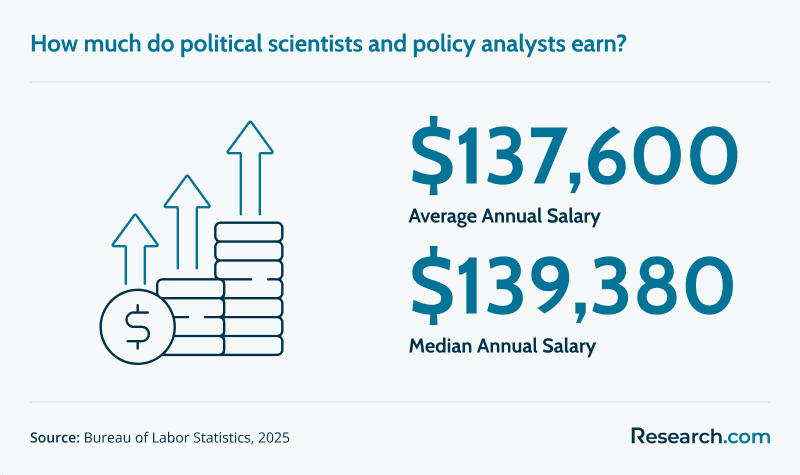
Policy analyst salaries vary widely by employer, location, education, specialization, and level of responsibility. According to the U.S. Bureau of Labor Statistics (BLS), political scientists—a category that includes policy analysts—earn a median annual wage of $139,380 and an average yearly salary of $137,600. Both figures are considerably higher than the collective median annual salary of all occupations in the United States ($49,500).
Entry-level positions for those with a bachelor’s degree typically start in the range of $65,000 to $80,000, while analysts with a master’s degree and specialized experience can command salaries well over $120,000.
Compensation is often strongest in the federal government, consulting, corporate public affairs, and specialized research roles. Salaries may be lower in some nonprofits, local government offices, or advocacy organizations, but those roles can offer strong mission alignment, policy exposure, and career-building experience.
Factors that influence pay
- Education: A master’s degree can improve access to senior analyst, management, and technical research roles.
- Specialization: Fields such as health, technology, energy, economics, and public finance can command higher pay when employers need scarce expertise.
- Sector: Federal agencies, scientific research organizations, and private-sector employers often pay more than smaller nonprofits or local agencies.
- Location: Salaries tend to be higher in policy hubs and high-cost labor markets.
- Technical skills: Strong data analysis, modeling, forecasting, and evaluation skills can increase competitiveness.
The healthcare industry shows how specialized expertise can affect earning potential. For example, salary benchmarks tied to an MSN public health salary reflect the value employers place on advanced knowledge in complex health systems.
The industries that offer the highest mean annual salaries to political scientists, and by extension, policy analysts, are federal, state, and local governments ($142,390) and scientific research and development services ($135,620).
Meanwhile, the highest-paying US states are Maryland ($155,520) and the District of Columbia ($146,600).
The visual below displays the average salary range of political scientists, including policy analysts, in the country.
Specialization can make a policy analyst more competitive because employers often need people who understand both research methods and a specific policy environment. A generalist can still build a strong career, but analysts with deep knowledge in high-priority areas may have clearer paths to senior roles.
- Health policy: Health policy analysts study healthcare access, insurance reform, public health programs, healthcare costs, workforce shortages, and health equity. They may work for agencies, hospitals, insurers, foundations, universities, or advocacy groups.
- Environmental and energy policy: Analysts in this area evaluate climate policy, renewable energy, emissions rules, conservation programs, environmental justice, utility regulation, and infrastructure planning. An online degree in energy policy can help candidates prepare for roles focused on renewable energy, carbon emissions, and conservation.
- Technology and cybersecurity policy: This specialization covers data privacy, artificial intelligence regulation, cybersecurity strategy, digital infrastructure, platform governance, and emerging technology risks. It is a strong option for analysts who can connect technical concepts with legal, ethical, and economic implications.
- Economic policy: Economic policy analysts study taxation, labor markets, inflation, trade, industrial policy, public finance, workforce development, and income inequality. Strong quantitative skills are especially valuable in this area.
- Education policy: Analysts may evaluate school funding, higher education access, accountability systems, student outcomes, workforce pathways, and equity initiatives.
- Housing and urban policy: This area focuses on affordability, zoning, homelessness, transportation, land use, infrastructure, and regional economic development.
How to choose a specialization
- Follow the problems you want to solve: Long-term motivation matters because policy careers require sustained research and learning.
- Check employer demand: Review job postings to see which degrees, software skills, and subject areas appear repeatedly.
- Build a portfolio: Write policy memos, publish analysis, complete capstone projects, or contribute to research in your target area.
- Pair expertise with methods: Subject knowledge is stronger when combined with statistics, evaluation, budgeting, or legal analysis.
Policy analysts are often grouped with lobbyists, researchers, consultants, public administrators, and program managers, but the roles are not identical. The policy analyst’s primary value is evidence-based assessment: defining the problem, evaluating options, and recommending a course of action.
A lobbyist, by contrast, focuses on advocacy. Lobbyists try to persuade lawmakers or agencies to support a specific position, often on behalf of an organization, industry, or interest group. Policy analysts may influence decisions too, but credible analysis requires transparency about evidence, trade-offs, and uncertainty.
The role also differs from direct service careers. In healthcare, for example, a policy analyst might study how a regulation affects access to care, while professionals in LVN careers provide direct patient care within the healthcare system. One role analyzes rules and outcomes; the other delivers services under those rules.
Key comparisons
- Policy analyst vs. lobbyist: Analysts evaluate evidence and policy options; lobbyists advocate for a preferred outcome.
- Policy analyst vs. political scientist: Political scientists often study political systems, behavior, and institutions; policy analysts apply evidence to practical policy decisions.
- Policy analyst vs. data analyst: Data analysts focus heavily on datasets and metrics; policy analysts connect data to laws, programs, budgets, and public consequences.
- Policy analyst vs. program manager: Program managers implement and oversee services; policy analysts evaluate whether those services should be created, changed, funded, or discontinued.
- Policy analyst vs. management consultant: Consultants often advise organizations on strategy and operations; policy analysts focus specifically on public problems, regulations, governance, and social impact.
These professions often work together. A policy analyst may rely on data analysts for technical modeling, program managers for implementation insight, lobbyists for political context, and practitioners for frontline knowledge.
The job outlook for policy analysts is competitive and somewhat mixed, depending on how the occupation is classified. The BLS projects that employment for political scientists will decline by 3% through 2034. At the same time, policy work continues to appear across government, consulting, nonprofits, research organizations, and private-sector regulatory roles.
This means aspiring analysts should not rely on a generic policy background alone. Employers increasingly look for candidates who can combine policy knowledge with technical skills, applied research experience, and specialization in areas with ongoing demand.
Exploring targeted fields can help candidates align education with stronger opportunities. For example, understanding what you can do with an energy policy degree can help students evaluate roles in energy regulation, sustainability, utilities, climate policy, and environmental analysis.
Advancement opportunities remain available for analysts who build strong portfolios and specialized expertise. Typical paths include senior policy analyst, legislative analyst, program evaluator, research manager, policy director, government affairs strategist, consultant, and executive roles in public agencies or nonprofit organizations.
As of November 2025, there are over 3,000 job openings for policy analyst jobs in the United States. This does not include closely related roles with titles such as research analyst, legislative analyst, public affairs analyst, regulatory analyst, program evaluator, government relations analyst, or policy associate.
How to improve your job prospects
- Develop a technical toolkit: Learn statistics, data visualization, evaluation methods, and at least one commonly used analysis tool.
- Choose a policy lane: Build expertise in a specific area such as health, energy, education, technology, housing, or economics.
- Build writing samples: Employers often want to see policy memos, briefs, reports, or research summaries.
- Gain applied experience: Internships, fellowships, capstone projects, and research assistantships can make entry-level candidates more credible.
- Understand institutions: Learn how budgets, agencies, legislatures, courts, regulations, and procurement affect whether policy ideas can be implemented.
The chart below shows the US states that offer the highest salaries to political scientists.
A career as a policy analyst may be right for you if you enjoy research, writing, problem-solving, and public issues. The work suits people who can sit with complexity, compare imperfect options, and explain evidence clearly to people who may not have time to read a long report.
It is also a good fit if you want impact but do not necessarily want a frontline service role or elected office. Policy analysts often work behind the scenes, shaping decisions through memos, models, evaluations, and briefings rather than public visibility.
You may enjoy this career if you:
- Like turning complicated information into clear recommendations.
- Are comfortable working with data, research, and uncertainty.
- Care about public problems such as health, education, climate, housing, labor, technology, or economic opportunity.
- Can write concisely and adjust your message for different audiences.
- Want a career that combines analysis, communication, and real-world decision-making.
This career may be less ideal if you:
- Prefer immediate, hands-on work over research and advisory roles.
- Dislike writing, revising, and explaining technical material.
- Want quick answers to problems that often involve trade-offs and incomplete data.
- Are uncomfortable separating personal views from evidence-based recommendations.
- Do not want to follow laws, budgets, politics, and institutional constraints.
For the right person, policy analysis offers intellectual challenge and purpose. The career rewards careful thinkers who can connect evidence with action and help organizations make better choices.
- : "Working as a policy analyst has allowed me to see how data-driven decisions can directly improve lives. Every report I write has the potential to influence legislation or funding priorities, and it is incredibly rewarding to see my research shape real-world outcomes. — Grace"
- : "The best part of being a policy analyst is the intellectual challenge. I get to combine research, critical thinking, and collaboration with experts across fields to address issues like healthcare access and environmental justice. It is fulfilling work that keeps me learning every day. — Richard"
- : "As a policy analyst, I have found a career that bridges passion and purpose. I love translating complex problems into actionable insights for decision-makers. It feels like I am part of something larger than myself, creating meaningful social change. — Jason"
Key Findings
- Policy analysts turn evidence into recommendations. Their work includes research, data analysis, stakeholder consultation, forecasting, report writing, and presentations for decision-makers.
- Strong writing is as important as strong analysis. Policy analysts must explain complex findings clearly in briefs, memos, reports, and presentations.
- A bachelor’s degree can open entry-level doors, but graduate education is common for advancement. MPP, MPA, and specialized master’s programs can strengthen prospects for senior roles.
- Employment settings shape the work. Government roles often focus on public programs and regulation, nonprofits emphasize mission-driven research and advocacy, and private-sector roles often center on regulatory risk and strategy.
- Salary potential varies by sector, location, and specialization. The BLS reports a median annual wage of $139,380 and an average yearly salary of $137,600 for political scientists, a category that includes policy analysts.
- Specialization improves competitiveness. Health, environmental and energy, technology and cybersecurity, economic, education, and housing policy are examples of areas where subject-matter expertise can matter.
- The outlook is competitive. The BLS projects that employment for political scientists will decline by 3% through 2034, but as of November 2025, there are over 3,000 policy analyst job openings in the United States.
- The career is best for analytical, mission-driven communicators. If you enjoy research, public problems, evidence-based writing, and practical decision-making, policy analysis can be a strong career path.
Other Things You Should Know About Becoming a Policy Analyst
In 2027, the average salary for a policy analyst in the United States is approximately $69,000 per year, according to the Bureau of Labor Statistics. Salaries can vary based on location, experience, and sector, with government positions often providing additional benefits.
Yes, many policy analyst roles on government contracts require a security clearance or the ability to obtain one. Federal agencies and contractors may ask for background checks, and some positions require a Public Trust clearance before an analyst can access nonpublic policy data or draft internal recommendations.
- Association for Public Policy Analysis and Management. (n.d.). Careers in public policy. Retrieved November 4, 2025, from https://www.appam.org/career-resources/careers-in-public-policy/
- Brookings Institution. (n.d.). Research programs. Retrieved November 4, 2025, from https://www.brookings.edu/about-us/research-programs/
- Harvard Kennedy School. (n.d.). Master in public policy curriculum. Retrieved November 4, 2025, from https://www.hks.harvard.edu/educational-programs/masters-programs/master-public-policy/curriculum
- McGann, J. G. (2021). 2020 Global Go To Think Tank Index Report. TTCSP Global Go To Think Tank Index Reports. University of Pennsylvania Lauder Institute. https://repository.upenn.edu/think_tanks/18/
- U.S. Bureau of Labor Statistics. (2024, September 4). Occupational outlook handbook: Political scientists. U.S. Department of Labor. Retrieved November 4, 2025, from https://www.bls.gov/ooh/life-physical-and-social-science/political-scientists.htm


