2027 What Does a Professional Curriculum Designer Do: Responsibilities, Requirements, and Salary

Co-Founder and Chief Data Scientist
Becoming a professional curriculum designer is usually a move from delivering instruction to shaping how instruction works at scale. The role appeals to teachers, trainers, instructional designers, education consultants, and learning specialists who want to build courses, assessments, digital learning experiences, and curriculum systems rather than manage one classroom or training cohort at a time.
This career matters because schools, colleges, EdTech companies, nonprofits, and employers are under pressure to improve learning outcomes, modernize online delivery, and prove that training investments work. The opportunity is strongest for professionals who can combine pedagogy, technology, assessment, data analysis, and project management. The field also sits near a growing labor market: training and development specialists have an 11% growth projection, although demand varies by sector.
This Research.com guide explains what professional curriculum designers do, how the role differs from teaching, what education and skills are commonly expected, where salaries tend to fall, which certifications may help, and what trends are reshaping curriculum work in 2027. It is designed to help you decide whether this path fits your goals and what steps can make you more competitive.
Key Things You Should Know About What a Professional Curriculum Designer Does
- The professional curriculum designer is an education expert who works behind the scenes to plan, design, and assess comprehensive course content, train teachers on implementation, and continuously improve structured learning experiences through collaboration and data analysis.
- The job outlook is strong in the digital sphere, with an 11% growth projection for training and development specialists and an average U.S. salary of approximately $87,652, driven by the K-12 digital curriculum market projected to reach $377.7 billion by 2037.
- Becoming a designer typically requires prior teaching experience and a master's degree, while modern success hinges on specialized skills like data analysis, LMS proficiency, and adopting emerging trends such as AI-powered personalization and microlearning.
What is a professional curriculum designer, and how does the role differ from a teacher?
A professional curriculum designer is an education specialist who plans, develops, evaluates, and improves structured learning programs. Instead of focusing only on one class or group of learners, curriculum designers create the frameworks that guide instruction across courses, grade levels, departments, online programs, or workforce training systems.
The role usually includes defining learning objectives, mapping lessons to standards or business goals, designing assessments, selecting instructional materials, reviewing learner data, supporting teachers or facilitators, and revising content when results show that something is not working. In school settings, curriculum designers may also observe instruction, mentor teachers, and help ensure that curriculum aligns with district or institutional expectations.
A teacher’s work is more direct and immediate. Teachers deliver lessons, manage classroom dynamics, assess student progress, adjust instruction in real time, communicate with families, and build day-to-day relationships with learners. Curriculum designers work more often behind the scenes, creating the instructional structure that teachers, trainers, or online platforms use.
The difference is best understood as a shift in scope:
- Teachers focus on instruction, student engagement, classroom management, and real-time learning support.
- Curriculum designers focus on learning architecture, content sequencing, assessment design, implementation support, and program improvement.
Many professionals move into curriculum design after proving themselves as effective teachers or trainers. That experience matters because strong curriculum design depends on understanding how learners actually respond to content, pacing, assessment, and feedback.
If you are still deciding between classroom teaching and curriculum-focused work, it may help to review the states with the highest demand for teachers, especially if your first step is gaining classroom experience before moving into design.
What are the primary job responsibilities of a professional curriculum designer?
A professional curriculum designer is responsible for turning learning goals into organized, teachable, measurable learning experiences. The exact duties vary by employer, but most roles combine instructional planning, content development, assessment, collaboration, and evaluation.
Common responsibilities include:
- Designing curriculum frameworks: Creating course outlines, learning objectives, lesson sequences, pacing guides, unit plans, and instructional pathways aligned with standards, competencies, or business needs.
- Developing instructional materials: Writing lesson plans, facilitator guides, student resources, assignments, rubrics, quizzes, exams, multimedia scripts, and digital learning assets.
- Researching requirements and learner needs: Reviewing exam requirements, academic standards, workforce skills, learner data, stakeholder feedback, and current educational practices before building or revising content.
- Collaborating with stakeholders: Working with teachers, subject matter experts, school leaders, policymakers, graphic designers, web designers, learning technologists, and assessment specialists.
- Creating implementation timelines: Setting realistic development schedules, course milestones, review cycles, and rollout plans so curriculum work is delivered on time.
- Building teacher and learner support tools: Preparing resource packs, teaching notes, implementation guides, student handouts, and digital support materials.
- Monitoring curriculum effectiveness: Reviewing student performance, completion data, teacher feedback, learner surveys, and assessment results to identify what should be improved.
- Training and mentoring educators: Helping teachers or facilitators understand the curriculum, adapt materials appropriately, and apply effective instructional strategies.
- Designing assessments: Creating formal and informal checks for understanding, including quizzes, tests, projects, performance tasks, and exams.
- Maintaining professional networks: Learning from other curriculum designers, educators, and training professionals to keep materials current and evidence-informed.
The job is not just “writing lessons.” Strong curriculum designers make decisions about sequence, rigor, accessibility, assessment validity, learner motivation, and implementation constraints. They also need to balance what should be taught with what teachers or facilitators can realistically deliver.
Specialization can shape the role significantly. Designers who work with exceptional learners, multilingual students, adult learners, or technical training audiences often need deeper expertise in differentiated instruction and accessibility. If your goal is to design for learners with diverse needs, fast-track education specialist programs in special education may be worth considering as a way to strengthen your preparation for individualized instruction and IEP-related work.
What educational qualifications are required to become a professional curriculum designer?
The usual starting point for a professional curriculum designer is a bachelor’s degree in education, instructional design, curriculum and instruction, educational technology, or a closely related field. For school-based roles, employers often prefer candidates who have classroom teaching experience because they understand pacing, standards, assessment, learner behavior, and practical implementation barriers.
Typical qualifications include:
- Bachelor’s degree: Common fields include education, instructional design, curriculum and instruction, educational technology, subject-area education, or a related discipline.
- Teaching or instructional experience: Many employers value candidates who have worked directly with learners, teachers, or training participants.
- Master’s degree: Many professional curriculum designers hold a graduate degree in curriculum and instruction, educational leadership, instructional design, educational technology, or a related specialization.
- Certifications or focused training: Credentials in instructional design, learning technologies, assessment, online teaching, accessibility, or specific curriculum frameworks can strengthen an application.
- Applied professional skills: Research, writing, project management, collaboration, assessment design, and data interpretation are often developed through graduate study and work experience.
The best educational route depends on your target sector. A public school curriculum role may place more weight on teaching credentials, standards alignment, and graduate education. A corporate training or EdTech role may place more weight on portfolio quality, technology tools, learning experience design, and measurable training outcomes.
While the degrees above represent the most common preparation routes, the following chart shows the degree levels currently held by practicing curriculum designers:
Is a master's degree in curriculum and instruction necessary for a career as a professional curriculum designer?
A master’s degree in curriculum and instruction is not always legally required, but it is often expected or strongly preferred for professional curriculum designer roles, especially in public schools, districts, higher education, and leadership-track positions. In many education systems, the strongest candidates have a background in teaching, a teaching license, several years of instructional experience, and graduate study in curriculum and instruction or educational leadership.
The value of the degree is practical. A strong master’s program can deepen your understanding of curriculum theory, standards alignment, assessment design, differentiated instruction, educational research, leadership, and program evaluation. These are the areas that separate a content writer from a curriculum professional.
However, the requirement is not the same in every sector. Private companies, EdTech firms, nonprofits, and corporate learning teams may prioritize a portfolio, technical skills, learning management system experience, and evidence of successful course development. In those environments, work experience and specialized skills may outweigh the absence of a master’s degree.
A useful way to decide is to match the degree to your target role:
- Choose a master’s in curriculum and instruction if you want to work in K–12 curriculum, district leadership, teacher development, standards-based instruction, or academic program design.
- Choose instructional design or educational technology if you want to build online courses, digital learning products, LMS-based programs, or multimedia learning experiences.
- Choose a more technical or analytics-focused path if you want to specialize in learning data, adaptive platforms, educational technology strategy, or large-scale measurement.
If your interests are moving toward analytics, big data, or technology-driven learning systems, a fast-track master's in data science online may support roles focused on curriculum effectiveness, learning analytics, and educational technology development.
What are the top specialized skills required for a modern professional curriculum designer?
Modern curriculum designers need more than subject knowledge. They must design learning that is organized, inclusive, measurable, accessible, and deliverable across classroom, hybrid, and digital environments.
The most important specialized skills include:
- Curriculum development and instructional design: Building standards-aligned curricula with clear objectives, coherent sequencing, effective activities, and appropriate assessments.
- Assessment design: Creating formative and summative assessments that measure the intended learning outcomes and provide useful feedback to learners and instructors.
- Data analysis: Interpreting learner performance, completion patterns, assessment results, and feedback to improve curriculum decisions.
- Educational technology integration: Using digital tools, e-learning platforms, multimedia resources, and online learning environments to support instruction rather than distract from it.
- User experience (UX) design: Organizing materials so learners can navigate content easily, understand expectations, and complete tasks with minimal confusion.
- Adaptive and personalized learning: Designing flexible pathways, supports, and enrichment options for learners with different needs, readiness levels, and goals.
- Project management: Managing timelines, stakeholders, review cycles, deliverables, documentation, and quality control.
- Collaboration and communication: Translating input from teachers, subject matter experts, administrators, designers, and technical teams into usable curriculum products.
- Cultural and educational equity awareness: Designing inclusive materials that account for accessibility, representation, language needs, and different learner backgrounds.
- Interdisciplinary design: Connecting concepts across subject areas to create authentic, relevant, and engaging learning experiences.
Data analysis and project management are now especially important in corporate training, EdTech, and large-scale online learning projects. In these settings, curriculum designers are often expected to show that learning products improve performance, reduce skill gaps, or support measurable outcomes.
For professionals aiming at director-level or product-focused learning roles, business and analytics knowledge can be an advantage. A top online MBA in business analytics may be useful for curriculum designers who want to manage learning programs as data-informed products tied to organizational strategy.
These essential competencies define the modern curriculum designer’s role, and current job market demand shows clear prioritization of the following specific skills:
What is the role of LMS proficiency for professional curriculum designers?
Proficiency in Learning Management Systems (LMS) is one of the most practical technical skills for curriculum designers. An LMS is where many courses are delivered, organized, updated, assessed, and tracked. If the curriculum looks strong on paper but fails inside the LMS, learners and instructors will still struggle.
Curriculum designers use LMS skills to:
- Upload, organize, and maintain lessons, assignments, readings, videos, files, and multimedia resources.
- Structure modules so learners understand what to do, when to do it, and how their progress will be evaluated.
- Build quizzes, discussions, assignments, rubrics, and other assessment tools directly into the platform.
- Use reporting features to track learner participation, completion, scores, and progress trends.
- Review LMS data to identify confusing content, weak assessments, low-engagement activities, or pacing problems.
- Support communication through announcements, messages, forums, discussion boards, and feedback tools.
- Adapt content for blended, hybrid, fully online, or self-paced learning models.
- Manage access, version control, content visibility, and compliance with institutional policies.
LMS proficiency also affects collaboration. Designers often need to work with instructors, administrators, media teams, accessibility staff, and IT professionals. Knowing how the platform functions helps a designer create content that is realistic to implement and easier to maintain.
Advanced LMS ecosystems increasingly depend on cloud-based infrastructure. Curriculum designers do not always need to become cloud engineers, but understanding how scalable digital learning platforms work can be valuable in EdTech, global training, and online program management. If you want deeper technical preparation, the best online cloud computing degrees can help you understand the infrastructure behind modern digital curriculum delivery.
What is the career path for a professional curriculum designer, from entry-level to senior roles?
The career path for a professional curriculum designer usually progresses from support work to independent design, then to leadership, strategy, or management. Some professionals enter after teaching; others come from corporate training, instructional design, educational publishing, EdTech, or subject matter expertise.
- Entry-Level: Junior Curriculum Designer or Assistant Curriculum Developer, 0-2 years: Supports senior designers, researches standards or learning needs, drafts lesson materials, organizes resources, assists with assessments, and learns curriculum tools and review processes.
- Mid-Level: Curriculum Designer, 2-4 years: Owns curriculum components, collaborates with subject matter experts and educators, develops assessments, revises instructional materials, manages small projects, and contributes to evaluation work.
- Senior-Level: Senior Curriculum Designer, 4-7 years: Leads full curriculum projects, mentors junior staff, conducts program evaluations, reviews learning outcomes, solves complex design problems, and advises stakeholders on instructional strategy.
- Lead or Managerial Roles: Lead Curriculum Designer or Curriculum Development Manager, 7+ years: Oversees curriculum teams, manages large-scale projects, aligns curriculum to institutional or organizational goals, monitors budgets and timelines, coordinates cross-functional work, and sets quality standards.
Career growth often depends on the evidence you can show. A strong portfolio may include curriculum maps, sample modules, assessment plans, facilitator guides, LMS course structures, evaluation reports, and before-and-after examples of curriculum improvement. For leadership roles, employers often look for the ability to manage people, budgets, timelines, stakeholder conflict, and quality assurance.
Common next-step roles include instructional design manager, curriculum manager, learning experience designer, director of curriculum, training and development manager, academic program manager, EdTech product specialist, or independent curriculum consultant.
What is the job outlook for professional curriculum designers?
The job outlook for professional curriculum designers is mixed but promising for professionals who can work across digital learning, corporate training, and technology-enabled education. Demand depends heavily on sector.
The U.S. Bureau of Labor Statistics (BLS) projects only a 1% increase for instructional coordinators from 2024 to 2034, which suggests slower growth in some traditional education settings. At the same time, the BLS predicts employment for training and development specialists will rise by approximately 11% during the same period. This difference matters: curriculum expertise is increasingly valuable outside traditional school systems, especially where organizations need scalable learning programs.
Several factors support demand:
- Technology integration: Schools, colleges, employers, and training providers need curricula that work in digital, hybrid, and blended formats.
- Sector diversification: Opportunities now extend into EdTech companies, corporate learning departments, educational nonprofits, healthcare training, professional certification programs, and online education providers.
- Accountability for outcomes: Employers and education institutions increasingly want evidence that learning experiences improve performance, completion, assessment results, or learner readiness.
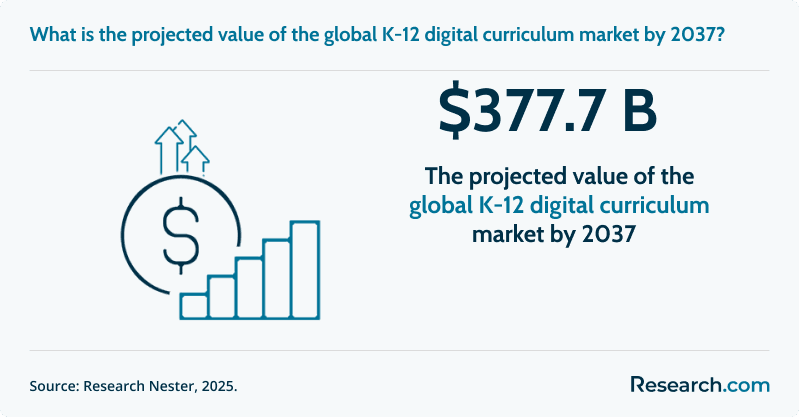
The digital curriculum market also points to long-term opportunity. The global K-12 digital curriculum market was worth about $10.3 billion in 2024. Experts project this value will rise to nearly $377.7 billion by 2037, with a compound annual growth rate (CAGR) of approximately 30.8%.
The strongest candidates will be those who can design for online delivery, use learner data, understand accessibility, collaborate with technical teams, and build materials that can scale beyond a single classroom.
What is the average professional curriculum designer salary in the United States?
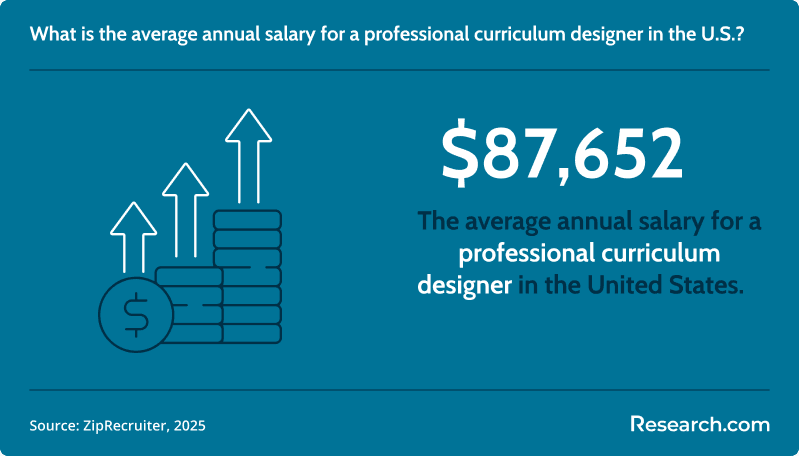
The average annual salary for a professional curriculum designer in the United States in 2027 is approximately $87,652, or about $42 per hour. Many curriculum designers earn between $76,500 and $95,000 annually, while top earners make over $118,500.
Entry-level salaries typically start around $55,000. Professionals with advanced degrees, strong portfolios, specialized technical skills, leadership responsibility, and significant experience can earn over $100,000.
Salary varies by several factors:
- Experience level: Senior designers and managers usually earn more than entry-level curriculum developers.
- Education and credentials: Graduate degrees and relevant certifications may strengthen salary negotiations, especially in education leadership or specialized design roles.
- Sector: Corporate training, EdTech, and specialized digital learning roles may pay differently from school-based positions.
- Location: Salaries tend to be higher in metropolitan areas with a greater cost of living.
- Technical skill set: LMS proficiency, learning analytics, accessibility knowledge, multimedia design, and project management can improve competitiveness.
The chart below shows the top five highest-paying states for curriculum designers:
What certifications can increase a curriculum designer's earning potential?
Certifications can help curriculum designers demonstrate specialized expertise, especially in instructional design, online learning, workforce training, educational technology, and course quality standards. They are not a substitute for strong curriculum work, but they can strengthen a resume, support promotion into senior roles, and improve credibility with employers or consulting clients.
According to industry data, curriculum designers with advanced credentials often earn 10–25% more than those without. The actual impact depends on the employer, sector, experience level, and whether the certification matches the role.
Certifications commonly valued in the field include:
- Certified Professional in Talent Development (CPTD): Useful for professionals in corporate learning, workforce education, and performance improvement roles.
- Association for Talent Development (ATD) Instructional Design Certificate: Focuses on practical instructional design tools and can support movement into senior designer or learning strategy roles.
- Learning and Performance Institute (LPI) Certification: A globally recognized credential that can strengthen a profile in learning facilitation and curriculum development.
- Google for Education Certified Trainer: Helpful for K–12 or higher education designers who integrate digital tools into teaching and curriculum systems.
- Quality Matters (QM) Certification: Particularly relevant for online course designers because it focuses on course design standards, accessibility, engagement, and quality review.
When choosing a certification, start with your target workplace. A district curriculum role may value education technology and course quality credentials. A corporate learning role may value talent development, performance improvement, and instructional design credentials. An online program role may place more weight on LMS, accessibility, and course quality standards.
What are the emerging trends in pedagogy and e-learning that professional curriculum designers must adopt?
Emerging trends in pedagogy and e-learning in 2027 are changing how curriculum designers plan content, support learners, and measure results. The most important trends are not just new tools; they reflect a shift toward more personalized, flexible, data-informed, and inclusive learning experiences.
- AI-powered personalized learning: Artificial intelligence can support adaptive learning paths based on learner progress, preferences, and performance. Designers must still ensure that AI-supported content is accurate, equitable, and aligned with learning goals.
- Microlearning: Short, focused modules help learners complete training or review content in manageable segments. This approach is especially useful for workforce learning, test preparation, and mobile delivery.
- Gamification and immersive learning with VR/AR: Integrating game mechanics, virtual reality, and augmented reality can make learning more interactive and memorable when used for clear instructional purposes.
- Hybrid and blended learning models: Designers need to create learning experiences that connect online content with face-to-face instruction rather than treating them as separate tracks.
- Mobile-first design: Curriculum should be readable, navigable, and usable on smartphones and tablets, especially for learners who rely on mobile access.
- Data-driven instructional design: LMS analytics, assessment results, completion data, and learner feedback can help designers identify where content should be revised.
- Social learning platforms: Forums, peer discussion, collaborative projects, and community features can improve engagement when they are intentionally designed and moderated.
- Sustainability and equity focus: Curriculum designers must consider accessibility, representation, learner diversity, and inclusive participation from the start of the design process.
The key is not to adopt every trend at once. Strong curriculum designers evaluate whether a trend improves learning, fits the audience, can be implemented by instructors, and can be measured. A simple, accessible module that achieves the learning outcome is often better than a flashy tool that creates confusion.
Here’s What Curriculum Designers Have to Say About Their Careers
- : "The most rewarding part of this career is seeing my designs turn scattered content into structured, useful learning journeys. I enjoy the mix of creativity and data-driven analysis, and it is meaningful to know that my work can improve educational outcomes for thousands of learners. Curriculum design lets you become a force multiplier in education. — Selena"
- : "After years in the classroom, I wanted to contribute to broader instructional change. Curriculum design gave me the chance to work with subject matter experts, support teachers, and integrate new technologies. The variety keeps the work challenging, whether the project involves corporate training or K-12 reform. — Marcus"
- : "I value the flexibility and project-based nature of curriculum development. The work is demanding, but it lets me keep learning new subjects while improving how others learn. Moving away from traditional teaching hours also improved my work-life balance while keeping me connected to education. — Elle"
Key Findings
- A professional curriculum designer builds and improves learning systems, while a teacher focuses on direct instruction and day-to-day learner support.
- Most roles require a bachelor’s degree, relevant instructional experience, and strong skills in curriculum development, assessment, collaboration, and educational technology.
- A master’s degree in curriculum and instruction is often preferred, especially in public schools, higher education, and leadership roles, but some private-sector and EdTech employers may prioritize portfolio quality and technical skills.
- LMS proficiency is essential because many curricula are now delivered, tracked, revised, and evaluated through digital platforms.
- The job outlook depends on sector: BLS projections show 1% growth for instructional coordinators from 2024 to 2034, while training and development specialists are projected to grow by approximately 11% during the same period.
- The average annual professional curriculum designer salary in the United States in 2027 is approximately $87,652, with many earning between $76,500 and $95,000 and top earners making over $118,500.
- Certifications such as CPTD, ATD instructional design training, LPI certification, Google for Education Certified Trainer, and Quality Matters can strengthen credibility and may improve earning potential.
- The strongest future-ready curriculum designers understand AI-supported learning, microlearning, blended delivery, mobile-first design, learning analytics, accessibility, and equity-centered curriculum development.
Other Things You Should Know About What a Professional Curriculum Designer Does
The Certified Professional Curriculum Designer credential is not a universal license, but employers often value a master’s degree and documented training in instructional design tools, assessment writing, and standards alignment. Professional memberships such as ASCD or AERA can also strengthen a candidate’s profile.
In 2027, the tech industry typically offers the highest salaries for curriculum designers. This is due to the growing demand for effective training programs and e-learning modules, especially in rapidly evolving tech companies that require constant upskilling of their workforce.
References
- Curriculum Designer salary. (2025). ZipRecruiter. Retrieved November 5, 2025, from https://www.ziprecruiter.com/Salaries/Curriculum-Designer-Salary
- Curriculum Designer Salary (November 2025) - ZiPPia. (2025, January 8). https://www.zippia.com/salaries/curriculum-designer
- How to become a curriculum designer: what it is and career path - Zippia. (2025, January 8). https://www.zippia.com/curriculum-designer-jobs
- How to become a curriculum Developer (With Tips). (2025, June 9). Indeed. Retrieved November 5, 2025, from https://www.indeed.com/career-advice/finding-a-job/how-to-become-curriculum-developer
- Instructional coordinators. (2025, August 28). U.S. Bureau of Labor Statistics. Retrieved November 5, 2025, from https://www.bls.gov/ooh/education-training-and-library/instructional-coordinators.htm
- Wani, P. (2025, October 15). K-12 Digital Curriculum Market Size, Industry Report 2037. Research Nester. https://www.researchnester.com/reports/k-12-digital-curriculum-market/3420