
2027 What Does a Cardiac Sonographer Do: Responsibilities, Requirements, and Salary

Co-Founder and Chief Data Scientist
Cardiac sonography is a specialized diagnostic imaging career for people who want direct patient contact, technical work, and a clear role in cardiovascular care. Cardiac sonographers, also called echocardiographers, use ultrasound equipment to create images of the heart so physicians can evaluate heart structure, blood flow, valve function, and signs of disease without surgery.
The career is especially relevant for students and career changers comparing allied health paths because it combines a relatively focused education route with strong demand for diagnostic imaging skills. According to the Bureau of Labor Statistics (BLS), more than 90,000 diagnostic medical sonographers are currently employed in the U.S., and cardiac imaging remains an important part of cardiovascular diagnosis and monitoring.
This guide explains what cardiac sonographers do, where they work, how to qualify, what skills matter most, what procedures they perform, and how salary and job demand look in 2027. It also highlights practical trade-offs, including physical demands, certification expectations, patient-care responsibilities, and advancement options.
Key Things You Should Know About What a Cardiac Sonographer Does
- A cardiac sonographer performs echocardiograms and other heart imaging procedures to help physicians diagnose cardiovascular conditions.
- Becoming a cardiac sonographer requires formal education in sonography and certification through recognized credentialing organizations.
- The salary and job outlook for a cardiac sonographer are projected to remain strong in 2027 and beyond, supported by rising demand for heart disease detection and management.
What are the main responsibilities of a cardiac sonographer?
A cardiac sonographer’s main responsibility is to perform echocardiograms that help physicians diagnose, monitor, or rule out heart conditions. The role is not simply “taking pictures.” A sonographer must obtain clinically useful images, recognize when views are incomplete or unclear, adjust technique in real time, and document findings accurately for the interpreting physician.
Most of the day is spent balancing three priorities: image quality, patient safety and comfort, and precise clinical documentation. Cardiac sonographers often work with patients who are anxious, short of breath, in pain, or undergoing evaluation for serious cardiovascular symptoms, so communication skills are as important as technical ability.
Key responsibilities of a cardiac sonographer include:
- Reviewing the exam order and relevant patient history before the procedure.
- Preparing patients, explaining what will happen, and positioning them for optimal imaging.
- Operating ultrasound equipment to capture accurate images of heart chambers, valves, vessels, and blood flow.
- Using Doppler, 2D, 3D, and other imaging modes as appropriate for the exam.
- Evaluating image quality and obtaining additional views when necessary.
- Recognizing possible cardiac abnormalities and documenting measurements for physician review.
- Working with cardiologists, physicians, nurses, and other clinicians to support diagnostic reporting.
- Maintaining imaging equipment, cleaning transducers, and following infection control and safety procedures.
- Protecting patient privacy and ensuring that imaging records are handled appropriately.
Cardiac sonography is a focused diagnostic role, while some allied health careers emphasize broader bedside care. Students comparing patient-care pathways may also want to review what jobs you can do with a CNA license, especially if they are deciding whether they prefer direct daily caregiving or specialized imaging work.
Where do cardiac sonographers work?
Cardiac sonographers work anywhere echocardiography is used to evaluate heart health. Hospitals employ many sonographers because they need cardiac imaging for emergency cases, inpatient monitoring, surgery planning, and outpatient testing. Other employers include cardiology practices, diagnostic laboratories, outpatient imaging centers, and contract or mobile imaging services.
BLS reports that most diagnostic medical sonographers work in general medical and surgical hospitals (49,540 positions), followed by offices of physicians (18,820), medical and diagnostic laboratories (9,540), outpatient care centers (3,630), and employment services (1,380). These settings can feel very different in pace, schedule, case complexity, and patient volume.
| Work setting | What the work is often like | Best fit for |
| Hospitals | Higher-acuity cases, emergency exams, inpatient imaging, and collaboration with larger care teams. | Sonographers who want complex cases, shift variety, and exposure to a wide range of cardiac conditions. |
| Physician offices | Scheduled echocardiograms, follow-up imaging, and long-term cardiac patient monitoring. | Professionals who prefer a more predictable outpatient workflow. |
| Medical and diagnostic laboratories | Specialized testing, technical imaging services, and support for physician referrals. | Sonographers who want procedure-focused work in a diagnostic environment. |
| Outpatient care centers | Planned imaging procedures in a non-hospital setting, often with steady daily volume. | Those seeking patient interaction without the constant pace of acute inpatient care. |
| Employment services, mobile, or contract services | Temporary, traveling, or on-site imaging assignments for facilities that need flexible coverage. | Experienced sonographers who value flexibility and can adapt quickly to new workflows. |
Professionals who want broader clinical authority rather than imaging specialization may also explore what jobs you can get with an FNP graduate certificate, which is a different path focused on advanced nursing practice.
How do you become a cardiac sonographer?
Most people become cardiac sonographers by completing a formal cardiac sonography or diagnostic medical sonography program, gaining supervised clinical experience, and earning a professional credential. Employers often prefer or require certification because it demonstrates that the sonographer has met recognized standards in ultrasound physics, cardiac anatomy, scanning technique, and patient care.
Education requirements vary by employer and state, but national data show that 55% of cardiac sonographers hold an associate degree, 29% have a bachelor’s degree, and 5% possess a diploma. For many students, an associate degree is the most direct entry route. A bachelor’s degree may offer broader preparation, more general education, or stronger long-term flexibility for leadership, education, or management roles.
Typical path to becoming a cardiac sonographer
- Complete prerequisites if required. Programs may expect coursework in anatomy, physiology, medical terminology, math, physics, or basic patient care.
- Enroll in an accredited cardiac sonography or diagnostic medical sonography program. Look for a program that includes didactic coursework and clinical training in echocardiography.
- Build hands-on clinical experience. Clinical rotations help students practice scanning, patient positioning, image acquisition, professional communication, and workflow under supervision.
- Prepare for professional certification. Many cardiac sonographers pursue credentials such as Registered Diagnostic Cardiac Sonographer (RDCS) through organizations like ARDMS.
- Apply for entry-level roles. New graduates typically look for positions in hospitals, cardiology offices, diagnostic labs, or outpatient imaging centers.
- Maintain competence through continuing education. Certification maintenance and ongoing learning are important because imaging technology, protocols, and clinical expectations continue to evolve.
Associate degree vs. bachelor’s degree
| Option | Common advantage | Possible trade-off |
| Associate degree | Often the most direct educational route into entry-level cardiac sonography. | May offer less broad preparation for future nonclinical or management roles. |
| Bachelor’s degree | Can provide broader academic preparation and may support advancement later. | Usually requires more time in school before entering the workforce. |
| Diploma pathway | May be available for focused training in some contexts. | Students should verify employer acceptance, clinical quality, and certification eligibility carefully. |
Students considering longer healthcare education routes can also compare this imaging pathway with advanced nursing options, such as what you can do with an FNP DNP degree.
What technical skills does a cardiac sonographer need?
A cardiac sonographer needs strong scanning technique, knowledge of cardiovascular anatomy, careful measurement skills, and the ability to communicate clearly with patients and clinicians. The best sonographers do not rely only on equipment settings; they understand what the physician needs to evaluate and adjust the exam when patient anatomy, symptoms, or image quality creates challenges.
According to current workforce data, the most common skills cited in cardiac sonographer resumes include patient interaction (15.5%), registry and credentialing (8.2%), RDCS and ARDMS certification (7.4% each), echocardiogram performance (7.0%), patient care (7.0%), and BLS certification (6.7%). These resume patterns show that employers value both technical credentials and patient-facing competence.
Core technical and clinical skills
- Performing transthoracic echocardiograms and obtaining standard cardiac views.
- Using Doppler and 2D/3D ultrasound imaging techniques appropriately.
- Understanding cardiac anatomy, physiology, hemodynamics, and common pathologies.
- Measuring chambers, valves, wall motion, blood flow, and other exam components accurately.
- Recognizing when image quality is inadequate and adjusting patient position, probe angle, or settings.
- Maintaining equipment calibration, transducer care, and image quality control.
- Documenting findings clearly for physician interpretation.
- Applying infection control, safety, patient identification, and HIPAA standards.
- Communicating with patients who may be anxious, uncomfortable, or medically unstable.
Common mistakes to avoid while building skills
- Focusing only on speed. Fast exams are not useful if the images and measurements are incomplete.
- Ignoring ergonomics. Poor scanning posture can contribute to long-term strain and injury.
- Underestimating patient communication. Clear explanations often improve cooperation, positioning, and image quality.
- Treating certification as the finish line. Cardiac sonography requires ongoing learning as protocols and technology change.
Those who are drawn primarily to in-home support and basic patient care may also compare sonography with jobs with a home health aide certificate, which involve a different level of clinical responsibility and technical imaging skill.
What kinds of echocardiography does a cardiac sonographer perform?
Cardiac sonographers perform several types of echocardiography, each designed to answer a different clinical question. Some exams are routine and noninvasive, while others support more detailed evaluation, stress testing, or complex cardiac care. The sonographer’s role can vary depending on the procedure, facility policy, physician involvement, and patient condition.
| Type of echocardiography | What it evaluates | How it is typically used |
| Transthoracic Echocardiogram (TTE) | Heart chambers, valves, wall motion, and overall cardiac function using a transducer placed on the chest. | The standard, noninvasive echocardiogram used for many initial and follow-up evaluations. |
| Transesophageal Echocardiogram (TEE) | Detailed internal images of the heart, especially structures that may be harder to see from the chest wall. | Often used to examine heart valves and chambers when more detail is needed. |
| Stress Echocardiogram | Heart performance before and after exercise or medication-induced stress. | Used to evaluate how the heart responds under physical strain or simulated exertion. |
| Doppler Echocardiography | The speed and direction of blood flow through the heart and vessels. | Helps detect abnormalities such as valve issues or blockages. |
| 3D Echocardiography | Three-dimensional views of cardiac structures. | Can support surgical planning or complex case analysis. |
As sonographers gain experience, they may develop deeper expertise in pediatric, fetal, stress, or advanced cardiac imaging. Some also move toward interdisciplinary roles in emergency preparedness, cardiology operations, or healthcare leadership. Those considering broader leadership paths can explore how healthcare experience may relate to emergency management master’s salary and related management careers.
What career options exist for experienced cardiac sonographers?
Experienced cardiac sonographers can advance by becoming more clinically specialized, taking on leadership responsibilities, teaching future sonographers, or moving into industry roles. Advancement usually depends on experience, credentials, communication skills, reliability, and the ability to support quality assurance and workflow improvement.
| Career option | What the role may involve | Good fit for |
| Lead cardiac sonographer | Coordinating daily workflow, mentoring staff, supporting protocol consistency, and helping solve technical imaging issues. | Experienced sonographers who want leadership while staying close to clinical practice. |
| Clinical instructor or educator | Teaching students, supervising clinical rotations, developing scanning skills, and providing feedback. | Professionals who enjoy training, communication, and skill development. |
| Department manager | Overseeing staffing, scheduling, quality control, budgets, compliance, and imaging operations. | Sonographers interested in administration and operational leadership. |
| Specialist in pediatric, fetal, or stress echocardiography | Developing advanced expertise in a focused type of cardiac imaging. | Clinicians who want deeper technical specialization and complex case exposure. |
| Research and development | Working with medical device companies or clinical teams to refine imaging technologies and workflows. | Sonographers interested in innovation, equipment performance, and applied clinical research. |
| Consulting or technical sales | Advising on ultrasound equipment, training users, and helping facilities improve imaging workflows. | Professionals with strong product knowledge, communication skills, and comfort working outside direct patient care. |
A practical way to plan advancement is to decide whether you want to move toward deeper clinical expertise, people leadership, education, or industry. Each path rewards different strengths. Clinical specialization requires advanced technical competence, while management and education require stronger communication, documentation, and coaching skills.
For those still comparing entry points into healthcare, PCT careers can provide another perspective on patient-care roles that may build useful clinical confidence before or alongside imaging education.
What is the average salary for a cardiac sonographer in 2027?
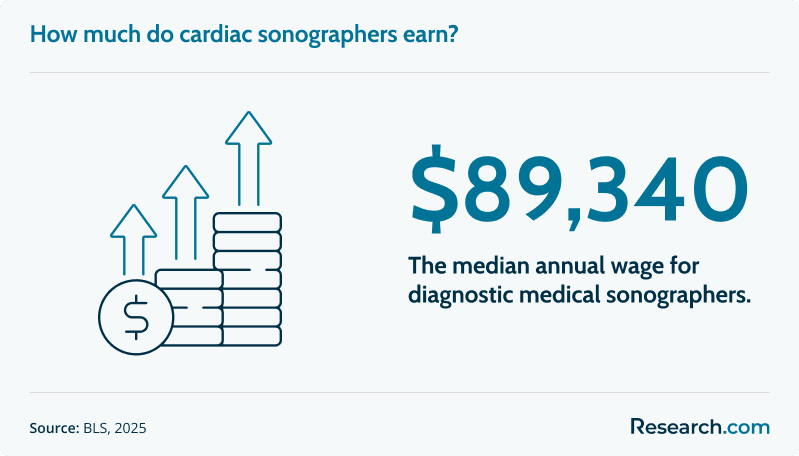
Cardiac sonographer salary depends on experience, credentials, employer type, schedule, specialty, and location. According to recent data from BLS, the median annual wage for diagnostic medical sonographers was $89,340 in May 2024. Cardiac sonographers may earn within or above this range depending on their role, certification, and market conditions.
Because salary data often groups cardiac sonographers with diagnostic medical sonographers more broadly, readers should treat national figures as a benchmark rather than a guaranteed offer. Local job postings, shift differentials, union rules, hospital systems, and specialty requirements can all affect actual pay.
| Salary factor | How it can affect earnings |
| Entry-level experience | Entry-level cardiac sonographers usually earn between $65,000 and $75,000 per year, depending on region and facility type. |
| Advanced experience | Experienced professionals often earn $90,000 to $100,000 or more annually, particularly in large hospitals or specialized cardiology centers. |
| Geographic variation | Salaries tend to be higher in metropolitan areas or states with higher costs of living. |
| Certification | Holding credentials such as RDCS or RCS can significantly enhance salary potential. |
| Work setting | Hospital-based cardiac sonographers may earn more than those in outpatient or private practice environments. |
| Schedule and responsibilities | Evening, weekend, call, lead, or specialized roles may affect total compensation depending on employer policy. |
When comparing job offers, look beyond base pay. Benefits, call requirements, overtime expectations, continuing education support, equipment quality, staffing levels, and opportunities to specialize can all influence long-term career value.
What is the current job demand for cardiac sonographers in 2027?
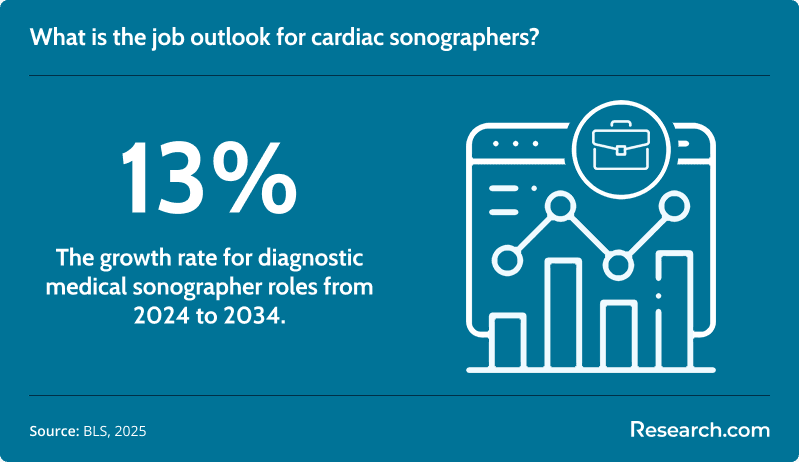
Job demand for cardiac sonographers remains strong in 2027 because healthcare systems continue to rely on noninvasive imaging to diagnose and monitor cardiovascular conditions. BLS projects that employment for diagnostic medical sonographers will grow by 13% from 2024 to 2034, which is much faster than the average for all occupations.
BLS also estimates 5,800 job openings each year nationwide due to employment growth and workforce turnover. For students, this points to a favorable outlook, but it does not mean every graduate will have the same job options. Demand can vary by region, employer, credentials, clinical experience, and willingness to work in hospitals, outpatient centers, or less saturated markets.
Why demand is expected to remain strong
- Cardiovascular diseases remain a leading cause of death globally.
- Ultrasound is noninvasive and widely used for cardiac evaluation and follow-up.
- Aging populations require more diagnostic testing and ongoing cardiac monitoring.
- Hospitals and cardiology practices need trained staff who can produce reliable images for physician interpretation.
- Certification and clinical readiness help employers maintain quality and patient safety standards.
To improve employability, students should prioritize accredited training, strong clinical rotations, credential preparation, professional references, and flexibility about first job setting. A first role in a high-volume environment can build speed, confidence, and exposure to varied cardiac cases.
How does a cardiac sonographer ensure patient comfort, safety and privacy?
A cardiac sonographer protects patients by combining respectful communication with careful procedure technique. Many patients do not know what an echocardiogram involves, and some may be worried because the test is related to heart symptoms. A clear explanation, calm tone, and professional bedside manner can make the exam easier and often improve image quality because the patient understands how to cooperate.
Patient comfort
- Explaining the exam before starting and describing what the patient may feel.
- Positioning the patient as comfortably as possible while still obtaining required views.
- Using appropriate draping and maintaining patient dignity throughout the exam.
- Checking in during the procedure, especially if the patient has pain, shortness of breath, or limited mobility.
- Adapting communication for older adults, anxious patients, and patients with hearing, language, or cognitive barriers.
Safety and infection control
- Confirming patient identity and exam orders before imaging begins.
- Cleaning equipment and transducers according to facility policy.
- Following infection control procedures, including hand hygiene and appropriate protective equipment.
- Using safe scanning practices and avoiding unnecessary exam time while still capturing diagnostic-quality images.
- Reporting urgent concerns through the proper clinical chain of communication.
Privacy and confidentiality
Cardiac sonographers also handle sensitive health information, images, and reports. They must follow HIPAA standards by protecting patient data, discussing cases only with authorized personnel, and ensuring that images and documentation are stored and shared through approved systems.
What are the biggest challenges faced by cardiac sonographers?
Cardiac sonography can be rewarding, but it is also physically, technically, and emotionally demanding. The work requires sustained concentration, precise movements, repeated scanning positions, and frequent interaction with patients who may be seriously ill or frightened. Research has also identified several challenges in the field, including issues related to ergonomics and workforce demands.
Common challenges
- Physical strain: Sonographers may stand for long periods, hold awkward positions, apply transducer pressure, and repeat the same hand and shoulder movements throughout the day.
- Image quality limitations: Body habitus, patient mobility, lung interference, surgical history, and acute illness can make it difficult to obtain clear images.
- Emotional pressure: Sonographers may perform exams on critically ill patients or gather images that contribute to serious diagnoses.
- Time pressure: High patient volume can make it challenging to balance efficiency with complete, high-quality imaging.
- Technology changes: New equipment, software, protocols, and credential requirements demand ongoing learning.
- Professional boundaries: Patients may ask for results, but sonographers generally must avoid interpreting findings directly for patients and instead refer them to the physician.
How to manage the challenges
- Use proper ergonomics, adjust bed and chair height, and avoid overreaching when scanning.
- Build strength and body mechanics habits early in training.
- Ask for feedback from experienced sonographers when exams are technically difficult.
- Develop a consistent script for explaining procedures without giving diagnostic interpretations.
- Maintain certification and continuing education so skills stay current.
- Choose work settings carefully, considering staffing, call expectations, patient volume, and support from leadership.
Here’s What Graduates Have to Say About What a Cardiac Sonographer Does
- Ashley: "Choosing cardiac sonography was the perfect blend of technology and patient care for me. My degree program gave me a solid foundation in ultrasound physics and cardiovascular anatomy, and clinical rotations helped me gain hands-on confidence. Performing echocardiograms daily now allows me to make a real impact on patient outcomes. I’ve also learned how vital communication and empathy are in this field."
- Marcus: "The most rewarding part of being a cardiac sonographer is seeing the direct results of your work. Each image you capture can help a cardiologist detect something life-changing for a patient. The training process was rigorous, but the moment you earn your RDCS credential makes it worthwhile. It’s a career that constantly challenges you to grow both technically and personally."
- Sofia: "I was drawn to cardiac sonography because of its stability and purpose. The job market was strong when I graduated, and I found a hospital position within weeks. Beyond the salary, the daily interactions with patients remind me how meaningful this work is. I’m proud to be part of a team that saves lives through early heart disease detection."
References
- BLS. (2025, August 28). Diagnostic Medical Sonographers. bls.gov.
- BLS. (2025). Occupational Employment and wage Statistics Profiles. data.bls.gov.
- Zippia. (2025, January 8). Best Colleges and Degrees for Cardiac Sonographers. zippia.com.
- Zippia. (2025, January 8). Cardiac Sonographer Demographics and Statistics [2025]: Number of cardiac sonographers in the US. zippia.com.
- Zippia. (2025, January 8). Cardiac Sonographer skills for your resume and career. zippia.com.


