
2027 Master Analyst in Financial Forensics Careers: Skills, Education, Salary & Job Outlook

Co-Founder and Chief Data Scientist
Choosing a Master Analyst in Financial Forensics career means choosing work where accounting, investigation, and legal evidence meet. This role is for professionals who want to go beyond routine financial reporting and help explain what happened in complex fraud, valuation, damages, compliance, or litigation matters.
The path is demanding. Employers and credentialing bodies expect strong accounting or finance knowledge, sound professional judgment, documented experience, and the ability to communicate findings clearly to attorneys, executives, courts, regulators, or clients. The reward is a specialized career with meaningful impact, strong earning potential, and demand supported by complex financial systems, rising regulations, and continued fraud risk.
This guide explains what Master Analysts in Financial Forensics do, the skills and credentials that matter, how to enter the field, what salaries and job outlook data suggest, and how to decide whether this career fits your strengths and goals.
Key Things You Should Know About Master Analyst in Financial Forensics Career
- The typical earning potential for forensic accountants is around $81,344 per year in 2025, with professionals in California earning closer to $123,195 annually; entry-level roles start between $50,000 and $65,000, while senior positions exceed $130,000.
- This field is stable and growing, with forensic accountants holding Certified Fraud Examiner (CFE) credentials earning 32% more than non-certified peers, and steady demand across insurance, banking, government, and law enforcement sectors.
- A bachelor's degree in forensic accounting, general accounting, computer science, information technology, or related fields is required to begin, while a master's degree in forensic accounting, digital forensics, or cybersecurity significantly boosts earning potential.
- Key skills include financial evidence investigation, fraud detection, digital forensic techniques, courtroom support including expert testimony, clear reporting, and specialized knowledge in cloud, mobile, or network forensics for higher-paying roles.
- Career advancement can move from entry-level digital forensics analyst or forensic accountant roles earning $50,000-$75,000 to senior investigator and management positions paying from $80,000 to $130,000+, with paths to leadership roles such as digital forensics manager or chief financial officer.
What do Master Analysts in Financial Forensics do?
Master Analysts in Financial Forensics examine financial information to answer questions that matter in investigations, disputes, and legal proceedings. Their work may involve tracing suspicious transactions, identifying fraud indicators, valuing business interests, calculating damages, reviewing records for compliance issues, or explaining financial evidence in a form that non-accountants can understand.
This career sits at the intersection of forensic accounting, litigation support, fraud investigation, and business valuation. A Master Analyst is not simply “checking the books.” The role requires building a defensible financial analysis that can withstand scrutiny from attorneys, opposing experts, regulators, executives, or a court.
A day in the life of Master Analysts in Financial Forensics
A typical day may include reviewing bank statements, ledgers, tax returns, invoices, contracts, emails, and transaction histories. Analysts often compare records across systems, look for inconsistencies, reconstruct missing information, and document the assumptions behind every conclusion.
The work is usually office-based, but the pace changes with case deadlines. Routine analysis can be quiet and detail-heavy, while litigation, audits, court preparation, and urgent investigations can require long hours and quick coordination. Analysts regularly work with attorneys, law enforcement, executives, auditors, valuation specialists, and clients.
Common work products include forensic accounting reports, damages calculations, fraud findings, financial models, exhibits for legal teams, and expert testimony. The best professionals combine technical accuracy with clear explanation because a correct conclusion has limited value if decision-makers cannot understand or trust it.
What are the key responsibilities of Master Analysts in Financial Forensics?
The core responsibility of a Master Analyst in Financial Forensics is to turn complex financial records into reliable evidence. The work must be accurate, well-documented, and understandable to both financial and non-financial audiences.
- Analyze financial records to identify fraud, embezzlement, misappropriation, irregular transactions, or reporting inconsistencies.
- Collect, organize, and interpret account histories, transaction records, invoices, contracts, statements, and supporting documentation.
- Perform forensic reviews or audits to assess regulatory compliance, internal controls, and potential criminal or civil wrongdoing.
- Prepare written reports that explain findings, methods, assumptions, limitations, and supporting evidence.
- Assist legal teams, courts, clients, or investigators by presenting findings and, when qualified, serving as an expert witness.
- Collaborate with attorneys, law enforcement, executives, auditors, and forensic teams during investigations and disputes.
- Assess fraud risk and recommend anti-fraud controls, monitoring processes, or remediation steps.
- Support litigation by calculating damages, tracing assets, valuing business interests, or analyzing financial losses.
The most challenging vs. the most rewarding tasks
The most challenging part of the job is often the pressure to be precise under scrutiny. A forensic conclusion may be challenged by opposing counsel, regulators, clients, or courts. Analysts must be able to defend not only the answer but also the process used to reach it.
Another challenge is working with incomplete, messy, or intentionally misleading records. Fraud cases rarely arrive neatly organized. Analysts may need to reconstruct timelines, reconcile conflicting documents, and separate honest mistakes from intentional misconduct.
The most rewarding part is the practical impact. A strong analysis can help recover assets, support a legal claim, expose wrongdoing, strengthen internal controls, or protect an organization from future harm. For students still choosing an academic foundation, comparing the highest-paying college majors can help identify programs that align with accounting, finance, analytics, and investigative career goals.
What are the key skills for Master Analysts in Financial Forensics?
Master Analysts in Financial Forensics need more than accounting knowledge. They must combine technical analysis, investigative discipline, legal awareness, and communication skills. The role rewards professionals who can follow evidence carefully, challenge assumptions, and explain complicated findings without overstating what the data proves.
Key hard skills
- Forensic accounting: Reconstructing financial records, tracing transactions, identifying irregularities, and documenting evidence.
- Financial analysis: Interpreting statements, cash flows, ledgers, account activity, and financial relationships across entities.
- Fraud risk assessment: Recognizing red flags, control weaknesses, suspicious patterns, and opportunities for misappropriation.
- Audit and compliance knowledge: Understanding internal controls, documentation standards, regulatory expectations, and evidence quality.
- Report writing: Producing clear, organized, defensible reports that explain methods, findings, and limitations.
- Expert testimony preparation: Presenting financial conclusions in legal settings and responding to questions under pressure.
- Business valuation and damages analysis: Estimating economic losses, lost profits, business value, or financial impact in disputes.
- Data handling: Working with large transaction files, spreadsheets, accounting systems, and supporting documents without losing accuracy.
Key soft skills
- Critical thinking: Testing explanations, identifying weak assumptions, and avoiding premature conclusions.
- Professional skepticism: Questioning incomplete records, unusual transactions, and unsupported claims.
- Judgment: Knowing when evidence is sufficient, when more work is needed, and how to state conclusions responsibly.
- Communication: Explaining financial issues to attorneys, executives, clients, judges, juries, and investigators.
- Attention to detail: Catching small discrepancies that may change the direction of an investigation.
- Confidentiality and ethics: Handling sensitive information with discipline and independence.
- Time management: Balancing multiple cases, deadlines, interviews, analyses, and reporting requirements.
The one overlooked skill that separates the good from the great
The most overlooked skill is translation: the ability to turn technical financial work into a clear, credible explanation for non-experts. A great analyst does not bury the reader in spreadsheets. They show what the evidence means, why it matters, and how strongly the conclusion is supported.
This matters most in high-stakes settings. An analyst may identify a subtle fraud pattern, but the finding must still be explained to attorneys, executives, judges, or juries. The strongest professionals can connect the financial trail to a plain-language narrative without exaggeration.
If you are building skills for this field, targeted professional learning can help. Reviewing certificates that pay well may help you compare options that strengthen accounting, fraud examination, analytics, compliance, or valuation expertise.
Master Analyst in Financial Forensics Careers: A Step-by-Step Guide to Getting Started
The most practical path into financial forensics is to build accounting competence first, then add investigative experience, litigation exposure, and specialized credentials. The field values demonstrated judgment as much as academic preparation.
- Earn a relevant undergraduate degree. Start with accounting, finance, economics, business administration, or a closely related field. Prioritize coursework in auditing, taxation, financial reporting, business law, data analysis, and fraud examination when available.
- Build a strong accounting and audit foundation. Entry-level accounting, audit, compliance, valuation, or risk roles can help you learn how records are created, reviewed, tested, and challenged.
- Seek exposure to investigations or disputes. Look for assignments involving internal investigations, fraud reviews, litigation support, insurance claims, business valuation, regulatory matters, or anti-money laundering work.
- Develop forensic documentation habits. Learn to preserve evidence, document assumptions, maintain workpapers, cite source records, and explain your reasoning clearly.
- Pursue relevant credentials. Once you meet eligibility requirements, consider credentials such as the Master Analyst in Financial Forensics (MAFF), Certified in Financial Forensics (CFF), Certified Fraud Examiner (CFE), or Certified Public Accountant (CPA), depending on your background and goals.
- Strengthen communication and testimony skills. Practice writing concise reports, preparing exhibits, explaining financial concepts to non-specialists, and answering challenging questions with precision.
- Choose a specialization. Over time, focus on areas such as fraud investigation, damages analysis, business valuation, anti-money laundering, compliance, asset tracing, or cyber-enabled financial crime.
- Move into senior case leadership. Advanced professionals manage complex engagements, supervise teams, interact directly with counsel or executives, and may provide expert testimony.
A successful career usually develops in stages. Trying to skip foundational accounting experience can make the forensic work harder, because analysts need to understand both normal financial activity and the ways records can be manipulated.
What education, training, or certifications are required?
A bachelor's degree in Accounting, Finance, Economics, Business Administration, or a closely related field is the usual educational foundation for Master Analyst in Financial Forensics careers. The strongest preparation includes financial accounting, auditing, taxation, business law, statistics, valuation, fraud examination, and data analysis.
Important credentials include the Master Analyst in Financial Forensics (MAFF) credential from the National Association of Certified Valuators and Analysts (NACVA) and the Certified in Financial Forensics (CFF) certification from the American Institute of Certified Public Accountants (AICPA). These credentials can strengthen credibility, especially for litigation support, valuation, fraud, and expert-related work.
Practical experience is essential. Requirements commonly involve leadership roles in at least 10 to 20 financial forensic matters or 1,000 to 2,500 hours of relevant experience. Written references from attorneys and business contacts may also be required to verify professional quality, credibility, and ethical conduct.
Specialized training, including NACVA's Foundations of Financial Forensics course, can help professionals formalize their knowledge. In some cases, equivalent practical exposure may substitute for formal training, but candidates should verify the current requirements directly with the credentialing organization before planning around any substitution.
Are advanced degrees or niche certifications worth the investment?
Advanced degrees, such as a master's or doctorate in Business, Accounting, or Finance, can be useful for professionals aiming at senior consulting, expert witness, academic, or leadership roles. They may also help candidates who want deeper specialization in valuation, analytics, fraud, economics, or litigation support.
Niche certifications can also be valuable, but they should match your target work. A Certified Fraud Examiner (CFE) may be useful for fraud investigation. A Certified Public Accountant (CPA) can strengthen accounting credibility. MAFF and CFF credentials can be especially relevant for financial forensics and litigation-focused work.
The trade-off is cost, time, exam preparation, membership fees, and continuing education. Before investing, compare the credential’s eligibility rules, recognition in your target market, and relevance to the cases or employers you want. Professionals considering advanced academic routes can also review options such as PhD programs without a dissertation when evaluating long-term education plans.
What is the earning potential for Master Analysts in Financial Forensics?
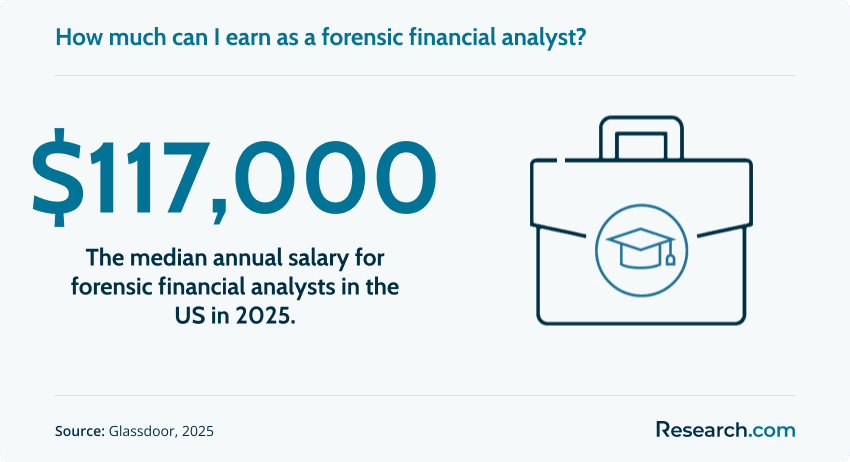
The earning potential for Master Analysts in Financial Forensics is strong because the work is specialized, evidence-driven, and often connected to high-stakes financial disputes. The median annual salary for a Forensic Analyst is $89,081, which provides a useful midpoint for evaluating compensation in this career area.
The financial forensics salary range 2025 spans from $67,000 at the entry level to $118,981 for senior positions. In practice, compensation depends on experience, credentials, employer type, geography, specialization, and whether the role includes expert testimony, leadership responsibility, or complex litigation support.
- Experience level: Analysts with stronger case histories, supervisory experience, and courtroom or deposition exposure often command higher pay.
- Credentials: MAFF, CFF, CPA, CFE, and related qualifications may improve credibility and marketability when aligned with the role.
- Employer type: Accounting firms, consulting firms, corporations, government agencies, law enforcement, and financial institutions may offer different compensation structures.
- Location: Major metropolitan areas typically offer higher compensation, though they may also come with higher cost of living and heavier competition.
- Specialization: Litigation support, business valuation, anti-money laundering, cyber-enabled fraud, and expert witness work can raise earning potential for experienced professionals.
Salary should not be evaluated in isolation. Also consider billable-hour expectations, travel, workload during litigation deadlines, promotion paths, bonus potential, public-sector benefits, and the long-term value of specialized experience.
What is the job outlook for Master Analysts in Financial Forensics?
The job outlook for Master Analysts in Financial Forensics is favorable because organizations continue to face fraud risk, regulatory scrutiny, litigation, cyber-enabled financial crime, and complex transactions. Government sources project growth for these roles in the range of 4% to 6%, which is at or above the 3% average for all occupations. Industry estimates suggest demand could rise up to 20% in certain forensic accounting specialties.
Earlier career planning discussions also cite a 6% to 8% job growth rate for these professionals. Because outlook figures vary by source, occupation classification, and specialty, job seekers should treat them as directional indicators rather than guarantees.
The key factors shaping the future outlook
- More complex fraud schemes: Digital transactions, layered entities, cross-border activity, and cyber-enabled financial crime increase the need for specialized analysis.
- Regulatory pressure: Organizations need professionals who can help identify compliance gaps, investigate issues, and support defensible remediation.
- Litigation demand: Business disputes, damages claims, asset tracing, divorce matters, insurance claims, and shareholder conflicts often require financial experts.
- Automation limits: Software can flag anomalies, but human judgment is still needed to interpret intent, context, evidence quality, and legal relevance.
- Reputation and risk management: Companies increasingly need credible internal investigations and fraud prevention strategies before problems escalate.
For professionals who want to differentiate themselves, advanced education and credentials can support movement into higher-level analytical, leadership, or expert roles. Some may explore options such as 1 year PhD programs as part of a broader plan for advanced specialization, teaching, consulting, or executive-level credibility.
What is the typical work environment for Master Analysts in Financial Forensics?
Master Analysts in Financial Forensics usually work in professional office environments, including accounting firms, consulting firms, corporate legal or compliance departments, government agencies, law enforcement-related settings, and financial institutions. Evidence shows that 27% of these professionals work in accounting-related services, 22% in government roles, and 10% in finance and insurance sectors.
The work combines independent analysis with frequent collaboration. Analysts may spend long stretches reviewing records, building models, or drafting reports, then shift into meetings with attorneys, executives, investigators, clients, auditors, or other subject-matter experts.
The forensic accountant daily schedule often follows standard business hours from Monday to Friday, 8 a.m. to 5 p.m. However, deadlines can change that rhythm. Court dates, urgent investigations, major audits, discovery deadlines, and report submissions may require evening or weekend work.
Remote and hybrid work are increasingly practical for document review, data analysis, report drafting, and internal meetings. Still, in-person work may be required for interviews, court appearances, client meetings, secure document reviews, onsite audits, or testimony preparation. Candidates should ask employers about travel, billable hours, workload spikes, confidentiality expectations, and technology tools before accepting a role.
What are the pros and cons of Master Analyst in Financial Forensics careers?
A Master Analyst in Financial Forensics career can be intellectually engaging and meaningful, but it is not a low-pressure accounting path. The same factors that make the work important—legal scrutiny, financial stakes, fraud allegations, and tight deadlines—also make it demanding.
Pros
- Meaningful impact: Your work can help expose fraud, recover assets, support legal claims, and improve financial integrity.
- Strong specialization: Financial forensics can distinguish you from general accounting or finance professionals.
- Intellectual challenge: Cases often require puzzle-solving, pattern recognition, evidence testing, and careful reasoning.
- Career resilience: Fraud, disputes, regulatory issues, and financial crime continue across economic cycles.
- Varied work: Cases can involve different industries, transaction types, legal questions, and investigative methods.
- Advancement potential: Experienced professionals can move into senior analyst, manager, director, consulting, or expert witness roles.
Cons
- High pressure: Reports and testimony may be challenged by attorneys, clients, regulators, or opposing experts.
- Heavy detail work: Reviewing transactions, reconciling records, and documenting workpapers can be time-consuming and repetitive.
- Deadline spikes: Litigation schedules, audits, and investigations can require long hours.
- Emotional strain: Some cases involve criminal activity, victim losses, workplace misconduct, or family disputes.
- Communication burden: Analysts must explain complex financial issues clearly to non-experts without oversimplifying.
- Credential investment: Certifications, continuing education, and experience requirements can require substantial time and money.
This career is a strong fit for people who enjoy evidence-based problem-solving, can stay objective under pressure, and are comfortable having their work reviewed closely. Students seeking broad academic preparation may also compare options such as undergraduate international dual degree programs when planning a versatile foundation in business, accounting, finance, or related fields.
What are the opportunities for advancement for Master Analysts in Financial Forensics?
Advancement in financial forensics usually comes from a combination of technical depth, case experience, credentials, communication skill, and trust from attorneys or clients. Professionals can move upward into leadership or sideways into higher-value specializations.
Advancement path
- Entry-level or junior forensic analyst: Build skills in accounting review, transaction testing, workpaper preparation, document organization, and basic fraud analysis.
- Forensic accountant, fraud examiner, or associate: Take on more complex analyses, support interviews, draft report sections, and contribute to litigation or investigation strategy.
- Master Analyst in Financial Forensics or senior analyst: Lead significant portions of engagements, review others’ work, manage evidence, and support expert reports or testimony.
- Manager or senior manager: Supervise teams, coordinate with counsel or executives, manage budgets and timelines, and ensure quality control.
- Director, principal, partner, or practice leader: Set strategy, develop client relationships, lead major matters, provide expert testimony, and guide the direction of a forensic practice.
Specialization areas
- Fraud examination and investigation: Focus on detecting, documenting, and preventing occupational fraud, embezzlement, misappropriation, and related misconduct.
- Litigation support and expert witness testimony: Analyze financial evidence for disputes and present findings in legal settings.
- Business valuation and damages: Estimate company value, lost profits, economic losses, or financial impact in civil matters.
- Anti-money laundering and compliance: Investigate suspicious activity, evaluate controls, and support regulatory compliance.
- Forensic technology and cybercrime: Work with digital evidence, large datasets, cyber-enabled fraud, and electronic transaction trails.
- Asset tracing: Follow funds across accounts, entities, jurisdictions, or transaction layers to identify hidden or diverted assets.
The best advancement strategy is to document case experience carefully, seek increasingly complex assignments, build relationships with legal and compliance professionals, and choose credentials that support your target specialization.
What other careers should you consider?
If you are interested in financial forensics but unsure whether the Master Analyst path is the right fit, consider related careers that use similar analytical, accounting, compliance, or investigative skills.
- Financial Analyst: Focuses on financial performance, forecasting, budgeting, investment analysis, and strategic decision support rather than fraud or litigation.
- Risk Management Specialist: Identifies, measures, and reduces financial, operational, compliance, or enterprise risks across an organization.
- Compliance Officer: Helps organizations follow laws, regulations, policies, and reporting requirements, often in banking, healthcare, insurance, or corporate settings.
- Financial Consultant or Advisor: Provides financial planning, business advisory, investment, or strategic guidance to individuals or organizations.
- Criminal Investigator with Financial Specialization: Uses financial records, interviews, and evidence analysis to support criminal investigations involving fraud, money laundering, theft, or corruption.
- Internal Auditor: Reviews controls, processes, risks, and compliance practices inside an organization to prevent errors, inefficiency, and misconduct.
- Anti-Money Laundering Analyst: Monitors transactions, reviews suspicious activity, and supports compliance with financial crime regulations.
- Business Valuation Analyst: Estimates the value of businesses, ownership interests, or intangible assets for transactions, disputes, tax matters, or litigation.
Choose based on the type of work you want every day. If you enjoy legal disputes and evidence, financial forensics may be the better fit. If you prefer planning and performance analysis, financial analysis may suit you. If you want to prevent regulatory violations, compliance or risk management may be more aligned.
Here's What Professionals Say About Their Master Analyst in Financial Forensics Careers
- : "When I uncover hidden assets through detailed financial analysis, it feels incredibly rewarding to help victims recover what was rightfully theirs. Providing clarity in complex cases not only supports families but also gives me a strong sense of purpose. Knowing my work contributes to justice and peace of mind for those affected drives me every day to dig deeper. The impact of unveiling truth in tangled financial webs is something I carry with pride. — Jessa"
- : "Every investigation feels like solving an intricate puzzle, especially when faced with fragmented or deliberately obscured records. I've spent countless hours sifting through data, interviewing key witnesses, and connecting faint clues that initially seemed unrelated. The patience and resilience required can be exhausting, but it's also a chance to sharpen my instincts and grow stronger as an analyst. Even when progress is slow, the challenge itself fuels my dedication. — Jenny"
- : "I remember a case where, after long nights tracing suspicious transactions and interviewing witnesses, I found critical evidence that led to a conviction and full restitution for my client. Seeing the direct impact of my work on bringing justice and correcting wrongs is deeply fulfilling. Moments like these remind me why I committed to financial forensics and show the real-world importance of diligence and precision in this field. It's those victories that keep me motivated. — Carlo"
Key Findings
- Master Analysts in Financial Forensics investigate complex financial issues involving fraud, litigation, valuation, damages, compliance, and asset tracing.
- The role requires a strong foundation in accounting, finance, auditing, business law, and financial analysis, along with excellent documentation and communication skills.
- A bachelor's degree in Accounting, Finance, Economics, Business Administration, or a related field is the typical starting point.
- Important credentials include the Master Analyst in Financial Forensics (MAFF) from NACVA and the Certified in Financial Forensics (CFF) from AICPA.
- Relevant experience is critical and may involve leadership roles in at least 10 to 20 financial forensic matters or 1,000 to 2,500 hours of relevant experience.
- The median annual salary for a Forensic Analyst is $89,081, with the financial forensics salary range 2025 spanning from $67,000 at the entry level to $118,981 for senior positions.
- Government sources project growth of 4% to 6%, compared with the 3% average for all occupations, while industry estimates suggest demand could reach up to 20% in certain forensic accounting specialties.
- The career offers meaningful impact, specialization, and advancement potential, but it also involves pressure, detailed documentation, tight deadlines, and scrutiny from legal or regulatory stakeholders.
- This path is best suited to professionals who are analytical, ethical, detail-oriented, skeptical, and able to explain complex financial evidence clearly.
Other Things You Should Know About Master Analyst in Financial Forensics
The Certified Fraud Examiner (CFE) is the best-known credential for this field, issued by the Association of Certified Fraud Examiners. Some employers also value CPA and Certified Anti-Money Laundering Specialist (CAMS) credentials. These certifications can strengthen hiring prospects and support advancement into senior forensic investigation roles.
In 2027, the average salary for a master analyst in financial forensics is estimated to be around $95,000 to $130,000 per year. This range reflects the growing demand for expertise in uncovering financial fraud and ensuring compliance with regulatory standards, impacting salary levels.
References
- Master Analyst in Financial Forensics (MAFF) https://www.nacva.com/maff
- Handbook https://coursehandbook.mq.edu.au/2020/courses/c000066
- Guide to Becoming a Forensic Accountant - Financial Edge https://www.fe.training/free-resources/accounting/guide-to-becoming-a-forensic-accountant/
- Forensic accountant https://www.prospects.ac.uk/job-profiles/forensic-accountant
- 6 Forensic Analyst Job Description Templates and Examples | Himalayas https://himalayas.app/job-descriptions/forensic-analyst
- Certification: Master Analyst in Financial Forensics (MAFF) at My Next Move https://www.mynextmove.org/profile/certinfo/3584-C
- Forensics Careers | FBIJOBS https://fbijobs.gov/forensics
- Is Becoming a Financial Crime Analyst Worth It? [15 Pros and Cons][2025] https://digitaldefynd.com/IQ/is-becoming-financial-crime-analyst-worth-it/
- 5 Essential Forensic Scientist Skills & Qualities to Consider https://www.alliant.edu/blog/forensic-scientist-skills
- Accounting and Financial Forensics, M.S. https://www.fit.edu/programs/accounting-and-financial-forensics-ms/


