2027 DNA Analyst Careers: Skills, Education, Salary & Job Outlook

Co-Founder and Chief Data Scientist
Choosing a DNA analyst career means deciding whether you want a science-heavy role where precision, documentation, and judgment can affect criminal investigations, court cases, and people’s lives. The work is not casual laboratory testing. It requires a strong foundation in biology, genetics, chemistry, and forensic procedures, plus the discipline to follow validated methods and defend results under scrutiny.
The field can be demanding, but it also offers a clear professional purpose. DNA analysts help identify individuals, connect evidence to cases, exclude innocent people, and support reliable decision-making in the justice system and related scientific settings. Forensic science technicians can earn median salaries around $67,000, with higher earnings possible in some locations, agencies, and specialized roles.
This guide explains what DNA analysts do, the skills and education they need, salary and job outlook expectations, work environment, advancement paths, and related careers to consider before committing to this path.
Key Things You Should Know About DNA Analyst Careers
- A DNA analyst in the United States typically earns around $90,605 annually, with most salaries ranging between $81,000 and $98,000, and some sources noting averages up to nearly $100,000.
- The field of DNA analysis is very active and growing, with a projected 13% job increase from 2022 to 2032, faster than the average for all occupations.
- A bachelor's degree in biology, chemistry, forensic science, or a related natural science is the standard qualification to start, though some roles may require a master's degree.
- Success as a DNA analyst depends on strong laboratory techniques, attention to detail, analytical thinking, clear communication, and the ability to operate complex scientific instruments.
- Career progression can lead from a DNA analyst to senior analyst, laboratory supervisor, technical leader, or forensic laboratory director, often requiring experience and sometimes additional education or certifications.
What do DNA analysts do?
DNA analysts examine biological evidence to develop, interpret, and report DNA profiles. In forensic settings, their work may help connect evidence to a person, exclude a person from suspicion, identify remains, or support further investigation. The role combines laboratory science, statistical interpretation, legal documentation, and careful communication.
A DNA analyst does not simply “run a test.” The job requires selecting the right method for the sample, protecting evidence from contamination, recognizing limitations in the data, and explaining results in a way that investigators, attorneys, judges, and juries can understand. Accuracy matters because DNA findings can influence criminal charges, convictions, appeals, and exonerations.
A day in the life of DNA analysts
Most DNA analysts work in controlled laboratory environments. A typical day may include reviewing case documentation, preparing biological samples, extracting DNA, using validated instruments, interpreting DNA profiles, completing quality checks, and writing reports. Some days are highly technical and repetitive; others involve complex interpretation, peer review, meetings with legal teams, or preparation for testimony.
The work is usually structured and procedure-driven. Analysts must document each step, maintain chain of custody, follow laboratory protocols, and be prepared for their work to be reviewed by supervisors, auditors, attorneys, and courts. Collaboration is common, but much of the actual analysis requires independent focus and sustained attention to detail.
What are the key responsibilities of DNA analysts?
The core responsibility of a DNA analyst is to produce reliable, defensible genetic evidence from biological material. That means every stage of the process, from sample intake to final reporting, must be handled with scientific care and legal awareness.
- Receiving and documenting evidence: Analysts log samples, confirm identifiers, preserve chain of custody, and follow procedures designed to prevent contamination or evidence mix-ups.
- Preparing biological samples: They may work with blood, saliva, hair, tissue, bone, or other biological materials, depending on the case and lab specialty.
- Extracting and quantifying DNA: Analysts isolate DNA and determine whether enough usable material is present for testing.
- Developing DNA profiles: They use validated laboratory methods and instruments to generate genetic profiles from evidence samples and reference samples.
- Interpreting results: Analysts compare profiles, evaluate single-source and mixed-source samples, and consider the strength and limitations of the findings.
- Preparing formal reports: Reports must clearly describe the methods, results, conclusions, assumptions, and any limitations that affect interpretation.
- Supporting quality assurance: Analysts participate in instrument checks, proficiency testing, technical review, documentation audits, and corrective actions when needed.
- Providing expert testimony: In forensic roles, analysts may explain their methods and conclusions in court and respond to cross-examination.
The most challenging vs. the most rewarding tasks
One of the most challenging parts of the job is interpreting complex, degraded, partial, or mixed DNA samples. These cases require technical knowledge, statistical reasoning, and careful restraint. A strong analyst knows not only what can be concluded, but also what cannot be responsibly claimed.
The most rewarding part is the public value of the work. DNA evidence can help identify perpetrators, support victims’ families, reopen cold cases, and exonerate people who were wrongly accused or convicted. For students still exploring entry points into science-based careers, reviewing the top 6-month online associate degree programs may help clarify whether a shorter credential can support early preparation before pursuing the more advanced education typically required for forensic DNA work.
What are the key skills for DNA analysts?
DNA analysts need more than laboratory competence. Employers look for people who can follow strict protocols, recognize scientific uncertainty, document work thoroughly, communicate clearly, and stay calm when results are questioned. The best candidates combine technical ability with professional judgment.
Key hard skills
- DNA profiling techniques: Analysts must understand the laboratory methods used to generate DNA profiles and know how sample quality, quantity, and contamination risk affect results.
- Genetics and molecular biology: A working knowledge of inheritance, genetic markers, molecular processes, and biological variation is essential.
- Analytical chemistry techniques: These skills support accurate sample preparation, testing, and interpretation of forensic results.
- Genetic data analysis: Analysts must compare DNA profiles, evaluate matches or exclusions, and interpret data in the context of case information.
- Statistical analysis: DNA findings often require statistical interpretation, especially when explaining the strength of evidence.
- Laboratory equipment operation: Analysts must use, maintain, and troubleshoot specialized instruments according to validated procedures.
- Quality control and assurance: Strong quality habits help ensure that results are accurate, repeatable, and legally defensible.
Important soft skills
- Attention to detail: Small documentation errors, sample mix-ups, or overlooked anomalies can create serious consequences.
- Critical thinking: Analysts must evaluate whether the evidence supports a conclusion and whether alternative explanations need to be addressed.
- Complex problem solving: Degraded, limited, or mixed samples often require careful troubleshooting and interpretation.
- Written communication: Reports must be precise, organized, and understandable to non-scientists.
- Verbal communication: Analysts may need to explain technical findings to investigators, attorneys, or juries.
- Emotional resilience: Some cases involve violence, trauma, or intense legal pressure, so analysts need healthy boundaries and composure.
The overlooked skill that separates strong analysts from average ones
Technical leadership is often overlooked early in a DNA analyst career. It does not always mean managing people. It can mean identifying a process weakness, mentoring a newer analyst, improving documentation practices, helping validate a method, or guiding a team through a complex quality issue.
For example, if an analyst notices inconsistent results across multiple cases, technical leadership means raising the concern, documenting the pattern, supporting corrective action, and helping prevent unreliable evidence from moving forward. This type of judgment builds trust and can prepare analysts for senior, technical review, training, or laboratory leadership roles.
Analysts who want to deepen their scientific range may eventually consider graduate study. Comparing options such as easiest masters programs can help prospective students think about workload and format, but the right choice should still align with forensic science standards, laboratory expectations, and long-term career goals.
The essential DNA analyst skills include DNA profiling techniques, statistical analysis, critical thinking, and emotional resilience, as valued by employers.
DNA Analyst Careers: A Step-by-Step Guide to Getting Started
The path to becoming a DNA analyst is structured because the work carries scientific and legal consequences. Most candidates build from formal science education to supervised laboratory experience, then progress into casework, proficiency testing, certification, and specialization.
- Build a science foundation. Start with coursework in biology, chemistry, genetics, molecular biology, biochemistry, statistics, and forensic science where available.
- Earn the required degree. A bachelor's degree in a relevant science is the usual starting point for DNA analyst roles.
- Gain hands-on laboratory experience. Seek laboratory coursework, internships, research assistantships, or forensic lab exposure. Employers want evidence that you can work carefully in a controlled lab.
- Learn forensic documentation standards. Chain of custody, contamination prevention, technical notes, peer review, and quality assurance are central to the job.
- Apply for entry-level lab or forensic positions. Early roles may involve sample processing, technician duties, evidence handling, or supervised DNA testing.
- Complete employer training and competency requirements. New analysts usually complete internal training, supervised casework, and proficiency testing before independent work.
- Pursue certification or specialized credentials when appropriate. Certification can strengthen credibility, especially after gaining relevant experience.
- Advance through specialization, technical review, or leadership. With experience, analysts can move into complex casework, method validation, training, management, or research and development.
The main mistake to avoid is treating the career as only a degree decision. Employers also evaluate laboratory maturity, documentation habits, judgment, communication, and the ability to follow validated procedures under pressure.
What education, training, or certifications are required?
A DNA analyst career typically begins with a bachelor's degree in forensic science, biology, chemistry, or a closely related field. The strongest preparation includes genetics, molecular biology, biochemistry, statistics, and laboratory-intensive coursework. Because forensic DNA work is evidence-based and legally sensitive, students should also understand chain of custody, contamination control, quality assurance, and courtroom communication.
Hands-on laboratory experience is essential. Coursework alone may not be enough to compete for forensic roles. Internships, undergraduate research, supervised lab positions, and forensic laboratory exposure can help demonstrate that you can work accurately, document properly, and follow protocols.
Common professional credentials include American Board of Criminalistics (ABC) certification, which requires a bachelor's degree and relevant experience, and International Association for Identification (IAI) certification, which can be useful in forensic science specialties. Requirements vary by role and employer, so candidates should confirm what is expected in their target laboratory, state, or agency.
Training after hiring
Many DNA analysts complete significant employer-based training before they handle independent casework. This may include method-specific instruction, supervised analysis, competency testing, proficiency testing, technical review, and quality system training. Continuing education is also important because DNA methods, interpretation standards, instruments, and legal expectations continue to evolve.
Are advanced degrees or niche certifications worth the investment?
Advanced degrees such as a master's in forensic science or molecular biology can be worthwhile for analysts who want deeper technical expertise, research opportunities, leadership roles, or stronger competitiveness in specialized laboratories. However, graduate education requires time and money, and it may not replace the value of direct forensic laboratory experience.
Niche certifications and graduate certificates in forensic DNA can also strengthen a resume when they match employer needs. Before enrolling, compare the program’s curriculum, laboratory requirements, accreditation context, faculty expertise, and relevance to your target roles. Reviewing resources such as masters that make the most money may help with financial planning, but salary potential should not be the only factor in a forensic science education decision.
The best credential path is the one that supports both employability and competence: rigorous science preparation, meaningful lab experience, and credentials that are recognized by the employers you plan to pursue.
What is the earning potential for DNA analysts?
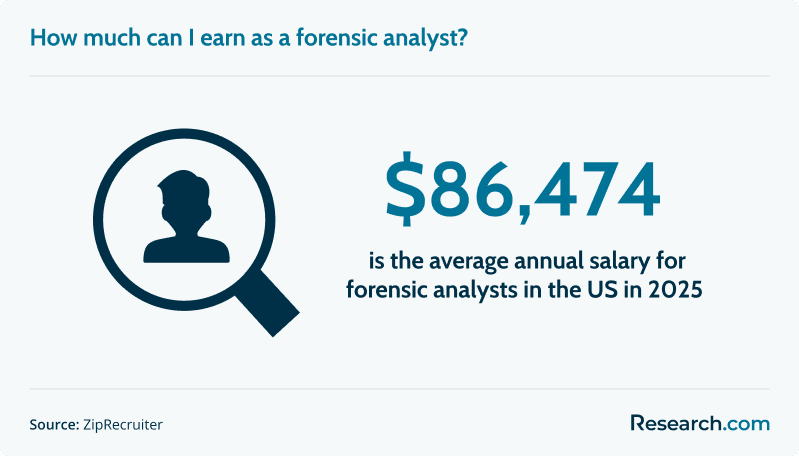
The median annual salary for forensic DNA analysts is $67,440. Entry-level salaries typically start around $45,560, while highly experienced professionals can earn about $110,710. Actual pay depends on location, employer type, experience, specialization, union or government pay scales, and whether the role includes leadership, technical review, or expert testimony responsibilities.
Geography matters. Analysts in states such as Illinois and California often see higher compensation because of demand, local budgets, and cost-of-living differences. However, a higher salary in a major metropolitan area may not always translate into stronger purchasing power, so candidates should compare pay with housing costs, commute expectations, and benefits.
Employer type also affects earning potential. Public-sector laboratories may offer stable employment, structured pay bands, pension or retirement benefits, and clear promotion systems. Private testing laboratories or metropolitan agencies may offer different salary ranges, workloads, advancement timelines, and specialization opportunities.
- Early career: Pay is usually lower while analysts build casework experience, complete training, and prove competency.
- Mid-career: Earnings can improve with independent casework, proficiency, courtroom experience, and technical depth.
- Senior career: Higher pay is more likely for analysts who handle complex cases, perform technical review, supervise staff, lead quality systems, or manage laboratories.
What is the job outlook for DNA analysts?
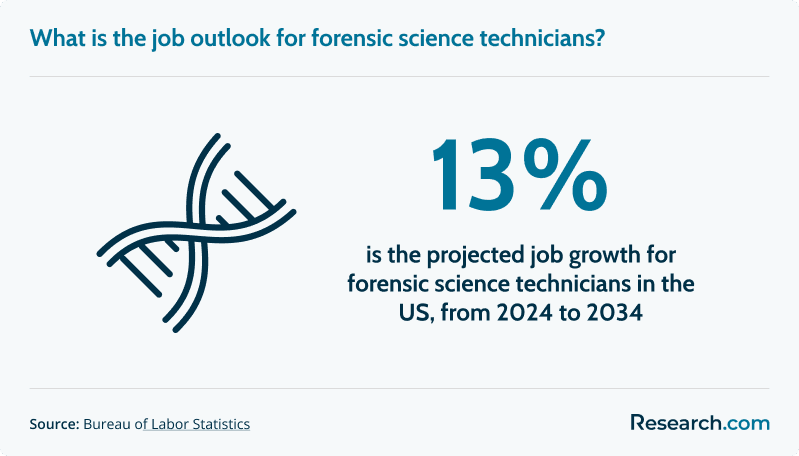
The demand for forensic science technicians, including DNA analysts, is projected to grow by 13% from 2024 to 2034. That is much faster than the average 3% growth expected across all occupations. This outlook reflects the growing role of DNA evidence in investigations, court proceedings, cold cases, post-conviction review, and identification work.
Job stability can be strong in government laboratories, but openings may still be competitive. Many labs require specific science coursework, hands-on experience, background checks, and the ability to meet internal training and quality standards. Candidates with strong laboratory preparation and clear communication skills are generally better positioned.
The key factors shaping the future outlook
Technology is expanding what laboratories can do. Rapid DNA technologies, improved sensitivity, and more sophisticated interpretation tools can increase both the speed and complexity of DNA analysis. These advances create opportunities, but they also require analysts who understand validation, limitations, and quality control.
Legal and policy changes continue to influence demand. Expanded DNA database criteria, post-conviction testing, and cold case initiatives have made DNA evidence central to more investigations and legal reviews.
Public expectations are higher. The “CSI effect” has made many jurors, attorneys, and investigators more aware of forensic evidence. That can increase demand for DNA testing, but it can also create unrealistic expectations. Skilled analysts must explain what DNA evidence can and cannot prove.
Students comparing flexible education options may want to research online colleges FAFSA supported, especially if they need a path that balances cost, schedule, and science prerequisites.
What is the typical work environment for DNA analysts?
DNA analysts usually work in secure laboratory settings designed to protect biological evidence and prevent contamination. Common employers include local government agencies, state government laboratories, medical or research institutions, and testing laboratories. Most DNA analysts are employed by local government agencies (about 59%), state government (27%), or testing laboratories (6%).
The typical schedule is often a standard weekday schedule, especially in government laboratories, but urgent cases, backlogs, court deadlines, or special projects may require occasional late nights or weekends. The work is generally on-site because evidence handling, laboratory testing, and instrument use require controlled conditions. Remote work, when allowed, is usually limited to report writing, literature review, administrative tasks, or training.
What the work setting feels like
- Structured: Procedures, checklists, documentation rules, and quality systems guide daily work.
- Quiet and focused: Analysts spend significant time performing detailed tasks that require concentration.
- Collaborative but independent: Analysts may work alone on technical tasks while coordinating with supervisors, reviewers, investigators, attorneys, and other lab staff.
- High accountability: Case notes, instrument records, reports, and conclusions may be reviewed internally and challenged in court.
- Emotionally serious: Forensic cases can involve violence, death, sexual assault, missing persons, or wrongful conviction claims.
This environment suits people who like science, order, accuracy, and public-service work. It may be less appealing to those who prefer fast social interaction, flexible remote work, or loosely structured creative tasks.
What are the pros and cons of DNA analyst careers?
DNA analyst careers can be meaningful and intellectually engaging, but they are not easy laboratory jobs. The same factors that make the work important—accuracy, legal consequences, and public impact—also make it demanding. Before choosing this path, compare the rewards with the realities of the work.
Pros
- Purpose-driven work: DNA analysts can help identify suspects, support victims’ families, and exonerate innocent people.
- Scientific depth: The job uses genetics, molecular biology, statistics, and forensic interpretation in practical ways.
- Public-service impact: Many roles support law enforcement, courts, medical identification, or research that affects real cases.
- Structured career development: Analysts can advance through training, proficiency, technical review, specialization, and leadership.
- Exposure to evolving technology: The field continues to change as DNA methods and interpretation tools improve.
Cons
- High pressure for accuracy: Mistakes can affect investigations, legal outcomes, and public trust.
- Heavy documentation: Analysts must maintain detailed records, follow strict protocols, and prepare work for review.
- Emotional strain: Some cases involve violent crimes, trauma, missing persons, or sensitive family situations.
- Repetitive procedures: Routine sample processing and quality checks can feel monotonous over time.
- Courtroom scrutiny: Expert testimony requires confidence, preparation, and the ability to remain composed under questioning.
This career is a strong fit for people who value scientific rigor, patience, and justice more than speed, informality, or constant variety. If you are still comparing education routes into applied technical careers, the most popular online trade schools can provide useful context, although DNA analyst roles usually require more science-focused academic preparation than many trade pathways.
What are the opportunities for advancement for DNA analysts?
DNA analysts can advance by becoming more technically capable, taking on quality or review responsibilities, leading people, or specializing in complex areas of forensic genetics. Advancement is usually based on experience, demonstrated accuracy, training completion, communication ability, and trust within the laboratory’s quality system.
Promotion and leadership growth
How to get promoted as a DNA analyst usually comes down to consistent casework performance, successful proficiency testing, strong documentation, sound judgment, and the ability to handle more complex assignments. Promotion often requires 3-5 years of progressive responsibility, technical review skills, and effective collaboration.
- Senior DNA Analyst: Handles more complex cases, reviews challenging profiles, supports training, and may assist with courtroom preparation.
- Technical Leader: Oversees technical procedures, validation, quality compliance, training standards, and method implementation.
- Laboratory Supervisor or Manager: Coordinates staff, workloads, performance, budgets, and operational priorities.
- Laboratory Director: Manages personnel, strategy, compliance, budgets, and long-term laboratory planning.
Specialization opportunities to deepen expertise
- Forensic DNA Profiling: Focuses on crime scene evidence, case interpretation, reports, and court testimony.
- Mitochondrial DNA Analysis: Supports work with degraded samples and maternal lineage cases.
- Y-STR Analysis: Focuses on paternal lineage and can be useful in some sexual assault investigations.
- Cold Case and Post-Conviction Review: Applies DNA methods to older evidence or cases under renewed legal review.
- Quality Assurance: Emphasizes audits, proficiency testing, corrective action, validation, and compliance systems.
- Research and Development: Works on improving forensic technology, testing methods, interpretation tools, or laboratory workflows.
- Academic or Training Specialist Roles: Educates future analysts, develops curriculum, and trains laboratory personnel.
The strongest advancement strategy is to become known for accuracy, judgment, and reliability before pursuing leadership. In forensic science, credibility is built over time.
What other careers should you consider?
If you are interested in DNA analysis but unsure whether the analyst role is the best fit, compare it with related careers that use forensic, biological, or genetic science in different ways. Some roles are more field-based, some are more medical, and others focus on technology development or research.
- Crime Scene Technician / Crime Scene Investigator (CSI): Collects, preserves, photographs, and documents evidence at crime scenes. This role is more field-based than DNA analysis and may involve irregular hours and direct exposure to crime scenes.
- Forensic Toxicologist: Analyzes biological samples for drugs, alcohol, poisons, or other chemicals relevant to investigations. It may appeal to students who prefer chemistry and toxicology over genetics.
- Medical Examiner / Forensic Pathologist Assistant: Supports death investigations by working with human remains, bodily fluids, medical records, and forensic documentation. DNA may be part of identification work, but the role is broader than genetic analysis.
- Forensic Anthropologist: Uses skeletal biology, human identification methods, and sometimes DNA-related evidence to assist in identifying remains and supporting legal investigations.
- Research and Development Scientist (Biotechnology/Forensic Technology Company): Develops or improves DNA analysis tools, laboratory protocols, instruments, or interpretation systems. This path may be a good fit for people who prefer innovation and product development over casework.
- Molecular Biology Laboratory Technician: Performs laboratory testing in research, healthcare, or biotechnology settings. This can be a practical option for gaining lab experience before moving toward forensic specialization.
- Genetic Counselor: Uses genetics in a healthcare and patient-facing context rather than a forensic setting. This career requires a different education path and stronger counseling focus.
Choose the path that matches how you want to use science. If you want courtroom-relevant evidence work, DNA analysis may be a strong fit. If you prefer field investigation, chemistry, medical investigation, research, or patient care, a related career may align better.
Here's What Professionals Say About Their DNA Analyst Careers
- Carlos: "I first became fascinated by forensic science when a long-unsolved cold case in my hometown was finally reopened. Watching the DNA evidence slowly piece together answers for the victim's family sparked something in me. I love how this career challenges me to think critically and carefully scrutinize every detail in my analyses, knowing that each result can bring justice. The balance of science and the pursuit of truth keeps me motivated every day."
- Amira: "Working as a DNA analyst means more than just identifying suspects-it's about clearing the innocent and restoring their lives. My passion grows from knowing my work can both convict and exonerate, which is a powerful responsibility. Sometimes the pay doesn't reflect the effort, but it's the impact on people's lives that truly matters to me. This field allows me to stand at the crossroads of science and fairness, and that keeps me deeply committed."
- Jordan: "Early in my career, I faced some tough challenges, especially when preparing for my first courtroom testimony. Thankfully, mentorship from experienced colleagues helped me gain confidence and insight, turning nerves into assurance. That support opened doors to collaborations and inspired me to propose improvements in our lab processes. Despite limited raises, knowing my work serves the public good gives me a sense of pride every day."
Key Findings
- DNA analysts use biology, genetics, laboratory methods, statistics, and documentation standards to interpret biological evidence and produce defensible findings.
- A bachelor's degree in forensic science, biology, chemistry, or a related field is the typical starting point, supported by strong laboratory experience and relevant coursework.
- The median annual salary for forensic DNA analysts is $67,440, with entry-level salaries around $45,560 and highly experienced professionals earning about $110,710.
- Demand for forensic science technicians, including DNA analysts, is projected to grow by 13% from 2024 to 2034, compared with 3% growth across all occupations.
- Most DNA analysts work in controlled laboratory settings, with employment concentrated in local government agencies, state government, and testing laboratories.
- The career offers meaningful public-service impact, but it also requires accuracy, emotional resilience, strict documentation, and comfort with legal scrutiny.
- Advancement is possible through senior analysis, technical leadership, laboratory management, quality assurance, specialization, research and development, or training roles.
Other Things You Should Know About DNA Analyst
DNA analysts in 2027 typically require certification from the American Board of Criminalistics (ABC). Obtaining this credential involves passing specific exams and meeting ongoing professional education requirements. This certification is vital to maintain expertise and credibility in the forensic science field.
To become a DNA analyst in 2027, you typically need at least a bachelor's degree in forensic science, biology, or a related field. Coursework should include genetics, biochemistry, and molecular biology to meet the requirements for entry-level positions in this field.
References
- Forensic Science: Forensic DNA Analysis | BGSU https://www.bgsu.edu/academics/forensic-science/forensic-dna-analysis.html
- 16+ Forensic DNA Analyst Cover Letter Examples & Samples (2024) - ApplyFox.ai https://applyfox.ai/cover-letter-examples/forensic-dna-analyst
- In her DNA: Spruce finds 'family,' career in forensic science https://news.unl.edu/article/in-her-dna-spruce-finds-family-career-in-forensic-science
- Forensic scientist | Explore Careers | National Careers Service https://nationalcareers.service.gov.uk/job-profiles/forensic-scientist
- What Degree Do You Need to Become a DNA Analyst? Essential Education and Training https://www.scuhs.edu/mshgg-article/what-degree-do-you-need-to-become-a-dna-analyst-essential-education-and-training/
- The Monday Interview - "So, what's it really like working as a...forensic scientist?" https://www.momentumcareersadvice.com/the-monday-interview-so-whats-it-really-like-working-as-a-forensic-scientist/
- DNA Analyst â How to Become, Salary and Jobs https://lifs.co.in/blog/dna-analyst.html
- Navigating the Job Market: Opportunities in DNA Sequencing https://www.base4.co.uk/navigating-job-market-opportunities-dna/
- Forensic DNA Analyst Career Guide 2025 | Salary & Requirements https://www.crimesceneinvestigatoredu.org/forensic-dna-analyst/
- From Career-Confusion to Clarity - Realize Career Success With DNA Analysis https://blog.genleap.co/from-confusion-to-clarity-the-journey-of-career-success-with-dna