
2027 What Does a Sports Marketing Manager Do: Responsibilities, Requirements, and Salary

Co-Founder and Chief Data Scientist
Sports marketing is the business of turning fan attention into revenue, loyalty, and measurable brand value. For someone who loves sports and wants a business career, becoming a sports marketing manager can be appealing—but it is not simply a job “around sports.” It is a marketing leadership role that requires campaign planning, sponsorship strategy, audience analytics, budget control, and the ability to perform under tight event-driven deadlines.
The U.S. sports marketing industry is valued at over $19 billion, which helps explain why the field attracts so many students, career changers, and early-career marketers. The opportunity is real, but so is the competition. Employers typically look for candidates who can prove they understand both marketing fundamentals and the commercial realities of sports organizations.
This guide explains what sports marketing managers do, how much they can earn, what education and skills matter, where the jobs are, and how to build a realistic career path in this competitive field.
Key Things You Should Know About What a Sports Marketing Manager Does
- The average salary for a sports marketing manager is around $118,220 per year, but this can vary significantly based on your experience, the organization you work for, and your location.
- The job outlook is strong, with the U.S. sports marketing industry valued at over $19 billion and projected to continue growing.
- Success in this field depends on a strong blend of business skills, like data analysis and digital marketing, not just a passion for sports.
- A bachelor’s degree is the standard requirement to enter the field, with over 55% of professionals holding one.
- The industry is highly competitive, so gaining practical experience through internships is one of the most critical steps you can take to stand out.
What does a sports marketing manager do on a daily basis?
A sports marketing manager spends most days managing the business side of fan engagement, sponsorship value, ticket demand, brand visibility, and campaign performance. The job is usually a blend of planning, coordination, data review, creative direction, and event execution.
Daily tasks often include:
- Reviewing campaign results to see what drove ticket sales, merchandise sales, engagement, or sponsor exposure.
- Meeting with sponsors or corporate partners to plan activations, review deliverables, and solve partnership issues.
- Working with creative, social media, video, ticketing, public relations, and event operations teams.
- Managing budgets, production timelines, vendor relationships, and approval workflows.
- Planning promotions for upcoming games, tournaments, community events, or digital campaigns.
- Adjusting messaging quickly based on team performance, player news, weather, fan sentiment, or media attention.
The work is less about watching games and more about using sports as a platform to reach audiences, sell experiences, and strengthen a brand.
In-season vs. off-season workflow
The pace of the job changes sharply depending on the sports calendar. During the season, sports marketing managers focus on execution: game-day promotions, sponsor visibility, social media coordination, fan communications, and quick responses to current events. Deadlines are short, and many decisions must be made before the next game or event.
In the off-season, the work becomes more strategic. Managers analyze the previous season, build annual marketing plans, review fan research, negotiate or renew sponsorships, develop creative themes, and prepare campaigns for ticket renewals or season launches. The off-season is often when the most important long-term planning happens.
What are the key responsibilities of a sports marketing manager?
A sports marketing manager is responsible for increasing awareness, engagement, revenue, and brand strength for a team, league, athletic department, agency, event, media property, or sports-related company. The exact scope varies by employer, but the role usually connects marketing strategy with measurable business results.
Core responsibilities typically include:
- Marketing strategy: Building campaigns that support ticket sales, sponsorship value, merchandise, media reach, event attendance, or brand growth.
- Sponsorship management: Helping secure corporate partners, planning activations, tracking deliverables, and showing sponsors how their investment performed.
- Brand management: Maintaining a consistent public voice, visual identity, and fan experience across digital, in-venue, community, and media channels.
- Fan engagement: Creating promotions, content, events, loyalty initiatives, and community programs that keep fans connected before, during, and after the season.
- Advertising and promotions: Managing paid media, email campaigns, social campaigns, broadcast promotions, giveaways, theme nights, and other audience-building efforts.
- Performance analytics: Tracking campaign performance, reporting results, identifying what worked, and using data to improve future decisions.
How responsibilities scale with the organization
The size and type of organization strongly affect the job. At a smaller college athletic department, minor league team, or local sports organization, one manager may handle social media, promotions, sponsorship support, email marketing, community outreach, and event planning. That can be demanding, but it also builds broad experience quickly.
At a major professional team, league office, global brand, or large agency, the work is usually more specialized. One manager may focus only on corporate partnerships, digital campaigns, fan data, content strategy, ticketing promotions, or brand marketing. These roles can offer deeper expertise, larger budgets, and more complex campaigns, but they may provide less variety day to day.
Before applying, read job descriptions carefully. A “sports marketing manager” title can mean a generalist role at one organization and a narrow specialist role at another.
How much can you earn as a sports marketing manager?
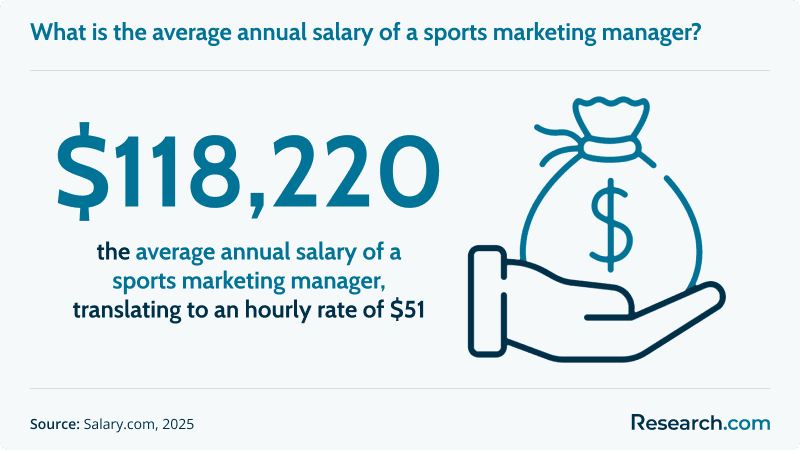
The average annual salary for a sports marketing manager is approximately $118,220. That figure is useful as a benchmark, but actual pay can vary widely based on employer type, market size, experience, performance record, and the revenue impact of the role.
Entry-level positions often start closer to the $51,000 range, while senior managers with a proven track record in major markets can earn upwards of $145,000 per year. Candidates should treat salary estimates as ranges rather than guarantees, especially because job titles in sports marketing are not standardized across teams, agencies, brands, and athletic departments.
The graphic below gives you a quick snapshot of the average.
Key factors that influence your salary
Several factors explain why compensation can differ so much from one sports marketing role to another:
- Level of competition: A marketing role with a major professional sports organization will often pay more than a similar role with a small college, minor league team, or local sports event company.
- Market size: Jobs in major media markets like New York or Los Angeles often come with higher pay expectations, although cost of living can also be higher.
- Revenue responsibility: Managers tied directly to sponsorship revenue, ticket sales, premium experiences, or large digital campaigns may have stronger earning potential.
- Experience and proven ROI: Employers value candidates who can show that their campaigns increased ticket sales, sponsorship revenue, merchandise sales, engagement, or brand reach.
- Specialized skills: Data analytics, paid media, sponsorship activation, CRM, and digital fan engagement can make a candidate more competitive.
It is also important to understand the “passion tax.” Because many people want to work in sports, some employers may offer lower salaries than comparable marketing roles in other industries. Before accepting an offer, compare the full package: salary, benefits, schedule expectations, relocation costs, advancement potential, and the quality of experience you will gain.
What is the job outlook for sports marketing managers?
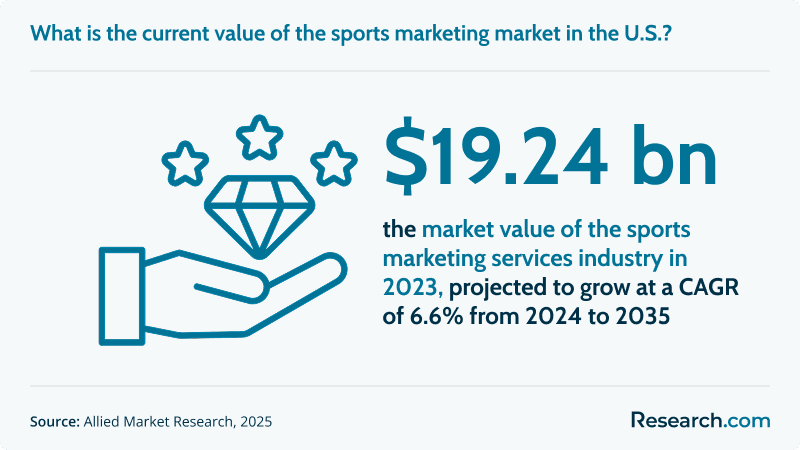
The job outlook for sports marketing managers is positive, but competitive. The U.S. sports marketing market was valued at over $19.24 billion and is projected to grow at a rate of 6.6% annually, signaling continued demand for professionals who can help sports organizations attract fans, sponsors, viewers, and digital audiences.
This graphic shows you the current market value.
A high-growth, high-competition field
Industry growth does not mean these jobs are easy to get. Sports marketing attracts candidates with business degrees, communications backgrounds, former athlete experience, agency experience, and strong personal interest in sports. Many entry-level openings receive attention from applicants who are willing to relocate, work long hours, and accept lower starting pay to enter the field.
Growth is being supported by league expansions, esports, collegiate athletics, digital media, sports betting, sponsorship innovation, and new fan engagement platforms. However, the best opportunities often go to candidates who bring more than enthusiasm. Employers want proof that you can execute campaigns, work cross-functionally, understand fan data, manage deadlines, and connect marketing activity to business outcomes.
To stand out, build experience before you need a full-time job. Internships, athletic department roles, agency projects, campus promotions, volunteer event work, and a portfolio of measurable campaigns can make a major difference.
What are the education requirements to become a sports marketing manager?
A bachelor's degree is the standard educational requirement for most sports marketing manager career paths. Common majors include marketing, business, communications, public relations, advertising, and sports management. Employers generally care most about whether you understand marketing fundamentals and can apply them in a sports or entertainment setting.
Data shows that this is the established path. Over 55% of professionals currently in the field hold a bachelor's degree, while another 37.5% have earned a master's degree, often to move into more senior leadership roles.
Choosing the right degree path
A sports management degree can be useful if it includes coursework in marketing, sponsorship, event management, sport law, sales, analytics, and internships. A marketing or business degree can be equally strong—sometimes stronger—if paired with sports-related experience. Communications degrees can also be valuable for roles focused on content, public relations, social media, and brand storytelling.
When comparing programs, look beyond the degree title. Stronger options usually offer:
- Internship access with teams, athletic departments, agencies, venues, or sports brands.
- Coursework in digital marketing, consumer behavior, analytics, sponsorship, and sales.
- Faculty or alumni with direct sports industry experience.
- Portfolio-building projects, case competitions, or live client work.
- Career services that understand the sports business job market.
Why experience can be more important than your major
Your degree may help you meet minimum qualifications, but practical experience is often what gets you interviews. Sports employers want evidence that you can handle deadlines, communicate professionally, manage events, support sponsors, and evaluate results.
A general business or marketing degree from a strong program, combined with multiple sports-related internships, can often be more compelling than a specialized sports management degree with no real-world experience. Students should aim to graduate with both a credential and a record of applied work.
For career changers or professionals targeting senior roles, a master's degree can help build specialized knowledge and signal commitment to the field. An accelerated online master's in sports management may be useful for those who need a condensed path to graduate-level credentials.
What skills do you need to succeed in sports marketing?
Sports marketing managers need both business discipline and creative judgment. Loving sports is not enough. The strongest candidates can interpret data, manage campaigns, collaborate with multiple departments, communicate with sponsors, and build fan experiences that support organizational goals.
Essential hard skills
These technical skills are especially important for resumes, interviews, and day-to-day performance:
- Data analysis: You should be able to evaluate campaign ROI, fan behavior, email performance, social engagement, ticketing trends, and sponsorship results.
- Digital marketing: This includes social media, email marketing, SEO, paid advertising, audience segmentation, landing pages, and campaign testing.
- Budget management: Managers often need to allocate spending, compare vendor costs, track campaign expenses, and explain whether the investment was worthwhile.
- Content creation: Strong writing, campaign messaging, visual judgment, and storytelling are essential for fan-facing promotions.
- Project management: Sports campaigns involve many moving parts, including creative assets, media buys, ticketing offers, sponsor approvals, event operations, and legal reviews.
- Sponsorship activation: Understanding how to turn a sponsorship agreement into visible, measurable fan experiences is a major advantage.
Because analytics has become central to sports business, some aspiring managers pursue the shortest sports analytics master's degree online to strengthen their competitive profile.
Crucial soft skills
Soft skills determine whether you can use your technical knowledge effectively in a high-pressure, public-facing industry:
- Communication: You need to write and speak clearly with executives, sponsors, fans, athletes, agencies, media teams, and internal departments.
- Adaptability: Sports are unpredictable. Injuries, losses, weather, viral moments, media issues, and schedule changes can force immediate adjustments.
- Relationship building: The industry depends heavily on trust, referrals, partnerships, and long-term professional networks.
- Creativity: Data can show what is happening, but creative thinking turns insight into campaigns that fans notice and remember.
- Composure: Game days, launches, sponsor events, and public campaigns can be stressful. Managers must make sound decisions under pressure.
The best professionals combine both skill sets: they can generate ideas, execute them reliably, and prove their impact.
Where can you work as a sports marketing manager?
Sports marketing jobs are not limited to famous professional teams. The industry includes leagues, colleges, agencies, brands, media companies, events, venues, technology firms, and esports organizations. Broadening your search can make it easier to enter the field and build experience.
Common employment settings include:
- Professional sports leagues and teams: These include organizations in the NFL, NBA, MLB, NHL, MLS, and other leagues. Roles may focus on ticketing, sponsorship, brand marketing, digital engagement, or fan experience.
- Collegiate athletic departments: Major NCAA universities operate large athletic departments with marketing needs similar to professional organizations, including promotions, sponsorships, attendance campaigns, and donor engagement.
- Sports marketing agencies: Agencies serve teams, leagues, athletes, events, and corporate brands. There are over 83 verified agencies in the U.S. alone, and agency work can expose you to multiple clients and campaign types.
- Corporate brands: Companies such as Nike, Pepsi, Toyota, and Anheuser-Busch use sports to reach customers through sponsorships, endorsements, events, advertising, and experiential marketing.
- Sports media companies: ESPN, Bleacher Report, regional sports networks, streaming platforms, and digital publishers need marketers to promote content, grow audiences, and support advertising revenue.
- Venues and event companies: Stadiums, arenas, tournaments, races, and special events need marketing professionals to drive attendance, partnerships, and fan experience.
Emerging opportunities in esports
Esports has become a significant career option for marketers who understand digital communities, streaming platforms, creator partnerships, live events, and younger fan audiences. Competitive gaming organizations need many of the same marketing functions as traditional sports: team branding, league promotion, sponsor activation, merchandise, fan engagement, and event marketing.
For candidates who want to enter this part of the industry, esports business programs online can provide focused training in the commercial side of competitive gaming. This path may be especially appealing to students who are comfortable with digital-first communities and fast-changing media platforms.
How do you get started on a sports marketing career path?
Getting started in sports marketing requires more than earning a degree and submitting applications. The strongest candidates build a record of relevant experience, professional relationships, and completed work before they pursue manager-level roles.
A common first step is earning a relevant undergraduate degree. A flexible sports management bachelor's degree online can fit students who need an accessible route into the field, but the degree should be paired with hands-on marketing experience.
Key steps include:
- Gain hands-on experience: Pursue internships, volunteer roles, campus athletic department positions, part-time event jobs, or work with local teams, youth sports organizations, minor league clubs, and nonprofits. Experience is often the deciding factor for entry-level hiring.
- Build marketing fundamentals: Learn campaign planning, copywriting, email marketing, social media strategy, paid media basics, sponsorship activation, CRM tools, and analytics reporting.
- Create a portfolio: Save examples of campaign plans, social posts, email campaigns, sponsorship proposals, event recaps, analytics reports, class projects, and internship work when you are allowed to share them.
- Network consistently: Connect with alumni, internship supervisors, professors, agency professionals, and people working for teams or athletic departments. Ask for advice and insight, not immediate job favors.
- Be open to entry points: Jobs in ticket sales, promotions, fan experience, event operations, or social media can lead to marketing roles if you perform well and build internal relationships.
The power of networking in a relationship-driven industry
Many sports jobs are filled through referrals, internal recommendations, or candidates already known to the organization. Networking does not mean asking strangers for jobs. It means building genuine professional relationships over time.
Start by requesting short informational conversations. Ask professionals how they entered the field, what skills matter most, what mistakes to avoid, and what entry-level roles provide the best foundation. Follow up professionally, share updates when appropriate, and look for ways to be helpful. When opportunities open, people are more likely to remember candidates who showed curiosity, reliability, and respect.
What does a typical career path for a sports marketing manager look like?
A sports marketing career usually progresses from execution-focused roles to planning, management, and strategy. Advancement is rarely perfectly linear. Many professionals move between teams, agencies, schools, brands, or media companies to gain broader experience or take on larger responsibilities.
A typical progression may look like this:
- Entry-level: Marketing Assistant, Marketing Coordinator, Promotions Assistant, Social Media Coordinator, Ticket Sales Representative, or Game Presentation Assistant. These roles focus on execution, scheduling, content support, event work, and campaign logistics.
- Early to mid-level: Marketing Specialist, Digital Marketing Specialist, Sponsorship Coordinator, Fan Engagement Coordinator, or Assistant Marketing Manager. Professionals begin owning parts of campaigns and reporting on results.
- Mid-level: Marketing Manager. At this stage, you may plan campaigns, manage budgets, supervise vendors or junior staff, coordinate cross-functional teams, and present performance results.
- Senior-level: Senior Marketing Manager or Director of Marketing. These roles involve larger budgets, staff leadership, annual planning, sponsor strategy, brand oversight, and executive reporting.
- Executive-level: Vice President of Marketing or Chief Marketing Officer (CMO). These leaders set overall marketing strategy and connect marketing to revenue, brand growth, fan development, and organizational priorities.
Specialist vs. generalist paths
Sports marketers can advance as specialists or generalists. The specialist path means becoming highly skilled in one valuable area, such as sponsorship activation, paid media, CRM, analytics, social strategy, or brand partnerships. This can be a strong route if you want to become known for a high-demand capability.
The generalist path involves gaining experience across multiple functions, including promotions, content, events, sponsorship, ticketing, research, and digital marketing. This path can prepare professionals for director and executive roles because senior leaders must understand how all revenue and engagement functions connect.
Early in your career, execution matters most. As you advance, employers will evaluate your ability to manage people, budgets, vendors, strategy, and measurable business outcomes.
What are the advancement opportunities for sports marketing managers?
Sports marketing managers can advance into senior marketing leadership, broader business roles, consulting, agency leadership, or specialized revenue-focused positions. The best advancement opportunities usually go to professionals who can connect marketing work to fan growth, sponsorship value, sales performance, and brand strength.
The most direct path is upward within marketing: Senior Marketing Manager, Director of Marketing, Vice President of Marketing, and Chief Marketing Officer (CMO). However, sports marketing experience can also lead to roles in business operations, partnerships, revenue strategy, fan experience, digital product, or general management.
Some professionals eventually launch consulting practices or agencies, especially after building a strong network and a record of successful campaigns. Consulting can offer flexibility and variety, but it also requires client development, financial discipline, and a clear specialty.
Advancing through specialization
Specialization can accelerate advancement when the specialty matches where the industry is moving. Data-driven marketing, fan analytics, sponsorship measurement, digital monetization, and audience segmentation are increasingly important because organizations want to understand which campaigns produce measurable returns.
Professionals interested in analytics-heavy leadership should explore the range of careers with a master's in sports analytics. These pathways may extend beyond traditional marketing into sports betting, technology, fan intelligence, business strategy, and digital revenue roles.
Advancement depends on more than tenure. To move up, document results, learn to present business cases, manage teams well, and build credibility with executives, sponsors, and revenue departments.
Is a career in sports marketing worth it?
A career in sports marketing can be worth it for people who want a business career in a high-energy, fan-driven industry and are comfortable with competition, irregular schedules, and performance pressure. It is less ideal for someone who wants predictable hours, a low-stress environment, or guaranteed rapid advancement.
The decision comes down to whether the rewards of working in sports outweigh the trade-offs.
The key rewards
- Passion and profession can align: You can apply marketing skills to teams, events, athletes, brands, and fan communities you care about.
- The work is dynamic: Campaigns often connect to live events, cultural moments, sponsorship launches, and fast-moving digital conversations.
- You can see the impact of your work: A strong campaign may show up in ticket demand, merchandise sales, sponsor satisfaction, attendance, engagement, or fan sentiment.
- The industry builds strong networks: Sports organizations often create close professional communities that can support long-term career movement.
The key challenges
- Schedules can be demanding: The work calendar follows the sports calendar, which often means nights, weekends, holidays, and long event days.
- Competition is intense: Many qualified people want these roles, so experience, networking, and measurable results matter.
- The “passion tax” is real: Some starting salaries may be lower than comparable marketing jobs in other industries because demand for sports roles is high.
- Performance pressure is visible: Marketing results may be judged by executives, sponsors, fans, media, and revenue teams.
This career is most likely to be worth it if you enjoy fast-paced work, can handle public-facing pressure, and are committed to building business skills—not just working near sports.
Here's What Sports Marketing Managers Have to Say About Their Careers
- Sydney: "As a sports marketing manager, my role is intensely results-driven, which is incredibly satisfying. I recently led a campaign that boosted merchandise sales by 20% quarter-over-quarter through targeted digital activations. The challenge of merging creative vision with hard data to directly impact the bottom line is what makes this job exciting and keeps me motivated every day."
- Javier: "The best part of being a sports marketing manager is feeling the direct connection to the fans and the community. I get to shape the stories that create powerful emotional bonds, and I find a lot of personal fulfillment in making the game day experience unforgettable for thousands of people. The professional fulfillment of executing a major brand partnership from concept to stadium reality is amazing."
- Kenji: "My work as a sports marketing manager is all about rapid innovation and strategic problem-solving. We're constantly navigating the fast-paced landscape of media rights, player endorsements, and new revenue streams, often managing budgets that exceed $5 million. I thrive on the complex analytical decisions and the high-stakes environment of growing a global athletic brand."
Key Findings
- A sports marketing manager leads campaigns that grow fan engagement, sponsorship value, ticket demand, merchandise interest, and brand visibility.
- The average annual salary for a sports marketing manager is approximately $118,220, with entry-level positions often closer to the $51,000 range and senior managers in major markets earning upwards of $145,000 per year.
- The U.S. sports marketing market was valued at over $19.24 billion and is projected to grow at a rate of 6.6% annually, but the field remains highly competitive.
- A bachelor's degree is the standard educational requirement. Over 55% of professionals currently in the field hold a bachelor's degree, while another 37.5% have earned a master's degree.
- Experience is often the deciding factor. Internships, campus athletic department work, agency projects, volunteer event roles, and portfolio samples can help candidates stand out.
- The most valuable skills include data analysis, digital marketing, sponsorship activation, content creation, budget management, communication, adaptability, and relationship building.
- Sports marketing jobs exist across professional teams, collegiate athletic departments, agencies, corporate brands, media companies, venues, events, and esports organizations.
- The career can be rewarding for people who enjoy sports, business strategy, live events, and fan communities, but it often requires long hours, resilience, and a willingness to compete for opportunities.
Other Things You Need To Know About Sports Marketing Managers
In 2027, a sports marketing manager primarily focuses on digital campaigns, brand partnerships, and fan engagement. They leverage data analytics to maximize market reach and collaborate closely with sports teams to enhance brand visibility both online and offline.
Sports marketing managers need strong skills in CRM platforms, email marketing tools, social media analytics, and spreadsheet software. Many employers also expect familiarity with data dashboards such as Tableau or Power BI, plus basic project management tools like Asana or Monday.com to track campaigns, sponsors, and event timelines.
References
- Campbellsville University. (n.d.). What does a sports marketing manager do? Retrieved from https://www.campbellsville.edu/online/degrees/business/sports-management/what-does-a-sports-marketing-manager-do/
- LSU Online & Continuing Education. (n.d.). Sports marketing manager: Roles and responsibilities. Retrieved from https://online.lsu.edu/newsroom/articles/sports-marketing-manager-roles-and-responsibilities/
- Maryville University. (n.d.). What does a sports marketing manager do? A look at duties and qualifications. Retrieved from https://online.maryville.edu/blog/what-does-a-sports-marketing-manager-do/
- Sports Management Degree Guide. (n.d.). How to become a sports marketing manager: Salary, job outlook & more. Retrieved from https://www.sports-management-degrees.com/job-profiles/sports-marketing-manager/
- U.S. Bureau of Labor Statistics. (2024, September 4). Occupational outlook handbook: Advertising, promotions, and marketing managers. Retrieved from https://www.bls.gov/ooh/management/advertising-promotions-and-marketing-managers.htm


