
2027 Ultrasound Travel Tech Careers: Skills, Education, Salary & Job Outlook

Co-Founder and Chief Data Scientist
Choosing an ultrasound travel tech career means weighing two big questions: whether you can meet the training and credentialing expectations, and whether the travel lifestyle fits how you want to work. This path is not an entry-level shortcut into healthcare. It requires sonography education, strong anatomy and imaging knowledge, clinical experience, and credentials such as ARDMS or ARRT before most employers will consider you for travel assignments.
For the right candidate, however, the payoff can be substantial. Ultrasound travel tech careers combine diagnostic imaging, patient care, and geographic flexibility in a field where demand remains strong. Reported pay averages $2,435 per week, and job growth is projected at 10% through 2032, faster than many healthcare roles. This guide explains what ultrasound travel technicians do, what qualifications they need, how much they can earn, where the work is headed, and how to decide whether this career fits your goals, temperament, and long-term plans.
Key Things You Should Know About Ultrasound Travel Tech Career
- The average national annual salary for a travel ultrasound technologist is about $126,672, with weekly earnings near $2,436, though pay can vary significantly by location.
- This career is growing steadily across the country, with employment expected to increase by 10% from 2022 to 2032, indicating strong job stability and expansion.
- An associate's degree in diagnostic medical sonography or a related field is typically required, along with passing a national certification exam like those offered by ARDMS.
- Success depends on skills such as operating ultrasound equipment proficiently, having a strong foundation in anatomy and physiology, applying critical thinking, maintaining attention to detail, and communicating well with patients.
- Career advancement can lead from staff technologist roles to lead sonographer or department supervisor, with options to specialize or move into education, training, or management positions.
What do Ultrasound Travel Technicians do?
Ultrasound travel technicians are diagnostic medical sonographers who take temporary assignments in facilities that need short-term imaging support. They use ultrasound equipment to create images of internal organs, blood flow, tissues, pregnancies, and other structures so physicians can evaluate, diagnose, and monitor medical conditions.
The “travel” part of the job is what makes this career different from a permanent staff sonography role. Instead of working for one hospital or clinic long term, travel techs move between assignment locations. They may fill staffing gaps, support busy departments, cover leaves, or help facilities in areas with limited imaging personnel.
A day in the life of Ultrasound Travel Technicians
A typical shift may include reviewing orders, checking patient histories, preparing the exam room, explaining procedures, positioning patients, performing scans, documenting images, and communicating urgent findings according to facility protocol. The work is highly hands-on and often fast-paced.
Travel ultrasound techs must also learn new systems quickly. Each facility may use different machines, reporting software, workflows, patient volume expectations, and physician preferences. Strong travel techs know how to ask the right questions early, follow local protocols, and still maintain consistent imaging quality.
This role is best suited for sonographers who are clinically confident, organized, calm with patients, and comfortable entering unfamiliar environments. It is less ideal for professionals who need a fixed routine, a long-term team structure, or minimal schedule disruption.
What are the key responsibilities of Ultrasound Travel Technicians?
The core responsibility of an ultrasound travel technician is to produce accurate diagnostic images while protecting patient safety and following the standards of the facility where they are assigned. Because travel techs are expected to contribute quickly, they must combine strong sonography technique with adaptability and professional judgment.
- Operate, adjust, and calibrate ultrasound equipment to capture clear diagnostic images.
- Review orders, patient histories, and relevant clinical information before the exam.
- Prepare exam rooms, equipment, and supplies while maintaining cleanliness and infection-control standards.
- Explain procedures to patients, answer basic questions within scope, and help reduce anxiety.
- Position patients correctly and adapt scanning techniques to body type, symptoms, mobility, and clinical need.
- Apply ultrasound gel and select appropriate transducers, presets, and imaging settings.
- Identify normal and abnormal image patterns and obtain the views needed for physician interpretation.
- Document images and technical notes accurately in the facility’s reporting system.
- Communicate urgent or unexpected findings to physicians or supervising clinicians according to protocol.
- Adjust quickly to new departments, equipment, policies, and team expectations during each assignment.
The most challenging vs. the most rewarding tasks
The hardest part of the job is usually not the scanning itself. It is performing at a high level while learning a new workplace, managing unfamiliar equipment, and keeping pace with patient volume. Travel techs often have less ramp-up time than permanent employees, so they must be prepared to work independently while still respecting local procedures.
The most rewarding moments come when imaging directly supports timely care. A clear scan can help detect a life-threatening condition, confirm a pregnancy concern, guide next steps in treatment, or give a patient and care team crucial information. For professionals who want a career that blends healthcare technology with direct patient impact, ultrasound travel work can be deeply meaningful.
If you are still comparing education routes across healthcare and technical fields, this list of college majors and careers can help you evaluate how sonography fits with related career options.

What are the key skills for Ultrasound Travel Technicians?
Ultrasound travel technicians need more than the ability to run a machine. They must produce diagnostic-quality images, communicate with anxious or uncomfortable patients, and integrate into a new clinical team quickly. The strongest candidates combine technical accuracy with professional maturity.
Hard skills
- Diagnostic ultrasound operation: Using ultrasound systems, transducers, presets, Doppler tools, and image optimization techniques for abdominal, vascular, OB/GYN, cardiac, and other exams as applicable.
- Anatomy and pathology recognition: Understanding normal anatomy, common abnormalities, and the views physicians need for interpretation.
- Real-time image assessment: Adjusting depth, gain, focus, angle, and patient positioning during the exam to improve image quality.
- Patient preparation and exam workflow: Confirming the correct patient and procedure, reviewing history, and adapting the scan to clinical indications.
- Equipment care and troubleshooting: Recognizing equipment issues, maintaining probes and accessories, and knowing when to escalate technical problems.
- Documentation: Capturing required images, recording technical impressions where appropriate, and following facility reporting standards.
Soft skills
- Clear communication: Explaining procedures in plain language and coordinating efficiently with physicians, nurses, and imaging staff.
- Active listening: Understanding patient concerns and gathering details that may affect the exam.
- Critical thinking: Responding appropriately when symptoms, anatomy, or image findings do not match expectations.
- Attention to detail: Preventing avoidable errors in imaging, documentation, patient identification, and exam selection.
- Professional composure: Staying calm during urgent cases, schedule pressure, or difficult patient interactions.
- Independence: Working with limited supervision while still following the chain of command and facility protocols.
The one overlooked skill that separates the good from the great
Adaptability is the skill that most often separates average travel techs from high-performing ones. A permanent sonographer may have months or years to master one department’s routines. A travel sonographer may need to become productive within days.
Adaptability means learning equipment quickly, asking precise questions, documenting according to local expectations, and building trust without overstepping. For example, a tech who can quickly understand a department’s workflow and physician preferences can prevent delays, reduce repeat imaging, and improve the patient experience.
For readers still planning an education pathway, reviewing what's the easiest bachelor's degree may help clarify how bachelor’s-level options compare with other routes, though sonography itself requires serious clinical and technical preparation.
Ultrasound Travel Tech Careers: A Step-by-Step Guide to Getting Started
Becoming a travel ultrasound technician usually takes several stages: education, clinical training, credentialing, staff experience, and then travel placement. The order matters because travel employers typically expect candidates to be competent enough to work with limited orientation.
- Build a science-focused academic foundation. Start with coursework that strengthens biology, anatomy, physiology, math, and communication skills. These subjects support later sonography training and patient care.
- Complete a formal diagnostic medical sonography program. Choose a program that combines classroom instruction, lab practice, and supervised clinical experience. Program quality and accreditation are important because they can affect credentialing eligibility and employer confidence.
- Gain hands-on clinical experience. Clinical rotations, internships, and entry-level roles help you develop scanning speed, patient interaction skills, and confidence with real cases.
- Earn professional certification. Most employers prefer or require recognized credentials. Certification signals that you meet professional standards in a specialty area.
- Work in a permanent or staff role first. Many travel positions are not designed for new graduates. Staff experience helps you learn department flow, handle difficult exams, and build the judgment needed for travel assignments.
- Apply through travel staffing agencies or direct employers. Once you meet education, credential, and experience expectations, compare assignment length, pay package, location, shift, housing arrangements, benefits, and cancellation terms.
- Keep records organized. Maintain copies of credentials, licenses if applicable, immunizations, health screenings, references, continuing education, and employment history so you can move quickly when assignments open.
The main mistake to avoid is rushing into travel work before you are clinically ready. Travel assignments can pay well, but they also assume independence. Building a strong foundation first makes you safer, more marketable, and more likely to receive repeat contracts.
What education, training, or certifications are required?
The most common educational routes for ultrasound travel technicians are an Associate of Science in Diagnostic Medical Sonography or a Bachelor of Science with a sonography focus. Employers commonly look for training from programs accredited by CAAHEP or JRC-DMS because accreditation helps demonstrate that the program meets recognized clinical and academic standards.
Credentialing is also central to employability. The Registered Diagnostic Medical Sonographer (RDMS) credential, issued by the American Registry for Diagnostic Medical Sonography (ARDMS), is one of the key credentials in the field. Additional credentials such as Registered Diagnostic Cardiac Sonographer (RDCS) and Registered Vascular Technologist (RVT) can broaden the types of assignments a tech may qualify for.
Clinical training is not optional. Clinical rotations lasting 6 to 12 months are a core on-the-job training requirement, and many programs also require documented observation hours before admission. After completing a degree, most travel positions require at least one year of full-time clinical experience before a candidate is considered ready for travel work.
Are advanced degrees or niche certifications worth the investment?
Advanced degrees can be worthwhile if your long-term goal is leadership, education, research, or a more specialized clinical role. A Bachelor's or Master's in Diagnostic Medical Sonography may strengthen your qualifications beyond bedside scanning and help position you for supervisory, teaching, or administrative responsibilities.
Specialty certifications can also be valuable. Credentials in cardiac, vascular, OB/GYN, musculoskeletal, or other focused areas may make you more competitive for certain assignments, especially when facilities need a specific skill set.
However, advanced education is not always the fastest or most cost-effective path into travel sonography. Many travel jobs focus first on accredited sonography training, primary certification, and proven clinical experience. Before committing to a higher degree or niche credential, compare the cost, time, assignment demand, and your preferred specialty. If you are beginning with cost in mind, researching the cheapest associate degrees online can help you think through affordability, though sonography programs must also meet clinical training and accreditation expectations.
What is the earning potential for Ultrasound Travel Technicians?
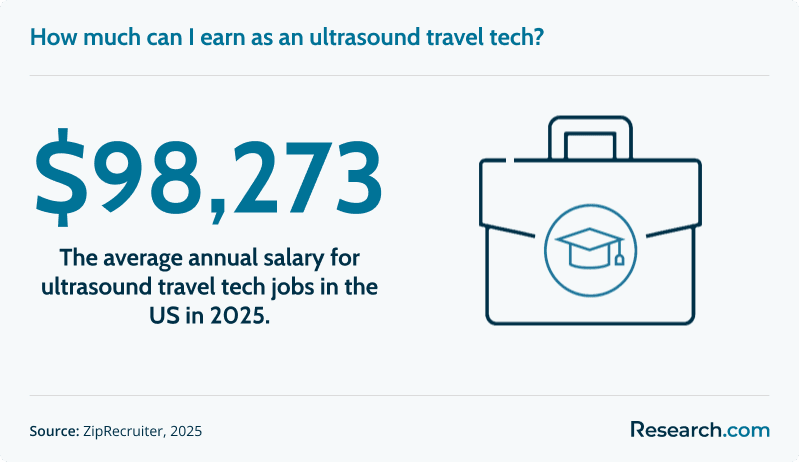
The earning potential for ultrasound travel technicians can be strong, but pay varies widely by location, specialty, shift, experience, agency, and assignment urgency. The median annual salary for a Travel Registered Ultrasound Technologist is $126,672. The ultrasound travel tech salary range 2025 runs from about $99,840 for entry-level positions to as high as $203,448 for senior roles.
These figures should be treated as planning benchmarks, not guarantees. Travel compensation may include a mix of taxable wages and other package components depending on the employer and assignment. Always compare the full offer rather than looking only at the advertised weekly number.
What affects pay the most?
- Location: High-demand markets and higher-cost metro areas may offer stronger rates. Seattle, WA, Jersey City, NJ, and large metropolitan areas in California are examples of locations that often provide premium pay rates.
- Specialty: Cardiac, vascular, and other specialized sonography skills can improve competitiveness for certain higher-paying assignments.
- Experience level: Senior techs who can work independently across multiple exam types are often more attractive to travel employers.
- Shift and urgency: Nights, weekends, hard-to-fill roles, and short-notice needs may affect compensation.
- Agency or employer terms: Benefits, housing support, cancellation policies, reimbursements, and contract structure can change the real value of an offer.
Before accepting an assignment, calculate expected take-home pay, housing costs, travel expenses, benefits, licensing costs if applicable, and gaps between contracts. A higher headline rate may not be the best choice if the location is expensive or the contract terms are weak.
What is the job outlook for Ultrasound Travel Technicians?
The job outlook for ultrasound travel technicians is favorable because the broader diagnostic medical sonography field continues to grow. Employment of diagnostic medical sonographers, including ultrasound travel technicians, is projected to grow 13% from 2024 to 2034, much faster than the average for all occupations at about 3%.
This demand is supported by several durable healthcare trends. Ultrasound is noninvasive, widely used, and valuable across hospitals, outpatient centers, physician offices, and diagnostic labs. As facilities manage patient volume and staffing shortages, travel sonographers can help fill temporary gaps.
The key factors shaping the future outlook
- Aging population: More older adults generally means more diagnostic testing and monitoring, which supports demand for imaging professionals.
- Shift toward outpatient care: As more services move outside the hospital, ultrasound roles may expand in outpatient centers and physician practices.
- Technology improvements: AI integration, higher resolution imaging, and portable devices are changing how ultrasound services are delivered, but skilled professionals remain necessary to perform exams, assess image quality, and support clinical interpretation.
- Regional staffing shortages: Facilities in underserved or hard-to-staff areas may rely on travel techs to maintain service coverage.
- Specialization: Techs with credentials and experience in high-demand specialties may have more assignment options.
Students preparing for this field should prioritize accredited, reputable training and strong clinical preparation. If you are comparing flexible education options, the best accredited non profit online colleges may be useful for general planning, but sonography training still requires hands-on clinical components.
What is the typical work environment for Ultrasound Travel Technicians?
Ultrasound travel technicians work in clinical environments where diagnostic imaging is needed. Common settings include hospitals, clinics, diagnostic laboratories, outpatient centers, and sometimes mobile or temporary care locations. Most diagnostic medical sonographers work in hospitals, about 60%, followed by offices of physicians at 20% and medical and diagnostic laboratories at 11%.
The work is physical and patient-facing. Techs may spend much of the shift standing, moving equipment, assisting patients with positioning, and scanning in ergonomically challenging positions. Because exams are hands-on, remote or hybrid work is generally not feasible.
Schedule and team structure
Travel ultrasound techs often work full-time schedules during assignments. Depending on the facility, shifts may include days, evenings, nights, weekends, holidays, or call coverage. Hospital assignments may be less predictable than outpatient roles because urgent imaging needs can arise at any time.
Although many exams are performed independently, the role still requires regular collaboration. Travel techs coordinate with radiologists, physicians, nurses, transport staff, schedulers, and other imaging professionals. The ability to fit into a team quickly is one of the most important parts of succeeding in a travel environment.
What are the pros and cons of Ultrasound Travel Technician careers?
Ultrasound travel tech careers can offer high flexibility and strong earning potential, but they also require resilience. The best fit is someone who enjoys clinical variety, can tolerate uncertainty, and is comfortable being the “new person” repeatedly.
Pros
- Varied work environments: Moving between facilities can strengthen clinical range and prevent routine from becoming stagnant.
- Potentially strong compensation: Travel roles may offer attractive pay compared with some permanent positions, depending on assignment and location.
- Flexibility: Techs may be able to choose assignments based on geography, schedule, specialty, or personal goals.
- Professional growth: Exposure to different equipment, workflows, patient populations, and physicians can sharpen skill and confidence.
- Travel opportunities: Assignments can make it possible to experience new cities and regions while working in healthcare.
Cons
- Frequent adjustment: New protocols, equipment, teams, and documentation systems can create stress, especially early in an assignment.
- Unpredictability: Contracts can vary, and gaps between assignments may affect income planning.
- Relocation strain: Moving often can be isolating and may complicate family, housing, and social routines.
- Demanding patient care: Sonographers may work with anxious, ill, or uncomfortable patients and must remain professional under pressure.
- Ongoing learning requirements: Maintaining credentials and keeping up with evolving imaging practices requires continuous effort.
Before entering this field, consider your tolerance for change, your financial cushion between contracts, and your ability to work independently. If you are still exploring degree affordability in healthcare or related fields, reviewing the cheapest online bachelor programs may help you compare broader education options.
What are the opportunities for advancement for Ultrasound Travel Technicians?
Advancement for ultrasound travel technicians can happen in several ways: deeper specialization, higher-level travel assignments, leadership roles, education, clinical applications, or management. The best path depends on whether you want to keep scanning, lead teams, teach, or move toward industry roles.
Advancement paths for Ultrasound Travel Techs
- Entry-Level Ultrasound Travel Technician: Qualify for travel-based diagnostic imaging roles after completing the necessary education, clinical training, and credentials such as RDMS, RDCS, or RVT.
- Experienced Travel Sonographer: Build a record of successful assignments, strong references, and competency across multiple exam types.
- Senior or Lead Ultrasound Technologist: Take on mentoring, quality review, workflow support, or training responsibilities.
- Supervisor or Department Manager: Move into roles such as supervisor, department manager, or ultrasound lab director to oversee operations, staffing, compliance, and quality standards.
- Educator or Clinical Trainer: Teach students, train new hires, or support continuing education for sonography teams.
- Clinical Applications Specialist: Work with ultrasound equipment companies to train clinicians, support product use, and connect technical knowledge with clinical practice.
Specialization opportunities to enhance your career
Specialization can improve assignment options and make a travel tech more valuable to facilities with specific imaging needs. Common areas include cardiovascular, vascular, OB/GYN, musculoskeletal, and neurosonography.
- Cardiac Sonography (Echocardiography): May involve credentials such as Advanced Cardiac Sonographer (ACS) or Registered Cardiac Sonographer (RCS).
- Vascular Sonography: The Registered Vascular Technologist (RVT) credential supports expertise in blood vessel imaging.
- Obstetric/Gynecologic (OB/GYN) Sonography: Focuses on prenatal imaging and women’s health.
- Musculoskeletal Sonography: May be supported by credentials such as Registered Musculoskeletal Sonographer (RMSKS).
- Neurosonography: Can involve specialized training or neurosonography certificates.
To advance strategically, track which assignments are most in demand, which credentials employers request, and which work settings you enjoy. The strongest long-term career plan balances market demand with the type of patient care and schedule you want.
What other careers should you consider?
If ultrasound travel tech careers interest you, it is worth comparing nearby roles before committing to a training path. Related imaging and clinical technology careers may offer similar patient care, technical work, or mobility with different education, credentialing, and work environment expectations.
- MRI Technologist: Uses magnetic resonance imaging equipment to produce detailed images. This role may appeal to those who want advanced imaging work with less operator-dependent scanning than ultrasound.
- X-Ray Technologist: Operates radiologic equipment for diagnostic imaging. It can be a good fit for students who want a broader entry point into medical imaging.
- Vascular Technologist: Focuses on blood flow and vascular imaging. This is closely related to ultrasound and may suit professionals who want a specialized diagnostic role.
- Clinical Application Specialist: Trains healthcare professionals on imaging equipment and workflows. This path can be attractive for experienced sonographers who enjoy teaching, technology, and travel but want less direct patient scanning.
- Research Sonographer: Supports diagnostic imaging research, study protocols, and clinical coordination. This option fits sonographers interested in investigation, data quality, and innovation.
When comparing careers, look beyond salary. Consider how much patient contact you want, whether you prefer fixed or changing locations, how much physical work you can sustain, and how comfortable you are with certification and continuing education. A strong career choice should match both your skills and your preferred lifestyle.
Here's What Professionals Say About Their Ultrasound Travel Tech Careers
- : "“Working as a travel ultrasound tech means I witness some of the most delicate moments in a patient's life. Every scan I perform is crucial—helping doctors pinpoint issues and decide next steps, which makes me feel deeply connected to their care. The mix of locations and varied patient needs keeps me engaged and pushes me to refine my skills constantly. It's incredible to see how much I grow both personally and professionally with each assignment.” — Danica"
- : "“Adjusting to a new hospital's workflow every few months isn't easy; every place has its quirks and team dynamics. At first, I felt overwhelmed learning different protocols and equipment setups, but I quickly learned that asking the right questions and being flexible are key. Over time, the anxiety fades as I settle in and remember that adapting fast is what makes me valuable. Those challenges have made me more confident and versatile as a technician.” — Darnell"
- : "“One moment I'll never forget is when a patient hugged me after I detected a dangerous blood clot during a routine scan. She said I saved her life, and those words hit me harder than any stress from the job. Knowing my skills can make such a direct impact keeps me motivated despite the unpredictable schedule and new environments. The gratitude from patients and earning the trust of different care teams are what make all the challenges worth it.” — Luciana"
Key Findings
- Ultrasound travel technicians are diagnostic medical sonographers who take temporary assignments in hospitals, clinics, diagnostic labs, outpatient centers, and related care settings.
- The role requires formal sonography education, clinical training, professional credentialing, and usually at least one year of full-time clinical experience before travel assignments are realistic.
- Common credentials include RDMS through ARDMS, with RDCS and RVT supporting cardiac and vascular opportunities.
- The median annual salary for a Travel Registered Ultrasound Technologist is $126,672, with the ultrasound travel tech salary range 2025 running from about $99,840 to as high as $203,448.
- Employment of diagnostic medical sonographers, including ultrasound travel technicians, is projected to grow 13% from 2024 to 2034, compared with about 3% for all occupations.
- The best candidates are technically strong, adaptable, communicative, detail-oriented, and comfortable working in new clinical environments.
- Major advantages include flexibility, travel, varied clinical experience, and strong earning potential; major drawbacks include relocation stress, changing protocols, and unpredictable assignment conditions.
- Advancement can come through specialization, lead roles, department management, education, or clinical applications work.
Other Things You Should Know About Ultrasound Travel Tech
Yes, many assignments require an active license in the state where you work, and some states add separate rules for sonographers. Employers and staffing agencies also ask for ARDMS or ARRT certification, BLS, immunizations, and recent clinical experience before placement.
In 2027, ultrasound travel techs can expect to earn between $70,000 and $90,000 annually, depending on factors such as location, experience, and specific employer benefits. High-demand areas may offer higher compensation, including per diem allowances for travel-related expenses.
In 2027, ultrasound travel techs are typically required to have ARDMS certification. This involves passing exams such as the SPI and a specialty area test like Abdomen. Specific hospital contracts may demand additional credentials or state licensure.
References
- What Are the Pros and Cons of Being a Sonographer? | Vivian Community Hub https://www.vivian.com/community/allied-health/pros-and-cons-of-being-a-sonographer/
- How To Become a Travel Ultrasonographer | Host Healthcare https://www.hosthealthcare.com/blog/how-to-become-a-travel-sonographer/
- Travel Ultrasound Tech Jobs | Anders Group Top Medical Staffing Firm https://www.andersgroup.org/travel-ultrasound-tech
- Day In The Life of a Travel Ultrasound Clinician https://epictravelstaffing.com/travel-allied/day-in-the-life-of-a-travel-ultrasound-clinician/
- Essential Ultrasound Tech Requirements & Education https://www.hctravelnursing.com/blog/ultrasound-tech-requirements-education
- Becoming a Travel Ultrasound Travel Tech: Qualifications, Salary, & FAQ https://www.trustedtalent.com/ultrasound-travel-tech/
- Travel Ultrasound Tech: Heidy’s Journey (Q&A) https://stafflucid.com/blog/travel-ultrasound-tech-real-experience/
- How to Become a Travel Ultrasound Tech: Start Your Career https://www.crosscountry.com/blog/how-to-become-a-travel-ultrasound-technician
- Travel Ultrasound Tech Review: Lanceâs Advantis Medical Journey https://advantismed.com/blog/a-travel-ultrasound-techs-journey
- Sonographer | Explore Careers | National Careers Service https://nationalcareers.service.gov.uk/job-profiles/sonographer


