
2027 Best ABSN Programs - Accelerated BSN Programs in Virginia: Online & Campus

Co-Founder and Chief Data Scientist
Accelerated BSN programs in Virginia are designed for people who already have a bachelor's degree in another field and want to become registered nurses without completing a second traditional four-year degree. They are fast, academically demanding, and often expensive, so choosing the right program requires more than comparing tuition or looking for the quickest start date.
This guide explains how online, hybrid, and campus-based accelerated BSN programs in Virginia work, who qualifies, what admission committees usually expect, how clinical training is handled, and what to consider before enrolling. It also covers accreditation, cost, financial aid, career paths, salary factors, ABSN versus ADN options, and common mistakes that can delay licensure or increase debt.
Virginia shows a growing demand for registered nurses, with employment projected to increase by 12% over the next decade. That demand makes nursing an appealing career-change option, but an ABSN is still a major commitment. The goal is not simply to find a fast program; it is to choose one that prepares you for NCLEX-RN eligibility, clinical practice, and long-term career growth.
Key Benefits of ABSN Programs in Virginia
Quick Answer: Are Accelerated BSN Programs in Virginia Worth Considering?
An accelerated BSN in Virginia can be a strong choice if you already hold a non-nursing bachelor's degree, have completed the required science prerequisites, and can commit to an intensive full-time nursing curriculum. Most programs are built to move students quickly from prior college experience into nursing coursework, simulation labs, clinical rotations, and NCLEX-RN preparation.
It may not be the best fit if you need to work full time, have not finished prerequisites, are unsure about nursing as a career, or have not verified that the program is approved by the Virginia Board of Nursing. Before applying, compare accreditation, clinical placement support, total cost, NCLEX preparation, schedule intensity, and whether the format fits your life.
- Who is eligible for accelerated BSN programs in Virginia?
- What do Virginia ABSN programs usually require for admission?
- Do applicants need TEAS, HESI, GRE, or other entrance exams?
- What will you study in an accelerated BSN curriculum?
- Which accreditation and approvals matter most?
- How long does an ABSN take in Virginia?
- How much should you budget for an accelerated BSN?
- What financial aid can ABSN students use?
- What nursing careers can ABSN graduates pursue?
- What affects RN salary after an ABSN in Virginia?
- What should you learn from graduate experiences?
- What do Virginia ABSN graduates say about the experience?
- How does an ABSN compare with an ADN?
- Is an ABSN a useful path toward an MSN?
- What challenges should students expect?
- Can you work while enrolled in an ABSN?
- References
Who can apply for accelerated BSN programs in Virginia?
Accelerated Bachelor of Science in Nursing programs in Virginia are primarily intended for students who already earned a bachelor's degree in a field other than nursing. Instead of repeating general education requirements, students move into a concentrated nursing sequence that combines classroom learning, lab practice, clinical rotations, and licensure preparation.
Typical applicants include career changers from education, business, science, public service, communications, psychology, and other fields. Recent graduates who realized they want a healthcare career may also use an ABSN to enter nursing faster than they could through a traditional BSN pathway.
The strongest candidates usually have solid grades in prerequisite science courses, realistic expectations about the pace, and a clear reason for entering nursing. Motivation matters, but it is not enough on its own. ABSN students need strong study habits, emotional resilience, comfort with patient care, and the ability to manage long blocks of coursework and clinical time.
An ABSN can also be a foundation for advanced nursing roles later. For example, students who eventually want psychiatric advanced practice work may benefit from understanding psychiatric nurse practitioner career and salary pathways before choosing their first nursing degree.
Who should consider a Virginia ABSN?
| Student profile | Why an ABSN may fit | What to confirm first |
| Career changer with a completed bachelor's degree | The program uses prior college experience to shorten the path into professional nursing. | Check prerequisite requirements, GPA expectations, and whether prior credits are accepted. |
| Recent graduate seeking a direct healthcare path | An ABSN can provide a focused route to RN licensure preparation. | Make sure you have patient-care exposure or shadowing experience before committing. |
| Working healthcare employee without an RN license | Prior healthcare experience may help with clinical confidence and career clarity. | Ask whether the schedule allows any employment and whether your employer offers tuition assistance. |
| Future graduate nursing student | A BSN can support later MSN or advanced practice study. | Confirm the program has recognized nursing accreditation and strong academic advising. |
What are the admission requirements for accelerated BSN programs in Virginia?
Admission requirements vary by school, but Virginia ABSN programs generally look for evidence that applicants can handle a compressed nursing curriculum. Because the program pace leaves little room for academic recovery, schools often review both academic history and readiness for clinical learning.
- Completed non-nursing bachelor's degree: Applicants are generally expected to hold a bachelor's degree from an accredited institution in a field other than nursing. This prior degree is what allows the program to move faster than a traditional undergraduate BSN.
- Required prerequisite courses: Common prerequisites include anatomy, physiology, microbiology, and statistics. Some schools may also expect chemistry, nutrition, psychology, or lifespan development. Grades in these courses are especially important because they predict readiness for pharmacology, pathophysiology, and clinical reasoning.
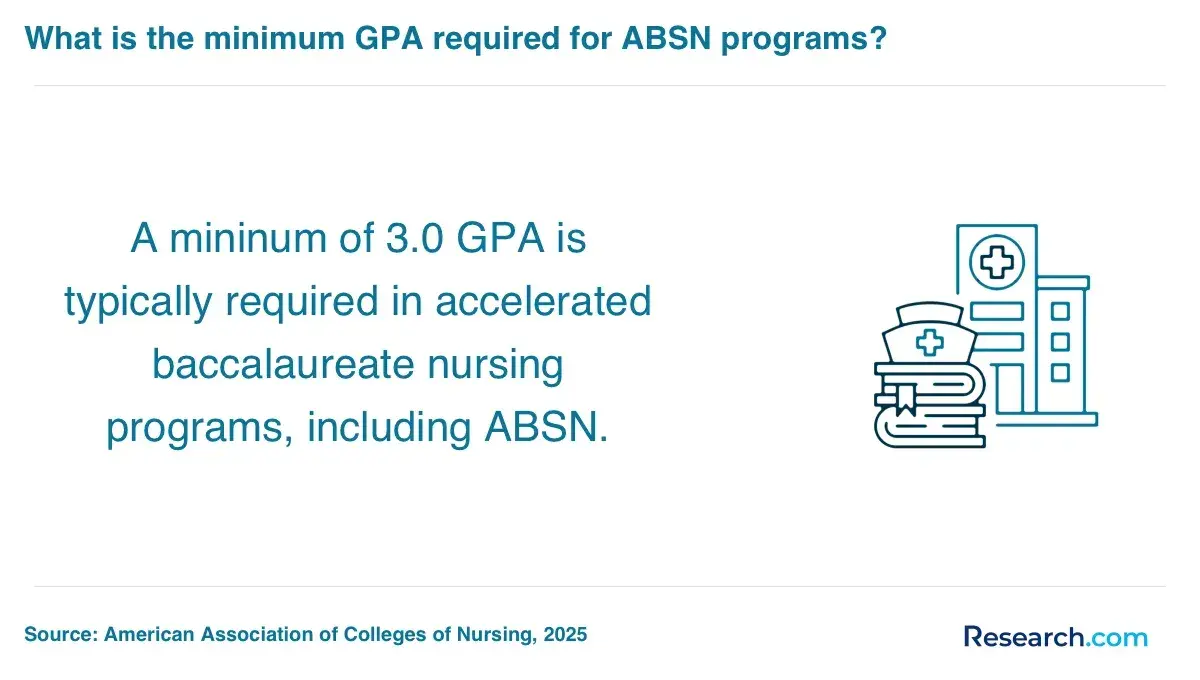
- Minimum GPA: Many programs expect a cumulative GPA around 3.0 or higher. A higher science GPA can strengthen an application, especially if the overall GPA is less competitive.
- Official transcripts: Schools usually require transcripts from every college attended, not only the institution that awarded the degree.
- Personal statement or essay: This is where applicants explain why they are switching into nursing, what they understand about the profession, and how they plan to manage an accelerated schedule.
- Letters of recommendation: Strong letters often come from professors, supervisors, healthcare professionals, or others who can speak to academic ability, professionalism, communication skills, and reliability.
- Resume or healthcare experience: Not every program requires healthcare work, but volunteer service, caregiving, medical assistant work, EMT experience, or shadowing can show that the applicant understands patient-facing environments.
Students planning for advanced nursing specialties should also think beyond admission. ABSN graduates who later pursue psychiatric-mental health nursing, for example, may want to review PMHNP salary differences by state as part of long-term career planning.
Questions to ask before applying
- Can prerequisite courses be in progress at the time of application, or must they be completed first?
- Is there an expiration limit for science prerequisites?
- Does the school calculate cumulative GPA, prerequisite GPA, science GPA, or all three?
- Are online prerequisite courses accepted?
- How many clinical sites are available, and who arranges placements?
- Does the program publish NCLEX-RN outcomes or student completion information?
Do accelerated BSN programs in Virginia require entrance exams?
Some accelerated BSN programs in Virginia require an entrance exam, while others do not. Requirements differ by institution, program format, and admission cycle, so applicants should verify the current policy directly with each school.
Common exams may include the TEAS, HESI, or GRE. The TEAS and HESI are often used to evaluate readiness in areas such as reading, math, science, and English. A GRE requirement is less directly tied to nursing fundamentals but may still appear in some graduate-linked or institution-specific admissions processes.
Entrance exams help schools compare applicants from different academic backgrounds. They can also reveal whether a student needs additional preparation before entering a program where the pace is fast and the volume of content is high.
How to prepare if an entrance exam is required
- Confirm the exact exam and deadline. Do not assume that one Virginia ABSN program has the same policy as another.
- Review the exam blueprint. Focus on the tested content rather than using a generic study plan.
- Refresh core sciences. Anatomy, physiology, microbiology, and basic chemistry often matter more for nursing readiness than broad memorization.
- Take timed practice tests. Many applicants know the content but struggle with pacing.
- Ask about retake rules. Schools may limit how often you can test or how recent scores must be.
A Virginia nurse who completed an ABSN described the TEAS requirement as stressful but useful. He said the exam forced him to revisit basic science and sharpen test-taking skills before the program began. By the time classes started, he felt more prepared for the speed of the coursework and the clinical decision-making expected in nursing school.
What does the curriculum of an accelerated BSN program in Virginia include?
An accelerated BSN curriculum in Virginia is built to prepare students for entry-level registered nursing practice and NCLEX-RN eligibility. The content is similar to a traditional BSN, but the schedule is compressed, which means students cover nursing theory, lab skills, clinical judgment, and patient care responsibilities in a shorter time.
- Nursing fundamentals: Students learn core patient-care concepts, safety practices, communication, documentation, infection control, and basic nursing interventions.
- Health assessment: Coursework and lab practice teach students how to collect patient histories, perform physical assessments, recognize abnormal findings, and communicate concerns.
- Pathophysiology and pharmacology: These courses connect disease processes, medications, side effects, contraindications, and patient education.
- Adult health and medical-surgical nursing: Students build the clinical reasoning needed to care for patients with acute and chronic conditions.
- Maternal, pediatric, mental health, and community health nursing: These areas broaden clinical exposure across the lifespan and across care settings.
- Simulation labs: Students practice scenarios such as medication administration, patient deterioration, wound care, communication, and emergency response in a controlled environment.
- Clinical rotations: In-person clinical experiences place students in hospitals, community agencies, long-term care facilities, or other approved healthcare settings.
- Leadership, ethics, and evidence-based practice: BSN-level education usually includes population health, research appraisal, quality improvement, delegation, and professional accountability.
- NCLEX-RN preparation: Many programs integrate practice questions, review modules, test plans, and readiness assessments throughout the curriculum.
Online, hybrid, and campus-based ABSN formats
| Format | What is usually online | What must be in person | Best for | Watch out for |
| Campus-based ABSN | Some assignments or learning modules may still use online systems. | Classes, labs, simulations, exams, and clinical rotations are often scheduled on or near campus. | Students who want face-to-face structure and frequent faculty interaction. | Less schedule flexibility and possible commuting costs. |
| Hybrid ABSN | Lectures, readings, discussions, and exams may be partly online. | Skills labs, simulations, assessments, and clinical rotations still require physical attendance. | Students who want flexibility but can travel for required in-person components. | Clinical and lab schedules may still be rigid despite online coursework. |
| Online ABSN coursework | Theory-heavy courses may be delivered online. | Clinical training cannot be fully online; nursing requires supervised hands-on practice. | Self-directed learners with reliable technology and strong time management. | Students must confirm who arranges clinical placements and where they occur. |
What accreditation should I look for in an ABSN program in Virginia?
Accreditation and state approval are among the most important factors in choosing an accelerated BSN program. They can affect financial aid eligibility, transfer options, graduate school admission, employer confidence, and the ability to pursue RN licensure.
- Institutional accreditation: The college or university should be institutionally accredited by a recognized accrediting body. In Virginia, many institutions fall under regional accreditation structures such as the Southern Association of Colleges and Schools Commission on Colleges (SACSCOC). Institutional accreditation is often tied to federal financial aid access and academic credibility.
- Nursing program accreditation: Look for programmatic nursing accreditation from the Commission on Collegiate Nursing Education (CCNE) or the Accreditation Commission for Education in Nursing (ACEN). These accreditors review nursing curriculum quality, faculty qualifications, student learning resources, and outcomes.
- Virginia Board of Nursing approval: State board approval is essential because it connects the program to Virginia licensure requirements and NCLEX-RN eligibility. Do not rely only on a school website; confirm approval with the Virginia Board of Nursing when making a final decision.
Why accreditation matters in practical terms
| Decision area | Why it matters | What to verify |
| RN licensure | You need a program that meets state requirements for NCLEX-RN eligibility. | Virginia Board of Nursing approval. |
| Financial aid | Federal aid is generally connected to eligible accredited institutions. | Institutional accreditation and aid eligibility. |
| Graduate school | MSN and doctoral nursing programs may prefer or require nursing program accreditation. | CCNE or ACEN accreditation. |
| Employment | Employers may review school reputation, accreditation, and licensure outcomes. | Program approval, NCLEX preparation, and clinical training quality. |
How long does it take to complete an accelerated BSN in Virginia?
Most accelerated BSN programs in Virginia are designed for full-time study and are much shorter than a traditional BSN. The typical completion time is 15 to 16 months, although the actual timeline depends on prerequisites, start dates, course sequencing, and clinical scheduling.
- Program length: Many ABSN tracks can be completed in 15 to 16 months once the nursing sequence begins.
- Prerequisite timing: Students who still need anatomy, physiology, microbiology, statistics, or other required courses may spend additional time preparing before admission.
- Full-time intensity: ABSN programs are usually built as full-time pathways. Part-time options are uncommon because courses and clinical experiences are tightly sequenced.
- Clinical scheduling: Clinical rotations can include early mornings, evenings, long shifts, or weekends depending on site availability.
- Start dates: Some schools offer multiple entry points, while others admit students only once or a few times per year.
One Virginia ABSN graduate described the 16-month schedule as “manageable only with serious planning.” She said the hardest part was not a single course, but the constant overlap of exams, lab checkoffs, care plans, and clinical shifts. Her advice was simple: arrange childcare, transportation, finances, and study routines before the first term begins.
Typical ABSN timeline
| Stage | What happens | Student priority |
| Before application | Complete prerequisites, collect transcripts, prepare essays, and confirm eligibility. | Avoid applying before prerequisite and GPA requirements are clear. |
| Admission period | Submit application materials, entrance exam scores if required, and recommendations. | Meet deadlines and verify that all documents were received. |
| Early nursing terms | Build foundations in assessment, pharmacology, pathophysiology, and skills labs. | Develop study systems immediately; falling behind is difficult to reverse. |
| Clinical progression | Rotate through patient-care settings while continuing advanced nursing coursework. | Treat clinical performance as seriously as classroom grades. |
| Final term | Complete capstone, leadership, NCLEX review, and graduation requirements. | Prepare licensure paperwork and NCLEX study schedule early. |
How much does an accelerated BSN program cost in Virginia?
The cost of accelerated BSN programs in Virginia varies by school, residency status, program format, fees, and living expenses. Tuition is usually the largest expense, but it is not the only one. Total costs can range from roughly $40,000 to over $68,000, so students should calculate the full cost of attendance before enrolling.
- Tuition: Some schools charge by credit hour, while others publish a program-level price. Always ask whether tuition includes only nursing courses or the entire ABSN sequence.
- University and nursing fees: Technology fees, lab fees, simulation fees, testing fees, and clinical compliance fees can add significantly to the total bill.
- Supplies and equipment: Students may need scrubs, a stethoscope, blood pressure cuff, shoes, clinical badges, immunizations, background checks, drug screening, and exam software.
- Transportation: Even in an online or hybrid program, clinicals and labs require in-person attendance. Fuel, parking, public transportation, or temporary housing may become major costs.
- Lost income: Because ABSN programs are intensive, many students reduce work hours or stop working. This opportunity cost should be part of the budget.
- Licensure and testing costs: Budget for NCLEX-RN registration, state licensure application fees, and review resources if they are not included.
Students who are comparing long-term nursing education options may also want to review one-year online nurse practitioner program options to understand how future graduate study could affect total educational investment.
Cost comparison checklist
| Cost item | Ask the school | Why it matters |
| Tuition | Is the price per credit, per term, or for the full program? | Published tuition may not reflect total cost. |
| Fees | Which lab, testing, technology, simulation, or clinical fees are required? | Fees can change the affordability comparison between schools. |
| Clinical placement | Does the school arrange placements, or must students find sites? | Placement responsibility affects stress, travel, and progression. |
| Supplies | What equipment, uniforms, screenings, and compliance documents are required? | These costs often come due before or early in the program. |
| Living expenses | Can the schedule realistically allow paid work? | Reduced income may be a larger burden than tuition for some students. |
What financial aid options are available for ABSN students in Virginia?
ABSN students in Virginia may be able to use federal loans, state aid, institutional scholarships, employer assistance, private scholarships, military benefits, or loan forgiveness programs. Eligibility depends on the school, enrollment status, prior borrowing, residency, academic standing, and the specific aid program.
- Federal student loans: Completing the FAFSA is usually the starting point for federal aid. Because ABSN students already have a bachelor's degree, grant eligibility may be limited, but federal Direct Loans may still be available depending on individual circumstances.
- State and institutional grants: Virginia residents attending eligible institutions may have access to state-supported aid such as the Virginia Tuition Assistance Grant, while schools may also offer need-based or merit-based awards.
- Nursing scholarships: Scholarships may be available through universities, healthcare systems, professional nursing organizations, foundations, and community groups seeking to support the nursing workforce.
- Employer tuition assistance: Students already working in healthcare should ask about tuition reimbursement, education benefits, work commitments, and post-graduation employment agreements.
- Military and veteran benefits: Eligible students may be able to apply military education benefits toward nursing education, depending on program approval and benefit rules.
- Loan forgiveness: Graduates working in qualifying public service or high-need settings may explore options such as Public Service Loan Forgiveness if they have eligible federal loans and meet service requirements.
If your long-term goal is advanced practice nursing, financial planning should include future graduate school. Reviewing nurse practitioner specialty program admission pathways can help you understand how ABSN performance may influence later options.
Ways to reduce ABSN debt
- Finish prerequisites at a lower-cost accredited institution if the ABSN program accepts those credits.
- Compare total cost of attendance, not just tuition.
- Apply for nursing scholarships early, including smaller local awards.
- Ask employers about tuition benefits before resigning or cutting hours.
- Borrow only what you need for tuition, supplies, and essential living expenses.
- Understand any service obligation before accepting employer or scholarship funding.
What career paths are available after earning an ABSN in Virginia?
After completing an ABSN and meeting RN licensure requirements, graduates can pursue registered nursing roles in hospitals, clinics, schools, public health agencies, long-term care facilities, rehabilitation centers, and community organizations. The degree does not limit graduates to one setting; it prepares them for entry-level RN practice with a BSN foundation.
- Hospital registered nurse: RNs in hospitals provide direct patient care, administer medications, monitor changes in condition, coordinate with physicians and other clinicians, and educate patients and families.
- Medical-surgical nurse: This broad role helps new nurses build assessment, prioritization, documentation, and time-management skills across many patient conditions.
- Critical care nurse: Nurses in intensive care and step-down settings care for high-acuity patients and often pursue additional training or certification as they gain experience.
- Emergency department nurse: ED nurses manage rapidly changing patient needs, triage concerns, and coordinate urgent interventions.
- Public health nurse: These nurses focus on prevention, education, outreach, immunization, community assessment, and population health.
- School nurse: School nurses support student health, chronic condition management, medication administration, emergency response, and health education.
- Community or outpatient nurse: Ambulatory care, primary care, specialty clinics, and home health can offer alternatives to hospital-based nursing.
- Charge nurse or nurse manager: Leadership roles usually require experience after licensure, but BSN coursework in leadership and evidence-based practice can support advancement.
Some ABSN graduates later compare nursing with other advanced clinical routes. If you are considering graduate healthcare roles, a guide on physician assistant versus nurse practitioner pathways can help clarify differences in training, scope, and career direction.
Career paths after an ABSN
| Role | Common settings | Typical next step |
| Entry-level RN | Hospitals, clinics, rehabilitation centers, long-term care | Build clinical competence and prepare for specialty experience. |
| Specialty nurse | ICU, emergency, pediatrics, labor and delivery, oncology, behavioral health | Pursue unit training, preceptorship, and possible certification. |
| Public or community health nurse | Health departments, schools, nonprofits, outreach programs | Develop population health, education, and case-management skills. |
| Nurse leader | Hospital units, clinics, long-term care, community agencies | Gain experience, demonstrate leadership, and consider graduate study. |
| Future advanced practice nurse | Graduate nursing education and clinical specialization | Complete an MSN or related graduate pathway if eligible. |
What is the average salary for nurses with an ABSN degree in Virginia?
An ABSN does not create a separate salary category from a traditional BSN. After licensure, graduates are generally paid according to their RN role, employer, location, shift, experience, specialty, and certifications. The BSN may help with eligibility for certain employers or advancement paths, but salary outcomes are not guaranteed.
- Experience level: New graduates typically start below experienced nurses, then may increase earnings as they gain specialty skills, preceptor experience, or leadership responsibilities.
- Employer type: Large hospitals, academic medical centers, specialty facilities, and high-acuity units may compensate differently from small clinics, schools, or community organizations.
- Location within Virginia: Areas with higher cost of living, such as Arlington, may offer higher pay than some rural markets, although job competition and expenses also differ.
- Shift and differential pay: Nights, weekends, holidays, overtime, and float pool roles can affect total compensation.
- Specialty preparation: Critical care, emergency, perioperative, oncology, and other specialties may provide advancement opportunities after appropriate experience and training.
- Additional education: Nurses who later earn an MSN may qualify for advanced practice, education, administration, or specialized roles with different compensation structures.
How to evaluate salary realistically
- Look at RN job postings in the Virginia region where you plan to work.
- Compare base pay separately from shift differentials, bonuses, and overtime.
- Ask whether new graduate residency programs have fixed pay scales.
- Consider benefits, retirement plans, tuition assistance, and scheduling flexibility.
- Do not base your ABSN decision on the highest salary you see online; use local employer data when possible.
What should you learn from graduate experiences?
Graduate stories can be helpful, but they should not replace program research. Testimonials often show what the schedule feels like, how students manage family responsibilities, and how clinical training connects to employment. However, every student's experience depends on finances, support systems, learning style, placement sites, and career goals.
Use graduate feedback to identify questions you should ask admissions teams. For example, if graduates mention heavy clinical travel, ask where clinical sites are located. If they praise faculty support, ask how advising works when students struggle. If they describe the program as flexible, ask which parts are actually flexible and which are fixed.
Here's What Graduates Have to Say About Their ABSN Degree in Virginia
- Vivian: "The online ABSN program at Virginia Commonwealth University gave me enough flexibility to keep up with family responsibilities while still holding me to a very high academic standard. The workload was intense, but it helped me become more disciplined, organized, and confident in clinical settings. After graduating, I began working in a local high school, where I support student health every day. The program strengthened my understanding of community health needs in Virginia and helped me connect nursing knowledge with practical service."
- Imam: "Studying in the on-campus ABSN program at Old Dominion University changed the way I saw both my career and myself. Being in the classroom with instructors and classmates helped me build relationships that made the difficult parts of the program easier to handle. Clinical rotations across Virginia healthcare settings were challenging, but they prepared me for real nursing responsibilities. My current work as a school nurse lets me advocate for students and contribute to a healthier learning environment."
- Harvey: "The ABSN program at George Mason University helped me see career possibilities I had not fully considered before enrolling. Courses focused on leadership and evidence-based practice gave me tools to adapt in a changing healthcare environment. In my school nursing role, I now take part in wellness efforts that support students' resilience and daily health. The experience pushed me academically and personally, and it strengthened my commitment to nursing in Virginia."
Related Articles for Nearby States
- 2027 Best ABSN Programs - List of Accelerated BSN Programs in West Virginia: Online & Campus
- 2027 Best ABSN Programs - Accelerated BSN Programs in Maryland: Online & Campus
- 2027 Best ABSN Programs - List of Accelerated BSN Programs in North Carolina: Online & Campus
- 2027 Best ABSN Programs - List of Accelerated BSN Programs in Tennessee: Online & Campus
- 2027 Best ABSN Programs - Accelerated BSN Programs in Kentucky: Online & Campus
- 2027 Best ABSN Programs - List of Accelerated BSN Programs in Pennsylvania: Online & Campus
- 2027 Best ABSN Programs - List of Accelerated BSN Programs in South Carolina: Online & Campus
- 2027 Best ABSN Programs - Accelerated BSN Programs in Ohio: Online & Campus
- 2027 Best ABSN Programs - Accelerated BSN Programs in Delaware: Online & Campus
- 2027 Best ABSN Programs - List of Accelerated BSN Programs in New Jersey: Online & Campus
How does an accelerated BSN compare to an ADN program in Virginia?
An accelerated BSN and an Associate Degree in Nursing can both lead toward RN licensure preparation, but they serve different students. An ABSN is usually for people who already have a bachelor's degree and want a fast BSN route. An ADN is often less expensive and may be a practical option for students who do not already have a bachelor's degree or who need a more gradual path.
| Factor | Accelerated BSN | ADN |
| Best fit | Students with a prior non-nursing bachelor's degree. | Students seeking a shorter or often lower-cost RN education route. |
| Credential earned | Bachelor of Science in Nursing. | Associate Degree in Nursing. |
| Pace | Fast and intensive, commonly full time. | May offer a more traditional pace depending on the school. |
| Cost considerations | Can be higher, with total costs ranging from roughly $40,000 to over $68,000 for some ABSN options. | May cost less depending on the institution and residency status. |
| Career considerations | BSN preparation may support employers that prefer bachelor's-prepared nurses and later graduate study. | Graduates may later complete RN-to-BSN education if they want or need a bachelor's degree. |
Choose an ABSN if you already have the required bachelor's degree, can manage the pace, and want a BSN as your first nursing credential. Consider an ADN if cost, schedule flexibility, or readiness for an accelerated program is a major concern.
Is an accelerated BSN a good step toward an MSN in Virginia?
An accelerated BSN can be a strong foundation for an MSN because it provides the undergraduate nursing credential often expected for graduate nursing admission. It can also help students build clinical experience before choosing a specialty such as nurse practitioner practice, education, leadership, informatics, or public health nursing.
That said, students should not treat the ABSN as only a stepping stone. Graduate nursing programs often expect applicants to have RN licensure, academic strength, and sometimes professional nursing experience. Your performance in the ABSN, your clinical references, and your early RN work can all affect future options.
Before choosing an ABSN for future MSN goals, ask:
- Is the nursing program accredited by CCNE or ACEN?
- Will the degree meet admission expectations for the MSN programs I may apply to later?
- Does the school offer advising for graduate nursing pathways?
- What specialties interest me, and do they require RN experience before admission?
- Can I afford the ABSN while still leaving room for future graduate tuition?
What are the common challenges students face in ABSN programs in Virginia?
The main challenge of an ABSN is the pace. Students are not only learning nursing content; they are learning how to think, communicate, prioritize, and perform safely in clinical environments. The compressed timeline can make ordinary life responsibilities feel more difficult.
| Common challenge | Why it happens | Better approach |
| Underestimating the workload | Students may compare the ABSN to a previous bachelor's degree, but nursing requires labs, clinicals, care plans, and high-stakes exams. | Treat the program like a full-time job with overtime. |
| Weak prerequisite foundation | Gaps in anatomy, physiology, microbiology, or statistics can make advanced nursing courses harder. | Review science content before the first term starts. |
| Poor time management | Assignments, exams, skills checkoffs, and clinical preparation overlap. | Use weekly planning, exam calendars, and structured study blocks. |
| Financial stress | Students may reduce work hours while tuition and living costs continue. | Create a full budget before enrollment and apply for aid early. |
| Clinical anxiety | Students may feel unprepared when moving from simulation to patient care. | Use faculty feedback, practice skills repeatedly, and prepare thoroughly before each shift. |
| Choosing the wrong format | Online coursework can still involve strict clinical and lab schedules. | Ask exactly when and where in-person requirements occur. |
Can ABSN students work while completing their degree in Virginia?
Some ABSN students work limited hours, but full-time employment is difficult in most accelerated programs. The schedule can include daytime classes, labs, clinical shifts, exam preparation, group assignments, and travel to healthcare sites. Even when lectures are online, clinical requirements are not optional and may change from term to term.
If you must work, ask each program about weekly time expectations, clinical scheduling, attendance rules, and whether students commonly maintain part-time employment. Also speak with your employer about flexible shifts, weekend work, leave options, or tuition support.
Work and school decision guide
| Work plan | Risk level | When it may be realistic |
| No paid work during the program | Lowest academic risk | Best if you can cover tuition and living expenses through savings, aid, family support, or loans. |
| Very limited part-time work | Moderate risk | Possible if hours are flexible and do not conflict with clinicals or exams. |
| Full-time work | High risk | Usually not advisable unless the program explicitly supports working students and your job is highly flexible. |
References:
- Common Challenges of Nursing School and How to Overcome Them https://www.herzing.edu/node/1923
- Online ABSN Programs in VA: Highlighting the Best Schools https://www.edumed.org/online-schools/nursing-rn-programs/accelerated-bsn/virginia-va/
- Virginia ABSN Programs - Accelerated Nursing Schools https://www.absnprograms.org/programs/virginia/
- Scholarships & Aid | School of Nursing | The George Washington University https://nursing.gwu.edu/scholarships-aid
- Accredited Accelerated Nursing School - Norfolk, Virginia https://absn.averett.edu/about-averett/accreditations/
- Tuition, Financial Aid, and Scholarships https://nursing.virginia.edu/admissions/tuition-financial-aid-scholarships/
- Working In Nursing School | Can You Work During an ABSN Program? https://bayadaeducation.org/resources/absn/working-in-nursing-school
- BSN Salary in Virginia | RN-BSN Salary in VA https://www.bsnedu.org/virginia-salary/
- Licensed Practical Nurse Salary in Virginia https://ceufast.com/nursesalaryguide/state/virginia
- Nurse Salary: How Much Do Nurses Make? https://nurse.org/education/how-much-do-nurses-make/
Key Insights
- An accelerated BSN in Virginia is mainly for students who already have a non-nursing bachelor's degree and want a faster route into registered nursing preparation.
- Most ABSN programs are intensive, full-time pathways; many take 15 to 16 months once nursing coursework begins.
- Always verify institutional accreditation, CCNE or ACEN nursing accreditation, and Virginia Board of Nursing approval before applying.
- Total cost matters more than tuition alone. Fees, supplies, clinical travel, testing, and lost income can significantly change affordability.
- Online ABSN coursework does not mean fully online nursing education. Labs, simulations, and clinical rotations still require in-person participation.
- Entrance exam requirements vary. Some schools may require TEAS, HESI, GRE, or another assessment, while others may not.
- An ABSN can support future MSN study, but students should first focus on RN licensure, clinical competence, and strong academic performance.
- The best program is not simply the fastest or cheapest. Choose the option that fits your prerequisites, finances, schedule, clinical needs, licensure goals, and long-term nursing plans.
Other Things You Need to Know About Accelerated BSN Programs in Virginia
The Virginia Board of Nursing approves nursing education programs in the state. ABSN curricula must meet Virginia Board of Nursing standards and prepare graduates for NCLEX-RN eligibility, including required clinical hours and approved course content.
To enroll in an Accelerated BSN program in Virginia in 2027, applicants typically need a bachelor's degree in a non-nursing field, a minimum GPA of 3.0, and completion of prerequisite courses such as anatomy, physiology, microbiology, and statistics. Specific requirements may vary by institution.


