
2027 Forensic Science Degree Careers: Skills, Education, Salary & Job Outlook

Co-Founder and Chief Data Scientist
Choosing a forensic science degree is really a decision about whether you want to apply laboratory science to legal questions where accuracy, documentation, and professional judgment matter. The field can be rewarding, but it is not the television version of crime solving. Most roles require a strong foundation in chemistry, biology, physics, statistics, evidence handling, and written reporting, plus the discipline to work within strict legal and laboratory standards.
This guide is for students comparing science majors, career changers considering forensic work, and current professionals deciding whether additional training or certification is worth it. You will learn what forensic scientists do, which skills and credentials matter, what salaries and job growth look like, where people in this field work, and how to evaluate related career paths before committing to a degree or specialization.
Key Things You Should Know About Forensic Science Degree Career
- The typical earning potential for forensic science technicians centers around a national median annual wage of $67,440, with some positions offering salaries as high as $120,100 depending on location and agency.
- This field is very stable and growing quickly, with employment expected to increase by 13% from 2022 to 2032, far exceeding the average growth rate for all occupations.
- A bachelor's degree in forensic science or a related natural science like chemistry, biology, or physics is generally required to enter the profession, while some roles or promotions may require a master's degree or specialized certifications.
- Success relies on strong analytical thinking, attention to detail, problem-solving skills, effective written and verbal communication, and proficiency with laboratory technology and scientific methods, along with critical thinking and teamwork abilities.
- Career advancement comes with experience, earning advanced degrees or certifications, and specializing in areas such as DNA analysis, digital forensics, or toxicology, leading to supervisory, management, or policy leadership roles.
What do Forensic Scientists do?
Forensic scientists use scientific methods to examine evidence connected to criminal, civil, or death investigations. Their work may involve biological samples, controlled substances, trace materials, fingerprints, firearms evidence, toxicology results, or digital evidence, depending on their specialization and employer.
The central purpose of the role is not to “solve crimes” alone. Forensic scientists generate reliable findings that investigators, attorneys, judges, and juries can use. That means their conclusions must be based on validated methods, careful documentation, chain-of-custody procedures, and clear reporting. A strong forensic scientist is both a scientist and a communicator: they must produce defensible work and explain it without overstating what the evidence can prove.
A day in the life of forensic scientists
A typical day may include receiving evidence, checking documentation, preparing samples, running laboratory tests, reviewing quality controls, comparing results, writing reports, and consulting with investigators or prosecutors. Some forensic scientists also visit crime scenes, although many spend most of their time in a lab or office setting.
The work is detail-heavy and often slower than people expect. A single case can require repetitive testing, peer review, instrument maintenance, and documentation before any report is released. In more senior roles, forensic scientists may testify in court, train new analysts, validate new methods, or review complex cases.
What are the key responsibilities of Forensic Scientists?
Forensic scientists turn physical or digital evidence into scientifically supported conclusions. Their responsibilities vary by specialty, but most roles combine evidence handling, laboratory or technical analysis, quality assurance, reporting, and courtroom communication.
- Preserve evidence integrity: Receive, label, store, and track evidence so the chain of custody remains clear and defensible.
- Collect or process samples: Work with physical, biological, chemical, or digital evidence while avoiding contamination, loss, or misinterpretation.
- Perform scientific analysis: Use tools such as microscopes, DNA instruments, chemical testing systems, or digital forensic software to generate results.
- Document every step: Maintain notes, worksheets, instrument logs, photographs, and reports that can withstand internal review and legal scrutiny.
- Interpret findings carefully: Explain what the evidence supports, what it does not support, and what limitations apply.
- Communicate with legal and investigative teams: Prepare reports, answer technical questions, and testify as an expert witness when required.
- Maintain quality standards: Follow laboratory procedures, calibrate equipment, complete proficiency testing, and stay current with legal and scientific updates.
The most challenging tasks
Court testimony is often one of the hardest parts of the job. A forensic scientist must explain technical findings in plain language while staying precise and neutral. Cross-examination can be demanding because attorneys may challenge methods, assumptions, wording, or qualifications. Strong preparation and honest limits are essential.
Another challenge is the pressure to avoid mistakes. Evidence may affect a person’s liberty, a victim’s family, or the outcome of a major investigation. That makes documentation and peer review just as important as the test itself.
The most rewarding tasks
The most rewarding part of forensic science is seeing careful scientific work clarify difficult questions. A well-supported result can help identify the right suspect, exclude an innocent person, confirm a pattern, or reveal that evidence is weaker than it first appeared. For people who value science, public service, and accountability, that purpose can be a major reason to stay in the field.
If you are still comparing academic options, reviewing broader college majors and career paths can help you decide whether forensic science, chemistry, biology, criminal justice, or another science-focused major best fits your goals.
What are the key skills for Forensic Scientists?
Forensic scientists need more than interest in crime investigation. The strongest candidates combine scientific training, laboratory discipline, analytical judgment, and the ability to communicate findings accurately under pressure. Employers usually look for evidence that you can handle precise technical work while following procedures without shortcuts.
Key technical skills
- Microscopy: Used to examine small or trace evidence such as hairs, fibers, tool marks, bullets, and other materials that require close visual comparison.
- Data analytics: Useful for interpreting large or complex datasets, especially in digital forensics, database comparisons, and case pattern analysis.
- DNA analysis: Important for extracting, quantifying, amplifying, and comparing genetic material from biological evidence.
- Mass spectrometry: Commonly used in toxicology, drug analysis, and trace evidence work to identify chemical substances with a high degree of specificity.
- Evidence handling: Essential for maintaining chain of custody, preventing contamination, and ensuring evidence remains admissible and reliable.
- Laboratory quality control: Includes instrument checks, control samples, method validation, proficiency testing, and proper documentation.
Essential soft skills
- Critical thinking: Helps analysts separate what the evidence actually shows from assumptions, pressure, or investigative theories.
- Attention to detail: Reduces the risk of missed evidence, mislabeled samples, incomplete notes, or flawed conclusions.
- Analytical reasoning: Supports accurate interpretation of scientific results, especially when data are partial, mixed, degraded, or complex.
- Communication skills: Needed to write clear reports, explain uncertainty, answer investigator questions, and testify in court.
- Professional objectivity: Keeps the scientist focused on evidence rather than on helping one side “win” a case.
- Emotional resilience: Important for work involving violent crimes, disturbing case materials, or high-stakes legal outcomes.
The overlooked skill that separates good forensic scientists from great ones
Project management is often underestimated. Forensic scientists may handle multiple cases at once, each with deadlines, documentation requirements, quality checks, and communication demands. Without strong organization, backlogs build, reports slow down, and errors become more likely.
Good project management means knowing which tasks are urgent, which require peer review, which instruments or specialists are needed, and how to keep casework moving without rushing scientific judgment. This skill becomes even more important in senior roles, where analysts may supervise others, manage validation projects, or coordinate with law enforcement and legal teams.
Professionals who want flexible ways to strengthen academic or technical skills may find value in reviewing the best online degree programs for seniors, especially if they are returning to school or changing fields later in their career.
Forensic Science Degree Careers: A Step-by-Step Guide to Getting Started
A forensic science career usually develops in stages. The exact route depends on the employer, specialty, and state or agency requirements, but most candidates move from science education to supervised experience, then into independent casework and specialization.
- Complete a bachelor's degree in a natural science field. Common majors include forensic science, biology, chemistry, biochemistry, or a related laboratory science. Choose coursework that builds real scientific depth, not only criminal justice theory.
- Build practical experience before graduation. Look for internships, undergraduate research, laboratory assistant roles, or agency volunteer opportunities. Employers value applicants who understand lab safety, documentation, and evidence protocols.
- Apply for entry-level forensic roles. New graduates often start as forensic science technicians, trainees, or laboratory analysts under supervision. Early work may focus on sample preparation, evidence intake, routine testing, and quality procedures.
- Complete agency training and proficiency requirements. Most laboratories require supervised training before an analyst can work cases independently. You may need to pass internal competency tests or external proficiency tests.
- Pursue certification when it supports your specialty. Certification can strengthen credibility, but it should match your job function, such as drug analysis, DNA, latent prints, toxicology, or another focused area.
- Specialize or pursue advanced education strategically. A master's degree, doctoral study, medical training, or niche certification may be useful for advanced laboratory roles, leadership, research, teaching, or highly specialized positions.
The main mistake to avoid is choosing a program based only on the word “forensic.” Employers often care more about scientific rigor, lab experience, accreditation, and technical competence than about a program title.
What education, training, or certifications are required?
Most forensic scientist roles require at least a bachelor's degree in a natural science. Common options include forensic science, biology, chemistry, biochemistry, or a closely related field. Programs with strong laboratory requirements are usually more useful than programs focused mainly on criminal justice concepts.
FEPAC-accredited programs are especially valued because they meet recognized standards for forensic science education. Accreditation does not guarantee a job, but it can signal that the curriculum includes appropriate science, laboratory, ethics, and forensic coursework.
Training expectations
On-the-job training is normal. New hires often work under supervision for several months before they are approved for independent casework. Training may include evidence handling, laboratory procedures, report writing, courtroom preparation, quality assurance, and agency-specific protocols. Background checks, drug testing, and criminal history reviews are also common before employment.
Certification options
Professional certification can be valuable, especially after you have gained experience in a specific discipline. Examples include credentials from the American Board of Criminalistics (ABC), such as ABC-Drug Analysis or ABC-Forensic DNA. These typically require a relevant degree and work experience. The International Association for Identification (IAI) also offers credentials for areas such as Certified Latent Print Examiner, with experience requirements that vary by specialization.
Are advanced degrees or niche certifications worth the investment?
Advanced degrees and specialized certifications can help in roles involving forensic DNA analysis, toxicology, research, supervision, expert testimony, or laboratory leadership. They may also improve credibility when testifying in court or competing for specialized positions.
However, they are not automatically necessary for every career goal. Many entry-level forensic scientist roles require a bachelor's degree rather than a master's degree. Before committing to graduate school or a certification, compare the cost, time, eligibility requirements, and local hiring expectations. If the credential is not required or strongly preferred for the role you want, gaining experience first may be the better move.
Students still building foundational science coursework can also review accelerated associate degree programs to understand alternative ways to begin college-level study, although most forensic scientist positions still expect a bachelor's degree for full professional entry.
What is the earning potential for Forensic Scientists?
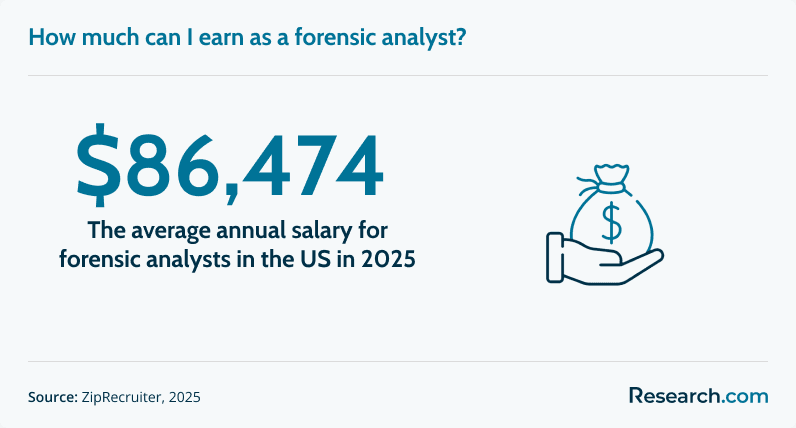
Forensic science pay varies by role, employer, location, specialization, and experience. The forensic science degree salary range 2025 includes entry-level forensic science technicians earning between $45,560 and $60,000, while senior or specialized roles such as federal forensic scientists can earn $100,000 to $130,000 or more annually. The median salary is $67,440 according to the U.S. Bureau of Labor Statistics.
Some of the highest paying forensic science jobs in 2025 include forensic pathologists, federal forensic scientists, and specialized digital forensics experts. Some positions exceed $200,000 annually depending on experience and location. These higher-paying roles usually require advanced education, medical training, federal hiring competitiveness, rare technical expertise, or substantial experience.
What affects forensic science salary?
- Employer type: Federal roles and specialized laboratories may pay more than some local agencies, but they can also be more competitive.
- Geographic location: States such as California and Illinois often offer higher pay, though cost of living should be considered when comparing offers.
- Specialization: Digital forensics, DNA analysis, toxicology, and forensic pathology can command higher compensation when demand is strong and expertise is scarce.
- Experience level: Senior analysts, supervisors, technical leaders, and expert witnesses generally earn more than entry-level technicians.
- Credentials and education: Certifications or advanced degrees may improve earning potential when they are tied to a high-demand specialty or promotion requirement.
When evaluating salary, look beyond the posted number. Government roles may offer stronger benefits, retirement plans, job stability, and structured advancement, while private or specialized roles may offer higher pay but different workload expectations.
What is the job outlook for Forensic Scientists?
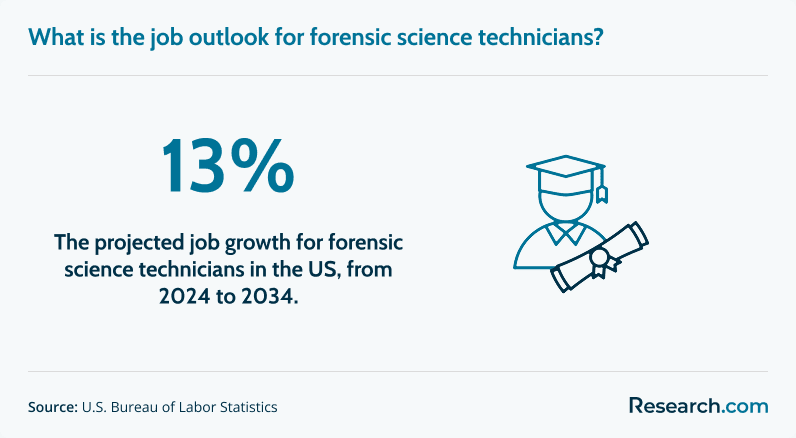
Employment for forensic science technicians is projected to grow 13 percent from 2024 to 2034, which is much faster than the average for all occupations. This outlook points to continued demand, but it does not mean every applicant will find a job easily. Competitive laboratories may still prefer candidates with strong science coursework, internships, laboratory experience, and clear specialization.
The key factors shaping the future outlook
- Greater reliance on forensic evidence: Investigators and courts continue to use scientific evidence in criminal and civil cases, supporting demand for trained analysts.
- Advances in DNA and digital forensics: Improved methods expand what can be examined, but they also require workers who can keep up with changing tools and standards.
- Government laboratory turnover: Retirements and staff movement create openings, especially in public agencies.
- Backlogs and case volume: Many agencies need trained personnel to process evidence efficiently while maintaining quality.
- Competition for desirable roles: Federal labs, large metropolitan agencies, and niche specialties may attract many qualified applicants.
Students preparing for this field should prioritize accredited, science-heavy education and hands-on experience. If cost and access are concerns, exploring accredited online schools with no application fee may help you compare more affordable starting points.
What is the typical work environment for Forensic Scientists?
The forensic science work environment is usually laboratory-based, but the setting depends on the role. Employment data shows that 56% work for local government, excluding education and hospitals; 29% work for state government; and 7% work in testing laboratories. Many forensic scientists also spend time in offices writing reports, reviewing case notes, communicating with investigators, or preparing for testimony.
Some positions require crime scene response, evidence collection, or field documentation. Others are almost entirely lab-based. A DNA analyst, toxicologist, or drug chemist may spend most days processing samples and reviewing results, while a crime scene-focused role may involve more unpredictable fieldwork.
Schedule and working conditions
Many forensic technicians work standard business hours, but the typical schedule in forensic careers can include nights, weekends, overtime, or on-call work when urgent evidence, crime scene response, or court deadlines require it. Court appearances may also interrupt normal laboratory schedules.
Remote or hybrid work is usually limited because evidence handling, laboratory testing, and secure systems require physical presence. Digital forensics may offer more computer-based work than wet-lab specialties, but chain-of-custody and security requirements still often keep work onsite.
What are the pros and cons of Forensic Scientist careers?
Forensic science can be meaningful, stable, and intellectually engaging, but it is also demanding. The best fit is someone who values accuracy, patience, scientific discipline, and public service more than speed or drama.
Pros
- Purpose-driven work: Your analysis can support justice, clarify evidence, and help prevent wrongful conclusions.
- Strong connection between science and public service: The role applies chemistry, biology, physics, statistics, or digital analysis to real legal questions.
- Varied specialties: You can pursue areas such as DNA, toxicology, drug analysis, firearms, latent prints, trace evidence, pathology, or digital forensics.
- Structured advancement: Many public laboratories have clear training, competency, and promotion systems.
- Continual learning: New methods, technologies, and legal standards keep the field from becoming static.
Cons
- High consequence of errors: Mistakes in evidence handling, analysis, or testimony can affect investigations and legal outcomes.
- Heavy documentation: Reports, notes, quality controls, and peer review are essential but can be repetitive.
- Emotional strain: Some cases involve violent crime, disturbing materials, or grieving families.
- Irregular hours: Depending on the role, you may face on-call work, urgent deadlines, or court schedules.
- Competitive entry: Popular agencies and specialties may require strong academic records, internships, and relevant laboratory experience.
If you are also considering shorter training routes in adjacent fields, reviewing certification programs that pay well can help you compare alternatives before committing to a longer forensic science pathway.
What are the opportunities for advancement for Forensic Scientists?
Forensic science offers advancement through two main routes: moving into higher-level responsibility or becoming a specialist in a high-demand area. The best path depends on whether you prefer casework, technical expertise, supervision, research, teaching, or agency leadership.
Promotion pathways in forensic science
- Trainee or Forensic Scientist I: Entry-level analysts learn agency procedures, complete supervised training, and build competency in one or more methods.
- Forensic Scientist II: Analysts handle cases more independently, produce reports, communicate with investigators, and may begin testifying more regularly.
- Forensic Scientist III: Senior analysts may review complex cases, mentor junior staff, serve as technical experts, or supervise a unit.
- Forensic Manager I: Managers may oversee a laboratory section, regional operation, staff assignments, quality systems, or caseflow.
- Forensic Manager II: Higher-level leaders may oversee broader agency operations, statewide programs, policy, budgets, and strategic planning.
- Academic or research roles: Teaching at a college or university often requires a Ph.D. and substantial professional or research experience.
Specialization areas to enhance growth
- Forensic Biology/DNA Analysis: Focuses on biological evidence, DNA profiling, bodily fluids, and interpretation of genetic results.
- Forensic Toxicology: Analyzes drugs, alcohol, poisons, and other substances in biological samples.
- Digital Forensics/Cybersecurity: Examines computers, mobile devices, networks, and electronic records connected to investigations.
- Forensic Pathology/Medical Examiner: Determines cause and manner of death and requires medical training.
- Forensic Chemistry/Drug Analysis: Identifies controlled substances, chemicals, and unknown materials.
- Forensic Anthropology: Applies biological anthropology to human remains, skeletal identification, and trauma interpretation.
Advancement is usually strongest when your education, certification, experience, and employer needs align. A credential that matters in one specialty may not help much in another, so choose training based on the role you want next, not only on general prestige.
What other careers should you consider?
If forensic science interests you, several related careers may also fit your skills. Some are more field-based, some are more laboratory-based, and others lean toward technology, medicine, or law enforcement. Comparing them can help you choose a path that matches how you actually want to spend your workday.
- Crime Scene Investigator (CSI): Focuses more on documenting scenes, collecting evidence, photographing evidence, and coordinating with investigators. This path may involve more fieldwork and irregular hours than many laboratory roles.
- Forensic Toxicologist: Specializes in identifying drugs, alcohol, toxins, or poisons in biological samples. This is a strong fit for students who enjoy chemistry, instrumentation, and laboratory interpretation.
- Digital Forensic Analyst: Examines digital devices, files, networks, communications, and cyber evidence. This path is better suited to people with strong technical, computing, and cybersecurity interests.
- Forensic DNA Analyst: Works with genetic evidence, biological samples, DNA profiles, and statistical interpretation. It typically requires strong biology, genetics, and lab training.
- Analytical Chemist: Applies chemical testing and instrumentation in settings beyond criminal justice, including industry, research, environmental testing, or pharmaceuticals.
Use these alternatives to clarify your priorities. If you want courtroom-connected science, forensic laboratory work may fit. If you want more technology, digital forensics may be stronger. If you want broader private-sector options, analytical chemistry or laboratory science may provide more flexibility.
Here's What Professionals Say About Their Forensic Science Degree Careers
- Marcus: "Every day I step into the lab knowing that I'm giving a voice to evidence that might otherwise be overlooked. It's powerful to see how my careful analyses can support investigators and keep innocent people from being wrongly convicted. Handling complex chemical tests and ensuring accurate documentation makes me feel like I'm directly contributing to justice in my community. That responsibility is something I take very seriously, and it keeps me motivated through every case I work on."
- Talia: "When I began my career in forensic pathology, I was unprepared for the emotional weight of encountering decomposing bodies up close. The first time I examined such a case, it was shocking, and I had to learn quickly how to manage that stress. My colleagues and rigorous training programs helped me develop the resilience I needed to continue. Focusing on the greater purpose of my work-bringing clarity to difficult cases-has guided me through the toughest days."
- Devon: "Completing the National Firearms Examiner Academy was one of the most challenging but rewarding experiences of my life. The intense hands-on training not only sharpened my skills but also connected me with forensic scientists from diverse backgrounds, whose expertise has been invaluable. I recall the satisfaction when I helped resolve a complicated firearms case that led to the prosecution of the right individual. Knowing that my work contributes to real outcomes in the justice system gives me immense fulfillment every day."
Key Findings
- Forensic science careers require strong natural science preparation, not just interest in criminal investigation.
- A bachelor's degree in forensic science, biology, chemistry, biochemistry, or a related natural science is the usual entry point for professional roles.
- FEPAC-accredited programs, internships, laboratory experience, and supervised training can improve readiness for competitive positions.
- Certifications from organizations such as the American Board of Criminalistics (ABC) and the International Association for Identification (IAI) are most useful when matched to a specific specialty and experience level.
- The forensic science degree salary range 2025 includes entry-level forensic science technicians earning between $45,560 and $60,000, while senior or specialized roles such as federal forensic scientists can earn $100,000 to $130,000 or more annually.
- The median salary is $67,440 according to the U.S. Bureau of Labor Statistics.
- Employment for forensic science technicians is projected to grow 13 percent from 2024 to 2034.
- Most forensic scientists work in laboratories, with employment concentrated in local government, state government, and testing laboratories.
- The field offers meaningful work and clear advancement paths, but it also requires emotional resilience, strict documentation, and comfort with high-stakes accountability.
Other Things You Should Know About Forensic Science Degree
The job outlook for forensic science graduates in 2027 is positive, with projected growth around 14% according to industry reports. Increased demand for forensic analysis in law enforcement and criminal investigations drives this growth, creating numerous opportunities for new graduates entering the field.
A forensic science degree typically requires a bachelor's degree in forensic science or a related field. In 2027, students must complete courses in biology, chemistry, and criminal justice. Accredited programs often include lab work and internships to provide practical experience.
References
- Top 10 Career Paths with an Online Master’s in Forensic Science https://www.stevenson.edu/online/about-us/news/top-10-career-paths-with-an-online-masters-in-forensic-science/
- Careers in Forensic Sciences - ASCLS https://ascls.org/careers-in-forensic-sciences/
- 14 Pros and Cons of Being a Forensic Science Technician https://legalcareerpath.com/pros-and-cons-of-being-a-forensic-science-technician/
- Forensic Science Technicians : Occupational Outlook Handbook: : U.S. Bureau of Labor Statistics https://www.bls.gov/ooh/life-physical-and-social-science/forensic-science-technicians.htm
- Careers in Forensic Science https://www.aafs.org/careers-forensic-science
- Forensic Science Technicians: Salary, career path, job outlook, education and more - RaiseMe https://www.raise.me/careers/life-physical-and-social-science/forensic-science-technicians/
- What can I do with my degree in Forensic Science? https://student.kent.ac.uk/careers/career-planning/what-can-i-do-with-a-degree-in/forensic-science
- Becoming a Forensic Scientist | Step by Step Guide https://www.lancashire.ac.uk/articles/advice/become-a-forensic-scientist
- Forensic science https://www.ucas.com/explore/subjects/forensic-science


