2027 Sociology Careers Most Resilient to AI and Automation

Co-Founder and Chief Data Scientist
Choosing a sociology career now means weighing human impact against automation risk. AI can summarize reports and screen datasets, but it struggles with trust-building, field judgment, crisis response, and ethical decisions. The U.S. Bureau of Labor Statistics projects strong demand in several people-centered roles, including 16% growth for marriage and family therapists through 2033.
This guide is for students, career changers, and working professionals who want sociology-related work that remains valuable as technology advances. You will compare careers, degrees, salaries, credentials, and program-selection steps.
Key Things You Should Know
- The most AI-resilient sociology careers are usually applied, regulated, or field-based roles such as social work, counseling, community program management, probation services, policy analysis, and human-centered research.
- BLS 2024 wage data shows wide salary variation: sociologists had a median annual wage of about $101,770, while social and community service managers were around $78,240 and social workers around $61,330.
- A sociology bachelor's degree can open entry-level paths, but long-term resilience is stronger when paired with internships, research methods, data literacy, licensure-track graduate study, or credentials in social services, counseling, public policy, or program evaluation.
Which sociology careers are most resilient to AI and automation?
The sociology careers most resilient to AI and automation are those where the core work depends on human judgment, social trust, field observation, legal accountability, cultural understanding, and face-to-face problem solving. AI can support these roles by drafting notes, analyzing trends, or organizing records, but it cannot easily replace the human relationship, ethical discretion, and local context that drive good outcomes.
For career planning, it helps to separate automation exposure from career resilience. A job may use AI heavily and still remain resilient if the worker makes decisions, builds relationships, manages conflict, interprets complex human behavior, or holds a credential that employers or states require.
The table below compares sociology-related careers by the type of work involved and the reason each role tends to resist full automation. Use it as a starting point, not as a guarantee; resilience varies by employer, state, funding source, and technology adoption.
| Career path | Typical sociology connection | Why it is relatively resilient | Best-fit student profile |
| Clinical social worker | Social inequality, family systems, trauma, community resources | Requires assessment, rapport, crisis judgment, and state licensure | Students willing to complete graduate study, supervised hours, and licensure |
| Marriage and family therapist | Family dynamics, social roles, culture, conflict, institutions | Therapeutic alliance and ethical judgment are central to the work | Students interested in counseling, family systems, and long-term client relationships |
| Social and community service manager | Program design, nonprofit leadership, community needs assessment | Requires local stakeholder management, funding decisions, and staff leadership | Students who want leadership roles in nonprofits, agencies, or public programs |
| Probation officer or correctional treatment specialist | Deviance, criminology, rehabilitation, social control | Requires field interviews, risk assessment, court coordination, and judgment | Students interested in criminal justice reform, public safety, and case supervision |
| Policy analyst or program evaluator | Research methods, statistics, social institutions, inequality | AI can process data, but humans frame questions, interpret trade-offs, and advise decision-makers | Students with strong writing, statistics, and public policy interests |
| User experience or social research specialist | Qualitative interviewing, social behavior, group norms, survey design | Requires research design, participant trust, synthesis, and ethical interpretation | Students who like research, technology, consumer behavior, or workplace systems |
The safest strategy is not to avoid technology. It is to choose sociology work where AI becomes a tool you supervise rather than a system that replaces your main value.
How is the sociology job market expected to change with AI and automation?
AI is likely to change sociology careers by automating routine documentation, basic data cleaning, survey coding, scheduling, and first-draft reporting. The strongest job market opportunities are expected to remain in roles that translate social data into action, serve vulnerable populations, manage programs, or meet legal and ethical obligations.
BLS projections published in 2024 point to continued demand in several sociology-adjacent fields. For example, social workers are projected to see 7% employment growth through 2033, faster than the average for all occupations. That matters because many social work tasks involve direct client support, care coordination, mandated reporting, and resource navigation-work that is difficult to reduce to software alone.
AI will affect the market in three practical ways for sociology students and graduates:
- More hybrid job descriptions: Employers may expect sociology graduates to combine interviewing, casework, or community engagement with data dashboards, digital records, and AI-assisted writing.
- Higher value for interpretation: Routine analysis may become easier, but employers will still need workers who can explain what social patterns mean for policy, services, customers, or communities.
- Greater scrutiny of ethics: Sociology graduates who understand bias, privacy, inequality, and institutional power can be valuable when organizations use AI in sensitive decisions.
The main risk is entering the labor market with only general writing and theory skills. The better position is to graduate with evidence of applied work: internships, field placements, research projects, statistical software experience, community partnerships, or supervised practice hours.
What sociology degree pathways best prepare for AI-resistant careers?
The best degree pathway depends on whether you want direct service, research, management, policy, or clinical work. A sociology degree is flexible, but that flexibility can become a weakness if you do not connect it to a specific career outcome early.
The table below shows how common sociology education paths align with AI-resistant roles. It also highlights when a sociology degree alone may not be enough.
| Pathway | Typical length | Best AI-resistant outcomes | Important limitation |
| Bachelor's in sociology | About 4 years full time | Case management, research assistant roles, nonprofit work, HR support, community outreach | May require experience, certificates, or graduate study for advancement |
| Bachelor's plus applied certificate | Usually added during or after the degree | Data analysis, public health outreach, grant writing, victim advocacy, social services | Quality and employer recognition vary by provider |
| Master's in sociology or applied sociology | Often 1.5 to 2 years | Program evaluation, research management, policy analysis, teaching at some colleges | Not usually a clinical license by itself |
| Master of Social Work | Often 2 years, shorter with advanced standing | Clinical social work, school social work, hospital social work, community leadership | Licensure requirements vary by state and require supervised practice |
| Doctorate in sociology | Often 5 or more years | Faculty roles, advanced research, policy leadership, think tank work | Long timeline and competitive academic job market |
Students who want direct clinical or community intervention work should compare sociology with social work, counseling, and psychology pathways before enrolling. For example, those aiming for licensed social work can review top master's in social work programs to understand how MSW options differ from academic sociology programs.
A practical way to choose is to start with the job posting, not the major name. If your target job regularly asks for licensure, supervised practice, or a specific graduate degree, plan backward from that requirement.
Which sociology roles combine human-centered skills that AI cannot easily replace?
The most durable sociology-related roles combine technical awareness with human-centered skills: listening, trust-building, cultural humility, negotiation, ethical judgment, and the ability to read a situation that is not fully captured in a dataset. These skills matter most when a decision affects someone's housing, safety, treatment, education, employment, or legal status.
Several role clusters are especially strong for students who want people-centered work. The list below explains what makes each cluster hard to automate and what preparation helps most.
- Clinical and therapeutic roles: Social workers, counselors, and family therapists rely on rapport, confidentiality, assessment, and treatment planning. A sociology background helps students understand how family, class, culture, and institutions shape individual behavior.
- Community intervention roles: Outreach coordinators, victim advocates, reentry specialists, and public health educators work in unpredictable environments where trust and local knowledge matter.
- Justice and rehabilitation roles: Probation officers and correctional treatment specialists use interviews, risk assessment, compliance monitoring, and court coordination that require judgment beyond automated scoring.
- Organizational and workplace roles: Diversity, equity, employee relations, labor research, and organizational development roles require conflict resolution and sensitivity to power dynamics.
- Qualitative research roles: Interviewers, ethnographers, and user researchers must design questions, interpret nonverbal context, and avoid flattening people's experiences into simplistic categories.
Students drawn to therapy should confirm whether sociology is the best undergraduate foundation for their state's graduate licensing route. Some may find that an online master's in marriage and family therapy is a more direct path to family-focused clinical practice than a graduate sociology degree.
The common thread is accountability. When a role requires explaining decisions to clients, courts, families, funders, communities, or licensing boards, AI is more likely to assist than replace the professional.
How do bachelor's, master's, and doctoral sociology degrees impact career resilience?
Degree level affects career resilience by changing the kind of work you can credibly do. A bachelor's degree can help you enter applied social service or research support roles, but master's and doctoral degrees usually open more specialized, higher-autonomy work. More education is not automatically better; the right level depends on the role, cost, time, and credential requirements.
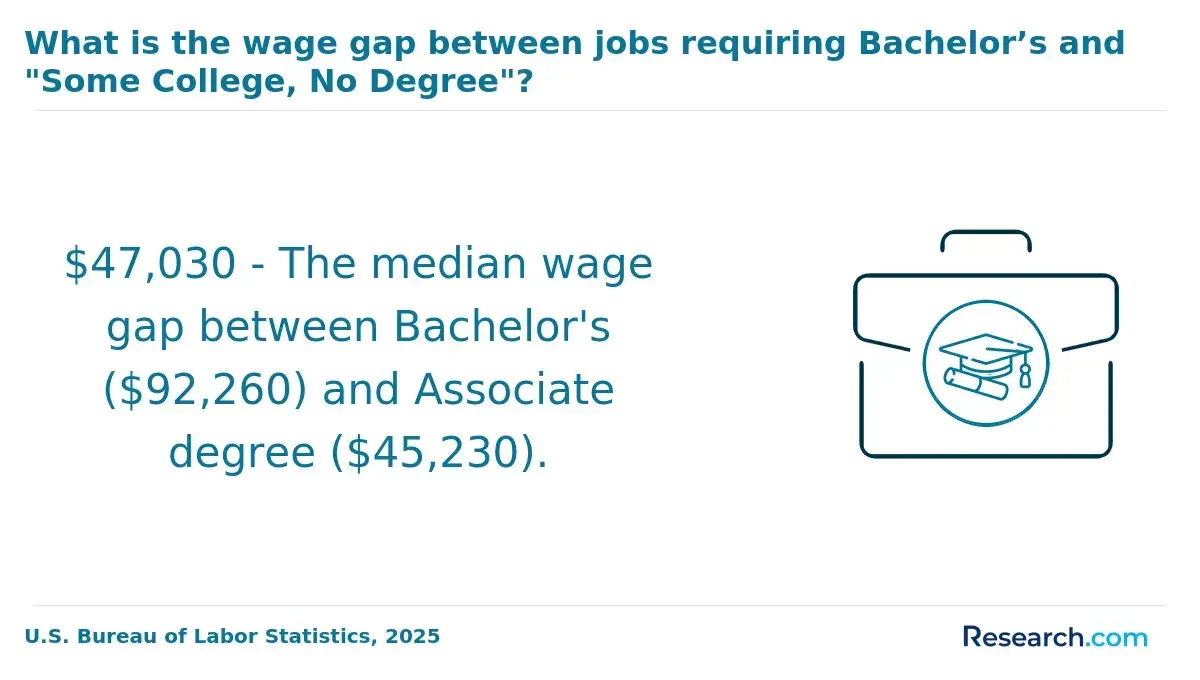
BLS 2024 wage data shows why specialization matters. Sociologists, a role that often requires at least a master's degree and frequently involves advanced research, had a median annual wage around $101,770. That figure should not be read as the typical outcome for every sociology graduate; it reflects a specific occupation with advanced skill expectations and a smaller labor market than broad social services.
Here is how to think about degree levels as a career-resilience decision:
- Bachelor's degree: Best for entry-level human services, nonprofit operations, research assistance, community outreach, and roles where experience can build quickly. It is less resilient if you graduate without internships or technical skills.
- Master's degree: Best for applied research, program evaluation, policy work, management, and licensure-track alternatives such as social work or counseling. It can improve resilience when it leads to a recognized professional function.
- Doctoral degree: Best for advanced research, university teaching, high-level policy analysis, and methodological leadership. It is not the fastest route to employment and should be chosen with a clear research or academic goal.
The biggest mistake is choosing a graduate degree because it sounds prestigious rather than because it matches a job requirement. Before applying, collect five to ten real job postings and mark the required degree, preferred experience, software tools, licenses, and salary range.
What coursework and specializations help sociology students future-proof their careers?
Future-proof sociology coursework should build two forms of value: the ability to understand people in context and the ability to use evidence responsibly. AI can produce quick outputs, but employers still need professionals who know whether those outputs are biased, incomplete, unethical, or irrelevant to the community being served.
The most useful specializations are those that connect sociology theory to a practical setting. Students should look for course clusters that produce portfolio projects, field experience, or measurable skills.
- Research methods and statistics: Essential for policy, evaluation, user research, public health, and graduate study.
- Criminology and justice studies: Useful for probation, reentry services, victim advocacy, legal support, and correctional treatment.
- Medical sociology and public health: Strong fit for hospitals, health nonprofits, public agencies, and community health programs.
- Social inequality, race, gender, and migration: Valuable for advocacy, policy, DEI-related work, and community-based organizations.
- Organizations and work: Useful for HR, labor research, employee relations, and organizational change.
- Data ethics and technology society: Increasingly important for roles involving AI tools, algorithmic decision-making, privacy, and bias audits.
Students interested in digital communities, online behavior, or public communication can also benefit from coursework outside sociology. For example, social media university courses may complement sociology training for careers in digital research, community management, campaign analysis, or audience insights.
A strong schedule does not need to include every topic. A student aiming for community health might pair medical sociology, statistics, grant writing, and an internship. A student aiming for research might prioritize survey design, qualitative methods, Python or R, and a capstone project with real data.
How do salaries and benefits compare for the most AI-resilient sociology careers?
Salaries vary widely because sociology-related careers span public agencies, schools, hospitals, nonprofits, private research firms, courts, and universities. Benefits can also differ substantially: government and school roles may offer stronger retirement or leave benefits, while private-sector research roles may offer higher pay but less mission alignment for some workers.
The table below uses U.S. Bureau of Labor Statistics May 2024 wage data where available. Use these figures as labor-market reference points, not promises of individual earnings; location, degree level, licensure, union status, and employer type can change compensation significantly.
| Role | Median annual wage, BLS May 2024 | Common benefits context | AI-resilience factor |
| Sociologist | $101,770 | Often tied to research institutions, government, consulting, or academia | Advanced research design, interpretation, and theory-driven analysis |
| Social and community service manager | $78,240 | May include public-sector or nonprofit benefits; funding cycles can affect stability | Program leadership, stakeholder coordination, and accountability |
| Market research analyst | $76,950 | Private-sector roles may offer bonuses or flexible work options | Human insight, research framing, and strategic interpretation |
| School and career counselor or advisor | $65,140 | School roles may include academic-year schedules and public benefits | Student guidance, crisis response, and individualized planning |
| Probation officer or correctional treatment specialist | $64,520 | Often public-sector benefits; work can be emotionally demanding | Field judgment, compliance decisions, and court coordination |
| Marriage and family therapist | $63,780 | Benefits vary by agency, healthcare employer, or private practice structure | Therapeutic alliance, diagnosis support, and ethical treatment planning |
| Social worker | $61,330 | Healthcare and government roles may offer stronger benefits than some nonprofit roles | Client assessment, advocacy, care coordination, and licensure |
Compensation should be weighed against education cost and licensing time. A lower starting salary may still be worthwhile if the role has strong benefits, loan forgiveness eligibility, union protections, advancement ladders, or a mission fit that keeps you engaged.
What certifications or licenses strengthen sociology careers against automation risks?
Credentials can improve career resilience when they give you legal authority, verified applied skills, or employer-recognized specialization. They are most valuable when they align with a specific job family; collecting unrelated certificates rarely improves employability.
Before paying for any credential, check whether employers in your target area request it. The list below shows credential categories that can strengthen sociology-related careers.
- State social work licensure: Licenses such as LBSW, LMSW, LCSW, or state equivalents can support roles in casework, clinical practice, healthcare, schools, and community agencies. Requirements vary by state.
- Counseling or marriage and family therapy licensure: These credentials are important for therapy roles and typically require a qualifying graduate degree, supervised hours, and exams.
- Certified Health Education Specialist: This can support public health education, prevention programs, and community outreach roles.
- Certified rehabilitation, victim advocacy, or substance use credentials: These can help students enter specialized human-service areas, depending on state rules and employer requirements.
- Data analytics or program evaluation certificates: These are useful for research, nonprofit evaluation, policy analysis, and roles that combine social insight with dashboards or reporting.
- Grant writing or nonprofit management certificates: These can strengthen community service management careers where funding and reporting are central.
The main red flag is a certificate that sounds impressive but is not requested in job postings, not connected to supervised practice, or not issued by a credible institution or professional association. For licensed fields, always verify requirements with the relevant state board before enrolling in a program.
How do online sociology programs compare to campus options for long-term career security?
Online and campus sociology programs can both support AI-resilient careers if they are accredited, rigorous, and connected to applied experience. The format matters less than whether the program helps you build research ability, communication skills, field exposure, and a credible path to employment or graduate study.
The table below compares online and campus options from a career-security perspective. The best choice usually depends on your schedule, budget, location, and need for in-person networking or fieldwork.
| Factor | Online sociology program | Campus sociology program |
| Flexibility | Often better for working adults, caregivers, and students outside commuting range | Better for students who want structured schedules and in-person routines |
| Networking | Depends on virtual advising, alumni access, discussion quality, and internship support | Often easier through campus events, faculty access, and local partnerships |
| Field experience | May be completed locally if the school approves placements | May have established relationships with nearby agencies or research centers |
| Cost control | Can reduce relocation and commuting costs; tuition varies widely | May offer campus employment, residential experiences, or local scholarships |
| Graduate preparation | Strong if it includes methods courses, faculty mentoring, and capstone research | Strong if students use office hours, labs, honors options, and research assistantships |
Students considering school-based mental health or child development careers should be especially careful about accreditation and field placement rules. Those comparing adjacent pathways can review online school psychology programs NASP-approved to see how professional approval requirements differ from general sociology accreditation.
A common mistake is assuming online means easier or less respected. Employers usually care more about institutional accreditation, relevant experience, writing and research quality, and whether the program meets any licensure or graduate admissions requirements tied to your career goal.
What criteria should students use to choose an accredited sociology program for AI-resilient work?
Students should choose an accredited sociology program by looking beyond the course catalog. The strongest programs connect sociology theory to applied research, field learning, career advising, and technology-aware ethics. Accreditation is the baseline; career alignment is the real decision point.
Use the steps below to evaluate whether a program can support AI-resilient work rather than just provide a credential.
- Confirm institutional accreditation through a recognized accreditor and make sure credits are likely to transfer if your plans change.
- Compare required courses in statistics, research methods, theory, inequality, institutions, and applied sociology.
- Ask whether students complete internships, service learning, capstone research, community projects, or faculty-led research.
- Review career outcomes carefully, including job titles, graduate school placements, internship partners, and alumni examples.
- Check whether the program supports adjacent pathways such as social work, public health, counseling, law, policy, HR, or data analysis.
- Ask how the department teaches AI, data ethics, privacy, algorithmic bias, survey quality, and responsible use of digital tools.
- Compare total cost, not just tuition, including fees, books, transportation, technology, lost work time, and possible graduate school expenses.
Several red flags should prompt deeper questions. Avoid choosing a program solely because it is fast, cheap, highly ranked, or advertised as career-guaranteed. Be cautious if the school cannot explain internship access, transfer rules, faculty advising, graduate placement, or whether the degree supports your intended licensure pathway.
A good sociology program should leave you with more than a transcript. Ideally, you graduate with a writing sample, a research project, field experience, references, basic data skills, and a clear explanation of how your sociological training helps organizations make better decisions about people and communities.
Other Things You Should Know About Sociology
Before graduation, sociology students should focus on building strong research and analytical skills, gaining internship experiences, and networking with professionals in various sectors. These actions can enhance employability and prepare them for careers that are resilient to AI and automation, like social research, policy analysis, and community planning.
Yes. Sociology majors can work in HR, consumer insights, organizational research, diversity and inclusion, training, corporate social responsibility, and user research. Business roles usually require students to translate sociology skills into employer language, such as research design, stakeholder communication, survey analysis, and workplace problem solving.
Neither major is universally harder. Sociology focuses more on groups, institutions, inequality, culture, and social systems, while psychology focuses more on individual behavior and mental processes. Sociology may feel harder for students who dislike reading, writing, theory, or social research; psychology may feel harder for students who dislike biology, cognition, or experimental methods.
References
- Ten Jobs That Should Be Safe From Automation | KQED https://www.kqed.org/mindshift/52193/ten-jobs-that-should-be-safe-from-automation
- Will Sociologists be replaced by AI & Robots? https://willrobotstakemyjob.com/sociologists
- The most future-proof IT degree programs that won’t be replaced by AI. https://itcompare.pl/en-us/articles/68/the-most-futureproof-it-degree-programs-that-won-t-be-replaced-by-ai
- Beyond Automation: 10 Human Skills AI Can’t Replace (And Why They Matter More Than Ever) https://happypeopleai.com/blog/beyond-automation-10-human-skills-ai-cant-replace-and-why-they-matter-more-than-ever
- 10 Jobs AI Can't Replace in 2025 | Future-Proof Career Guide https://prometai.app/blog/10-jobs-ai-wont-replace-future-proof-careers-for-the-ai-era
- The Future of IT Careers: the Skills and Certifications You Need | Joe The IT Guy https://www.joetheitguy.com/it-careers-future/
- The 65 Jobs With the Lowest Risk of Automation by Artificial Intelligence and Robots - USCI https://www.uscareerinstitute.edu/blog/65-jobs-with-the-lowest-risk-of-automation-by-ai-and-robots
- Artificial intelligence and the future of work: Disruptions and opportunities https://unric.org/en/ai-and-the-future-of-work-disruptions-and-opportunitie/
- The Most AI-Resilient Jobs 2026 | AI Resilience Report https://www.airesilience.org/all-careers/rankings/ai-resilient-careers
- AI Policies Every Online Institution Should Adopt Before 2027 https://iacde.org/uncategorized/ai-policies-every-online-institution-should-adopt-before-2027/