
2027 Best Online Social Media Marketing Degree Programs

Co-Founder and Chief Data Scientist
While concerns about market saturation in digital marketing are understandable, current data suggests otherwise. Currently, 5.56 billion individuals worldwide are internet users. Meanwhile, 63.9% of the global population is active on social media.
This continued growth has created sustained demand for skilled social media professionals who can navigate digital platforms with creativity and strategic insight.
As an educator who has examined trends in digital communication for over a decade, I’ve worked with my research team to identify the best online social media marketing degree programs for 2025. I will walk you through program requirements, career outcomes, industry-relevant skills, and more in this guide.
What are the benefits of getting an online degree in social media marketing?
- A degree in social media marketing can lead to roles such as social media manager, digital strategist, or marketing manager, with a projected 8% job growth from 2023 to 2033, according to the Bureau of Labor Statistics (2023).
- Senior-level roles, like social media marketing managers, earn a median annual salary of $159,660 per year $76.76 per hour (BLS, 2024).
- Earning this degree online allows students to gain practical experience, complete internships, and learn industry-relevant tools while maintaining a flexible schedule that accommodates work and personal commitments.
What can I expect from an online social media marketing degree?
- Students enrolled in an online social media marketing degree can expect a curriculum that blends foundational marketing theory with hands-on digital application.
- Classes are delivered asynchronously through interactive learning platforms, allowing students to engage with lectures, quizzes, and group projects at their own pace.
- Course activities often include real-world simulations, such as designing social media campaigns, analyzing audience data, and developing content strategies for platforms like Instagram, LinkedIn, or TikTok.
- Students are expected to learn how to use tools like Google Analytics, Canva, or Meta Business Suite.
Where can I work with an online social media marketing degree?
Graduates of online social media marketing degree programs are qualified for various roles across industries that rely on digital communication and branding. They may work as social media strategists, digital marketing coordinators, content managers, or marketing analysts in corporate, nonprofit, agency, or freelance settings.
Opportunities also exist in specialized fields such as e-commerce, tech startups, public relations, and media production.
With experience or advanced education, graduates may advance into leadership positions such as digital marketing manager or director of social strategy.
How much can I make with an online social media marketing degree?
Earning potential in social media marketing depends on several factors, including your level of education, years of experience, area of specialization, and the industry or company size you work for.
For instance, entry-level professionals typically have salaries on the lower end of the pay scale. However, those with strong portfolios, certifications, or specializations in high-demand areas like SEO or branding often see accelerated salary growth.
The abovementioned aside, geographic location and whether you work in-house, for an agency, or as a freelancer can also significantly impact your income.
According to ZipRecruiter (2025), the following job roles can earn an annual salary of:
- Social Media Specialist: $54,455
- Content Marketing Strategist: $93,586
- Community Manager: $58,937
- SEO/SEM Specialist: $67,388
- Brand Manager: $84,160
- Best Online Social Media Marketing Degree Programs for 2027 List of Programs
- How long does it take to complete an online social media marketing degree program? Completion Time
- How does an online social media marketing degree program compare to an on-campus program? How does an online social media marketing degree program compare to an on-campus program?
- What is the average cost of an online social media marketing degree program? Program Costs
- What are the financial aid options for students enrolling in an online social media marketing degree program? Financial Aid
- What are the prerequisites for enrolling in an online social media marketing degree program? Program Requirements
- What courses are typically in an online social media marketing degree program? What courses are typically in an online social media marketing degree program?
- What types of specializations are available in online social media marketing degree programs? What types of specializations are available in online social media marketing degree programs?
- How to choose the best online social media marketing degree program? How to choose the best online social media marketing degree program?
- What career paths are available for graduates of social media marketing degree programs? Career Paths
- What is the job market for graduates with a online social media marketing degree? Job Market
- How Does Accreditation Influence the Value of an Online Social Media Marketing Degree? How Does Accreditation Influence the Value of an Online Social Media Marketing Degree?
- How Can an Integrated UX Approach Strengthen Social Media Marketing Strategies? How Can an Integrated UX Approach Strengthen Social Media Marketing Strategies?
Best Online Social Media Marketing Degree Programs for 2027
Choosing an online social media marketing degree is not just a question of convenience. It is a decision about cost, time, credibility, career fit, and whether the curriculum will actually prepare you to plan campaigns, measure results, create content, manage communities, and adapt as platforms and AI tools change.
This guide is for students comparing online bachelor’s and master’s options in social media marketing, digital marketing, communication, and related fields. You will find a ranked program list, cost and timeline expectations, admissions requirements, common courses, specialization options, career paths, accreditation guidance, and practical questions to ask before enrolling.
Quick Answer: What Is the Best Online Social Media Marketing Degree?
The best online social media marketing degree is one that is offered by an accredited institution, teaches both marketing strategy and platform-specific execution, includes analytics and content creation coursework, and gives students portfolio-ready projects. For many students, a bachelor’s degree is the right entry point; working professionals who already have a degree may benefit more from a focused master’s program in communication, marketing communication, or mass communication with a social media concentration.
If speed matters, compare standard online formats with a fast-track online social media management degree. Accelerated options can shorten completion time, but they usually require stronger time management and a heavier course load.
How Research.com Evaluates Online Social Media Marketing Programs
A degree can affect your budget, schedule, and career options for years, so rankings should be based on more than name recognition. Research.com reviews programs using a data-informed process that considers academic quality, affordability, flexibility, accreditation, and student outcomes.
To support transparency, our ranking process uses recognized education data sources, including the IPEDS database, Peterson's Distance Learning Database, College Scorecard, and the National Center for Education Statistics. You can also review our broader Research.com methodology for more detail on how programs are assessed.
Top Online Social Media Marketing Degree Programs
| Rank | School and Program | Degree Level | Credits | Estimated Program Length | Cost per Credit | Accreditation |
| 1 | University of Florida — Master of Arts in Mass Communication, Social Media Concentration | Master’s | 36 | Approximately 16 months | $815.75, including fees | Southern Association of Colleges and Schools Commission on Colleges (SACSCOC) |
| 2 | University of Denver — Master of Arts in Communication Management, Marketing Communication Concentration | Master’s | ~30 | Approximately 18 months | $859, excluding minor fees | Higher Learning Commission (HLC) |
| 3 | Southern New Hampshire University — Bachelor of Science in Marketing, Social Media Marketing Concentration | Bachelor’s | 120 | Typically 4 years, with accelerated options available | $330 | New England Commission of Higher Education (NECHE) |
| 4 | Johnson & Wales University — Bachelor of Science in Digital Marketing and Social Media | Bachelor’s | 120 | 4 years, with flexible pacing options | $495 | New England Commission of Higher Education (NECHE) |
| 5 | Liberty University — Bachelor of Science in Strategic Communication, Social Media Management | Bachelor’s | 120 | 3.5 to 4 years, depending on transfer credits | $390, full-time undergraduate online rate | Southern Association of Colleges and Schools Commission on Colleges (SACSCOC) |
| 6 | University of North Carolina at Greensboro — Bachelor of Science in Marketing, Social Media Marketing Concentration | Bachelor’s | 120 | 4 years | ~$184 in-state, ~$368 out-of-state | Southern Association of Colleges and Schools Commission on Colleges (SACSCOC); AACSB |
| 7 | Arizona State University — Bachelor of Science in Technical Communication, Social Media Management Track | Bachelor’s | 120 | 4 years | Varies by academic load, typically ~$561 per credit | Higher Learning Commission (HLC) |
| 8 | Regent University — Bachelor of Arts in Communication Studies, Internet and Social Media Concentration | Bachelor’s | 120 | 4 years | $395 | Southern Association of Colleges and Schools Commission on Colleges (SACSCOC) |
| 9 | Grand Canyon University — Bachelor of Arts in Social Media | Bachelor’s | 120 | 4 years | $477 | Higher Learning Commission (HLC) |
| 10 | Purdue University Global — Bachelor of Science in Business Administration, Digital and Social Media Management | Bachelor’s | 180 quarter credits | 4 years | $371 | Higher Learning Commission (HLC); ACBSP-accredited program |
1. University of Florida: Master of Arts in Mass Communication — Social Media Concentration
The University of Florida offers an online master’s program for students who want advanced training in social media strategy, digital storytelling, branding, analytics, and communication leadership. The curriculum is built for professionals who want to move beyond daily posting into campaign planning, audience analysis, and strategic decision-making.
The program is fully online and does not require a campus residency. Students complete applied coursework and a final capstone project that can help demonstrate their ability to solve real communication problems.
- Program Length: Approximately 16 months, 36 credit hours
- Tracks/concentrations: Social Media
- Cost per Credit: $815.75, including fees
- Required Credits to Graduate: 36
- Accreditation: Southern Association of Colleges and Schools Commission on Colleges (SACSCOC)
2. University of Denver: Master of Arts in Communication Management — Marketing Communication Concentration
The University of Denver’s online MA in Communication Management is designed for professionals who want to strengthen their marketing communication, brand messaging, campaign strategy, digital content, and leadership skills. The program uses 10-week terms, which may appeal to students who want a structured but flexible academic calendar.
This degree is a strong fit for students interested in persuasive communication, audience engagement, digital marketing, and organizational messaging. Many students can finish in under two years, depending on course load and scheduling.
- Program Length: Approximately 18 months
- Tracks/concentrations: Marketing Communication
- Cost per Credit: $859, excluding minor fees
- Required Credits to Graduate: ~30
- Accreditation: Higher Learning Commission (HLC)
3. Southern New Hampshire University: Bachelor of Science in Marketing — Social Media Marketing Concentration
Southern New Hampshire University offers a fully online BS in Marketing with a concentration in Social Media Marketing. The program covers consumer behavior, brand management, digital advertising, and social platform strategy, making it suitable for students seeking a broad marketing degree with a clear digital focus.
The online format supports full-time and part-time study, which can help working students balance school with employment or family responsibilities.
- Program Length: Typically 4 years, with accelerated options available
- Tracks/concentrations: Social Media Marketing
- Cost per Credit: $330
- Required Credits to Graduate: 120
- Accreditation: New England Commission of Higher Education (NECHE)
4. Johnson & Wales University: Bachelor of Science in Digital Marketing and Social Media
Johnson & Wales University Online offers a BS in Digital Marketing and Social Media that combines technical marketing knowledge with creative campaign development. Students study analytics, content strategy, mobile marketing, audience engagement, and digital branding.
The curriculum is designed around applied digital marketing skills and may include industry certifications where applicable, giving students practical credentials to support their portfolio.
- Program Length: 4 years, with flexible pacing options
- Tracks/concentrations: Digital Marketing and Social Media
- Cost per Credit: $495
- Required Credits to Graduate: 120
- Accreditation: New England Commission of Higher Education (NECHE)
5. Liberty University: Bachelor of Science in Strategic Communication — Social Media Management
Liberty University’s online BS in Strategic Communication with a concentration in Social Media Management focuses on digital writing, campaign development, visual communication, and online brand interaction. The program is faith-based and incorporates Christian principles into its coursework.
Courses are delivered in 8-week sessions, and the university accepts up to 75% of credits through transfer, which may make the program more efficient for students with prior college coursework.
- Program Length: 3.5 to 4 years, depending on transfer credits
- Tracks/concentrations: Social Media Management
- Cost per Credit: $390, full-time undergraduate online rate
- Required Credits to Graduate: 120
- Accreditation: Southern Association of Colleges and Schools Commission on Colleges (SACSCOC)
6. University of North Carolina at Greensboro: Bachelor of Science in Marketing — Social Media Marketing Concentration
The University of North Carolina at Greensboro offers a fully online BS in Marketing with a Social Media Marketing concentration through the Bryan School of Business and Economics. The program emphasizes buyer behavior, digital marketing analytics, strategic content, and applied projects.
Students may benefit from internship and networking opportunities, and the program is designed to be transfer-friendly. Its tuition structure may be especially attractive for in-state students.
- Program Length: 4 years
- Tracks/concentrations: Social Media Marketing
- Cost per Credit: ~$184 in-state, ~$368 out-of-state
- Required Credits to Graduate: 120
- Accreditation: Southern Association of Colleges and Schools Commission on Colleges (SACSCOC); AACSB
7. Arizona State University: Bachelor of Science in Technical Communication — Social Media Management Track
Arizona State University’s online BS in Technical Communication includes a Social Media Management track for students who want to combine writing, multimedia communication, digital strategy, and platform management. The program connects communication theory with applied tools and digital publishing practices.
Flexible start dates may help students begin when their schedule allows, and the curriculum is well suited to learners interested in both written communication and visual storytelling.
- Program Length: 4 years
- Tracks/concentrations: Social Media Management
- Cost per Credit: Varies by academic load, typically ~$561 per credit
- Required Credits to Graduate: 120
- Accreditation: Higher Learning Commission (HLC)
8. Regent University: Bachelor of Arts in Communication Studies — Internet and Social Media Concentration
Regent University offers an online BA in Communication Studies with a concentration in Internet and Social Media. The program blends digital communication coursework with a Christian academic framework.
Students learn about web content, campaign design, digital storytelling, and online strategy. A senior capstone gives learners an opportunity to synthesize what they have studied into a final applied project.
- Program Length: 4 years
- Tracks/concentrations: Internet and Social Media
- Cost per Credit: $395
- Required Credits to Graduate: 120
- Accreditation: Southern Association of Colleges and Schools Commission on Colleges (SACSCOC)
9. Grand Canyon University: Bachelor of Arts in Social Media
Grand Canyon University offers an online BA in Social Media that focuses on social strategy, audience engagement, analytics, multimedia content, brand storytelling, platform management, digital marketing, and influencer collaboration.
The curriculum incorporates a Christian worldview, and flexible start dates can help adult learners and working students plan around other responsibilities.
- Program Length: 4 years
- Tracks/concentrations: Social Media
- Cost per Credit: $477
- Required Credits to Graduate: 120
- Accreditation: Higher Learning Commission (HLC)
10. Purdue University Global: Bachelor of Science in Business Administration — Digital and Social Media Management
Purdue University Global’s BS in Business Administration with a Digital and Social Media Management concentration is built for working adults who want business fundamentals along with specialized digital marketing and social media training.
The program is fully online and offers both traditional study and ExcelTrack® self-paced learning paths, which may appeal to students who want more control over how quickly they move through eligible coursework.
- Program Length: 4 years
- Tracks/concentrations: Digital and Social Media Management
- Cost per Credit: $371
- Required Credits to Graduate: 180 quarter credits
- Accreditation: Higher Learning Commission (HLC); ACBSP-accredited program
How Long Does It Take to Earn an Online Social Media Marketing Degree?
Completion time depends mainly on degree level, transfer credits, course load, and whether the school offers accelerated or self-paced options.
| Degree Type | Typical Time to Complete | Best For | Important Consideration |
| Associate degree | Generally two years | Students who want a lower-cost starting point or plan to transfer later | Check whether credits will apply cleanly to a bachelor’s program. |
| Bachelor’s degree | About four years of full-time study; some accelerated formats may take as little as three years | Students seeking entry-level marketing, communication, content, and social media roles | Transfer credits can significantly affect both time and cost. |
| Master’s degree | Usually 12 to 24 months | Professionals seeking advancement into strategy, analytics, leadership, or specialized communication roles | Part-time enrollment may extend the timeline but can be more manageable for working adults. |
Some online programs use year-round terms, condensed sessions, prior learning credit, or work-experience credit to reduce time to graduation. These options can be useful, but they are not automatically easier. A shorter program often means more work each week and less time between assignments.
Online vs. On-Campus Social Media Marketing Degrees: Which Format Fits You?
Online social media marketing programs often match the way digital marketing work is actually done: through content calendars, analytics dashboards, campaign briefs, collaboration platforms, and performance reports. Courses in social media strategy, SEO, paid media, and digital analytics can translate well to an online learning environment because students can practice directly with tools such as Google Analytics, Hootsuite, Canva, and related platforms.
This model can be especially helpful for working adults. Similar to an accelerated online entrepreneurship master’s degree, many online marketing programs use project-based assignments that ask students to build campaigns, review audience data, create platform-specific content, and submit digital work for instructor feedback.
Campus programs may be stronger for students who want regular face-to-face collaboration, live workshops, student organization involvement, local internship access, and informal faculty interaction. Courses such as brand storytelling, communication workshops, and creative campaign labs can benefit from real-time discussion and in-person critique.
| Factor | Online Program | On-Campus Program |
| Schedule | Often more flexible; may include asynchronous coursework | Usually requires attendance at set times and locations |
| Hands-on work | Strong for digital campaign projects, analytics, and content assignments | Strong for live workshops, group critique, and in-person creative collaboration |
| Networking | Often virtual; depends on program design and alumni engagement | May offer more spontaneous campus events and local employer connections |
| Best fit | Working adults, transfer students, self-directed learners, and students outside commuting range | Students who prefer in-person structure and campus-based support |
The field itself is tied to large digital platforms and mobile-first communication. The chart below shows Meta earned over $164 billion in 2024, LinkedIn over $16 billion, and Snapchat $5.3 billion, illustrating why organizations continue to invest in social media strategy, platform engagement, and digital advertising skills.
What Does an Online Social Media Marketing Degree Cost?
Costs vary widely by school, degree level, residency status, transfer credits, and fee structure. For a bachelor’s degree in this area, tuition often falls between $300 and $600 per credit, with total tuition commonly ranging from $36,000 to $72,000. Associate programs are typically less expensive, often ranging from $6,000 to $20,000 in total. Master’s programs in marketing or communication with a social media focus may cost anywhere from $15,000 to over $40,000.
Students should also budget for technology fees, textbooks, digital materials, and access to industry tools. Some programs include course materials or provide access to platforms such as Hootsuite or Google Analytics as part of instruction, while others may charge separate fees.
Online study does not always mean lower tuition, but it can reduce total attendance costs by eliminating or reducing housing, commuting, relocation, parking, and some campus-based expenses. Students comparing unrelated online skill programs, such as online pet grooming courses, should use the same cost logic: compare total price, required tools, credential value, and career relevance before enrolling.
Cost Factors to Compare Before Enrolling
| Cost Category | What to Check | Why It Matters |
| Tuition per credit | Resident, nonresident, full-time, part-time, and online rates | The advertised rate may not reflect your actual cost. |
| Total credits required | 120 credits, 180 quarter credits, or graduate credit requirements | A lower per-credit rate can still be expensive if the program requires more credits. |
| Fees | Technology, course, graduation, and distance learning fees | Fees can change the real total beyond tuition. |
| Transfer credits | Maximum accepted credits and course equivalency rules | Accepted credits can reduce both time and total tuition. |
| Software and materials | Analytics tools, design platforms, textbooks, and subscriptions | Marketing programs may require access to digital tools. |
Financial Aid Options for Online Social Media Marketing Students
Online students at accredited institutions may qualify for several forms of financial support. Eligibility depends on the school, enrollment status, degree level, financial need, academic profile, employer policy, and federal aid rules.
- Institutional aid: Colleges may offer scholarships, grants, tuition discounts, payment plans, or fee waivers for online learners, adult students, military-affiliated students, transfer students, or high-achieving applicants.
- Federal aid: Eligible students can complete the Free Application for Federal Student Aid (FAFSA) to be considered for Pell Grants, FSEOG, subsidized and unsubsidized loans, work-study, and, for graduate students, federal Direct PLUS Loans.
- Private scholarships: Students in marketing and communication fields can look for external awards, including the Intuitive Digital Inclusion in Digital Marketing Scholarship, Marketing EDGE scholarships, The LAGRANT Foundation awards, and Media Fellows opportunities.
- Employer tuition assistance: Some employers help pay for job-related education. Organizations such as Amazon, Disney, and Starbucks may cover partial or full tuition when employees enroll in approved programs.
If your long-term interests extend beyond marketing into culture, society, communication, or human behavior, compare this path with online social sciences degrees before committing to a specialized marketing major.
Admissions Requirements for Online Social Media Marketing Programs
Admissions standards depend on whether you apply to an associate, bachelor’s, or master’s program. Requirements also vary by institution, but most schools look for evidence that applicants can handle online coursework, written communication, and technology-supported learning.
| Requirement | Bachelor’s Programs | Master’s Programs |
| Prior education | High school diploma or GED; some schools expect a minimum GPA, often around 2.0 to 3.0 | Bachelor’s degree, often in marketing, business, communication, entrepreneurship, or another relevant area |
| Application materials | Application form, official transcripts, and sometimes a personal statement | Application form, official transcripts, resume, statement of purpose, and possibly recommendation letters or writing samples |
| Technology readiness | Basic comfort with learning management systems, social platforms, and productivity tools | Stronger expectations for independent work, digital collaboration, research, and professional communication |
| Standardized tests | Usually not central to admission decisions | Some programs may request GRE scores, though many online programs use test-optional policies |
Applicants from adjacent fields can still be competitive. For example, someone who completed one of the fastest online bachelor’s degree in entrepreneurship programs may bring useful business knowledge to a graduate-level marketing or communication program.
Common Courses in an Online Social Media Marketing Degree
Strong social media marketing programs combine marketing theory, audience research, content creation, platform management, campaign analytics, communication ethics, and hands-on digital production. The goal is not only to teach students how to post online but to help them understand why campaigns work, how to measure performance, and how to adjust strategy based on evidence.
Students comparing very different online degree options, including the best accelerated online anthropology degree programs, should look closely at curriculum fit. A social media marketing degree should include applied business, communication, analytics, and content coursework rather than only broad media theory.
| Course | What Students Learn | Why It Matters for Social Media Marketing |
| Introduction to Marketing | Market research, consumer behavior, branding, and the marketing mix | Provides the foundation for campaign planning and audience targeting. |
| Social Media Strategy and Management | Campaign design, multi-platform planning, engagement tracking, and account management | Builds the core skill set for social media coordinator and manager roles. |
| Content Creation and Curation | Original content development, content selection, brand alignment, and audience fit | Helps students produce consistent, relevant posts, videos, blogs, and campaigns. |
| Digital Analytics and SEO | Traffic measurement, campaign data interpretation, search visibility, and optimization | Turns creative work into measurable marketing performance. |
| Email Marketing and CRM | Email campaign design, automation, subscriber management, and personalization | Connects social media engagement with customer relationship management. |
| Visual Communication and Design | Design principles and visual content creation using tools such as Canva or Adobe Creative Suite | Improves the quality and clarity of social media assets. |
| Influencer and Affiliate Marketing | Partner identification, campaign collaboration, and performance assessment | Prepares students to manage creator partnerships and brand collaborations. |
| Mobile Marketing | SMS campaigns, in-app ads, mobile-first content, and on-the-go audience behavior | Supports strategies designed for mobile users. |
| Marketing Ethics and Law | Consumer privacy, data protection, advertising rules, and ethical marketing practices | Helps students avoid compliance and trust problems in digital campaigns. |
| Professional Writing for Digital Media | Blogs, website copy, captions, promotional emails, and audience-specific messaging | Develops writing skills also emphasized in fast-track online professional writing degree programs. |
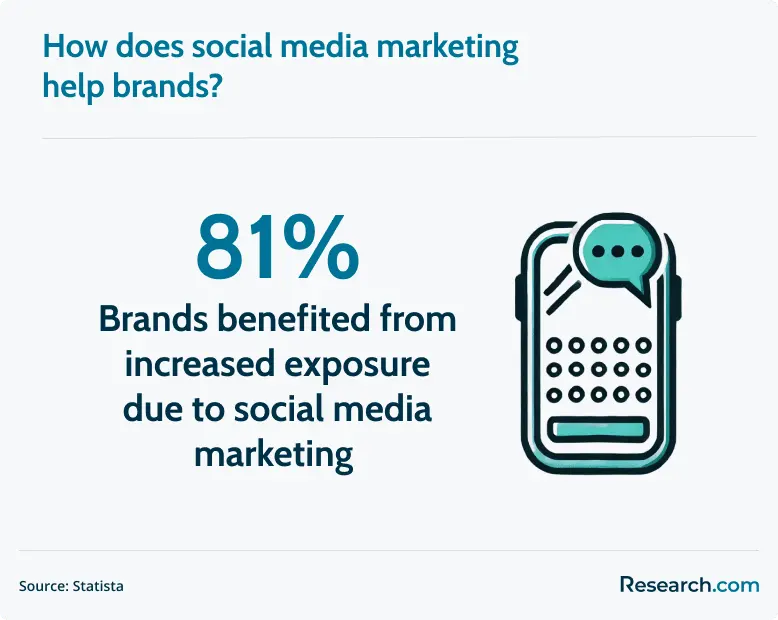
These courses align with employer needs because social media marketing is used to build visibility, engagement, and customer relationships. According to Statista (2025), approximately 81% of marketers globally identified increased brand exposure as the most significant benefit of social media marketing.
Specializations in Online Social Media Marketing Programs
Specializations help students tailor a broad marketing or communication degree toward a specific career direction. The best choice depends on whether you want to focus on creative content, campaign analytics, paid advertising, brand strategy, automation, UX, or reputation management.
| Specialization | Main Focus | Best For Students Who Want To |
| Digital Content Strategy | Planning, producing, and managing blogs, videos, emails, and social posts | Build long-term content calendars and brand narratives |
| Social Media Analytics | KPIs, engagement reports, dashboards, and data interpretation | Use evidence to improve campaigns and explain performance |
| Influencer Marketing and Brand Partnerships | Creator selection, collaboration, negotiation, and campaign evaluation | Manage influencer relationships and partnership campaigns |
| Paid Media and Digital Advertising | Meta Ads, Google Ads, LinkedIn campaigns, budgets, bidding, and targeting | Plan and optimize paid social and search campaigns |
| Visual Media and Design | Graphics, video, Adobe Creative Suite, Canva, and basic UX/UI concepts | Create stronger visual assets for social platforms |
| Brand Management and Storytelling | Brand voice, messaging consistency, and narrative development | Shape how audiences recognize and remember a brand |
| Mobile and Emerging Platforms | TikTok, Snapchat, AR, live streaming, and mobile-first experiences | Adapt campaigns to new formats and user behaviors |
| Public Relations and Online Reputation Management | Crisis response, trust-building, transparency, and public-facing communication | Protect brand credibility and manage public perception online |
| Marketing Automation and CRM | HubSpot, Mailchimp, automated workflows, personalization, and lifecycle engagement | Connect social campaigns to customer journeys and retention |
Some programs now include AI-focused electives that explore audience targeting, content automation, predictive analytics, and chatbot development. Students interested in design-heavy digital careers may also compare degree options with online UX design training bootcamps to decide whether they want a marketing-centered or design-centered path.
The data below shows that 17% of marketing professionals are already using AI extensively in data-driven work, while 39% have adopted it in select areas. Another 26% are exploring AI integration, and only 13% report no plans to adopt the technology. These figures point to a clear need for marketers who understand how AI can support targeting, segmentation, content testing, and campaign optimization.
How to Choose the Best Online Social Media Marketing Degree Program
The right program depends on your goals, budget, experience level, and preferred learning style. A student starting college for the first time may need a broad bachelor’s program, while a working professional may need a shorter graduate program focused on strategy, analytics, or leadership.
Step-by-Step Program Selection Checklist
- Confirm institutional accreditation. Choose a school accredited by a recognized accrediting body. Accreditation affects credit transfer, graduate school eligibility, employer confidence, and access to federal financial aid.
- Match the degree level to your goal. A bachelor’s degree is usually more appropriate for entry-level career preparation, while a master’s degree may be better for advancement or specialization.
- Review the curriculum line by line. Look for coursework in analytics, SEO, paid media, content strategy, brand management, writing, ethics, and campaign planning.
- Evaluate hands-on learning. Prioritize programs that require portfolios, capstones, campaign simulations, analytics reports, or client-style projects.
- Check tool exposure. Ask whether students use platforms such as Hootsuite, Google Analytics, Canva, HubSpot, Meta Business Suite, or similar industry tools.
- Compare flexibility honestly. Asynchronous courses can help busy students, but they require discipline. Synchronous courses offer more structure but less schedule freedom.
- Ask about transfer credits. Transfer-friendly policies can reduce cost and time, but only if your prior credits apply to degree requirements.
- Consider AI coursework carefully. Some students may pursue one of the fastest online master’s in artificial intelligence programs, while others may prefer a marketing degree with AI electives in campaign automation, segmentation, and personalization.
- Look at career support. Ask about internship help, portfolio review, resume support, alumni networks, job boards, and employer partnerships.
- Estimate total cost, not just tuition. Include fees, textbooks, software, time out of the workforce, and financing costs.
The chart below shows that most advertising and promotions managers hold a bachelor’s degree, with 41,774 individuals at that level. A smaller group, 9,424, have a graduate degree, often associated with more advanced roles. Another 5,482 report some college but no degree, suggesting that non-degree entry exists but is more limited for management-oriented positions.
Common Mistakes to Avoid When Choosing a Program
| Mistake | Why It Can Hurt You | Better Approach |
| Choosing only by school name | A well-known university may not have the curriculum, flexibility, or support you need. | Compare courses, outcomes, costs, and career services. |
| Ignoring accreditation | Unaccredited programs may create problems with financial aid, transfer credits, and employer recognition. | Verify institutional accreditation before applying. |
| Looking only at tuition per credit | Fees, required credits, software, and textbooks can change the real price. | Calculate total program cost. |
| Assuming online means self-paced | Many online programs still have weekly deadlines, live sessions, and fixed term schedules. | Ask whether courses are asynchronous, synchronous, accelerated, or self-paced. |
| Skipping portfolio opportunities | Marketing employers often want proof of skills, not only a transcript. | Choose programs with projects, capstones, campaign work, or internship options. |
| Overlooking analytics | Creative content alone is not enough in modern marketing roles. | Prioritize programs that teach measurement, reporting, SEO, and campaign optimization. |
Career Paths With a Social Media Marketing Degree
Graduates can pursue roles across agencies, corporations, nonprofits, media organizations, startups, higher education, healthcare, retail, entertainment, and consulting. The strongest candidates usually combine writing, strategy, platform fluency, analytics, creativity, and professional judgment.
| Career Path | Typical Responsibilities | Skills That Matter Most |
| Social Media Manager | Builds content calendars, manages posting schedules, engages audiences, and monitors performance across platforms | Platform strategy, analytics, copywriting, community engagement |
| Content Strategist | Plans and manages branded content across digital channels | Editorial planning, brand voice, SEO, audience research |
| Influencer Marketing Coordinator | Finds creators, coordinates partnerships, supports negotiations, and evaluates campaign impact | Relationship management, campaign tracking, brand fit analysis |
| Community Manager | Moderates conversations, responds to users, builds loyalty, and represents the brand in online spaces | Communication, empathy, judgment, crisis awareness |
| SEO/SEM Specialist | Improves visibility through keyword strategy, search optimization, and paid search campaigns | SEO tools, paid media, analytics, content optimization |
| Brand Manager | Maintains consistent messaging, positioning, and visual identity across channels | Brand strategy, cross-functional leadership, market research |
| Advertising Account Executive | Coordinates client communication and internal teams to develop advertising campaigns | Client service, campaign planning, communication, project management |
| Public Relations Specialist | Manages reputation, writes press materials, coordinates media outreach, and supports social response strategy | Writing, media relations, crisis communication, public messaging |
| Digital Marketing Consultant | Audits digital strategies, recommends improvements, analyzes competitors, and advises organizations | Strategy, analytics, client communication, business judgment |
| Marketing Communications Manager | Oversees marketing materials and coordinates messaging across teams and channels | Leadership, integrated communication, campaign management |
Graduates who want stronger analytics credentials sometimes add training through the fastest online data analytics bootcamps. Skills in Tableau, SQL, and Python can support more specialized roles such as Marketing Data Analyst, Social Media Intelligence Specialist, or Digital Insights Strategist.
Job Market Outlook for Social Media Marketing Graduates
The job market for social media marketing graduates is supported by continued business investment in digital platforms, mobile-first communication, customer engagement, influencer marketing, content strategy, and data-driven campaign optimization.
According to the U.S. Bureau of Labor Statistics (2024), employment for Marketing Managers is projected to grow by 8% from 2022 to 2032, faster than the average for all occupations. This projection represents approximately 36,600 job openings per year in advertising, promotions, and marketing management fields.
Mobile behavior is also shaping employer demand. The HubSpot Web Strategy & Analytics Report (2023) found that more than half of annual web traffic comes from mobile devices, which pushes organizations to design content for mobile users and platform-specific engagement.
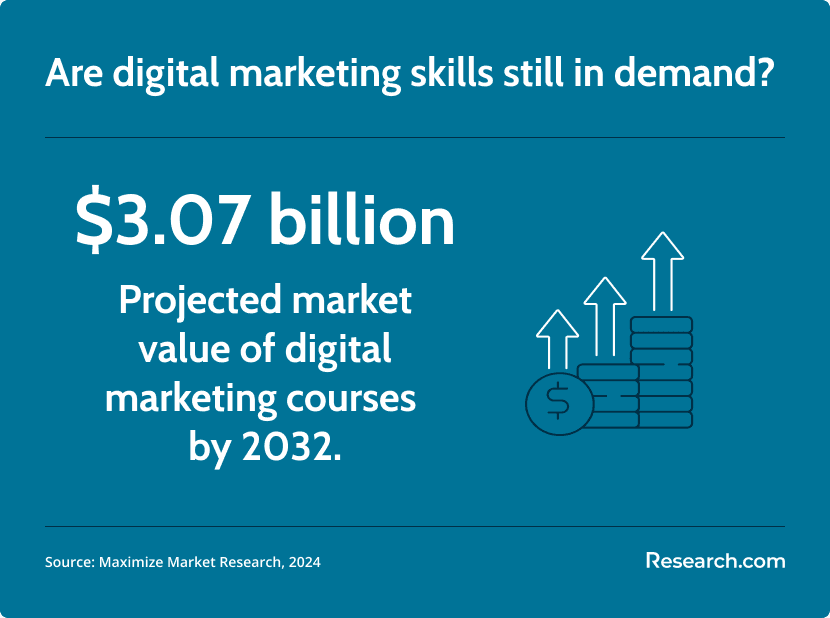
Education demand reflects the same shift. The Digital Marketing Courses Market was valued at USD 1.2 billion in 2024 and is projected to reach $3.07 billion by 2032, growing at a CAGR of 12.45% (Maximize Market Research, 2024). This suggests rising interest in digital marketing training, but students should still evaluate each program’s quality, accreditation, cost, and career support rather than assuming any digital marketing credential will produce the same result.
Why Accreditation Matters for an Online Social Media Marketing Degree
Accreditation is one of the most important checks to complete before enrolling. It signals that the institution has been reviewed for academic quality, governance, faculty standards, student support, and educational resources. For students, accreditation can affect federal financial aid eligibility, transfer credit acceptance, graduate school admission, and employer confidence in the credential.
Do not rely only on a school’s marketing language. Verify the accreditor, confirm that it is recognized, and ask whether any business-specific program accreditation applies. Also review student outcomes, faculty experience, technology resources, portfolio requirements, and credit transfer policies. Cost-conscious students comparing creative or communication-related graduate programs may also find value in reviewing the most affordable online MFA creative writing programs as a benchmark for how tuition and program structure can vary across online degrees.
How UX Skills Can Strengthen Social Media Marketing
Social media marketing is increasingly connected to user experience. A campaign does not end when someone sees a post. The user may click to a landing page, sign up for an email list, interact with a chatbot, watch a video, browse products, or abandon the journey because the experience is confusing.
UX knowledge helps marketers understand behavior, reduce friction, test content, improve calls to action, and create digital experiences that feel coherent from post to website to conversion. Students who want deeper design training can compare marketing programs with a UX design online degree to determine whether their career goal is closer to digital marketing strategy, product design, or experience optimization.
What Graduates Say About Online Social Media Marketing Programs
- Tanya: "The online format made it possible for me to keep working while finishing school. I could review lectures after my shift, complete assignments around my schedule, and still stay on track with deadlines. Without that flexibility, finishing on time would have been much harder."
- Jordan : "What helped me most was the practical work. We used tools like Meta Business Suite and Google Analytics, built sample campaigns, reviewed engagement data, and learned how to change strategy based on results. When I started my job, the tools already felt familiar."
- Skylar : "I chose a master’s program because I wanted to move from execution into strategy. The coursework in branding, analytics, and digital planning helped me make that shift. Soon after graduating, I moved into a digital marketing manager role."
Questions to Ask Before You Apply
- Is the institution accredited by a recognized accrediting body?
- Does the curriculum include analytics, SEO, paid media, content strategy, and ethics?
- Will I graduate with portfolio pieces or a capstone project?
- Which tools and platforms will I use during the program?
- How many transfer credits can I apply, and how will they count toward graduation?
- Are courses asynchronous, synchronous, self-paced, or term-based?
- What is the total cost after tuition, fees, materials, and software?
- What career services are available to online students?
- Are internships, employer projects, or networking opportunities available remotely?
- Does the program prepare me for the type of role I actually want?
References
- Intuitive Digital. (n.d.). Digital marketing scholarship. https://intuitivedigital.com/digital-marketing-scholarship/
- Maximize Market Research. (2024). Digital marketing courses market size, share, growth, forecast 2024-2032. https://www.maximizemarketresearch.com/market-report/digital-marketing-courses-market/2452/
- Statista. (2025). Digital population worldwide as of January 2025. https://www.statista.com/statistics/617136/digital-population-worldwide/
- Statista. (2025). Extent of artificial intelligence (AI) use in data-driven marketing worldwide as of 2025. https://www.statista.com/statistics/1487841/extent-ai-use-data-driven-marketing/
- ZipRecruiter. (n.d.). Social media specialist salary. https://www.ziprecruiter.com/Salaries/Social-Media-Specialist-Salary
- ZipRecruiter. (n.d.). Content marketing strategist salary. https://www.ziprecruiter.com/Salaries/Content-Marketing-Strategist-Salary
- ZipRecruiter. (n.d.). Community manager salary. https://www.ziprecruiter.com/Salaries/Community-Manager-Salary
- ZipRecruiter. (n.d.). SEO/SEM specialist salary. https://www.ziprecruiter.com/Salaries/Seo-Sem-Specialist-Salary
- ZipRecruiter. (n.d.). Brand manager salary. https://www.ziprecruiter.com/Salaries/Brand-Manager-Salary
Key Insights
- Accreditation should be your first filter. It affects financial aid, transferability, graduate study options, and employer trust.
- A strong program teaches more than posting. Look for strategy, analytics, SEO, paid media, content planning, ethics, and portfolio-building assignments.
- Bachelor’s and master’s programs serve different goals. A bachelor’s degree is usually better for entering the field, while a master’s degree can support advancement into strategy or leadership.
- Total cost matters more than tuition per credit. Compare required credits, fees, software, transfer policies, and time to completion.
- AI and analytics skills are becoming more important. Programs that include data interpretation, automation, segmentation, and performance reporting may better match current employer expectations.
- Online learning can be highly practical for this field. Social media marketing work already happens through digital tools, dashboards, content platforms, and remote collaboration.
- The best choice is career-specific. Choose a program based on the role you want, the projects you will complete, the tools you will learn, and the support you will receive after enrollment.
Other Things You Need to Know About Online Social Media Marketing Degree Programs
Some programs require a portfolio or work sample, but many do not. Schools that ask for one usually want examples of social media posts, campaign analytics, graphic design, or writing. When required, it is often submitted with the application and reviewed alongside transcripts and GPA.
The admission requirements typically include a high school diploma or equivalent, with some programs requiring standardized test scores like the SAT or ACT. Applicants may also need to submit letters of recommendation and a personal statement specific to 2027 admissions.
The best online social media marketing degree programs in 2027 emphasize skills such as digital analytics, content creation, SEO, and strategic communication. Students also learn about social media platforms' tools and algorithms to craft effective marketing campaigns. These programs focus on equipping students with the ability to adapt to the rapidly evolving digital landscape.


