2027 Fastest Online Social Media Degree Programs

Co-Founder and Chief Data Scientist
If you want to move into social media marketing without spending four traditional years on campus, a fast online social media degree can shorten the path while still giving you structured training in content strategy, analytics, branding, digital communication, and campaign management. The field is large enough to offer multiple entry points: Zippia reports that more than 52,542 social media specialists are currently employed in the United States.
This guide is for working adults, transfer students, career changers, and first-time college students comparing accelerated online programs. You will learn how fast these degrees can be completed, what they cost, what courses and specializations to expect, how online programs compare with campus programs, and which career paths may follow after graduation.
Quick answer: What are the benefits of a fast online social media degree?
- It can lead to several marketing and communication roles. Graduates may pursue jobs such as social media manager, content strategist, digital marketing coordinator, community manager, public relations specialist, or digital advertising coordinator.
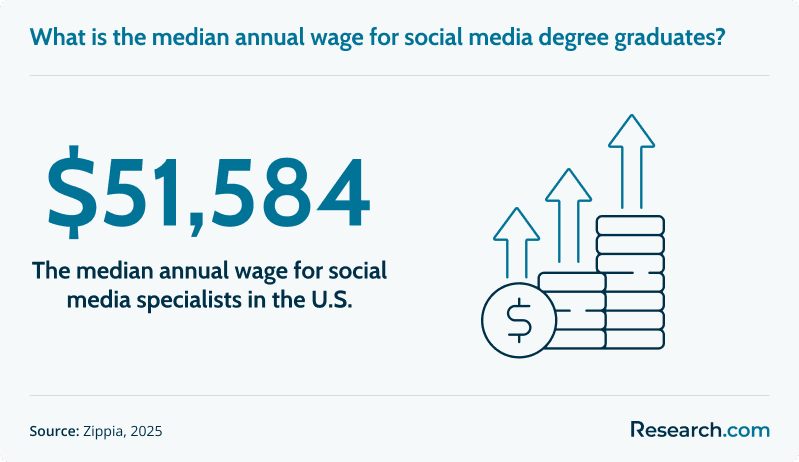
- It can support entry into a field with measurable salary potential. According to Zippia, social media specialists in the U.S. earn an average salary of $51,584 per year, with most salaries falling between $38,000 and $68,000 annually.
- It is built for flexibility. Online delivery, shorter academic terms, and transfer-friendly policies can help working adults and career switchers finish faster than they would in many traditional programs.
- It can help you build a portfolio while earning credit. Strong programs include campaign plans, social analytics reports, content calendars, brand audits, and other work samples that employers can evaluate.
What can I expect from a fast online social media degree?
A fast online social media degree usually combines communication, marketing, digital media, and analytics coursework into a compressed format. Instead of focusing only on posting content, these programs teach students how to plan campaigns, understand audiences, measure engagement, protect brand reputation, and connect social media activity to business goals.
Students commonly study social media strategy, brand messaging, search engine optimization, digital advertising, audience research, visual storytelling, content creation, analytics, and online community management. Many programs use real-world projects so students can practice building campaign briefs, editorial calendars, platform reports, and digital brand strategies.
Accelerated formats vary, but many are designed for completion in under two years, and some can be finished in as little as 12 to 18 months. The fastest timelines usually require transfer credits, full-time enrollment, year-round study, or prior learning credit.
| What to evaluate | Why it matters | What to ask before enrolling |
| Completion speed | Accelerated terms can reduce time to graduation, but the workload may be intense. | Can I finish faster with transfer credits, prior learning credit, or year-round courses? |
| Portfolio opportunities | Employers often want proof that you can create content, analyze performance, and manage campaigns. | Will I graduate with campaign samples, analytics reports, or a capstone project? |
| Career alignment | Social media roles differ: some are creative, some analytical, and some strategic. | Does the curriculum match my target job, such as content strategy, social analytics, PR, or digital advertising? |
| Student support | Fast online programs require strong advising, tutoring, and career guidance. | How quickly can I reach faculty, advisors, tech support, and career services? |
Where can I work after completing a social media degree program?
Social media graduates can work anywhere organizations need to reach, inform, convert, or support audiences online. Common employers include marketing agencies, public relations firms, media companies, e-commerce brands, technology startups, corporate communications teams, nonprofit organizations, education institutions, healthcare organizations, and government agencies.
The work setting depends on the role. Agency jobs often involve multiple clients, fast deadlines, and campaign variety. In-house roles usually focus on one brand’s long-term audience growth and reputation. Freelance or consulting work can offer flexibility, but it also requires client management, pricing, contracts, and business development skills.
How much can I make after completing a social media degree program?
Zippia reports that the average salary for a social media specialist in the U.S. is $51,584 per year. Entry-level roles often begin around $38,000 annually, while more experienced professionals or those in specialized positions may earn up to $68,000 or more. Actual pay depends on location, industry, employer size, job title, portfolio strength, and experience with analytics or paid advertising tools.
Graduates who move into broader marketing or communications leadership may pursue roles such as social media manager, digital marketing strategist, content director, or public relations manager. Some of these positions can exceed $70,000 to $90,000 per year, but salary outcomes are not guaranteed by the degree alone. Experience, measurable campaign results, leadership ability, and industry fit matter heavily.
- Fastest Online Social Media Degree Programs for 2027
- How Long Does a Fast Online Social Media Degree Take?
- Online vs. On-Campus Social Media Degrees
- Average Cost of an Online Social Media Degree
- Financial Aid for Online Social Media Degree Students
- Admissions Requirements for Online Social Media Degree Programs
- Common Courses in an Online Social Media Degree
- Social Media Degree Specializations
- Career Support and Networking in Fast Online Programs
- Using a Social Media Degree for Advanced Business Study
- Challenges in Accelerated Online Social Media Programs
- Pairing an Online Social Media Degree with an Online MBA
- How to Choose the Fastest Online Social Media Degree
- Career Paths After an Online Social Media Degree
- Job Market for Online Social Media Degree Graduates
Fastest Online Social Media Degree Programs for 2027
How do we rank schools?
Choosing a degree is both an academic and financial decision, so speed should not be the only factor. Research.com’s ranking of the fastest online social media degree programs is designed to help students compare programs using data that is broad, transparent, and decision-focused.
The ranking draws from trusted sources, including the IPEDS database, Peterson’s database through its Distance Learning Licensed Data Set, the College Scorecard, and the National Center for Education Statistics. Readers can review the broader process in Research.com’s methodology section.
Below is a curated list of 10 fast online social media degree options for 2027. Use it as a starting point, then verify current tuition, transfer rules, start dates, and graduation requirements directly with each school.
| School | Relevant online program | Fastest listed timeline | Cost information | Accreditation |
| Southern New Hampshire University | BA in Communication, New Media concentration | As few as 16 months with transfer credits | $330 per credit | NECHE |
| Liberty University | BS in Strategic Communication – Social Media Management | Three and a half years on average; faster with transfer credits | $390 full-time; $455 part-time | SACSCOC |
| Arizona State University Online | BS in Digital Audiences | Approx. three years; faster with full course loads | $561 to $661 per credit | HLC |
| Point University | BS in Social Media Marketing | As few as two years | $410 per credit | SACSCOC |
| Franklin University | BS in Marketing with Digital Marketing and Social Media focus | As little as 16 months with transfer credits | $398 per credit | HLC |
| California Baptist University | BA in Communication Studies with digital and social media coursework | As few as 16 months | $613 per credit | WASC |
| Full Sail University | BS in Media Communications | 29 months accelerated | Total program cost approx. $61,000 | ACCSC |
| University of Maryland Global Campus | BS in Marketing with social media and digital branding coursework | Two to three years; faster with transfer credits | $318 in-state; $526 out-of-state | MSCHE |
| Walden University | BS in Communication with new and emerging media focus | As few as 18 months | $340 per credit | HLC |
| Colorado State University Global | Bachelor’s in Marketing with digital and social media coursework | Two to three years; accelerated with prior credits | $350 per credit | HLC |
1. Southern New Hampshire University
Southern New Hampshire University offers an online Bachelor of Arts in Communication with a concentration in New Media. The program is a practical fit for students who want a communication degree with social media, digital storytelling, and online audience engagement built into the curriculum. Its asynchronous structure can help working adults manage coursework around job and family obligations.
- Program Length: As few as 16 months with transfer credits
- Tracks/concentrations: New Media
- Cost per Credit: $330
- Required Credits to Graduate: 120
- Accreditation: New England Commission of Higher Education (NECHE)
2. Liberty University
Liberty University provides an online Bachelor of Science in Strategic Communication – Social Media Management. The program uses accelerated eight-week terms and may appeal to students seeking a faith-based university with flexible online scheduling. Coursework emphasizes campaign planning, analytics, digital storytelling, and social media management.
- Program Length: Three and a half years on average; faster with transfer credits
- Tracks/concentrations: Social Media Management
- Cost per Credit: $390 (full-time); $455 (part-time)
- Required Credits to Graduate: 120
- Accreditation: Southern Association of Colleges and Schools Commission on Colleges (SACSCOC)
3. Arizona State University Online
Arizona State University Online offers a Bachelor of Science in Digital Audiences through the Walter Cronkite School of Journalism. The degree focuses on audience growth, digital strategy, engagement, and data-informed communication. It is best suited for students who want social media training connected to journalism, media, and digital marketing practice.
- Program Length: Approx. three years; faster with full course loads
- Tracks/concentrations: Digital Strategy, Audience Engagement
- Cost per Credit: $561 to $661
- Required Credits to Graduate: 120
- Accreditation: Higher Learning Commission (HLC)
4. Point University
Point University offers an online Bachelor of Science in Social Media Marketing. The program is delivered through a Christian worldview and is structured for adult and nontraditional learners who want to study online while continuing to work. Students can build skills in branding, marketing strategy, digital content, and campaign planning.
- Program Length: As few as two years
- Tracks/concentrations: Social Media Marketing
- Cost per Credit: $410
- Required Credits to Graduate: 120
- Accreditation: SACSCOC
5. Franklin University
Franklin University offers a Bachelor of Science in Marketing with coursework focused on Digital Marketing and Social Media. The school’s online model is designed for adults, and transfer-friendly policies may help students shorten completion time. Rolling admission options and six- to twelve-week courses can make pacing more flexible.
- Program Length: As little as 16 months with transfer credits
- Tracks/concentrations: Digital Marketing & Social Media
- Cost per Credit: $398
- Required Credits to Graduate: 124
- Accreditation: HLC
6. California Baptist University
California Baptist University offers an online Bachelor of Arts in Communication Studies that includes digital media and social media communication coursework. The program uses accelerated 8-week formats and includes academic support for online learners. Students who want a faith-based communication program with ethical discussion of digital communication may find it especially relevant.
- Program Length: As few as 16 months
- Tracks/concentrations: Digital Media, Social Media Communication
- Cost per Credit: $613
- Required Credits to Graduate: 120
- Accreditation: Western Association of Schools and Colleges (WASC)
7. Full Sail University
Full Sail University offers a Bachelor of Science in Media Communications with a creative focus on content strategy and digital storytelling. The monthly course structure is designed for faster completion than many conventional schedules. This option may suit students who want a media production-oriented route into social media, content creation, or digital brand storytelling.
- Program Length: 29 months (accelerated)
- Tracks/concentrations: Digital Storytelling, Content Strategy
- Cost per Credit: Varies; total program cost approx. $61,000
- Required Credits to Graduate: 120
- Accreditation: Accrediting Commission of Career Schools and Colleges (ACCSC)
8. University of Maryland Global Campus
University of Maryland Global Campus offers an online Bachelor of Science in Marketing with coursework in social media management, analytics, and digital branding. The university serves many adult and military-affiliated learners, and students may be able to accelerate progress through transfer credit, military training, or prior learning credit.
- Program Length: Two to three years; faster with transfer credits
- Tracks/concentrations: Digital Marketing
- Cost per Credit: $318 (in-state), $526 (out-of-state)
- Required Credits to Graduate: 120
- Accreditation: Middle States Commission on Higher Education (MSCHE)
9. Walden University
Walden University offers a Bachelor of Science in Communication with a focus on new and emerging media. The fully online format supports students who want to develop skills in digital communication, online community building, and content management while progressing at a flexible pace.
- Program Length: As few as 18 months
- Tracks/concentrations: New Media, Digital Communication
- Cost per Credit: $340
- Required Credits to Graduate: 181 quarter credits (approx. 120 semester credits)
- Accreditation: HLC
10. Colorado State University Global
Colorado State University Global offers an online Bachelor’s in Marketing with coursework in social media strategy, content marketing, and digital campaign management. Its 8-week courses and monthly start dates are designed for working professionals. Transfer credits, prior learning assessments, and testing options may help qualified students reduce time to graduation.
- Program Length: Two to three years; accelerated with prior credits
- Tracks/concentrations: Digital Marketing, Social Media Strategy
- Cost per Credit: $350
- Required Credits to Graduate: 120
- Accreditation: HLC
How long does it take to complete a fast online social media degree program?
Most fast online social media degree programs take about two to three years, but students with significant transfer credit may finish much sooner. Some programs list completion timelines of as little as 16 to 18 months when students transfer prior coursework, enroll full time, and take courses continuously.
Accelerated programs often use 6- to 8-week terms instead of the longer semester format. That can make progress faster, but it also means assignments, discussions, projects, and exams arrive quickly. Students comparing multiple business or communication routes may also review timelines in related fields, such as how long it takes to earn a human resources degree, to decide which path fits their schedule and career plans.
| Student profile | Likely timeline | Best-fit strategy |
| New college student with no transfer credit | Often closer to a traditional bachelor’s timeline unless the program is highly accelerated | Ask about year-round enrollment, course load limits, and whether summer terms are required. |
| Transfer student with many credits | May finish in as little as 16 to 18 months in some programs | Request an official transfer evaluation before committing. |
| Working adult studying part time | Usually longer than the fastest advertised timeline | Choose a program with predictable course rotations and strong advising. |
| Student with military, professional, or prior learning credit | May shorten the path if the school awards applicable credit | Confirm how prior learning credit applies to major requirements, not only electives. |
How does an online social media degree compare to an on-campus program?
Flexibility and access
Online social media degrees are often more convenient for students who work, care for family, live far from campus, or need to study outside traditional class hours. Many courses are asynchronous, which means students can complete lectures, assignments, and discussions on a set weekly schedule without attending live class at a fixed time.
Pace and completion time
Accelerated online programs may offer shorter terms, frequent start dates, and year-round enrollment. These features can help motivated students finish faster than they might in a standard campus program, especially if they enter with transfer credit.
Curriculum and learning quality
The strongest online programs cover the same core subjects as campus programs: communication theory, brand strategy, digital content, audience research, analytics, ethics, and campaign execution. The main difference is delivery. Online students need to be comfortable with learning platforms, remote collaboration, multimedia assignments, and self-directed time management.
Students who like the combination of digital coursework and flexible delivery sometimes compare social media programs with related technical options, such as a low-cost online web development degree, because web skills can strengthen digital marketing and user experience work.
| Format | Advantages | Trade-offs | Best for |
| Online accelerated | Flexible location, faster terms, easier fit for working adults | Requires discipline, fewer spontaneous campus interactions | Transfer students, career changers, working professionals |
| Online traditional pace | Flexible but less compressed | May take longer than fast-track programs | Students balancing heavy work or family responsibilities |
| On-campus | Face-to-face networking, campus resources, in-person collaboration | Less schedule flexibility and often location-dependent | Students who prefer structured classroom learning and campus life |
What is the average cost of an online social media degree program?
Program cost depends on institution type, residency status, transfer credits, fees, technology requirements, and financial aid. According to Data USA, the median in-state tuition for public institutions offering degrees in Digital Communication and Multimedia is $7,492, while the median for out-of-state students at private institutions is around $37,825. Communication and Media Studies programs show similar patterns, with $7,492 for in-state tuition and $36,088 for out-of-state median tuition.
Public universities may be more affordable for in-state students, while private and specialized institutions may offer more frequent start dates, niche concentrations, or flexible formats. Students should compare total program cost, not just tuition per credit. Fees, textbooks, software, transfer credit limits, and required remaining credits can change the real price significantly.
Cost should also be weighed against career goals. Students interested in public relations, brand strategy, or communication leadership may also explore pathways such as how to become a public relations manager to understand how education, experience, and advancement connect.
| Cost factor | Why it changes the total price | What to verify |
| Per-credit tuition | Higher tuition adds up quickly across 120 or more credits. | Ask for the full tuition estimate based on your transfer evaluation. |
| Transfer credit acceptance | Accepted credits can reduce both time and cost. | Confirm which credits apply to major, general education, and elective requirements. |
| Residency status | Public institutions may charge different rates for in-state and out-of-state students. | Check whether online students receive a separate tuition rate. |
| Fees and materials | Technology, course, graduation, and software costs can increase expenses. | Request an itemized estimate beyond tuition. |
| Financial aid | Grants, scholarships, employer support, and payment plans can reduce upfront cost. | Ask which aid applies to accelerated online enrollment. |
What are the financial aid options for students enrolling in an online social media degree program?
Online students at eligible institutions may qualify for many of the same aid options available to campus-based students. The key is to confirm that the school is accredited, that the program is aid-eligible, and that your enrollment level meets aid requirements.
- Federal aid: Pell Grants, federal student loans, and work-study eligibility are determined through the FAFSA application.
- Institutional scholarships: Colleges may offer awards for communication, marketing, digital media, adult learners, transfer students, or online students.
- Private scholarships: Professional associations, nonprofits, and local organizations may support students in media, marketing, communication, or business-related fields.
- Employer tuition assistance: Some employers help pay for degrees that improve job-related skills in communication, marketing, analytics, or digital strategy.
- State grants: State-funded aid may be available to residents attending eligible public colleges or universities.
- Payment plans: Monthly installment options can reduce the need for a large upfront tuition payment.
Students who want to enter related digital marketing roles may also compare education investments with career guides such as how to become an SEO manager, especially if they are deciding between a broad marketing degree, a social media concentration, or a more technical analytics pathway.
What are the prerequisites for enrolling in an online social media degree program?
Admissions requirements vary by college, but most bachelor’s programs in social media, digital communication, marketing, or communication studies ask for basic undergraduate eligibility materials. Transfer students may also need transcripts from every college previously attended.
- High school diploma or GED: This is the standard baseline requirement for first-time bachelor’s students.
- Minimum GPA: Some schools require a minimum GPA, often around 2.0 to 2.5, for admission or transfer credit evaluation.
- Standardized test scores: Many institutions make test scores optional, but some may still request them in specific cases.
- Technology access: Students need reliable internet, a computer capable of handling multimedia work, and comfort with online learning tools.
- Transfer documentation: Prior college credit must usually meet grade, accreditation, and course-equivalency standards to count toward the degree.
Zippia reports that 79% of social media specialists hold a bachelor’s degree, making it the most common education level in the field. Associate degrees account for 9%, while master’s degrees account for 7%. Students comparing education levels across fields may also review related requirements, such as cloud consultant education requirements, to understand how different careers value degrees, certifications, and experience.
What courses are typically in an online social media degree program?
Online social media degree programs usually blend communication foundations with applied digital marketing skills. A good curriculum should teach students not only how to create posts, but how to define an audience, choose platforms, plan campaigns, analyze performance, write persuasively, and manage a brand’s public voice.
- Digital Marketing Fundamentals: Introduces online advertising, content strategy, audience targeting, marketing funnels, and campaign measurement.
- Social Media Strategy and Management: Covers platform planning, content calendars, audience engagement, community moderation, and brand voice.
- Content Creation and Visual Communication: Builds skills in copywriting, design, video, photography, short-form storytelling, and multimedia content planning.
- Analytics and Social Listening: Teaches students how to monitor audience behavior, measure engagement, evaluate campaign results, and make data-informed decisions. Students who want deeper analytics training may compare options such as the fastest online graduate certificate programs in data analytics.
- Public Relations and Digital Reputation: Explores media relations, crisis communication, online reputation, and stakeholder messaging.
- Ethics in Digital Communication: Examines privacy, misinformation, inclusivity, transparency, influencer disclosure, and responsible platform use.
Students interested in usability, customer journeys, and interface design may also review the fastest online user experience design programs, since UX knowledge can improve landing pages, campaign flows, and social commerce experiences.
Some programs now include AI-assisted content workflows, automation tools, or emerging media topics. Students who want to understand AI-related digital work may also explore related career information such as AI trainer salary and career paths.
What types of specializations are available in online social media degree programs?
Specializations allow students to shape a broad communication or marketing degree around a specific career direction. Zippia data shows that communication is the most common major among aspiring social media specialists at 21%, followed closely by business and marketing. That mix reflects how social media work sits between messaging, audience behavior, brand strategy, and measurable business outcomes.
- Social Media Marketing: Focuses on campaign planning, platform strategy, influencer collaboration, paid and organic promotion, and brand engagement.
- Digital Content Creation: Emphasizes multimedia storytelling, design, video, copywriting, and branded content production.
- Analytics and Data-Driven Marketing: Develops skills in measurement, dashboards, campaign optimization, and audience insights. Students who want advanced quantitative training may compare a fast-track master’s in data analytics online.
- Public Relations and Strategic Communication: Covers reputation management, crisis response, media outreach, stakeholder communication, and public messaging.
- Branding and Digital Identity: Centers on consistent voice, visual identity, positioning, community perception, and cross-platform presence.
The right specialization depends on your preferred work style. Creative students may favor content creation or branding. Analytical students may prefer social listening, paid media, or digital analytics. Students who enjoy writing under pressure and managing reputation may be better suited to public relations or strategic communication.
Do fast online social media degree programs offer integrated career support and networking?
Many online programs include career support, but the depth varies widely. Useful services may include resume feedback, interview preparation, portfolio reviews, internship guidance, employer panels, virtual job fairs, alumni networking, and access to career coaching. Because social media hiring often depends on proof of skill, portfolio support can be just as important as general job-search help.
Before enrolling, ask whether the program helps students build public-facing work samples, complete internships, connect with alumni, or prepare for entry-level marketing roles. Students who plan to move from campaign execution into operations or leadership may also consider whether a future credential, such as an affordable online MBA in project management, would support longer-term goals.
Can a fast online social media degree facilitate a transition to advanced business education?
A social media degree can provide a practical foundation for graduate business study because it develops skills in communication, audience analysis, digital strategy, brand positioning, and performance measurement. These areas connect directly to business functions such as marketing, customer experience, product promotion, entrepreneurship, and corporate communications.
Students planning for management roles may use an accelerated bachelor’s program as a stepping stone toward graduate education. Those comparing next-step options often review programs such as the quickest online MBA pathways to decide whether business training should follow after gaining work experience.
What challenges might students face in accelerated online social media degree programs?
Fast programs save time, but they are not easier. Courses may move quickly, deadlines can overlap, and students must stay organized without the structure of in-person class meetings. The workload can be especially demanding for students balancing school with full-time employment, caregiving, or freelance work.
Common challenges include limited real-time interaction, compressed assignments, difficulty absorbing technical tools quickly, and the need to produce creative work under short deadlines. Strong advising, responsive faculty, tutoring, library support, writing support, and career services can make a major difference. Students comparing workload and support models may also review related accelerated options, such as a fast-track project management bachelor degree online, to understand how different online programs structure pacing and student resources.
| Common challenge | Why it matters | How to reduce the risk |
| Underestimating weekly workload | Accelerated courses can require frequent assignments and fast feedback cycles. | Ask for sample syllabi and estimate study hours before enrolling full time. |
| Weak time management | Missed deadlines can compound quickly in 6- to 8-week terms. | Use a weekly calendar, set project milestones, and avoid overloading terms. |
| No portfolio plan | A degree alone may not show employers what you can do. | Save polished campaign plans, analytics reports, writing samples, and creative assets. |
| Choosing speed over fit | The fastest program may not match your goals or budget. | Compare curriculum, accreditation, cost, transfer credit, and career support together. |
Can an online social media degree be effectively paired with an online MBA?
An online social media degree can pair well with an online MBA accredited program for students who want to combine digital communication skills with broader business training. The undergraduate degree can build marketing, audience, content, and analytics knowledge, while an MBA can add management, finance, operations, leadership, and strategic decision-making skills.
This pairing makes the most sense for students aiming at leadership, consulting, entrepreneurship, product marketing, brand management, or digital strategy roles. It may be less necessary for students who want strictly entry-level content creation roles, where portfolio quality and platform experience can matter more than graduate business education.
How do you choose the fastest online social media degree program?
The best fast program is not simply the shortest one. It is the program that helps you graduate efficiently, stay within budget, build relevant work samples, and qualify for the type of role you want. Before applying, compare speed, accreditation, cost, transfer policy, curriculum, faculty support, and career services.
- Check program length and transfer rules: Look for clear policies on transfer credit, prior learning assessment, military credit, and shortened academic terms.
- Verify accreditation: Use the federal database to confirm whether the institution is regionally accredited or otherwise properly recognized.
- Match specializations to your goal: Choose analytics for measurement-heavy roles, content creation for creative work, public relations for reputation and media roles, or branding for strategy-focused work. Students interested in trend-driven industries may also compare fast-track online fashion merchandising degrees because branding, consumer behavior, and visual marketing can overlap with social media careers.
- Calculate total cost: Review tuition, fees, materials, remaining credits, financial aid, and the opportunity cost of studying full time.
- Evaluate career services: Prioritize programs that offer portfolio development, internship support, job-search help, and employer connections.
- Review technology and software expectations: Social media coursework may require design tools, analytics platforms, video editing, collaboration software, or content management systems.
| Question to ask | Why it matters |
| How many credits will I actually need after transfer evaluation? | Advertised speed may not apply if few of your credits transfer. |
| Are courses asynchronous, synchronous, or mixed? | Your schedule may depend on whether live attendance is required. |
| Will I complete a capstone, internship, or portfolio project? | Employers often look for evidence of applied campaign skills. |
| Does the program teach analytics and paid media, not only content creation? | Data and campaign measurement can improve job competitiveness. |
| What support is available if I struggle in an accelerated term? | Fast pacing increases the importance of tutoring and advising. |
| What is the total estimated cost after aid and transfer credit? | Per-credit tuition alone does not show the real cost of the degree. |
What career paths are available for graduates of online social media degree programs?
Zippia reports an average salary of $51,584 for social media specialists. A social media or digital communication degree can prepare graduates for creative, analytical, and strategic positions across marketing, communications, media, and public relations. Students who want a more focused credential may also compare an accelerated social media marketing degree online.
Public relations is one related career direction. According to the U.S. Bureau of Labor Statistics, public relations specialists help create and maintain a positive public image for the organizations they represent. These professionals earned a median annual wage of $69,780 in May 2024.
Writing is another possible path. Writers and authors, including professionals who produce web content, campaigns, blogs, scripts, and digital copy, earned a median annual wage of $72,270 in May 2024.
- Social Media Manager: Plans campaigns, oversees content calendars, coordinates platform activity, and reports on engagement and growth.
- Digital Content Strategist: Develops content plans aligned with audience needs, business goals, and brand voice.
- Community Manager: Monitors online conversations, responds to audiences, manages communities, and supports brand reputation.
- Influencer Marketing Specialist: Identifies creators, manages partnerships, tracks campaign deliverables, and evaluates performance.
- Digital Advertising Coordinator: Supports paid social campaigns, audience targeting, budget tracking, creative testing, and performance reports.
Because many social media roles rely on data, students who want stronger quantitative preparation may also consider an accelerated online bachelor's in analytics to complement content and communication skills.
| Career path | Core strengths needed | Helpful program features |
| Social media specialist | Writing, scheduling, engagement, analytics, platform knowledge | Hands-on campaigns, content calendars, social listening projects |
| Content strategist | Audience research, brand voice, editorial planning, SEO awareness | Content strategy courses, writing-intensive assignments, portfolio reviews |
| Public relations specialist | Media writing, reputation management, crisis communication | PR coursework, digital reputation modules, writing samples |
| Digital marketing coordinator | Campaign tracking, paid media basics, email or web analytics | Analytics courses, digital advertising projects, marketing fundamentals |
| Freelance consultant | Client communication, pricing, project management, measurable results | Capstone projects, entrepreneurship electives, portfolio development |
What is the job market like for graduates who completed an online social media degree program?
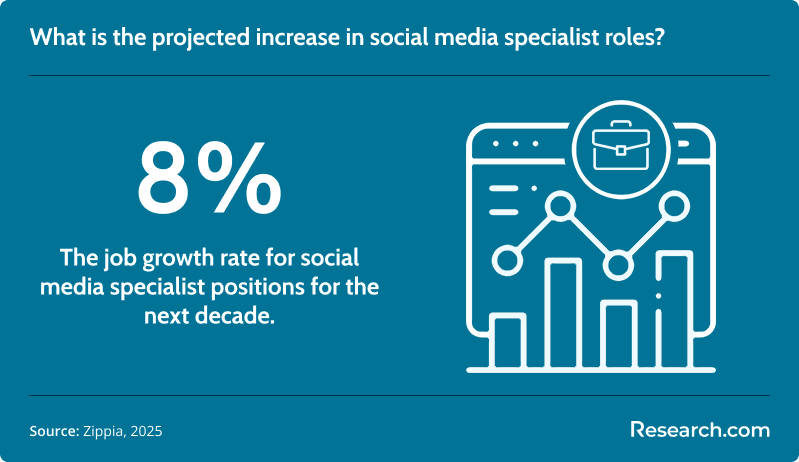
The job market for social media graduates is promising but competitive. Zippia projects an 8% job growth rate for social media specialists, indicating continued employer need for professionals who can manage online communities, strengthen brand visibility, and support digital campaigns.
Competition is strong because many candidates can create content, but fewer can connect content performance to business objectives. Graduates improve their chances when they combine a degree with internships, certifications, analytics skills, paid media exposure, writing samples, and a polished portfolio. Students interested in starting their own agency or consulting practice may also compare the shortest online bachelor's degree in entrepreneurship to build business planning and venture skills.
Strong writing remains valuable in social media work. Students who want to sharpen storytelling, tone, and long-form content development may also find value in the shortest online creative writing programs, especially if their target roles involve brand voice, scripts, blogs, newsletters, or campaign narratives.
Current trends shaping social media careers
- AI-assisted content workflows: Employers increasingly expect marketers to understand how to use AI tools responsibly for drafting, ideation, editing, repurposing, and analysis while still applying human judgment.
- Stronger analytics expectations: Social media teams are under pressure to show how campaigns affect awareness, traffic, leads, sales, retention, or community health.
- Platform volatility: Algorithms, creator tools, advertising rules, and audience behavior change frequently, so graduates need adaptable platform skills rather than training tied to only one app.
- Brand safety and ethics: Misinformation, privacy concerns, influencer disclosure, and crisis response make ethical communication and reputation management increasingly important.
- Portfolio-based hiring: Employers often want examples of strategy, writing, analytics, creative production, and campaign results, not only transcripts.
Here’s What Graduates Have to Say About the Fastest Online Social Media Degree Programs
I finished my degree in slightly less than two years while keeping my full-time job because the online schedule gave me enough flexibility. The 8-week courses moved quickly, but the virtual discussions were more active than I expected. I was able to use lessons from class almost immediately at work. Managing both school and employment was challenging, but the self-paced structure helped me stay organized and keep progressing. I now feel more prepared to grow in digital marketing. Sarah
Going back to school after more than a decade away felt overwhelming at first, but the online format made the transition manageable. The materials were easy to access, instructors answered questions, and I could complete assignments around my schedule. I especially valued the exposure to current tools such as analytics platforms and campaign managers. I now work as a freelance social media consultant, and the degree helped me build both skills and confidence. Finishing quickly was an added benefit. Jared
The online format let me study while traveling, which made the program much more practical for my life. I appreciated that the assignments focused on realistic campaigns instead of only theory. Choosing a content strategy concentration helped me create a portfolio that employers could review. The accelerated pace kept me focused, and I did not feel like I was spending time on unnecessary coursework. I accepted a content creator position within a month of graduating. Lena
Common mistakes to avoid when choosing a fast online social media degree
| Mistake | Why it can hurt you | Better approach |
| Choosing the shortest advertised program without checking transfer rules | You may not qualify for the fastest timeline if your credits do not apply. | Request a written transfer evaluation before enrolling. |
| Looking only at tuition per credit | Fees, remaining credits, software, and lost work time can affect total cost. | Compare full program cost after transfer credit and financial aid. |
| Ignoring accreditation | Accreditation can affect financial aid, credit transfer, and employer recognition. | Verify the institution through official accreditation resources. |
| Assuming all programs teach the same tools | Some programs are communication-heavy, while others include more analytics or marketing technology. | Review syllabi for analytics, paid media, content production, and campaign strategy. |
| Graduating without a portfolio | Employers may need proof of applied social media skills. | Save your best projects and revise them into job-ready samples. |
| Expecting a degree to guarantee salary growth | Pay depends on experience, location, industry, role, and measurable results. | Build experience through internships, freelance work, certifications, and portfolio projects. |
Key Insights
- A fast online social media degree is best for students who want structured training in digital communication, content strategy, analytics, branding, and campaign execution without committing to a traditional campus schedule.
- Speed depends heavily on transfer credit. Some programs can be completed in as little as 16 to 18 months, but students without prior college credit may need longer.
- Zippia reports more than 52,542 employed social media specialists in the U.S. and an average salary of $51,584, with most professionals earning between $38,000 and $68,000 annually.
- Relevant career paths include social media manager, content strategist, community manager, influencer marketing specialist, digital advertising coordinator, public relations specialist, and writer.
- BLS data shows that public relations specialists earned a median annual wage of $69,780 in May 2024, while writers and authors earned $72,270 in May 2024.
- Cost varies widely. Data USA reports median in-state tuition of $7,492 for public institutions offering Digital Communication and Multimedia programs, while the median for out-of-state students at private institutions is around $37,825. Communication and Media Studies programs show $7,492 in-state and $36,088 out-of-state median tuition.
- The best program is not automatically the fastest. Prioritize accreditation, transfer credit value, total cost, portfolio opportunities, analytics training, career support, and fit with your target role.
- AI tools, analytics expectations, platform changes, and brand safety concerns are reshaping social media work, so students should choose programs that teach adaptable strategy rather than narrow platform tactics.
References:
- BLS. (2025, April 18). Public relations specialists. bls.gov.
- BLS. (2025, April 18). Writers and authors. bls.gov.
- Data USA. (n.d.). Communication and Media Studies. datausa.io.
- Data USA. (n.d.). Digital Communication & Multimedia. datausa.io.
- Zippia. (2025, January 8). Social Media Specialist Demographics and Statistics [2025]: Number of social media specialists in the US. zippia.com.
- Zippia. (2025, January 8). Social Media Specialist Salary (June 2025). zippia.com.
Other Things You Should Know About the Fastest Online Social Media Degree Programs
Yes, many 2027 fastest online social media degree programs offer virtual internships. Typically, these internships are designed to provide hands-on experience in digital marketing and content creation. Some programs integrate internships as course credits, helping students to build networks and real-world skills.
In 2027, speedy online social media programs include accelerated bachelor's degrees from institutions like Southern New Hampshire University and Full Sail University. These programs often allow completion in less than three years through intensive coursework and continuous enrollment.
Most accelerated online social media bachelor’s degrees require about 120 semester credits, while some completion pathways accept up to 90 transfer credits from prior college work. Programs using eight-week terms can let full-time students finish in about 2 to 3 years.