2027 Fastest Online User Experience (UX) Design Programs

Co-Founder and Chief Data Scientist
Choosing a fast online user experience (UX) design program is really a decision about time, credibility, cost, and career readiness. You may want to move into UX quickly, but you still need enough training to build a portfolio, understand users, work with product teams, and compete for roles that often expect both design judgment and evidence-based decision-making.
This guide is for career changers, working adults, recent students, and creative or technical professionals comparing accelerated UX degrees, certificates, and online alternatives. You will learn how fast online UX programs work, what they cost, how they compare with campus-based study, what employers look for, and how to choose a program that supports your career goals rather than simply promising speed.
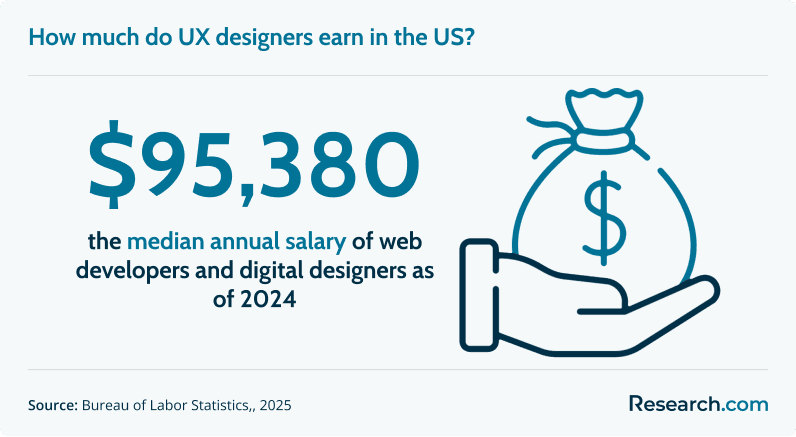
UX design remains attractive because it combines research, problem-solving, communication, and digital product design. It can also lead to strong compensation: the U.S. Bureau of Labor Statistics reports median pay of around $95,380 per year for web and digital designers. A fast program can help you reach the market sooner, but only if it gives you the right mix of theory, applied projects, feedback, and career support.
Quick Answer: Are Fast Online UX Design Programs Worth It?
A fast online UX design program can be worth it if it is accredited, portfolio-driven, realistic about workload, and aligned with the type of UX role you want. Degree programs are usually better for learners who want a formal credential, broader academic foundation, and access to financial aid. Certificates and bootcamps may be better for learners who already have a degree or related experience and need focused skills training.
The best choice depends on your starting point. If you are new to higher education, an online bachelor’s degree may provide the strongest foundation. If you already have a bachelor’s degree, a 12-month master’s program or a shorter professional certificate may be more efficient. If you need the lowest-cost introduction to UX, a subscription-based certificate can help you test the field before committing to a degree.
What Are the Main Benefits of a Fast Online UX Design Program?
- You can shorten your path into the field. Accelerated programs reduce the time between enrollment and job search. This is especially useful for working adults, career changers, and students who do not want to spend four full years before building UX experience.
- You build a stronger foundation than tool-only training usually provides. UX work is not just about learning Figma or making screens look polished. A strong program teaches user research, usability testing, information architecture, accessibility, design ethics, and the reasoning behind product decisions.
- You can study around work and family responsibilities. Online delivery can make UX education more practical for students who cannot relocate or attend daytime classes. Asynchronous courses provide the most scheduling freedom, while synchronous programs offer more live interaction.
- You may improve long-term career mobility. A formal degree can help with corporate hiring filters, graduate study, leadership pathways, and roles that prefer or require a bachelor’s or master’s credential. A certificate may be faster, but it may not carry the same value with every employer.
- You can graduate with a portfolio if the program is designed well. Employers want proof that you can identify user problems, test assumptions, explain trade-offs, and iterate. The strongest programs require multiple portfolio projects, not just quizzes or software tutorials.
What Can I Expect From a Fast Online User Experience (UX) Design Program?
A fast online UX design program is usually intensive. Instead of spreading courses over a traditional schedule, accelerated programs compress assignments, critiques, projects, and research work into shorter terms. That can be efficient, but it also means you should expect a consistent weekly workload.
Most programs combine design theory with applied work. You may study human-computer interaction, user psychology, design thinking, accessibility, wireframing, prototyping, usability testing, visual design, content strategy, and project communication. The strongest programs require you to document your process so that each project becomes a case study, not just a finished screen.
Graduates typically leave as UX generalists. That means you should understand the full design process from research through testing, but you may not yet be a deep specialist in UX research, product strategy, or advanced interaction design. Your first goal is to become employable for junior or mid-level roles, depending on your previous experience.
| What to Expect | Why It Matters | What to Ask Before Enrolling |
| Condensed coursework | Faster completion requires more work per week. | How many hours should students expect to study each week? |
| Portfolio projects | UX hiring depends heavily on case studies and process documentation. | How many portfolio-ready projects will I complete? |
| Research and testing practice | Employers look for evidence-based design decisions, not just visuals. | Will I conduct interviews, surveys, usability tests, or user analysis? |
| Software training | Design tools are necessary, but they should not be the whole curriculum. | Which tools are taught, and how are they used in real projects? |
| Faculty or mentor feedback | Critique helps students improve judgment, presentation, and design reasoning. | Who reviews my work, and how often will I receive feedback? |
Where Can I Work After Graduating From a Fast Online UX Design Program?
UX designers work wherever people use digital products, websites, apps, platforms, portals, dashboards, or service interfaces. Technology companies and design agencies are common employers, but they are not the only options. Finance, healthcare, education, retail, government, transportation, insurance, media, and nonprofit organizations all need clearer, more usable digital experiences.
Some graduates join in-house product teams. Others work for consultancies or agencies that serve multiple clients. Freelance and contract work are also common in UX, especially for designers who can manage client communication, research, scope, and deliverables independently.
The practical takeaway is simple: do not choose a UX program only because it says “UX” in the title. Choose one that prepares you for the industries and product environments you care about. A healthcare UX role, for example, may require a stronger focus on accessibility and complex workflows, while e-commerce UX may emphasize conversion, testing, and content organization.
How Much Can I Make After Graduating From a Fast Online UX Design Program?
UX earnings vary by role, location, employer, experience level, portfolio quality, and whether you work as an employee or freelancer. The U.S. Bureau of Labor Statistics reports median pay of around $95,380 for web and digital designers, which shows why UX attracts students who want both creative work and stronger earning potential.
That figure should not be read as a guaranteed starting salary. Entry-level designers may earn less, and graduates entering the field without prior professional experience may need time to build credibility. On the other hand, designers who develop strong research skills, product thinking, analytics fluency, or leadership ability may move into higher-paying roles over time.
Location can also affect pay. Existing salary data in this article notes that California offers an average annual salary of over $130,240 for designers, but high-salary regions may also have higher living costs and stronger competition.
- Fastest Online UX Design Programs for 2027
- How long fast online UX design programs take
- Online UX programs vs. on-campus UX programs
- Average cost of fast online UX design programs
- Financial aid options for UX students
- Typical admission requirements for UX programs
- Common courses in fast online UX design programs
- UX design specializations and career focus areas
- How creative writing can support UX work
- How to check credibility and accreditation
- How to choose the right fast online UX program
- Career paths for UX graduates
- Student support and career services to look forCareer preparation checklist
- Job market outlook for UX design graduatesUX salary and labor market sources
7 Fastest Online User Experience (UX) Design Programs for 2027
The programs below include online degrees, certificates, and accelerated training options. They are not identical credentials, so compare them carefully. A master’s degree, bachelor’s degree, certificate, and non-degree course can all support UX career development, but they serve different students and carry different levels of academic recognition.
| Program | Credential Type | Best Fit | Reported Time to Complete |
| University of Rhode Island | Master of Arts | Professionals with a bachelor’s degree seeking graduate-level UX/UI study | As few as 12 months |
| Western Governors University | Bachelor of Science | Self-paced learners who want a competency-based bachelor’s degree | Varies; average 30 months |
| Franklin University | Bachelor of Science | Students who want UX combined with graphic design | Approximately 4 years, depending on transfer credits |
| Institute of Data | Certificate program | Career changers seeking intensive, skills-focused training | 24 weeks, part-time |
| Google UX Design Certificate | Professional certificate | Beginners testing the field at a lower upfront cost | Under 6 months, self-paced |
| Tulane University | Bachelor of Arts | Students seeking an academic UX/UI degree from a professional advancement school | Approximately 4 years |
| Arizona State University | Bachelor of Science | Students interested in technical communication with a user experience focus | Approximately 4 years |
1. University of Rhode Island — Master of Arts in User Experience/User Interface (UX/UI) Design
The University of Rhode Island offers an online Master of Arts in User Experience/User Interface (UX/UI) Design for students who already hold an undergraduate degree and want a graduate credential. The program is structured for learners seeking advanced UX/UI knowledge, portfolio development, design research, project leadership, and ethical decision-making in digital design contexts.
- Program Length: As few as 12 months
- Required Credits to Graduate: 30 credits
- Cost per Credit: $900
- Accreditation: New England Commission of Higher Education (NECHE)
2. Western Governors University — Bachelor of Science in User Experience Design
Western Governors University provides a Bachelor of Science in User Experience Design through a competency-based online format. This model may suit independent students who want to progress by demonstrating mastery rather than following a traditional semester pace. Coursework emphasizes the UX process, including research, information architecture, interaction design, usability testing, and applied design work.
- Program Length: Varies (competency-based); average 30 months
- Required Credits to Graduate: 121 Competency Units
- Tuition: Flat-rate per 6-month term (approx. $4,385)
- Accreditation: Northwest Commission on Colleges and Universities (NWCCU)
3. Franklin University — Bachelor of Science in User Experience & Graphic Design
Franklin University offers a Bachelor of Science in User Experience & Graphic Design for students who want to combine user-centered product thinking with visual communication. The program may be a good match for learners who want design fundamentals, UX methods, prototyping practice, and graphic design training within one undergraduate pathway.
- Program Length: Approximately 4 years (varies with transfer credits)
- Required Credits to Graduate: 120 semester hours
- Cost per Credit: $398
- Accreditation: Higher Learning Commission (HLC)
4. Institute of Data — Accelerated UI/UX Design Course
The Institute of Data offers an Accelerated UI/UX Design Course for students who want a shorter non-degree route into practical UX/UI skills. The program focuses on applied projects, user research, prototyping, visual design, and portfolio development. Because it is not a degree, students should evaluate how the credential will be viewed by their target employers.
- Program Length: 24 weeks (part-time)
- Required Credits to Graduate: N/A (Certificate Program)
- Total Program Cost: Varies; contact for pricing
- Accreditation: N/A (Non-degree program)
5. Google UX Design Certificate — Google User Experience Certificate
The Google UX Design Certificate is a beginner-oriented professional certificate delivered through Coursera. It introduces the UX design process, including user empathy, problem definition, wireframes, prototypes, and tools such as Figma. This option can be useful for learners who want to explore UX before committing to a longer degree or higher-cost program.
- Program Length: Under 6 months (self-paced)
- Required Credits to Graduate: N/A (Professional Certificate)
- Cost: Subscription-based via Coursera
- Accreditation: N/A (Professional Certificate)
6. Tulane University — Bachelor of Arts in Interactive UX/UI Design
Tulane University offers a Bachelor of Arts in Interactive UX/UI Design through its School of Professional Advancement. The program is designed for students who want undergraduate training at the intersection of design, technology, and human behavior. Coursework covers user-centered research, design principles, prototyping, and the development of usable interactive experiences.
- Program Length: Approximately 4 years
- Required Credits to Graduate: 120 credits
- Cost per Credit: $632
- Accreditation: Southern Association of Colleges and Schools Commission on Colleges (SACSCOC)
7. Arizona State University — Bachelor of Science in Technical Communication
Arizona State University offers an online Bachelor of Science in Technical Communication with a User Experience concentration. This path may appeal to students who want to connect UX with content strategy, usability, information design, and clear communication. It is especially relevant for learners interested in making complex information easier for users to understand and act on.
- Program Length: Approximately 4 years
- Concentrations: User Experience
- Required Credits to Graduate: 120 credits
- Cost per Credit: $654 - $766
- Accreditation: Higher Learning Commission (HLC)
How Long Does It Take to Complete a Fast Online UX Design Program?
The time required depends on the credential. A traditional bachelor’s degree commonly takes four years, while some accelerated online bachelor’s programs can be completed in about two to three years, especially when students transfer prior credits or move through competency-based coursework quickly. The time to achieve a degree varies by credential level, enrollment intensity, and institutional requirements.
Graduate programs are often shorter for students who already have a bachelor’s degree. A fast-track master’s in UX design may take 12 to 18 months, while the University of Rhode Island option listed above reports completion in as few as 12 months.
Certificates and bootcamps are usually shorter still. The Institute of Data course is 24 weeks part-time, while the Google UX Design Certificate is listed as under 6 months and self-paced. These options can build skills quickly, but they are not the same as accredited degree programs.
| Credential | Typical Fast Timeline Mentioned | Best For | Main Trade-Off |
| Bachelor’s degree | As little as two to three years in some accelerated formats | Students needing a full undergraduate credential | Longer and more expensive than certificates |
| Master’s degree | 12 to 18 months in some fast-track programs | Students who already have a bachelor’s degree | Requires prior undergraduate study |
| Certificate or bootcamp | Under 6 months or 24 weeks in examples listed | Career changers seeking targeted skills | May not satisfy degree preferences in some hiring processes |
Fast does not mean low effort. Accelerated UX programs can be demanding because design work requires research, iteration, critique, and documentation. Before enrolling, ask whether the program is self-paced, cohort-based, full-time, part-time, synchronous, or asynchronous. Those details will shape your weekly schedule more than the headline completion time.
How Does a Fast Online UX Design Program Compare to an On-Campus Program?
Online and on-campus UX programs can lead to similar academic outcomes when the institution is accredited and the curriculum is comparable. The right format depends on how you learn, how much structure you need, your work schedule, and whether you value campus access or remote flexibility more.
| Factor | Fast Online UX Program | On-Campus UX Program |
| Flexibility | Better for working adults, caregivers, and students who cannot relocate | Better for students who want a fixed schedule and campus routine |
| Interaction | May use video meetings, discussion boards, Slack, Miro, Figma, and remote critiques | Offers in-person studios, live critiques, and informal campus networking |
| Cost considerations | May reduce commuting, housing, and meal-plan costs | May require relocation, transportation, or campus-based living expenses |
| Portfolio development | Can be strong if the program includes projects, critique, and case-study guidance | Can be strong if studio culture and faculty feedback are consistent |
| Best fit | Independent learners who can manage deadlines remotely | Students who benefit from face-to-face structure and campus resources |
- Accredited online degrees can carry the same academic value. If a university is properly accredited, online delivery does not automatically make the degree less legitimate. What matters is institutional recognition, curriculum quality, faculty involvement, and student outcomes.
- Online programs require digital collaboration. Remote UX students often use the same tools distributed design teams use professionally. That can be an advantage if you plan to work remotely or with cross-functional teams.
- Campus programs may offer more informal networking. Some students benefit from studio spaces, in-person faculty access, and local employer events. If those experiences are important to you, compare them against the convenience of online study.
- Online study can lower indirect costs. Tuition may still be substantial, but students can often avoid relocation, commuting, campus housing, and meal-plan expenses. Similar priorities drive interest in other flexible programs, including the fastest online graduate certificate programs in logistics and supply chain management.
What Is the Average Cost of a Fast Online UX Design Program?
Costs vary widely because “UX program” can mean a professional certificate, a non-degree bootcamp, a bachelor’s degree, or a master’s degree. The credential type, school, tuition model, transfer credits, and fees can all change the final price.
Master's degree programs typically have a total tuition cost ranging from $25,000 to $40,000. The University of Rhode Island's online Master of Arts program costs around $27,000 in total based on the listed $900 cost per credit and 30-credit requirement.
Bachelor's degrees represent a larger investment, with total costs often falling between $30,000 and $80,000. A competency-based model such as Western Governors University can cost as little as $22,000. Programs that charge by credit, including Franklin University at $398 per credit, Tulane University at $632 per credit, and Arizona State University at $654 - $766 per credit, can produce total costs ranging from approximately $48,000 to over $80,000.
Certificate options can lower the initial cost. The Google UX Design Certificate uses a subscription-based Coursera model, while the Institute of Data program lists pricing as variable and requires students to contact the provider. When comparing programs, include technology fees, software subscriptions, books, portfolio hosting, and any required hardware.
| Program Type | Cost Information Stated | What to Consider |
| Master’s degree | $25,000 to $40,000; University of Rhode Island around $27,000 in total | Best for students who already hold a bachelor’s degree and want a graduate credential |
| Bachelor’s degree | Often between $30,000 and $80,000 | Transfer credits can significantly affect total cost and time |
| Competency-based bachelor’s | Western Governors University can cost as little as $22,000 | Works best for self-directed students who can progress efficiently |
| Per-credit bachelor’s | Franklin University $398; Tulane University $632; Arizona State University $654 - $766 | Multiply cost per credit by required credits and add fees |
| Certificate or bootcamp | Google is subscription-based; Institute of Data varies | Lower or faster entry, but not equivalent to an accredited degree |
Students comparing accelerated options in other fields face similar trade-offs. For example, a fast-track online bachelor's in homeland security degree may also appeal to learners balancing speed, cost, and career relevance.
What Financial Aid Options Are Available for Fast Online UX Design Students?
Financial aid depends heavily on whether the program is offered by an accredited institution and whether the credential is eligible for aid. Accredited online degree students are often able to access many of the same aid options as campus students. Non-degree bootcamps and some certificate programs may have fewer federal aid options, so verify eligibility before enrolling.
- Complete the FAFSA first. The Free Application for Federal Student Aid (FAFSA) is the starting point for federal grants, federal student loans, and work-study consideration. It is also used by many schools to determine institutional aid.
- Ask the school about program-specific scholarships. Universities may offer scholarships for online students, adult learners, transfer students, graduate students, or students in design and technology programs.
- Look for outside scholarships and grants. Professional associations, foundations, employers, and community organizations may offer awards based on field, background, financial need, or career goals.
- Check employer tuition assistance. If you already work in marketing, product, technology, customer experience, education, or communications, your employer may view UX training as job-relevant.
- Use loans carefully. Federal student loans often provide more borrower protections than private loans. Compare total debt against realistic salary expectations, not just the program’s marketing claims.
- Ask about payment plans. Monthly payment options can help reduce upfront pressure, although they do not reduce total cost.
What Are the Prerequisites for Enrolling in a Fast Online UX Design Program?
You do not always need a design or coding background to start a UX program. UX draws from psychology, writing, research, visual communication, product strategy, information science, marketing, anthropology, and technology. Coding knowledge can help, but many UX roles focus more on research, structure, prototyping, accessibility, and collaboration than production-level programming.
For bachelor’s programs, the usual baseline requirement is a high school diploma or GED. Some schools may ask for transcripts, a minimum GPA, test scores, or placement information, although many online programs have flexible or test-optional admission practices.
For master’s programs, students generally need a bachelor’s degree from an accredited institution. Many UX master’s programs accept students from different undergraduate majors. Application materials may include transcripts, a resume, a statement of purpose, recommendation letters, and sometimes a portfolio.
If you are deciding between technology-related paths, it can help to understand which is better computer science or information technology for your goals. UX overlaps with both in some workplaces, but it is its own discipline centered on users, product experience, and design decisions.
Students who want to combine UX with venture creation, product leadership, or independent consulting may also explore the shortest online master's degree in entrepreneurship as a way to add business strategy to design training.
What Courses Are Typically Included in a Fast Online UX Design Program?
Course names differ by school, but strong UX curricula usually cover the full product design process. A degree should teach more than software. It should help you understand users, frame problems, test assumptions, communicate decisions, and improve digital experiences based on evidence.
This focus differs from programs centered on educational content development, such as a most affordable online master's in instructional design. Instructional design focuses primarily on learning experiences, while UX design focuses on the usability, accessibility, and effectiveness of products, services, and interfaces.
| Course Area | What You Learn | Portfolio Value |
| User-centered design foundations | Design thinking, human-computer interaction, ethics, accessibility, and UX vocabulary | Shows you can explain the reasoning behind design choices |
| User research | Interviews, surveys, personas, journey maps, usability tests, and synthesis methods | Demonstrates that your designs are based on user evidence |
| Information architecture | Navigation, content grouping, user flows, site maps, and labeling systems | Shows how you organize complex information clearly |
| Interaction design | Task flows, microinteractions, interface behavior, and prototype logic | Helps employers see how your product experiences work |
| Wireframing and prototyping | Low-fidelity sketches, high-fidelity mockups, clickable prototypes, and iteration | Creates visible artifacts for case studies |
| Visual and UI design | Typography, color, layout, hierarchy, responsive design, and interface consistency | Strengthens the presentation quality of your work |
| Portfolio or capstone | End-to-end project work, critique, documentation, and presentation | Often becomes the most important hiring asset |
Some students combine UX with industry-specific interests. For example, accelerated online entertainment business degree programs may interest learners who want to design experiences for media platforms, streaming services, events, or entertainment technology.
What Specializations Are Available in Fast Online UX Design Programs?
Many fast UX programs start with generalist training because employers often expect entry-level designers to understand the full process. After building that foundation, you can specialize through electives, projects, internships, certificates, or work experience.
Students interested in behavioral metrics, experimentation, or product performance may also consider the shortest graduate certificate programs in data analytics online. Data skills can strengthen UX research, product strategy, usability evaluation, and stakeholder communication.
- UX research: Best for students who enjoy interviews, usability testing, behavioral analysis, and turning evidence into product recommendations.
- Interaction design: Best for designers who like flows, interface behavior, task completion, prototyping, and the logic of how products respond.
- Information architecture: Best for students who are strong at organizing content, simplifying complexity, and building intuitive navigation systems.
- UI design: Best for visually oriented learners who want to focus on layouts, design systems, typography, color, and accessible interface presentation.
- Product design: Best for designers who want a broader role spanning UX, UI, business goals, product requirements, and launch decisions.
- AI and emerging technology experience design: Best for students interested in how people interact with intelligent systems, automation, chat interfaces, or adaptive tools. If this area interests you, it may also help to learn what does an AI trainer do, since some AI-related roles involve evaluating and improving human-system interactions.
How Can Creative Writing Complement UX Design Education?
Creative writing can strengthen UX work because digital products rely on clear language, story structure, tone, and user-centered communication. UX designers often need to explain user journeys, write interface copy, present case studies, and make research findings understandable to stakeholders. Strong writing also helps with portfolio narratives, product messaging, onboarding flows, and content strategy.
If your design interests include UX writing, content design, storytelling, or brand experience, writing coursework can be a useful complement. Students who want a low-cost way to build narrative and communication skills can compare the cheapest online creative writing programs.
How Do I Evaluate the Credibility and Accreditation of a Fast Online UX Design Program?
Start with accreditation. For degree programs, confirm that the institution is accredited by a recognized accrediting body. Accreditation affects credit transfer, graduate school eligibility, employer perception, and access to many financial aid options. A non-degree certificate may still be useful, but it should not be described as equivalent to an accredited bachelor’s or master’s degree.
Next, examine the curriculum and outcomes. A credible UX program should include user research, usability testing, prototyping, accessibility, portfolio development, and feedback from qualified instructors. Review faculty backgrounds, sample student work if available, career services, internship support, alumni outcomes, and whether the program clearly explains its total cost and time commitment.
When comparing value across design-related graduate pathways, some students also review programs outside UX, such as the most affordable online architecture master's degree, to understand how different creative and technical disciplines approach accreditation, studio work, cost, and career preparation.
How to Choose the Best Fast Online UX Design Program
The best program is not automatically the shortest or cheapest one. It is the program that fits your current education level, target role, budget, learning style, and need for a recognized credential. Treat the decision like a UX research project: define your goal, gather evidence, compare options, and avoid assumptions.
For example, someone researching SEO manager education requirements would compare employer expectations before selecting a marketing program. UX students should do the same by reviewing job descriptions for UX designer, UI designer, UX researcher, product designer, and content designer roles.
| Decision Factor | Choose a Degree If... | Choose a Certificate or Bootcamp If... |
| Credential needs | You want a bachelor’s or master’s credential for long-term mobility. | You already have a degree or need targeted skills quickly. |
| Career stage | You are starting from limited college experience or want a structured academic path. | You are changing roles and need portfolio projects or tool practice. |
| Cost | You can use financial aid, transfer credits, or employer assistance. | You want a lower-cost way to test the field before committing. |
| Time | You can commit to a longer but more comprehensive pathway. | You need a shorter training option and understand its limits. |
| Hiring goals | You are targeting employers that prefer formal degrees. | You are targeting skills-based roles where portfolio strength matters most. |
- Match the credential to your goal. A degree may be more useful for corporate advancement, graduate study, and roles with formal education requirements. A certificate may be enough for learners who already have related experience.
- Prioritize portfolio outcomes. Ask how many case studies you will complete, who reviews them, and whether projects include research, testing, and iteration. A polished portfolio often matters more in interviews than course titles.
- Review the curriculum in detail. Make sure the program covers both research and design execution. Avoid programs that focus only on tools without teaching users, usability, accessibility, and design rationale.
- Check faculty and mentor experience. UX changes quickly. Programs that combine academic grounding with current industry practice can provide more useful feedback.
- Verify accreditation for degree programs. Accreditation is essential for many forms of financial aid and for the broader recognition of your credential.
- Evaluate support services. Look for career coaching, portfolio review, resume support, mock interviews, networking events, alumni access, and internship guidance.
- Consider complementary skills. Students who want stronger analytics and product decision-making skills may compare the fastest online master's degree programs in analytics as a related option.
Common Mistakes to Avoid When Choosing a UX Program
| Mistake | Why It Can Hurt You | Better Approach |
| Choosing only the fastest option | You may finish quickly without enough portfolio evidence. | Compare speed with project depth, critique, and career support. |
| Ignoring accreditation | Credits may not transfer, and financial aid may be limited. | Verify institutional accreditation before applying to a degree program. |
| Focusing only on tuition | Fees, software, hardware, and lost time can change total cost. | Calculate full program cost before borrowing or enrolling. |
| Assuming tools equal UX skill | Employers expect research, reasoning, communication, and usability judgment. | Choose programs that teach process, not just software. |
| Relying only on rankings | A highly visible program may not fit your schedule, budget, or goals. | Use rankings as one input, then review curriculum and outcomes. |
| Believing salary outcomes are guaranteed | Pay depends on market, role, portfolio, location, and experience. | Use salary data as context, not a promise. |
Considering where UX designers work can also help you choose a program with relevant projects. The chart below shows the largest employers of web and digital interface designers.
What Career Paths Are Available for Graduates of Fast Online UX Design Programs?
A UX education can lead to several related roles. Some graduates become UX designers, while others move toward research, interface design, product design, content design, or strategy. Your previous experience matters: a graphic designer may move toward UI or product design, while a psychology or social science graduate may be drawn to UX research.
| Role | Primary Focus | Good Fit For |
| UX Designer | End-to-end design process, user flows, wireframes, testing, and product improvements | Generalists who enjoy both research and design execution |
| UI Designer | Visual interface design, layout, typography, color, components, and design systems | Students with strong visual design interests |
| UX Researcher | User interviews, surveys, usability tests, analysis, and insight communication | People who enjoy evidence, behavior, and qualitative or quantitative research |
| Product Designer | UX, UI, product requirements, business goals, and cross-functional collaboration | Designers who want broader ownership of product decisions |
| Information Architect | Navigation, content structure, taxonomy, and findability | Students who like organizing complex systems |
| UX Strategist | Connecting user needs, business goals, product roadmaps, and service design | Experienced professionals moving into planning or leadership |
| Content Designer or UX Writer | Interface language, user guidance, microcopy, and content flows | Strong writers who understand users and product context |
Technical fluency can expand your options. UX designers do not always need to code, but understanding web technologies, cybersecurity concerns, data systems, and cloud-based products can improve collaboration with engineers. Students who want broader technical preparation may explore accelerated IT training online.
UX thinking can also apply in less obvious roles. For example, user-centered thinking is valuable in secure product design and risk communication, both of which can relate to the information security manager career path.
The financial compensation for these roles is strong and can be significantly influenced by geographic location. The chart below highlights the states where web and digital designers earn the highest average salaries.
What Student Support and Career Services Can Improve UX Career Prospects?
Career support can make a major difference in a fast online UX program because students must translate coursework into job-ready evidence. Look for programs that help you build a portfolio, practice interviews, write case studies, and explain your process to hiring managers.
- Portfolio review: Students should receive detailed feedback on case studies, not just assignment grades.
- Career coaching: Resume help, LinkedIn review, mock interviews, and job-search planning can shorten the transition from school to employment.
- Mentorship: Access to faculty, industry mentors, or alumni can help students understand employer expectations.
- Networking opportunities: Virtual career fairs, guest speakers, alumni events, and critique sessions can help online students build professional connections.
- Internship or project support: Real or realistic client-style projects help students demonstrate applied problem-solving.
- Cross-disciplinary options: Some students strengthen design thinking by studying adjacent creative fields, such as an online architecture degree, especially when interested in spatial experience, service design, or complex systems.
What Is the Job Market for Graduates of a Fast Online UX Design Program?
The job market for UX-related roles is tied to the continued use of websites, apps, software platforms, digital services, and online customer experiences. Organizations need professionals who can reduce friction, improve usability, support accessibility, and help teams make better product decisions.
The U.S. Bureau of Labor Statistics data cited in this article shows an 8% projected growth rate for digital designers, which is double the average growth rate for all occupations in the U.S. That does not mean every graduate will find a role immediately, but it does indicate continued demand for digital design skills.
Competition can still be real, especially for entry-level UX designer roles. Employers often expect a strong portfolio, clear communication, collaboration skills, and evidence that you can connect research to design decisions. Adding complementary skills can help. For example, fast-track bachelor's in analytics online programs may support students who want to combine UX design with data analysis and business intelligence.
Freelancing and consulting can also be part of the UX market. Some designers work independently with startups, agencies, small businesses, or product teams, similar to the flexibility found in an IT consulting career. Independent work can offer variety, but it also requires client management, pricing, contracts, and business development.
How to Judge Graduate Outcomes Before You Enroll
Instead of relying on testimonials alone, ask for evidence. Strong UX programs should be able to explain how they support portfolio development, what types of roles graduates pursue, whether career services are available to online students, and how often students receive feedback from instructors or mentors.
When speaking with admissions advisors, ask direct questions: How many UX case studies will I graduate with? Are projects based on real users or hypothetical prompts? Do students receive portfolio reviews from industry professionals? What job titles do graduates commonly pursue? Are salary claims based on verified graduate data or broad labor-market statistics?
If a program cannot answer those questions clearly, keep comparing options.
Current Trends Affecting UX Design Education and Hiring
- AI is changing workflows, not eliminating the need for UX judgment. Designers increasingly use AI-assisted tools for ideation, content drafts, analysis support, and prototyping. Employers still need people who can define problems, understand users, evaluate outputs, and make ethical design decisions.
- Portfolio quality matters more than course completion alone. Hiring teams want to see how you think. A case study should explain the problem, users, research method, constraints, iterations, and outcome.
- Remote collaboration is now a core skill. Online UX programs can prepare students for distributed design work if they include team projects, critiques, and shared tools.
- Accessibility is becoming harder to ignore. UX designers are expected to consider inclusive design, readable interfaces, keyboard navigation, and usability for diverse users.
- Data literacy is increasingly valuable. UX professionals who can interpret behavioral metrics, usability findings, and product analytics may communicate more effectively with product managers and business stakeholders.
Questions to Ask Before Choosing a Fast Online UX Design Program
- Is the institution accredited, and does the credential qualify for financial aid?
- Is this a degree, professional certificate, bootcamp, or non-degree course?
- How many portfolio-ready projects will I complete?
- Will I conduct user research and usability testing, or only create designs?
- Who gives feedback on my work, and how often?
- Does the program teach accessibility and ethical design?
- Are career services available to online students?
- What is the total cost, including fees and software?
- Can I transfer credits into the program?
- Will the schedule fit my work and family responsibilities?
- Do the courses match the job descriptions I am targeting?
- Does the program provide realistic information about salaries and employment outcomes?
Key Insights
- A fast online UX design program is worthwhile when it balances speed with accreditation, portfolio development, user research, critique, and career support.
- Degree programs and certificates serve different needs. A bachelor’s or master’s degree may support long-term mobility, while a certificate can be a faster way to build targeted skills or test the field.
- UX compensation can be strong, with web and digital designers earning median pay of around $95,380, but starting salaries vary by role, location, experience, and portfolio quality.
- The job outlook is favorable, with an 8% projected growth rate for digital designers, double the average growth rate for all occupations in the U.S.
- Cost varies sharply. Master’s programs typically range from $25,000 to $40,000, bachelor’s programs often fall between $30,000 and $80,000, and certificate costs depend on the provider and pricing model.
- Do not choose a program based only on speed. The strongest hiring asset is usually a well-documented portfolio showing research, design reasoning, testing, iteration, and communication.
- Accreditation matters for degree programs because it can affect financial aid, transfer credit, employer recognition, and future education options.
- AI, accessibility, remote collaboration, and data literacy are shaping UX expectations, so students should look for programs that prepare them for modern product teams.
References:
- Bureau of Labor Statistics, U.S. Department of Labor. (2024). Web developers and digital designers: Occupational outlook handbook. bls.gov
- Interaction Design Foundation. (n.d.). What is user experience (UX) design? interaction-design.org
- Interaction Design Foundation UX design topic page. UX design overview
- Nielsen Norman Group. (2024, July 10). Growing in your UX career: Study guide. nngroup.com
- Nielsen Norman Group UX career resource. UX career study guide
- Tulane School of Professional Advancement. (2025). Bachelor of Arts In Interactive UX/UI Design. sopa.tulane.edu
- Zippia. (n.d.). User experience designer skills for your resume and career. zippia.com
Other Things You Should Know About the Fastest Online User Experience (UX) Design Programs
In 2027, some of the quickest online UX design programs can be completed in approximately 3 to 6 months. Providers like General Assembly, Coursera's Google UX Design Certificate, and Springboard offer intensive courses tailored for rapid learning outcomes.
Yes, many of the fastest online UX design programs in 2027 award certifications upon completion. These certifications can be a valuable addition to a resume, demonstrating proficiency in UX design skills and potentially enhancing job prospects in the field.
Most 2027 fastest online UX design programs require basic familiarity with design tools like Adobe XD or Sketch, as well as fundamental knowledge of HTML and CSS. Some programs may also request submission of a portfolio showcasing prior design work.
Yes, many accelerated online UX programs accept transfer credits, usually up to 30 to 60 semester credits, if the courses match required UX, design, or general-education subjects. Schools typically require official transcripts, a minimum grade of C or better, and approval from the program director.