2027 Best Online Business Communication Degree Programs

Co-Founder and Chief Data Scientist
Feeling lost between similar-sounding communication degrees is common—but the right choice brings real clarity and career security. Unlike media’s storytelling focus or strategic communication’s leadership emphasis, business communication is about operational clarity, alignment, and measurable impact. With an estimated 60% of companies not effectively measuring their internal communication, the opportunity for skilled professionals is clear.
To help you seize that opportunity, our career planning experts developed this comprehensive guide. It provides a clear map to the best programs and the valuable, in-demand career paths they unlock, helping you make a truly confident decision
What are the benefits of getting an online business communication degree?
- This degree prepares you for strategic roles like communications project manager, marketing communications manager, and corporate consultant across every major industry.
- Graduates are positioned for excellent earning potential, with roles like Communications Consultant commanding an average salary of $91,455.
- Studying online offers the flexibility to balance your education with work, family, and other life commitments without sacrificing academic quality.
What can I expect from an online business communication degree?
The curriculum of an online strategic communication degree centers on business strategy, viewed through the lens of high-impact communication. You’ll begin by building a solid foundation in core business disciplines—courses in management, marketing, and organizational behavior will help you understand how effective organizations function from the inside out.
From there, the focus shifts to mastering advanced communication skills tailored for leadership. This goes beyond presentation skills, diving into areas like conflict resolution, digital media strategy, and intercultural communication. The goal is to equip you to not only diagnose complex business challenges but also rally others around clear, persuasive solutions.
Where can I work with an online business communication degree?
One of the biggest strengths of an online business communication degree is that you are not locked into a single industry. These skills are in high demand everywhere, giving you incredible career flexibility. Graduates are sought after in high-growth, high-paying sectors like technology, finance, and healthcare.
These complex industries need professionals who can translate technical information, manage diverse teams, and shape company culture. Of course, you’ll also find abundant opportunities in traditional corporate roles, marketing agencies, and non-profit organizations. This versatility is a powerful asset, providing you with career stability and the freedom to pursue your interests.
How much can I make with an online business communication degree?
The earning potential with an online strategic communication degree is strong, offering a clear pathway to high-paying leadership and management roles. While starting salaries vary by role, industry, and location, the long-term financial outlook is highly promising.
A prime example is the role of a marketing manager—a common career for graduates of this program—with a median annual salary of $161,030, according to the latest data. Salaries in this field typically range from $81,900 to well over $239,200 for top earners in major sectors, showing both solid entry-level potential and substantial room for growth as your career advances.
- List of the Best Online Business Communication Degree Programs for 2027 List of Programs
- How long does it take to complete an online business communication degree program? Completion Time
- How does an online business communication degree program compare to an on-campus program? How does an online business communication degree program compare to an on-campus program?
- What is the average cost of an online business communication degree program? Program Cost
- What are the financial aid options for students enrolling in an online business communication degree program? Financial Aid
- What are the prerequisites for enrolling in an online business communication degree program? What are the prerequisites for enrolling in an online business communication degree program?
- What courses are typically in an online business communication degree program? What courses are typically in an online business communication degree program?
- What types of specializations are available in an online business communication degree program? What types of specializations are available in an online business communication degree program?
- How to Choose the Best Online Business Communication Degree Program How to Choose the Best Online Business Communication Degree Program
- What career paths are available for graduates of an online business communication degree program? What career paths are available for graduates of an online business communication degree program?
- What is the job market for graduates with an online business communication degree program? Job Market
- Are Advanced Degrees Beneficial for Elevating My Business Communication Career? Are Advanced Degrees Beneficial for Elevating My Business Communication Career?
- How Can Incorporating UX Design Enhance Business Communication? How Can Incorporating UX Design Enhance Business Communication?
Best Online Business Communication Degree Programs for 2027
Choosing an online business communication degree is not just about finding a convenient bachelor’s program. You are deciding whether a curriculum will help you write clearly, present persuasively, manage brand messages, work with data, and communicate across departments in real business settings. For students who want business training without giving up communication-focused career options, this degree can lead toward roles in corporate communication, public relations, marketing communication, employee communication, consulting, and management support.
This guide is designed for first-time college students, transfer students, working adults, and career changers comparing online bachelor’s programs. You will find ranked program options, cost and duration details, admissions expectations, course topics, specialization choices, job-market context, and practical questions to ask before enrolling. If your goals are more leadership-centered or faith-based, you may also want to compare this path with programs such as the fastest online Christian leadership degree programs.
Quick Answer: Is an Online Business Communication Degree Worth Considering?
An online business communication degree can be a strong choice if you want a bachelor’s program that combines business foundations with writing, presentation, media, public relations, and organizational messaging skills. Most programs require 120 credits and take about 4 years for full-time students, though transfer credits can shorten the timeline. Costs vary widely: among the listed programs, per-credit tuition ranges from $235.57 (in-state) to $823.13. The best program for you is the one that is accredited, fits your budget, accepts your transfer credits, and offers coursework connected to your target career.
| Decision Factor | What to Look For | Why It Matters |
| Accreditation | Regional institutional accreditation and, when relevant, business-specific accreditation | Accreditation affects credit transfer, graduate school eligibility, employer recognition, and federal financial aid access. |
| Cost | Per-credit tuition, fees, transfer credit policies, and employer tuition assistance | A low tuition rate may not be the lowest total cost if fees are high or few credits transfer. |
| Curriculum | Business writing, public relations, digital media, organizational communication, marketing, analytics, and capstone work | The strongest programs build a portfolio of practical work, not only theoretical knowledge. |
| Online Support | Advising, tutoring, career services, internship guidance, library access, and faculty availability | Online students need structured support to stay on track and build professional networks. |
| Career Fit | Alignment with corporate communication, PR, marketing communication, HR communication, or consulting goals | Business communication is broad, so specialization and electives should match the role you want after graduation. |
How the Programs Are Ranked
Because a bachelor’s degree is a major financial and time commitment, the ranking process uses institutional and program data rather than promotional claims. Research.com evaluates online business communication programs using trusted education data sources, including the IPEDS database, Peterson's database, the College Scorecard database, and The National Center for Education Statistics.
These sources help compare programs using available information on institutions, costs, completion-related data, and academic quality indicators. To understand how Research.com evaluates schools and programs, review the Research.com methodology page.
1. Arizona State University - Bachelor of Arts in Business – Communication
The Bachelor of Arts in Business – Communication from the W. P. Carey School of Business at Arizona State University blends business fundamentals with communication training. It is a good fit for students who want a business degree with a strong emphasis on organizational messaging, team coordination, and professional communication across industries.
- Program Length: 4 years
- Required Credits to Graduate: 120
- Cost per Credit: $763
- Accreditation: Higher Learning Commission (HLC)
2. Cleary University - Bachelor of Business Administration (BBA) – Business Communications
The Business Communications concentration at Cleary University is built for students who want a BBA structure with applied communication coursework. The program emphasizes writing, speaking, technology use, advertising, and media creation, making it especially relevant for students interested in connecting internal business goals with public-facing communication.
- Program Length: 4 years
- Required Credits to Graduate: 120
- Cost per Credit: $823.13
- Accreditation: Higher Learning Commission (HLC)
3. Southern New Hampshire University - Bachelor of Arts in Communication with a Concentration in Business Communication
The business communication concentration at Southern New Hampshire University focuses on communication strategies for both internal and external audiences. Students who want a communication degree with workplace-focused applications may find this format useful, especially if they want to build skills in collaboration, interpersonal communication, and organizational messaging.
- Program Length: 4 years
- Required Credits to Graduate: 120
- Cost per Credit: $342
- Accreditation: New England Commission of Higher Education (NECHE)
4. Liberty University - Bachelor of Science in Business Administration (BSBA) and Data Analysis – Communications
Liberty University offers an ACBSP-accredited BSBA option that combines business administration, data analysis, and communication. The program is taught from a biblical worldview and may appeal to students who want quantitative business exposure along with communication strategy for corporate, entrepreneurial, or global business environments.
- Program Length: 4 years
- Required Credits to Graduate: 120
- Cost per Credit: $390
- Accreditation: Southern Association of Colleges and Schools Commission on Colleges (SACSCOC)
5. Purdue Global - Bachelor’s in Communication
The online bachelor’s in communication from Purdue Global covers core communication concepts along with workplace-relevant topics such as conflict management, diversity, and digital media. Students who select the business foundations concentration can add coursework in accounting, management, and marketing.
- Program Length: 4 years
- Required Quarter Credits to Graduate: 180
- Cost per Credit: $371
- Accreditation: Higher Learning Commission (HLC)
6. Pace University - BS in Professional Communication Studies
The BS in Professional Communication Studies from Pace University offers a broader liberal arts-based communication foundation through areas such as English, history, and psychology. It may suit students who want professional communication training with exposure to media, public image management, marketing, and independent decision-making.
- Program Length: 3–4 years
- Required Credits to Graduate: 120
- Cost per Credit: $641
- Accreditation: Middle States Commission on Higher Education (MSCHE)
7. St. Cloud State University - BA Professional Communication
The online BA in Professional Communication at St. Cloud State University draws from communication studies, English, and mass communications. Students learn to apply communication theory ethically across written, oral, social media, and audience-specific formats.
- Program Length: 4 years
- Required Credits to Graduate: 120
- Cost per Credit: $312.87 (in-state)
- Accreditation: Higher Learning Commission (HLC)
8. Florida International University - Bachelor of Science in Public Relations, Advertising and Applied Communications
The fully online program from Florida International University prepares students to create communication strategies for public relations, advertising, and applied communication settings. FIU Online also offers support resources such as a personal success coach and access to the Communication Studio for professional coaching.
- Program Length: 4 years
- Required Credits to Graduate: 120
- Cost per Credit: $235.57 (in-state)
- Accreditation: Southern Association of Colleges and Schools Commission on Colleges (SACSCOC)
Program Comparison Table
| School | Program | Length | Credits | Cost per Credit | Accreditation |
| Arizona State University | BA in Business – Communication | 4 years | 120 | $763 | Higher Learning Commission (HLC) |
| Cleary University | BBA – Business Communications | 4 years | 120 | $823.13 | Higher Learning Commission (HLC) |
| Southern New Hampshire University | BA in Communication, Business Communication concentration | 4 years | 120 | $342 | New England Commission of Higher Education (NECHE) |
| Liberty University | BSBA and Data Analysis – Communications | 4 years | 120 | $390 | Southern Association of Colleges and Schools Commission on Colleges (SACSCOC) |
| Purdue Global | Bachelor’s in Communication | 4 years | 180 quarter credits | $371 | Higher Learning Commission (HLC) |
| Pace University | BS in Professional Communication Studies | 3–4 years | 120 | $641 | Middle States Commission on Higher Education (MSCHE) |
| St. Cloud State University | BA Professional Communication | 4 years | 120 | $312.87 (in-state) | Higher Learning Commission (HLC) |
| Florida International University | BS in Public Relations, Advertising and Applied Communications | 4 years | 120 | $235.57 (in-state) | Southern Association of Colleges and Schools Commission on Colleges (SACSCOC) |
How Long Does an Online Business Communication Degree Take?
Most online business communication bachelor’s programs are designed around 120 credits and take 4 years for full-time students. That timeline can change if you enroll part time, take summer courses, transfer previous credits, or choose a school with shorter academic terms. Purdue Global uses quarter credits and lists 180 required quarter credits to graduate.
Traditional First-Time Students
Students entering after high school typically follow the standard 4-year path. This pace allows room for general education courses, major requirements, electives, internships, and portfolio-building projects. AP, dual-enrollment, or other approved credits may reduce the number of courses needed. Students comparing online program formats across unrelated fields can also review examples such as the fastest online space studies degree programs to understand how acceleration models differ by discipline.
Transfer Students and Working Adults
If you have prior college coursework, ask each school for a transfer evaluation before committing. A program that appears more expensive per credit may become more affordable if it accepts more of your previous credits. Working adults should also check whether courses are asynchronous, whether deadlines are weekly, and whether the program allows part-time enrollment without losing access to advising or financial aid options.
| Student Profile | Likely Timeline | What Can Shorten the Degree | What Can Extend the Degree |
| First-time full-time student | About 4 years | AP, dual-enrollment, summer courses | Changing majors, repeating courses, stopping out |
| Transfer student | Varies by accepted credits | Generous transfer policies and prior completed general education courses | Credits that do not match program requirements |
| Working adult | Often depends on part-time or full-time enrollment | Employer support, flexible course scheduling, prior learning evaluation | Heavy work schedules, family responsibilities, limited course availability |
Online vs. On-Campus Business Communication Programs: What Changes?
An online business communication degree from an accredited institution is generally intended to meet the same academic standards as the school’s campus-based programs. Employers typically look at the institution, accreditation, skills, experience, and portfolio rather than assuming a degree is weaker because courses were completed online. In many cases, diplomas do not identify the delivery format.
The bigger difference is the student experience. Campus programs provide in-person classroom interaction, local networking, and face-to-face events. Online programs offer flexibility, access from different locations, and the ability to continue working while studying. The better choice depends on your schedule, learning style, support needs, and career goals.
Online Program Support: What to Verify Before Enrolling
Do not assume that an online program means studying alone. Strong online programs provide academic advising, library access, faculty office hours, writing help, career services, internship support, and virtual networking opportunities. If a school cannot clearly explain how online students receive these services, treat that as a warning sign.
Students should also compare the digital learning environment itself. Ask whether group projects use live meetings, whether presentations are recorded, how feedback is delivered, and how career preparation works remotely. If you are also exploring skills-based online options, career-oriented guides such as the best online CCNA training bootcamps can help you compare how different online formats handle hands-on learning and professional preparation.
| Feature | Online Business Communication Degree | On-Campus Business Communication Degree |
| Schedule Flexibility | Usually stronger for working adults and students with family responsibilities | Often tied to fixed class times and campus attendance |
| Networking | Requires proactive use of virtual events, class discussions, and career services | More spontaneous networking through campus events and in-person activities |
| Classroom Interaction | May be asynchronous, live online, or a mix of both | Usually face-to-face with immediate classroom discussion |
| Location | Students can study from anywhere with reliable technology access | Students need to live near or commute to campus |
| Best For | Self-directed students who need flexibility | Students who prefer in-person structure and campus life |
What Is the Average Cost of an Online Business Communication Degree?
Tuition varies substantially by school, residency status, and fee structure. A useful planning estimate is average out-of-state tuition around $580 per credit hour. For a full 120-credit program, that equals approximately $72,000 before considering fees, books, transfer credits, financial aid, scholarships, employer tuition assistance, or changes in tuition over time.
Do not compare programs by tuition alone. A school with a higher per-credit price may cost less overall if it accepts more transfer credits. A school with low tuition may still become expensive if fees are high or if required courses are not available when you need them. Always ask for a complete cost estimate based on your credit evaluation and enrollment plan.
How to Think About ROI
An online business communication degree can support roles that require a bachelor’s credential, but no program can guarantee a specific salary. Career outcomes depend on location, experience, internships, portfolio quality, industry, employer, and your ability to apply communication skills in measurable ways. The degree can also serve as a foundation for later business study, including advanced credentials connected to leadership and executive compensation, such as roles discussed in Research.com’s guide to doctorate of business administration salary.
The original career data associated with this field shows that graduates may pursue roles such as Communications Consultant, which averages over $91,000 annually, or Marketing Communications Manager, which averages over $84,000. Use these figures as context, not promises. Your personal return depends on total degree cost, debt, transfer credits, employer support, and post-graduation job progression.
| Cost Question | Why You Should Ask It |
| How many of my prior credits will transfer into the major and general education requirements? | Accepted transfer credits can reduce both tuition and time to graduation. |
| Are online students charged technology, distance learning, graduation, or course-specific fees? | Fees can change the real cost beyond the posted per-credit tuition. |
| Is tuition different for in-state, out-of-state, military, or employer-partner students? | Residency and affiliation discounts may significantly affect affordability. |
| Can I enroll part time and still receive financial aid? | Enrollment intensity can affect aid eligibility and monthly workload. |
| Does the program include portfolio projects, internships, or career services? | Career preparation affects the practical value of the degree. |
Financial Aid Options for Online Business Communication Students
Most students pay for an online bachelor’s degree using more than one funding source. Start early, compare aid packages carefully, and avoid judging affordability by sticker price alone.
- Federal Aid: The usual first step is completing the Free Application for Federal Student Aid. Federal aid may include grants, loans, and work-study depending on eligibility.
- Scholarships: Scholarships do not need to be repaid. Students can look for university awards, local scholarships, employer-sponsored awards, and major-specific opportunities such as communications scholarships.
- Grants: Grants are commonly need-based and may come from federal or state sources. Like scholarships, they generally do not require repayment when requirements are met.
- Employer Tuition Assistance: Working adults should ask whether their employer reimburses tuition for job-related coursework, business degrees, or communication training.
- Payment Plans: Some schools allow students to spread tuition payments over a term, which may reduce the need for borrowing.
Before accepting loans, ask the financial aid office to explain your estimated total borrowing, monthly repayment implications, and whether scholarships or grants are renewable. To access federal grants, loans, and many institutional aid opportunities, complete the FAFSA through the official federal student aid site.
Admissions Requirements for Online Business Communication Degree Programs
The baseline requirement for most bachelor’s programs is a high school diploma or GED equivalent. Some universities may also review GPA, transcripts, essays, recommendations, or SAT/ACT scores. Many online programs have test-optional policies, but requirements vary by institution.
Transfer applicants usually need official transcripts from every college previously attended. Some schools also require a minimum number of transferable credits or a minimum college GPA. If you are returning to school after several years, ask whether the program offers credit for prior learning, professional training, military experience, or portfolio review.
Why the Bachelor’s Degree Matters in This Field
Some entry-level communication jobs may be available without a bachelor’s degree, but the bachelor’s credential is commonly expected for advancement, professional roles, and leadership-track positions. The available data in this article shows that 79% of corporate communications specialists hold a bachelor's degree, which indicates how strongly the occupation is tied to undergraduate education.
Common Courses in an Online Business Communication Degree
A strong online business communication curriculum should help students understand how organizations work and how messages influence employees, customers, media, stakeholders, and the public. The best programs combine theory, writing practice, digital communication, business context, and applied projects.
- Business Foundations: Courses may cover management, marketing, organizational behavior, accounting basics, and business decision-making.
- Communication Theory: Students examine persuasion, interpersonal communication, mass communication, audience analysis, and message design.
- Professional Writing and Speaking: Coursework often includes business writing, presentations, corporate messaging, executive communication, and editing.
- Digital and Social Media Communication: Students learn to adapt messages for websites, social platforms, email, multimedia, and other digital channels.
- Public Relations and Brand Communication: Many programs include media relations, reputation management, campaign planning, and crisis communication.
- Data-Informed Communication Strategy: Modern communication roles increasingly require comfort with metrics, audience insights, and performance reporting. Students interested in deeper analytics careers can also compare outcomes discussed in Research.com’s business analytics salary guide.
Career Relevance of the Curriculum
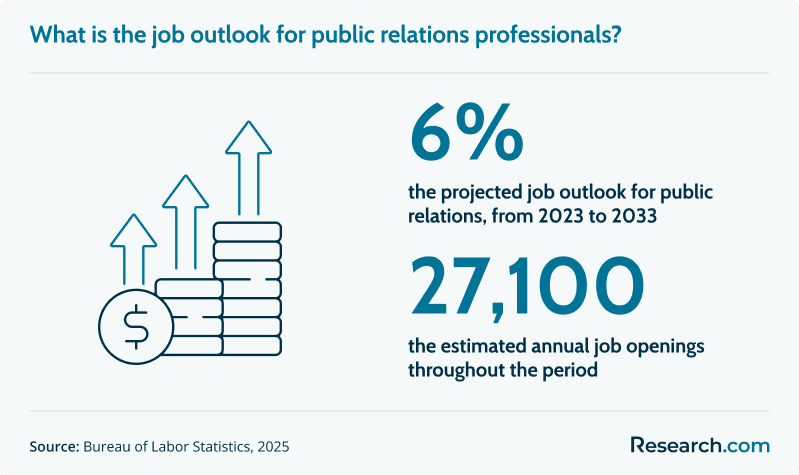
Business communication coursework prepares students for a large professional area that overlaps with public relations, marketing, media, consulting, and corporate operations. Public relations, a closely related field, is projected to grow by 6% between 2023 and 2033, with an estimated 27,100 job openings each year during that period.
Specializations in Online Business Communication Programs
Specializations help narrow a broad communication degree toward a specific career direction. Before choosing a concentration, compare the required courses with job postings for roles you want after graduation.
- Corporate Communication: Focuses on internal messaging, executive communication, change communication, employee updates, and cross-department coordination.
- Public Relations: Covers media relations, reputation management, press materials, campaign planning, and public-facing brand communication. Students planning graduate study in this area can compare options such as a fast-track online public relations master's degree.
- Marketing Communication: Blends messaging strategy with campaign planning, advertising, content creation, customer communication, and brand positioning.
- Human Resources Communication: Prepares students to communicate benefits, policy updates, recruitment messages, training materials, and employee relations content.
- Digital Communication and UX-Aligned Content: Focuses on how audiences experience digital messages, websites, platforms, and content flows.
How Specialization Can Affect Career Direction
Specialization does not guarantee a salary, but it can help position you for industries that value specific communication skills. For example, public relations skills may be used across corporate, nonprofit, agency, and government settings. The data cited in this article notes that professionals working in government often see the highest average salaries, earning around $78,220 annually.
How to Choose the Best Online Business Communication Degree Program
The best online business communication program is the one that fits your goals, budget, schedule, and career plan. Rankings can help you build a shortlist, but they should not replace your own evaluation.
- Confirm accreditation before anything else. Make sure the institution is properly accredited. Accreditation affects federal aid, transfer credits, graduate school options, and employer confidence.
- Request a personalized transfer review. Do not rely on general transfer statements. Ask exactly how many credits apply to your degree plan.
- Compare total cost, not just tuition. Include fees, books, technology requirements, residency rates, financial aid, and how long you expect to stay enrolled.
- Read the course list carefully. Look for applied assignments such as campaigns, presentations, writing samples, strategy projects, or capstones.
- Ask how online students access career services. Strong programs should offer resume support, interview preparation, internship guidance, networking opportunities, and job-search help.
- Evaluate faculty experience. In communication fields, instructors with current or recent professional experience can connect theory to real workplace expectations.
- Check whether the format fits your life. Confirm whether courses are asynchronous, live, accelerated, term-based, or self-paced.
Questions to Ask an Admissions Advisor
| Question | What a Strong Answer Should Clarify |
| Is the program fully online, or are any campus visits required? | You should know whether the degree can be completed from your location. |
| How are presentations, group projects, and discussions handled online? | Business communication programs should give students meaningful practice with real communication tasks. |
| Can online students complete internships or applied projects? | Practical experience can improve your resume and portfolio. |
| What support is available if I struggle in writing-intensive courses? | Writing support is especially important in this major. |
| What are recent graduates doing after completing the program? | Ask for career examples, not guaranteed outcomes. |
Career Paths for Online Business Communication Graduates
Business communication graduates can pursue roles that involve writing, messaging, public relations, marketing support, employee communication, client communication, and campaign coordination. The field is broad, and the best opportunities often go to candidates who can show a strong writing portfolio, presentation ability, digital fluency, and business awareness.
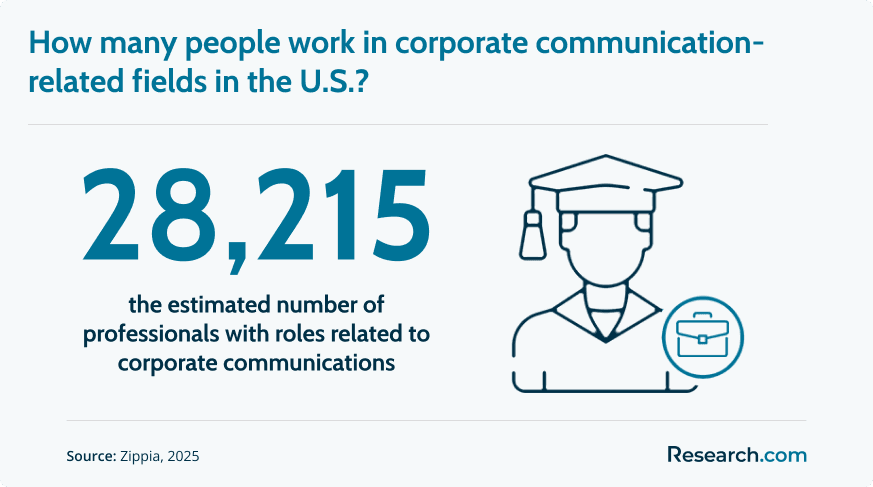
If you are changing careers, the field has an existing labor market base. An estimated 28,215 professionals currently work in corporate communication-related roles across the U.S., reflecting an established employment area for trained communicators.
| Career Path | Typical Work | Useful Preparation |
| Corporate Communication Specialist | Internal announcements, executive messages, employee updates, intranet content, and change communication | Business writing, organizational communication, editing, and stakeholder analysis |
| Public Relations Specialist | Press releases, media outreach, reputation management, event communication, and public messaging | PR writing, media relations, campaign planning, and crisis communication |
| Marketing Communications Coordinator | Email campaigns, social content, brand messaging, sales materials, and campaign support | Marketing, digital media, content strategy, and analytics basics |
| Communications Consultant | Advising organizations on messaging, audience strategy, change communication, and stakeholder engagement | Professional experience, portfolio evidence, presentation skills, and strategic planning |
| HR Communication Specialist | Recruitment messaging, benefits communication, policy updates, training materials, and employee engagement content | HR basics, employee communication, plain-language writing, and confidentiality awareness |
Job Market Outlook for Business Communication Graduates
The job market for communication-related business roles is supported by demand in public relations, marketing, internal communication, digital content, and stakeholder engagement. The U.S. Bureau of Labor Statistics projects that employment for public relations specialists will grow by 6% and for marketing managers by 8% through 2033.
These projections suggest continued demand for professionals who can translate business goals into clear messages, manage relationships, and communicate across digital and traditional channels. However, competition can still be strong for high-profile brand, marketing, and corporate communication roles, especially in major metro areas or well-known companies.
How AI and Digital Tools Are Changing the Field
AI tools can draft, summarize, analyze, and repurpose content, but they do not replace the need for judgment, audience insight, ethics, stakeholder awareness, and strategic decision-making. Employers increasingly need communicators who can use technology responsibly while ensuring that messages are accurate, appropriate, and aligned with organizational goals.
The highest-level earning potential in related management roles can be significant. The top 10% of marketing and advertising managers earn more than $239,200. Communication skills also matter outside corporate settings, including public agencies and civic organizations. Students interested in public-sector leadership may compare this path with an accelerated online public administration degree.
Can an Advanced Degree Strengthen a Business Communication Career?
An advanced degree can be useful when it clearly supports your next career step. A master’s degree in public relations, strategic communication, business, marketing, analytics, or public administration may help professionals move toward leadership, consulting, research, or specialized strategy roles. Creative graduate study can also support careers involving storytelling, brand voice, campaign content, and executive messaging; students considering that direction can explore what jobs you can get with an MFA in creative writing.
Still, graduate school is not automatically necessary. Many business communication professionals advance through experience, portfolio quality, industry knowledge, certifications, and measurable results. Consider an advanced degree when it fills a specific gap, helps you qualify for target roles, or is valued in your industry. If affordability is a concern, compare options such as the most affordable online MFA programs before committing to a creative graduate path.
Common Challenges in Online Business Communication Programs
Online communication students often need strong self-management because reading, writing, discussion, and project deadlines can accumulate quickly. The subject may sound familiar, but upper-level coursework can be writing-intensive and feedback-heavy.
- Time management: Weekly writing assignments, discussions, presentations, and group projects require consistent work rather than last-minute effort.
- Limited face-to-face networking: Online students must be intentional about joining virtual events, contacting faculty, and using career services.
- Group project coordination: Team communication can be harder across time zones, work schedules, and online platforms.
- Technology issues: Students need reliable internet, presentation tools, file-sharing platforms, and comfort with learning management systems.
- Portfolio development: A degree alone may not be enough; students should save strong writing samples, campaign plans, presentations, and digital projects.
How UX Design Can Improve Business Communication
UX design and business communication increasingly overlap because many messages are delivered through websites, apps, portals, emails, dashboards, and digital campaigns. UX principles help communicators think about how audiences find, understand, and act on information. That can improve clarity, reduce confusion, and make communication more useful to customers, employees, and stakeholders.
Students interested in digital communication, content strategy, or product-related messaging may benefit from learning user research, information architecture, usability testing, and plain-language design. A program such as a UX bachelor's degree online can provide a useful comparison point for students deciding whether they want a communication-heavy path, a design-heavy path, or a hybrid digital strategy role.
Common Mistakes to Avoid When Choosing a Program
| Mistake | Why It Can Hurt You | Better Approach |
| Choosing a school without checking accreditation | Unaccredited programs may create problems with financial aid, transfer credits, graduate school, and employer recognition. | Verify institutional accreditation before applying. |
| Comparing only per-credit tuition | Total cost also depends on fees, transfer credits, program length, and aid. | Request a full cost estimate based on your situation. |
| Assuming all online programs offer the same support | Career services, advising, writing help, and internship support vary widely. | Ask specifically what online students receive. |
| Ignoring the curriculum details | A program may not include the PR, marketing, corporate communication, or digital courses you need. | Compare required courses and electives with your target job postings. |
| Relying only on rankings | A highly ranked program may not be best for your budget, transfer credits, or schedule. | Use rankings as a shortlist, then evaluate fit. |
| Assuming a degree guarantees a salary | Pay depends on location, industry, experience, role, and performance. | Use salary data as context and build a strong portfolio while enrolled. |
Key Insights
- Business communication is a practical, flexible bachelor’s path. It combines business knowledge with writing, presentation, public relations, digital media, and organizational messaging skills.
- Most programs require 120 credits and take about 4 years. Transfer credits, enrollment pace, and prior learning policies can change your timeline.
- Costs vary widely. The listed programs range from $235.57 (in-state) to $823.13 per credit, while a planning estimate for average out-of-state tuition is around $580 per credit hour, or approximately $72,000 for 120 credits.
- Accreditation should be your first filter. It affects financial aid, credit transfer, employer recognition, and future graduate study.
- Career preparation matters as much as coursework. Look for portfolio projects, writing support, career services, internships, faculty feedback, and applied communication assignments.
- The job outlook is favorable but not automatic. Public relations specialists are projected to grow by 6% and marketing managers by 8% through 2033, but students still need strong skills, experience, and evidence of results.
- AI raises the bar for communicators. Graduates who can combine human judgment, ethical messaging, audience insight, and digital tools will be better positioned than those who only learn basic content production.
References:
- Bureau of Labor Statistics (BLS). (2025, April). Advertising, promotions, and marketing managers. U.S. Department of Labor. https://www.bls.gov/ooh/management/advertising-promotions-and-marketing-managers.htm#tab-1
- Bureau of Labor Statistics (BLS). (2025, April). Media & communication occupations. U.S. Department of Labor. https://www.bls.gov/ooh/media-and-communication/
- Bureau of Labor Statistics (BLS). (2025, April). Public relations specialists. U.S. Department of Labor. https://www.bls.gov/ooh/media-and-communication/public-relations-specialists.htm#tab-1
- Data USA. (2023). Communications degree profile. https://datausa.io/profile/cip/communications?redirect=true
- National University. (n.d.). What can I do with a strategic communication degree? https://www.nu.edu/blog/what-can-i-do-with-a-strategic-communications-degree/
- O*NET Online. (n.d.). Public relations specialists (27-3031.00). https://www.onetonline.org/link/summary/27-3031.00
- Pumble. (2025, February). Workplace communication statistics in 2025. https://pumble.com/learn/communication/communication-statistics/
- Zippia. (2025, January). Corporate communications specialist jobs. https://www.zippia.com/corporate-communications-specialist-jobs/
- Zippia. (2025, August). Strategic communications consultant jobs. https://www.zippia.com/strategic-communications-consultant-jobs/
Other Things You Need To Know About Business Communication
In 2027, leading online business communication degree programs include those offered by Arizona State University, University of Southern California, and Northeastern University. These programs provide comprehensive coursework, flexible scheduling, and a robust online learning platform that supports interactive and practical learning experiences.
Yes, you can and you should. Most reputable universities have robust career services that help online students find and secure internships. Many companies now offer remote or virtual internships, allowing you to gain valuable real-world experience from anywhere. An internship is a critical step in building your resume before you graduate.