
2027 Moving States as an LPC: Reciprocity & Licensing

Co-Founder and Chief Data Scientist
Moving states as a Licensed Professional Counselor (LPC) involves navigating complex reciprocity and licensing requirements that vary significantly across jurisdictions. As of early 2025, 37 states plus the District of Columbia have enacted legislation to join the Counseling Compact, an agreement designed to facilitate multi-state practice privileges for LPCs, signaling a growing trend toward interstate mobility in the counseling profession.
Readers can expect this introduction to cover the fundamentals of LPC reciprocity, including what it entails, key criteria for eligibility, and current statistics reflecting how states address license portability.
Key things you should know about moving states as an LPC
- Reciprocity for LPCs involves meeting key requirements such as holding an independent, unencumbered license in the current state, fulfilling educational and clinical experience criteria, and passing a nationally recognized exam like the National Counselor Examination (NCE). Each state may have additional specific steps to complete for reciprocity or license endorsement.
- The emergence of the Counseling Compact allows LPCs from member states (currently 37 states plus D.C.) to practice across state lines without obtaining multiple licenses, significantly easing the relocation process and expanding job opportunities across states that participate in the compact.
- Salary range for Licensed Professional Counselors in 2025 varies from approximately $45,000 for entry-level positions to over $100,000 for highly experienced LPCs, with an average salary of around $71,915 per year.
- How do LPC licensing requirements vary by state? Requirements by State
- What does LPC license reciprocity mean? Reciprocity Definition
- Which states currently offer LPC license reciprocity? Which states currently offer LPC license reciprocity?
- What are the benefits of LPC reciprocity for counselors? Benefits
- Can I practice as an LPC without a license in a new state? Can I practice as an LPC without a license in a new state?
- How do I apply for a license transfer as an LPC? Transfer Application
- How long does the LPC license transfer process take? Process Length
- What common challenges do LPCs face when transferring licenses? Challenges
- How to maintain licensure compliance across states? How to maintain licensure compliance across states?
- Are LPC salaries different between states? Salaries
- What legal considerations should LPCs be aware of when moving states? What legal considerations should LPCs be aware of when moving states?
LPC License Transfer and Reciprocity: What Counselors Need to Know Before Practicing in Another State
Moving your counseling career across state lines is not as simple as packing up your office or updating your telehealth address. Licensed Professional Counselors are regulated at the state level, which means the rules that allowed you to practice independently in one state may not automatically qualify you to see clients in another.
This guide is for LPCs planning a move, counselors hoping to provide telehealth across state lines, graduate students choosing a licensure-focused program, and clinicians comparing compact privileges with traditional endorsement. You will learn how state requirements differ, what reciprocity actually means, when the Counseling Compact may help, what documents to prepare, and how to avoid costly licensing mistakes.
Quick answer: Can an LPC license transfer to another state?
An LPC license usually does not “transfer” automatically. In most cases, you either apply for licensure by endorsement in the new state or, if both states participate in the Counseling Compact, apply for a privilege to practice. You should not provide counseling services to clients located in a new state until that state’s board or compact process authorizes you to do so.
State-by-state planning matters for counselors just as much as location-based compensation research matters in other healthcare fields. For example, resources such as nurse care coordinator salary by state show how much professional requirements and career outcomes can depend on where you work.
How LPC requirements differ by state
Every state requires a master’s degree in counseling for LPC licensure, but the details vary widely. Some boards require a degree from a program accredited by the Council for Accreditation of Counseling and Related Educational Programs (CACREP), while others focus on whether the degree included required credit hours in areas such as ethics, human development, assessment, diagnosis, counseling theories, social and cultural foundations, and professional practice.
Program format can also matter. Students comparing options such as shortest counselor education degrees online should verify that speed does not come at the expense of licensure alignment in the state where they intend to practice.
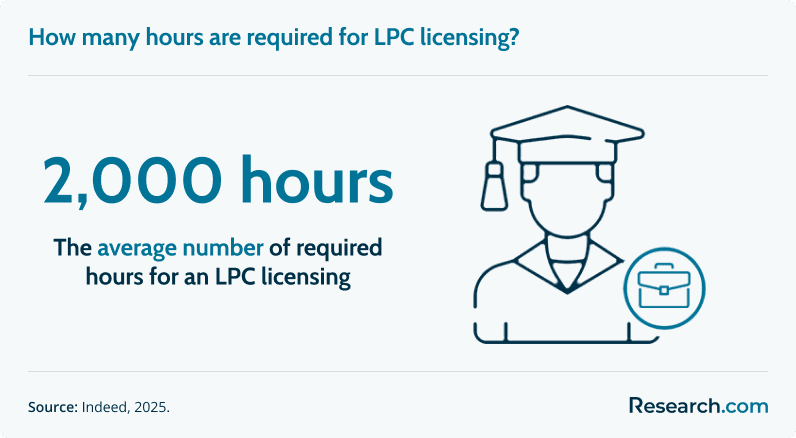
Postgraduate supervised experience is one of the biggest sources of variation. Some states require 2,000 supervised hours, while others require over 4,000 hours. Boards may also define direct client contact, indirect service, supervision frequency, acceptable supervisors, and completion timelines differently.
Exam requirements also differ. Most states require the National Counselor Examination for Licensure and Certification (NCE) or the National Clinical Mental Health Counseling Examination (NCMHCE), both administered by the National Board for Certified Counselors. Some states add state-specific testing. California requires the California Law and Ethics exam before LPC licensure, while Texas requires the Texas Jurisprudence Exam.
| Requirement area | How states may differ | Why it matters when moving |
| Graduate education | Some boards require CACREP accreditation; others review required coursework and credit hours. | A degree accepted in one state may require additional coursework in another. |
| Supervised experience | Requirements can range from 2,000 to over 4,000 hours, with different rules for direct and indirect hours. | You may need to document past supervision in detail or complete additional hours. |
| Examinations | States may require the NCE, NCMHCE, both, or an additional law or jurisprudence exam. | Passing one national exam may not fully satisfy the destination state’s rules. |
| Practice title | States use different titles and license levels for professional counselors. | You must apply under the correct license category and scope of practice. |
| Telehealth rules | States regulate counseling based on the client’s location, not only the counselor’s location. | You generally need authority to practice in the state where the client is physically located. |
What LPC Reciprocity Really Means
LPC reciprocity refers to a process that allows a licensed counselor to obtain authorization to practice in another state without repeating the entire original licensing pathway. In practice, true automatic reciprocity is uncommon because counseling boards set their own education, supervision, exam, ethics, and renewal rules.
For career planning, licensure portability can be as important as compensation research. A nurse evaluating the nurse anesthetist salary may look at geography, demand, and state rules; counselors should take the same disciplined approach when deciding where they can lawfully work.
Reciprocity is often confused with endorsement. Endorsement usually means the new state reviews your license, education, supervised experience, exams, disciplinary history, and sometimes continuing education to decide whether your qualifications are substantially equivalent. Reciprocity, when available, is typically more streamlined.
The Counseling Compact is designed to make interstate practice easier for qualified LPCs in member states. Instead of applying for a completely separate license in every compact state, eligible counselors may seek a privilege to practice in another compact state. However, the compact does not eliminate the need to follow state laws, ethics rules, scope-of-practice limits, and reporting requirements.
| Path | What it means | Best fit | Key limitation |
| Licensure by endorsement | The destination state reviews your existing license and credentials. | Counselors moving to a non-compact state or a state where compact privileges are not available. | You may need extra coursework, exams, supervision documentation, or board review. |
| Counseling Compact privilege | An eligible LPC in a compact home state applies for permission to practice in another compact state. | Counselors who want multistate practice without applying for full separate licenses. | You must meet compact eligibility rules and comply with the remote state’s laws. |
| Full new license | You apply as if seeking a separate state license. | Counselors relocating permanently or seeking a state license beyond a compact privilege. | This may be the longest and most document-heavy route. |
Which States Offer LPC Reciprocity Through the Counseling Compact?
As of 2025, 37 states plus the District of Columbia have enacted legislation to join the Counseling Compact. This framework allows eligible LPCs licensed in member states to apply for a privilege to practice in other member states rather than pursuing a completely new license in each jurisdiction.
Recent states to join include Arizona, Minnesota, New Jersey, Rhode Island, South Carolina, and South Dakota. Counselors should confirm current participation directly because implementation details and operational timelines can change.
Expanding practice authority is a credentialing issue across healthcare. Just as advanced practice nurses may pursue nurse practitioner subspecialty certifications to broaden their professional options, LPCs can use compact participation and endorsement pathways to expand where they can legally serve clients.
The compact is intended to reduce barriers to interstate counseling practice and improve access to mental health services, especially for clients who move, travel, or live in areas with limited provider availability. Outside the compact, true reciprocity remains rare, so many counselors still need to use state-specific endorsement applications.
Before making relocation or telehealth plans, check the official list of compact member states and then verify details with the licensing board in the state where your client will be located.
Benefits of LPC Reciprocity and the Counseling Compact
LPC reciprocity can reduce one of the most frustrating barriers in counseling careers: having to prove professional competence again each time you cross a state line. The Counseling Compact does not erase state regulation, but it can make multistate practice more predictable for eligible counselors.
Licensure-aware program selection also matters before counselors ever reach the transfer stage. Students often compare recognized programs, such as MPCAC accredited psychology master’s programs by state, because accreditation and curriculum alignment can influence future licensing options.
Greater career mobility
Reciprocity and compact privileges can make it easier to relocate for a job, follow a spouse or partner, serve military-connected families, expand a private practice, or accept opportunities in another state. Without a streamlined pathway, counselors may face months of waiting before they can legally work in the new jurisdiction.
More practical telehealth options
Telehealth has changed how clients expect to receive care, but licensing still depends heavily on where the client is located. Counselors who provide virtual care should understand how teletherapy works for mental health professionals, including consent, privacy, emergency planning, documentation, and interstate practice rules.
Compact privileges can help counselors continue care when clients temporarily or permanently move to another compact state, provided the counselor has the required authorization for that state. This can be especially valuable for clients who travel frequently or experience repeated relocations.
Lower administrative friction
Traditional endorsement can require official transcripts, supervision logs, license verifications from every state where you have been licensed, exam score reports, background checks, and board-specific forms. A compact privilege is intended to rely on a shared system that verifies an unencumbered home-state license and relevant licensure information more efficiently.
Better continuity of care
When licensing barriers delay practice, clients may have to pause treatment or find a new clinician. Streamlined interstate authorization can help counselors maintain care relationships more safely and legally, especially when moves are planned in advance.
Can You Practice as an LPC in a New State Without Authorization?
No. You should not practice independently as an LPC in a new state unless that state has granted you a license, compact privilege, temporary permission, or another legally recognized authorization. Counseling boards generally regulate practice based on the client’s physical location at the time services are delivered.
Even under the Counseling Compact, you must hold the proper home-state license and obtain the appropriate privilege to practice in the remote compact state. The compact is not a blanket permission slip to counsel clients anywhere.
Practicing without authorization can expose a counselor to board discipline, legal penalties, malpractice coverage problems, denied insurance claims, and ethics complaints. Limited exceptions may exist in some states for emergencies, short-term continuity of care, consultation, or federally regulated settings, but those exceptions are narrow and should be confirmed in writing with the relevant board or legal counsel.
How to Apply for LPC Licensure in Another State
The correct application route depends on whether your home state and destination state participate in the Counseling Compact and whether you are relocating permanently or only seeking authority to serve clients across state lines.
Step 1: Identify where the client will be located
For telehealth, the key licensing question is usually not where you sit; it is where the client is physically located during the session. If the client will be in another state, you need to understand that state’s rules before providing care.
Step 2: Confirm whether the Counseling Compact applies
If your home state and the remote state are compact members, determine whether you qualify for a privilege to practice. To participate, you must hold an unencumbered license in your home state, and that home state must be a compact member. Your license must also be at the highest level for independent practice.
Step 3: Use endorsement if the compact does not apply
If the destination state is not available through the compact, apply through licensure by endorsement, licensure by credentials, or the equivalent pathway used by that state board. The board will compare your background with its own requirements.
Step 4: Collect official documents early
Expect to gather official transcripts, exam score reports, license verifications, supervised hour records, supervisor attestations, background check materials, continuing education records, and any disciplinary explanations if applicable. Many boards require documents to come directly from the issuing source.
Step 5: Budget for fees and delays
You may pay application fees, license fees, background check fees, transcript fees, exam reporting fees, and compact privilege fees. If gaps appear in your record, you may also need additional coursework or supervision.
| Application route | Typical steps | Documents to prepare | Decision point |
| Traditional endorsement | Submit a state board application and prove substantial equivalence. | Transcripts, supervision records, exam scores, license verifications, background check, continuing education documentation. | Use this when the compact is unavailable or when you need a full license in the new state. |
| Counseling Compact privilege | Verify eligibility, apply for a privilege to practice, and pay required fees. | Unencumbered home-state license verification and information required by the compact system. | Use this when both states participate and you meet compact requirements. |
| New license application | Apply under the destination state’s standard licensure pathway. | Full education, examination, supervision, and background documentation. | Use this if endorsement is not available or if the board requires a full review. |
For states that are members of the Counseling Compact, the process is intended to be simpler. While the application system is still in the process of being launched, anticipated in late 2025, counselors should continue checking official compact and board updates before relying on a future practice timeline.
How Long Does an LPC License Transfer Take?
The LPC license transfer or endorsement process commonly takes several weeks to a few months. The exact timeline depends on board workload, completeness of your application, whether your education and supervision match the destination state’s requirements, and how quickly third parties send official records.
Graduates of programs such as master's in clinical mental health counseling online should keep syllabi, practicum records, internship documentation, and supervision details because boards may request more than a transcript when reviewing equivalency.
The most common delays come from incomplete supervision logs, missing license verifications, outdated forms, unpaid fees, background check issues, or documents sent by the applicant when the board requires direct source submission. Contact the board before applying if you have an older degree, a non-CACREP program, a disciplinary history, or supervision completed under rules that differ from the destination state.
Legal Issues LPCs Should Review Before Moving States
Interstate practice creates legal risk because each state can define counseling practice, client protections, documentation duties, and board jurisdiction differently. Before seeing clients in a new state, review the destination state’s rules on informed consent, mandatory reporting, record retention, telehealth, emergency procedures, confidentiality, minors, duty to warn or protect, and release of records.
Malpractice insurance also deserves special attention. Confirm that your policy covers services delivered to clients in every state where you are authorized to practice, including telehealth services. A licensing approval does not automatically mean your professional liability coverage follows you across state lines.
If you own a private practice, review business registration, tax rules, insurance contracts, employment agreements, noncompete or nonsolicitation terms, and supervision responsibilities. When in doubt, consult an attorney familiar with professional licensing and healthcare practice in the relevant state.
Common Challenges When Moving an LPC License
Even experienced counselors can run into problems when they assume a clean license in one state will be enough for another. The Counseling Compact may reduce some barriers, but endorsement and board review remain important for many relocations.
Coursework gaps
A counseling degree that satisfied one board may not satisfy another. This issue is especially important for graduates of older programs, non-CACREP programs, or programs with limited coursework in diagnosis, ethics, assessment, multicultural counseling, or clinical mental health practice. Students comparing counselor education programs online should ask each program which states its curriculum is designed to support.
Supervised hour mismatches
One state may accept a supervision arrangement that another state rejects. Differences can involve total hours, direct client contact, supervisor credentials, group supervision limits, timeframes, documentation formats, and whether hours must be completed after the degree is awarded.
Weak documentation
Licensing boards often need more than a résumé. They may require official transcripts, license verifications from every state where you have held a license, sealed exam reports, signed supervision forms, and detailed practice history. Missing documentation can turn an otherwise eligible application into a months-long delay.
Board processing backlogs
Licensing boards may need months to review applications, especially during high-volume periods. If you move before receiving approval, you may be unable to work independently until the board acts.
Unexpected costs
Application fees, background checks, transcript requests, exam score transfers, jurisprudence exams, continuing education, and duplicate license fees can add up. Counselors should budget for the process before relocating.
| Common mistake | Why it creates problems | Better approach |
| Assuming reciprocity is automatic | Most states still require board approval, endorsement, or a compact privilege. | Confirm the exact process with the destination board before accepting clients. |
| Choosing a program based only on speed or price | The curriculum may not meet the licensing rules in your target state. | Ask for a state licensure disclosure and compare required coursework. |
| Moving before approval | You may face a gap where you cannot legally practice. | Start the application early and maintain income plans during board review. |
| Ignoring telehealth rules | Clients located in another state may trigger that state’s licensing laws. | Track client location at each session and obtain proper authorization. |
| Keeping poor supervision records | Boards may reject undocumented or vaguely documented hours. | Save signed logs, supervisor credentials, dates, hours, and client-contact breakdowns. |
How to Stay Compliant When Practicing in Multiple States
Multistate practice requires an organized compliance system. You must follow each state’s renewal rules, continuing education requirements, ethics standards, telehealth regulations, and reporting obligations. Continuing education requirements typically range from 20 to 40 hours every 1-2 years.
If you practice through the Counseling Compact, you must maintain a full, unrestricted home-state license and keep your compact privilege in good standing. A disciplinary issue in one jurisdiction can affect your ability to practice elsewhere.
Counseling is often grouped with broader helping professions and humanities careers, but licensed practice has stricter regulatory obligations than many nonclinical roles. Keep proof of liability insurance, CEU completion, license renewals, background checks, and board communications in a secure, easy-to-access system.
Update your address, practice location, business name, supervisor status, and contact information with every relevant board when required. Calendar renewal dates separately for each license or compact privilege, and do not assume states share the same deadlines.
Questions to ask before practicing in another state
- Do I need a full license, endorsement approval, temporary permission, or a compact privilege?
- Does the state regulate telehealth based on the client’s location?
- Will my malpractice insurance cover services in this state?
- Are there state-specific informed consent or emergency contact requirements?
- Do I need a jurisprudence, law, or ethics exam?
- What continuing education rules will apply after approval?
- Can I keep seeing existing clients if they move or travel to the new state?
Do LPC Salaries Vary by State?
Yes. LPC salaries can differ substantially by location, cost of living, employer type, experience, specialization, and demand for mental health services. In 2025, median annual salaries range from about $45,100 in Mississippi to over $78,200 in California.
Alaska, Massachusetts, New Jersey, and Oregon also report higher median salaries, often exceeding $65,000 annually. Southern and midwestern states often report lower salaries closer to $48,000 to $58,000.
The national average LPC salary is around $71,900 to $82,000 per year, but individual earnings vary widely. Counselors in metropolitan or higher-cost areas may earn more than those in rural or lower-cost regions, though higher salaries do not always mean stronger purchasing power after housing, taxes, insurance, commuting, and practice expenses.
Counselors seeking higher earnings may consider supervision credentials, private practice ownership, clinical specialization, leadership roles, program administration, or additional education. For example, understanding what you can do with a master’s degree in organizational leadership can help counselors evaluate nonclinical management and administrative paths in behavioral health organizations.
| Salary factor | How it can affect LPC earnings |
| State and region | Pay differs by local labor markets, cost of living, public funding, and demand for services. |
| Work setting | Private practice, hospitals, schools, community agencies, group practices, and government roles may pay differently. |
| Experience | Fully independent clinicians, supervisors, and practice owners may have more earning options than newly licensed counselors. |
| Specialization | Training in high-need areas may support stronger job prospects, but outcomes are not guaranteed. |
| Licensure portability | Authority to practice in multiple states can expand client access and employment options when handled legally. |
What LPCs Say About Moving Their Counseling Practice Across States
- : "I used to think relocating would mean rebuilding my counseling career from the beginning. Having a clearer interstate pathway made the move feel possible and helped me keep client care at the center of my plans. — Shane"
- : "The most important lesson for me was preparation. Once I understood which documents the new board needed, I could avoid delays and continue planning my practice instead of reacting to surprises. — Jeremy"
- : "Changing states pushed me to review my niche, my supervision records, and the kind of community I wanted to serve. The licensing process took work, but it also helped me make a more intentional career move. — Isla"
Current Trends Affecting LPC Mobility
Several developments are changing how counselors think about interstate practice. The Counseling Compact is the most significant licensure trend because it creates a more structured path for eligible LPCs to practice in multiple member states. At the same time, telehealth has made client location tracking, emergency planning, and privacy compliance more important than ever.
Demand for mental health treatment continues to be a major workforce issue, and employers increasingly value clinicians who can serve clients legally and ethically across settings. Digital tools, electronic health records, online scheduling, and AI-assisted administrative systems may improve efficiency, but they also raise documentation, confidentiality, and informed consent questions that counselors should evaluate carefully.
Sources and Further Reading
- Association for Financial Counseling and Planning Education. (2025). Licensed Professional Counselor (LPC) Salary. https://careercenter.afcpe.org/salary/licensed-professional-counselor-lpc
- American Psychological Association. (2021). Demand for mental health treatment continues to increase, say psychologists. Retrieved from APA.
- Data USA. (2023). Counseling psychology. Retrieved from DataUSA.io
- U.S. Bureau of Labor Statistics. (2024). Occupational Outlook Handbook: Substance Abuse, Behavioral Disorder, and Mental Health Counselors. https://www.bls.gov/ooh/community-and-social-service/substance-abuse-behavioral-disorder-and-mental-health-counselors.htm#tab-8
Key Insights
- An LPC license usually does not transfer automatically. Most counselors need licensure by endorsement, a full new license, or a Counseling Compact privilege before practicing in another state.
- State rules differ in meaningful ways. Education standards, CACREP expectations, supervised hours, direct client contact requirements, exams, jurisprudence tests, and telehealth laws can all vary.
- The Counseling Compact can improve mobility, but it is not universal. As of 2025, 37 states plus the District of Columbia have enacted legislation to join, and eligible counselors must still apply for the proper privilege to practice.
- Telehealth does not remove licensing obligations. If your client is located in another state, you generally need authorization from that state or a valid compact privilege.
- Documentation is the difference between a smooth move and a long delay. Keep transcripts, supervision logs, exam records, license verifications, CEUs, and board communications organized before you relocate.
- Salary should be evaluated alongside cost of living and licensing access. Higher-paying states may also have higher expenses, different practice rules, and longer approval timelines.
- The safest next step is board verification. Before accepting a job, moving a private practice, or seeing an out-of-state telehealth client, confirm requirements directly with the destination state’s counseling board.
Other Things You Should Know About Moving States as an LPC
No. Most states do not offer true reciprocity for LPCs. You usually apply for licensure by endorsement and must meet the new state board’s rules, including a passing NCE or NCMHCE score, supervised experience, and verification from your current licensing board.
California and New York have distinctive rules for LPC license transfers in 2027. California requires an additional jurisprudence exam, while New York mandates two years of post-licensure experience. Check with the respective state boards for specific, updated requirements.


