
2027 How to Become a Licensed Counselor (LPC) in Vermont

Co-Founder and Chief Data Scientist
Becoming a licensed counselor in Vermont means planning around one important distinction: the state’s independent clinical counseling credential is the Licensed Clinical Mental Health Counselor, or LCMHC. If you are comparing counseling programs, estimating costs, or trying to understand whether online study can lead to licensure, the details matter. Coursework, practicum hours, supervised experience, exams, and renewal rules all affect how quickly you can practice independently.
This guide explains how to become a licensed professional counselor in Vermont, what education and supervised experience are required, which Vermont counseling programs may fit different goals, and how to evaluate cost, accreditation, specialization, salary, and job outlook before enrolling. It is written for prospective graduate students, career changers, bachelor’s degree holders, and current helping professionals who want a practical path into counseling work in Vermont.
Quick Answer: How Do You Become an LPC in Vermont?
To become a licensed clinical mental health counselor in Vermont, you generally need a bachelor’s degree, a qualifying master’s degree in counseling, a 100-hour practicum and 900-hour internship or an approved 1,000-hour internship, 3,000 hours of supervised clinical practice, passing scores on the NCE and NMHCE, professional references, and approval from the Vermont Board of Allied Mental Health. The full path can take up to 9 years from the start of college through licensure.
Vermont is a strong state for counseling access and demand. In 2025, Vermont ranked 4th nationally for mental health access. Still, access does not remove licensing complexity. Before choosing a program, confirm that the curriculum, clinical placement structure, and accreditation status align with Vermont’s current licensing rules.
Key Benefits of Becoming an LPC in Vermont
- A counseling degree in Vermont can prepare graduates for roles in mental health counseling, school counseling, rehabilitation counseling, marriage and family therapy, substance abuse counseling, and related helping professions.
- The full pathway from a bachelor’s degree to independent licensure may take up to 9 years, depending on enrollment pace, clinical placement timing, and supervised experience completion.
- According to 2024 data, mental health counselors in Vermont receive a median annual salary of $60,410; school counselors take home $61,710; marriage and family therapists earn $58,510; and rehabilitation counselors make $44,040.
- Master's programs in counseling may cost $30,000 to $120,000 annually, so comparing tuition, fees, clinical placement costs, and aid is essential.
- Employment for mental health, behavioral disorder, and substance abuse counselors is expected to grow by 18% until 2032.
- 2027 Best Counseling Programs in Vermont
- What are the educational requirements for licensed counselors in Vermont?
- What is the licensure application and renewal process for licensed professional counselors in Vermont?
- How long does it take to become a licensed professional counselor in Vermont?
- Are online counseling programs accepted for LPC licensure in Vermont?
- How does an online counseling program in Vermont compare to an on-campus program?
- What is the average cost of LPC programs in Vermont?
- How do I choose the best LPC program in Vermont?
- What types of specializations are available within counseling in Vermont?
- What career paths are available for LPCs in Vermont?
- What are the first steps to becoming a licensed counselor in Vermont?
- How can licensed professional counselors in Vermont expand their practice?
- How can advanced academic degrees boost a counseling career in Vermont?
- What are the differences between counselor and psychologist licensure in Vermont?
- How can I integrate faith-based approaches into my counseling practice in Vermont?
- Which professional associations and support networks can boost my LPC career in Vermont?
- What are the specific LPC requirements in Vermont?
- How can licensed counselors navigate ethical and legal challenges in Vermont?
- How can I become a behavior analyst in Vermont?
- What is the job market for licensed counselors in Vermont?
- What role does Vermont’s focus on holistic health play in counseling practices?
- How can I protect my counseling practice through risk management and malpractice insurance in Vermont?
- How can I pursue ongoing professional development to enhance my counseling practice in Vermont?
- How to specialize in Marriage and Family Therapy in Vermont?
- How can I specialize in substance abuse counseling in Vermont?
- How can I manage the business side of my counseling practice in Vermont?
- How can LPCs address Vermont’s rural mental health challenges?
2027 Best Counseling Programs in Vermont
How do we rank schools?
Choosing a counseling program is a licensing decision as much as an academic one. Our research team reviews program information using established education data sources, including the IPEDS database, Peterson's database, the College Scorecard, and the National Center for Education Statistics. You can review our full approach on the Research.com methodology page.
The programs below are useful starting points for students researching counseling education in Vermont. Before applying, contact both the program and the Vermont licensing board to confirm whether the degree plan satisfies your intended license pathway.
| Program | Best fit | Length | Credits | Listed cost | Accreditation noted |
| University of Vermont Master of Science in Counseling | Students seeking CACREP-accredited clinical mental health or school counseling preparation | 2 to 3 years | 60 to 76 | $678 in-state; $1,375 out-of-state per credit | Council for Accreditation of Counseling and Related Educational Programs |
| Vermont State University Master of Arts in Counseling | Students interested in clinical mental health or school counseling with internship experience | 2.5 to 3.5 years | 60 | $661 per credit | Vermont Standards Board for Professional Educators |
| Goddard College Master of Arts in Clinical Mental Health Counseling | Students looking for concentrations such as expressive arts, spirituality, or human-animal interaction | 2 to 3 years | 60 | $11,799 per semester | New England Commission of Higher Education |
| University of Vermont Counselor Education and Supervision PhD | Licensed or advanced counselors pursuing research, teaching, supervision, or leadership | 4 to 6 years | 75 | $678 in-state; $1,780 out-of-state per credit | New England Commission of Higher Education |
| Vermont State University Master of Science in Clinical Mental Health | Students interested in integrated mental health and substance use counseling | 2 to 3 years | 60 | $661 per credit | New England Commission of Higher Education |
1. University of Vermont Master of Science in Counseling
The University of Vermont offers a Master of Science in Counseling with two main concentrations: Clinical Mental Health Counseling and School Counseling. Students may also pursue a dual option that combines parts of both concentrations, which can support preparation across two specialization areas. The Clinical Mental Health Counseling and School Counseling specializations are the only counseling programs in Vermont accredited by CACREP.
- Program Length: 2 to 3 years
- Tracks/Concentrations: Clinical Mental Health Counseling; School Counseling
- Cost per Credit: $678 (in-state); $1,375 (out-of-state)
- Required Credits to Graduate: 60 to 76
- Accreditation: Council for Accreditation of Counseling and Related Educational Programs
2. Vermont State University Master of Arts in Counseling
The Vermont State University Master of Arts in Counseling includes Clinical Mental Health and School Counseling concentrations. The program is structured around licensure preparation in the student’s selected concentration and includes additional specialization coursework to broaden clinical and professional competency. Students also complete field-based training through internship experience.
- Program Length: 2.5 to 3.5 years
- Tracks/Concentrations: Clinical Mental Health; School Counseling
- Cost per Credit: $661
- Required Credits to Graduate: 60
- Accreditation: Vermont Standards Board for Professional Educators
3. Goddard College Master of Arts in Clinical Mental Health Counseling
The Goddard College Master of Arts in Clinical Mental Health Counseling is a 60-credit program with concentrations that include Expressive Arts Therapy, Spiritual Counseling and Care, and Human Animal Interaction. The program is designed to prepare students for licensure, includes applied clinical experiences, and offers placement services to help students locate counseling opportunities in their communities. Goddard College also offers a bridge program from its MA in Psychology to this counseling degree.
- Program Length: 2 to 3 years
- Tracks/Concentrations: Expressive Arts Therapy; Human Animal Interaction; Sexual Orientation and Sexual, Affectional, Intersex, and Gender Expansive Communities; Spiritual Counseling & Care
- Cost per Semester: $11,799
- Required Credits to Graduate: 60
- Accreditation: New England Commission of Higher Education
4. University of Vermont Counselor Education and Supervision PhD
The University of Vermont Counselor Education and Supervision PhD is aimed at professional counselors who want to move into advanced roles in research, supervision, teaching, program leadership, or counselor education. Coursework covers advanced counseling theory, supervision theory, pedagogy, and research-oriented professional preparation. Students may complete the doctoral program in four years of full-time study or six years of part-time study.
- Program Length: 4 to 6 years
- Tracks/Concentrations: None
- Cost per Credit: $678 (in-state); $1,780 (out-of-state)
- Required Credits to Graduate: 75
- Accreditation: New England Commission of Higher Education
5. Vermont State University Master of Science in Clinical Mental Health
The Vermont State University Master of Science in Clinical Mental Health offers two concentrations: Integrated MH & SU Counseling with Adults and Integrated MH & SU Counseling with Children, Youth & Families. The program prepares students for clinical mental health and substance use disorder licensure pathways, and many graduates pursue dual licensure. Coursework covers areas such as consumer and family mental health, rural mental health, and treatments for substance use disorders.
- Program Length: 2 to 3 years
- Tracks/Concentrations: Integrated MH & SU Counseling with Adults; Integrated MH & SU Counseling with Children, Youth & Families
- Cost per Credit: $661
- Required Credits to Graduate: 60
- Accreditation: New England Commission of Higher Education
Here's What Graduates Have to Say About Being an LPC in Vermont
"My practicum placements gave me repeated opportunities to practice counseling skills with real supervision, not just classroom discussion. Those hours helped me strengthen crisis response, listening skills, and the ability to build trust. In a rural Vermont setting, relationships matter. Clients often need time before they feel safe opening up, and seeing that trust lead to real progress is the most rewarding part of the work." - Beatrice
"The strongest part of my program was the balance between evidence-based practice and self-reflection. I learned counseling theory, but I also learned how culture, identity, and school climate affect students. As a school counselor in a diverse Vermont district, that training helps me support students who are dealing with social pressure, academic stress, and emotional growth." - Spencer
"My counseling education taught me how to combine traditional clinical methods with mindfulness and holistic approaches. That combination has been useful in Vermont communities where clients often value connection, wellness, and practical support. The degree gave me a framework for meeting people where they are." - Tara
What are the educational requirements for licensed counselors in Vermont?
Vermont’s independent clinical counseling credential is regulated by the Board of Allied Mental Health. To qualify for licensure as a licensed clinical mental health counselor, candidates must meet education, clinical training, supervision, examination, and application requirements. The education portion is the foundation, so program choice matters early.
Required Degrees
- Bachelor’s degree: Applicants typically begin with a bachelor’s degree in counseling or a closely related social or behavioral science field, such as psychology, social work, human services, or a similar discipline. Different types of psychology degrees may be acceptable for undergraduate preparation, but counseling-focused coursework and online counseling degree programs can provide a more direct foundation.
- Master’s degree in counseling: Vermont requires graduate-level preparation in counseling. A CACREP-accredited graduate program is often the clearest route because CACREP-accredited graduate programs must include 60 credits of mental health counseling coursework. If the program is not CACREP-accredited, it must still satisfy the coursework requirements in Vermont’s administrative rules.
Practicum and Internship Experience
Vermont counseling candidates must complete field training during graduate study. The standard requirement includes a 100-hour practicum and a 900-hour internship in a clinical setting with direct client contact under board-approved supervision.
The state also allows an alternative route: 1,000 hours of internship that meets board standards for clinical professional experience.
Postgraduate Supervised Experience
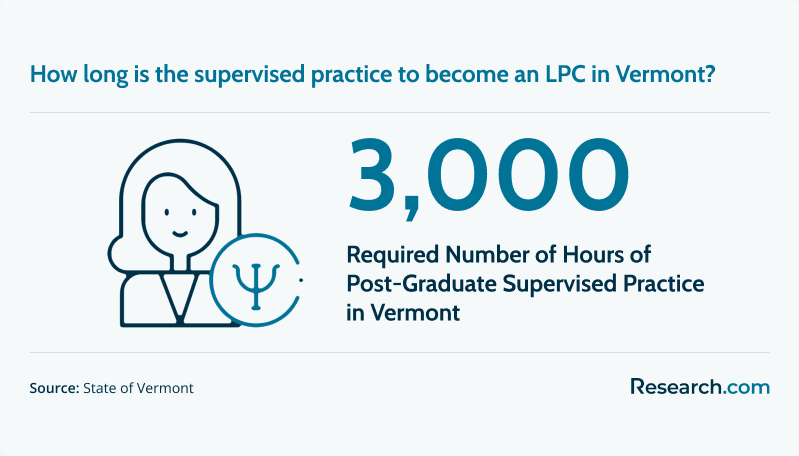
After graduate education, candidates must complete two years of supervised clinical work totaling 3,000 hours. Of those hours, 2,000 must involve direct client contact while providing mental health therapy.
Vermont also requires at least 100 hours of face-to-face supervision. At least 50% of those supervision hours must be individual one-on-one sessions. Candidates need one hour of supervision for every 30 hours of experience earned.
Supervision must come from a board-authorized supervisor who is currently licensed in one of the following professional categories:
- Licensed Clinical Mental Health Counselor (LCMHC)
- Marriage and Family Therapist
- Psychiatric Nurse Practitioner
- Psychiatrist
- Psychologist
- Independent Clinical Social Worker
| Requirement | What Vermont expects | Why it matters |
| Graduate degree | Master’s degree in counseling with required coursework | Determines whether you can move forward to supervised practice and exams |
| Practicum and internship | 100-hour practicum and 900-hour internship, or approved 1,000-hour internship | Builds supervised direct client experience before graduation |
| Supervised clinical practice | 3,000 hours across two years, including 2,000 direct client contact hours | Prepares candidates for independent clinical responsibility |
| Supervision | 100 hours face-to-face, with at least 50% individual supervision | Provides clinical oversight, documentation, and professional development |
What is the licensure application and renewal process for licensed professional counselors in Vermont?
After completing graduate education and supervised experience, applicants move through Vermont’s formal licensing process. The sequence can vary depending on documentation timing, but candidates should expect to verify education, supervision, examination eligibility, background clearance, and professional references.
- Complete a criminal background check.
- Finish the required supervised clinical experience.
- Apply to the Board for approval to take the national qualifying examinations.
- Pass both required exams.
- Submit three professional reference letters.
- Apply to the Board for licensure as an LCMHC.
Counselor Exams
Vermont requires applicants to pass the National Counselor Examination (NCE) and the National Mental Health Counselor Examination (NMHCE), both administered by the National Board of Certified Counselors. Candidates must receive Board approval before sitting for these exams.
The NCE is a 200-item multiple-choice exam that assesses core counseling knowledge typically covered in graduate counselor education. The NCMHCE uses 10 clinical simulations to evaluate clinical decision-making and mental health counseling judgment.
Both the NCE and NMHCE are required for Vermont licensure.
License Renewal and Continuing Education
Licensure does not end once the initial credential is issued. Vermont LCMHCs must renew their license every two years and meet continuing education requirements to remain in good standing.
Vermont requires 40 hours per year of continuing education. Licensed mental health professionals must also complete one hour of continuing education related to systematic oppression and anti-oppressive practice, or related areas. Online continuing education courses are acceptable if they meet Board standards.
How long does it take to become a professional licensed counselor in Vermont?
The Vermont counseling licensure path can take around nine years or less, starting with undergraduate education and ending with licensure approval. The timeline depends on full-time versus part-time enrollment, transfer credits, whether clinical placements are available on schedule, and how quickly supervised hours are completed.
| Stage | Typical time | Decision point |
| Bachelor's Degree | 4 years | Choose a major that supports graduate counseling admission, such as counseling, psychology, social work, or human services. |
| Master's Degree | 2 years | Confirm the program meets Vermont coursework, practicum, internship, and accreditation expectations. |
| Supervised Experience | 2 years | Track direct client hours, supervision hours, supervisor credentials, and required documentation from the start. |
| Licensure Exam and Licensing | 6 months to 1 year | Build in time for Board approval, exam scheduling, background checks, references, and application processing. |
Accelerated and bridge programs may shorten the academic portion of the path, but they often require heavier course loads and careful planning around practicum and internship availability.
Are online counseling programs accepted for LPC licensure in Vermont?
Online counseling programs may be accepted for Vermont licensure if they meet the state’s education, coursework, practicum, internship, and accreditation requirements. The delivery format alone is not the main issue; licensing eligibility depends on whether the program satisfies Vermont Board expectations.
Programs accredited by recognized bodies such as CACREP or COAMFTE are often easier to evaluate for licensure alignment, but students should never assume that online accreditation automatically guarantees Vermont eligibility. Before enrolling, ask the program for a written licensure disclosure for Vermont and confirm requirements directly with the Board of Allied Mental Health.
How does an online counseling program in Vermont compare to an on-campus program?
Online and on-campus counseling degrees can both lead to strong preparation, but they work best for different learners. The right format depends on your schedule, learning style, need for local networking, comfort with technology, and access to approved clinical placements.
| Factor | Online counseling program | On-campus counseling program |
| Schedule | Often better for working adults, parents, and students outside commuting distance | Better for students who prefer fixed class times and in-person structure |
| Clinical placements | May require students to locate or coordinate local practicum and internship sites | May offer stronger local placement relationships near campus |
| Networking | Can include virtual cohorts, online faculty access, and geographically diverse classmates | Provides more face-to-face interaction with peers, faculty, and local agencies |
| Learning style | Works well for self-directed students who can manage deadlines independently | Works well for students who benefit from in-person discussion and immediate classroom engagement |
| Cost considerations | May reduce relocation, commuting, housing, and campus-related expenses | May involve commuting or relocation but can provide direct access to campus resources |
When an Online Program Makes Sense
- You need flexibility: Online study can make graduate counseling education more realistic for students balancing work, caregiving, or rural location barriers.
- You are comfortable managing your own schedule: Online programs require strong organization, consistent participation, and proactive communication with faculty and site supervisors.
- You want a broader peer network: Online cohorts may include students from many locations, which can expose you to different counseling settings and client populations.
- You want to reduce living costs: Studying from home can lower expenses tied to housing, food, transportation, and relocation.
When an On-Campus Program May Be Better
- You want in-person community: Campus-based programs can make it easier to build relationships with faculty, classmates, and local counseling agencies.
- You rely on structured learning: Regular in-person meetings may help students who learn best through live discussion, group practice, and scheduled accountability.
- You want direct access to campus resources: Libraries, advising, counseling labs, research facilities, and local placement partnerships may be easier to use on campus.
What is the average cost of LPC programs in Vermont?
Cost varies widely by institution type, residency status, enrollment format, and program length. According to 2024 data from the NCES, bachelor's degrees at 4-year public institutions typically cost $36,000 annually on campus, while private nonprofit institutions cost $58,600. For master's programs in counseling, a two-year degree in social sciences costs around $24,200 annually. The cheapest online counseling degree programs should be about $30,000 or less.
Data USA reports that the median annual cost of mental health counseling programs in public institutions for in-state students is $7,070. For programs at private institutions for out-of-state students, the annual cost is about $32,900.
When comparing affordability, do not look only at tuition. Add fees, technology charges, travel for residencies, textbooks, supervision-related costs, internship travel, exam fees, background checks, and lost income if you reduce work hours. Salary can help with long-term return on investment, and the average masters in counseling psychology salary is one useful benchmark, but individual outcomes are never guaranteed.
How do I choose the best LPC program in Vermont?
The best counseling program is not always the cheapest or most recognizable. It is the program that fits your license goal, financial limits, preferred population, schedule, and clinical training needs. Use the checklist below before committing.
| Question to ask | Why it matters | Red flag |
| Does the program meet Vermont LCMHC education requirements? | Licensure depends on specific coursework and clinical training, not just degree title. | The school cannot provide a Vermont licensure disclosure. |
| Is the program CACREP-accredited or otherwise clearly aligned with state rules? | Accreditation can simplify review and support portability. | The program says accreditation is “not important” for licensure. |
| How are practicum and internship placements handled? | Delayed placements can delay graduation and licensure. | Students must find sites with little support. |
| What specialization options are available? | Your concentration should match the clients and settings you want to serve. | The curriculum does not match your intended role. |
| What is the total cost after fees and clinical expenses? | Tuition alone can underestimate the real cost of attendance. | The school gives only a per-credit price without a full cost breakdown. |
| What are faculty members’ clinical and research strengths? | Faculty expertise affects mentorship, supervision quality, and professional preparation. | Few faculty members have experience in your intended specialty. |
- Prioritize accreditation and licensure alignment: Confirm whether the program is CACREP-accredited or meets Vermont’s required coursework under state rules.
- Match specialization to career goals: Common Vermont-relevant areas include clinical mental health counseling, school counseling, marriage and family therapy, substance abuse counseling, and rural mental health.
- Evaluate faculty and supervision quality: Strong mentorship can affect clinical confidence, references, research opportunities, and practicum success.
- Compare clinical placement support: Ask where students complete practicum and internship hours and whether sites are available near your location.
- Review affordability realistically: Students with tighter budgets may want to compare the cheapest CACREP accredited programs online while still confirming Vermont eligibility.
Common Mistakes to Avoid When Choosing a Counseling Program
- Assuming any master’s degree with “counseling” in the title meets Vermont licensing rules.
- Choosing only by tuition without checking fees, placement costs, and supervision logistics.
- Enrolling in an online program before confirming that Vermont accepts its coursework and clinical structure.
- Ignoring internship placement support until the semester before fieldwork begins.
- Assuming salary figures guarantee a specific income after graduation.
- Relying only on rankings instead of comparing licensure fit, accreditation, cost, and outcomes.
What types of specializations are available within counseling in Vermont?
Counseling specializations help students build skills for specific client populations, treatment settings, and career goals. Your specialization should match both your interests and Vermont’s licensure requirements for the role you want.
| Specialization | Focus | Common settings |
| Clinical Mental Health Counseling | Assessment, diagnosis, and treatment of mental health conditions | Community mental health agencies, hospitals, private practice |
| School Counseling | Academic, social-emotional, and career support for students | K-12 schools and education agencies |
| Marriage & Family Therapy | Relationship systems, communication, couples work, and family dynamics | Private practice, family service agencies, healthcare organizations |
| Addiction Counseling | Substance use disorders, recovery support, relapse prevention, and treatment planning | Treatment centers, rehabilitation facilities, community programs |
| Rehabilitation Counseling | Support for clients with disabilities, chronic conditions, or barriers to independence | Vocational rehabilitation, community agencies, supported living programs |
| Child & Adolescent Counseling | Behavioral concerns, trauma, development, family support, and youth mental health | Schools, clinics, youth programs, private practice |
| Geriatric Counseling | Aging, grief, transition planning, caregiving stress, and later-life mental health | Healthcare settings, senior services, private practice |
What career paths are available for LPCs in Vermont?
A counseling degree can lead to several career paths, especially when paired with the right license, supervised experience, and specialization. Some roles require additional credentials beyond the LCMHC, so students should confirm requirements before selecting a degree plan.
- Clinical Mental Health Counselors: These counselors provide therapy for individuals, couples, families, and groups in settings such as community agencies, hospitals, integrated care clinics, and private practice. Their work includes assessment, treatment planning, and evidence-based intervention.
- School Counselors: School counselors support academic planning, social-emotional development, crisis response, and career exploration in K-12 environments. They often collaborate with teachers, families, administrators, and community providers.
- Substance Abuse Counselors: These professionals support clients dealing with addiction and recovery. They may work in treatment centers, rehabilitation facilities, hospitals, or community programs. Students asking what degree is best for substance abuse counselor should usually start by comparing counseling master’s programs with addiction-focused coursework and supervised addiction placements.
- Mental Health Rehabilitation Specialists: These specialists help people with mental health conditions build independence, manage symptoms, and use community supports effectively.
- Career Counselors: Career counselors assist clients with career exploration, job search strategy, vocational decision-making, and transitions between education and work.
- Genetic Counselors: Genetic counselors assess inherited condition risks, explain genetic testing, support medical decision-making, and help clients understand ethical, legal, and family implications. Students interested in this path typically compare genetic counseling master's programs rather than general counseling degrees.
The chart below shows the median annual salaries of some counselor specializations.
What are the first steps to becoming a licensed counselor in Vermont?
Start by identifying the exact counseling credential you want, then choose a bachelor’s and master’s pathway that supports it. For most future LCMHCs, the early steps are to complete an undergraduate degree, research Vermont-approved graduate counseling preparation, compare CACREP and non-CACREP options, and ask each school how its practicum and internship meet Vermont requirements. Students who want a step-by-step licensing overview can also review how to become a licensed mental health counselor in Vermont.
- Decide whether your goal is clinical mental health counseling, school counseling, marriage and family therapy, substance abuse counseling, or another specialty.
- Complete a bachelor’s degree with relevant coursework in psychology, counseling, human services, social work, or a related field.
- Shortlist master’s programs and ask for written confirmation of Vermont licensure alignment.
- Plan finances before enrolling, including tuition, fees, fieldwork expenses, and exam costs.
- Keep documentation from the first semester, including syllabi, clinical hour records, supervisor information, and program disclosures.
How can licensed professional counselors in Vermont expand their practice?
Once licensed, Vermont counselors can grow their careers by deepening clinical expertise, adding service formats, building referral networks, and developing practice niches. Expansion should be strategic: add services only when you have the training, supervision, documentation systems, and ethical framework to provide them well.
- Add advanced certifications: Training in trauma-informed care, cognitive behavioral therapy, dialectical behavior therapy, grief work, addiction treatment, or family systems can expand the types of clients you can serve responsibly.
- Use telehealth carefully: Telehealth can improve access for rural clients, but counselors must follow Vermont rules, confidentiality standards, informed consent practices, and documentation requirements.
- Build a private practice: Private practice can provide autonomy and flexibility, but it also requires business planning, billing systems, insurance decisions, policies, and risk management.
- Offer workshops or groups: Community education, support groups, stress management workshops, parenting groups, and recovery-focused groups can broaden impact beyond one-on-one therapy.
How can advanced academic degrees boost a counseling career in Vermont?
Advanced degrees can help counselors move beyond direct practice into supervision, teaching, administration, policy, research, or program leadership. A doctorate is not required for many counseling roles, so the decision should be based on career goals rather than prestige alone. Counselors comparing clinical leadership and social service administration pathways may benefit from understanding the value of a DSW degree versus research-focused doctoral study.
An advanced degree may make sense if you want to teach future counselors, supervise clinicians, design evidence-based programs, lead behavioral health organizations, or contribute to statewide mental health policy. It may not be worth the cost if your primary goal is only to practice independently as a counselor.
What are the differences between counselor and psychologist licensure in Vermont?
Counselor and psychologist licensure differ mainly in degree level, scope of training, assessment preparation, and regulatory pathway. Licensed counselors typically complete a master’s degree with clinical counseling coursework, practicum, internship, supervised clinical practice, and counselor examinations. Psychologists generally complete doctoral education with deeper emphasis on research, psychological testing, advanced assessment, and doctoral-level supervised training.
Professionals considering psychology should compare the educational and regulatory commitments before changing paths. For a closer look at the psychology route, review how to become a psychologist in Vermont.
How can I integrate faith-based approaches into my counseling practice in Vermont?
Faith-based counseling can be appropriate when it respects client autonomy, informed consent, cultural context, and evidence-based care. Vermont counselors who integrate spirituality should avoid imposing beliefs and should document how spiritual interventions support the client’s stated goals. Additional education, such as a Christian counseling degree online, may help clinicians develop skills in spiritual assessment, ethical integration, and faith-sensitive care.
The safest approach is collaborative: ask clients whether faith or spirituality matters to their treatment, clarify boundaries, and use spiritual resources only when clinically relevant and client-directed.
Which professional associations and support networks can boost my LPC career in Vermont?
Professional associations can help Vermont counselors stay current on ethics, continuing education, supervision practices, telehealth rules, and emerging treatment models. National organizations such as the American Counseling Association offer professional development and practice resources, while state and local groups can help counselors build referral networks and understand regional needs.
Students and professionals who are still comparing academic options may also benefit from reviewing good colleges for psychology in Vermont, especially if they are deciding between counseling, psychology, social work, or human services pathways.
What are the specific LPC requirements in Vermont?
Vermont’s counselor licensure process requires more than completing a graduate degree. Applicants must document qualifying coursework, supervised clinical training, post-degree experience, exam completion, references, and compliance with Board procedures. Small documentation gaps can delay approval, especially if a program is not CACREP-accredited or if supervision records are incomplete.
For a focused breakdown of procedural details, review the full guide to LPC requirements in Vermont. Candidates should also check the Board’s current instructions before submitting an application because licensing procedures can change.
How can licensed counselors navigate ethical and legal challenges in Vermont?
Ethical practice in Vermont requires careful attention to confidentiality, documentation, informed consent, mandated reporting, supervision records, telehealth boundaries, and culturally responsive care. Counselors should not wait for a crisis to review policies. Routine consultation, continuing education, and accurate records are part of competent practice.
Legal and ethical responsibilities also vary by profession. Counselors who collaborate with social workers, case managers, and community agencies may find it helpful to understand how to become a social worker in Vermont and how that role differs from counseling practice.
How can I become a behavior analyst in Vermont?
Behavior analysis is a related but distinct path from counseling. Candidates typically need specialized coursework in applied behavior analysis, supervised fieldwork, and credentialing that prepares them to design data-driven behavior interventions. Behavior analysts may work in schools, clinics, developmental services, healthcare organizations, and other settings.
If you are comparing counseling with applied behavior analysis, review the pathway for how to become a behavior analyst in Vermont before choosing a graduate program.
What is the job market for licensed counselors in Vermont?
Vermont’s counselor job market is positive, although growth varies by counseling specialty. According to 2024 BLS data, employment of mental health, behavioral disorder, and substance abuse counselors from 2022 to 2032 is projected to grow by 3.3%; genetic counselors by 12.5%; school and career counselors by 2.1%; and rehabilitation counselors by 2.6%.
For annual job openings during the same period, substance abuse, behavioral disorder, and mental health counselors have the highest number among the listed fields, with 120 new vacancies, as shown in the chart below.
What role does Vermont’s focus on holistic health play in counseling practices?
Vermont’s culture of wellness, community care, and integrative health can shape how counseling services are delivered. For many clients, mental health is connected to physical health, family systems, work, spirituality, environment, and community belonging. Counselors who understand that context can build more relevant treatment plans.
Collaboration Across Disciplines
Vermont counselors may collaborate with primary care providers, nutrition professionals, yoga instructors, acupuncturists, educators, and community organizations when clinically appropriate and authorized by the client. This team-based approach can help address mental, physical, and social factors together.
Mindfulness and Nature-Based Approaches
Some counselors incorporate mindfulness, grounding practices, outdoor reflection, or nature-informed interventions when these methods fit the client’s goals and clinical needs. These approaches should complement, not replace, evidence-based treatment planning.
Specialization Opportunities
Holistic health interests can align with specializations such as grief counseling, trauma recovery, wellness coaching, family work, and addiction recovery. Counselors interested in supporting bereaved clients can explore how to become a grief counselor while building skills in loss, transition, and resilience.
How can I protect my counseling practice through risk management and malpractice insurance in Vermont?
Risk management protects clients, counselors, and the long-term stability of a practice. Vermont counselors should maintain appropriate malpractice insurance, use clear informed consent documents, keep timely records, define telehealth procedures, document consultation, and review policies regularly. Solo practitioners should be especially careful because they do not have an agency compliance department to rely on.
Insurance needs can vary by setting, client population, services offered, and whether the counselor provides telehealth, group therapy, supervision, or high-risk clinical services. Counselors should compare coverage options and confirm that their policies align with state expectations, including Vermont LPC license requirements.
How can I pursue ongoing professional development to enhance my counseling practice in Vermont?
Continuing education should do more than satisfy renewal requirements. Strong professional development helps counselors update treatment skills, understand regulatory changes, improve cultural responsiveness, and expand into new settings. Useful options include state workshops, clinical certification courses, ethics seminars, supervision training, conferences, peer consultation groups, and mentorship.
Counselors who want to diversify their work may also consider related pathways, such as becoming a school counselor in Vermont, especially if they enjoy youth development, academic planning, and school-based prevention work.
How to specialize in Marriage and Family Therapy in Vermont?
Marriage and Family Therapy is a distinct specialization for professionals who want to help individuals, couples, and families address relational, emotional, psychological, and communication challenges. In Vermont, this path requires the right graduate education, supervised clinical experience, examination, and licensure through the Vermont Board of Allied Mental Health Professions.
Educational Requirements for MFTs in Vermont
Prospective Marriage and Family Therapists in Vermont generally need a master's or doctoral degree in marriage and family therapy, counseling, or a closely related field. Programs may be accredited by recognized bodies such as CACREP or COAMFTE. Coursework commonly develops skills in relationship dynamics, family systems, human development, ethics, treatment planning, and supervised clinical practice.
Common curriculum topics include:
- Family Systems Theory
- Couples Therapy
- Child and Adolescent Counseling
- Ethical and Legal Issues in Marriage and Family Therapy
- Crisis Intervention Techniques
Supervised Experience
After completing the degree, candidates must gain supervised clinical experience through practicum, internship, or post-degree clinical work. In Vermont, MFT candidates are required to complete a minimum number of supervised hours of direct client contact, usually around 2,000 to 4,000 hours. Because requirements can vary by credential and rule updates, candidates should verify current hour requirements with the Board.
Licensure Requirements in Vermont
To become a licensed marriage and family therapist in Vermont, candidates must pass the Marriage and Family Therapy National Examination administered by the Association of Marital and Family Therapy Regulatory Boards. Vermont also requires applicants to demonstrate knowledge of state-specific law and ethics through the Vermont jurisprudence exam.
After completing education, supervised experience, and examinations, candidates apply for licensure through the Vermont Board of Allied Mental Health Professions.
Career Opportunities for MFTs in Vermont
- Private Practice: MFTs may work with couples, families, parents, children, and individuals dealing with relationship conflict, parenting stress, family transitions, and mental health concerns.
- Healthcare Settings: MFTs may collaborate with physicians, behavioral health teams, rehabilitation providers, and community health organizations.
- Non-profit Organizations: Family-focused agencies may employ MFTs to support low-income families, at-risk youth, survivors of trauma, and clients affected by addiction or crisis.
Students who want a broader overview of this specialization can review how to become a marriage and family therapist.
How can I specialize in substance abuse counseling in Vermont?
Substance abuse counseling requires focused training in addiction, co-occurring disorders, recovery models, relapse prevention, motivational interviewing, treatment planning, and ethics. Students should look for programs with addiction-specific coursework and supervised placements in substance use treatment settings.
Because addiction counseling credentials and clinical mental health licensure can overlap but are not always identical, candidates should verify Vermont-specific requirements before choosing a degree plan. For a dedicated pathway, review how to become a substance abuse counselor in Vermont.
How can I manage the business side of my counseling practice in Vermont?
Running a counseling practice requires business systems as well as clinical skill. Private practitioners must manage scheduling, documentation, billing, insurance panels, marketing, taxes, informed consent, records retention, telehealth tools, privacy compliance, and referral relationships. A strong practice starts with clear policies before the first client appointment.
Digital scheduling, secure recordkeeping, and billing tools can reduce administrative burden, but counselors still need to understand their legal and ethical responsibilities. If your goal is to move efficiently into practice, compare training routes and supervised experience requirements through the guide to the fastest way to become a counselor in Vermont.
How can LPCs address Vermont’s rural mental health challenges?
Rural counseling work in Vermont often requires flexibility, cultural humility, privacy awareness, and creative access strategies. Clients may face long travel distances, limited provider availability, stigma, transportation barriers, and overlapping community relationships. Effective rural counselors adapt services while maintaining professional boundaries and confidentiality.
Use Telehealth to Reduce Distance Barriers
Telehealth can help clients receive care without long travel times, especially in underserved areas. Counselors should confirm that their telehealth platform, informed consent process, emergency planning, and documentation meet Vermont standards.
Understand Rural Privacy and Community Dynamics
In close-knit communities, clients may worry about being recognized, discussed, or judged. Counselors should address privacy concerns directly, explain confidentiality limits clearly, and avoid dual relationships whenever possible.
Build Local Partnerships
Rural counselors can improve access by collaborating with schools, primary care clinics, community organizations, recovery groups, and local service providers. These relationships can support referrals, prevention programs, and earlier intervention.
Develop Specialty Skills for Rural Needs
Common rural counseling concerns may include isolation, family stress, trauma, substance use, grief, and limited access to specialized care. Counselors interested in family systems can explore how to become a marriage and family therapist in Vermont to build deeper expertise in relational work.
Key Insights
- Vermont’s independent clinical counseling credential is the LCMHC, and candidates should plan around Board requirements from the beginning of graduate school.
- The path can take up to 9 years, including a bachelor’s degree, master’s degree, supervised clinical practice, exams, and licensing review.
- Program choice affects licensure. Confirm accreditation, coursework, practicum, internship, and Vermont-specific eligibility before enrolling, especially in online programs.
- Costs vary widely. Compare total cost, not just tuition, and include fees, travel, clinical placement expenses, exam costs, and lost income.
- Specialization should be strategic. Clinical mental health, school counseling, addiction counseling, marriage and family therapy, rehabilitation counseling, and child or geriatric counseling each lead to different roles and requirements.
- Rural access, telehealth, integrated care, and holistic wellness are important practice considerations for Vermont counselors.
- Licensure is not the finish line. Continuing education, ethical documentation, malpractice coverage, supervision, and professional networking are essential for long-term practice stability.
Related Articles for Nearby States
- 2027 How to Become a Licensed Counselor (LPC) in New Hampshire
- 2027 How to Become a Licensed Counselor (LPC) in Massachusetts
- 2027 How to Become a Licensed Counselor (LPC) in New York
- 2027 How to Become a Licensed Counselor (LPC) in Connecticut
- 2027 How to Become a Licensed Counselor (LPC) in Rhode Island
- 2027 How to Become a Licensed Counselor (LPC) in Maine
- 2027 How to Become a Licensed Counselor (LPC) in New Jersey
- 2027 How to Become a Licensed Counselor (LPC) in Pennsylvania
- 2027 How to Become a Licensed Counselor (LPC) in Delaware
- 2027 How to Become a Licensed Counselor (LPC) in Maryland
References:
- BLS (2024, April 17). Genetic Counselors. BLS
- BLS (2024, April 17). Marriage and Family Therapists. BLS
- BLS (2024, April 17). Rehabilitation Counselors. BLS
- BLS (2024, April 17). School and Career Counselors and Advisors. BLS
- BLS (2024, April 17). Substance Abuse, Behavioral Disorder, and Mental Health Counselors. BLS
- ZipRecruiter (2024, April 26). Licensed Professional Counselor Salary in Vermont. ZipRecruiter
- KFF. Vermont mental health and substance use state fact sheet. KFF
Other Things You Should Know About Being a Licensed Counselor in Vermont
In Vermont, mental health counselors face limited resources and rural accessibility challenges. However, they have opportunities to work in community-based settings and influence policy due to a tight-knit professional community. Counselors need to adapt approaches to fit diverse rural populations and collaborate with state health initiatives to enhance service delivery.
If you're passionate about education and youth development, here's a streamlined path to becoming a licensed school counselor in Vermont:
Education:
- Earn a Master's in School Counseling (CACREP-accredited preferred)
- Coursework focuses on student development, social-emotional learning, counseling techniques, and collaboration.
Experience:
- Complete supervised practicum and internship experiences within a school setting as part of your Master's program.
Licensure:
Meet Vermont Department of Education and Board of Allied Mental Health Professions requirements, including passing the NSCE, completing an approved program, and supervised experience verification.
In 2027, to become a Licensed Professional Counselor in Vermont, you need a master’s degree in counseling, complete 3,000 hours of supervised clinical experience, pass the National Counselor Examination (NCE), and apply to the Vermont Board of Allied Mental Health for licensure.
Mental health counselors in Vermont face unique challenges and opportunities due to the state's rural and small-town demographics. One challenge is the limited access to mental health services in remote areas, which can lead to higher demand and larger caseloads. However, this also provides an opportunity for counselors to make a significant impact on underserved communities. The close-knit nature of Vermont's communities can foster strong, supportive relationships between counselors and clients. Additionally, Vermont's emphasis on holistic and integrative health approaches allows counselors to collaborate with other healthcare providers, enhancing the overall quality of care. The state's scenic environment also offers a tranquil setting conducive to mental health work.


