
2027 Vermont Psychology Licensure Requirements – How to Become a Psychologist in Vermont

Co-Founder and Chief Data Scientist
Getting a Vermont psychology license is a major commitment: you will need doctoral-level education, supervised professional experience, examinations, application paperwork, and ongoing continuing education. The payoff can be meaningful for people who want to provide psychological assessment, diagnosis, treatment, consultation, or research-based services in a state where access to care still has gaps.
Vermont ranked 12th among the 50 states and the District of Columbia for low prevalence of mental illness and high access to care in 2024, according to Mental Health America (2024). That ranking is encouraging, but it does not mean every Vermonter can get help when needed. In 2024, financial cost was the primary reason 23.8% of the 38,000 Vermont adults who needed mental health care did not receive it, according to the National Alliance on Mental Illness (2024). For future psychologists, this creates both a professional opportunity and a public-service need.
This guide explains how Vermont psychology licensure works, what education and supervised experience you need, how to compare psychology programs, what careers may be available with or without licensure, and how related credentials can expand your options. If you are still exploring the field, reviewing possible careers with a psychology degree can help you decide whether the psychologist pathway is the right level of training for your goals.
Vermont Psychology Licensure Requirements Table of Contents
- Vermont Psychology Licensure: Quick Answer
- Education Required to Become a Psychologist in Vermont
- Vermont Psychology License Application, Exams, and Renewal
- How to Choose a Psychology Program in Vermont
- Top Psychology Programs in Vermont for 2027
- Online Doctorates and Vermont Psychology Careers
- Psychology Careers in Vermont That May Not Require Psychologist Licensure
- Therapist vs. Clinical Psychologist in Vermont
- Moving Into Counseling or Private Practice in Vermont
- Using Interdisciplinary Training to Broaden Your Psychology Career
- School Psychology Pathways in Vermont
- Current Trends Affecting Psychology Careers in Vermont
- LPC Licensure Options in Vermont
- Substance Abuse Counseling Specialization in Vermont
- Criminal Psychology Pathways in Vermont
- Legal and Ethical Duties for Vermont Psychologists
- Vermont Psychology Job Market Considerations
Vermont Psychology Licensure: Quick Answer
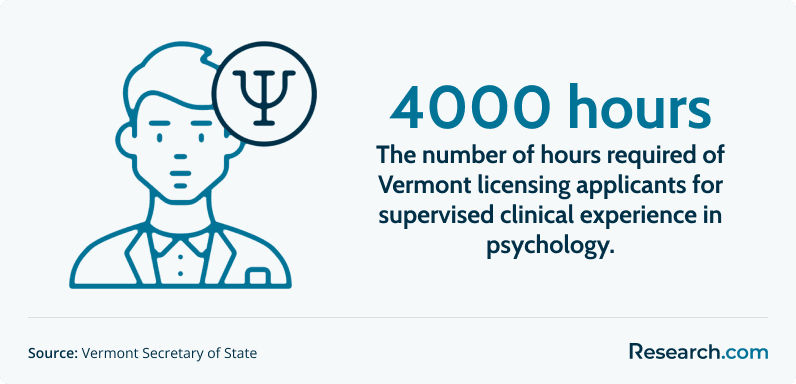
To become a licensed psychologist in Vermont, you generally need to complete a bachelor’s degree, earn a doctoral degree in psychology such as a PhD or PsyD, document 4,000 hours of supervised professional experience, apply through the Vermont Secretary of State, complete the Vermont jurisprudence examination requirement, pass the Examination for Professional Practice in Psychology (EPPP), and renew the license every two years with approved continuing education.
The Vermont pathway is best suited for people who want the authority and training associated with doctoral-level psychological practice. If your goal is primarily counseling, school-based services, substance use treatment, or human services work, a master’s-level license or certification may be more practical, faster, or better aligned with your intended role.
| Decision Point | What It Means in Vermont | Why It Matters |
| Minimum degree path | Bachelor’s degree followed by a doctoral degree in psychology | Psychologist licensure is a doctoral-level route, not only a counseling credential. |
| Supervised experience | 4,000 hours are required, with at least 2,000 hours completed after the doctorate | You need to plan for training time beyond coursework. |
| Application fee | $175 | Licensure costs include more than tuition and books. |
| Renewal | Every two years with a $150 renewal fee and 60 approved continuing education credits | Maintaining a license requires ongoing professional learning and budgeting. |
| APA-accredited doctoral option in Vermont | The APA accredited only one doctoral program in the Green Mountain State in 2026: the University of Vermont PhD program in clinical psychology | Accreditation can affect training quality, internship competitiveness, and licensure planning. |
Overview of the Psychology Industry in Vermont
Vermont can be a strong state for psychology professionals who want to work across health care, schools, government agencies, research settings, community organizations, or private practice. The state’s mental health access ranking is relatively favorable, but cost barriers, rural geography, provider availability, and insurance limitations still shape how services are delivered.
Compensation also helps explain why many students consider the psychologist route despite the long training timeline. As of 2022, the estimated median annual wage for all occupations in Vermont was $43,680. During the same period, local school psychologists had an estimated median annual wage of $73,401.6, while clinical and counseling psychologists had an estimated median annual wage of $69,753.6, according to the U.S. Bureau of Labor Statistics (BLS, 2023). These figures do not guarantee individual earnings, but they show that psychology roles requiring advanced preparation can pay above the statewide median for all occupations.
Vermont also has several institutions offering psychology-related undergraduate and graduate education through schools accredited by institutional accreditors such as the New England Commission of Higher Education (NECHE). For students pursuing doctoral clinical psychology training in the state, program-level accreditation is especially important. In 2026, the University of Vermont’s PhD program in clinical psychology was the only APA-accredited doctoral psychology program in Vermont. Institutional and programmatic accreditation should be reviewed carefully before enrolling because licensure boards, internship sites, employers, and doctoral admissions committees may treat accreditation status as a key quality indicator.
Education Required to Become a Psychologist in Vermont
The Vermont psychology license is not an entry-level credential. It is built on years of academic preparation, supervised practice, and testing. Before committing to this path, compare it with related master’s-level routes such as counseling, social work, marriage and family therapy, school psychology, or behavior analysis. The right choice depends on the services you want to provide, the populations you want to serve, and how much time and cost you can responsibly take on.
If cost is a major constraint, you may want to begin by comparing accredited and lower-cost pathways, including affordable online colleges for psychology. However, online flexibility should never replace licensure due diligence. You still need to confirm whether a program’s curriculum, supervised training structure, and accreditation status support your long-term goals in Vermont.
| Stage | Typical Requirement | What to Check Before Enrolling |
| Bachelor’s degree | A four-year undergraduate degree in psychology or a related field such as sociology, social work, or behavioral science | Confirm whether graduate programs require prerequisite psychology courses if your major is outside psychology. |
| Foundational coursework | Core study in behavior, research methods, statistics, development, abnormal psychology, and intervention concepts | Look for courses that build readiness for graduate training, including exposure to the therapeutic modalities used by mental health professionals. |
| Doctoral degree | A PhD or PsyD in psychology, often taking four to seven years to complete | Compare research expectations, clinical training, internship placement support, faculty mentorship, and whether PsyD programs fit your practice goals. |
| Continuing education | Ongoing education after licensure, required for renewal | Plan for 60 approved credits every two years once licensed. |
Bachelor’s Degree
Your first step is a bachelor’s degree from an accredited institution. Psychology is the most direct major, but related fields can work if you complete the prerequisites required by graduate programs. Students who do not major in psychology should be especially careful to build a transcript that includes research methods, statistics, developmental psychology, abnormal psychology, biological bases of behavior, and other common graduate admissions expectations.
Doctoral Degree in Psychology
Vermont psychologist licensure requires doctoral preparation. Students typically choose between a PhD and a PsyD. A PhD often places heavier emphasis on research, teaching, and scientific training, while a PsyD is commonly designed around professional practice and clinical service. Both can support licensure when properly accredited and structured, but admissions, funding, research expectations, internship processes, and career outcomes can differ significantly.
Continuing Education After Licensure
Education does not stop once you become licensed. Vermont requires psychologists to renew their licenses every two years. Continuing education helps practitioners keep current with ethics, assessment, clinical methods, legal responsibilities, research, telehealth, and population-specific practice issues. Vermont had 152 local clinical and counseling psychologists and 148 local school psychologists according to the U.S. Bureau of Labor Statistics (2024), and licensed professionals are expected to maintain competency throughout their careers.
Vermont Psychology License Application, Exams, and Renewal
After completing the required academic preparation, Vermont applicants must document supervised professional experience and complete the licensing examination process. Treat this as a project with deadlines, forms, fees, supervisor documentation, and board review. Missing records or unclear supervision documentation can slow the process.
1. Complete 4,000 hours of supervised professional experience.
Vermont requires 4,000 hours of supervised professional experience in psychology. You may count up to 2,000 supervised clinical hours during the doctoral program, but at least 2,000 hours must be completed after earning the doctorate. Supervision must be provided by a licensed psychologist, and applicants must submit documentation such as the Supervision Report form and the Summary of Supervised Experience to the Board.
2. Apply for Vermont psychology licensure and complete the required examinations.
Applications are submitted online through the Vermont Secretary of State system. The online portal is used for application instructions, status updates, and renewal matters. Applicants should prepare documentation before applying so they can respond promptly to Board requests.
- Application fee: $175
- Education records: Official transcripts
- Supervised experience records: Documentation from supervised clinical training
- Jurisprudence requirement: Answer sheet for the Vermont jurisprudence examination
After the Board approves the application, candidates may be authorized to take the Examination for Professional Practice in Psychology (EPPP), which is developed by the Association of State and Provincial Psychology Boards (ASPPB). Once the applicant passes the required examination process and satisfies Board requirements, Vermont may issue the psychology license.
3. Renew the license and complete continuing education.
Vermont psychologists must renew their licenses every two years. Renewal is not just an administrative step; it is part of the state’s system for ensuring that licensed psychologists continue to meet professional and ethical standards.
For renewal, psychologists must pay a $150 fee and complete 60 credits of continuing education approved by the APA, the Vermont Psychological Association, or the Board.
| Licensure Step | Best Way to Prepare | Common Risk |
| Doctoral education | Confirm accreditation, clinical training expectations, and licensure alignment before enrolling. | Assuming any psychology doctorate automatically meets Vermont requirements. |
| Supervised experience | Track hours, supervisor credentials, dates, duties, and required forms as you go. | Trying to reconstruct supervision records after training ends. |
| Application | Gather transcripts, supervision documentation, fee payment, and jurisprudence materials early. | Submitting an incomplete application and delaying Board review. |
| EPPP | Create a study plan and take the exam only after Board authorization. | Underestimating the breadth of topics covered by the exam. |
| Renewal | Build continuing education into your professional calendar. | Waiting until the renewal deadline to find approved credits. |
How to Choose a Psychology Program in Vermont
The best psychology program is not always the most famous, the cheapest, or the closest to home. It is the program that matches your career target, licensure plan, finances, learning format, and need for supervised training. For Vermont students, accreditation deserves special attention because the state has a limited number of doctoral psychology options, and the APA-accredited doctoral pathway is concentrated at the University of Vermont.
Start With the Career You Actually Want
Before comparing schools, decide whether you want to become a licensed psychologist, licensed counselor, school psychologist, researcher, human services worker, or another type of mental health professional. A bachelor’s degree can open entry-level and support roles, a master’s degree can support several counseling-related credentials, and a doctorate is generally required for psychologist licensure.
Check Accreditation at Both Levels
Institutional accreditation, such as NECHE accreditation, indicates that the college or university has gone through a recognized quality-review process. Programmatic accreditation, such as APA accreditation for doctoral psychology programs, may be especially important for clinical psychology students. Do not rely only on a school’s marketing language. Verify accreditation status directly and ask the program how it prepares graduates for Vermont licensure.
Compare Specialization, Supervision, and Fieldwork
Psychology programs may emphasize clinical psychology, developmental psychology, behavioral neuroscience, forensic psychology, school psychology, counseling, research, or applied human services. If your intended career requires supervised practice, ask how placements are arranged, who supervises students, what populations students serve, and whether placements are available near your location.
Evaluate Cost Beyond Tuition
Tuition is only one part of affordability. Consider fees, books, transportation, technology, housing, lost work time, internship requirements, and the cost of future licensure. Prospective students can compare the best colleges for psychology in Vermont to review program options, costs, and academic resources.
| Question to Ask | Why It Matters | Better Decision Rule |
| Is the institution accredited? | Accreditation affects transferability, graduate admissions, financial aid eligibility, and employer confidence. | Verify accreditation before applying, not after enrolling. |
| Does the doctoral program fit Vermont licensure expectations? | Licensure boards may require specific education and training documentation. | Ask the program to explain how graduates meet Vermont requirements. |
| How are practicum, internship, or supervised placements handled? | Field training is essential for clinical and school-based careers. | Choose programs with clear placement support and transparent supervision policies. |
| Can credits transfer or count toward graduate study? | Transfer policies can affect completion time and cost. | Get transfer evaluations in writing before committing. |
| What funding is available? | Scholarships, assistantships, and work-study can change the real cost of attendance. | Compare net cost, not only published tuition. |
Challenges Psychologists May Face in Vermont
Vermont can be a meaningful place to practice, but the work is not without constraints. Understanding these issues before entering the field can help you choose the right specialty, work setting, and long-term practice model.
- Access barriers: Even with a relatively strong state ranking, many residents still face cost, provider availability, and distance-related obstacles when seeking psychological services.
- Burnout risk: Psychologists working in high-need communities may manage heavy caseloads, crisis needs, administrative demands, and emotional strain.
- Insurance complexity: Reimbursement rules, documentation requirements, and payer restrictions can affect practice operations and client access.
- Changing rules: Practitioners must monitor licensing, telehealth, privacy, and documentation requirements so their work remains compliant.
- Mental health stigma: Some clients may delay treatment because of shame, privacy concerns, cultural barriers, or fear of being judged.
Top Psychology Programs in Vermont for 2027
The following Vermont institutions offer psychology-related programs that may support different career goals. Some are better suited for undergraduate preparation, while others offer graduate or doctoral options. Costs vary, so students should compare tuition, aid, transfer credit, housing, and program format carefully. If affordability is a concern, consider researching scholarship programs available in the US before finalizing your school list.
1. University of Vermont
The University of Vermont is a public research university founded in 1791 and is the oldest university in the state. Through the College of Arts and Sciences, students can study across fine arts, humanities, natural sciences, mathematics, and social sciences. Its Department of Psychological Science offers research, laboratory, and community-based learning opportunities led by experienced faculty. Psychology coursework covers areas recognized by the APA, including clinical psychology, developmental psychology, social psychology, and behavioral neuroscience. Students may also pair psychology study with minors such as social work, human development, neuroscience, and pharmacology. Annual undergraduate tuition may cost $35,998 for resident students and $61,442 for non-resident students. Annual graduate tuition may cost $678 per credit for resident students and $1,720 per credit for non-resident students.
Programs Available:
- Bachelor of Arts (BA) in Psychological Science
- Bachelor of Science in Psychological Science
- Accelerated Master’s Program in Psychology
- PhD Program in Clinical Psychology
- Experimental Psychology Program
- Clinical and Developmental Training Program
Accreditation: New England Commission of Higher Education (NECHE), American Psychological Association (APA)
2. Vermont State University
Vermont State University was established in 2023 through the combination of Northern Vermont University, Castleton University, and Vermont Technical College. The regional public university offers more than 100 academic programs, including mostly on-campus undergraduate and graduate psychology options at the Castleton, Johnson, and Lyndon campuses. Students can shape their program pathways around academic interests, career goals, and learning preferences, and psychology courses are available to students across campuses. Resident undergraduate students may spend $9,984 annually, while non-resident undergraduate students may spend $19,992 annually. Resident graduate students may pay $639 per credit, while non-resident graduate students may pay $821 per credit.
Programs Available:
- Associate of Science (AS) in Psychological Science
- BS in Psychological Science
- BS in Applied Psychology and Human Services
- Online BA in Psychology
- Master of Science in School Psychology
Accreditation: NECHE
3. Northern Vermont University
Northern Vermont University, now part of Vermont State University, originated in 2018 after Johnson State College and Lyndon State College merged. Its associate and bachelor’s psychology programs may be completed online, and the Johnson campus reports connections with more than 300 internship locations for psychology students. The curriculum follows APA guidelines, and full-time faculty members lead research opportunities. For undergraduate study, resident tuition may cost $483 per credit and non-resident tuition may cost $1,070 per credit. For graduate study, resident tuition averages $629 per credit and non-resident tuition may cost $916 per credit.
Programs Available:
- AS in Human Services
- BA in Psychology
- BS in Applied Psychology and Human Services
- BA in Anthropology and Sociology
- Master of Arts (MA) in Counseling
- MS in Clinical Mental Health Counseling
Accreditation: NECHE
4. Champlain College
Champlain College is a private institution in Burlington, Vermont, founded in 1878. It offers in-person and online degree options, including an undergraduate psychology program built around an “upside-down” curriculum that introduces major-focused work early. Students can explore applied psychology through concentrations such as health and well-being, social change/social impact, and the flex path. The flex path allows students to work with a faculty member to design a personalized academic plan. The college does not offer a graduate psychology program. Undergraduate study may cost $45,100 annually.
Program Available: BS in Psychology
Accreditation: NECHE
5. Goddard College
Goddard College is a private institution founded in 1938 with three campuses: one in Vermont and two in Washington. Its psychology programs are designed for students interested in psychology and counseling-related work. Undergraduate students may use the final semester as a transition term that includes graduate coursework toward an MA in psychology or an MA in Clinical Mental Health Counseling. The MA in psychology includes four concentrations, including sexual orientation and sexual, affectional, intersex, and gender-expansive communities. Undergraduate tuition may cost $9,634 per semester, while graduate tuition may cost $11,799 per semester.
Programs Available:
- BS in Psychology
- MA in Psychology
- MA in Clinical Mental Health Counseling
Accreditation: NECHE
Can an Online Doctorate in Psychology Enhance My Career Prospects in Vermont?
An online doctorate can strengthen career prospects only if it fits your intended role and licensure plan. Flexibility is valuable, especially for working adults, but Vermont licensure requires more than completing online coursework. You still need appropriate doctoral training, supervised experience, examination eligibility, and Board approval.
Before choosing an online doctoral program, review accreditation, residency requirements, practicum and internship arrangements, faculty mentorship, dissertation or research expectations, and whether the program has experience supporting students seeking Vermont licensure. If affordability is your main concern, compare options through resources on the cheapest online doctorate in psychology, but do not choose based on price alone.
| Online Doctorate Factor | Why It Matters for Vermont Students |
| Accreditation | Licensure planning, internship competitiveness, and employer confidence can depend on recognized accreditation. |
| Clinical placement support | Online students may need local supervised experiences that meet program and state expectations. |
| Residency requirements | Some programs require in-person intensives, campus visits, or supervised training blocks. |
| Faculty fit | Research and clinical mentorship should align with your specialty interests. |
| Total cost | Include tuition, fees, travel, technology, supervision-related expenses, and lost work time. |
Psychology Careers in Vermont That May Not Require Psychologist Licensure
You do not always need a doctoral psychology license to work in a psychology-related field. Many roles use psychology knowledge without granting the full scope of practice of a licensed psychologist. These options can be useful for students building experience, professionals who prefer master’s-level work, or graduates who want to apply psychology in education, business, research, or human services.
- Psychology research assistant: Research assistants support studies by helping with data collection, literature reviews, participant coordination, coding, and basic analysis under supervision.
- Mental health aide: Mental health aides provide support in clinical or residential settings under licensed professionals, often assisting with client care, scheduling, observation, and documentation.
- Human resources specialist: Psychology training can support recruiting, training, employee engagement, workplace behavior analysis, and organizational development.
- School psychologist: School psychology typically requires graduate preparation and state certification rather than the same doctoral-level psychologist license used for independent clinical psychology practice.
If you want more responsibility than a bachelor’s-level role but do not want to pursue a doctorate, an online masters in psychology may help you build advanced knowledge for research, human services, education, or preparation for related credentials. Always check whether the degree meets the requirements for the specific license or certification you plan to pursue.
What are the differences between a therapist and a clinical psychologist in Vermont?
In Vermont, “therapist” is a broad term that may refer to professionals with different licenses and educational backgrounds, while a clinical psychologist is a doctoral-level professional trained in psychological assessment, diagnosis, therapy, research, and evidence-based practice. Many therapists hold master’s degrees and focus primarily on counseling or psychotherapy. Clinical psychologists complete doctoral study and typically have deeper preparation in assessment, research design, psychological testing, and complex diagnosis.
The practical difference matters when choosing a degree. If you want to provide counseling services, a master’s-level route may be enough depending on the license. If you want the psychologist title, doctoral-level training, psychological testing authority, and a broader clinical scope, the Vermont psychology license pathway is the more relevant option. For a fuller comparison, review the guide to therapist vs clinical psychologist differences.
What are the key steps to transition into a counseling role or private practice in Vermont?
Moving into counseling or private practice requires more than clinical skill. You need the right license, appropriate supervision, ethical documentation habits, business planning, payer strategy, and a clear service model. If you are already trained in psychology, identify whether your current education supports a counseling credential or whether you need additional coursework, supervised hours, or examinations.
Private practice also involves nonclinical decisions: legal structure, liability coverage, record systems, billing, client intake, emergency protocols, referral networks, office or telehealth setup, and compliance with state and federal privacy rules. If counseling is your main target, use a Vermont-specific guide such as how to become an LPC in Vermont to compare that route with doctoral psychologist licensure.
Using Interdisciplinary Training to Broaden Your Psychology Career in Vermont
Psychology overlaps with social work, education, public health, neuroscience, criminal justice, behavior analysis, and counseling. Adding interdisciplinary training can make you more useful in team-based settings, especially when clients need support with housing, school services, family systems, disability services, substance use, trauma, or community resources.
For example, combining psychology knowledge with social work training can be valuable in community mental health, child and family services, and integrated care. If you are considering that direction, compare psychology licensure requirements with the degree needed to become a social worker in Vermont before committing to another graduate program.
How Can I Pursue a Career as a School Psychologist in Vermont?
School psychology is a distinct pathway for professionals who want to support students’ learning, behavior, mental health, assessment needs, and educational planning. School psychologists often work with students, parents, teachers, administrators, and community providers to design interventions and improve academic and social-emotional outcomes.
If you are drawn to school-based work, focus on programs that include assessment, child and adolescent development, special education law, consultation, crisis response, and supervised school placements. Credentialing can differ from clinical psychologist licensure, so review Vermont-specific requirements through a resource on how to become a school psychologist in Vermont.
Current Trends Affecting Psychology Careers in Vermont
Psychology careers in Vermont are being shaped by access needs, technology, rural service delivery, integrated care, and employer expectations. These trends do not remove the need for licensure, ethics, or high-quality training, but they do influence which skills may make a professional more competitive.
Telehealth and Remote Psychological Services
Telehealth has become an important service model for clients who live far from providers, have mobility barriers, need scheduling flexibility, or prefer remote care. Psychologists offering telehealth must understand clinical appropriateness, emergency planning, informed consent, privacy, documentation, and secure technology use. Telehealth can improve reach, but it is not a shortcut around licensing rules or professional standards.
Rural Mental Health Needs
Vermont’s smaller and geographically dispersed communities create challenges for mental health access. Psychologists who understand rural practice may need to address isolation, transportation barriers, limited specialist availability, substance use concerns, and the privacy challenges of working in close-knit communities.
Integrated Behavioral Health
Psychologists are increasingly part of teams that include primary care physicians, nurses, social workers, counselors, and school professionals. Integrated care requires strong communication, concise documentation, consultation skills, and comfort working with interdisciplinary treatment plans.
If you want advanced clinical preparation that can support work in these settings, compare training options such as the best online clinical psychology programs, while confirming whether any program you consider aligns with licensure and supervised training requirements.
What Other Licenses and Certifications Can Psychology Professionals Consider in Vermont?
A Vermont psychology license is one route, but it is not the only credential that can lead to mental health or behavioral health work. Depending on your interests, you may consider counseling, marriage and family therapy, school psychology, substance abuse counseling, social work, or behavior analysis. Each credential has its own education, supervision, examination, and renewal requirements.
If your preferred work centers on couples and families, review requirements for the MFT license in Vermont. If your interests involve counseling, addiction treatment, school services, or behavioral intervention, compare those pathways before committing to a doctorate. A narrower credential may be more efficient for your goals, while the psychologist pathway may be stronger for assessment, diagnosis, research, and broader clinical leadership.
How Can I Obtain an LPC License in Vermont?
The Licensed Professional Counselor pathway is designed for people who want to provide counseling services, usually after completing a relevant master’s degree, supervised clinical experience, and required examinations. This can be a better fit than psychology licensure for students who want to begin professional counseling without completing a doctoral psychology program.
Because LPC requirements are specific, students should verify coursework, practicum, internship, supervision, documentation, and exam expectations before enrolling in a program. A Vermont-focused overview of Vermont LPC license requirements can help you decide whether this credential matches your timeline and practice goals.
Can I Specialize Further in Substance Abuse Counseling in Vermont?
Substance abuse counseling can be a meaningful specialization for psychology, counseling, social work, or human services professionals who want to support clients dealing with addiction and recovery. Training may include screening, assessment, treatment planning, relapse prevention, motivational approaches, ethics, co-occurring conditions, and referral coordination.
If this specialty is your main interest, review the education and credentialing route in detail before choosing a general psychology program. Start with guidance on how to become a substance abuse counselor in Vermont and compare it with broader psychologist and counselor pathways.
What are the pathways to criminal psychology in Vermont?
Criminal psychology connects psychology with criminal justice, offender behavior, forensic assessment, corrections, victim services, legal processes, and public safety. People interested in this field may pursue coursework or supervised experience in forensic psychology, assessment, legal psychology, trauma, research methods, and criminal behavior.
Because “criminal psychology” can refer to different roles, clarify whether you want to conduct research, provide forensic evaluation, work in corrections, support law enforcement, consult on legal matters, or provide clinical services to justice-involved clients. For a role-focused roadmap, review how to become a criminal psychologist in Vermont.
Legal and Ethical Duties for Vermont Psychologists
Licensed psychologists in Vermont must follow legal and ethical standards involving confidentiality, informed consent, assessment practices, professional boundaries, recordkeeping, supervision, mandatory reporting, advertising, and scope of competence. Ethical practice is not optional; it is central to public trust and license protection.
Telehealth adds additional responsibilities. Psychologists must consider client location, emergency procedures, privacy safeguards, technology security, documentation, and whether remote care is clinically appropriate. Professionals who expand into specialized services should also ensure that their training supports competent practice. For example, behavior-focused work may require understanding credentials such as how to become a BCBA in Vermont.
Vermont Psychology Job Market Considerations
Vermont’s psychology job market is influenced by demand for accessible mental health care, school-based support, telehealth, rural service delivery, and integrated behavioral health. Employers may value candidates who can work across disciplines, document clearly, use digital care tools appropriately, and serve clients with complex needs.
Students should not assume that a degree alone guarantees a specific job or salary. Location, specialty, supervised experience, licensure status, employer type, insurance participation, and willingness to work in high-need settings all affect opportunities. If your goal is to enter counseling work as efficiently as possible, compare the psychologist pathway with the shortest path to become a counselor in Vermont.
Common Mistakes to Avoid When Planning for Vermont Psychology Licensure
- Choosing a program without checking accreditation: Accreditation should be verified before you apply, especially for doctoral training tied to licensure.
- Assuming all online programs meet Vermont requirements: Online delivery does not automatically mean a program satisfies education, supervision, or licensure expectations.
- Focusing only on tuition: Total cost includes fees, books, travel, internship requirements, reduced work hours, application fees, exam preparation, and renewal expenses.
- Ignoring supervised experience rules: Track supervision hours carefully and confirm that your supervisor meets Vermont requirements.
- Waiting too long to plan for the EPPP: The exam covers a broad range of psychology knowledge and should be built into your timeline.
- Confusing psychology licensure with counseling licensure: A psychologist, LPC, MFT, school psychologist, and substance abuse counselor may have different scopes of practice and requirements.
- Relying only on rankings: Rankings can be useful, but licensure fit, faculty mentorship, field placement quality, and affordability matter more.
Practical Steps Before You Apply to a Vermont Psychology Program
- Define the role you want. Decide whether your goal is clinical psychology, school psychology, counseling, research, forensic work, substance abuse treatment, human services, or another path.
- Match the degree level to the role. Do not pursue a doctorate if a master’s-level credential better fits your timeline and practice goals.
- Verify accreditation. Check institutional accreditation and, for doctoral clinical psychology, programmatic accreditation when relevant.
- Ask about licensure outcomes. Request clear information on how the program prepares students for Vermont requirements.
- Review field training logistics. Ask where placements occur, who supervises students, and how hours are documented.
- Compare net cost. Look at tuition, aid, assistantships, scholarships, living costs, travel, and lost income.
- Plan for postdoctoral supervised experience. Vermont requires at least 2,000 supervised hours after the doctorate, so build that into your timeline.
- Keep records from the start. Save syllabi, transcripts, supervision forms, practicum records, internship records, and continuing education documentation.
Help Improve Mental Healthcare Access as a Licensed Professional
Vermont’s mental health system has strengths, but the state still needs trained professionals who can deliver ethical, accessible, and evidence-based care. The fact that financial cost kept many adults from receiving needed mental health care in 2024 shows that licensure is not only a personal career goal; it is also connected to broader access challenges.
Psychologists can help individuals, families, schools, agencies, and communities address emotional distress, behavioral concerns, trauma, developmental needs, learning challenges, and life transitions. The work requires serious preparation, but it can lead to a career centered on assessment, treatment, research, consultation, and public service.
If you are also considering counseling or another allied mental health pathway, compare requirements before choosing a degree. For official application and renewal information, visit the Vermont Secretary of State’s website.
Key Insights
- Vermont psychologist licensure is a doctoral-level pathway. You should expect to complete undergraduate preparation, a psychology doctorate, supervised experience, examinations, and continuing education.
- Supervised experience is a major requirement. Vermont requires 4,000 hours, and at least 2,000 hours must be completed after earning the doctorate.
- Accreditation should drive program choice. Vermont had only one APA-accredited doctoral psychology program in 2026, so students should verify program fit before enrolling.
- Psychology salaries can exceed the statewide median, but outcomes vary. In 2022, Vermont’s median annual wage for all occupations was $43,680, while school psychologists had $73,401.6 and clinical and counseling psychologists had $69,753.6.
- Licensure is not the only mental health route. Counseling, school psychology, marriage and family therapy, substance abuse counseling, social work, and behavior analysis may be better fits depending on your goals.
- Renewal requires ongoing commitment. Vermont psychologists renew every two years, pay a $150 renewal fee, and complete 60 approved continuing education credits.
- The best program is the one that matches your license target. Compare accreditation, supervised training, cost, specialization, online requirements, and postgraduation support before applying.
Related Articles for Nearby States
- 2027 New Hampshire Psychology Licensure Requirements – How to Become a Psychologist in New Hampshire
- 2027 Massachusetts Psychology Licensure Requirements – How to Become a Psychologist in Massachusetts
- 2027 New York Psychology Licensure Requirements – How to Become a Psychologist in New York
- 2027 Connecticut Psychology Licensure Requirements – How to Become a Psychologist in Connecticut
- 2027 Rhode Island Psychlogy Licensure Requirements – How to Become a Psychologist in Rhode Island
- 2027 Maine Psychology Licensure Requirements – How to Become a Psychologist in Maine
- 2027 New Jersey Psychology Licenure Requirements – How to Become a Psychologist in New Jersey
- 2027 Pennsylvania Psychology Licensure Requirements – How to Become a Psychologist in Pennsylvania
- 2027 Delaware Psychology Licensure Requirements – How to Become a Psychologist in Delaware
- 2027 Maryland Psychology Licensure Requirements – How to Become a Psychologist in Maryland
References
- Mental Health America. (2024). 2024 State of mental health in America. https://mhanational.org/reports/2024/state-mental-health-america
- National Alliance on Mental Illness. (2024). Vermont report on adult mental health access. https://nami.org/reports/vermont-2024
- National Alliance on Mental Illness. (2025). Mental Health in Vermont. https://www.nami.org/NAMI/media/NAMI-Media/StateFactSheets/VermontStateFactSheet.pdf
- U.S. Bureau of Labor Statistics. (2025). Psychologists. https://www.bls.gov/ooh/life-physical-and-social-science/psychologists.htm
Other Things You Should Know About The Vermont Psychology Licensure
To become a licensed psychologist in Vermont, you need a bachelor’s degree in psychology or a related field, followed by a doctoral degree (PhD or PsyD) in your chosen concentration in psychology from an accredited institution.
You must complete 4,000 hours of supervised professional experience, with at least 2,000 of these hours gained after earning your doctoral degree.
Yes, non-psychology majors can apply for graduate programs in psychology in Vermont. Most programs require prerequisite courses in psychology, and candidates may need to demonstrate strong foundational knowledge through additional coursework or relevant experience in the field. Always check specific program requirements for details.
Yes, licensed psychologists must complete 60 credits of continuing education approved by the APA, the Vermont Psychological Association, or the Vermont Board of Psychology as part of the license renewal process.
In 2027, applying for a psychology license in Vermont requires several fees. The application fee is $150, while taking the Examination for Professional Practice in Psychology (EPPP) incurs an additional $600 fee. Candidates may also need to budget for other associated costs, including background checks and fingerprinting.
In Vermont, aspiring psychologists must pass the Examination for Professional Practice in Psychology (EPPP) and the Vermont jurisprudence examination to obtain a psychology license. The EPPP assesses foundational psychology knowledge, while the jurisprudence exam covers Vermont laws and regulations relevant to psychology practice.


