
2027 Missouri Psychology Licensure Requirements – How to Become a Psychologist in Missouri

Co-Founder and Chief Data Scientist
How to Become a Psychologist in Missouri: Licensure, Education, Programs, and Career Paths
Becoming a licensed psychologist in Missouri requires more than earning a psychology degree. You need the right doctoral training, supervised professional experience, national and state exams, and a clear understanding of Missouri’s licensing rules. This guide is for students planning their education, graduates comparing psychology career routes, out-of-state psychologists considering Missouri licensure, and professionals exploring related credentials in counseling, school psychology, behavior analysis, substance abuse treatment, or forensic work.
You will learn how Missouri psychology licensure works, what education and supervised experience are typically required, how salaries differ by specialization, which Missouri programs are commonly considered by psychology students, and what questions to ask before committing to a degree path. Along the way, this guide also connects the licensing process to broader psychology training, including concepts beyond the four goals of psychology.
Quick Answer: What Does It Take to Become a Psychologist in Missouri?
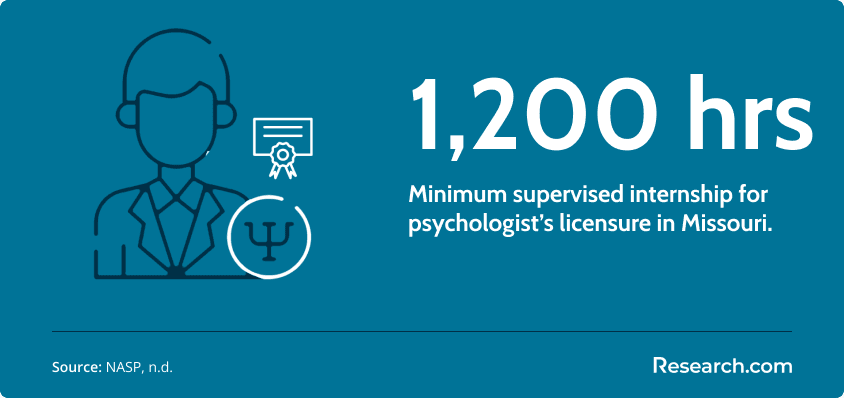
To become a licensed psychologist in Missouri, candidates generally complete a bachelor’s degree, earn an APA- or CPA-accredited doctoral degree in psychology, complete supervised professional experience, pass the Examination for Professional Practice in Psychology (EPPP), pass Missouri’s state-specific jurisprudence requirement, and satisfy application, background check, and renewal requirements. School psychology follows a different credentialing route through education-focused requirements, including a specialist or equivalent degree with at least 60 graduate semester hours, a 1,200-hour supervised internship, and a passing score of 147 on the School Psychologist (5402) Exam.
Missouri Psychology Licensure Requirements Table of Contents
- Psychology careers and salary outlook in Missouri
- Education requirements for Missouri psychologists
- Licensure application, exams, supervised hours, and renewal
- Top psychology programs in Missouri for 2027
- Specialized psychology certifications and related credentials
- Substance abuse counseling specialization in Missouri
- Accelerated online psychology programs
- BCBA credentialing in Missouri
- Sport psychology career options
- Counseling credentials for psychology professionals
- Interdisciplinary collaboration in psychology practice
- Criminal psychology pathways in Missouri
- Exam preparation resources for Missouri candidates
- Entry-level psychology careers in Missouri
- Continuing education and professional development
- Business psychology in Missouri workplaces
- Research opportunities for psychology students and professionals
- Missouri LPC credential pathways
Overview of the Psychology Industry in Missouri
Missouri’s psychology field includes licensed clinical and counseling psychologists, school psychologists, postsecondary instructors, researchers, consultants, and professionals working in related mental health and behavioral science roles. Demand is shaped by mental health needs, school-based services, healthcare access, substance use treatment, assessment services, workplace well-being, and community-based care.
For students asking what can you do with a psychology major?, the answer depends heavily on degree level. A bachelor’s degree can support entry-level work in human services, research support, case coordination, and business roles. Independent psychology practice, however, generally requires doctoral education and state licensure.
Job and Salary Outlook
Psychologist salaries in Missouri vary by role, work setting, experience, licensure status, and specialization. Postsecondary psychology teachers earn a median salary of $85,470. Clinical and counseling psychologists typically earn $90,480, while school psychologists earn around $65,640. Professionals in other psychology roles have a median salary of $114,990. In practice, the best paying psychology jobs usually require advanced education, specialized training, licensure, and experience in higher-responsibility settings.
| Psychology role in Missouri | Median salary stated | What this means for students |
| Postsecondary psychology teachers | $85,470 | This route usually requires graduate study and is most relevant for those interested in teaching, research, or academic careers. |
| Clinical and counseling psychologists | $90,480 | This is the core licensed practice pathway for assessment, diagnosis, therapy, and clinical services. |
| School psychologists | $65,640 | This path focuses on student learning, assessment, intervention, and support services in educational settings. |
| Other psychology roles | $114,990 | These roles may include specialized, applied, research, or consulting work and often require advanced expertise. |
Where Psychologists Work in Missouri
Psychology employment is spread across several settings. To date, the employment landscape shows that many psychologists are self-employed (28%), while others work in elementary and secondary schools (27%), ambulatory healthcare services (21%), government roles (8%), and hospitals (4%). This variety matters because education, supervision, daily duties, and salary potential can differ significantly by setting.
Licensure Exam Performance and Training Quality
Missouri candidates for psychologist licensure must pass the EPPP, a national exam designed to measure broad professional psychology knowledge. The state’s pass rate has exceeded the national average in recent years, suggesting that many Missouri-trained candidates receive strong preparation. Still, pass rates should not be treated as a guarantee. Individual outcomes depend on doctoral training quality, internship experience, study time, test readiness, and familiarity with professional ethics and state law.
Current Trends Affecting Missouri Psychology Careers
Several trends are changing how psychologists work in Missouri. Telehealth has made service delivery more flexible, but it also requires careful attention to licensure boundaries, privacy, documentation, and ethics. Schools and healthcare organizations increasingly value interdisciplinary care, which means psychologists often coordinate with counselors, social workers, physicians, educators, behavior analysts, and case managers. Artificial intelligence tools may help with administrative workflows and research support, but they do not replace clinical judgment, licensed assessment, informed consent, or ethical responsibility.
Educational Requirements for Psychologists in Missouri
If you are wondering how long does it take to become a psychologist, the answer depends on your target credential. Licensed psychologist roles require extensive graduate education, while school psychology, counseling, behavior analysis, and entry-level psychology-related careers may follow different timelines.
Missouri school psychologist certification has its own pathway. Candidates typically complete a specialist or equivalent program with at least 60 graduate semester hours, including substantial preparation in school psychology. They must also receive a recommendation from a designated university approved by the Missouri Department of Elementary and Secondary Education, complete a supervised internship of at least 1,200 hours with a significant portion in an educational setting, and earn a passing score of 147 on the School Psychologist (5402) Exam administered by Educational Testing Service.
Bachelor’s Degree
Most future psychologists begin with a bachelor’s degree in psychology or a closely related field. At this level, students build a foundation in human behavior, research design, statistics, development, cognition, social psychology, abnormal psychology, and ethical reasoning. A bachelor’s degree alone does not qualify someone for independent psychologist licensure, but it can prepare students for graduate admissions and entry-level work in research, social services, business, or mental health support roles.
Doctoral Degree
Missouri psychologist licensure generally requires a doctoral degree in psychology. The two common doctoral routes are the Doctor of Philosophy (Ph.D.) and the Doctor of Psychology (Psy.D.). The doctoral program must be accredited by the American Psychological Association (APA) or the Canadian Psychological Association (CPA). These programs prepare students in assessment, intervention, ethics, research, professional practice, and supervision. Students interested in areas such as child psychology should use graduate training, practica, internship placement, and supervised experience to build the appropriate specialization.
Internship and Supervised Professional Experience
Doctoral training must be paired with supervised experience that meets Missouri licensure standards. The internship experience is where candidates apply assessment, diagnosis, treatment planning, consultation, documentation, and ethical decision-making under supervision. Depending on the license type and training history, candidates may also complete postdoctoral supervised experience.
Accurate hour tracking is not optional. A survey found that 47% of internship directors sometimes estimate a student’s hours, which can create documentation problems. If a licensing board later questions the record, unclear hour logs may delay an application. Candidates should maintain dated records, supervisor signatures, client-contact categories, assessment hours, supervision hours, and setting descriptions throughout training.
| Training stage | Purpose | Decision point for students |
| Bachelor’s degree | Builds the academic base for psychology and graduate study. | Choose a program with research methods, statistics, faculty mentoring, and graduate school preparation. |
| Doctoral degree | Provides advanced preparation for professional psychology practice, research, assessment, and intervention. | Verify APA or CPA accreditation before applying if your goal is psychologist licensure. |
| Internship or residency | Develops supervised real-world competence in clinical, counseling, school, or applied settings. | Track hours carefully and confirm that placements align with Missouri requirements. |
| Exams and licensure application | Demonstrates readiness for independent practice under Missouri rules. | Plan for both the EPPP and Missouri-specific jurisprudence expectations. |
Missouri Licensure Application and Renewal Process for Psychologists
The Missouri psychology licensure process is designed to confirm that applicants have appropriate education, supervised experience, examination readiness, ethical grounding, and fitness to practice. Before applying, candidates should review the Missouri Committee of Psychologists rules and verify requirements directly, especially if they completed training outside Missouri or outside the United States.
National and State Licensing Exams
Missouri candidates must pass the Examination for Professional Practice in Psychology, commonly called the EPPP. This national exam, administered through the Association of State and Provincial Psychology Boards (ASPPB), evaluates knowledge across major areas of professional psychology.
Missouri also requires a state-specific jurisprudence exam. This exam focuses on Missouri laws, rules, ethical responsibilities, and regulations governing psychology practice. Candidates should not treat the jurisprudence exam as an afterthought; it tests the legal and professional boundaries that shape daily practice in the state.
Supervised Clinical Hours
Applicants must complete supervised experience that satisfies Missouri requirements. Depending on the license category, candidates typically complete 2,000 to 4,000 hours of supervised experience. These hours should involve appropriate supervision by a licensed psychologist and may include direct client contact, assessment, intervention, consultation, and related professional duties.
Because supervised experience rules can be technical, candidates should confirm the acceptable setting, supervisor qualifications, documentation format, and timing of hours before beginning a placement. A placement that is clinically useful may still create licensure problems if it does not meet the board’s documentation or supervision standards.
Additional Application Requirements
Missouri applicants may need to complete requirements beyond education, exams, and supervised hours. These commonly include documentation review and suitability checks.
- Background checks: Applicants may be required to complete criminal background checks, particularly because psychologists often serve vulnerable clients in healthcare, school, forensic, and community settings.
- Continuing education: Licensed psychologists must complete ongoing professional development to maintain competence and meet Missouri psychology license continuing education requirements. The requirement is typically around 40 hours every two years, but licensees should verify the current rule for their renewal cycle.
License Reciprocity
Psychologists already licensed in another jurisdiction may qualify for Missouri licensure through reciprocity if they meet state criteria. Missouri may consider applicants with a clean disciplinary history, successful completion of a written exam on Missouri psychology practice rules, and qualifying professional credentials such as diplomate status with the American Board of Professional Psychology, membership in the National Register of Health Service Providers in Psychology, or a certificate of professional qualification (CPQ) from the Association of State and Provincial Psychology Boards (ASPPB). Some applicants may also need to complete an oral examination. Psychologists licensed through reciprocity may qualify for health service provider certification if they meet Missouri’s standards for health service delivery expertise.
Out-of-State and International Applicants
Out-of-state and internationally trained psychologists should not assume that prior education or licensure automatically satisfies Missouri rules. The board may require additional documentation, coursework, supervised experience, credential evaluation, or examinations depending on the applicant’s background. The safest approach is to gather transcripts, internship records, supervision documentation, license verifications, disciplinary history, and program accreditation evidence before applying.
| Requirement | Why it matters | Common mistake to avoid |
| APA or CPA doctoral accreditation | Supports eligibility for psychologist licensure. | Choosing a doctoral program without confirming accreditation status. |
| Supervised experience records | Shows that training met Missouri standards. | Waiting until the end of internship or residency to reconstruct hours. |
| EPPP preparation | Assesses broad professional psychology knowledge. | Studying only familiar clinical areas and ignoring weaker content domains. |
| Missouri jurisprudence exam | Confirms knowledge of state laws, rules, and ethics. | Assuming national ethics knowledge is enough for state-specific practice. |
| Continuing education | Maintains competence after licensure. | Tracking credits poorly or missing renewal deadlines. |
List of Top Psychology Programs in Missouri for 2027
The programs below can help students begin or continue psychology training in Missouri. Use this list as a starting point, not as a substitute for your own program comparison. Before enrolling, confirm current tuition, total credits, transfer policies, modality, faculty interests, practicum options, graduate placement outcomes, and whether the program aligns with your intended license or career path.
| School | Program snapshot | Length | Credits | Cost stated | Accreditation stated |
| University of Missouri | BA in Psychological Sciences with core psychology, statistics, research methods, distribution, and elective coursework. | 4 years | 120 | $74,040 per semester | Commission on Accreditation of American Psychological Association, the Psychological Clinical Science Accreditation System, Academy of Psychological Clinical Science. |
| Washington University in St. Louis | Psychological & Brain Sciences major emphasizing breadth, depth, research literacy, data gathering, literature review, and scientific writing. | 4 years | 120 | $61,750 per semester | Psychological Clinical Science Accreditation System and by the American Psychological Association |
| Missouri State University | Psychology pathway with research participation, laboratory and clinical facility access, and possible mixed credit toward Behavior Analysis and Therapy for eligible students. | 4 years | 118 | $13,392 per semester | Higher Learning Commission |
| Saint Louis University | Psychology BS centered on empirical science, theory, evidence-based understanding, ethics, diversity, research, service, and applied human behavior. | 4 years | 120 | $26,130 per semester | The American Psychological Association |
| Southeast Missouri State University | Psychology program covering learning and memory, cognition, social psychology, development, clinical/personality psychology, statistics, and research design. | 4 years | 120 | $364.70 per credit |
1. University of Missouri
The University of Missouri offers a Bachelor of Arts in Psychological Sciences for students interested in behavior, applied psychology, research, or future graduate study. The on-campus curriculum includes 30 credit hours of psychology coursework, General Psychology (Psych 1000), a statistics requirement (Stat 1200 or equivalent), a research methods sequence (Psych 3010/3020/Capstone), four psychology distribution courses, and two psychology electives.
- Program length: 4 years
- Total credits: 120
- Cost per semester: $74,040
- Accreditation: Commission on Accreditation of American Psychological Association, the Psychological Clinical Science Accreditation System, Academy of Psychological Clinical Science.
2. Washington University in St. Louis
The Psychological & Brain Sciences major at Washington University in St. Louis is built to give students both broad exposure and deeper study in psychology. Students develop skills in evaluating psychological evidence, collecting data, reviewing research literature, and writing scientifically. The department’s undergraduate mission emphasizes core theories, research methods, and opportunities for focused study or concentrations.
- Program length: 4 years
- Cost per semester: $61,750
- Total credits: 120
- Accreditation: Psychological Clinical Science Accreditation System and by the American Psychological Association
3. Missouri State University
Missouri State University offers psychology students access to research activity, faculty support, and facilities such as the Learning Diagnostic Clinic. Eligible undergraduates may begin graduate coursework in Behavior Analysis and Therapy and apply up to 12 hours of mixed credit, which can help them move more efficiently from undergraduate study into advanced preparation.
- Program length: 4 years
- Cost per semester: $13,392
- Total credits: 118
- Accreditation: Higher Learning Commission
4. Saint Louis University
Saint Louis University frames psychology as an empirical and applied discipline. Its program emphasizes theory, evidence-based understanding of behavior and experience, family and organizational contexts, critical thinking, ethics, diversity, research, service, and the practical use of psychology to support human welfare.
- Program length: 4 years
- Cost per semester: $26,130
- Total credits: 120
- Accreditation: The American Psychological Association
5. Southeast Missouri State University
Southeast Missouri State University provides psychology coursework in learning and memory, cognition, social psychology, developmental psychology, clinical/personality psychology, statistics, and research design. The university also highlights career support services that can help students connect classroom learning with employment planning.
- Program length: 4 years
- Cost per credit: $364.70
- Total credits: 120
- Accreditation:
How to Choose a Missouri Psychology Program
The best psychology program is the one that fits your target career, budget, academic preparation, and licensure needs. A student planning for doctoral psychology practice should evaluate different factors than a student seeking an entry-level human services role or a future counseling credential.
| Question to ask | Why it matters |
| Does the program support my intended credential? | Psychologist, school psychologist, LPC, BCBA, and substance abuse counseling pathways have different educational requirements. |
| Is the relevant program accredited? | Accreditation can affect licensure eligibility, doctoral admissions, internship competitiveness, and employer recognition. |
| What supervised experience is available? | Practicum, internship, research labs, clinics, and school placements can shape graduate admissions and career readiness. |
| What is the full cost, not just tuition? | Fees, books, housing, commuting, technology, lost work time, and internship travel can change affordability. |
| How strong is faculty mentoring? | Graduate school applicants often need research experience, recommendation letters, and advice on specialization. |
| Can credits transfer or apply to graduate study? | Transfer policies and mixed-credit options can affect time to completion and total cost. |
What Opportunities Exist for Specialized Certifications in Psychology?
Specialized credentials can help Missouri psychology professionals focus their work, broaden services, or move into adjacent fields. Options may include marriage and family therapy, counseling, behavior analysis, substance abuse counseling, school psychology, forensic psychology, sport psychology, and organizational psychology. For example, professionals interested in relational and family systems work can explore the MFT license in Missouri.
Specialization is most useful when it is tied to a clear practice goal. A credential can strengthen credibility, but it does not automatically expand your legal scope of practice unless Missouri law and the relevant licensing board recognize it. Before enrolling in any certificate or graduate program, confirm the credentialing body, supervised experience requirements, exam requirements, and whether the training supports your intended job setting.
What steps are involved in specializing in substance abuse counseling in Missouri?
Psychologists and psychology graduates interested in addiction work should look for training in substance use assessment, motivational interviewing, relapse prevention, co-occurring disorders, group therapy, ethics, and evidence-based treatment models. Depending on the role, specialization may require targeted coursework, supervised experience with substance abuse cases, and an additional credential beyond standard psychology licensure. A practical next step is to review the requirements in this guide on how to become a substance abuse counselor in Missouri.
Can accelerated online programs fast-track my psychology career in Missouri?
Accelerated online programs can shorten the classroom portion of a degree, but they do not erase licensure requirements. If your goal is psychologist licensure, you still need appropriate doctoral education, supervised experience, and exams. If your goal is career advancement, a career change, or preparation for graduate study, an accelerated program may be useful if it is rigorous, properly accredited, and accepted by future schools or employers.
Students comparing programs such as a 1 year master's in psychology online should ask whether the curriculum includes research methods, statistics, applied coursework, faculty access, practicum options, and preparation for the next credential. Speed is valuable only when the degree still supports your long-term plan.
How can I become a BCBA in Missouri?
Becoming a Board Certified Behavior Analyst in Missouri is different from becoming a licensed psychologist. BCBA preparation focuses on behavior analysis, behavioral assessment, intervention planning, data-based decision-making, and supervised fieldwork. Candidates typically need graduate-level behavior analysis coursework, supervised practicum or fieldwork, and successful completion of a certification examination. For a step-by-step explanation, see how to become a BCBA in Missouri.
What are the career opportunities in sport psychology for Missouri professionals?
Sport psychology can be a fit for professionals interested in performance, motivation, stress management, injury recovery, team dynamics, and athlete well-being. In Missouri, this work may occur in colleges, athletic departments, private consulting, community sports programs, healthcare collaborations, or performance settings. Training should be chosen carefully because some roles require psychology licensure, while others may focus on coaching, consulting, or performance enhancement. To compare potential roles, review this list of the best careers to pursue with an sport psychology masters degree.
How can obtaining counseling credentials enhance your psychology career in Missouri?
Counseling credentials can be valuable for professionals who want structured preparation in therapy, community mental health, crisis response, career counseling, school-adjacent services, or integrated care. However, counseling licensure and psychologist licensure are separate pathways. Adding counseling credentials can make sense when it expands your employability, supports your intended population, or helps you serve clients in settings where counselor licensure is preferred. For Missouri-specific details, review how to become an LPC in Missouri.
How Can Interdisciplinary Collaboration Enhance Psychology Practice in Missouri?
Many Missouri clients need support that crosses professional boundaries. Psychologists may collaborate with social workers, physicians, school teams, counselors, case managers, behavior analysts, and community agencies. This collaboration can improve care coordination, reduce duplicated services, and help clients access resources beyond therapy or assessment.
Interdisciplinary practice works best when each professional understands their scope of practice and documentation responsibilities. Psychologists interested in community systems, advocacy, and service coordination may also benefit from understanding social work training. For related guidance, read What degree do you need to be a social worker in Missouri?.
What are the professional networking opportunities for psychologists in Missouri?
Networking is not just about finding jobs. For psychologists and psychology trainees in Missouri, professional connections can support supervision, referrals, continuing education, research collaboration, mentorship, advocacy, and awareness of state policy changes.
- Missouri Psychological Association (MoPA): A statewide professional organization where psychologists can attend events, follow policy issues, join interest groups, and meet colleagues across practice areas.
- Workshops and seminars: Universities, healthcare systems, professional groups, and training organizations may offer sessions on ethics, assessment, treatment methods, telehealth, supervision, and emerging research.
- University alumni networks: Graduates from Missouri psychology programs can use alumni communities for mentoring, graduate school advice, job leads, and research connections.
- Online professional communities: LinkedIn groups and psychology-focused forums can help professionals exchange resources, discuss practice trends, and stay connected across regions.
How can I become a criminal psychologist in Missouri?
Criminal psychology is typically connected to forensic assessment, legal systems, correctional settings, victim services, risk assessment, competency issues, and behavioral analysis. Students interested in this path should seek coursework and supervised experience in forensic psychology, psychopathology, assessment, ethics, criminal behavior, and legal processes. Internships or placements in courts, correctional agencies, forensic hospitals, law enforcement-adjacent settings, or victim advocacy organizations can help clarify whether this specialty is a good fit. For a focused pathway, see how to become a criminal psychologist in Missouri.
Which exam preparation resources are most effective for Missouri licensure candidates?
Effective exam preparation usually combines a structured content review, practice questions, timed simulations, ethics review, and a realistic study schedule. EPPP candidates should identify weaker content areas early instead of repeatedly reviewing topics they already know well. Missouri candidates should also study the jurisprudence requirement separately because state law, rules, and professional obligations are tested differently from general psychology knowledge.
Candidates who are comparing mental health licensure paths may also want to understand counseling timelines and exams. This resource on the shortest path to become a counselor in Missouri can help readers compare counseling preparation with psychology licensure planning.
What are the entry-level career paths for psychology graduates in Missouri?
Students with an associate or bachelor’s degree in psychology can work in psychology-related roles before graduate school, but they should understand the limits. These positions generally do not allow independent diagnosis, psychotherapy, or psychological assessment without the appropriate license and supervision.
| Entry-level path | Typical work | Best fit for |
| Psychological technician or assistant | Supports licensed psychologists with research, testing logistics, client support, or clinical administration. | Students planning graduate school or seeking supervised exposure to psychology practice. |
| Social services or case support | Helps clients navigate services, documentation, referrals, and program participation. | Graduates interested in community mental health, advocacy, public services, or nonprofit work. |
| Human resources | Applies knowledge of motivation, training, communication, employee relations, and workplace behavior. | Psychology graduates who prefer business, organizational development, training, or employee wellness. |
| Research support | Assists with data collection, participant coordination, literature review, and lab administration. | Students considering graduate research, academic psychology, or applied behavioral science. |
If you want a flexible starting point, a 2-year psychology degree online may help you begin foundational coursework while balancing work or family obligations. Before enrolling, check transfer agreements, total cost, online student support, and whether credits will apply toward a bachelor’s degree.
What are the continuing education and professional development opportunities for psychologists in Missouri?
Continuing education keeps psychologists current in ethics, assessment, treatment methods, cultural competence, telehealth, supervision, risk management, and new research. Missouri psychologists should track approved credits carefully and confirm renewal rules for each licensing period. Professional development can also include workshops, conferences, webinars, consultation groups, specialty training, teaching, supervision training, and mentorship.
Professionals working in schools or considering that direction can review how to become a school psychologist in Missouri for more detail on school-based credentialing, training expectations, and education-focused practice.
The Role of Business Psychology in Missouri’s Workforce
Business psychology applies psychological principles to leadership, employee motivation, workplace culture, hiring, organizational change, conflict, training, and well-being. This path can appeal to psychology students who are interested in organizations but do not necessarily want to provide clinical services.
A business psychology degree can provide a foundation in organizational behavior, leadership psychology, workplace motivation, and applied research. Students should compare whether a business psychology program is more aligned with their goals than industrial-organizational psychology, human resources, counseling, or clinical psychology.
Missouri's Research Opportunities for Psychology Students and Professionals
Research experience is especially important for students considering graduate school, academic careers, clinical science, assessment, or evidence-based practice. Missouri students may find research opportunities through university labs, honors projects, faculty collaborations, healthcare partnerships, community mental health initiatives, and interdisciplinary projects.
Some of the best colleges for psychology in Missouri emphasize research as part of undergraduate and graduate training. Students should look for faculty whose research interests match their goals, opportunities to present or publish, access to data or lab work, and mentorship for graduate applications.
Research topics may include mental health disparities, substance abuse prevention, developmental psychology, school-based services, assessment, trauma, organizational behavior, and community interventions. The strongest projects connect research questions to real community needs and use evidence responsibly to improve practice or policy.
What are the pathways to obtaining a Licensed Professional Counselor (LPC) credential in Missouri?
The Licensed Professional Counselor pathway is separate from psychologist licensure. Missouri LPC candidates generally need a qualifying graduate degree in counseling or a closely related field, supervised clinical experience, required examinations, and continuing education after licensure. This path may be a better fit than psychologist licensure for students whose primary goal is counseling practice rather than psychological assessment, doctoral research, or independent psychologist status. For detailed requirements, review Missouri LPC license requirements.
Common Mistakes to Avoid When Planning a Psychology Career in Missouri
- Choosing a program before choosing a credential: Psychology, counseling, school psychology, BCBA, and social work credentials lead to different requirements and scopes of practice.
- Ignoring accreditation: Accreditation can affect licensure eligibility, internship options, graduate admissions, and employer confidence.
- Focusing only on tuition: Fees, living costs, commuting, internship requirements, exam prep, and delayed earnings can change the real cost of a degree.
- Assuming online always means faster: Online courses may be flexible, but supervised experience, internships, and licensure exams still take time.
- Waiting too long to document supervised hours: Incomplete records can slow licensure review.
- Relying only on rankings: A highly ranked school may not be the best match for your specialization, budget, location, or graduate plan.
- Assuming salary outcomes are guaranteed: Pay varies by role, employer, specialization, experience, licensure, and local demand.
Is Becoming a Psychologist in Missouri Worth It?
Becoming a psychologist in Missouri can be worth it for students who are committed to advanced graduate education, supervised training, ethical practice, and long-term work in assessment, therapy, research, consultation, or education. It is a demanding route, but it can lead to independent practice and specialized professional opportunities.
Students who want to enter the workforce faster, avoid doctoral study, or focus primarily on counseling may want to compare related options first. A master’s-level counseling pathway, school psychology credential, BCBA route, social work degree, or applied psychology career may better match some goals. If you are considering therapy roles after graduate study, it may also help to explore options if you want to be a therapist with a master’s in psychology.
Key Insights
- Missouri psychologist licensure is a doctoral-level pathway: A bachelor’s degree is a starting point, but independent psychologist practice generally requires an APA- or CPA-accredited doctoral degree, supervised experience, and exams.
- School psychology has separate requirements: Missouri school psychologist candidates need a specialist or equivalent program with at least 60 graduate semester hours, a 1,200-hour internship, and a passing score of 147 on the School Psychologist (5402) Exam.
- Salary varies by specialization: Stated Missouri median salaries include $85,470 for postsecondary psychology teachers, $90,480 for clinical and counseling psychologists, $65,640 for school psychologists, and $114,990 for other psychology roles.
- Supervised hours must be documented carefully: Candidates typically complete 2,000 to 4,000 hours of supervised experience, and poor documentation can delay licensure review.
- Licensure requires both national and Missouri-specific knowledge: Candidates must prepare for the EPPP and Missouri’s jurisprudence requirement.
- Related credentials may be better for some goals: LPC, BCBA, MFT, school psychology, substance abuse counseling, and social work pathways can lead to meaningful mental health careers without following the same route as psychologist licensure.
- Program choice should be strategic: Before enrolling, confirm accreditation, cost, transfer policies, research options, practicum access, faculty fit, and alignment with your intended credential.
- Ongoing learning is part of the profession: Missouri psychologists must meet continuing education expectations, typically around 40 hours every two years, and should stay current with ethics, law, telehealth, assessment, and evidence-based practice.
Related Articles for Nearby States
- 2027 Kansas Psychology Licensure Requirements – How to Become a Psychologist in Kansas
- 2027 Iowa Psychology Licensure Requirements – How to Become a Psychologist in Iowa
- 2027 Nebraska Psychology Licensure Requirements – How to Become a Psychologist in Nebraska
- 2027 Arkansas Psychology Licensure Requirements – How to Become a Psychologist in Arkansas
- 2027 Oklahoma Psychology Licensure Requirements – How to Become a Psychologist in Oklahoma
- 2027 Illinois Psychology Licensure Requirements – How to Become a Psychologist in Illinois
- 2027 Kentucky Psychology Licensure Requirements – How to Become a Psychologist in Kentucky
- 2027 Tennessee Psychology Licensure Requirements – How to Become a Psychologist in Tennessee
- 2027 Indiana Psychology Licensure Requirements – How to Become a Psychologist in Indiana
- 2027 South Dakota Psychology Licensure Requirements – How to Become a Psychologist in South Dakota
References:
- 337.029. (n.d.). https://revisor.mo.gov/main/OneSection.aspx?section=337.029
- Alternative Career Options with a Psychology Degree. Psychology.org (2025, December 22). https://www.psychology.org/resources/alternative-careers-for-psychology-majors/
- Committee of Psychologists The Division of Professional Registration Missouri. (n.d.). Rules & Statutes. Missouri Division of Professional Registration. Retrieved from https://pr.mo.gov/psychologists-rules-statutes.asp
- Missouri. (n.d.). National Association of School Psychologists (NASP). https://www.nasponline.org/standards-and-certification/school-psychology-credentialing-resources/states/missouri
- Occupational Employment and Wage Statistics: Area: Missouri. U.S. Bureau of Labor Statistics. (2024, May). https://data.bls.gov/oes/#/area/2900000
- Psychologists: Occupational Outlook Handbook:: U.S. Bureau of Labor Statistics. (2025, August 28). https://www.bls.gov/ooh/life-physical-and-social-science/psychologists.htm#tab-3
- Training and education in professional Psychology. (n.d.). https://www.apa.org. https://www.apa.org/pubs/journals/tep
Other Things You Should Know About The Missouri Psychology Licensure
Aspiring psychologists in Missouri need to obtain a bachelor's degree in psychology or a related field, followed by a doctoral degree (Ph.D. or Psy.D.) in psychology from an accredited program. Additionally, they must complete a supervised internship or postdoctoral residency.
Candidates must accumulate between 2,000 to 4,000 supervised clinical hours, depending on the type of license being pursued. These hours must be completed under the supervision of a licensed psychologist.
Yes. Missouri allows licensure by endorsement for psychologists already licensed in another jurisdiction if the applicant meets Missouri’s education, supervised experience, and examination standards. The Missouri Board of Healing Arts reviews credentials and may require verification of the current license and disciplinary history.
The Missouri Committee of Psychologists is the governing body responsible for psychologist licensure in the state. They ensure compliance with state requirements, process applications, and handle renewals and disciplinary actions for licensed psychologists practicing in Missouri.
In 2027, licensed psychologists in Missouri must complete 40 hours of continuing education every two years. This includes at least three hours focused on ethics. These requirements ensure adherence to updated practices and standards within the field of psychology.


