2027 Wyoming Psychology Licensure Requirements – How to Become a Psychologist in Wyoming

Co-Founder and Chief Data Scientist
Becoming a licensed psychologist in Wyoming is a long but structured path: you need advanced education, supervised clinical experience, licensure exams, annual renewal, and ongoing professional development. The decision matters because Wyoming’s rural geography, provider access challenges, telehealth expansion, and growing demand for youth mental health services create real opportunities for psychologists who are prepared to serve diverse communities.
This guide is for students comparing psychology programs, graduates preparing for licensure, and professionals considering relocation or specialization in Wyoming. You will learn the education path, licensing process, renewal expectations, program options, career specialties, online study considerations, funding strategies, and common mistakes to avoid. If your goal is independent practice, clinical work, school-based service, forensic work, or one of the higher-paying child psychology career paths, use this as a decision guide rather than a simple checklist.
Wyoming Psychology Licensure Requirements Table of Contents
- Psychology careers and demand in Wyoming
- Education needed to become a psychologist in Wyoming
- Application, exams, supervision, and renewal
- Top psychology programs in Wyoming for 2027
- Wyoming’s mental health needs and community impact Compare program options
- Legal and ethical issues Wyoming psychologists should plan for
- Professional organizations and advanced study options
- Additional certifications that may strengthen career prospects
- Applied Behavior Analysis as a psychology-related specialization
- How an LPC license can complement psychology training
- Working with social workers in Wyoming practice settings Related counseling licensure option
- Preparing for the EPPP exam
- Criminal psychology and forensic career routes
- Scholarships, financial aid, and funding options School comparison
- Risk management and regulatory compliance
- What to do after licensure
- Psychology specialties and career options in Wyoming
- Moving into private practice
- Online psychology programs and Wyoming licensure planning Rural access context Program comparison
Quick Answer: How Do You Become a Licensed Psychologist in Wyoming?
To become a licensed psychologist in Wyoming, you typically need a doctoral degree in psychology from a regionally accredited institution, supervised professional experience, a completed application through the Wyoming Board of Psychology, a background check, and a passing score on the Examination for Professional Practice in Psychology (EPPP). Once licensed, psychologists must renew their licenses by June 30th each year and meet continuing education expectations.
| Step | What it means | Decision point for students |
| Complete undergraduate study | Most students begin with psychology, sociology, social work, neuroscience, or a related major. | Choose courses that build research, statistics, writing, and human behavior knowledge. |
| Consider a master’s degree | A master’s can support counseling, research, behavioral health, or doctoral admissions goals. | Confirm whether the degree leads to the credential you actually want. |
| Earn a doctoral degree | A Ph.D. or Psy.D. is generally the core academic requirement for psychologist licensure. | Compare research-heavy programs with practice-focused programs. |
| Complete supervised experience | Licensure candidates gain supervised practice before independent work. | Ask programs how internships and practica are arranged in Wyoming. |
| Pass required exams and apply | Candidates usually complete the EPPP and submit required state materials. | Use the Wyoming Board of Psychology as the official source before applying. |
| Renew and keep learning | Licensed psychologists must maintain active status and continue professional development. | Budget time and money for renewal, continuing education, and compliance. |
Overview of the Psychology Industry in Wyoming
Wyoming can be a strong state for psychologists who are comfortable serving rural communities, using telehealth when appropriate, collaborating across disciplines, and addressing gaps in mental health access. For a broader look at roles, settings, and long-term pathways, see Research.com’s guide to psychology careers.
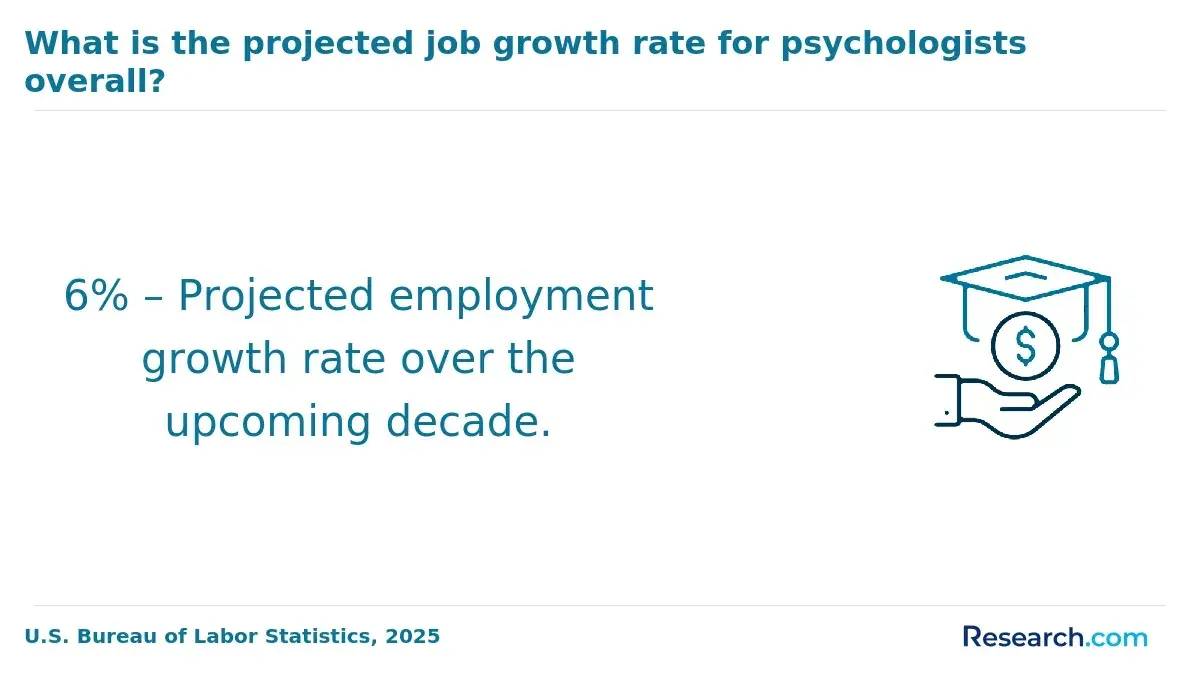
According to the Bureau of Labor Statistics, the psychology field in Wyoming is expected to grow by 7% through 2033, which matches the national average. Approximately 11,300 psychologist job openings are projected annually over the next decade. These openings are expected to come from new demand as well as replacement needs when workers retire or leave the occupation.
The American Psychological Association has also noted that psychologists are taking on more visible roles in government, media, film production, technology companies, and other nontraditional settings. Equity, diversity, and inclusion roles have become a fast-growing area connected to psychology training, with the EDI market valued at $11.4 billion in 2025. A psychology background does not automatically qualify someone for every EDI position, but training in behavior, assessment, group dynamics, and organizational change can be valuable.
Compensation is another reason some students consider Wyoming. While the median annual income for psychologists in the United States was around $85,330, psychologists in Wyoming earned $98,900. Salary still depends on specialty, employer, experience, location, private practice revenue, and whether the psychologist works in clinical, school, forensic, organizational, or academic settings.
Wyoming’s education pipeline is smaller than in many larger states, so program choice requires careful planning. The University of Wyoming is a major option because it offers psychology training that may include areas such as trauma-focused cognitive-behavioral therapy for youth, support for autistic individuals across the lifespan, and psychological assessment for learning disabilities and ADHD.
Educational Requirements for Psychologists in Wyoming
The education path to psychologist licensure is not the same as the path to every mental health role. A bachelor’s degree may qualify you for entry-level behavioral health, research, or human services positions. A master’s degree may support related counseling, research, or assessment roles. However, independent practice as a psychologist generally requires doctoral-level preparation.
Students should evaluate each degree by asking one practical question: “Does this program move me closer to the license or career title I want?” Wyoming has regionally accredited on-campus and online options, but online flexibility does not remove the need for supervised experience, exams, and state approval.
Bachelor’s Degree
A bachelor’s degree is the first academic step for most future psychologists. Psychology is a common choice because it introduces students to human behavior, development, cognition, abnormal psychology, research methods, and statistics. These subjects become especially important later in graduate school, where students must read research, evaluate evidence, and understand assessment and intervention models.
Psychology was the fourth most common major in the United States by number of degrees awarded (NCES, 2025). That popularity reflects how broadly psychology applies across mental health, education, research, business, public policy, and human services.
A psychology major is helpful, but it is not the only possible starting point. Students may also prepare through sociology, social work, neuroscience, education, criminal justice, or related fields. If you choose a non-psychology major, take enough psychology, statistics, and research courses to remain competitive for graduate admission.
Master’s Degree
A master’s degree can be useful, especially for students who want more preparation before doctoral study or who are interested in related fields such as counseling, assessment, research, organizational psychology, behavior analysis, or forensic psychology. It is important to understand, however, that a master’s degree alone typically does not authorize independent practice as a licensed psychologist.
Some master’s-level psychology graduates pursue roles outside psychologist licensure. Examples of higher-paying jobs listed for master’s degree holders in psychology include marriage and family therapist at $57,598 per year, public affairs specialist at $64,351 per year, and psychometrics specialist at $79,911 per year. Before enrolling, verify whether the degree aligns with the credential, job title, or doctoral admissions goal you want.
Doctoral Degree
A doctoral degree is generally the key academic requirement for becoming a licensed psychologist in Wyoming. Students most often compare two types of doctorates:
- Ph.D. in Psychology: A Ph.D. is often a better fit for students who want strong research training, academic options, grant-funded work, teaching, or research-informed clinical practice. Many Ph.D. programs require a dissertation and substantial research involvement.
- Psy.D. in Psychology: A Psy.D. is usually more practice-centered and may appeal to students who want intensive clinical training for therapy, assessment, and applied mental health service. If you are comparing flexible graduate options, Research.com’s guide to online psychology graduate programs can help you understand available formats.
| Degree level | Best fit | Limitations |
| Bachelor’s | Students exploring psychology, human services, research assistance, or graduate school preparation. | Does not qualify someone for independent psychologist practice. |
| Master’s | Students seeking advanced preparation, related counseling or research roles, or a bridge to doctoral study. | May not meet psychologist licensure requirements by itself. |
| Ph.D. | Students interested in research, academia, assessment, clinical science, or evidence-based practice. | Can be research-intensive and may require a major dissertation commitment. |
| Psy.D. | Students focused on applied clinical work, psychotherapy, and psychological assessment. | Students should compare cost, internship support, and licensure alignment carefully. |
Wyoming Licensure Application and Renewal Process
After completing the required education, licensure candidates must move through supervised experience, application review, examination, and renewal. Because regulations can change, the Wyoming Board of Psychology should be your final authority for forms, deadlines, fees, and documentation.
1. Internship and Supervised Experience
Supervised experience is where classroom learning becomes professional practice. Candidates usually work under a licensed psychologist for one to two years, applying assessment, intervention, documentation, consultation, and ethical decision-making skills with real clients or patients.
This stage is not just a licensing formality. It helps new psychologists learn how to manage risk, respond to crises, communicate with referral partners, and decide when a case requires consultation or referral. If you are still early in your education, review what you can do with a psychology degree to identify roles that can build relevant experience before licensure.
2. Licensing Application and Exams
To practice independently as a psychologist in Wyoming, you must obtain a license from the Wyoming Board of Psychology. The process generally includes documenting your education, supervised experience, and fitness to practice.
Candidates will likely need to pass the Examination for Professional Practice in Psychology (EPPP), a national exam that assesses foundational psychology knowledge and professional competence. Applicants should also expect a background check and verification of required education and experience.
Licensure gives psychologists legal authority to provide psychological services within the scope of their training and state rules. It also creates continuing responsibilities: accurate records, ethical practice, informed consent, confidentiality, competence, and compliance with state and federal requirements.
3. Renewal and License Verification
In Wyoming, psychologists must renew their licenses by June 30th each year. As of January 1, 2025, Behavior Analysts also require a Wyoming license to maintain professional standing. Renewal typically involves completing the state form, submitting required documentation, and paying applicable fees through the Wyoming Board of Psychology process.
The Wyoming Board of Psychology provides a license lookup tool on its website that is updated bi-monthly. Prospective clients, employers, and other professionals can use it for Wyoming psychology license verification before entering into a professional relationship.
4. Continuing Education and Specialty Credentials
Licensure is not the end of professional training. Wyoming psychologists must continue learning so they can keep up with research, ethics updates, treatment advances, technology changes, and evolving standards of care.
Some psychologists also pursue specialty credentials in clinical psychology, school psychology, forensic psychology, or other areas. Specialty recognition can help with credibility, referrals, and employer confidence, especially when serving specific populations. The Bureau of Labor Statistics notes that clinical psychology is the largest specialty area in psychology, with 67,500 psychologists working in that field.
| Common mistake | Why it creates problems | Better approach |
| Assuming any psychology doctorate qualifies for licensure | State boards review accreditation, curriculum, supervised experience, and documentation. | Confirm Wyoming licensure alignment before enrolling. |
| Waiting too long to plan supervised hours | Internship and practicum access can affect graduation and licensure timing. | Ask programs how placements are approved and supported. |
| Focusing only on tuition | Fees, travel, residency requirements, internship costs, and lost wages can change total cost. | Compare full cost of attendance and time-to-completion. |
| Ignoring renewal requirements | A missed renewal can interrupt legal practice. | Track June 30th renewal and continuing education requirements early. |
| Assuming online means easier | Online programs still require rigorous coursework and supervised field training. | Evaluate accreditation, faculty support, and placement logistics. |
List of Top Psychology Programs in Wyoming for 2027
Wyoming has fewer psychology program options than many larger states, so students should compare schools carefully. The right program depends on your starting point, transfer plans, budget, preferred format, and whether you ultimately need doctoral preparation for licensure.
The programs below can help students begin or continue psychology study in Wyoming. Always verify current costs, accreditation, transfer agreements, licensure alignment, and program requirements directly with the institution before enrolling.
| School | Accreditation | Program type | Listed cost | Best fit |
| University of Wyoming at Casper | Higher Learning Commission (HLC) | Bachelor of Arts in Psychology | $21,728 (in-state), $37,508 (out-of-state) | Students seeking a bachelor’s pathway with access to University of Wyoming resources. |
| Laramie County Community College | Higher Learning Commission (HLC) | Associate of Arts in Psychology | $16,062 (in-state), $22,362 (out-of-state) | Students planning an affordable start before transferring to a four-year program. |
| Northern Wyoming Community College | Higher Learning Commission (HLC) | Associate of Arts in Psychology | $18,735 (in-state), $25,035 (out-of-state) | Students who want foundational psychology coursework with transfer potential. |
| University of Wyoming | Higher Learning Commission (HLC) | Undergraduate and Doctoral Programs | $21,728 (in-state), $37,508 (out-of-state) | Students seeking the state’s major psychology department and doctoral options. |
| Capella University | Higher Learning Commission (HLC) | Online Psychology programs | $2,535 to $2,950 per credit | Students who need online flexibility and are prepared to verify Wyoming licensure alignment. |
1. University of Wyoming at Casper
- Accreditation: Higher Learning Commission (HLC)
- Programs: Bachelor of Arts in Psychology
- Cost: $21,728 (in-state), $37,508 (out-of-state)
The University of Wyoming at Casper psychology program gives students a broad foundation in psychological science while allowing them to work with faculty who study areas such as brain function, development, cognition, and emotion.
This option may suit students who want an undergraduate psychology degree that supports either workforce entry or graduate study. Students may gain practical exposure through internships and professional events, which can help them clarify whether they want counseling, therapy, research, grant writing, human services, or another psychology-related path.
2. Laramie County Community College
- Accreditation: Higher Learning Commission (HLC)
- Programs: Associate of Arts in Psychology
- Cost: $16,062 (in-state), $22,362 (out-of-state)
Laramie County Community College’s psychology program introduces students to human behavior, child development, abnormal psychology, social functioning, brain science, and research methods.
The program may be a practical starting point for students who want lower-division coursework before transferring. Its applied learning elements, such as case studies, observation, and student research, can help learners test their interest in psychology before committing to a longer and more expensive degree path.
Because many psychology careers require at least a master’s degree, and psychologist licensure generally requires doctoral education, students should discuss transfer plans early. Possible future pathways include counseling, social work, psychology, psychiatric support roles, social and community service management, and mental health counseling.
3. Northern Wyoming Community College
- Accreditation: Higher Learning Commission (HLC)
- Programs: Associate of Arts in Psychology
- Cost: $18,735 (in-state), $25,035 (out-of-state)
The Northern Wyoming Community College psychology program is designed to help students understand behavior, emotion, cognition, and human development while building research and critical thinking skills.
Students can use the Associate of Science in Psychology as a base for transfer into bachelor’s programs or for future work in related fields such as counseling, education, research, social work, health professions, business, communication, or biology. Coursework may include general psychology, research methods, abnormal psychology, social psychology, developmental psychology, and biological psychology.
NWCCD may appeal to students who want accessible early-stage psychology training with faculty support and opportunities for internships or volunteer experience. Students should confirm transfer agreements and degree applicability before enrolling.
4. University of Wyoming
- Accreditation: Higher Learning Commission (HLC)
- Programs: Undergraduate and Doctoral Programs
- Cost: $21,728 (in-state), $37,508 (out-of-state)
The University of Wyoming Department of Psychology is a central option for students who want a fuller psychology pathway within the state. Its department emphasizes psychological theory, research methods, teaching, service, and scientific study of behavior, emotion, and cognition.
Undergraduates can pursue a Bachelor of Science in Psychology with exposure to biological, physiological, clinical, cognitive, developmental, neuroscientific, and social psychology. The curriculum can help students develop research skills, statistical reasoning, communication, and problem-solving abilities.
For advanced students, the university offers doctoral programs in Clinical Psychology, Psychology and Law, Social Psychology, and Cognitive Psychology/Cognitive Development. Students planning psychologist licensure should speak directly with advisors about supervised training, internship expectations, EPPP preparation, and Wyoming Board of Psychology requirements.
5. Capella University
- Accreditation: Higher Learning Commission (HLC)
- Programs: Online Psychology programs
- Cost: $2,535 to $2,950 per credit
Capella University’s online psychology programs are designed for students who need distance learning options while studying behavior, motivation, human development, research, assessment, and applied psychology topics.
Capella offers bachelor’s, master’s, certificate, EdS, PsyD, and PhD options in psychology-related areas. Depending on the program, students may study applied behavior analysis, school psychology, clinical psychology, educational psychology, psychotherapy, mental health assessment, or advanced psychological science.
Online students in Wyoming should be especially cautious about licensure fit. Before enrolling in any online doctorate, confirm accreditation, supervised placement support, residency or in-person requirements, state authorization, and whether the program’s curriculum satisfies Wyoming psychologist licensure expectations.
Mental Health Landscape and Community Impact in Wyoming
Wyoming’s mental health needs are shaped by geography. Large rural areas, low population density, travel barriers, and limited provider availability can make psychological care difficult to access. These conditions create demand for psychologists who understand rural mental health, crisis response, telepsychology, substance use concerns, and collaborative care.
According to the Wyoming Department of Health, approximately 23% of adults in the state reported experiencing a mental health condition in 2025, while access to care remained a major concern. Geographic isolation and stigma can prevent residents from seeking support, which is why community-based services and telehealth have become important tools for expanding access.
Psychologists in Wyoming may serve clients affected by substance use disorders, adolescent behavioral concerns, trauma, PTSD, and stress linked to occupations such as farming, mining, and law enforcement. They may also contribute to prevention, public education, policy advocacy, and stigma reduction.
Telemedicine can help psychologists reach remote clients without requiring long-distance travel, but it also requires attention to privacy, informed consent, emergency planning, documentation, and jurisdictional rules. Students planning to practice in Wyoming should treat telehealth competence as part of career preparation, not as an optional add-on.
If you are comparing education options, Research.com’s list of the best colleges for psychology in Wyoming can help you start evaluating programs that may prepare you for the state’s behavioral health needs.
What are the legal and ethical challenges for psychologists in Wyoming?
Wyoming psychologists must manage confidentiality, informed consent, mandated reporting, record keeping, telehealth security, scope of practice, boundary issues, and HIPAA-related responsibilities. Rural practice can add complications because clients, families, schools, courts, and employers may overlap in small communities.
Risk also increases when psychologists work in high-need areas such as substance use, trauma, custody matters, forensic assessment, or crisis response. Professionals considering substance use work should understand the distinct regulatory and ethical issues involved; Research.com’s guide on how to become a substance abuse counselor in Wyoming explains a related credentialing route.
How can professional organizations and advanced studies enhance your career in Wyoming?
Professional organizations can help Wyoming psychologists build referral relationships, find mentors, follow regulatory updates, access continuing education, and stay connected to peers across rural and urban practice settings. This is especially useful in a state where professional networks may be smaller and interdisciplinary collaboration is often necessary.
Advanced study can also open doors. An online doctorate in psychology may be relevant for students who need flexibility, but it should be evaluated carefully for accreditation, supervised experience support, and Wyoming licensure compatibility.
What Additional Certification Paths Can Enhance Your Career Prospects in Wyoming?
Additional credentials can help psychologists expand services, but they should be chosen strategically. Behavior analysis, school-based credentials, forensic training, trauma-focused certifications, and assessment specializations may improve fit for certain employers or client populations.
Applied behavior analysis is one option for professionals interested in behavioral intervention across educational, clinical, and community settings. If this path fits your goals, review Research.com’s guide on how to become a BCBA in Wyoming.
Can Specializing in Applied Behavior Analysis Advance Your Psychology Practice?
Applied Behavior Analysis can strengthen a psychologist’s ability to assess behavior patterns, design intervention plans, track outcomes, and support clients with developmental, educational, or behavioral needs. ABA training may be especially useful for professionals working with schools, families, autism services, or community programs.
ABA is not the right specialization for every psychologist. It makes the most sense when your practice involves observable behavior change, data-driven intervention, and collaboration with families, educators, or care teams. For compensation and career context, see Research.com’s overview of behavior analyst salary and career paths.
How Can an LPC License Complement Your Psychology Practice in Wyoming?
An LPC license can be relevant for professionals whose goals center on counseling services, psychotherapy, and client support under a counseling regulatory framework. It may also be useful for students who decide that the psychologist path is too long, too research-focused, or not aligned with their preferred scope of work.
Psychology licensure and counseling licensure are not interchangeable, so students should compare requirements before choosing a path. Research.com’s guide on how to become an LPC in Wyoming explains this related option.
How Can Collaboration with Social Work Enhance Your Practice in Wyoming?
Psychologists often work best when they collaborate with social workers, physicians, school staff, case managers, and community organizations. This is especially true in rural or underserved areas where clients may need housing support, benefits navigation, crisis resources, family services, or coordinated care in addition to therapy or assessment.
Social workers can help address social and environmental factors that affect mental health, while psychologists contribute assessment, diagnosis, treatment planning, and evidence-based intervention. To understand the social work route more clearly, review what degree you need to be a social worker in Wyoming.
What is the Optimal Pathway to Prepare for the EPPP Exam in Wyoming?
EPPP preparation should begin before the final weeks of study. Candidates should build a structured schedule, review official content areas, take practice exams, track weak areas, and study ethics, assessment, intervention, biological bases of behavior, social and multicultural topics, research methods, and professional responsibilities.
Wyoming candidates should also separate national exam preparation from state-specific compliance. The EPPP measures broad professional knowledge, while state practice requires attention to Wyoming rules, renewal requirements, documentation, and ethical expectations. Students interested in school settings can compare a related pathway through Research.com’s guide on how to become a school psychologist in Wyoming.
How Can Specializing in Criminal Psychology Benefit Your Career in Wyoming?
Criminal psychology and forensic-related work can appeal to psychologists interested in courts, correctional settings, offender rehabilitation, risk assessment, expert consultation, and the intersection between mental health and law. This route requires strong ethics, careful documentation, and the ability to communicate psychological findings to legal audiences.
Because forensic work can create higher legal exposure, students should seek targeted training, supervision, and consultation before offering specialized services. Research.com’s guide on how to become a criminal psychologist in Wyoming provides a more focused look at this career direction.
Scholarships, Financial Aid, and Funding Options for Psychology Students in Wyoming
Psychology education can become expensive because the path to psychologist licensure often extends through doctoral study, supervised training, exam preparation, and renewal costs. Students should compare funding before enrolling, not after tuition bills arrive.
1. Scholarships for Psychology Students in Wyoming
Scholarships can reduce borrowing, especially for students who qualify for merit-based, need-based, departmental, or identity-based awards.
- University of Wyoming Scholarships: Psychology majors may be able to access merit scholarships and departmental awards that reduce tuition for in-state or out-of-state study.
- American Psychological Association (APA) Scholarships: APA scholarships and fellowships may support graduate psychology students, including programs such as the APA Minority Fellowship Program for underrepresented groups.
2. Federal and State Financial Aid Programs
Federal and state aid can help cover tuition, fees, books, and living costs. Students should complete required financial aid applications early and compare grants, loans, and institutional aid packages.
- Federal Pell Grants: These grants are available to undergraduate students with significant financial need and do not require repayment.
- Federal Direct Loans: Undergraduate and graduate students may use these loans, which often have lower interest rates than private loans and offer multiple repayment options.
- Wyoming College Access Program (WyCAP): This state-funded program provides need-based aid for undergraduate students attending eligible Wyoming institutions.
3. Work-study Programs and Assistantships
Work-study and assistantship opportunities can reduce costs while building relevant experience. Graduate assistantships are especially important to compare because they may include tuition support, a stipend, research experience, teaching responsibilities, or faculty mentorship.
- Graduate Assistantships: These roles may include tuition remission and a stipend in exchange for research, teaching, or department work.
- Psychology Departmental Assistantships: Department-based roles may involve grading, research assistance, lab support, or instructional support.
4. Online Psychology Programs with Affordable Tuition
Online programs can reduce relocation, commuting, and housing costs, but affordability depends on tuition, fees, residency requirements, internship travel, and whether credits transfer. Students interested in organizational psychology can compare affordable online master’s programs in organizational psychology.
5. Private Scholarships and Grants
Private awards may come from honor societies, foundations, professional associations, or research organizations. Eligibility often depends on membership, academic performance, research interests, or career goals.
- Psi Chi Scholarships: Psi Chi offers scholarships for undergraduate and graduate members of the international honor society in psychology.
- The National Institute of Mental Health (NIMH) Grants: NIMH grants may support psychology and behavioral science research, particularly in mental health-related areas.
6. Employer Tuition Assistance
Students already working in behavioral health, education, healthcare, public service, or human services should ask about tuition reimbursement. Employer assistance can be valuable, but employees should check grade requirements, repayment clauses, eligible programs, and work commitments.
| Funding source | Best for | Question to ask |
| Scholarships | Students with academic merit, financial need, or field-specific goals. | Is the award renewable, and what GPA must I maintain? |
| Federal and state aid | Undergraduate and graduate students seeking grants or loans. | How much of my package is grant aid versus borrowed money? |
| Assistantships | Graduate students seeking funding plus experience. | Does the assistantship include tuition remission, a stipend, or both? |
| Online study savings | Students balancing school with work or family obligations. | Are there travel, residency, or practicum costs not included in tuition? |
| Employer support | Working adults in related fields. | Will I owe repayment if I leave the employer after using the benefit? |
How Can Psychologists Manage Risk and Ensure Regulatory Compliance in Wyoming?
Risk management should be built into daily practice. Psychologists need secure records, clear informed consent, careful documentation, appropriate malpractice coverage, data protection procedures, crisis response plans, and a process for monitoring legal or regulatory updates.
Compliance is also easier when psychologists understand adjacent credentials and scopes of practice. For example, reviewing Wyoming LPC license requirements can help psychologists understand how counseling services are regulated differently from psychological services.
What Happens After Obtaining a Psychology License in Wyoming?
After licensure, psychologists can pursue employment, private practice, specialization, supervision roles, research, consultation, teaching, or leadership. They should also maintain renewal calendars, continuing education records, malpractice coverage, and referral networks.
Psychologists considering relocation should remember that licensure is state-specific. Requirements vary across the country, so a Wyoming license does not automatically transfer into every state. To see how different mental health credentials can vary by location, compare the process for an MFT license in Wisconsin.
What are the career options and specialties available for psychologists in Wyoming?
Wyoming psychologists can work in hospitals, clinics, schools, correctional settings, community agencies, private practice, universities, business organizations, and telehealth settings. The best specialty depends on your training, population interests, tolerance for documentation and legal exposure, and preferred work environment.
- Clinical Psychology: Clinical psychologists assess, diagnose, and treat mental health conditions in settings such as hospitals, clinics, and private practice. Some focus on trauma therapy or cognitive behavioral therapy.
- School Psychology: School psychologists support students with learning, behavioral, developmental, and emotional needs while working with families and educators.
- Forensic Psychology: Forensic psychologists apply psychological expertise to legal questions, evaluations, correctional work, and expert consultation.
- Industrial-Organizational Psychology: I-O psychologists apply behavioral science to workplace productivity, hiring, leadership, morale, and organizational behavior.
- Health Psychology: Health psychologists help clients manage chronic illness, stress, behavior change, treatment adherence, and lifestyle factors that affect health.
How Can Psychologists Successfully Transition to Private Practice in Wyoming?
Private practice requires clinical skill and business planning. Psychologists should research community needs, choose a service niche, estimate startup costs, secure malpractice insurance, set documentation systems, understand billing, build referral relationships, and decide how telehealth will be used.
Wyoming’s rural context can create both opportunities and challenges. A psychologist may be one of few providers in a region, but small communities also require careful boundary management and strong emergency referral plans. Professionals who want a shorter counseling-related route can compare the fastest way to become a counselor in Wyoming as an alternative or complementary path.
Online Psychology Programs and Their Role in Wyoming Licensure
Online psychology programs can make graduate education more accessible for Wyoming students who cannot relocate or stop working. They can be useful, but students must verify whether the program meets Wyoming licensure expectations before committing.
Benefits of Online Psychology Programs
- Flexibility for working adults: Online coursework can make it easier to balance education with employment, caregiving, or rural location constraints.
- Access beyond state borders: Wyoming students may be able to study through accredited programs without moving.
- Potential cost control: Online study may reduce commuting and housing expenses, though total cost depends on tuition, fees, and field placement requirements.
- Specialization options: Some programs offer tracks in clinical, forensic, school, organizational, or behavioral psychology areas.
Meeting Wyoming Licensure Requirements with Online Programs
Students seeking psychologist licensure in Wyoming must complete a doctoral program in psychology from a regionally accredited institution. Some online or hybrid options, including online PsyD programs, may offer relevant coursework and supervised training structures, but students should confirm state alignment in writing.
Online programs may support licensure preparation through:
- Core coursework: Students may study cognitive psychology, developmental psychology, data analysis, psychopathology, assessment, and intervention.
- Supervised practica: Some programs help students identify local clinical placements under qualified supervision.
- EPPP preparation: Programs may provide exam review resources, practice questions, or structured preparation support.
Considerations When Choosing an Online Program
- Accreditation: Confirm that the institution is regionally accredited and that the psychology program meets the standards needed for Wyoming licensure.
- Practicum and internship support: Ask whether the school helps arrange placements in Wyoming or expects students to find sites independently.
- State-specific fit: Request written confirmation that the curriculum is designed to support Wyoming licensure requirements, including exam preparation and supervised experience expectations.
- Total cost: Compare tuition, fees, travel, residency sessions, exam costs, and the cost of reducing work hours during clinical training.
Starting Your Psychology Licensure Journey
The best way to start is to work backward from your desired role. If you want to practice independently as a psychologist, plan for doctoral education, supervised experience, EPPP preparation, licensure application, annual renewal, and continuing education. If your goal is counseling, school support, behavior analysis, social work, or human services, another credential may be faster or more directly aligned.
Before choosing a school, ask whether the program is accredited, whether credits transfer, how supervised placements work, what the total cost will be, and whether graduates are prepared for Wyoming licensure. Students interested in clinical practice can also explore clinical psychology careers to understand how training connects to real work settings.
-
: "
Decision rule: Choose the program that matches your license goal, not just the one with the most convenient format or lowest advertised tuition.
"
Key Insights
- Wyoming licensure usually requires doctoral preparation: A bachelor’s or master’s degree can support entry-level or related roles, but independent psychologist practice generally requires a Ph.D. or Psy.D., supervised experience, exams, and board approval.
- Demand is tied to access gaps: Wyoming’s rural geography, limited provider availability, and youth mental health needs create opportunities for psychologists who can serve underserved communities and use telehealth responsibly.
- Salary can be competitive, but it is not guaranteed: Psychologists in Wyoming earned $98,900 compared with a national median of $85,330, but actual income depends on specialty, setting, experience, location, and practice model.
- Program choice should be license-driven: Students should verify accreditation, doctoral pathway fit, supervised placement support, and Wyoming Board of Psychology requirements before enrolling, especially in online programs.
- Renewal and compliance are part of the career: Wyoming psychologists must renew by June 30th each year and maintain ethical, legal, documentation, confidentiality, and continuing education standards.
- Specialization can improve fit: Clinical, school, forensic, health, industrial-organizational, ABA-related, and rural mental health work can all be viable, but each path has different training, risk, and practice expectations.
Related Articles for Nearby States
- 2027 Montana Psychology Licensure Requirements – How to Become a Psychologist in Montana
- 2027 South Dakota Psychology Licensure Requirements – How to Become a Psychologist in South Dakota
- 2027 Nebraska Psychology Licensure Requirements – How to Become a Psychologist in Nebraska
- 2027 Colorado Psychology Licensure Requirements – How to Become a Psychologist in Colorado
- 2027 Idaho Psychology Licensure Requirements – How to Become a Psychologist in Idaho
- 2027 Utah Psychology Licensure Requirements – How to Become a Psychologist in Utah
- 2027 North Dakota Psychology Licensure Requirements – How to Become a Psychologist in North Dakota
- 2027 Kansas Psychology Licensure Requirements – How to Become a Psychologist in Kansas
- 2027 Iowa Psychology Licensure Requirements – How to Become a Psychologist in Iowa
- 2027 Nevada Psychology Licensure Requirements – How to Become a Psychologist in Nevada
References:
- American Psychological Association. (2025). Practitioner pulse survey: Trends in mental health demand and workforce capacity. https://www.apa.org/news/press/releases/2025/01/practitioner-pulse-survey-results
- American Psychological Association. (2025). APA Practice Central – State Licensing/Regulatory Boards. https://practice.psychiatry.org/state-boards
- American Psychological Association. (2025). APA Commission on Accreditation. https://www.apa.org/ed/accreditation
- Behavioral Health Division Annual Report: Mental Health Metrics and Access Trends. https://health.wyo.gov/behavioralhealth/reports/2025-annual-statistics/
- National Center for Education Statistics. (2025). The Condition of Education 2025. U.S. Department of Education. https://nces.ed.gov/programs/coe/indicator/cta
- Wyoming Board of Psychology. (2026). Home – Wyoming Board of Psychology. https://psychology.wyo.gov/
- Wyoming Board of Psychology. (2026). Professional Licensing Boards Office – Psychology Applications & Forms. https://psychology.wyo.gov/professionals/forms
- U.S. Bureau of Labor Statistics. (2025). Psychologists – Occupational Outlook Handbook. https://www.bls.gov/ooh/life-physical-and-social-science/psychologists.htm
Other Things You Should Know About Wyoming Psychology Licensure Requirements
To become a licensed psychologist in Wyoming, you must first obtain a bachelor's degree in psychology or a related field. While a master's degree is optional, it can provide valuable expertise and open up additional career opportunities. The most critical educational requirement is obtaining a doctoral degree (Ph.D. or Psy.D.) in psychology from a regionally accredited institution.
In Wyoming, becoming a licensed psychologist generally takes about 10-12 years. This includes earning a bachelor's degree (4 years), completing a doctoral degree in psychology (4-7 years), and fulfilling a supervised postdoctoral experience (1-2 years), followed by passing the required licensing exams.
Aspiring psychologists in Wyoming must pass the Examination for Professional Practice in Psychology (EPPP). This exam assesses your knowledge and skills in psychology and is a critical component of the licensure process.
To obtain a psychology license in Wyoming, you must complete the required education (bachelor's, master's, and doctoral degrees), gain supervised experience through internships, pass the EPPP, and undergo a background check. You must also meet specific educational and experience requirements set by the Wyoming Board of Psychology.
Psychologists in Wyoming must renew their licenses annually by June 30th. The renewal process involves completing a form provided by the Wyoming Board of Psychology, submitting it with the necessary documents and fees, and fulfilling continuing education requirements.
Psychologists in Wyoming are required to engage in ongoing continuing education to stay current with the latest advancements in the field. This ensures that their knowledge and skills remain up-to-date, promoting the delivery of high-quality psychological services.
To become a licensed psychologist in Wyoming in 2027, you must pass the Examination for Professional Practice in Psychology (EPPP), followed by the Wyoming Jurisprudence Examination. These tests assess your knowledge of psychology and state laws. Passing these exams is a crucial step towards licensure.