2027 How to Become a Licensed Counselor (LPC) in Wyoming

Co-Founder and Chief Data Scientist
Becoming a licensed counselor in Wyoming is a structured process: you need the right graduate degree, supervised clinical training, a professional exam, a background check, and approval from the state licensing board. The decision matters because Wyoming continues to face mental health access challenges, especially in rural communities, and counselors can play an important role in schools, clinics, hospitals, community agencies, private practice, and substance use treatment settings.
This guide explains how to become a Licensed Professional Counselor (LPC) in Wyoming, what education and supervised experience you need, how online counseling degrees fit into the process, what license types are available, where counselors work, and how to evaluate whether this career path is worth the investment. It also compares related paths such as school counseling, marriage and family therapy, psychology, social work, substance abuse counseling, and behavior analysis so you can choose the route that best matches your goals.
Quick Answer: How Do You Become a Licensed Counselor in Wyoming?
To become an LPC in Wyoming, you generally need to complete a master’s or doctoral degree in counseling, finish the required practicum and internship hours, pass an accepted counseling exam such as the NCE or NCMHCE, complete a criminal background check, and provide proof of U.S. citizenship or lawful residency. Wyoming’s rules also allow applicants from non-CACREP or non-CORE programs to qualify if their graduate education meets the state’s coursework and accreditation standards.
Key Things You Should Know About Becoming a Licensed Counselor in Wyoming
- Wyoming requires LPC applicants to complete at least a master’s degree in counseling from a qualifying program, with CACREP or CORE accreditation commonly used as the clearest benchmark.
- Graduate training must include supervised clinical preparation, including at least 100 clock hours of practicum and a 600-clock-hour internship.
- Applicants must pass an approved professional counseling examination, such as the National Counselor Examination (NCE) or the National Clinical Mental Health Counseling Examination (NCMHCE).
- A criminal background check is required, and applicants must document U.S. citizenship or legal residency.
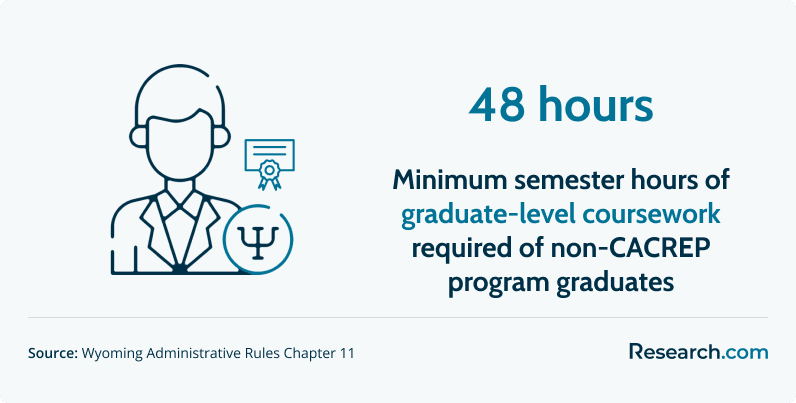
- If your program is not accredited by CACREP or CORE, Wyoming may still consider your application if you completed at least 48 semester hours of graduate-level coursework and otherwise meet state education standards.
- Steps to become an LPC in Wyoming
- Education requirements for Wyoming counseling licensure
- Counselor license types in Wyoming
- Wyoming counseling industry overview
- Counselor job outlook in Wyoming
- Challenges new Wyoming LPCs should expect
- Counselor salaries in Wyoming
- Common workplaces for counselors in Wyoming
- What counselors do day to day
- Using an online counseling degree for Wyoming LPC licensure
- Substance abuse counseling specialization in Wyoming
- Tuition and financial aid for counseling programs
- Psychologist versus counselor licensing in Wyoming
- Continuing education for licensed counselors
- Certifications that can strengthen a counseling career
- Using social work practices in counseling
- Adding behavior analysis to counseling practice
- Professional organizations for Wyoming counselors
- Transitioning into school counseling
- Wyoming LPC license requirements checklist
- Top Counselor Programs in Wyoming for 2027
- Next steps after licensure
- Is counseling in Wyoming worth it?
- LPCs versus Marriage and Family Therapists in Wyoming
- Are online counseling programs accepted in Wyoming?
- Key Insights
What are the steps to become an LPC in Wyoming?
Wyoming’s current counseling rules and regulations state that LPC applicants must complete graduate-level counseling education that satisfies the state’s standards. In most cases, the most direct route is a master’s degree in counseling from an accredited program.
According to the state licensing requirements, the core pathway includes the following steps:
- Earn a master’s or doctoral degree in counseling.
- Complete at least 100 clock hours of supervised practicum and a 600-clock-hour internship.
- Pass a recognized counseling exam, such as the National Counselor Examination (NCE) or the National Clinical Mental Health Counseling Examination (NCMHCE).
- Submit to a criminal background check and provide documentation of U.S. citizenship or lawful residency.
If your counseling program was not CACREP-accredited, Wyoming still provides a possible licensure route if your transcript shows at least 48 semester hours of graduate-level coursework and your education meets the board’s standards. If you are still comparing counseling careers more broadly, Research.com’s guide on how to become a counselor can help you understand the profession beyond Wyoming’s state-specific rules.
| Step | What to verify before moving forward | Why it matters |
| Choose a graduate program | Confirm accreditation, coursework, practicum, and internship structure. | A degree that does not meet Wyoming standards can delay or block licensure. |
| Complete clinical training | Document practicum and internship hours carefully. | The board needs evidence that your training meets required supervision standards. |
| Prepare for the exam | Check whether the program prepares students for the NCE, NCMHCE, or another accepted exam. | Passing an approved exam is part of the licensure process. |
| Apply for licensure | Gather transcripts, supervision records, exam results, background materials, and residency documents. | Incomplete applications can create avoidable delays. |
What Graduates Say About LPC Careers in Wyoming
- My work as an LPC in Wyoming gives me a direct connection to the people around me. The job is demanding, but watching clients build healthier lives makes the effort worthwhile. Susan
- I completed my degree online, and the flexibility helped me keep moving toward licensure while balancing other responsibilities. Practicing in Wyoming has exposed me to many client needs and has helped me grow both professionally and personally. James
- Counseling in Wyoming can mean working in schools, agencies, private offices, and community-based settings. The state’s close communities make the work personal, and I can see the value of what I do every day. Janice
What are the educational requirements for Wyoming counseling licensure?
Wyoming LPC applicants must hold a master’s or doctoral degree in counseling. A program accredited by the Council for Accreditation of Counseling and Related Educational Programs (CACREP) or the Council on Rehabilitation Education (CORE) offers the clearest alignment with state expectations, but graduates from other qualifying programs may still be eligible if the program and coursework meet Wyoming standards.
The main education requirements include:
- The graduate degree should come from a qualifying counseling program, preferably one accredited by CACREP or CORE.
- If the program is not CACREP- or CORE-accredited, it should be accredited by an accreditor recognized by the Council for Higher Education Accreditation (CHEA).
- Coursework must closely match counseling training expectations, including appropriate faculty qualifications and supervised clinical instruction.
- Applicants from non-CACREP or non-CORE programs must show at least 48 semester hours of graduate-level coursework or 60 semester hours, depending on the applicable standard reviewed by the state.
- Clinical preparation must include at least 100 supervised practicum hours and a 600-hour internship.
These requirements are designed to ensure that new counselors have academic preparation, supervised practice, and ethical grounding before entering professional counseling careers in Wyoming.
How to evaluate whether a counseling degree meets Wyoming requirements
| Program feature | What to look for | Question to ask the school |
| Accreditation | CACREP, CORE, or another CHEA-recognized accreditor if applicable. | Does this program meet Wyoming LPC education requirements? |
| Credit hours | At least 48 semester hours of graduate-level coursework for qualifying non-CACREP or non-CORE programs. | Will my transcript clearly show the required graduate credits? |
| Clinical training | Practicum and internship experiences that satisfy Wyoming hour expectations. | Can I complete approved clinical placements in Wyoming or near my community? |
| Exam preparation | Curriculum that supports preparation for the NCE, NCMHCE, or another accepted exam. | Which exam do your graduates typically take for licensure? |
What are the types of counselor licenses issued in Wyoming?
Wyoming recognizes several mental health licenses, and each one prepares professionals for a different scope of practice. Choosing the wrong license path can lead to extra coursework, additional supervised hours, or a career direction that does not match your intended client population.
- Licensed Professional Counselor (LPC): This license supports broad counseling practice with individuals and groups. LPCs usually work with concerns such as anxiety, depression, trauma, life transitions, stress, and behavioral health needs.
- Licensed Marriage and Family Therapist (LMFT): This path focuses on couples, families, relationship patterns, and family systems. It requires graduate training in marriage and family therapy and supervised experience aligned with that specialty.
- Licensed Addiction Therapist (LAT): This credential focuses on addiction assessment, diagnosis, and treatment. Applicants typically need a mental health foundation plus substance abuse training.
- Licensed Clinical Social Worker (LCSW): This license is built on a master’s degree in social work and supervised clinical experience. LCSWs often combine therapy with case management, advocacy, and support around social and environmental factors.
In 2025, Wyoming ranked 14th nationally with 442.0 mental health providers per 100,000 population. Even with that ranking, the state still has communities where access to care is difficult, which makes license selection and long-term professional development important. Every license also has renewal expectations, so future counselors should plan for continuing education throughout their careers.
| License path | Best fit for | Choose this if you want to... |
| LPC | General mental health counseling | Work with individuals or groups across a wide range of emotional, behavioral, and mental health concerns. |
| LMFT | Couples and family systems | Focus on relationship dynamics, family conflict, communication, and systemic treatment. |
| LAT | Addiction treatment | Specialize in substance use disorders and recovery-focused care. |
| LCSW | Clinical social work | Combine therapy with social services, advocacy, resource coordination, and systemic support. |
What is the state of the counseling industry in Wyoming?
Wyoming’s counseling field is shaped by two major realities: the state needs mental health professionals, and many communities have limited access to care. Reporting on the Mountain West has highlighted a shortage of mental health providers, with rural and designated shortage areas facing particular pressure.
For families and individuals, provider shortages can mean longer wait times, travel barriers, limited specialty care, and higher financial strain. Budget constraints in mental health services can also make it harder for agencies to expand access. For new counselors, however, the same environment may create opportunities to serve communities where care is urgently needed.
The counseling workforce in Wyoming includes professionals in substance abuse, behavioral disorder, mental health counseling, educational counseling, guidance counseling, career counseling, rehabilitation counseling, and related areas. The state has also explored options such as inter-state licensing to help address workforce gaps. If you plan to become an LPC in Wyoming, it is important to understand that rural practice may require flexibility, broad clinical knowledge, and comfort working across multiple client needs.
What is the job outlook for counselors in Wyoming?
The outlook for counselors in Wyoming is favorable for applicants entering high-need areas, especially mental health, substance use, and school-related counseling. According to the Wyoming Department of Workforce Services, short-term projections for 2024-2026 show the greatest projected openings among occupations requiring a master's degree for substance abuse, behavioral disorder, & mental health counselors (204) and educational, guidance, school, & vocational counselors (131).
These projected openings do not guarantee employment for every graduate, but they do show where demand is concentrated. Counselors who are willing to work in rural communities, provide substance use services, serve students, or support underserved populations may find stronger opportunities. Wyoming’s participation in the Counseling Compact may also expand possibilities for qualified counselors who want cross-state practice options once applicable requirements are met.
Students who need flexibility while completing graduate education may want to compare online counseling degrees, but they should verify that any online program includes qualifying practicum and internship experiences. Reported annual mean wages range from $53,260 for Rehabilitation Counselors to $66,430 for Substance Abuse and Mental Health Counselors, making it important to compare both mission fit and earning potential before choosing a specialty.
What are the common challenges and considerations for new LPCs in Wyoming?
New LPCs in Wyoming often face a practice environment that is professionally meaningful but not always easy. Rural service areas may have fewer nearby colleagues, fewer referral options, and limited specialty providers. This can make consultation, supervision, and professional community especially important.
Another challenge is the breadth of client needs. In smaller or underserved communities, a counselor may work with anxiety, depression, trauma, grief, substance use, family stress, and crisis concerns, sometimes in the same week. That variety can accelerate learning, but it also requires strong boundaries, careful referral judgment, and ongoing training.
Wyoming’s Counseling Compact participation may create additional flexibility for counselors interested in cross-state or remote practice, but counselors should not assume compact privileges apply automatically. Always review current board guidance before offering services outside your licensed jurisdiction.
Some future counselors also want a faith-integrated practice model. In that case, a master's in Christian counseling may be relevant, provided the program also meets Wyoming’s licensure requirements if the goal is LPC eligibility.
Common mistakes to avoid when pursuing Wyoming LPC licensure
| Mistake | Why it can hurt your progress | Better approach |
| Choosing a program based only on convenience | A flexible program is not useful if it does not meet Wyoming licensure standards. | Confirm accreditation, credit hours, clinical training, and board alignment before enrolling. |
| Ignoring practicum and internship logistics | Online coursework may be flexible, but clinical hours must be completed in approved settings. | Ask where students complete placements and who approves supervision. |
| Assuming salaries are guaranteed | Pay varies by role, city, employer, experience, and specialty. | Compare wage data with local job postings and cost-of-living needs. |
| Waiting until graduation to study licensing rules | Missing requirements can lead to delays after completing the degree. | Review Wyoming board rules before applying to programs and again before graduation. |
| Overlooking professional support | Rural practice can feel isolating without peer consultation or mentorship. | Join professional organizations and build a referral and consultation network early. |
How much do counselors in Wyoming make?
LPCs in Wyoming earn an average of $63,764 per year, though individual pay depends on location, employer, license type, specialty, years of experience, and whether the counselor works in an agency, school, healthcare setting, or private practice.
Salary also varies by counseling occupation. Substance abuse, behavioral disorder, and mental health counselors earn around $66,430 annually. Educational, Guidance, and Career Counselors in Wyoming earn an annual mean wage of $65,160, while Rehabilitation Counselors earn about $53,260. If you are still deciding between specializations, reviewing what you can do with a counseling degree can help you compare career paths before committing to a program.
| Counseling role | Reported Wyoming wage | What may affect earnings |
| Licensed Professional Counselor | $63,764 per year | Experience, specialty, work setting, city, caseload, and private practice status. |
| Substance abuse, behavioral disorder, and mental health counselor | $66,430 annually | Demand for behavioral health and addiction treatment services. |
| Educational, Guidance, and Career Counselor | $65,160 annual mean wage | School district, student population, contract structure, and credential requirements. |
| Rehabilitation Counselor | $53,260 | Agency type, population served, public funding, and experience level. |
Where can I work as a counselor in Wyoming?
Licensed counselors in Wyoming can work in several settings, including community mental health agencies, schools, hospitals, rehabilitation programs, addiction treatment centers, private practices, correctional settings, social service organizations, and telehealth-based roles when permitted by law and employer policy.
- Cities: Counselors may find opportunities in places such as Rock Springs, Evanston, Casper, Green River, and Sheridan. Rock Springs is reported as offering the highest average salary for LPCs, with counselors earning around $79,078 on average.
- Industries: Wyoming counselors work in behavioral health, education, healthcare, rehabilitation, substance use treatment, community services, private practice, and related human services fields.
Where you work will influence your schedule, client population, administrative responsibilities, supervision needs, income potential, and career advancement options. For example, school-based counseling may provide a predictable academic calendar, while private practice may offer autonomy but require business management, billing knowledge, and referral development.
What do counselors do?
Counselors help clients understand emotional distress, mental health symptoms, behavior patterns, relationships, coping strategies, and life challenges. Their work can involve short-term support, long-term therapy, crisis intervention, prevention, career support, school-based services, or specialized treatment depending on their license and setting.
- Assess client concerns: Counselors gather information through interviews, screening tools, observations, and clinical judgment.
- Create treatment plans: They identify goals, interventions, timelines, and progress measures based on each client’s needs.
- Provide counseling sessions: Counselors help clients examine thoughts, emotions, behaviors, relationships, stressors, and coping skills.
- Teach practical strategies: They may help clients develop communication skills, safety plans, emotional regulation tools, relapse prevention strategies, or problem-solving techniques.
- Coordinate care when appropriate: Counselors may collaborate with schools, physicians, social workers, case managers, family members, or community agencies when legally and ethically permitted.
Counseling is different from psychology, psychiatry, and social work, though these fields often overlap in mental health settings. If you are interested in child-focused mental health careers outside LPC practice, you may also want to explore the path connected to a child psychology degree.
Can I become an LPC in Wyoming with an online counseling degree?
Yes. An online counseling degree can support LPC licensure in Wyoming if the program meets the state’s education, accreditation, coursework, practicum, and internship requirements. The delivery format matters less than whether the program satisfies Wyoming’s licensing standards.
The most important point is that online does not mean fully remote. Counseling programs must include supervised clinical training, and those practicum and internship experiences usually happen in person at approved local sites. Before enrolling, ask the program how Wyoming students secure placements, who approves supervisors, and whether the school has experience supporting licensure applicants in Wyoming.
You should also confirm that the program prepares students for the required counseling exam, such as the NCE or NCMHCE. A program may be academically strong but still create licensure complications if its clinical training structure does not align with Wyoming expectations.
Online versus campus counseling programs for Wyoming LPC applicants
| Factor | Online counseling program | Campus counseling program |
| Course flexibility | Often better for working adults or students far from campus. | Usually more structured, with scheduled in-person classes. |
| Clinical placement | May require the student to locate or coordinate local practicum and internship sites. | May have stronger local placement relationships near the campus. |
| Licensure fit | Acceptable if it meets Wyoming requirements. | Acceptable if it meets Wyoming requirements. |
| Best for | Students who need flexibility and can manage placement planning. | Students who prefer face-to-face learning and local faculty access. |
Can I specialize in substance abuse counseling in Wyoming?
Yes. Counselors who want to focus on addiction treatment can pursue coursework, supervised experience, and continuing education related to substance use disorders. This specialization is especially relevant in behavioral health settings where clients may need integrated support for mental health symptoms, substance use, relapse prevention, family stress, and recovery planning.
Additional training can help counselors work more effectively with co-occurring conditions, motivational interviewing, group treatment, recovery support systems, and ethical issues specific to addiction counseling. For a state-specific pathway, review Research.com’s guide on how to become a substance abuse counselor in Wyoming.
What are the tuition and financial aid options for counseling programs in Wyoming?
Tuition for counseling programs can differ widely depending on the institution, residency status, delivery format, enrollment load, and fees. Students should compare total program cost rather than tuition alone because counseling degrees often include technology fees, clinical placement costs, textbooks, exam fees, background checks, and possible travel for internship or residency requirements.
Financial aid options may include scholarships, grants, assistantships, employer tuition support, federal student loans, and state-specific aid programs for eligible students. If you are comparing adjacent mental health paths, a social work degree may also be worth reviewing because social work can lead to different licensure options and practice settings.
Questions to ask before enrolling in a counseling program
- What is the total estimated cost of the degree, including fees and clinical requirements?
- Does the program meet Wyoming LPC education requirements?
- Is the program CACREP-accredited, CORE-accredited, or otherwise aligned with Wyoming standards?
- How are practicum and internship placements arranged?
- What exam do graduates typically take for licensure?
- Does the school publish licensure outcomes or student outcome data?
- Can transfer credits reduce the time or cost of completion?
- Are assistantships, scholarships, or employer partnerships available?
What are the distinct licensing requirements for psychologists compared to counselors in Wyoming?
Psychologists and counselors both work in mental health, but their training paths differ substantially. Counselors typically enter the field through master’s-level counseling education and supervised counseling practice. Psychologists usually complete doctoral-level training with a broader emphasis on psychological theory, research, assessment, diagnosis, and advanced clinical work.
Psychology programs commonly involve a dissertation, extensive supervised clinical preparation, and national and state examinations designed for the psychology profession. Because the scope and depth of training differ, the psychologist licensing path is longer than the LPC route. For detailed state guidance, see Research.com’s overview of how to become a psychologist in Wyoming.
What are the continuing education guidelines for licensed counselors in Wyoming?
Licensed counselors in Wyoming must keep their credentials current through license renewal and approved continuing education. Continuing education helps counselors stay informed about ethics, diagnosis, treatment approaches, cultural responsiveness, trauma-informed care, telehealth, substance use, suicide prevention, and other practice issues.
Because renewal rules can change, counselors should review the Wyoming State Board of Counseling’s current guidance before selecting courses. Approved education may come through conferences, workshops, webinars, accredited online courses, professional association training, and other board-accepted activities. Counselors working in education settings may also compare options such as the most affordable online school counseling degrees if they are considering additional school-focused preparation.
What additional certifications can enhance your counseling career in Wyoming?
Specialized certifications can help counselors deepen their expertise, but they do not replace state licensure. Certifications may be useful when they align with your client population, employer requirements, or long-term career goals.
- Trauma-informed care: Useful for counselors working with clients affected by violence, grief, abuse, accidents, or chronic stress.
- Substance abuse counseling: Relevant for clinicians serving clients with addiction or co-occurring mental health needs.
- School counseling: Helpful for professionals who want to work in K-12 or postsecondary educational environments.
- Clinical supervision: Valuable for experienced counselors who want to supervise future professionals.
- Evidence-based practice training: Supports stronger treatment planning and measurable client progress.
Students still comparing academic options can also review good colleges for psychology in Wyoming if they are weighing counseling against psychology-related study.
How can integrating social work practices enhance your counseling career in Wyoming?
Social work perspectives can strengthen counseling practice by helping clinicians consider the social, economic, family, community, and systems-level factors that affect mental health. This is especially useful in rural areas where clients may face barriers related to transportation, housing, employment, healthcare access, or family support.
Counselors who understand social work concepts may be better prepared to coordinate referrals, collaborate with agencies, support clients facing resource gaps, and advocate for practical solutions beyond the therapy room. If you are considering a separate social work license or a career shift, review how to become a social worker in Wyoming.
How can I integrate behavior analysis into my counseling career in Wyoming?
Behavior analysis can complement counseling by adding structured, evidence-based strategies for understanding and changing behavior. This may be especially relevant when working with developmental concerns, behavioral challenges, skill-building goals, or treatment plans that require careful measurement of progress.
Counselors interested in this area may need additional coursework, supervised fieldwork, and a separate credential depending on the services they want to provide. For a dedicated pathway, see Research.com’s guide on how to become a behavior analyst in Wyoming.
What professional organizations can support my counseling career in Wyoming?
Professional organizations can reduce isolation, support continuing education, connect counselors with mentors, and provide updates on practice standards. National groups such as the American Counseling Association and state-level organizations such as the Wyoming Association for Professional Counseling may offer conferences, webinars, advocacy updates, ethics resources, and networking opportunities.
Students and early-career professionals can use these organizations to find supervision leads, learn about specialty certifications, understand regulatory changes, and build a peer network. If you are looking for a streamlined overview of the process, Research.com also explains the fastest way to become a counselor in Wyoming.
How can I transition into school counseling in Wyoming?
School counseling is a specialized path for professionals who want to support students’ academic, social, emotional, and career development. Transitioning into this area may require school-focused coursework, supervised experience in educational settings, and compliance with Wyoming’s education-related credentialing rules.
Before changing paths, confirm whether your current degree and supervised experience apply to school counseling requirements. You should also seek internship placements in K-12 or postsecondary environments and connect with practicing school counselors for realistic insight into the role. For a Wyoming-specific route, see Research.com’s guide to becoming a school counselor in Wyoming.
What are the Wyoming LPC license requirements?
Wyoming LPC licensure requires more than completing a graduate degree. Applicants must show that their education, supervised experience, examination results, background documentation, and application materials meet the state’s standards.
- Complete a qualifying master’s or doctoral counseling degree.
- Document required graduate coursework, especially if the program is not CACREP- or CORE-accredited.
- Finish the required supervised practicum and internship hours.
- Pass the required professional counseling examination.
- Complete the criminal background check process.
- Provide proof of U.S. citizenship or lawful residency.
- Submit the required licensing application and supporting documents.
- Maintain the license through renewal and approved continuing education.
For a focused checklist, review Research.com’s detailed guide to Wyoming LPC license requirements.
Top Counselor Programs in Wyoming for 2027
Choosing a counseling program is one of the most important decisions in the licensure process. A strong program should align with Wyoming’s education standards, provide supervised clinical experiences, prepare students for counseling exams, and match the student’s desired practice area. Salary potential can also vary by location; for example, counselors in Rock Springs earn the highest average annual salary at around $79,078.
How do we rank schools?
Research.com rankings are based on research and data analysis conducted by our team. To learn more about the ranking process, visit our methodology section. Sources used in developing these rankings include:
- IPEDS database
- Peterson’s database
- Distance Learning Licensed Data Set and College Scorecard database
- National Center for Education Statistics
1. Master Of Science (M.S.), University of Wyoming
The University of Wyoming offers a Master of Science in Counseling for students preparing for professional counseling practice. The CACREP-accredited program is designed to support Wyoming licensure preparation and includes coursework in core counseling areas, mental health foundations, school counseling, career development, and supervised clinical training. Students who want a structured graduate route into counseling practice should review the curriculum, clinical placement process, and exam preparation support before applying.
2. School Counseling, M.S. University of Wyoming
The University of Wyoming’s Master of Science in School Counseling is intended for students who want to work with children and adolescents in K-12 settings. The CACREP-accredited curriculum emphasizes student support, crisis response, conflict resolution, assessment, and school-based counseling practice. Prospective students should confirm how the program supports Wyoming school counseling credential requirements and what clinical or field experiences are available in educational environments.
3. Counselor Education and Supervision, Ph.D., University of Wyoming
The University of Wyoming’s Ph.D. in Counselor Education and Supervision is designed for professionals pursuing advanced roles in counselor training, supervision, research, leadership, or higher education. The CACREP-accredited program includes advanced counseling theory, research methods, supervision preparation, and leadership development. This route is best suited for licensed or experienced counselors who want to move beyond entry-level clinical practice into teaching, scholarship, program leadership, or advanced professional influence.
What are the next steps after becoming a licensed counselor in Wyoming?
After earning your Wyoming counseling license, your next steps should depend on the type of career you want. Some counselors focus on building clinical experience in agencies or schools, while others pursue specialty certifications, supervision credentials, private practice, doctoral study, or compact-related practice options.
- Choose a practice setting that matches your strengths and preferred client population.
- Build a continuing education plan around ethics, diagnosis, trauma, substance use, telehealth, and your specialty area.
- Join professional organizations to reduce isolation and develop consultation relationships.
- Track renewal deadlines and continuing education documentation carefully.
- Consider advanced training if you want to supervise, teach, specialize, or open a private practice.
If you want a broader view of mental health counseling roles in the state, see Research.com’s guide on how to become a licensed mental health counselor in Wyoming.
Is a career in counseling in Wyoming worth it?
A counseling career in Wyoming can be worth it for students who want meaningful mental health work, are comfortable with licensure requirements, and are willing to serve communities with real access needs. Financially, the decision depends on your graduate program cost, debt level, specialty, location, employer, and long-term income goals.
Wyoming's cost of living is approximately 7% below the national average, with lower housing and utility costs noted as advantages. LPC salaries vary by location, and LPCs in Rock Springs can earn an average annual salary of about $79,078. These factors can make mental health counseling careers appealing, but students should still compare program costs, supervised experience requirements, job availability, and personal fit before enrolling.
Who should consider counseling in Wyoming?
- Students who want a mental health career requiring graduate education but not necessarily a doctoral degree.
- Professionals who are comfortable working with underserved or rural populations.
- People interested in counseling, substance use treatment, school support, trauma work, or community mental health.
- Students who are prepared for supervised clinical training, licensing exams, and continuing education.
Who may want a different path?
- Students who want to prescribe medication should consider medical or psychiatric pathways instead.
- Students who want doctoral-level psychological testing and research roles may prefer psychology.
- Those who want a stronger case management and systems-advocacy focus may prefer social work.
- Students unwilling to complete supervised clinical hours should reconsider counseling licensure.
What is the difference between LPCs and Marriage and Family Therapists in Wyoming?
LPCs and Marriage and Family Therapists both provide mental health services, but they are trained for different emphases. LPCs usually have a broad counseling scope and may work with individuals, groups, and sometimes families on mental health symptoms, coping skills, trauma, stress, depression, anxiety, and life transitions.
Marriage and Family Therapists focus more specifically on relationships and family systems. Their work often involves couples, families, parent-child conflict, communication problems, marital concerns, and the ways relationship patterns affect mental health. MFT training is built around systemic and relational therapy models.
If you are drawn to relationship dynamics and family-centered care, review Research.com’s guide on how to become a marriage and family therapist in Wyoming.
| Comparison point | LPC | Marriage and Family Therapist |
| Main focus | Broad mental health counseling | Couples, families, and relational systems |
| Common clients | Individuals, groups, and sometimes families | Couples, families, and relationship units |
| Typical concerns | Anxiety, depression, trauma, stress, coping, behavioral health | Conflict, communication, marital issues, family dynamics |
| Best fit for students who want to... | Work across a wide range of counseling concerns | Specialize in systemic and relationship-based therapy |
Are online counseling programs acceptable in Wyoming?
Online counseling programs can satisfy Wyoming LPC education requirements if they are properly accredited and meet the state’s standards for coursework, practicum, internship, and clinical supervision. Programs accredited by the Council for Accreditation of Counseling and Related Educational Programs (CACREP) or the Council on Rehabilitation Education (CORE) are commonly recognized, but applicants should still confirm state-specific eligibility before enrolling.
Key considerations for choosing an online counseling program
- Accreditation: Confirm whether the program is CACREP-accredited, CORE-accredited, or otherwise recognized in a way that aligns with Wyoming requirements.
- Practicum and internship: Make sure the program includes supervised in-person clinical experiences that satisfy Wyoming’s required practicum and internship hours.
- Wyoming placement support: Ask whether the program has supported Wyoming students before and how it helps secure approved clinical sites.
- Exam preparation: Check whether coursework prepares students for the NCE, NCMHCE, or another accepted exam.
- Flexibility: Look for scheduling options that fit your work and family obligations, but do not prioritize flexibility over licensure fit.
If your primary interest is family systems and relationship counseling, you may also want to compare online MFT programs, provided they meet the licensing rules for the state where you plan to practice.
Related Articles for Nearby States
- 2027 How to Become a Licensed Counselor (LPC) in Montana
- 2027 How to Become a Licensed Counselor (LPC) in South Dakota
- 2027 How to Become a Licensed Counselor (LPC) in Nebraska
- 2027 How to Become a Licensed Counselor (LPC) in Colorado
- 2027 How to Become a Licensed Counselor (LPC) in Idaho
- 2027 How to Become a Licensed Counselor (LPC) in Utah
- 2027 How to Become a Licensed Counselor (LPC) in North Dakota
- 2027 How to Become a Licensed Counselor (LPC) in Kansas
- 2027 How to Become a Licensed Counselor (LPC) in Iowa
- 2027 How to Become a Licensed Counselor (LPC) in Nevada
Key Insights
- Wyoming LPC licensure requires a qualifying master’s or doctoral counseling degree, supervised practicum and internship training, an accepted counseling exam, a background check, and proof of citizenship or lawful residency.
- CACREP or CORE accreditation is the clearest way to evaluate a counseling program, but non-CACREP and non-CORE programs may qualify if they meet Wyoming’s coursework and accreditation standards, including at least 48 semester hours of graduate-level coursework when applicable.
- Online counseling degrees can work for Wyoming licensure, but only if the program meets state requirements and provides approved in-person practicum and internship experiences.
- Wyoming’s mental health workforce needs are significant, especially in rural and shortage areas, which can create opportunities for counselors who are adaptable and willing to serve diverse client needs.
- Salary varies by specialty and location. Reported figures include $63,764 per year for LPCs, $66,430 annually for substance abuse, behavioral disorder, and mental health counselors, $65,160 for Educational, Guidance, and Career Counselors, and $53,260 for Rehabilitation Counselors.
- Before enrolling, ask every program about accreditation, Wyoming licensure alignment, clinical placement support, exam preparation, total cost, and graduate outcomes.
- Counseling is not the only mental health path. Students who want family systems work, doctoral-level psychology roles, social services integration, addiction specialization, or behavior analysis should compare the requirements for LMFT, psychologist, LCSW, LAT, and BCBA-related pathways.
References:
- Arizona State University. (2025). Master of Counseling Program Evaluation Outcomes Report. Arizona State University program outcomes report
- Licensed Professional Counselor. (2025). ZipRecruiter salary data for Wyoming LPCs.
- North Dakota State University. (2025). Counselor Education Program/Student Outcomes Report. North Dakota State University counselor education outcomes
- Texas State University. (2025). CACREP Student Outcome Data Summary for AY 2024-2025. Texas State University CACREP student outcome data
- U.S. Bureau of Labor Statistics. (2025). Occupational Outlook Handbook: Community and Social Service Occupations. BLS community and social service occupations overview
Other Things You Should Know About How to Become a Licensed Counselor
Wyoming LPC applicants must submit a criminal background check as part of the licensure process through the Wyoming Mental Health Professions Licensing Board. Applicants should follow the board’s current fingerprinting and record-review instructions before the license is issued.
In Wyoming, LPC candidates must complete 100 hours of supervision by a Board-approved supervisor as part of the 3,000 hours of required post-graduate supervised experience in mental health counseling. Supervisors must meet specific qualifications set by the Wyoming Mental Health Professions Licensing Board.