
2027 How To Become a Crime Scene Technician

Co-Founder and Chief Data Scientist
Becoming a crime scene technician is a practical forensic career path for people who want to work directly with physical evidence, law enforcement teams, and criminal investigations. The challenge is that the job title is often confused with crime scene investigator, forensic scientist, evidence technician, and crime analyst, and hiring requirements can vary by agency. Some employers prioritize a bachelor’s degree, others emphasize police academy or field experience, and many prefer candidates who already understand evidence handling, documentation, and courtroom standards.
This guide explains how to become a crime scene technician in a decision-focused way. You will learn what the job involves, what education and training are commonly expected, how long the path can take, what salary and job outlook data suggest, which certifications may help, and how to compare online, campus-based, and hands-on training options before committing time and money.
Quick answer: How do you become a crime scene technician?
Most crime scene technicians prepare for the field by earning a bachelor’s degree in forensic science, criminal justice, biology, or a closely related area, then gaining hands-on experience through internships, forensic labs, law enforcement agencies, or medical examiner’s offices. Many employers also value specialized training in crime scene photography, fingerprint processing, bloodstain pattern analysis, evidence packaging, report writing, and courtroom testimony. Certification is not always required, but credentials such as the Certified Crime Scene Investigator (CCSI) can strengthen a candidate’s profile once they meet experience requirements.
Key things you should know about becoming a crime scene technician
- Most crime scene technicians need a bachelor’s degree in forensic science, criminal justice, or a related field.
- The role centers on documenting scenes, collecting and preserving evidence, maintaining chain of custody, and supporting forensic analysis involving fingerprints, DNA, firearms, trace evidence, and other materials.
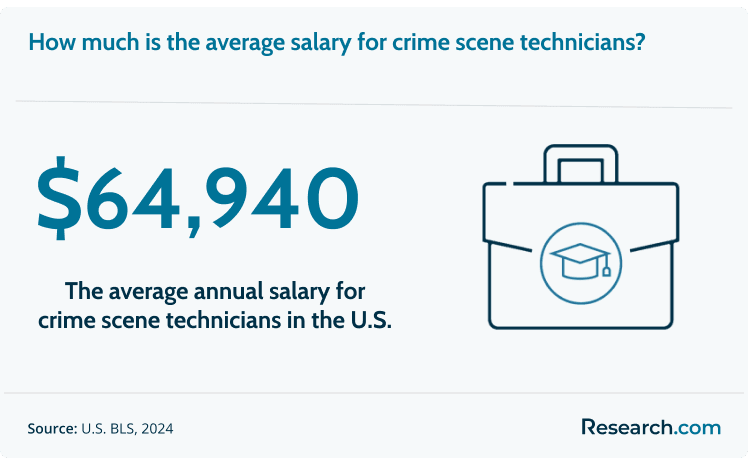
- The average salary for forensic science technicians, including crime scene technicians, is around $64,940 per year, though pay differs by employer, location, experience, and specialization.
- Crime scene technician duties and daily work
- Average crime scene technician salary for 2027
- Types of crime scenes technicians may process
- Step-by-step path to becoming a crime scene technician
- Typical timeline to enter the field
- Job outlook and hiring demand
- Certifications that can support your career
- Technology trends changing crime scene work
- Common challenges in the profession
- Financial aid options for training and degrees
- Online crime scene technician programs
- Skills employers look for
- Internships that build practical experience
- Working effectively with attorneys and courts
- Higher-paying roles related to crime scene work
- Professional organizations and career growth
- Moving from crime scene work into federal law enforcement
What are the primary job responsibilities of a crime scene technician?
A crime scene technician is responsible for protecting the integrity of physical evidence from the moment it is identified at a scene until it is submitted for analysis or used in court. The job is highly procedural. A missed photograph, poorly labeled sample, broken chain of custody, or incomplete report can weaken an investigation, even when the evidence itself is important. Students comparing forensic and criminal justice programs can start by reviewing a list of online schools that offer relevant academic pathways.
| Responsibility | What it involves | Why it matters |
| Crime scene documentation | Photographing the scene, creating sketches, taking measurements, recording observations, and noting the location of evidence before anything is moved. | Detailed documentation helps investigators reconstruct events and allows attorneys, judges, and juries to understand the scene later. |
| Evidence collection and preservation | Collecting fingerprints, biological samples, firearms, trace materials, digital devices, clothing, tools, and other physical evidence using approved procedures. | Proper packaging, labeling, and storage help prevent contamination, loss, or challenges to admissibility. |
| Chain-of-custody control | Recording who collected, handled, transported, stored, and transferred each piece of evidence. | Courts need confidence that evidence has not been altered, misplaced, or mishandled. |
| Support for forensic analysis | Working with forensic scientists, crime laboratory staff, detectives, and specialized analysts on items such as bloodstain patterns, ballistic evidence, chemical substances, and trace evidence. | Accurate field collection improves the quality of later laboratory testing and interpretation. |
| Report writing and case preparation | Preparing clear, factual reports that describe scene conditions, methods used, evidence recovered, and actions taken. | Investigators and prosecutors rely on reports to connect physical evidence to the broader case narrative. |
| Court testimony and legal support | Explaining how evidence was found, collected, packaged, preserved, and transferred, and answering questions about procedures. | Technicians may need to defend their methods under cross-examination, so accuracy and consistency are essential. |
How much is the average salary for crime scene technicians for 2027?
The average salary for crime scene technicians is approximately $64,940 per year. That figure should be treated as a broad benchmark rather than a guaranteed outcome because pay can change based on employer type, geographic area, education, years of experience, overtime policies, union agreements, and specialized skills. Entry-level technicians typically start with salaries around $45,000 per year, while experienced professionals, especially those working for federal agencies or in high-demand areas, can earn over $80,000 annually.
Local police departments, sheriff’s offices, state crime laboratories, medical examiner’s offices, and federal agencies may structure compensation differently. Candidates who want broader eligibility for forensic, investigative, or supervisory roles often compare degree options, including an online criminal justice degree, before choosing a program.
| Factor | How it can affect pay |
| Experience level | New technicians may begin near entry-level pay, while experienced specialists and supervisors may qualify for higher compensation. |
| Employer | Federal agencies, state labs, and larger metropolitan departments may offer different salary ranges than smaller local agencies. |
| Specialization | Skills in bloodstain analysis, firearms evidence, digital forensics, or laboratory testing can improve competitiveness for advanced roles. |
| Location | Cost of living, agency budgets, and regional demand influence compensation. |
| Credentials | Certifications and documented case experience may help candidates compete for specialized or supervisory positions. |
What types of crime scenes do crime scene technicians investigate?
Crime scene technicians may be called to many different environments, and each type of scene requires careful judgment about safety, documentation, contamination risks, and evidence priority. The work overlaps with several criminal justice roles, so students comparing related careers may also find it useful to review a crime analyst career guide to understand how field evidence and analytical work connect.
| Crime scene type | Common evidence | Special considerations |
| Homicide scenes | Bloodstains, weapons, shell casings, trace evidence, clothing, biological samples, and scene patterns. | These scenes often require extensive photography, careful sequencing, coordination with detectives, and close attention to reconstruction details. |
| Burglary and theft scenes | Fingerprints, shoe impressions, tool marks, broken glass, surveillance footage, and entry-point evidence. | The goal is often to identify how entry occurred and whether physical evidence can connect a suspect to the scene. |
| Arson and explosive scenes | Burn patterns, accelerant residue, explosive residue, debris, ignition sources, and structural damage. | Technicians may work with fire investigators and must follow safety protocols because scenes can remain unstable or hazardous. |
| Sexual assault scenes | DNA, biological material, trace fibers, clothing, bedding, and other contact evidence. | Evidence must be handled with exceptional care, sensitivity, and strict procedural control. |
| Traffic accidents and hit-and-run scenes | Skid marks, vehicle debris, paint transfer, glass, tire impressions, and damage patterns. | Documentation supports accident reconstruction and may help determine whether criminal conduct was involved. |
What is the step-by-step process to become a crime scene technician?
The best path depends on your current education, work background, location, and target employer. Still, most candidates follow a similar progression: build the academic foundation, get practical exposure, learn evidence procedures, and compete for entry-level positions.
- Confirm the requirements in your target area. Review job postings from local police departments, sheriff’s offices, state crime labs, medical examiner’s offices, and federal agencies. Note whether they require a degree, law enforcement experience, academy training, a valid driver’s license, background checks, or specific coursework.
- Earn a relevant bachelor’s degree. Many positions prefer or require a bachelor’s degree in forensic science, criminal justice, biology, chemistry, or a related field. Veterans and active-duty service members who need flexible options may compare military-friendly online colleges while checking whether programs include forensic coursework and practical learning opportunities.
- Take courses that match the job, not just the major title. Useful subjects include forensic photography, criminal investigation, evidence law, anatomy, biology, chemistry, fingerprint analysis, report writing, statistics, and courtroom procedure.
- Build hands-on experience early. Look for internships, volunteer opportunities, job shadowing, campus labs, mock crime scene exercises, or part-time roles involving evidence handling, records, dispatch, laboratory assistance, or law enforcement support.
- Complete specialized training. Employers may value training in latent prints, bloodstain pattern documentation, forensic mapping, shooting reconstruction, evidence packaging, death investigation, or hazardous scene safety.
- Consider certification when eligible. Credentials such as the Certified Crime Scene Investigator (CCSI) from the International Association for Identification (IAI) can demonstrate professional commitment and documented competence.
- Apply strategically for entry-level roles. Search for titles such as crime scene technician, crime scene specialist, forensic technician, evidence technician, forensic identification technician, property and evidence technician, or laboratory assistant.
- Advance through experience and specialization. With field experience, technicians may move into supervisory roles, crime laboratory positions, forensic specialties, detective work, or federal investigations.
How long does it take to become a crime scene technician?
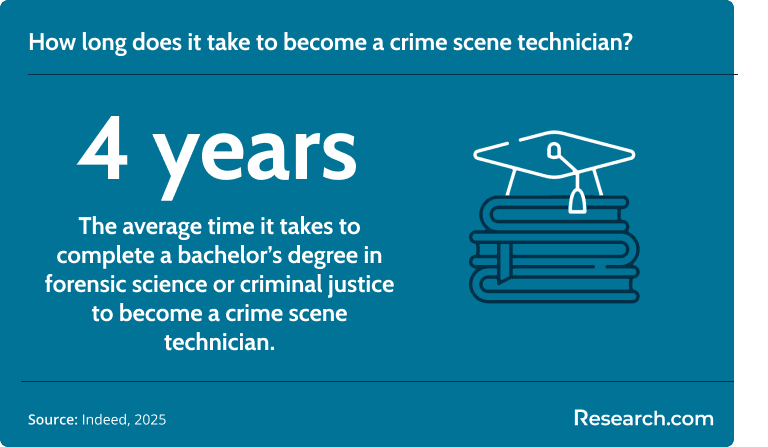
Becoming a crime scene technician typically takes about four years because many employers expect a bachelor’s degree in forensic science, criminal justice, biology, or a related discipline. Students who attend full time may finish in that timeframe, while part-time students may need longer. Some learners compare accredited online colleges when they need more flexible scheduling or want to evaluate accelerated options.
Education is only part of the timeline. Internships, agency training, background investigations, field training, certifications, and specialized forensic courses can add several months to two years. A realistic path often takes between four to six years, depending on how quickly a candidate completes a degree, gains practical experience, and meets employer-specific requirements.
| Stage | Typical purpose | Time consideration |
| Bachelor’s degree | Builds the scientific, investigative, and legal foundation for the role. | Usually about four years for full-time students. |
| Internship or field exposure | Provides experience with crime scene procedures, evidence handling, or laboratory operations. | May occur during school or after graduation. |
| Agency hiring process | May include applications, interviews, background checks, drug screening, and sometimes physical or psychological evaluation. | Varies widely by employer. |
| On-the-job training | Teaches local policies, documentation systems, evidence submission rules, and scene response procedures. | Can take months and continues as cases become more complex. |
| Certification and specialization | Supports advancement into recognized forensic specialties. | Often requires experience, documented work, and exams. |
What is the job outlook for crime scene technicians?
The job outlook for crime scene technicians is strong. Employment is projected to grow by 14% from 2023 to 2033. In 2023, there were approximately 18,600 forensic science technicians employed, and this number is expected to rise to 21,200 by 2033. That projected growth is significantly faster than the average for most occupations and reflects continued reliance on forensic evidence in investigations.
Demand is influenced by advances in DNA analysis, digital forensics, forensic databases, evidence management systems, and technology-assisted scene documentation. However, the field can still be competitive because many applicants are attracted to forensic careers. Candidates with a relevant degree, strong writing skills, documented internships, certifications, and comfort with scientific procedures tend to be better positioned.
For context, some crime scene technician roles have pay patterns comparable to other technical laboratory careers. Students comparing forensic work with healthcare lab roles may review clinical technologist salary information, where experienced professionals in well-funded labs can exceed $70,000 annually.
What certifications are required to become a crime scene technician?
Certification is not universally required for crime scene technician jobs, but it can be useful when an employer prefers documented training or when a technician wants to move into a specialized role. Before paying for any credential, check whether the certification is recognized by the agencies where you plan to apply, whether it requires experience, and whether it fits your career goal. Candidates exploring shorter credentials can also compare online certifications that build job-relevant skills.
| Certification | Provider | Best fit |
| Certified Forensic Science Technician (CFST) | National Forensic Science Technology Center (NFSTC) | Candidates who want a credential focused on evidence collection, preservation, and crime scene procedures. |
| Crime Scene Certification: Basic, Advanced, Senior | International Crime Scene Investigators Association (ICSIA) | Technicians seeking credentials aligned with different experience levels in crime scene investigation and evidence handling. |
| Bloodstain Pattern Analyst Certification | International Association of Bloodstain Pattern Analysts (IABPA) | Professionals who want to specialize in bloodstain documentation, interpretation, and reconstruction. |
| Certified Crime Scene Investigator (CCSI) | International Association for Identification (IAI) | Technicians with at least one year of experience, documented casework, and the ability to pass an exam. |
How are emerging technologies transforming crime scene investigations?
Crime scene work is becoming more technology-driven, especially in documentation, mapping, evidence tracking, and digital evidence recovery. Tools such as 3D imaging, laser scanning, virtual reconstruction, and artificial intelligence-supported workflows can help agencies record scenes more precisely and review complex evidence more efficiently. These tools do not replace careful field judgment, but they can reduce avoidable errors when technicians are properly trained.
Technology skills can also improve long-term mobility. Technicians who understand digital forensics, forensic imaging, evidence databases, and advanced reconstruction methods may be better prepared for specialized units and roles connected to the highest paying criminal justice jobs.
What challenges do crime scene technicians commonly face?
Crime scene technicians work in conditions that can be physically demanding, emotionally difficult, and legally unforgiving. They may respond at night, in bad weather, in unsafe locations, or at scenes involving violence, death, or trauma. They must also follow exact procedures while working around detectives, patrol officers, victims, families, medical personnel, fire crews, and attorneys.
- Emotional exposure: Graphic scenes can affect mental health, making resilience, peer support, and healthy coping strategies important.
- Procedural pressure: Evidence mistakes can create legal problems, so technicians must slow down, document carefully, and avoid assumptions.
- Technology changes: New tools require ongoing training rather than one-time education.
- Courtroom scrutiny: Technicians may need to explain every step they took and defend their methods under questioning.
- Irregular schedules: Crime scenes do not follow a standard workday, so shift work, callouts, and overtime may be part of the job.
Those considering adjacent roles can also explore careers in criminology to compare field-based, analytical, policy, and research-oriented options.
What financial aid options are available for crime scene technician training?
Students preparing for crime scene technician careers may be able to reduce costs through scholarships, grants, work-study, employer tuition assistance, military education benefits, federal student aid, and state-based aid programs. The most important step is to confirm that the school is accredited and eligible for the type of aid you plan to use.
When comparing programs, do not look only at tuition. Include fees, textbooks, lab costs, travel for in-person requirements, background checks, certification exam costs, equipment, and the opportunity cost of reducing work hours. Students considering a criminal justice bachelor degree online should ask whether the program provides career services, internship support, transfer credit evaluation, and forensic-focused electives.
| Cost question to ask | Why it matters |
| Is the institution accredited? | Accreditation can affect financial aid eligibility, credit transfer, employer acceptance, and graduate study options. |
| Are there in-person labs or field experiences? | Online coursework may still require travel or local placement for practical training. |
| Does the program help students find internships? | Hands-on experience is one of the most valuable résumé builders for this field. |
| Are certification costs included? | Some programs prepare students for credentials, but exam fees may be separate. |
| Can prior credits transfer? | Transfer credits can reduce both completion time and total cost. |
Are there online programs for crime scene technician training?
Yes. Students can find online and hybrid programs in forensic science, criminal justice, crime scene investigation, and related areas. Online coursework can be especially useful for working adults, military students, career changers, and students who do not live near a campus with a forensic science program. Typical courses may cover evidence collection, criminal investigation, forensic photography, fingerprint analysis, criminal law, crime scene reconstruction, and report writing.
The limitation is that crime scene work is hands-on. A program that is entirely online may teach the theory well but still leave students needing practical experience. Look for virtual labs, mock scene exercises, local internship options, hybrid residencies, or partnerships with law enforcement agencies. To better understand what employers may expect, compare coursework with crime scene investigator job requirements.
| Program format | Advantages | Trade-offs |
| Fully online | Flexible scheduling, easier access for remote learners, and often better compatibility with full-time work. | May require students to find their own hands-on experience through internships or local agencies. |
| Hybrid | Combines online theory with in-person labs, mock crime scenes, or campus residencies. | Travel, scheduling, and location may still be barriers. |
| Campus-based | More direct access to labs, faculty, equipment, mock scenes, and peer practice. | Less flexible and may require relocation or commuting. |
What key skills are critical for success as a crime scene technician?
Strong crime scene technicians combine scientific thinking with patience, communication, and procedural discipline. The job rewards people who can notice small details without jumping to conclusions, work methodically under pressure, and write reports that are clear enough to stand up in court. Students seeking deeper academic preparation can compare programs at the best colleges in the US for forensic science.
- Observation: The ability to notice patterns, inconsistencies, scene conditions, and evidence that may be easy to overlook.
- Documentation: Skill in photography, sketching, note-taking, measurement, and evidence logs.
- Scientific reasoning: Comfort with biology, chemistry, anatomy, trace evidence, and laboratory concepts.
- Attention to procedure: Consistent use of protocols for contamination prevention, packaging, labeling, and chain of custody.
- Writing: Clear reports that separate observations from conclusions and avoid vague language.
- Communication: Professional interaction with detectives, patrol officers, forensic scientists, attorneys, victims, and witnesses.
- Composure: The ability to work carefully in stressful, graphic, or chaotic settings.
- Technology readiness: Familiarity with digital evidence, 3D imaging, mapping tools, databases, and forensic software.
What are the best internships for aspiring crime scene technicians?
Internships are one of the most effective ways to prove that you understand the realities of forensic work. They also help students learn whether they prefer field response, laboratory analysis, evidence management, death investigation, or analytical support.
| Internship type | What you may learn | Best for students interested in |
| Law enforcement agency internships | Scene response, evidence documentation, report preparation, property room procedures, and interaction with investigators. | Police department, sheriff’s office, or crime scene unit roles. |
| Forensic laboratory internships | DNA analysis, toxicology, fingerprints, trace evidence, quality control, and laboratory documentation. | Crime lab careers and forensic science positions. A crime lab analyst career guide can help students compare this path with field technician roles. |
| Medical examiner’s office internships | Death investigation, autopsy support, cause-of-death documentation, and forensic pathology workflows. | Homicide investigations, death investigation, and forensic pathology support. |
| Federal agency internships | Exposure to national-level investigative work, forensic evidence systems, and specialized agency procedures. | Competitive federal careers with agencies such as the FBI, the Bureau of Alcohol, Tobacco, Firearms and Explosives (ATF), and the Drug Enforcement Administration (DEA). |
| University and research internships | Forensic technology research, evidence method testing, criminal behavior studies, and laboratory-based projects. | Graduate study, forensic research, and academic or technical specialization. |
How can crime scene technicians enhance collaboration with legal professionals?
Crime scene technicians do not only serve investigators; they also support the legal process. Their work may be reviewed by prosecutors, defense attorneys, judges, and expert witnesses. To collaborate effectively, technicians should understand legal terminology, search and seizure basics, evidence admissibility, discovery, courtroom procedure, and the difference between objective observations and expert interpretation.
Technicians can strengthen collaboration by writing reports in plain language, documenting uncertainty honestly, keeping complete evidence logs, meeting with prosecutors before testimony when appropriate, and preparing to explain technical methods without exaggeration. Some professionals who want a stronger legal foundation may consider an affordable ABA approved paralegal program online to better understand how evidence moves from scene to courtroom.
What are the highest-paying jobs for crime scene technicians?
Crime scene technician experience can lead to higher-paying work in forensic specialties, crime laboratories, supervision, investigations, and federal agencies. The roles below are related to crime scene investigation and forensic evidence work, but they may require additional education, certification, agency experience, or specialized training.
| Role | Average annual salary | How it connects to crime scene work |
| Forensic Science Technologist | $64,940 | Focuses on advanced forensic testing and evidence analysis, including work that may overlap with blood spatter analyst job requirements. |
| Police Detective or Criminal Investigator | $74,910 | Uses investigative authority to manage cases, interview witnesses and suspects, and coordinate forensic evidence with broader case strategy. |
| Clinical Laboratory Technologist and Technician | $60,780 | Performs laboratory testing that may involve biological evidence such as blood, DNA, and toxicology samples. |
| Chemical Technician | $56,750 | Analyzes substances such as drugs, explosives, residues, or unknown chemicals connected to investigations. |
| Forensic Ballistics Expert | $87,877 | Examines firearms, bullets, shell casings, and gunshot residue to help connect weapons to events or suspects. |
| Federal Forensic Examiner | $61,011 | Works with evidence in major or federal investigations involving agencies such as the FBI, DEA, or ATF. |
| Crime Scene Unit Supervisor | $69,853 | Manages crime scene teams, trains technicians, reviews procedures, and oversees evidence documentation quality. |
Higher-paying roles are usually not immediate entry-level options. They typically require years of case experience, strong performance, specialized training, and sometimes advanced credentials. The chart below shows the average salaries for some of the highest-paying job roles as crime scene technicians:
How can joining professional organizations boost career advancement?
Professional organizations can help crime scene technicians stay current, meet mentors, learn about new forensic methods, attend conferences, and identify certification opportunities. Membership can also signal commitment to the field, especially when paired with continuing education and documented case experience.
When choosing an organization, look for training quality, certification relevance, conference access, local chapters, publication resources, and whether employers in your area recognize the group. Students still choosing a degree path can also compare the best online colleges for forensic science to find programs that align with professional expectations in the field.
How can crime scene technicians transition to federal law enforcement roles?
Federal roles are usually more competitive and may require additional screening, security clearance eligibility, specialized experience, advanced training, and strong written communication skills. Crime scene technicians who want to move in this direction should build a record of reliable casework, learn federal hiring processes, strengthen digital forensics or laboratory skills, and maintain a clean professional background.
Useful preparation may include experience with complex investigations, evidence databases, firearms evidence, cyber investigations, controlled substances, immigration-related investigations, or interagency task forces, depending on the target agency. For a broader look at one federal law enforcement pathway, review this guide on how to be an ICE agent.
Is becoming a crime scene technician worth it?
Becoming a crime scene technician can be worth it for people who want meaningful investigative work, can tolerate stressful scenes, and are willing to follow strict procedures even when the environment is chaotic. It is not the best fit for someone who wants a predictable schedule, minimal exposure to trauma, or a job that is mostly laboratory-based and isolated from law enforcement operations.
| This path may be a good fit if you... | Consider another path if you... |
| Are detail-oriented and patient when documenting complex information. | Prefer fast conclusions and dislike repetitive procedural work. |
| Can handle graphic or emotionally difficult scenes professionally. | Want to avoid exposure to death, violence, or trauma. |
| Enjoy science, investigation, photography, writing, and teamwork. | Want a role that is purely scientific with little field response or court involvement. |
| Are willing to work nights, weekends, holidays, or on-call shifts if required. | Need a consistent daytime schedule. |
| Can testify clearly and remain calm under questioning. | Are uncomfortable having your work challenged in court. |
Common mistakes to avoid when preparing for this career
- Choosing a school without checking accreditation. Accreditation can affect financial aid, transfer credits, employer perception, and future graduate study.
- Assuming every forensic program prepares you for fieldwork. Some programs are more laboratory-focused, while others emphasize criminal justice or investigation.
- Ignoring hands-on experience. A degree alone may not be enough in competitive markets; internships and applied training matter.
- Focusing only on tuition. Lab fees, travel, background checks, equipment, certification exams, and lost work hours can change the real cost.
- Waiting until graduation to network. Faculty, internship supervisors, law enforcement contacts, and professional organizations can help you find openings.
- Assuming online programs automatically meet employer expectations. Online coursework can be valuable, but you still need practical evidence-handling experience.
- Overlooking report writing. Strong documentation is as important as technical collection skills because reports may be used in court.
- Expecting salary outcomes to be guaranteed. Published averages are useful, but actual pay depends on agency budgets, location, specialization, and experience.
Questions to ask before enrolling in a crime scene technician program
- Is the institution accredited, and what type of accreditation does it hold?
- Does the curriculum include crime scene photography, evidence handling, forensic science, criminal investigation, and report writing?
- Are there mock crime scene exercises, labs, or required in-person components?
- Does the school help students secure internships with law enforcement agencies, forensic labs, or medical examiner’s offices?
- What percentage of credits can transfer from prior college work?
- Does the program prepare students for any recognized certification, and are exam fees included?
- What career services are available for forensic science or criminal justice students?
- Do local employers recognize graduates from this program?
- What is the total cost after tuition, fees, books, supplies, travel, and certification costs?
- Can the program fit your schedule if you need to work while studying?
Graduate perspectives on forensic science training
"Working as a crime scene technician has given me a career where careful evidence work can help victims and families get answers. The job requires patience, precision, and problem-solving, but that is what makes it meaningful." – Jennifer
"I wanted a role where science and public service intersect. Processing fingerprints, documenting bloodstain patterns, and supporting investigations has challenged me to think critically on every case." – Marcus
"The field keeps changing, and that constant learning is one of the reasons I value this career. New technology, new methods, and close work with law enforcement make the work demanding but purposeful." – Taylor
Resources
- Glassdoor. (2025). Crime Scene Section Supervisor Salaries. https://www.glassdoor.com
- Indeed Editorial Team. (2025). How To Become a Forensic Ballistics Expert: A Career Guide. https://www.indeed.com
- U.S. Bureau of Labor Statistics. (2024). OOH: Forensic Science Technicians. https://www.bls.gov
- ZipRecruiter. (2025). Salary: Forensic Ballistics Expert (Mar, 2025) United States. https://www.ziprecruiter.com
Key Insights
- Most crime scene technician candidates should plan for a bachelor’s degree in forensic science, criminal justice, biology, or a related field, plus practical experience through internships or agency training.
- The average salary is around $64,940 per year, with entry-level technicians typically starting around $45,000 per year and experienced professionals in certain agencies or high-demand areas earning over $80,000 annually.
- The career outlook is favorable, with employment projected to grow by 14% from 2023 to 2033, increasing from approximately 18,600 forensic science technician jobs in 2023 to 21,200 by 2033.
- Online programs can be useful, but students should verify accreditation, hands-on training options, internship support, and employer recognition before enrolling.
- Certifications are not always mandatory, but credentials such as the Certified Crime Scene Investigator (CCSI) can support advancement after candidates gain the required experience and casework.
- The strongest applicants combine scientific knowledge, evidence-handling discipline, strong writing, emotional resilience, and the ability to testify clearly in court.
- Before choosing this path, weigh the realities of shift work, graphic scenes, strict legal procedures, and competitive hiring against the opportunity to contribute directly to criminal investigations.
Other Things You Should Know About How To Become a Crime Scene Technician
The International Association for Identification, or IAI, offers the best-known certification for crime scene technicians through its Certified Crime Scene Investigator and Certified Crime Scene Analyst credentials. Many agencies also require post-hire field training and a passing score on a department skills assessment before independent casework.
To become a crime scene technician in 2027, obtaining certifications like the International Association for Identification's (IAI) Crime Scene Certification is crucial. This certification typically requires a mix of education, practical experience, and passing a comprehensive examination to validate your skills.


