2027 How to Become a Blood Spatter Analyst

Co-Founder and Chief Data Scientist
Becoming a blood spatter analyst is not a general “crime scene” job. It is a specialized forensic role focused on interpreting bloodstain patterns to help investigators understand how an event may have unfolded. The work can influence criminal investigations, laboratory findings, expert reports, and courtroom testimony, so the path requires science-based education, careful training, and a strong understanding of both evidence handling and the limits of forensic interpretation.
This guide is for students, career changers, law enforcement professionals, and forensic science graduates who want to know what it actually takes to enter bloodstain pattern analysis. You will learn what the job involves, which degrees and certifications are most relevant, how salary and job demand compare with related roles, what skills matter, where analysts work, and what mistakes to avoid before choosing a program or career path.
Quick answer: How do you become a blood spatter analyst?
Most aspiring blood spatter analysts start with a bachelor's degree in forensic science, biology, chemistry, criminal justice, or another closely related field. They then build practical experience in crime scene investigation, laboratory evidence handling, photography, documentation, and bloodstain pattern interpretation. Professional training and certification, especially through organizations such as the International Association for Identification, can strengthen credibility because bloodstain pattern analysis is often questioned closely in court.
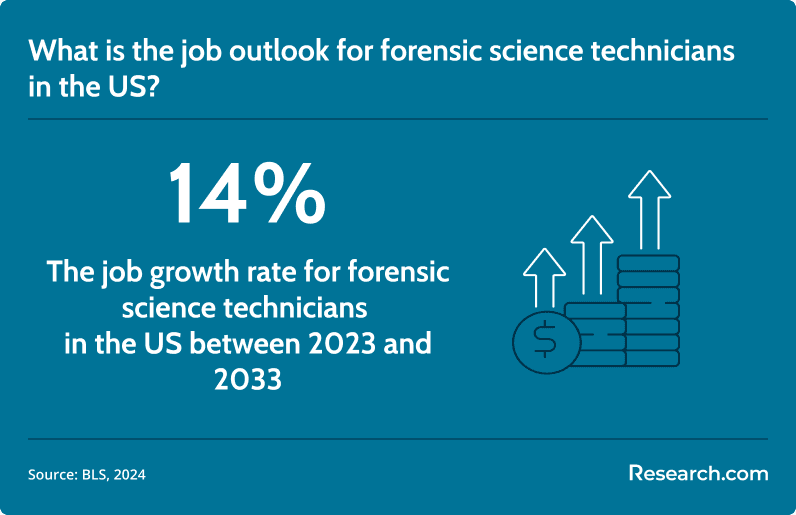
The broader forensic labor market remains relevant for this career path. Violent crime decreased by 10.3% from June 2023 and 2024 [Federal Bureau of Investigation (FBI), 2024], but criminal investigations still require specialists who can document, analyze, and explain physical evidence. In 2023, forensic science technicians in the United States had a median annual wage of $64,940 [US Bureau of Labor Statistics (BLS), 2024], and employment for forensic science technicians was projected to grow by 14% between 2023 and 2033, equal to about 2,700 openings per year on average (US BLS, 2024).
Why consider this career?
- The work has real investigative value. Bloodstain pattern analysts help investigators test possible timelines, movement, force, directionality, and event sequences using physical evidence.
- It builds on several forensic specialties. Professionals who handle blood evidence may work alongside forensic biologists, forensic toxicologists, forensic serologists, crime scene investigators, detectives, and laboratory analysts.
- The related job outlook is strong. Forensic science technician employment was projected to increase by 14% from 2023 to 2033, which is much faster than the average for all occupations in the US (US BLS, 2024).
- The work is intellectually demanding. Analysts combine biology, physics, mathematics, photography, documentation, legal procedure, and report writing.
- What does a blood spatter analyst do?
- What degree do you need to become a blood spatter analyst for 2027?
- Which certifications are available for bloodstain pattern analysts?
- What technical skills are required for blood spatter analysts?
- What soft skills help blood spatter analysts succeed?
- How much do blood spatter analysts make per year?
- What jobs can you get with a forensic science degree besides blood analysis?
- How is evolving technology shaping bloodstain pattern analysis?
- How can interdisciplinary training enhance a bloodstain pattern analyst's career?
- How can bloodstain pattern analysts maintain their professional expertise?
- How can online education complement traditional forensic training?
- What is the job demand for bloodstain pattern analysts?
- What ethical and legal standards guide blood spatter analysis?
- Where do blood spatter analysts work? Police, FBI, private sector, and laboratories
- What are the emerging research trends in blood spatter analysis?
- What are the biggest challenges bloodstain pattern analysts face?
- How can bloodstain pattern analysts advance their careers?
- What are the limitations and potential sources of error in blood spatter analysis?
What does a blood spatter analyst do?
A blood spatter analyst, more formally called a bloodstain pattern analyst, studies the size, shape, location, direction, and distribution of bloodstains at a scene or on evidence. The goal is not simply to identify blood. The analyst evaluates how the blood may have been deposited and whether the patterns are consistent with possible actions, injuries, movements, or mechanisms described by investigators, witnesses, suspects, or other forensic findings.
Typical duties may include photographing and measuring bloodstain patterns, preserving and sampling evidence for DNA testing, documenting the scene, reviewing autopsy and injury information when available, comparing stains across surfaces, preparing technical reports, and explaining findings to investigators, attorneys, judges, or juries. Analysts often work as part of a larger forensic team rather than as isolated decision-makers.
Reliable bloodstain interpretation depends on specialized scientific education and training. Professionals need a working command of:
- standard bloodstain pattern terminology
- the accuracy limits of measurement tools used at scenes and in laboratories
- applied mathematics, including geometry and trigonometry
- fluid transfer and motion principles
- wound pathology and injury mechanisms
- common bloodstain patterns created after blood leaves the body
Bloodstain pattern analysis also overlaps with several other forensic fields. Forensic biologists may examine biological evidence and DNA. Forensic serologists may focus on body fluids. Forensic toxicologists evaluate substances in biological samples. A bloodstain pattern analyst must understand where their role begins, where it ends, and when another specialist should interpret the evidence.
| Task | Why it matters in an investigation |
| Photographing and mapping bloodstains | Creates a visual and measurable record that can be reviewed later by investigators, attorneys, and other experts. |
| Assessing stain size, shape, and distribution | Helps evaluate directionality, possible motion, impact, transfer, or pooling. |
| Collecting or coordinating biological samples | Supports later DNA or laboratory testing when the source of the blood must be identified. |
| Reconstructing possible event sequences | Allows investigators to compare physical patterns with statements, injury findings, or other evidence. |
| Writing reports and testifying | Translates technical analysis into clear conclusions that can be scrutinized in legal proceedings. |
What degree do you need to become a blood spatter analyst for 2027?
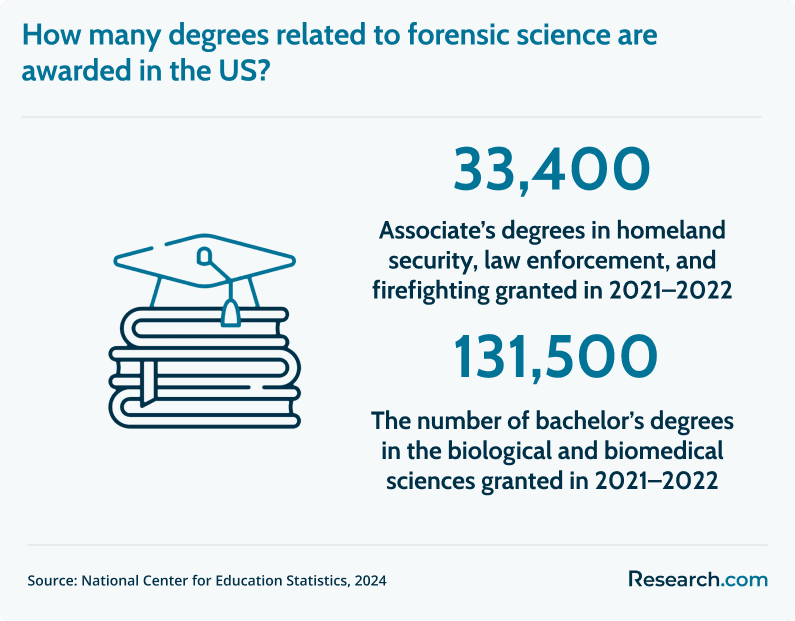
A bachelor's degree is usually the starting point for a blood spatter analyst career. The most common majors include forensic science, biology, chemistry, criminal justice, or a closely related scientific field. A forensic science degree may be especially useful because it can include crime scene processing, forensic biology, laboratory methods, evidence documentation, and legal foundations.
That said, the best degree depends on the type of role you want. A crime scene-focused position may value evidence collection, photography, and investigative procedure. A laboratory-based position may place greater weight on biology, chemistry, microscopy, and quality assurance. Students who want broader scientific preparation may compare forensic science programs with biology or chemistry degrees, while those seeking graduate study may also research related options such as a master of health science degree.
| Education path | When it makes sense | What to watch for |
| Bachelor's in forensic science | Best fit for students who want direct exposure to evidence handling, crime scene methods, and forensic laboratory concepts. | Check whether the curriculum includes chemistry, biology, statistics, microscopy, documentation, and court testimony preparation. |
| Bachelor's in biology | Useful for students interested in DNA, body fluids, forensic biology, serology, or laboratory roles. | You may need extra coursework or training in crime scene investigation and bloodstain pattern analysis. |
| Bachelor's in chemistry | Strong option for students considering laboratory analysis, toxicology, trace evidence, or broader forensic chemistry roles. | Bloodstain pattern analysis also requires scene documentation, photography, and reconstruction training. |
| Bachelor's in criminal justice | Can help students understand policing, courts, criminal procedure, and investigations. | For science-heavy forensic roles, employers may prefer stronger biology, chemistry, physics, and laboratory preparation. |
| Graduate degree or advanced study | May support advancement, research, leadership, or specialized forensic roles. | A graduate degree should add relevant scientific, analytical, or managerial value rather than simply adding a credential. |
Because bloodstain pattern analysis involves trajectories, surface effects, and fluid behavior, coursework in physics and mathematics can be valuable. Laboratory experience, internships, mock crime scene work, and supervised evidence documentation are also important because employers need proof that you can apply scientific concepts in controlled, defensible ways.
How to choose a degree program for this career
- Prioritize science depth. Look for biology, chemistry, physics, statistics, and laboratory coursework rather than a program that focuses only on criminal justice theory.
- Ask about hands-on training. Programs with crime scene labs, mock scenes, forensic photography, evidence packaging, and report writing are more practical for this path.
- Check internship options. A placement with a crime lab, medical examiner, law enforcement agency, or forensic unit can make your resume more credible.
- Review faculty experience. Instructors with forensic laboratory, crime scene, or courtroom experience can help you understand how evidence is challenged in practice.
- Consider cost and transfer policies. If you need a flexible starting point, an affordable online college may help you complete general education or foundational coursework before moving into more specialized forensic training.
Which certifications are available for bloodstain pattern analysts?
Certification is not always the first requirement for entry-level forensic work, but it can become important as analysts gain experience and begin providing expert interpretation. The International Association for Identification (IAI), described as the oldest and largest forensic association globally, offers several certification programs, including the Bloodstain Pattern Analyst Certification program. The certification is valid for 5 years.
Applicants preparing for IAI certification should expect to document qualifying professional experience in the past 5 years, relevant training, at least two endorsement letters, and two additional references. Because requirements can change, candidates should review the current certification handbook and verify eligibility before paying fees or planning an application timeline.
The International Association of Bloodstain Pattern Analysts (IABPA) also lists training courses submitted to the association that meet IABPA standards for basic bloodstain pattern analysis courses. These courses can help new professionals build foundational skills before attempting more advanced interpretation or certification.
| Credential or training option | Best for | Decision tip |
| IAI Bloodstain Pattern Analyst Certification | Experienced professionals who need a recognized forensic credential. | Review the experience, training, endorsement, and reference requirements before assuming you are eligible. |
| IABPA-listed basic BPA courses | Students, investigators, and early-career forensic professionals learning bloodstain fundamentals. | Use these courses to build a foundation, but do not treat a short course as a substitute for scientific education and supervised practice. |
| Legal or evidence-focused coursework | Analysts who need stronger courtroom, documentation, or evidence-handling knowledge. | Programs such as the cheapest paralegal certificate options may be useful for understanding legal procedure, but they do not replace forensic science training. |
What technical skills are required for blood spatter analysts?
Blood spatter analysts need more than curiosity about crime scenes. Their conclusions must be scientifically grounded, carefully documented, and understandable to non-specialists. Technical competence usually develops through a mix of degree coursework, forensic training, supervised practice, and continuing education.
- Bloodstain pattern interpretation: Analysts must recognize and describe patterns related to impact, transfer, flow, pooling, projection, and other mechanisms while avoiding conclusions that go beyond the evidence.
- Mathematics and physics: Geometry, trigonometry, measurement, and fluid dynamics help analysts evaluate angles, possible directions of travel, and areas of origin.
- Crime scene documentation: Proper photography, scale placement, note-taking, scene mapping, and evidence logs are essential because analysis is only as reliable as the record supporting it.
- Laboratory awareness: Analysts should understand how biological evidence may be collected, preserved, tested, contaminated, or limited.
- Digital tools: Crime scene reconstruction software, imaging tools, and data-management platforms can support measurement, visualization, and reporting when used appropriately.
- Report writing: Technical findings must be written in a clear, defensible way that separates observations, methods, assumptions, limitations, and conclusions.
Students who want a stronger biological science foundation may also compare forensic pathways with advanced scientific study, including a biotechnology master degree online, especially if they are interested in biological evidence, DNA-related work, or laboratory-based forensic applications.
What soft skills help blood spatter analysts succeed?
Soft skills matter because bloodstain pattern analysis is collaborative, legally sensitive, and often emotionally difficult. Analysts must communicate with investigators, prosecutors, defense attorneys, laboratory personnel, medical examiners, and sometimes families or juries. Strong scientific knowledge is not enough if an analyst cannot explain what the evidence does and does not show.
| Skill | How it shows up on the job |
| Attention to detail | Small differences in stain shape, surface texture, drying, or distribution can change how evidence is interpreted. |
| Critical thinking | Analysts must compare multiple possible explanations instead of forcing the evidence to fit one theory. |
| Clear communication | Reports and testimony must explain technical findings in language that investigators, attorneys, judges, and jurors can understand. |
| Objectivity | Forensic conclusions must be based on evidence, methods, and limitations rather than pressure from either side of a case. |
| Emotional resilience | The work may involve violent scenes and graphic evidence, requiring healthy coping strategies and professional boundaries. |
| Teamwork | Bloodstain interpretation often depends on coordination with DNA analysts, medical examiners, detectives, photographers, and crime laboratory staff. |
How much do blood spatter analysts make per year?
Blood spatter analyst salaries vary by employer, location, experience, education, certification, and whether the role is housed in a laboratory, law enforcement agency, medical examiner's office, or private consulting setting. Because “blood spatter analyst” is often a specialization rather than a separate Bureau of Labor Statistics occupation, salary comparisons usually rely on related forensic and law enforcement roles.
In the US, blood spatter analysts had an annual base pay that ranged from $81,000 to $152,000 (Glassdoor, 2024). Related 2023 median annual wages from the US BLS were:
| Related occupation | 2023 median annual wage | How it relates to bloodstain pattern analysis |
| Forensic Science Technicians | $64,940 | Closest broad occupational category for laboratory and crime scene evidence specialists. |
| Detectives and Criminal Investigators | $91,100 | Investigators may work closely with bloodstain analysts or build forensic expertise after law enforcement experience. |
| Police and Sheriff’s Patrol Officers | $72,280 | Some professionals begin in patrol or crime scene response before moving toward specialized forensic duties. |
The main factors that can affect earnings include:
- Experience and case responsibility: Analysts with years of supervised practice, courtroom experience, and complex casework may qualify for higher-level positions.
- Education and specialization: Advanced scientific training can help in laboratory-heavy roles. Students comparing forensic biology or evidence analysis may also review how the biologist career path connects with forensic work such as DNA, serology, and trace evidence.
- Employer type: Local agencies, state agencies, federal law enforcement, laboratories, universities, and private forensic firms may use different pay structures.
- Location: Major metro areas and high-cost regions may offer higher salaries, though competition and cost of living should be considered.
- Certification and courtroom credibility: Recognized credentials and defensible testimony experience can strengthen advancement opportunities.
The chart below provides a visualization of the 2023 median annual wages of professions related to bloodstain pattern analysis, according to 2024 data from the US BLS.
What jobs can you get with a forensic science degree besides blood analysis?
A forensic science degree can lead to several evidence, laboratory, investigative, and law enforcement roles. Bloodstain pattern analysis is only one possible specialization, and many students first enter broader forensic positions before narrowing their focus.
| Career option | What the role does | 2023 employment level |
| Forensic Science Technicians | Collect, preserve, and analyze physical evidence such as blood, DNA, fingerprints, fibers, and other materials in laboratories or at crime scenes. | 18,600 forensic science technicians were employed across the US (US BLS, 2024). |
| Detectives and Criminal Investigators | Investigate crimes, interview witnesses, gather evidence, reconstruct events, and work with forensic specialists to build cases. | 113,400 detectives and criminal investigators were employed in the US (US BLS, 2024). |
| Police and Sheriff’s Patrol Officers | Respond to emergencies, enforce laws, secure scenes, document initial observations, and preserve evidence until specialists arrive. | 700,600 police and sheriff’s patrol officers worked across the US (US BLS, 2024). |
Some students use flexible admissions options, including online colleges with no application fee, to begin or continue undergraduate study before transferring into a forensic science, biology, chemistry, or criminal justice program. Others compare adjacent public safety fields and ask, what jobs can you get with a homeland security degree, especially if they are interested in intelligence, emergency management, federal agencies, or security analysis rather than laboratory forensics.
The chart below provides a visualization of the 2023 employment levels of professions related to bloodstain pattern analysis, according to 2024 data from the US BLS.
How is evolving technology shaping bloodstain pattern analysis?
Technology is changing how analysts document, measure, model, and present bloodstain evidence. Advanced imaging, digital photography, three-dimensional scene documentation, and software-assisted reconstruction can help analysts capture more detail and test possible interpretations more efficiently. These tools do not remove the need for scientific judgment. They make documentation stronger when the analyst understands the method, assumptions, error potential, and limits of the technology.
AI-assisted modeling and machine learning are also being explored in forensic contexts, but analysts should treat these tools as aids rather than unquestioned authorities. Any software-generated interpretation must be explainable, validated, and defensible in court. A tool that produces a polished visual reconstruction is not automatically scientifically reliable.
Digital recordkeeping is also becoming more important. Forensic professionals increasingly need organized case files, consistent documentation, audit trails, and clear reporting workflows. Students comparing evidence documentation with administrative fields may notice parallels with healthcare data and billing systems, though medical billing and coding program cost research is only relevant as a broader example of structured records training, not as a replacement for forensic education.
How can interdisciplinary training enhance a bloodstain pattern analyst's career?
Bloodstain pattern analysis sits at the intersection of forensic science, biology, physics, mathematics, law, psychology, photography, and communication. Interdisciplinary training can make an analyst more effective when it strengthens the core work: evidence interpretation, documentation, courtroom explanation, quality control, or team coordination.
| Supplemental field | How it can help | Important limitation |
| Physics and mathematics | Supports calculations involving angles, trajectories, motion, and fluid behavior. | Equations must be applied cautiously because real scenes are often messy and incomplete. |
| Biology and anatomy | Helps analysts understand blood, tissue injury, and the relationship between wounds and patterns. | Medical causation should be interpreted with the appropriate medical or pathology expertise. |
| Digital imaging and photography | Improves documentation, measurement, courtroom exhibits, and case review. | Images must be captured and stored in ways that preserve evidentiary integrity. |
| Legal studies | Strengthens understanding of admissibility, chain of custody, expert testimony, and discovery. | Legal training does not qualify someone to conduct forensic analysis without scientific preparation. |
| Administrative and procedural training | Can improve file management, scheduling, documentation, and interagency communication. | Programs such as cheap online medical assistant programs may teach procedural habits, but they are not forensic science credentials. |
How can bloodstain pattern analysts maintain their professional expertise?
Forensic methods, courtroom standards, imaging tools, and research findings change over time. Bloodstain pattern analysts must keep their knowledge current because outdated assumptions can weaken an investigation and damage expert credibility. Continuing education should be deliberate, documented, and tied to actual forensic responsibilities.
- Attend specialized training regularly. Workshops and advanced courses can introduce updated methods, new case examples, and changes in best practices.
- Read peer-reviewed research. Analysts should follow studies on fluid dynamics, pattern classification, error rates, validation, and digital analysis tools.
- Maintain certification requirements. If holding a credential such as IAI certification, track renewal dates, continuing education, and professional activity requirements.
- Seek peer review. Complex cases should be reviewed by qualified professionals when possible to reduce individual bias and strengthen conclusions.
- Practice courtroom communication. Analysts need to explain methods, limits, and conclusions clearly under direct and cross-examination.
- Build complementary procedural skills. Courses from online medical assistant programs may offer examples of structured documentation and procedural discipline, but forensic professionals still need dedicated forensic training.
How can online education complement traditional forensic training?
Online education can be useful for background knowledge, degree completion, legal coursework, mathematics, biology, report writing, and professional development. It is less suitable as a complete substitute for hands-on forensic training because bloodstain pattern analysis requires supervised practice with real or simulated scenes, laboratory procedures, photography, measurement, and evidence handling.
The best use of online learning is targeted supplementation. A working professional might take online coursework in statistics, digital imaging, technical writing, or courtroom procedure. A student might complete general education online before transferring into a campus or hybrid forensic science program with laboratory components. Someone interested in biomechanics might explore a kinesiology online degree to better understand body movement, but blood dispersion analysis still requires specific forensic training.
| Online learning can help with | Usually needs in-person or supervised training |
| biology, chemistry, physics, mathematics, and statistics foundations | crime scene processing and physical evidence collection |
| technical writing and report preparation | bloodstain pattern measurement and documentation exercises |
| legal procedure and courtroom concepts | mock testimony, peer review, and case-based forensic interpretation |
| digital imaging theory and software basics | photographing, scaling, and preserving actual evidence scenes |
What is the job demand for bloodstain pattern analysts?
Bloodstain pattern analyst demand is tied to the broader forensic science and law enforcement workforce because many professionals hold broader job titles. A person may be hired as a forensic science technician, crime scene investigator, criminalist, laboratory analyst, detective, or law enforcement specialist and later develop bloodstain pattern expertise.
For students researching how to become a crime analyst, it is important to distinguish between analytical roles. Crime analysts often study crime patterns, data, and intelligence trends, while bloodstain pattern analysts interpret physical evidence from specific incidents. The roles may collaborate, but they require different training.
- Forensic Science Technicians: Employment was expected to grow by 14%, much faster than the average for all occupations in the US. This equals about 2,700 openings per year on average throughout the decade. The projection may reflect advances in forensic technology and increased reliance on forensic evidence in criminal cases.
- Detectives and Criminal Investigators: Employment was projected to grow by 2%, slower than average, as law enforcement agencies maintain relatively stable hiring.
- Police and Sheriff’s Patrol Officers: Employment was expected to increase by 4%, about as fast as average, as public safety needs continue to support steady hiring.
| Career category | Projected growth | What it means for aspiring bloodstain analysts |
| Forensic Science Technicians | 14% | This is the strongest related BLS growth category and the most relevant broad occupational group for forensic evidence work. |
| Detectives and Criminal Investigators | 2% | Law enforcement experience can support investigative expertise, but hiring growth is slower. |
| Police and Sheriff’s Patrol Officers | 4% | This can be an entry route into crime scene or investigative work, depending on agency structure. |
What ethical and legal standards guide blood spatter analysis?
Bloodstain pattern analysis must be objective, transparent, and legally defensible. Analysts should document what they observed, how they measured it, what assumptions they made, which methods they used, and what limitations apply. They should not tailor conclusions to fit a prosecution or defense theory.
- Chain of custody: Evidence must be tracked from collection through analysis, storage, transfer, and courtroom presentation.
- Confidentiality: Case information should be shared only with authorized parties and handled according to agency policy and law.
- Method transparency: Reports should describe methods clearly enough for another qualified professional to evaluate the work.
- Objectivity: Analysts must acknowledge uncertainty and avoid overstating what the bloodstains can prove.
- Competence: Professionals should accept assignments only when their training and experience match the required analysis.
- Disclosure of limitations: Measurement error, scene contamination, incomplete evidence, and alternative explanations should be addressed honestly.
Strong biology preparation can help analysts understand biological evidence, and students comparing scientific options may review a cheap biology online degree. However, ethical forensic work requires more than biology coursework; it also requires evidence law, quality assurance, documentation, and professional accountability.
Where do blood spatter analysts work?
Bloodstain pattern analysts may work for local or state government laboratories, law enforcement agencies, medical examiner or coroner offices, crime scene units, educational institutions, testing laboratories, medical and diagnostic laboratories, or private forensic consulting firms. Some federal agencies may also use forensic specialists, though many bloodstain analysts begin in local or state systems.
In the US, 18,600 forensic science technicians were employed in 2023. Most worked in the following industries (US BLS, 2024):
| Industry | Share of forensic science technician employment |
| Local Government, excluding Education and Hospitals | 60% |
| State Government, excluding Education and Hospitals | 27% |
| Educational Services, State, Local, and Private | 4% |
| Testing Laboratories and Services | 3% |
| Medical and Diagnostic Laboratories | 2% |
In the same year, 796,800 police and detectives worked across the country, with 96% employed by the government and 4% employed by state, local, and private educational institutions (US BLS, 2024). If you are researching how to become a crime laboratory analyst, these employment patterns show why many forensic careers are concentrated in government labs and agencies.
The chart below provides a visualization of the largest employers of forensic science technicians in the US in 2023, according to 2024 data from the US BLS.
What are the emerging research trends in blood spatter analysis?
Research in bloodstain pattern analysis is increasingly focused on reducing subjectivity, improving validation, and strengthening the scientific basis of courtroom testimony. Areas of interest include computational modeling, machine learning, high-resolution imaging, fluid dynamics, surface interaction, standardized protocols, and peer-reviewed error analysis.
The most important trend is not simply “more technology.” It is stronger evidence that a method works under defined conditions. Courts, laboratories, and forensic organizations are placing more emphasis on validation, documentation, proficiency, and clear statements of uncertainty. Analysts who understand both the science and the limits of a method will be better prepared than those who rely only on software outputs.
Interdisciplinary study can support research careers, but it should be relevant. A cheap online Pharm D degree may be appropriate for someone pursuing pharmacy or pharmacology, but it would not be a direct bloodstain pattern analysis credential. Students should choose advanced education based on the forensic problems they want to solve.
What are the biggest challenges bloodstain pattern analysts face?
Bloodstain pattern analysis can be rewarding, but it is not an easy or routine forensic specialty. Analysts must deal with complex scenes, incomplete information, legal pressure, emotionally difficult evidence, and the possibility that different qualified experts may disagree about interpretation.
Students exploring how to become a criminalist should understand these challenges before committing to the field:
- Complex scenes can mislead analysts. Movement, cleanup attempts, environmental conditions, surface texture, overlapping stains, medical intervention, and contamination can all affect patterns.
- Courtroom scrutiny is intense. Analysts may need to defend their methods, training, assumptions, and conclusions under cross-examination.
- The emotional burden can be serious. The work often involves violent injuries and graphic evidence, so resilience and professional support matter.
- Interpretation has limits. Bloodstains may support or contradict a scenario, but they do not always provide a complete sequence of events.
- Bias must be actively managed. Case context, investigator expectations, and prior theories can influence interpretation if analysts do not use disciplined methods and peer review.
How can bloodstain pattern analysts advance their careers?
Career advancement usually comes from a combination of experience, certification, technical specialization, courtroom credibility, leadership ability, and continuing education. Many analysts begin in broader forensic or law enforcement roles, then move toward specialized evidence analysis, senior analyst positions, training roles, quality assurance, laboratory management, consulting, or research.
Practical steps for advancement
- Build a strong casework record. Document the types of scenes, evidence, reports, and testimony experience you have completed.
- Pursue recognized certification when eligible. Certification can support credibility, especially for analysts who testify as experts.
- Develop a specialty beyond basic BPA. Useful areas may include forensic photography, digital reconstruction, DNA evidence coordination, courtroom testimony, or quality assurance.
- Seek peer review and mentorship. Senior analysts can help you identify weak assumptions and improve report quality.
- Teach or present when qualified. Training others, presenting at conferences, and contributing to professional discussions can increase visibility.
- Prepare for leadership. Supervisory roles require budgeting, staffing, case management, policy writing, and communication skills in addition to technical competence.
Not every continuing education option needs to be forensic, but it should have a clear purpose. For example, learning how to become a nutritionist is relevant for a nutrition career, not for bloodstain interpretation. For advancement in this field, prioritize forensic science, biology, physics, law, data analysis, documentation, quality systems, and leadership training.
What are the limitations and potential sources of error in blood spatter analysis?
Bloodstain pattern analysis can provide valuable investigative information, but it is not infallible. A careful analyst must explain uncertainty instead of presenting every pattern as conclusive. Errors can arise from poor scene preservation, incomplete documentation, measurement problems, surface effects, environmental changes, contamination, confirmation bias, or conclusions that exceed the available evidence.
| Potential source of error | Better practice |
| Scene contamination or cleanup | Document conditions thoroughly, identify possible disturbance, and avoid treating altered patterns as original deposition. |
| Poor photography or missing scale references | Use proper forensic photography methods, include scales, and preserve original image files. |
| Overreliance on software | Use digital tools as aids, verify inputs, and explain assumptions and limitations. |
| Subjective interpretation | Use standard terminology, peer review, proficiency testing, and documented methods. |
| Ignoring alternative explanations | Compare multiple plausible scenarios and state what the evidence can and cannot support. |
| Weak report writing | Separate observations, analysis, assumptions, limitations, and opinions in clear language. |
Supplemental training can improve documentation and procedural accuracy. For instance, medical certificate programs online may teach structured records or healthcare procedures, but they do not replace forensic science education, bloodstain pattern training, or supervised crime scene experience.
Common mistakes to avoid when preparing for this career
- Choosing a program based only on the word “forensic.” Review actual courses, labs, faculty expertise, internship options, and science requirements.
- Assuming a short course makes you an expert. Introductory BPA training is useful, but expert-level interpretation requires education, experience, review, and continued practice.
- Ignoring courtroom skills. Analysts must be able to explain methods and limitations clearly under pressure.
- Skipping physics and math. Bloodstain pattern analysis uses measurement, angles, trajectories, and fluid behavior.
- Overlooking emotional readiness. Violent crime evidence can be difficult to process over time.
- Relying only on salary estimates. Compare job titles, employer type, location, cost of living, and advancement requirements before making career decisions.
- Failing to check certification requirements early. Some credentials require documented experience, training, endorsements, and references.
Questions to ask before choosing a forensic science program
- Does the program include biology, chemistry, physics, mathematics, statistics, and laboratory work?
- Are there courses in crime scene processing, forensic photography, evidence documentation, and courtroom testimony?
- Can students complete internships with law enforcement agencies, forensic laboratories, medical examiner offices, or related employers?
- Do instructors have forensic casework, laboratory, crime scene, or courtroom experience?
- Will online courses satisfy only general education requirements, or do they include supervised laboratory components?
- Does the program help students prepare for forensic technician, criminalist, crime scene, or laboratory roles?
- What are the program's placement outcomes, and how are they measured?
- How much will the degree cost after transfer credits, fees, supplies, commuting, housing, and lost work time are considered?
Key Insights
- A blood spatter analyst interprets bloodstain patterns to help reconstruct possible events, but the work must be careful, scientific, and limited to what the evidence can support.
- A bachelor's degree in forensic science, biology, chemistry, criminal justice, or a related field is the usual starting point. Strong science, math, documentation, and hands-on training are especially important.
- The IAI offers a Bloodstain Pattern Analyst Certification that is valid for 5 years and requires documented experience, training, endorsements, and references.
- In the US, blood spatter analysts had an annual base pay range of $81,000 to $152,000 (Glassdoor, 2024). Related 2023 median wages were $64,940 for forensic science technicians, $91,100 for detectives and criminal investigators, and $72,280 for police and sheriff’s patrol officers (US BLS, 2024).
- Forensic science technician employment was projected to grow by 14% between 2023 and 2033, equal to about 2,700 openings per year on average (US BLS, 2024).
- Technology is improving imaging, measurement, modeling, and reporting, but analysts still need validation, peer review, and the ability to explain uncertainty in court.
- The best preparation combines science education, supervised practice, ethical discipline, courtroom communication, and continuing professional development.
References:
- Federal Bureau of Investigation (2024). FBI Releases 2024 Quarterly Crime Report and Use-of-Force Data Update. https://www.fbi.gov/news/press-releases/fbi-releases-2024-quarterly-crime-report-and-use-of-force-data-update-q2
- Glassdoor. (2024, June 06). Blood Spatter Analyst Salaries. https://www.glassdoor.com/Salaries/blood-spatter-analyst-salary-SRCH_KO0,21.htm
- National Center for Education Statistics. (2024, May). Undergraduate Degree Fields. https://nces.ed.gov/programs/coe/indicator/cta
- US Bureau of Labor Statistics. (2024, August 29). Forensic Science Technicians. Occupational Outlook Handbook. https://www.bls.gov/ooh/life-physical-and-social-science/forensic-science-technicians.htm
- US Bureau of Labor Statistics. (2024, August 29). Police and Detectives. Occupational Outlook Handbook. https://www.bls.gov/ooh/protective-service/police-and-detectives.htm
Other Things You Should Know about How to Become a Blood Spatter Analyst
The International Association of Bloodstain Pattern Analysts (IABPA) is the best-known professional group for this field. It offers training, conferences, and certification-linked education. Many employers also look for coursework that follows standards used in forensic science and crime scene investigation.
Essential skills for a blood spatter analyst in 2027 include a strong understanding of forensic science principles, attention to detail, data analysis, and proficiency in crime scene investigation techniques. Familiarity with crime scene reconstruction software and effective communication skills are also vital to interpreting and reporting findings accurately.
To work as a blood spatter analyst in 2027, you need certifications in forensic science or criminal investigations, such as the IAI's Certified Senior Crime Scene Analyst certification. This ensures you are equipped with the latest analytical techniques and industry standards.