
2027 How to Become a Park Ranger

Co-Founder and Chief Data Scientist
Becoming a park ranger is a career decision that combines outdoor work, public service, conservation, education, and, in some roles, law enforcement. It can be deeply rewarding, but it is not simply a job spent hiking through scenic places. Rangers may respond to emergencies, protect wildlife, explain cultural history to visitors, enforce regulations, maintain trails, monitor ecosystems, and work in remote locations in difficult weather.
This guide explains how to become a park ranger, what the job actually involves, which education and training paths make sense, how federal, state, and local ranger roles differ, and what to consider before investing in a degree or certification. It is written for students, career changers, veterans, outdoor professionals, and anyone deciding whether park service work is a realistic long-term career.
Quick answer: How do you become a park ranger?
Most aspiring park rangers earn a bachelor’s degree in a relevant field, build hands-on experience through seasonal jobs or volunteer work, meet physical and background requirements, complete any required agency training, and apply for federal, state, local, or private conservation positions. Law enforcement ranger roles usually require police academy or Federal Law Enforcement Training Center training, while interpretive, wildlife, and recreation-focused roles may prioritize education, conservation experience, visitor service skills, and specialized certifications.
Key things to know before pursuing a park ranger career
- Many park ranger jobs require a bachelor’s degree in environmental science, forestry, criminal justice, history, natural resource management, education, or a related area. Some advanced or supervisory roles may require graduate study, law enforcement credentials, or substantial field experience.
- “Park ranger” is an umbrella title. Common tracks include law enforcement ranger, interpretive ranger, wildlife or natural resource specialist, recreation ranger, wildland fire support, and search-and-rescue-oriented roles.
- Federal National Park Service positions can be competitive. Many applicants begin with seasonal work, internships, volunteer service, or entry-level conservation jobs before landing permanent roles.
- The work can be physically demanding. Rangers may hike long distances, patrol isolated areas, assist injured visitors, work during storms or extreme heat, and handle tense visitor interactions.
- Entry-level ranger salaries commonly fall in the $30,000–$50,000 per year range, with pay varying by agency, location, duties, and employment status. Additional training in first aid, CPR, GIS mapping, wildland firefighting, wildlife management, and law enforcement can improve competitiveness.
- Hiring is influenced by public funding, park visitation, environmental priorities, wildfire risk, and the staffing needs of federal, state, and local agencies.
- What is a park ranger?
- What does a park ranger do?
- What are the different types of park rangers?
- What are the steps to becoming a park ranger for 2027?
- What education do park ranger jobs require?
- What certifications do park rangers need?
- How long does park ranger training take?
- How do park ranger roles compare with criminal justice careers?
- How much do park rangers make?
- What career paths are available for park rangers?
- What is the job outlook for park rangers?
- What skills do successful park rangers need?
- Can legal training help park rangers?
- How can further education support advancement?
- Can forensic science training be useful for park rangers?
- How do park rangers respond to climate-related park challenges?
- Can park ranger experience transfer to other public safety careers? Climate response Forensic training Further education Ranger skills Job outlook
What is a park ranger?
A park ranger is a public service professional who helps protect parks, forests, historic sites, recreation areas, wildlife habitats, and cultural resources while supporting safe public access. Depending on the employer and assignment, a ranger’s work may include visitor education, conservation, emergency response, law enforcement, trail and facility oversight, research support, or community programming.
The park ranger role exists across federal, state, county, city, and sometimes private conservation settings. A ranger at a national park may have a very different job from a ranger at a local recreation area. Some spend most of their time interpreting history or ecology for visitors; others patrol backcountry areas, investigate violations, manage campgrounds, or assist with wildfire and rescue operations.
The core purpose is the same: protect the resource and serve the public. A strong ranger balances access and preservation, helping people experience natural and cultural places without damaging the very resources they came to enjoy.
What does a park ranger do?
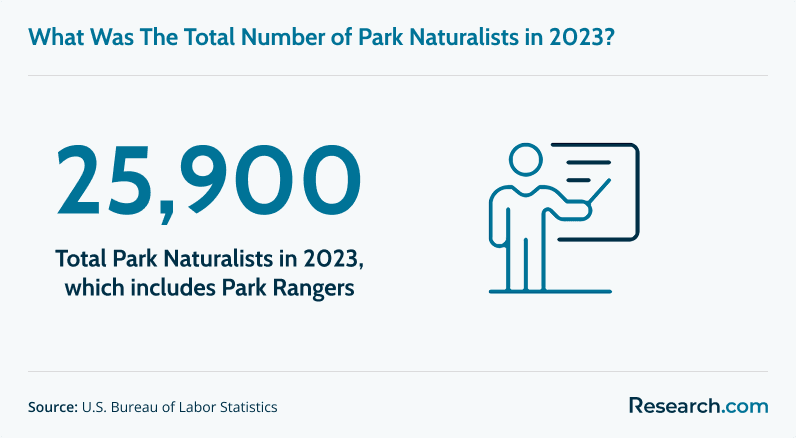
According to Bureau of Labor Statistics data, there were 25,900 park naturalists in 2023, a category that includes park rangers. The job is broad because parks need staff who can protect resources, guide visitors, respond to problems, and keep operations running.
Typical park ranger responsibilities include the following:
- Protecting natural and cultural resources: Rangers monitor wildlife, vegetation, water quality, trails, historic structures, archaeological areas, and geological features. They may help control invasive species, document environmental damage, and reduce harm caused by visitor activity.
- Helping visitors: Rangers answer questions, explain rules, recommend routes, assist lost or injured guests, staff visitor centers, and help people understand how to enjoy the park responsibly.
- Teaching and interpretation: Interpretive rangers lead walks, talks, school programs, campfire presentations, museum-style exhibits, and educational events about ecology, history, geology, wildlife, or local culture.
- Enforcing rules and laws: Rangers with enforcement authority may issue citations, respond to disturbances, investigate poaching or vandalism, manage traffic and crowd issues, and coordinate with other public safety agencies.
- Emergency response: Many rangers are trained in first aid, CPR, wilderness response, search and rescue, evacuation procedures, and incident management.
- Supporting operations: In smaller parks, rangers may inspect campgrounds, maintain signage, assist with trail work, check permits, collect data, and support special events.
Students preparing for ranger work often choose conservation, recreation, public safety, or natural science programs. For those comparing low-cost degree options, Research.com’s guide to affordable online bachelor degree programs can help identify programs that may fit an early career plan.
What are the different types of park rangers?
The title “park ranger” can refer to several different jobs. The National Park Service career materials show that ranger work can branch into education, protection, resource management, operations, and related specialties. Choosing the right track matters because the degree, certifications, physical requirements, and hiring process can differ significantly.
| Ranger type | Main focus | Best fit for |
| Law enforcement ranger | Public safety, patrol, citations, investigations, emergency response, and protection of park resources | Applicants interested in policing, security, search and rescue, and regulation enforcement |
| Interpretive ranger | Visitor education, guided programs, exhibits, tours, and public outreach | People who enjoy teaching, storytelling, history, ecology, and working directly with the public |
| Wildlife or natural resource ranger | Habitat protection, wildlife monitoring, ecological data, restoration, and invasive species management | Students drawn to biology, environmental science, forestry, conservation, or field research |
| Wildland firefighting ranger | Wildfire prevention, response, fireline support, and resource protection during fire events | Physically fit candidates comfortable with difficult field conditions and emergency operations |
| Recreation ranger | Campgrounds, trails, permits, visitor use, outdoor recreation programs, and facility oversight | Applicants interested in recreation management, visitor services, and outdoor operations |
| Historical or cultural resource ranger | Historic preservation, archaeology, cultural interpretation, and artifact stewardship | Students with backgrounds in history, anthropology, archaeology, museum studies, or education |
How ranger roles vary by agency
- National Park Rangers: These rangers work for the National Park Service in national parks, monuments, historic sites, recreation areas, and other federal units.
- State Park Rangers: These professionals serve state park systems and may cover enforcement, interpretation, maintenance coordination, recreation, and natural resource duties.
- Forest Service Rangers: These rangers work with the U.S. Forest Service, often in large public lands where recreation, timber, wildfire, conservation, and multiple-use management intersect.
Agency size also affects the job. NRPA data show that agencies serving smaller jurisdictions under 20,000 residents have a median of 11.3 full-time equivalent staff, which means individual employees often cover several functions. In a small park system, one ranger might handle visitor questions in the morning, inspect trails in the afternoon, and respond to a rule violation later in the day.
By contrast, agencies serving populations of 50,000 to 99,999 residents have a median of 75.8 FTEs. Larger agencies are more likely to separate work into specialized positions such as law enforcement, interpretation, recreation programming, or wildlife management.
What are the steps to becoming a park ranger for 2027?
The best route depends on the type of ranger position you want. A future law enforcement ranger should plan differently from someone pursuing interpretation, wildlife conservation, or park administration. Still, most candidates follow a similar sequence: education, experience, fitness and background screening, specialized training, applications, and agency onboarding.
Step 1: Choose the ranger track you want
Before selecting a degree or certification, decide what kind of work you want to do. If you want to carry enforcement authority, look closely at criminal justice, emergency response, and academy requirements. If your goal is environmental protection, focus on ecology, forestry, wildlife biology, or natural resource management. If you want to educate visitors, consider history, education, interpretation, anthropology, recreation, or environmental communication.
Step 2: Earn a relevant degree
Many ranger jobs prefer or require a bachelor’s degree. Common majors include environmental science, forestry, wildlife management, criminal justice, history, natural resource management, parks and recreation, education, and public administration. Applicants aiming for public safety roles may compare criminal justice programs, including options discussed in Research.com’s guide to the easiest criminal justice degree.
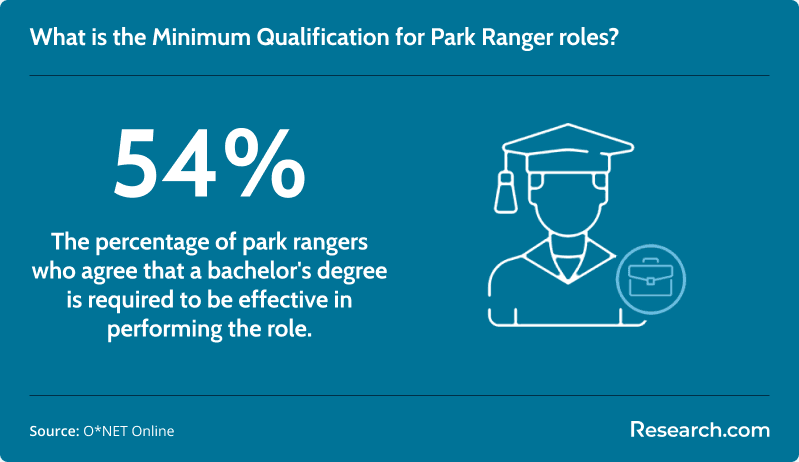
Some state and local employers may accept an associate degree plus relevant field experience. Among park rangers, 54% agree that a bachelor’s degree is required to be effective in the role, while 26% believe an associate’s degree is enough.
Step 3: Build field experience before applying for permanent jobs
Experience is one of the strongest ways to become competitive. Many rangers start as seasonal employees, volunteers, park aides, tour guides, conservation crew members, visitor center assistants, campground staff, trail workers, or interns. Students who are considering conservation-related careers can also review Research.com’s guide to entry level jobs with environmental science degree to understand adjacent roles that build useful experience.
Look for experience that proves you can work outdoors, communicate with the public, follow safety procedures, and handle responsibility without close supervision. For law enforcement tracks, experience in security, military service, emergency medical response, dispatch, or policing can be relevant.
Step 4: Meet physical, medical, and background requirements
Many ranger jobs require good physical conditioning. Depending on the agency and duties, candidates may need to hike long distances, carry equipment, work in heat or cold, operate vehicles or boats, and assist during emergencies. Law enforcement positions may also require medical screening, vision and hearing checks, psychological evaluation, drug testing, and a background investigation.
Step 5: Complete required specialized training
Training varies by position. Law enforcement park rangers commonly need police academy or federal law enforcement training. Federal law enforcement rangers may be required to complete training such as the Land Management Police Training Program at the Federal Law Enforcement Training Centers. Other rangers may need wilderness first aid, CPR, search and rescue, wildfire, GIS, interpretation, or agency-specific training.
Step 6: Apply through the correct hiring channel
Federal jobs are commonly posted through federal hiring systems for agencies such as the National Park Service, U.S. Forest Service, and Bureau of Land Management. State ranger jobs are typically listed through state government career portals. County and municipal jobs may appear on local government websites. Applications often require a tailored resume, transcripts, proof of certifications, questionnaires, interviews, written exams, or background checks.
Step 7: Complete probationary and on-the-job training
New rangers usually receive site-specific training after hire. This may include park policies, local hazards, radio procedures, incident reporting, visitor communication, cultural resource rules, natural resource protocols, and emergency operations. Some agencies use probationary periods before granting permanent status.
| Stage | What to do | Why it matters |
| Explore ranger tracks | Compare law enforcement, interpretation, wildlife, recreation, and cultural resource roles | Each path may require different education, fitness, training, and certifications |
| Earn education | Complete a relevant bachelor’s or, where accepted, an associate degree plus experience | Education helps meet minimum qualifications and supports long-term advancement |
| Gain experience | Work seasonal, volunteer, internship, outdoor recreation, conservation, or visitor service roles | Permanent ranger jobs often favor applicants with practical park or field experience |
| Meet screening requirements | Prepare for physical tests, medical checks, background reviews, and agency standards | Ranger work can involve safety-sensitive duties and difficult outdoor conditions |
| Complete training | Pursue law enforcement, first aid, CPR, wildfire, interpretation, GIS, or rescue training as needed | Specialized credentials can make an application stronger and may be required for specific roles |
| Apply strategically | Target positions by agency, location, job series, seasonality, and qualification level | Federal, state, and local hiring processes differ, and competition can be strong |
What education do park ranger jobs require?
Education requirements depend on the agency and specialization. Federal, state, and local employers may classify ranger jobs differently, so always read the specific job announcement rather than assuming one degree fits every role.
Bachelor’s degree options
A four-year degree is common for many permanent ranger positions. Relevant majors include:
- Environmental science: Useful for conservation, ecology, resource protection, and environmental monitoring.
- Forestry: Helpful for land management, forest health, wildfire awareness, and habitat stewardship.
- Wildlife biology: Strong preparation for roles involving species monitoring, habitat management, and endangered species protection.
- Natural resource management: Directly aligned with sustainable land use, conservation planning, and public lands management.
- Criminal justice: Relevant for law enforcement rangers who need a foundation in policing, legal systems, public safety, and investigations. Students comparing affordability can review Research.com’s guide to criminal justice degree cost.
- History, archaeology, or anthropology: Valuable for interpretive and cultural resource roles at historic parks, monuments, battlefields, and heritage sites.
- Education or recreation management: Useful for public programming, visitor services, outdoor recreation operations, and community engagement.
Associate degree plus experience
Some employers, especially at the local or state level, may consider an associate degree when paired with strong field experience. Relevant backgrounds can include park maintenance, outdoor recreation, conservation volunteering, military service, emergency response, or law enforcement support work. Students exploring two-year options can compare easy associate degrees that may support entry into park, recreation, or conservation work.
Graduate education
A master’s degree is usually not required for entry-level ranger work, but it can help with leadership, research, policy, and specialized conservation positions. Common graduate paths include environmental science, ecology, public administration, wildlife biology, natural resource management, and nonprofit or public-sector leadership.
Law enforcement education and academy requirements
Rangers with law enforcement authority need more than a general conservation background. Depending on the employer, they may need state peace officer certification, police academy training, or federal training. These programs commonly cover arrest procedures, constitutional law, evidence, defensive tactics, firearms, emergency response, report writing, search and rescue, and public safety operations.
Education choices by career goal
| Career goal | Helpful education | Additional preparation to consider |
| Law enforcement ranger | Criminal justice, public safety, natural resource management, or related field | Police academy, federal law enforcement training, first aid, CPR, search and rescue |
| Interpretive ranger | History, education, environmental studies, anthropology, communication, or recreation | Interpretive guide training, public speaking, museum or visitor center experience |
| Wildlife or resource ranger | Environmental science, ecology, forestry, wildlife biology, or natural resource management | GIS, field data collection, habitat restoration, species monitoring |
| Park manager or superintendent | Public administration, recreation management, environmental policy, or leadership-focused graduate study | Budgeting, personnel management, grant writing, public-sector administration |
| Cultural resource specialist | History, archaeology, anthropology, museum studies, or preservation | Historic preservation, artifact documentation, community consultation |
What certifications do park rangers need?
Not every ranger job requires the same certifications. A seasonal interpretive ranger may need a very different credential set from a commissioned law enforcement ranger or a wildfire response ranger. The safest approach is to review several job postings from your target agency and build credentials that match those requirements.
- First Aid and CPR: These are widely useful because rangers often assist visitors during injuries, heat-related illness, falls, boating incidents, and other emergencies.
- Wilderness First Aid, Wilderness First Responder, or EMT: These credentials are especially valuable for remote parks, backcountry patrols, search and rescue, and high-risk recreation settings.
- Law enforcement certification: Required for ranger positions with police powers. Requirements may include state academy completion, peace officer certification, or Federal Law Enforcement Training Center training for federal roles.
- National Park Service training: NPS positions may include agency-specific instruction in resource protection, visitor services, park operations, interpretation, and safety procedures.
- Wildland firefighting credentials: Rangers involved in wildfire prevention or response may need training recognized by the National Wildfire Coordinating Group or related agency standards.
- National Recreation and Park Association credentials: NRPA certifications such as Certified Park and Recreation Professional and Certified Playground Safety Inspector can support broader park and recreation careers.
- Interpretation credentials: Training through interpretation-focused organizations can help rangers who lead programs, write visitor materials, or manage educational exhibits.
Some park work overlaps with environmental health, public policy, and community wellness. Professionals interested in that intersection may compare conservation-related roles with public health careers and review Research.com’s guide to the average salary with MPH degree.
How long does park ranger training take?
Park ranger training can take a few days, several weeks, or several months depending on the role. The longest pathway is usually law enforcement, while seasonal visitor service or interpretation jobs may involve shorter agency onboarding plus position-specific training.
Training length depends on three main factors:
- Ranger type: Law enforcement, firefighting, search and rescue, and backcountry roles generally require more extensive preparation than basic visitor service positions.
- Agency requirements: Federal, state, and local agencies set their own hiring, onboarding, and credential standards.
- Assigned duties: A ranger who presents history programs may need interpretive and subject-area training, while a ranger assigned to emergency response may need medical, rescue, and incident command preparation. For interpretive roles at historical sites, even applicants without history majors may need additional site-specific learning.
Among full-time park and recreation staff, 46% are dedicated to operations and maintenance, 30% to programming, and 17% to administrative work. This helps explain why training varies: parks employ people with different technical, public-facing, and management responsibilities.
| Training area | Typical content | Time frame stated in source material |
| Law enforcement training | Legal authority, patrol, investigations, firearms, defensive tactics, report writing, emergency procedures | Park Ranger Law Enforcement Academies can take 17 weeks |
| General ranger onboarding | Park rules, visitor services, resource protection, radios, local hazards, safety procedures | Can range from a few weeks to several months |
| Ongoing training | Policy updates, technology, safety refreshers, seasonal procedures, skill maintenance | Typically takes one to two days |
How do park ranger roles compare with criminal justice careers?
Park ranger jobs can overlap with criminal justice, but they are not identical to conventional police, corrections, or investigative roles. Law enforcement rangers may patrol, investigate incidents, issue citations, and protect public safety, yet they also work in outdoor settings where conservation, visitor education, wildlife protection, and environmental rules are central to the mission.
Traditional criminal justice jobs often focus primarily on public order, investigation, court procedures, incarceration, or security. Park rangers may handle those issues while also teaching visitors, protecting habitats, responding to natural hazards, and working with land managers, scientists, and recreation staff. For students deciding between the two, the key question is whether they want a public safety job in a natural resource environment or a more traditional justice system role.
How much do park rangers make?
Park ranger pay varies by employer, location, seniority, permanent or seasonal status, and whether the position includes law enforcement, emergency response, supervision, or specialized technical duties. Federal, state, and local agencies may use different pay systems, so salary comparisons should always be tied to a specific job posting.
According to the U.S. Bureau of Labor Statistics and salary data sources such as Glassdoor, ZipRecruiter, and Payscale, park ranger salaries in the United States are commonly reported in the following ranges:
| Park ranger type | Salary range |
| Federal Park Rangers | $40,000 – $75,000 |
| State Park Rangers | $35,000 – $65,000 |
| Local and Seasonal Park Rangers | $25,000 – $45,000 |
Specialization can affect pay in park service work just as it does in other federal careers. For example, Research.com’s overview of CIA agent salary by role shows how responsibility, clearance, and specialization can shape compensation. In park ranger careers, enforcement authority, supervisory duties, technical expertise, remote assignments, and agency pay scales can all influence earnings.
What career paths are available for park rangers?
A park ranger career can move in several directions. Some rangers stay close to visitors and education. Others move into law enforcement, wildlife management, fire, cultural preservation, or administration. Advancement often depends on experience, performance, training, willingness to relocate, and the ability to compete for permanent or supervisory openings.
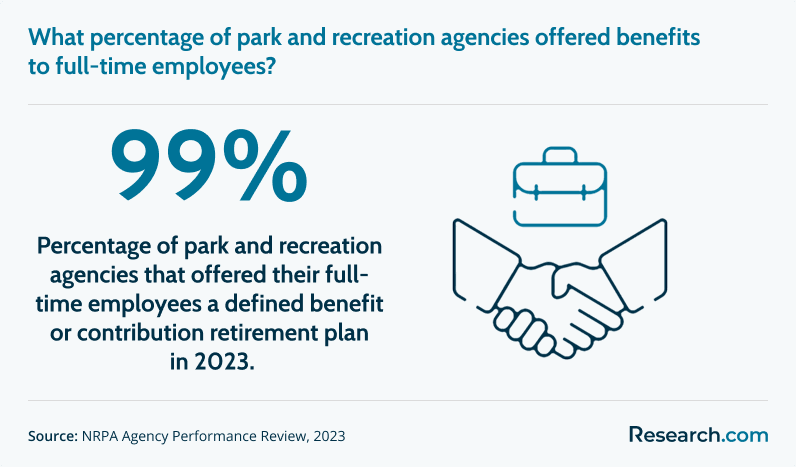
The progression can resemble other public service fields, where professionals start in entry-level roles and later specialize or supervise. Research.com’s discussion of the ER nurse career path offers a useful comparison: both careers can involve high-responsibility public service work, specialty training, and advancement into leadership or specialized practice. Park and recreation jobs may also offer strong benefits; in 2024, 99% of park and recreation agencies offer their fulltime employees a defined benefit or contribution retirement plan.
Law enforcement park ranger
Best for: Candidates who want public safety responsibilities in parks, forests, monuments, recreation areas, and protected lands.
- Enforce park rules and applicable federal or state laws
- Respond to emergencies, disturbances, accidents, and visitor safety issues
- Investigate poaching, vandalism, illegal dumping, theft, and resource damage
- Support search and rescue, first aid, evacuations, and wildfire-related operations
- Educate visitors about safety, regulations, and resource protection
Interpretive park ranger
Best for: People who enjoy teaching, public speaking, storytelling, visitor engagement, and making science or history understandable.
- Lead guided walks, talks, tours, and school programs
- Develop exhibits, brochures, signs, and visitor center materials
- Explain park ecology, history, geology, wildlife, and cultural context
- Answer visitor questions and help shape positive public experiences
Natural resource and wildlife ranger
Best for: Candidates focused on conservation, environmental monitoring, habitat restoration, and wildlife protection.
- Monitor wildlife and habitat conditions
- Support ecological research and field data collection
- Manage invasive species, restoration work, and resource protection projects
- Help develop conservation strategies and management plans
Cultural and historical preservation specialist
Best for: Applicants interested in archaeology, historic preservation, museum-style interpretation, anthropology, or cultural resource management.
- Protect historic structures, artifacts, landscapes, and archaeological sites
- Assist with documentation, research, and preservation projects
- Create exhibits and interpretive programs for cultural resources
- Work with local, indigenous, and stakeholder communities when appropriate
Park management and administration
Best for: Rangers who want to lead teams, manage budgets, coordinate projects, and shape long-term park operations.
- Supervise staff and coordinate daily park operations
- Manage budgets, schedules, facilities, and visitor services
- Plan improvements, funding requests, partnerships, and policy implementation
- Coordinate with government agencies, nonprofit partners, volunteers, and community groups
What is the job outlook for park rangers?
The outlook for park rangers depends on the agency, location, specialization, and funding environment. The U.S. Bureau of Labor Statistics reports that employment for conservation scientists and foresters, a category that includes some park ranger roles, is projected to grow 4% from 2022 to 2032, about as fast as the average for all occupations.
Federal park ranger jobs, especially permanent National Park Service positions, can be highly competitive because funding, turnover, and location availability limit openings. State and local park systems may provide additional opportunities, particularly for applicants willing to begin seasonally, relocate, or accept broader park operations duties.
Several forces may shape hiring needs: visitor volume, public budgets, wildfire risk, conservation priorities, climate-related resource stress, and demand for outdoor recreation. Candidates can improve their odds by combining a relevant degree with practical park experience, emergency credentials, strong communication skills, and specialized training. This is similar to other fields where credentials and role-specific skills matter; Research.com’s guide to patient care coordinator requirements shows how targeted qualifications can influence access to career opportunities.
What park rangers say about the work
-
: "
Working as a park ranger lets me connect conservation and education every day. I protect wildlife, guide visitors, and help people understand why these places matter. Esther
"
-
: "
The job is unpredictable in the best and hardest ways. One day may involve a rescue call, another may involve wildlife issues or visitor safety problems. You need judgment, stamina, and flexibility. Jason
"
-
: "
As a law enforcement ranger, I focus on keeping people safe while protecting resources that cannot easily be replaced. The work has purpose because every decision affects both visitors and the park. Mark
"
What skills do successful park rangers need?
Strong park rangers combine outdoor competence, public service judgment, and technical knowledge. The exact skill mix depends on the role, but the most competitive candidates can communicate clearly, stay calm during emergencies, follow procedures, work independently, and make decisions that protect both people and resources.
| Skill area | Why it matters | How to build it |
| Communication | Rangers explain rules, calm visitors, teach programs, write reports, and coordinate with other agencies | Public speaking, interpretation training, visitor service work, writing practice |
| Physical stamina | Many roles require hiking, lifting, patrols, rescues, and outdoor work in difficult conditions | Consistent conditioning, hiking, fieldwork, emergency response training |
| Emergency judgment | Rangers may respond before other help arrives | First aid, CPR, wilderness response, search and rescue, scenario-based training |
| Environmental knowledge | Resource protection requires understanding ecosystems, wildlife, and human impacts | Environmental science, forestry, wildlife biology, conservation experience |
| Observation and documentation | Accurate notes support investigations, monitoring, maintenance, and incident reports | Field data collection, GIS, report writing, law enforcement or research training |
| Conflict management | Visitor interactions can involve rule violations, frustration, intoxication, crowding, or safety risks | De-escalation training, customer service, security experience, criminal justice coursework |
Some rangers also build skills that connect to related public safety and investigative fields. For example, applicants interested in enforcement and investigation may compare ranger work with criminology job opportunities.
Can legal training help park rangers?
Legal knowledge can be valuable for rangers who enforce regulations, document violations, protect resources, or coordinate with prosecutors and courts. Even rangers who are not sworn law enforcement officers benefit from understanding evidence preservation, incident documentation, administrative rules, liability concerns, public lands regulations, and visitor rights.
Legal training is most useful when it directly supports the ranger’s duties. A law enforcement ranger may need formal academy training, while a resource or administrative ranger may benefit from targeted coursework in environmental regulation, public administration, or legal documentation. Professionals seeking a shorter legal education option can compare programs such as the cheapest ABA paralegal online programs, especially if they work with reports, compliance, or regulatory processes.
How can further education support park ranger advancement?
Further education can help rangers move into specialized, supervisory, investigative, or administrative roles. The best option depends on the career goal. A ranger pursuing management may benefit from public administration or recreation management. A ranger moving toward enforcement may consider criminal justice. A conservation-focused ranger may choose ecology, wildlife biology, forestry, or environmental policy.
For rangers who want stronger public safety and enforcement preparation, online criminal justice programs may provide coursework in law enforcement systems, crisis response, investigations, ethics, and interagency coordination. The key is to avoid enrolling only because a program sounds relevant; compare curriculum, accreditation, transfer credit, cost, and whether the degree matches actual job announcements.
Can forensic science training be useful for park rangers?
Forensic science training can help rangers who document poaching, vandalism, illegal dumping, artifact theft, wildlife trafficking, environmental damage, or suspicious incidents in remote areas. The value is practical: better scene documentation, evidence handling, photography, chain-of-custody awareness, and coordination with investigators.
Not every ranger needs a forensic science degree. However, rangers in protection, law enforcement, wildlife crime, or cultural resource roles may benefit from targeted courses or certificates. Those considering deeper study can review forensic science colleges online to compare flexible options that may complement ranger experience.
How do park rangers respond to climate-related park challenges?
Park rangers are increasingly involved in monitoring and responding to climate-related pressures on protected areas, including severe wildfires, changing weather patterns, habitat disruption, invasive species, and visitor safety risks. Rangers may collect field observations, report resource changes, support wildfire readiness, educate visitors about changing conditions, and help implement management responses developed by scientists and agency leaders.
Technology also matters. GIS tools, field data systems, remote monitoring, mapping, and improved incident documentation can help agencies detect problems earlier and respond more effectively. In some cases, forensic-style documentation is useful when environmental damage may involve violations or legal action. Rangers interested in science-based investigative skills can explore programs at a top college for forensic science as one possible way to strengthen technical knowledge.
Can park ranger experience transfer to other public safety careers?
Park ranger experience can transfer well to related public safety, emergency management, conservation enforcement, law enforcement support, security, environmental compliance, and government operations roles. Rangers often develop practical skills in emergency response, public communication, incident documentation, conflict management, interagency coordination, and field decision-making.
The transfer is strongest when the ranger’s credentials match the target job. A sworn law enforcement ranger may be better positioned for enforcement roles than a seasonal interpretive ranger, while a resource ranger may fit environmental compliance or conservation positions. Professionals considering federal enforcement careers should compare requirements carefully; Research.com’s guide to qualifications to be ICE agent can help show how federal public safety roles may differ in eligibility, training, and responsibilities.
How to decide if becoming a park ranger is worth it
A park ranger career is worth considering if you want mission-driven public service, outdoor work, conservation impact, and varied responsibilities. It may not be the best fit if you need predictable office hours, rapid salary growth, limited public contact, or a job that avoids physical demands and relocation.
| Choose this path if... | Consider another path if... |
| You want to protect natural, cultural, or recreational resources | You mainly want a high-paying outdoor job with minimal public service duties |
| You are comfortable working weekends, holidays, seasons, or remote assignments | You need a fixed weekday schedule from the start |
| You can handle physical work, changing weather, and unpredictable situations | You prefer controlled indoor environments and low physical risk |
| You enjoy explaining rules, educating visitors, and resolving conflict | You dislike frequent public interaction or enforcement-related conversations |
| You are willing to begin with seasonal or entry-level roles to gain experience | You need immediate permanent employment in one specific location |
Common mistakes to avoid when preparing for park ranger jobs
- Choosing a degree without checking job postings: Review actual federal, state, and local ranger announcements before committing to a major.
- Assuming every ranger job is law enforcement: Many roles focus on education, resource management, recreation, operations, or cultural preservation instead.
- Ignoring seasonal work: Seasonal jobs and volunteer roles often provide the practical experience needed for permanent positions.
- Focusing only on tuition: Consider transfer credits, internship access, field experience, location, accreditation, and whether the curriculum matches your target role.
- Underestimating physical demands: Fitness, outdoor tolerance, and emergency readiness can matter as much as classroom preparation.
- Assuming online programs automatically meet career requirements: Online degrees can be useful, but some roles require fieldwork, academy training, certifications, or agency-specific credentials.
- Using rankings as the only decision tool: Rankings may help start research, but job alignment, cost, accreditation, experience opportunities, and employer requirements matter more.
- Expecting salary outcomes to be guaranteed: Pay depends on agency, location, duties, seniority, employment status, and funding.
Questions to ask before choosing a park ranger education path
- Which ranger role do I want: law enforcement, interpretation, wildlife, recreation, cultural resources, fire, or administration?
- Do job postings from my target agencies require a bachelor’s degree, associate degree, academy training, or specific certifications?
- Will the program help me gain field experience through internships, seasonal placements, labs, or local agency partnerships?
- Is the school accredited, and will credits transfer if I continue to a bachelor’s or graduate program?
- Does the curriculum include relevant topics such as ecology, public lands policy, GIS, criminal justice, interpretation, emergency response, or recreation management?
- Can I afford the total cost, including tuition, fees, travel, equipment, field courses, and lost work time?
- Am I willing to relocate or begin with seasonal work to become competitive?
- What certifications can I earn before graduation, such as CPR, first aid, wilderness response, interpretation, or wildfire training?
References
- Bureau of Labor Statistics. (2024). Forest and conservation workers. U.S. Department of Labor.
- Bureau of Labor Statistics. (2024). Forest and conservation workers. U.S. Department of Labor.
- National Association of Park Rangers. (2024). Park Ranger Law Enforcement Academy.
- National Recreation and Park Association. (2023). 2023 agency performance review.
- National Recreation and Park Association. (2024). 2024 salary survey abridged.
- National Recreation and Park Association. (2024). Summer seasonal hiring report.
- O*NET OnLine. (n.d.). Conservation scientists.
Key Insights
- Park ranger is not one job. It includes law enforcement, interpretation, wildlife management, recreation, cultural preservation, fire support, and administration, so your education should match the role you want.
- A bachelor’s degree is common for many ranger positions, and 54% of park rangers agree it is required to perform the role effectively; however, 26% believe an associate degree can be enough, especially when paired with strong experience.
- Hands-on experience is critical. Seasonal work, volunteering, internships, conservation crews, visitor services, and outdoor recreation jobs can make applicants more competitive for permanent roles.
- Law enforcement ranger positions require the most specialized preparation, often including academy or federal training. Park Ranger Law Enforcement Academies can take 17 weeks.
- Salary varies widely by agency and responsibility. Reported ranges include $40,000 – $75,000 for federal park rangers, $35,000 – $65,000 for state park rangers, and $25,000 – $45,000 for local and seasonal park rangers.
- The job outlook is steady but competitive. BLS projects 4% growth from 2022 to 2032 for conservation scientists and foresters, a category that includes some ranger roles.
- Before enrolling in a program, compare real job postings, accreditation, cost, transfer policies, field experience options, and required certifications. The best path is the one that fits your target agency and ranger specialty.
Other Things You Should Know About Becoming a Park Ranger
To become a park ranger in 2027, a bachelor’s degree in fields such as natural resource management, forestry, or environmental science is typically required. Some roles might accept relevant work experience in lieu of a degree, but advanced positions often demand specialized education and training.
Yes. Most park ranger positions require a background check, and many law-enforcement ranger roles also require a drug test, physical fitness screening, and a valid driver’s license. Federal jobs are commonly filled through USAJOBS, where applicants must meet citizenship and suitability requirements before appointment.


