
2027 Fastest Online Master’s in Legal Studies Program

Co-Founder and Chief Data Scientist
Choosing one of the fastest online master’s in legal studies programs is not just a question of speed. The real decision is whether an accelerated legal studies degree can give you useful legal, regulatory, compliance, and contract knowledge without requiring a Juris Doctor or a multiyear law school commitment.
This guide is for working professionals, paralegals, compliance staff, HR leaders, contract specialists, healthcare administrators, policy professionals, and others who regularly deal with laws or regulations but do not plan to become licensed attorneys. You will learn how fast online MLS programs work, what they cost, which schools offer accelerated options, what careers they may support, and how to compare programs without being misled by marketing claims.
The key is to balance pace, accreditation, curriculum quality, cost, career alignment, and employer recognition. A short program can be valuable, but only if it gives you the legal fluency and practical training your role actually requires.
Quick answer: What is the fastest online master’s in legal studies?
The fastest online master’s in legal studies programs can often be completed in about one year by full-time students. Arizona State University, the University of Arizona, American University, and Purdue University Global are among the accelerated options in this guide with one-year or approximately one-year completion timelines. Some programs take 16 months, five semesters, or 12-24 months depending on course load, transfer policies, start dates, and whether the student studies full time or part time.
A Master of Legal Studies is designed for non-lawyers. It can strengthen careers in compliance, contracts, HR, healthcare regulation, legal operations, policy, and risk management, but it does not generally qualify graduates to practice law or sit for a state bar exam.
What are the main benefits of the fastest online Master’s in Legal Studies programs?
- Faster career movement: An accelerated MLS can help professionals prepare for higher-responsibility roles such as Compliance Manager, Contract Administrator, Paralegal Supervisor, and Regulatory Affairs Specialist.
- Stronger legal and regulatory judgment: The degree can help non-lawyers read legal documents, understand compliance obligations, communicate with attorneys, and reduce organizational risk.
- Flexible graduate study: Online delivery allows students to continue working while completing legal studies coursework on a compressed timeline.
- Targeted professional value: Specializations in areas such as compliance, intellectual property, healthcare law, cybersecurity, HR law, and contract law can make the degree more relevant to a specific career path.
What should you expect from the fastest online Master’s in Legal Studies programs?
Accelerated online MLS programs usually compress graduate-level legal training into shorter terms, heavier course loads, or year-round enrollment. The format can be efficient, but it is not automatically easier. Students should expect substantial reading, legal analysis, writing assignments, case-based projects, and applied work tied to business, government, or regulatory problems.
| Program feature | What it means for students | Why it matters |
| Core legal foundation | Courses often cover U.S. law, legal research, legal writing, contracts, administrative law, and legal ethics. | You build the vocabulary and reasoning skills needed to work with lawyers and interpret legal requirements. |
| Accelerated schedule | Many programs use short sessions, frequent start dates, or full-time course sequencing. | You may finish faster, but weekly workload can be intense. |
| Applied assignments | Students may complete case studies, contract reviews, regulatory analyses, policy memos, or legal writing projects. | Practical work matters more to employers than theory alone. |
| Online interaction | Programs may combine recorded lectures, live sessions, discussion boards, and virtual faculty access. | The quality of online engagement affects networking, feedback, and learning depth. |
| Professional networking | Faculty may include practicing attorneys, judges, compliance professionals, or legal scholars. | Career value improves when the program connects coursework to real legal and regulatory workplaces. |
Where can you work with an online Master’s in Legal Studies?
An MLS is most useful in roles where legal knowledge supports business, compliance, policy, contracts, risk, or operations. It is not a substitute for a JD, but it can help professionals become stronger decision-makers in law-adjacent environments.
- Corporate legal departments: Graduates may support contract management, governance, compliance programs, litigation preparation, and communication with in-house counsel.
- Law firms: Experienced legal support professionals may move into senior paralegal, case management, legal operations, or supervisory roles.
- Government agencies: Legal studies training can support work in administrative law, regulatory enforcement, policy analysis, procurement, and public-sector compliance.
- Healthcare and pharmaceutical organizations: Professionals may work on HIPAA, patient privacy, healthcare compliance, regulated contracts, and risk management.
- Consulting firms: MLS graduates may help clients interpret regulations, strengthen internal processes, and manage compliance exposure.
- Leadership pathways: The degree can support long-term movement toward roles such as Chief Compliance Officer, Director of Contracts, or Director of Regulatory Affairs, depending on experience and industry.
How much can you make with a qualification from the fastest online Master’s in Legal Studies programs?
Pay depends heavily on job title, industry, location, experience, and whether the role involves management. An MLS may improve qualifications, but it does not guarantee a specific salary.
- Analyst-level roles: Positions such as Compliance Analyst or Policy Analyst typically fall between $70,000 and $95,000 annually.
- Management-level roles: Jobs such as Contract Manager or Senior Paralegal may range from $85,000 to over $120,000 for experienced professionals.
- Senior and specialized roles: Executive or highly specialized positions such as Chief Compliance Officer or Director of Regulatory Affairs can exceed $160,000.
- Fastest Online Master’s in Legal Studies Program for 2027
- What is the average cost of an online Master’s degree in Legal Studies?
- What are the financial aid options for an online Master’s degree in Legal Studies?
- What are the prerequisites for enrolling in an online Master’s degree in Legal Studies?
- What courses are typically in an online Master’s degree in Legal Studies?
- What types of specializations are available for Master’s degree in Legal Studies graduates?
- How do you choose the best online Master’s degree in Legal Studies?
- What career paths are available for graduates of online Master’s degree in Legal Studies programs?
- What are the potential limitations of online Master’s in Legal Studies programs?
- How much can I earn with an online Master’s degree in Legal Studies?
- How do online Master’s in Legal Studies programs support practical training and professional connections?
- What is the job market for graduates with an online Master’s degree in Legal Studies?
- What are some current and future trends in legal studies?
- How can an online Master’s in Legal Studies open pathways to national security roles?
Fastest Online Master’s in Legal Studies Program for 2027
The programs below are built for students who want graduate-level legal knowledge without the time and cost of a JD. They are especially relevant for professionals comparing accelerated public policy, compliance, regulatory, and legal-adjacent credentials, including readers also reviewing the fastest online public policy degree programs.
How do we rank schools?
Because an accelerated master’s degree is still a major academic and financial decision, Research.com reviews programs using transparent data sources and a consistent methodology. Sources include:
- the IPEDS database
- Peterson's database, including the Distance Learning Licensed Data Set
- the College Scorecard database
- the National Center for Education Statistics
Below are the featured accelerated online legal studies programs.
1. Arizona State University
Arizona State University offers an online Master of Legal Studies through the Sandra Day O’Connor College of Law for students who want a working foundation in U.S. law without becoming attorneys. The program can be completed in as little as one year and uses 10 courses delivered in 7.5-week terms.
Students begin with U.S. Law and Legal Analysis, then choose eight electives to shape the degree around career interests. Options include areas such as construction law and criminal law, although specializations are optional and do not appear on the diploma. The program can support careers such as contract manager or patent officer, but it does not qualify graduates to practice law. Faculty bring over 300 years of combined experience to the classroom.
- Program Length: Under 12 months (full-time)
- Tracks/Concentrations: 11 (e.g., conflict resolution, sports law, sustainability, HR law, corporate regulation)
- Tuition Cost: $14,286/year (in-state), $28,480/year (out-of-state)
- Required Credits to Graduate: 30
- Accreditation: Higher Learning Commission (HLC)
2. University of Arizona
The University of Arizona online Master of Legal Studies is intended for professionals whose work involves statutes, rules, contracts, or regulatory systems but who do not need a law license. Students can complete a general legal studies path or select a concentration such as Criminal Law and Policy or International Trade and Business Law.
The program develops legal analysis, negotiation, and critical-thinking skills. It also qualifies graduates to seek Arizona’s Legal Paraprofessional (LP) license. Alumni have worked in compliance, contracts administration, and advocacy roles, including Compliance Analyst, Contract Administrator, and Tribal Advocate. Applicants submit materials directly to the University of Arizona’s College of Law.
- Program Length: 1 year (full-time)
- Tracks/Concentrations: Criminal law and policy, human rights, intellectual property, international trade/business law
- Tuition Cost: $750.00/credit
- Required Credits to Graduate: 30
- Accreditation: WASC Senior College and University Commission (WSCUC)
3. American University
American University offers a 30-credit online Master’s in Legal Studies that can be completed in about one year, with both full-time and part-time study available. The program is designed for professionals who handle law-related responsibilities and need to work more effectively with attorneys.
Students study the U.S. legal system and build practical skills in legal interpretation, contract drafting, and internal policy development. Specialization options include Business, Healthcare, and Technology. Graduates may pursue advancement as Business Executives, Compliance Officers, or Health Care Compliance Managers.
American University supports military-affiliated students through accepted benefits such as the Post-9/11 GI Bill® and the Yellow Ribbon Program. Recently active-duty U.S. military members may receive an application fee waiver, and support is available through the Office of Veterans Services.
- Program Length: Approximately 1 year
- Tracks/Concentrations: General MLS, Business, Healthcare, Technology, Cybersecurity, U.S Legislation
- Tuition Cost: $ $7,158 per 3 credits per term
- Required Credits to Graduate: 30
- Accreditation: Middle States Commission on Higher Education (MSCHE)
4. Regent University
Regent University provides an online Master of Arts in Law – Legal Studies from a Christian perspective. Beginning in Spring 2026, the degree will be renamed the Master of Legal Studies (MLS). The program is built for working adults who want an alternative to a traditional Juris Doctor and can be finished in five semesters.
Students study legal theory and practice, including issues in contract and property law, American statutes, and case law research. The degree may support careers in nonprofit advocacy, national security, and executive leadership. It does not make graduates eligible to sit for the bar exam in any state.
- Program Length: 1.5 years (five semesters)
- Tracks/Concentrations: Various, customizable (e.g., criminal justice, healthcare law, immigration law)
- Tuition Cost: $715/credit
- Required Credits to Graduate: 32
- Accreditation: Southern Association of Colleges and Schools Commission on Colleges (SACSCOC)
5. William & Mary Law School
William & Mary offers an online Master of Legal Studies for non-lawyer professionals who need to understand the U.S. legal system and operate in regulated environments. Courses run in 8-week sessions, and students typically take two per semester, making the program suitable for part-time study while working full time.
Concentrations include compliance and risk management, law and emerging technologies, finance, and health law. Coursework covers legal concepts, regulatory interpretation, negotiation, mediation, arbitration, corporate governance, business entities, contracts, mergers, and intellectual property. Students also complete coursework involving interviews with industry professionals.
- Program Length: 16 months (part-time, four semesters)
- Tracks/Concentrations: Compliance and Risk Management, Law and Emerging Technologies, Finance, Health Law
- Tuition Cost: $41,216 (total)
- Required Credits to Graduate: 32
- Accreditation: Southern Association of Colleges and Schools Commission on Colleges (SACSCOC)
6. Purdue University Global
Purdue University Global offers an online Master of Science in Legal Studies made up of 9 total courses. Students complete 7 core courses and 2 electives while studying subjects such as legal research, dispute resolution, and legal doctrine.
The program is taught by experienced faculty in law. Purdue Global reports that 99% of all Purdue Global faculty members hold advanced degrees, and 54% hold a doctorate. Graduates may apply coursework toward an Executive Juris Doctor (EJD) at Purdue Global Law School, which could allow them to graduate from the EJD program a year sooner. The degree does not allow graduates to practice law or sit for any state’s bar examination.
- Program Length: 1 year
- Tracks/Concentrations: None specified
- Tuition Cost: $420/credit
- Required Credits to Graduate: 45 quarterly credits
- Accreditation: Higher Learning Commission (HLC)
7. Drexel University
Drexel University offers an online Master of Legal Studies for non-lawyers who need practical knowledge of legal compliance and risk management. The program uses a 10-week quarter system and allows students to study part time or full time.
Students may complete a general MLS or choose from eight specialized concentrations, including Cybersecurity & Information Privacy Compliance and Health Care Compliance. Courses are taught by faculty from the Kline School of Law, and Drexel also draws on interdisciplinary expertise from other schools within the university.
The Kline Graduate Programs Virtual Career Office provides online students with job postings, a virtual career classroom, and one-on-one coaching.
- Program Length: Typically 16 to 24 months (part-time or full-time options)
- Tracks/Concentrations: Criminal Law, Cybersecurity & Information Privacy Compliance, Entrepreneurship & Law, Financial Regulatory Compliance, Health Care Compliance, Higher Education Compliance, Human Resources Compliance, NCAA Compliance & Sports Law, Pharmaceutical & Medical Device Regulatory Compliance
- Tuition Cost: $975/ quarter credit
- Required Credits to Graduate: 65 credits
- Accreditation: Compliance Certification Board (CCB), Middle States Commission on Higher Education (MSCHE)
8. Texas A&M University Online
Texas A&M University offers a Master of Legal Studies for non-lawyer professionals who want focused legal education for complex fields. Students can begin during three annual start dates and choose full-time or part-time enrollment, with completion possible within one to two years.
The program is primarily asynchronous and online, although optional in-person classes are available for networking. Students can choose from 12 concentration areas, including Cybersecurity Law & Policy and Health Law, Policy & Management. Most tracks are fully online, while hybrid options include the Intellectual Property, Technology, & Innovation track in Fort Worth and the Business Law & Compliance track in San Antonio.
Courses are taught by nationally recognized faculty, many of whom also teach in the JD program. Graduates may benefit from the Aggie Network, which includes over 500,000 alumni in more than 160 countries.
- Program Length: 1-2 years
- Tracks/Concentrations: 12 tracks, including dispute resolution, contract law, regulatory law, energy law
- Tuition Cost: $35,008 (total)
- Required Credits to Graduate: Not explicitly stated
- Accreditation: Southern Association of Colleges and Schools Commission on Colleges (SACSCOC); Council of the Section of Legal Education and Admissions to the Bar of the American Bar Association
9. Pepperdine University
Pepperdine University offers an online Master of Legal Studies for non-lawyers who want legal knowledge for professional advancement. GRE, GMAT, or LSAT scores are not required for admission.
The curriculum includes 8 units of required courses and 8 units of general electives. Students attend two in-person weekend residencies on the Malibu campus and can focus on dispute resolution, human resources, or litigation. Dispute resolution coursework is taught through the Straus Institute. Graduates join an alumni network that spans over 60 countries.
- Program Length: 12-24 months
- Tracks/Concentrations: Dispute Resolution, Human Resources, Litigation
- Tuition Cost: $2,680/unit
- Required Credits to Graduate: 26
- Accreditation: WASC Senior College and University Commission (WSCUC)
10. University of Miami
The University of Miami offers a 100% online Master of Legal Studies for non-lawyers. The fully asynchronous format allows students to access course content 24/7, and the program is designed for flexible, part-time study. GRE, GMAT, or LSAT scores are not required, and there are no application fees.
Students complete 12 credits of required core courses, including Foundations in U.S. Law and Regulation and Corporate Compliance & Enterprise Risk Management. After the core, they may select one of 6 specialized tracks, such as healthcare law or technology law. Faculty hold JDs or other professional credentials and teach current legal and regulatory topics.
Students become part of the University of Miami School of Law community and gain access to a global alumni network of over 23,000 people. Online students also receive career support from virtual professional law advisors.
- Program Length: Not explicitly stated; flexible (typically 1–2 years)
- Tracks/Concentrations: Healthcare Law and Regulation, Law and Technology: Cybersecurity, Information Privacy, and AI, Employment Law and Human Resources Risk Management, Real Estate and Construction Law and Regulation, Financial Services and FinTech Regulation, General Legal Studies
- Tuition Cost: $1,348/credit
- Required Credits to Graduate: 30
- Accreditation: Southern Association of Colleges and Schools Commission on Colleges (SACSCOC); American Bar Association (ABA)
If affordability matters more than speed, compare these options with Research.com’s list of online legal studies degree programs.
Fastest online MLS programs compared
| School | Fastest stated timeline | Credits | Best fit |
| Arizona State University | Under 12 months (full-time) | 30 | Students seeking many elective options and a highly accelerated schedule |
| University of Arizona | 1 year (full-time) | 30 | Professionals interested in legal paraprofessional eligibility in Arizona |
| American University | Approximately 1 year | 30 | Working professionals in business, healthcare, technology, cybersecurity, or legislation |
| Regent University | 1.5 years (five semesters) | 32 | Students wanting legal studies from a Christian perspective |
| William & Mary Law School | 16 months (part-time, four semesters) | 32 | Working adults seeking part-time study in compliance, technology, finance, or health law |
| Purdue University Global | 1 year | 45 quarterly credits | Students considering a future Executive Juris Doctor pathway |
| Drexel University | Typically 16 to 24 months | 65 credits | Students wanting numerous compliance-focused concentrations |
| Texas A&M University Online | 1-2 years | Not explicitly stated | Students wanting a broad selection of legal and regulatory tracks |
| Pepperdine University | 12-24 months | 26 | Students interested in dispute resolution, HR, litigation, and limited residencies |
| University of Miami | Not explicitly stated; flexible (typically 1–2 years) | 30 | Part-time students seeking an asynchronous program with six tracks |
What is the average cost of an online Master’s degree in Legal Studies?
The cost of an online Master’s in Legal Studies depends on the school, credit requirements, public or private status, residency rules, and fees. Students comparing accelerated graduate options, including the fastest online bachelor's degree in sustainability programs, should focus on total program price rather than tuition per credit alone.
- Credits required: Many MLS programs require between 24 to 36 credit hours, though some use quarter-credit systems or different structures.
- Public universities: In-state students at public institutions may see total tuition of approximately $20,000 to $40,000 for the full program.
- Out-of-state public tuition: Nonresident students may pay considerably more unless the online program uses a flat-rate tuition model.
- Private universities: Private programs often charge higher tuition and may cost from $35,000 to over $70,000 in total.
- Extra costs: Students should ask about technology fees, application fees, textbooks, digital materials, graduation fees, residency travel, and exam-related expenses.
| Cost factor | Question to ask before enrolling |
| Tuition structure | Is tuition charged per credit, per term, per unit, or as a total program cost? |
| Residency pricing | Do online out-of-state students pay more than in-state students? |
| Required credits | How many credits are required, and are they semester credits, quarter credits, or units? |
| Fees | Are technology, library, graduation, or course-material fees mandatory? |
| Residencies | Are any campus visits required, and who pays travel and lodging costs? |
| Employer reimbursement | Will the school’s calendar and billing schedule work with your employer’s tuition benefit rules? |
What are the financial aid options for an online Master’s degree in Legal Studies?
Financial aid can make an accelerated MLS more manageable, but students should understand the difference between grants, scholarships, employer benefits, military benefits, and loans. This is similar to evaluating financing for other high-demand online graduate pathways, such as the fastest online master's in artificial intelligence programs.
- Federal student aid: Eligible students can complete the Free Application for Federal Student Aid (FAFSA) to be considered for federal loans, including Direct Unsubsidized Loans.
- Military and veteran benefits: Some universities offer military tuition discounts or accept benefits such as the Post-9/11 GI Bill and the Yellow Ribbon Program.
- Employer tuition assistance: Professionals already working in compliance, HR, government, contracts, legal support, healthcare, or regulated industries should ask whether their employer reimburses graduate coursework.
- Scholarships and grants: Schools and professional associations may offer awards for legal studies students, especially those pursuing compliance, public service, or industry-specific legal training.
- State aid: Some states provide grants or other aid for residents pursuing graduate education, so students should review state-level options before borrowing.
Legal profession context: diversity, employment, and compensation
The sixth annual ABA Profile of the Legal Profession report shows meaningful demographic changes in legal education and employment. Women now make up 56.2% of all law students. Since 2020, women have also been the majority among the 44,000 general lawyers in the executive branch of the federal government. Progress is slower in private practice, where women represented 28% of law firm partners in 2023.
Diversity has also increased across the profession. Lawyers of color have nearly doubled as a share of the profession over the past decade and now represent 23% of all lawyers. In U.S. firms, 4.6% of lawyers identify as LGBTQ, with higher representation among associates at 6.8% and summer associates at 11.7%. As of August 1, 2024, however, the 1,457 sitting Article III federal judges remained 67% male and 74% white.
The same report noted that the average lawyer's salary rose by 19.2% from 2021 to 2023, reaching $176,470. It also reported that a record 53% of new law school graduates now enter law firms, and one out of every four lawyers in the U.S. is located in either New York or California. Selected findings are visualized below.
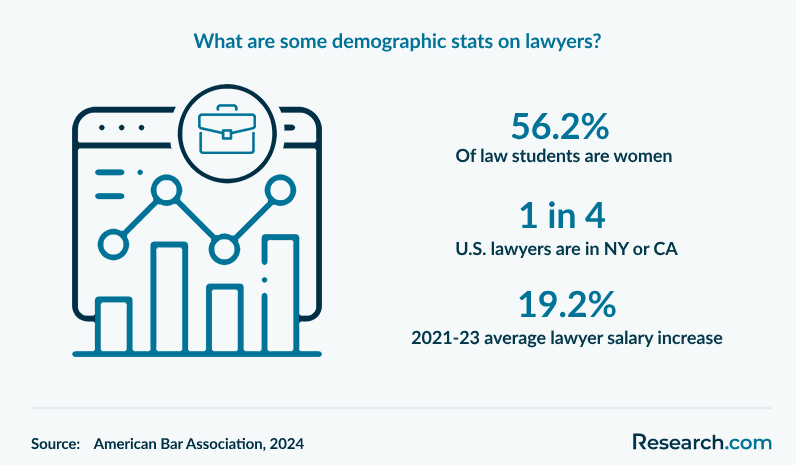
These figures are useful context for legal studies students because they show a profession that is changing demographically and economically. However, MLS students should remember that lawyer salary data does not directly represent MLS outcomes, because the MLS is generally for non-lawyers.
What are the prerequisites for enrolling in an online Master’s degree in Legal Studies?
Admissions requirements vary by university, but most online MLS programs are designed for applicants who already hold a bachelor’s degree and want graduate-level legal training for professional use. Requirements are comparable to many applied graduate programs, including the fastest educational policy degree online options.
- Bachelor's degree: Applicants typically need a bachelor’s degree from a regionally accredited institution.
- Minimum GPA: Many schools look for an undergraduate GPA around 3.0 on a 4.0 scale, though some may consider conditional admission.
- Professional background: Relevant work experience may strengthen an application, especially for compliance, HR, contracts, healthcare, government, or legal support professionals.
- Application documents: Common materials include official transcripts, a resume, recommendation letters, and a statement of purpose explaining career goals.
- Test scores: Many online MLS programs do not require GRE or GMAT scores, but policies differ by school.
A Master of Legal Studies does not automatically allow graduates to represent clients, practice law, or handle legal matters reserved for licensed attorneys. Students who want a shorter legal support credential may want to compare MLS programs with an online paralegal certification.
What courses are typically in an online Master’s degree in Legal Studies?
Online MLS curricula are designed to help non-lawyers understand how law affects organizations, contracts, regulations, risk, and decision-making. Students comparing program depth and affordability can also review Research.com’s guide to Masters in Legal Studies online programs.
| Common course | What students learn | Career relevance |
| Introduction to the American Legal System | Structure of U.S. law, courts, agencies, sources of law, and legal authority. | Useful for any role requiring communication with counsel or interpretation of legal requirements. |
| Legal Research and Writing | How to locate, read, cite, and explain legal sources in professional formats. | Important for compliance memos, policy work, contract support, and legal operations. |
| Contract Law | Formation, interpretation, enforcement, and management of agreements. | Directly relevant to procurement, vendor management, construction, technology, and corporate operations. |
| Administrative Law and Regulatory Compliance | Agency authority, rulemaking, enforcement, and compliance systems. | Essential for regulated industries such as healthcare, finance, energy, education, and pharmaceuticals. |
| Legal Ethics and Professional Responsibility | Ethical boundaries for professionals working in law-related roles. | Helps non-lawyers understand confidentiality, conflicts, unauthorized practice risks, and professional conduct. |
| Civil Procedure | Rules and processes used in civil litigation. | Useful for legal support, risk management, claims, and dispute-related roles. |
| Property Law | Legal concepts involving ownership, real property, personal property, and transactions. | Relevant to real estate, construction, finance, and business operations. |
What types of specializations are available for Master’s degree in Legal Studies graduates?
Specializations are one of the most important selection factors because they connect the MLS to a specific job market. If you are still deciding whether the credential fits your goals, compare potential outcomes in Research.com’s guide on what you can do with a Master of Legal Studies.
- Corporate and Business Law: Best for students working with contracts, governance, business transactions, compliance, and corporate risk.
- Healthcare Law: Useful for professionals who need to understand HIPAA, patient privacy, insurance rules, healthcare compliance, and regulated care delivery.
- Human Resources Law: Relevant for HR staff and managers dealing with employment law, labor relations, workplace safety, discrimination, and employee policies.
- Intellectual Property: Appropriate for professionals in technology, research, creative industries, patents, trademarks, copyrights, and trade secrets.
- Dispute Resolution: Strong fit for students interested in negotiation, mediation, arbitration, employee relations, or conflict management.
- Environmental Law: Useful for professionals working with environmental compliance, sustainability regulation, permitting, and corporate responsibility.
How do you choose the best online Master’s degree in Legal Studies?
The best program is not always the fastest one. Students should choose an MLS based on accreditation, curriculum match, total cost, workload, support, and whether the program’s outcomes align with their target role. This decision process is similar to comparing other accelerated online credentials, such as the fastest online exercise science degree options, where speed must be weighed against quality and relevance.
| Selection factor | What to verify | Warning sign |
| Accreditation | Confirm that the institution is accredited by a recognized accrediting body. | The school highlights speed but provides little clear accreditation information. |
| Career fit | Match courses and concentrations to your target role, such as compliance, contracts, HR, or healthcare regulation. | The curriculum is broad but does not include your needed legal area. |
| Faculty background | Look for instructors with legal, regulatory, judicial, compliance, or industry experience. | Faculty information is vague or difficult to find. |
| Online format | Check whether courses are asynchronous, synchronous, hybrid, or residency-based. | Required live sessions or residencies conflict with your work schedule. |
| Student support | Ask about advising, writing support, technical help, career services, and access to faculty. | Online students receive fewer services than campus students. |
| Licensure or practice limits | Confirm whether the degree affects any state-specific credential, such as Arizona’s Legal Paraprofessional path. | The program implies that an MLS is equivalent to a law degree. |
Many students choose online legal studies because they need flexibility while remaining employed. That can be a strong reason, but it should be paired with a realistic view of workload and outcomes. For more on evaluating value, review Research.com’s discussion of the reasons for getting a Master of Legal Studies.
Questions to ask admissions advisors before applying
- What is the fastest realistic completion timeline for a working adult?
- How many hours per week should students expect to study in accelerated terms?
- Are courses asynchronous, live, or a mix of both?
- Does the program have required residencies, exams, or capstones?
- Are legal writing and research courses required?
- What career services are available to online MLS students?
- Do graduates work in compliance, HR, contracts, legal operations, or government roles?
- Does the program meet any state-specific credential requirements?
- What is the full cost after tuition, fees, books, and travel?
What career paths are available for graduates of online Master’s degree in Legal Studies programs?
An MLS can support a wide range of law-related careers, especially for professionals who already have industry experience. Students comparing graduate pathways may also review options such as the fastest online health education degree when deciding how to combine subject-matter expertise with regulatory knowledge.
- Compliance Manager: Oversees policies, audits, training, and procedures to help organizations follow applicable laws and regulations.
- Contract Administrator/Manager: Drafts, reviews, negotiates, tracks, and manages agreements in fields such as construction, technology, healthcare, and government contracting.
- Senior Paralegal or Paralegal Manager: Handles advanced legal support tasks, manages cases, and supervises paralegal teams. Students considering this route may first explore how to become a criminal paralegal.
- Regulatory Affairs Specialist: Interprets rules and coordinates with agencies in industries such as pharmaceuticals, finance, energy, and healthcare.
- Policy Advisor: Works with agencies, nonprofits, think tanks, or elected officials to analyze, draft, and improve public policies.
- Mediator or Arbitrator: Helps parties resolve disputes outside traditional court processes, especially after training in dispute resolution.
- Human Resources Manager: Applies employment law knowledge to employee relations, benefits, investigations, workplace policies, and labor compliance.
Based on 2025 BLS data, the legal services industry is the largest employer of legal occupations, with 753,360 jobs. Government is also a major employer: local governments provide 98,390 jobs, state governments provide 94,610 jobs, and a combined federal, state, and local government designation accounts for another 76,210. Insurance carriers represent another employment area with 32,910 positions.
The graph below shows that legal services dominate employment for legal professionals, while government at multiple levels forms the next major employment category.
What are the potential limitations of online Master’s in Legal Studies programs?
Accelerated online MLS programs can be efficient, but they are not right for everyone. Students must be honest about workload, career goals, and the degree’s legal limits. Online programs may require more self-direction than campus programs, and networking can vary depending on live class access, cohort design, faculty engagement, and career services. Students considering legal support roles may also compare MLS programs with affordable ABA-approved online paralegal programs.
| Potential limitation | Why it matters | Better way to evaluate it |
| It is not a JD | An MLS generally does not qualify graduates to practice law or sit for a bar exam. | Ask the school to explain exactly what the degree does and does not authorize. |
| Accelerated workload | Short terms can mean heavy weekly reading, writing, and discussion requirements. | Request sample syllabi and estimated weekly study hours. |
| Variable networking | Some online programs have rich live interaction, while others are mostly self-paced. | Ask about cohort structure, alumni access, live events, and career office support. |
| Career outcomes differ | Salary and advancement depend on prior experience, industry, geography, and role. | Look for role-specific graduate outcomes rather than broad legal profession data. |
| Licensure complexity | Only certain programs may connect to state-specific credentials. | Verify requirements with the relevant state authority before enrolling. |
How much can I earn with an online Master’s degree in Legal Studies?
MLS-related salaries vary widely. Support roles may start near $50K, while specialized, senior, and executive compliance roles can move into six figures. Similar to the fastest online bachelor's in mathematics degree programs, the strongest returns usually come when the credential is paired with technical expertise, management responsibility, and relevant work experience.
- Support and entry-level roles: A legal assistant earns an average salary of $50,730, while a litigation paralegal earns $54,167. A human resources (HR) generalist earns an average of $59,106.
- Specialist and analyst roles: A contract specialist earns an average of $69,290, and a compliance analyst earns $70,274.
- Management roles: A human resources (HR) manager earns an average of $80,365, a compliance manager earns $84,695, and a contracts manager averages $99,993.
- Senior and director roles: A senior paralegal earns an average of $104,061, and a senior human resources (HR) business partner earns $109,492. A compliance director averages $114,129, while a vice president, compliance officer earns an average of $140,980.
Based on 2025 PayScale.com data shown below, compensation generally rises as roles become more specialized and managerial. Legal assistants average $50,730, while paralegal roles fall between approximately $54,000 and $61,000. Analyst and specialist roles move into the $70,000s, including $70,274 for compliance analysts and $74,913 for contract analysts.
Management responsibility is associated with higher pay. Compliance managers and human resources managers earn salaries in the mid-$80,000s, while senior and director-level jobs often exceed six figures. A senior paralegal averages $104,061, a compliance director averages $114,129, and the highest-paying listed role, vice president and compliance officer, averages $140,980.
The pattern is clear: salary growth is tied less to the MLS alone and more to role level, specialization, leadership responsibility, and industry demand.
How do online Master’s programs in Legal Studies enhance practical training and industry connections?
Strong online MLS programs move beyond lectures by using applied projects, simulations, legal writing assignments, capstones, case analyses, and sometimes internships or industry-facing coursework. These experiences help students practice interpreting regulations, reviewing contracts, preparing compliance materials, and communicating legal risks to non-lawyer audiences.
Industry connections also matter. Programs with active faculty, alumni networks, career coaching, employer panels, and partnerships with legal, regulatory, government, or business organizations can help students translate coursework into career opportunities. Professionals interested in security, intelligence, or regulatory risk may also compare legal studies with online intelligence masters degrees.
What is the job market for graduates with an online Master’s degree in Legal Studies?
The job market for MLS graduates is strongest in organizations that need non-lawyer professionals who understand regulations, legal processes, risk, contracts, and compliance. This can include corporate departments, healthcare organizations, government agencies, financial institutions, law firms, nonprofits, and consulting firms. Students coming from regulated fields, including those reviewing the fastest online health sciences degree, may find legal studies useful for moving into compliance or administrative leadership.
- Corporate sector: Companies use legal studies graduates to manage contracts, monitor compliance, support governance, and reduce legal risk.
- Government sector: The U.S. Bureau of Labor Statistics projects that employment for paralegals and legal assistants will grow by 4% between 2022 and 2032, faster than the average for all occupations.
- High-demand specializations: Healthcare law, compliance, and cybersecurity are especially relevant as organizations face complex rules and data risks. The U.S. Bureau of Labor Statistics reports that compliance officer employment is projected to grow 6% from 2022 to 2032, also faster than the average.
- Nonprofit sector: Advocacy groups, social service organizations, and international aid organizations may need professionals who can interpret rules, manage funding requirements, and support policy work.
According to 2025 data from the U.S. Bureau of Labor Statistics shown below, lawyers had median pay of $151,160 per year in 2024 1, equal to $72.67 per hour. The typical entry-level education for lawyers is a doctoral or professional degree. The occupation included 859,000 jobs in 2023 and is projected to grow by 5% between 2023 and 2033, which is considered as fast as the average for all occupations. That projection represents an employment change of 44,200 jobs over the decade.
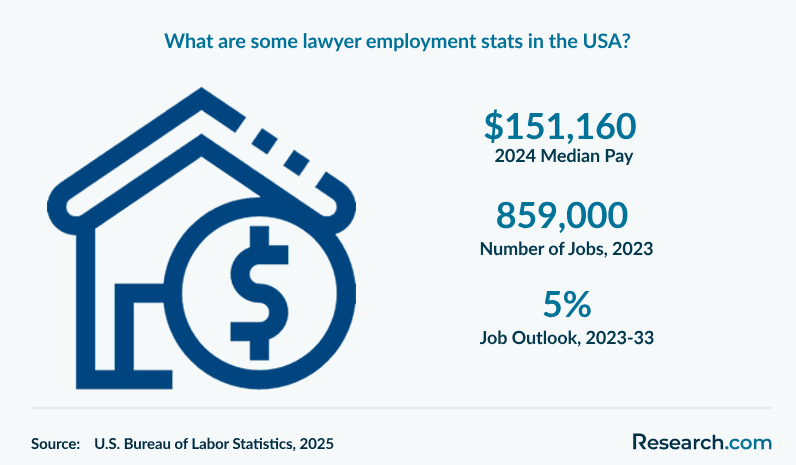
These lawyer statistics show that the legal profession is large and well compensated, but MLS students should interpret them carefully. Most MLS graduates are not becoming lawyers; they are using legal knowledge in compliance, contracts, HR, policy, operations, and regulated industries.
What are some current and future trends in legal studies?
Legal studies is changing as organizations adopt new technologies, face expanding regulatory obligations, and seek faster ways to manage risk. MLS students should pay attention to trends that affect non-lawyer legal work.
- Artificial intelligence and legal technology: AI is reshaping legal research, contract review, document analysis, and workflow automation. Professionals need to understand both the efficiency gains and the legal and ethical risks.
- Alternative dispute resolution (ADR): Mediation, arbitration, and negotiation remain important because they can help resolve disputes outside court. Many MLS programs include ADR coursework or concentrations.
- Data privacy and cybersecurity law: Privacy rules, breach response, information governance, and cybersecurity compliance are increasingly important for businesses, healthcare organizations, schools, and government contractors.
- Legal operations: Corporate legal teams increasingly rely on professionals who can manage budgets, vendors, technology, reporting, and projects. The field known as Legal Ops combines legal knowledge with operational and business skills.
- Environmental, Social, and Governance (ESG): Organizations need professionals who can understand environmental rules, social responsibility expectations, reporting frameworks, and governance practices.
Market analysis using 2023 as the base year valued the legal technology market at USD 26.89 billion. The market is projected to reach USD 60.04 billion by 2032, reflecting a compound annual growth rate (CAGR) of 9.4% during the forecast period from 2024 to 2032. Growth is tied to AI adoption, cloud solutions, contract management automation, and demand for more efficient legal services.
The visual below shows the projected expansion of the legal technology sector. For MLS students, the takeaway is practical: legal fluency combined with technology awareness may become increasingly valuable.

How can an online Master’s in Legal Studies open pathways to national security roles?
Legal studies can be useful in national security, defense, homeland security, intelligence, and government risk roles because these fields depend on statutory authority, compliance, ethics, privacy, procurement rules, and interagency policy. MLS coursework can help professionals analyze legal frameworks, evaluate risk, and support decision-making in sensitive environments.
An MLS alone does not guarantee a federal security or intelligence role. Candidates may still need citizenship requirements, clearances, relevant experience, specialized technical skills, language capabilities, or agency-specific qualifications. Professionals interested in federal intelligence careers can review Research.com’s guide on how to join CIA to understand eligibility and selection considerations.
Common mistakes to avoid when choosing a fast online MLS
| Mistake | Why it can hurt you | Better approach |
| Choosing only by speed | The fastest program may not have the concentration, support, or workload structure you need. | Compare completion time with curriculum, faculty, career services, and cost. |
| Ignoring accreditation | Employer recognition and financial aid eligibility can be affected. | Verify institutional accreditation before applying. |
| Assuming the MLS lets you practice law | Most MLS degrees are for non-lawyers and do not lead to bar eligibility. | Ask the program to provide a written explanation of professional limitations. |
| Looking only at tuition per credit | Fees, credit requirements, travel, and materials can change the real cost. | Calculate total program cost. |
| Overlooking workload | Accelerated terms can be difficult for students working full time. | Ask for weekly time estimates and sample course schedules. |
| Relying only on rankings | A highly ranked program may not match your industry or goals. | Prioritize fit, specialization, outcomes, and flexibility. |
Here’s what graduates say about their online Master’s Degree in Legal Studies programs
-
: "
I completed my online master's in legal studies in just 15 months while working full-time in human resources. The coursework in employment law and dispute resolution gave me the tools to move into a director-level role right after graduation. Jess
"
-
: "
The program's focus on healthcare compliance and regulatory law helped me transition from a clinical role into a hospital administration position. I loved how the instructors brought real-world case studies into every lecture—it made the learning feel urgent and relevant. Michaela
"
-
: "
What stood out most was the balance of speed and depth—I finished in under 18 months, but never felt rushed. The capstone project let me apply everything I learned to a real-world corporate compliance scenario, and that experience gave me the confidence to lead. Drina
"
Key Insights
- The fastest MLS programs can take about one year: Several online programs in this guide advertise one-year or approximately one-year completion options, but full-time enrollment and heavy workloads are usually required.
- An MLS is for non-lawyers: The degree can strengthen legal, regulatory, compliance, and contract knowledge, but it generally does not qualify graduates to practice law or sit for a bar exam.
- Program fit matters more than speed alone: The best choice depends on your target role, preferred specialization, accreditation, total cost, online format, and available career support.
- Legal studies can support multiple career paths: Graduates may work in compliance, contracts, HR, legal operations, government, healthcare regulation, policy, dispute resolution, and risk management.
- Salary growth is tied to role level and experience: Pay ranges from support roles such as legal assistant at $50,730 to senior compliance leadership roles such as vice president, compliance officer at $140,980.
- Legal technology is changing the field: The legal technology market was valued at USD 26.89 billion in 2023 and is projected to reach USD 60.04 billion by 2032, with a 9.4% CAGR from 2024 to 2032.
- Legal profession data needs context: Lawyers had median pay of $151,160 in 2024, but lawyer outcomes should not be treated as MLS outcomes because lawyers usually need a doctoral or professional degree.
- Diversity is improving but uneven: Women now make up 56.2% of all law students, while women represented 28% of law firm partners in 2023. Lawyers of color make up 23% of all lawyers, and 4.6% of lawyers in U.S. firms identify as LGBTQ.
- The strongest applicants compare total ROI: Before enrolling, calculate full cost, expected workload, employer tuition support, career relevance, and whether the degree will help you qualify for your next realistic job.
References:
- American Bar Association. (2024, November 18). Wages. In Profile of the Legal Profession 2024. American Bar Association.
- Bureau of Labor Statistics. (2025, April 18). Lawyers. In Occupational Outlook Handbook. U.S. Department of Labor.
- Bureau of Labor Statistics. (2023, May). Occupational employment and wages, May 2023: 23‑1011 Lawyers. U.S. Department of Labor.
- Bureau of Labor Statistics. (2023, May). Occupational employment and wages, May 2023: Legal occupations (23‑0000). U.S. Department of Labor.
- PayScale. (2025). Master of Legal Studies (MLS), Law salary – Average salaries by industry, region, and other factors. PayScale.
- SNS Insider. (2025, May 29). Legal technology market to reach USD 60.04 billion by 2032, driven by AI, cloud solutions, and contract management. Yahoo Finance.
Other Things You Should Know About the Fastest Online Master's Degree in Legal Studies Programs
To enroll in the 2027 fastest online Master’s in Legal Studies program, you'll need a reliable internet connection, a device like a laptop or desktop computer, and updated software for accessing online course materials and virtual classrooms. Specific platforms may require additional plugins or applications.
A stable broadband connection with at least 25 Mbps download speed is recommended for live classes, proctored exams, and document uploads in a 2027 online Master’s in Legal Studies program. Many programs also require a webcam, microphone, and current browser for learning platforms and exam software.


