2027 Fastest Online Bachelor's in Mathematics Degree Programs

Co-Founder and Chief Data Scientist
Choosing an accelerated online bachelor’s in mathematics is a practical decision, not just an academic one. You are weighing speed, cost, transfer credits, course difficulty, career outcomes, and whether an online format can support a subject that many students find demanding. A 2025 report from Just Equations identified math anxiety, confusing transfer rules, and scheduling barriers as major obstacles for online STEM students. The report also noted that fewer than 40% of students who begin STEM courses graduate in that field, with math-intensive majors facing similar challenges.
Still, a well-chosen online mathematics degree can be a strong pathway into quantitative careers. Mathematics training supports work in data science, finance, actuarial analysis, operations research, engineering-adjacent roles, and education. This guide explains what fast online bachelor’s in mathematics programs include, how long they take, what they cost, which schools offer accelerated options, and how to decide whether this degree is worth the investment for your goals.
Quick answer: Is a fast online bachelor’s in mathematics worth it?
A fast online bachelor’s in mathematics can be worth it if you are comfortable with intensive math coursework, can manage independent online study, and want to move into data, finance, actuarial, analytics, teaching, or graduate-school pathways. The strongest programs are accredited, transfer-friendly, transparent about costs, and supported by tutoring, faculty access, career services, and clear pathways into internships, licensure, or graduate study.
What are the benefits of getting an online bachelor's in mathematics program?
- Career flexibility: An online bachelor’s in mathematics can prepare graduates for roles in data science, actuarial analysis, operations research, finance, and education.
- Strong earning potential: The median annual wage for math-related occupations was $104,620, based on a 2025 BLS study, nearly double the national median.
- Faster completion options: Many online math programs accept transfer credits, use accelerated terms, or allow year-round enrollment, which can help qualified students finish sooner.
What can I expect from a fast online bachelor's in mathematics program?
A fast online bachelor’s in mathematics is usually built for students who need flexibility but do not want to delay graduation. Courses may be asynchronous, meaning you can watch lectures, complete assignments, and participate in discussions outside fixed class times. However, “asynchronous” does not mean “easy” or “self-paced with no deadlines.” Most programs still require weekly submissions, proctored exams, group work, and regular instructor interaction.
Accelerated options commonly use multiple start dates, condensed 8-week courses, transfer-credit evaluations, or prior-learning policies. Some students with substantial previous college credit may finish in as little as two to three years. Students entering with few or no credits should expect a longer timeline because mathematics courses often build sequentially from calculus and proofs into advanced theory and applications.
The curriculum usually starts with calculus, linear algebra, discrete mathematics, statistics, and proof-writing. Upper-level coursework may include abstract algebra, real analysis, differential equations, probability, mathematical modeling, numerical methods, or computational mathematics. Many programs also require programming, data analysis, or software-based assignments so students can apply mathematical reasoning to real problems.
Depending on the school, you may be able to choose electives or concentrations in data science, actuarial science, cryptography, applied mathematics, or mathematics education. These choices matter. A student aiming for actuarial work should prioritize probability, statistics, economics, and exam preparation, while a future teacher should check licensure alignment before enrolling.
Because math can be difficult to learn in isolation, the best online programs provide structured support. Look for virtual tutoring, faculty office hours, math labs, peer discussion spaces, boot camps, corequisite support, and early alerts when students fall behind. These services are especially important in accelerated formats, where one missed concept can affect several future courses.
Many programs also include capstone projects, applied research, portfolio assignments, career coaching, resume help, internship guidance, or teaching placements. These experiences help students translate abstract coursework into evidence of skill for employers or graduate admissions committees.
Where can I work with a fast online bachelor's in mathematics program?
A fast online bachelor’s in mathematics can support employment across business, technology, government, education, insurance, research, and finance. The degree is strongest when paired with a career direction, such as analytics, actuarial work, teaching, software, or graduate study.
| Career direction | How mathematics applies | What can strengthen your preparation |
| Data analysis | Math graduates interpret datasets, test assumptions, identify patterns, and communicate findings for decision-making. | Excel, SQL, Python, R, statistics, visualization, internships, and applied projects. |
| Actuarial science | Actuaries and actuarial analysts use probability, statistics, and financial mathematics to evaluate risk. | Coursework in statistics, economics, finance, and progress toward actuarial certification exams. |
| Government and research | Graduates may support statistical modeling, population analysis, logistics, economic analysis, or national-security work. | Programming, statistics, modeling, technical writing, and eligibility for agency requirements. |
| Education | Mathematics graduates may teach middle or high school math after meeting state licensure requirements. | A state-approved teacher-preparation track, student teaching, pedagogy courses, and exam preparation. |
| Graduate school | A math degree can lead to graduate study in mathematics, statistics, computer science, business, engineering-adjacent fields, or law. | Proof-heavy courses, research, strong faculty recommendations, and a clear academic plan. |
Many graduates begin as data analysts, actuarial analysts, financial analysts, research assistants, operations analysts, software-adjacent analysts, or teachers. Roles at federal agencies such as the Census Bureau, National Security Agency, or Department of Defense may involve modeling population changes, analyzing economic trends, or improving logistical systems.
How much I can make with a fast online bachelor's in mathematics program?
The median annual wage for math-related occupations was $104,620 in 2024. Entry-level roles such as data analysts, financial analysts, and math teachers typically offer starting salaries between $55,000 and $75,000, depending on the industry, location, employer, and the graduate’s technical skills.
Earnings can increase with experience, specialization, graduate education, or professional credentials. Actuaries earn a median salary of $120,970, while operations research analysts average around $90,600 annually. Graduates who move into data science or machine learning roles, especially with added training or certifications, can earn over $130,000 per year. Employers in finance, technology, and government often value candidates who combine quantitative reasoning with programming ability.
Salary outcomes are not guaranteed by the degree alone. Students improve their marketability by building a portfolio, learning statistical software or programming languages, completing internships, preparing for certification exams when relevant, and choosing electives that match a target career.
- Fastest Online Bachelor's in Mathematics Degree Programs for 2027
- How long does it take to complete a bachelor's in mathematics program?
- How does an online bachelor's in mathematics compare to a traditional program?
- What is the average cost of a bachelor's in mathematics program?
- What are the financial aid options for students enrolling in a bachelor's in mathematics program?
- What are the prerequisites for enrolling in a bachelor's in mathematics program?
- What courses are typically in a bachelor's in mathematics program?
- What types of specializations are available in bachelor's in mathematics programs?
- How to choose the best bachelor's in mathematics program?
- What career paths are available for graduates of bachelor's in mathematics programs?
- How can interdisciplinary studies enhance an online bachelor's in mathematics?
- How do online bachelor's in mathematics programs build professional networks?
- Can a Bachelor's in Mathematics Lead to Leadership Opportunities?
- What advanced degree options complement an online bachelor's in mathematics?
List of Fastest Online Bachelor's in Mathematics Degree Programs for 2027
The programs below are useful starting points for students comparing accelerated or transfer-friendly online mathematics pathways. They differ in degree type, tuition structure, pacing, transfer policies, and career focus. If you are also comparing shorter technology credentials, you may notice that some math programs use pacing strategies similar to the shortest artificial intelligence certification online, but a bachelor’s degree still requires a broader general education and upper-division math sequence.
How do we rank schools?
A bachelor’s degree is a major financial and academic commitment, so ranking information should be used as one input rather than the only decision factor. This list emphasizes fast online bachelor’s in mathematics options using transparent data sources and program information.
Our research methodology draws from established education datasets, including the IPEDS database, Peterson’s database and its Distance Learning Licensed Data Set, the College Scorecard database, and the National Center for Education Statistics.
1. University of Massachusetts–Lowell BS in Mathematics
UMass Lowell offers an online BS in Mathematics designed for students who want flexibility and may already have college credit. The program allows up to 90 transfer credits, which can significantly reduce completion time for eligible learners. Coursework covers calculus, linear algebra, discrete mathematics, proof-writing, statistics, and electives, with an option to pursue an accelerated BS to MS pathway. Some evening on-campus sessions may be included.
- Tuition: $15,698 in-state; up to $33,624 out‑of‑state
- Cost Per Credit: Starts at $275 per credit, depending on residency
- Required Credits to Graduate: 120-126 credits
- Program Length: As little as 12 months with transfer credits, otherwise 2–3 years full-time.
2. Ottawa University BA in Mathematics
Ottawa University provides an accelerated online BA in Mathematics with asynchronous courses and multiple start dates. Students study calculus, algebra, geometry, statistics, proof methods, and computer programming. Concentration options include Actuarial Science and Secondary Education, and the program includes a capstone integrative seminar for students preparing for education, actuarial, or quantitatively focused careers.
- Cost Per Credit: $430
- Required Credits to Graduate: 120 credits
- Program Length: 18–24 months
3. Washington University in St. Louis Bachelor’s in Data Analytics
Washington University in St. Louis offers an online bachelor’s pathway with a strong quantitative foundation through the McKelvey School of Engineering’s online portal. Students complete work in calculus, linear algebra, probability, and statistics while building applied analytics skills. The program uses a flexible, asynchronous format and includes practical experience with Python and R, along with a capstone project focused on real-world analytics.
- Cost Per Credit: $1,325
- Required Credits to Graduate: 120 credits
- Program Length: 2–4 years
4. Mayville State University, BS in Mathematics
Mayville State University offers a 100% online BS in Mathematics with coursework in calculus, algebra, statistics, and numerical methods. Students interested in teaching can pursue K–12 mathematics licensure tracks that include internships. The program blends synchronous and asynchronous learning and emphasizes mathematical communication, structured problem-solving, and faculty interaction.
- Cost Per Credit: $305-$365
- Required Credits to Graduate: 120 credits
- Program Length: 24–36 months
5. Western Governors University, BS in Mathematics – Secondary Education
Western Governors University uses a competency-based model that allows students to move forward once they demonstrate mastery. This can benefit motivated learners who already have strong math knowledge or teaching-related experience. Students complete mathematics coursework in areas such as calculus, statistics, and geometry, along with teacher-preparation content. Student-teaching placements are arranged near students’ homes, and licensure exam preparation, including Praxis preparation, is built into the program.
- Tuition: $4,890/6-month term (flat rate tuition)
- Required Credits to Graduate: 120 credits
- Program Length: 18-24 months
6. Midway University, BS in Mathematics
Midway University offers an online BS in Mathematics that emphasizes applied learning, mentoring, projects, and internship opportunities. Students develop quantitative reasoning and critical-thinking skills for careers in education, data analysis, finance, and actuarial science. The program also encourages peer engagement and participation in math-focused academic community activities.
- Cost Per Credit: $420
- Required Credits to Graduate: 120 credits
- Program Length: 24–36 months
7. University of New Hampshire, BS in Upper-Level Mathematics
UNH offers a mathematics program focused on preparing future educators to teach high school students. The curriculum develops advanced mathematical knowledge through algebra, geometry, and related upper-level concepts while strengthening critical thinking. The credential is designed to meet advanced prerequisites for secondary-school teaching positions in New Hampshire and supports eligibility for New Hampshire Department of Education teacher certification in Mathematics (Upper Level).
- Cost Per Credit: Starts at $330
- Required Credits to Graduate: 120 credits
- Program Length: As little as 18 months
8. National University, BS in Mathematics
National University offers a fully online BS in Mathematics with monthly starts and 4-week accelerated quarters. Students study calculus, linear algebra, differential equations, and statistics. Concentrations in Data Analytics and Single‑Subject Teaching help students prepare for technology-focused work or education careers. The program is structured for adult learners and emphasizes critical thinking across multiple instructional approaches.
- Cost Per Credit: $370
- Required Credits to Graduate: 180 quarter units
- Program Length: 24–36 months
9. Southern New Hampshire University, BS/BA in Mathematics
SNHU offers an online BS/BA in Mathematics with coursework in calculus, statistics, and abstract algebra. Students may pursue pathways such as Actuarial Science and Applied Math. The program uses accelerated six-8‑week terms, provides online tutoring and faculty support, and allows students to transfer up to 90 credits. Students may also earn up to 12 credits through proficiency testing.
- Cost Per Credit: $320
- Required Credits to Graduate: 120 credits
- Program Length: 18–24 months
10. Mercy College, BS in Mathematics
Mercy College offers a BS in Mathematics with fully online, synchronous, and hybrid options. Students receive personalized “PACT” mentoring and study applied mathematics along with computer science fundamentals. The program includes optional teacher certification and a combined BS/MS track in Mathematics and Adolescence Education. Virtual labs and faculty support help students connect mathematical theory to teaching and technical applications.
- Cost Per Credit: $320
- Required Credits to Graduate: 120 credits
- Program Length: 3 years
11. Liberty University, BS in Computational Mathematics
Liberty University offers a BS in Computational Mathematics in an accelerated online format with 8-week course modules and eight annual start dates. Students study applied mathematics, probability, calculus, differential equations, and computational methods. Concentration options include areas such as Actuarial Science and Computer Science. The program accepts up to 75% of prior college credits, which can shorten the path for transfer students.
- Tuition: $11,700
- Cost Per Credit: $390
- Required Credits to Graduate: 120 credits
- Program Length: 3 years
12. Grand Canyon University, BS in Mathematics – Secondary Education
Grand Canyon University offers an online BS focused on preparing secondary mathematics teachers for licensure. The program combines 7-week accelerated courses with practicum requirements and clinical experiences. Students complete coursework in calculus, algebra, statistics, geometry, and pedagogy. Faculty with mathematics education experience and 24/7 online support are available, and students may also participate in faith-based community activities.
- Cost Per Credit: $449
- Required Credits to Graduate: 120 credits
- Program Length: 3-4 years
13. Bellevue University, BS in Mathematics
Bellevue University offers an online BS in Mathematics with five concentration options: Computer Programming, Business Analytics, Secondary Education, Data Analysis, and Predictive Modeling. Students take calculus, discrete mathematics, statistical modeling, and programming-related courses. The program includes flexible scheduling, accelerated sessions, optional campus-based courses, and transfer-friendly policies. Up to 60 credits from an associate's degree can be accepted.
- Cost Per Credit: $449
- Required Credits to Graduate: 127 credits
- Program Length: 3–4 years
14. Indiana University–East, BS in Mathematics
Indiana University–East offers an online BS designed especially for transfer students with 60+ credits. The curriculum includes modern algebra, calculus, abstract mathematics, real analysis, mathematical modeling, and linear algebra, with electives such as Financial Decision Making and Informatics. The program balances pure and applied mathematics for students planning either graduate study or direct entry into quantitative work.
- Cost Per Credit: $378-$448
- Required Credits to Graduate: 120 credits
- Program Length: Under 2 years for transfers
15. University of Illinois Springfield, BA in Mathematical Sciences
University of Illinois Springfield offers a 100% online BA in Mathematical Sciences. Coursework includes business calculus, applied statistics, real analysis, abstract algebra, topology, and history of mathematics. The program serves students interested in both applied and theoretical mathematics and includes an Engaged Citizenship Requirement that connects broader global learning with the degree.
- Tuition Per Credit: Starts at $317
- Required Credits to Graduate: 120 credits
- Program Length: 3–4 years; transfer options may shorten time
How long does it take to complete a bachelor's in mathematics program?
A standard bachelor’s in mathematics generally takes four years, but accelerated online programs can reduce the timeline to 2.5 to 3.5 years for students who transfer credits, take year-round courses, or enroll in condensed terms. This faster structure is similar in concept to the shortest Microsoft Azure dual certification programs online, although a bachelor’s degree requires substantially broader coursework.
Completion time depends on several factors: how many credits you bring in, whether prerequisites are already complete, how many courses you take each term, whether the school offers 8-week terms, and whether upper-level math courses are available every term. Students should be cautious about overloading. Advanced math courses are cumulative and proof-heavy, so taking too many at once can slow progress if it affects performance.
| Student situation | Likely timeline | What to check before enrolling |
| First-time college student | Often close to the traditional four-year pace unless the program offers year-round accelerated terms. | Math placement, calculus readiness, tutoring, and course sequencing. |
| Transfer student with many credits | May finish in 2.5 to 3.5 years, or faster in some highly transfer-friendly programs. | How many credits apply to major requirements, not just electives. |
| Adult learner with prior learning | Timeline varies based on accepted credits, proficiency testing, or competency-based options. | Prior-learning policies, residency credit rules, and assessment fees. |
| Future teacher | May need additional time for practicum, student teaching, and licensure requirements. | State approval, placement availability, and exam preparation. |
Here's the latest on the number of STEM bachelor's degrees conferred by postsecondary institutions.
How does an online bachelor's in mathematics compare to a traditional program?
An accredited online bachelor’s in mathematics should cover the same academic foundation as a campus-based program: calculus, linear algebra, statistics, proof-writing, and upper-level mathematical theory. Many online programs are taught by the same faculty who teach on campus and must meet the same institutional standards. This is comparable to how the shortest master's degree in adult education online can maintain academic expectations while using a different delivery format.
The main differences are schedule, classroom interaction, and student support. Online programs are often more convenient for working adults, caregivers, military-affiliated students, and learners who cannot relocate. Campus programs may offer easier access to in-person clubs, faculty conversations, research groups, and spontaneous peer study sessions.
| Factor | Online bachelor's in mathematics | Traditional campus program |
| Schedule | Often asynchronous or partially asynchronous, with weekly deadlines. | Class meetings usually happen at fixed times. |
| Pace | May offer 8-week terms, multiple starts, or transfer-friendly formats. | Often follows semesters or quarters with a more predictable calendar. |
| Support | Virtual tutoring, online office hours, discussion boards, and academic coaching may be available. | In-person office hours, study groups, math labs, and campus services may be easier to access. |
| Networking | Depends heavily on virtual projects, alumni platforms, and career services. | More informal networking through campus events, clubs, and faculty relationships. |
| Best fit | Self-directed students who need flexibility and can manage deadlines independently. | Students who prefer face-to-face instruction and a structured campus routine. |
Employers are more likely to care about accreditation, skills, projects, internships, and the institution’s reputation than whether the degree was completed online. For teaching careers, however, students must verify that the online program meets the licensure requirements in the state where they plan to work.
What is the average cost of a bachelor's in mathematics program?
Recent reports show that the average annual tuition and fees for a four-year public college were $9,750 for in-state students and $27,450 for out-of-state students in the 2023–2024 academic year. At private nonprofit institutions, the average was higher—about $38,800 per year, bringing the total four-year cost to well over $150,000 without financial aid. As with the shortest online master's of legal studies programs, pricing can vary widely depending on school type, residency rules, and per-credit tuition.
Many online mathematics programs charge between $250 and $450 per credit hour, with total tuition ranging from $30,000 to $60,000 for the full degree. Students may also save by avoiding housing, commuting, relocation, and some campus-based fees. However, the advertised tuition is not the same as the full cost of attendance.
| Cost item | Why it matters | Question to ask |
| Per-credit tuition | This is usually the largest direct cost and may vary by residency. | Is the online rate different for in-state and out-of-state students? |
| Transfer credits | Accepted credits can reduce both time and tuition. | Which credits apply to the major, general education, or electives? |
| Technology and course fees | Online courses may require software, proctoring, or platform fees. | Are fees included in the tuition estimate? |
| Books and software | Math courses may require textbooks, calculators, statistical tools, or coding software. | What materials are required each term? |
| Lost income | Full-time study can affect work hours, while part-time study can extend the timeline. | Can the program be completed while working? |
Flat-rate tuition, military discounts, prior-learning assessments, and generous transfer policies can reduce the net cost. Always compare total program cost after scholarships and grants, not just the sticker price.
What are the financial aid options for students enrolling in a bachelor's in mathematics program?
Students in bachelor’s in mathematics programs may qualify for federal aid, institutional scholarships, state grants, employer tuition assistance, military benefits, and STEM-specific awards. Funding is relevant whether you are pursuing a full degree or comparing shorter credentials such as accelerated CompTIA Security+ certification training online. Mathematics students should ask each school about both general undergraduate aid and scholarships specifically for STEM majors.
- Barry Goldwater Scholarship: This competitive award supports high-achieving undergraduates in mathematics, natural sciences, and engineering. It offers up to $7,500 per academic year and is awarded based on academic merit and research potential.
- NSF S-STEM Scholarship Programs: Supported by the National Science Foundation, S-STEM scholarships are distributed through individual colleges to low-income, academically talented STEM students. Award amounts and eligibility rules vary by institution, and many participating schools support mathematics majors.
- MathWorks Math Modeling (M3) Challenge Scholarships: This competition-based scholarship is available to high school seniors planning to enter math-related fields. Participants solve real-world problems using mathematical modeling, and winners receive scholarships totaling $100,000 in awards each year.
- Alice T. Schafer Mathematics Prize: Offered by the Association for Women in Mathematics, this prize recognizes undergraduate women who show outstanding achievement in mathematics. Although it is not a traditional tuition scholarship, it can add recognition, networking value, and strength to future academic applications.
What are the prerequisites for enrolling in a bachelor's in mathematics program?
Admission requirements vary by institution, but most bachelor’s in mathematics programs expect students to be ready for college-level quantitative work. Some requirements resemble those used in other technical programs, including an accelerated online ethical hacking dual certification, where math readiness, academic preparation, and problem-solving ability matter.
Colleges may also consider standardized test scores, GPA, and other coursework, depending on their admission policies.
- High School Diploma or Equivalent: Applicants generally need a high school diploma or GED. Some schools may also require a college-preparatory curriculum or state-specific graduation requirements.
- Strong Math Background: Algebra II, Pre-Calculus, or Calculus is often expected. More competitive programs may prefer AP Calculus or IB Math credits.
- Minimum GPA Requirement: Many universities set a minimum GPA, often around 2.5 to 3.0. Selective schools may expect higher grades or stronger class rank.
- Standardized Test Scores (if required): Some institutions still ask for SAT or ACT scores. A strong math score can help demonstrate readiness for a mathematics major.
- Letters of Recommendation and Personal Statement: Some programs request teacher recommendations or an essay explaining your interest in mathematics, academic preparation, or career goals.
What courses are typically in a bachelor's in mathematics program?
A bachelor’s in mathematics combines general education, foundational math, proof-based theory, applied quantitative work, and electives. Students who want a more employment-focused path often add programming, statistics, or analytics coursework, similar to the skills emphasized in an accelerated data science online course with certificate.
- Calculus I, II, and III: Students study differential calculus, integral calculus, multivariable calculus, and applications that support later work in modeling, physics, economics, and advanced mathematics.
- Linear Algebra: This course covers matrices, vector spaces, transformations, and systems of equations. It is especially important for computer science, data analysis, engineering-related work, and machine learning foundations.
- Abstract Algebra: Students examine groups, rings, fields, and other algebraic structures. The course develops proof skills and deepens understanding of mathematical systems.
- Real Analysis: This proof-intensive course explores limits, continuity, sequences, and the theoretical basis of calculus. It is important for students considering graduate-level mathematics.
- Differential Equations: Students learn to model change and solve equations involving rates. The subject is widely used in economics, engineering, biology, physics, and applied modeling.
What types of specializations are available in bachelor's in mathematics programs?
Specializations help students connect a broad mathematics degree to a clearer career goal. Some tracks combine math with computing, statistics, business, or education, much like accelerated data analytics training programs combine technical coursework with applied use cases.
| Specialization | Best for | Typical focus |
| Applied Mathematics | Students interested in industry, science, engineering-related work, or modeling. | Numerical methods, modeling, computation, optimization, and real-world problem-solving. |
| Pure Mathematics | Students considering graduate school, research, or theory-heavy work. | Logic, proofs, algebraic structures, analysis, and abstract reasoning. |
| Statistics and Data Science | Students targeting analytics, healthcare data, business intelligence, or technology roles. | Probability, statistical modeling, data analysis, programming, and visualization. |
| Actuarial Science | Students planning careers in insurance, pensions, consulting, or risk analysis. | Probability, risk modeling, financial mathematics, economics, and exam preparation. |
| Mathematics Education | Students who want to teach middle or high school math. | Pedagogy, classroom practice, student teaching, content knowledge, and state licensure requirements. Students can also review how to become a math teacher. |
How to choose the best bachelor's in mathematics program?
The best bachelor’s in mathematics program is the one that matches your academic readiness, schedule, budget, and career goal. As with choosing an accelerated artificial intelligence online degree, students should look beyond speed and compare curriculum depth, faculty support, outcomes, accreditation, and applied learning opportunities.
- Accreditation and Reputation: Choose a regionally accredited institution. Accreditation affects transfer credits, financial aid eligibility, graduate-school options, and employer confidence.
- Curriculum Fit: Review required math courses and electives. A program strong in pure mathematics may not be the best fit for a student seeking analytics roles unless it also offers programming and statistics.
- Faculty and Research Opportunities: Check whether faculty teach online students directly, offer mentoring, or support undergraduate research. Research experience can strengthen graduate-school applications.
- Internship and Career Support: Ask whether the school helps online students access internships, job boards, portfolio development, mock interviews, and career advising. Career services can also help students explore adjacent business roles and questions such as What does an accounting manager do?
- Program Format and Class Size: Decide whether you need fully online, hybrid, synchronous, or asynchronous delivery. Smaller classes may provide more feedback, which is valuable in proof-based courses.
- Licensure Alignment: If you plan to teach, verify that the program meets requirements in your state before enrolling. Do not assume an online education concentration automatically leads to certification everywhere.
| Question to ask | Why it matters |
| How many of my transfer credits apply to the major? | Credits that count only as electives may not shorten the mathematics sequence. |
| Are upper-level math courses offered every term? | Limited course availability can delay graduation even in an accelerated program. |
| What tutoring is available for online students? | Calculus, proofs, real analysis, and abstract algebra often require frequent support. |
| Does the program include programming or statistics? | These skills are important for data, analytics, finance, and technology-related roles. |
| What are the total fees, not just tuition? | Technology fees, proctoring, software, and books can change the real cost. |
What career paths are available for graduates of bachelor's in mathematics programs?
Graduates with a bachelor’s in mathematics can work in roles that require quantitative reasoning, statistical thinking, logical analysis, and problem-solving. The degree is broad, so career preparation should be intentional. Students who add programming, internships, certifications, teaching licensure, or industry-specific electives usually have clearer employment options.
- Mathematics Teacher: Graduates can teach middle or high school mathematics after completing the required certification or licensure process. Students considering this route may find this middle school teacher job description useful for understanding classroom responsibilities.
- Data Analyst or Data Scientist: These professionals use statistics, coding, and visualization tools to interpret data and support decisions in business, healthcare, research, and technology.
- Actuary: Actuaries use mathematics, statistics, and financial theory to measure risk. They commonly work in insurance, pensions, consulting, and finance.
- Operations Research Analyst: These analysts use modeling, optimization, and data analysis to improve systems, logistics, staffing, pricing, and resource allocation.
- Software Developer or Programmer: Math majors with coding skills can work on software, algorithms, simulations, or technical systems. Abstract reasoning is a useful advantage, but programming experience is usually essential.
- Financial Analyst: Financial analysts evaluate trends, investments, risks, and business performance. Strong quantitative skills can also support longer-term movement into finance leadership, including roles connected to a high investment manager salary.
With these jobs, you can earn:
How can interdisciplinary studies enhance an online bachelor's in mathematics?
Interdisciplinary coursework can make a mathematics degree more career-ready. Mathematics teaches structure, abstraction, and logic; related fields help students apply those skills to business, computing, economics, policy, education, and ethics. A student interested in analytics may pair math with computer science and statistics, while a future educator may combine math with psychology, curriculum design, and classroom assessment.
This broader approach also helps students explain the value of their training to employers. For example, philosophy can strengthen logic and argumentation, which are useful in proof-based mathematics and technical communication. Students interested in this kind of cross-disciplinary reasoning may also compare options such as the fastest online bachelor's degree in philosophy.
What is the job market for graduates of bachelor's in mathematics programs?
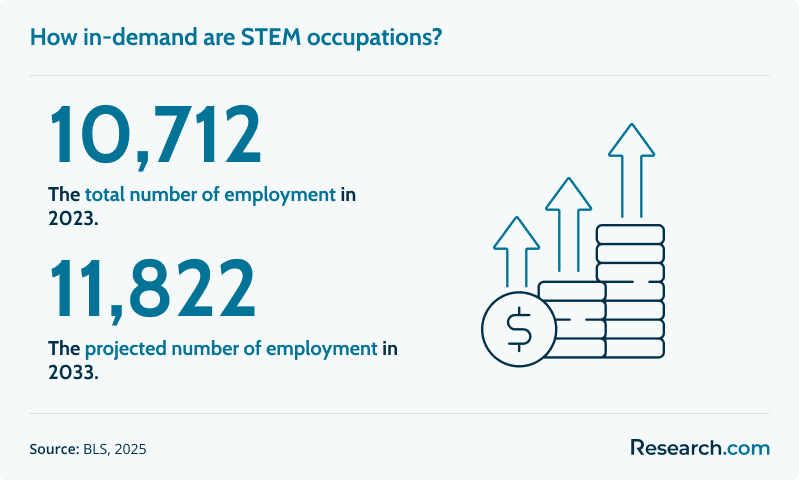
The demand for math-related roles is projected to grow 10.4% from 2023 to 2033, outpacing many other fields. This growth is connected to demand for data analysis, quantitative modeling, algorithmic thinking, and evidence-based decision-making across technology, finance, healthcare, government, and research. Some students also use a mathematics background to explore economics-related careers and may want to review how to become an economist.
Employers value math graduates because they can break down complex problems, evaluate assumptions, work with abstract systems, and analyze data. However, the job market rewards applied skills. Students aiming for immediate employment should build experience with tools such as Excel, SQL, Python, R, statistical packages, visualization software, or industry-specific platforms.
Artificial intelligence, cybersecurity, financial technology, and automation are also increasing the value of mathematical thinking. AI tools can automate some routine calculations, but they do not replace the need for professionals who understand modeling assumptions, statistical validity, uncertainty, optimization, and ethical interpretation of quantitative results.
Some mathematics graduates continue to graduate school in statistics, applied mathematics, computer science, engineering-adjacent fields, business, or education. Students considering teaching should confirm their state requirements early and may also find it useful to read about whether Can I get a teaching certificate with an associate's degree?
How do online bachelor's in mathematics programs build professional networks?
Online mathematics students build networks differently from campus students, but strong programs create structured ways to connect. Useful networking features include group problem-solving assignments, virtual office hours, alumni communities, online math clubs, career-center events, webinars, employer panels, and internship support. These resources matter because many quantitative jobs are found through referrals, project visibility, or faculty guidance rather than coursework alone.
Students should ask whether online learners have the same access to career services as campus students. They should also look for programs that encourage participation in professional associations, competitions, research projects, and cross-disciplinary events. Some learners expand their professional options by exploring adjacent fields, including information science pathways such as the cheapest MLIS online degree programs.
Can a Bachelor's in Mathematics Lead to Leadership Opportunities?
A bachelor’s in mathematics can support leadership over time, especially in roles where decisions depend on evidence, forecasting, risk analysis, budgeting, operations, or technical strategy. Early-career graduates usually start in analyst, teaching, technical, or research-support roles, then move toward senior analyst, team lead, manager, curriculum lead, or project leadership positions as they gain experience.
Leadership generally requires more than mathematical ability. Communication, project management, domain knowledge, mentoring, and organizational judgment are also important. Professionals who want to move into education leadership or senior organizational roles may later pursue graduate credentials, including options such as the cheapest online doctorate in educational leadership.
What advanced degree options complement an online bachelor's in mathematics?
An online bachelor’s in mathematics can lead naturally into graduate study, especially for students who want specialized technical roles, research careers, advanced teaching credentials, or leadership positions. Common next steps include master’s programs in data science, statistics, applied mathematics, actuarial science, computer science, operations research, economics, finance, business, or education.
Students interested in academic leadership, curriculum design, policy, or senior education roles may consider doctoral study after gaining relevant experience. Options such as the fastest EdD programs online can complement a quantitative undergraduate background for professionals moving toward education-focused leadership.
Common mistakes to avoid when choosing an online mathematics degree
- Choosing only the fastest option: A shorter timeline is useful only if the course sequence, support services, and workload are realistic.
- Ignoring accreditation: Accreditation affects financial aid, transferability, graduate-school eligibility, and employer recognition.
- Assuming all credits will transfer: Some credits may count as electives but not satisfy major requirements, which can extend the degree.
- Underestimating upper-level math: Real analysis, abstract algebra, and proof-based courses often require more time than general education classes.
- Overlooking licensure rules: Future teachers must confirm that the program meets certification requirements in the state where they plan to teach.
- Focusing only on tuition: Fees, books, software, proctoring, lost income, and delayed graduation can change the real cost.
- Skipping career preparation: A mathematics degree is stronger when paired with internships, coding, statistics, applied projects, or certification exams.
Here’s what graduates have to say about their online bachelor's in mathematics programs
"Completing my bachelor's in mathematics online let me keep working full time while still taking rigorous courses. The virtual tutoring and interactive platform were especially helpful in difficult subjects like real analysis, and I was surprised by how connected I felt to classmates and instructors." - Jasper
"I had doubts about learning mathematics online, but the organized course modules and responsive professors made the program manageable. The degree strengthened my problem-solving skills and helped me secure a remote data analyst role soon after graduation. Being able to work at my own pace made the experience practical and motivating." - Mitch
"Online study allowed me to remain close to my family while earning a credential I respected. The courses were demanding, but the technology made graphing work, collaboration, and projects easier than I expected. It became one of the most efficient and supportive learning experiences I have had." - Paula
Key Insights
- A fast online bachelor’s in mathematics is best for students who are self-directed, comfortable with challenging quantitative work, and clear about their career direction.
- Online math degree options can shorten the common 4-year timeline to 2.5 to 3.5 years, especially for students with transfer credits or access to accelerated terms.
- Many online math programs charge between $250 and $450 per credit hour, but total cost depends on fees, transfer policies, software, books, and financial aid.
- Competitive math programs may prefer applicants with AP Calculus or IB Math credits, and students should be ready for calculus, proofs, and statistics.
- As a math degree-holder, expect to earn around $73,000 to $119,000 per year, depending on occupation, location, experience, and technical skills.
- The demand for math-related occupations will grow by 10.4% until 2033, supported by data analysis, AI, finance, government, and technology needs.
- Students planning to teach should verify licensure alignment before enrolling because online education programs do not automatically meet every state’s requirements.
- The strongest ROI usually comes from combining the degree with applied skills such as Python, R, SQL, statistics, modeling, internships, actuarial exam preparation, or teaching certification.
References:
- Binkley, C. (2023, August 31). College students are still struggling with basic math. Professors blame the pandemic. Retrieved July 2, 2025, from Associated Press.
- BLS. (2025, April 18). Math Occupations. Retrieved July 2, 2025, from BLS.
- Burdman, P. et al. (2025, May). A Complex Equation: Confronting Math Obstacles on the Transfer Path. Retrieved July 2, 2025, from Just Equations.
- Mowreader, A. 2025, June 17). Math Prerequisites a Barrier to Transfer Success. Retrieved July 2, 2025, from Inside Higher Ed.
Other Things You Should Know About Online Bachelor's in Mathematics Degree Programs
Yes, many programs allow transfer credits to accelerate completion time. Typically, up to 90 credits can be transferred from accredited institutions. Check individual program policies for exact limits and requirements for eligibility.
Most 120-credit mathematics degrees require calculus I–III, linear algebra, differential equations, discrete mathematics, and at least one proof-based course such as abstract algebra or real analysis. Many programs also require statistics, computer programming, and a capstone or senior seminar before graduation.
Admission requirements typically include a high school diploma or equivalent, a minimum GPA of 2.5 or 3.0, and completion of specific math courses. Some programs may also require standardized test scores or previous college credits for admission to 2027's fastest programs.