
2027 How To Become a Business Psychologist: Salary & Career Paths

Co-Founder and Chief Data Scientist
If you are interested in psychology but do not want your career to center on clinical therapy, business psychology offers a practical route into leadership, workplace behavior, employee performance, organizational change, and talent strategy. Instead of treating individual clients in a traditional mental health setting, business psychologists use psychological research to help organizations hire better, develop stronger leaders, improve employee well-being, and solve people-related business problems.
This guide is for students, psychology graduates, HR professionals, consultants, and career changers who want to know whether business psychology is a realistic, worthwhile path. You will learn what business psychologists do, what education is usually required, where they work, how licensing works, which certifications can help, what skills employers expect, and how salary compares with related careers.
The field can be financially attractive, but it is not an automatic shortcut to a high-paying psychology job. Industrial-organizational psychologists, a related category that includes many business psychology roles, earn $92,813 annually according to the salary figure cited in this article, while top earners may make up to $300,000 depending on experience, specialization, employer type, and consulting opportunities. The best outcomes usually come from combining psychology training with data skills, business judgment, and practical workplace experience.
Quick Answer: Is Business Psychology a Good Career Path?
Business psychology can be a strong career choice for people who want to apply psychology in organizations rather than provide traditional therapy. Most business psychologist roles require at least a master’s degree in psychology, industrial-organizational psychology, business psychology, organizational behavior, or a closely related field. A doctoral degree may be useful for senior consulting, research, academic, assessment, or licensed psychology roles.
| Question | Short Answer |
| What does a business psychologist do? | Applies psychology to workplace problems such as hiring, leadership, motivation, employee engagement, culture, training, and organizational change. |
| What degree is usually needed? | A master’s degree is common for many roles; a doctorate can support advanced consulting, research, academic, or licensed practice. |
| Is a license always required? | No. Many corporate, HR, analytics, and organizational development roles do not require a psychology license. Licensure is generally needed for regulated psychological services, therapy, or certain independent assessment services. |
| What is the cited average salary? | The article cites an average annual salary of $92,813 for business psychologists in the United States. |
| Where do business psychologists work? | Consulting firms, private companies, government agencies, universities, HR departments, leadership development teams, and organizational development units. |
Key Points About Building a Career in Business Psychology
- Most business psychology careers require graduate education, usually a master’s or doctoral degree in psychology or a related field.
- Business psychologists in the United States earn an average annual salary of $92,813, while top earners may reach up to $300,000 depending on specialization, seniority, and work setting.
- Common career paths include human resources, organizational development, people analytics, leadership development, consulting, employee assessment, and executive coaching.
- The field is being reshaped by AI, hybrid work, employee wellness expectations, people analytics, and the need for evidence-based change management.
- What does a business psychologist do?
- How can you become a business psychologist for 2027?
- What entry-level roles can lead to business psychology careers?
- Which technical and workplace skills matter most for 2027?
- Which industries employ business psychologists?
- Is a license required to work as a business psychologist?
- Which certifications can strengthen your profile?
- What is the job outlook for business psychology professionals?
- What salary can business psychologists expect for 2027?
- Are online PsyD programs useful for business psychology careers?
- What trends are changing business psychology?
- What challenges should business psychologists expect?
- How does business psychologist pay compare with related careers?
- How can you move faster through education and career preparation?
- Are affordable psychology master’s programs a smart choice?
What does a business psychologist do?
Business psychology is one of the applied areas of psychology focused on how people think, behave, lead, collaborate, and perform at work. A business psychologist uses psychological methods to help organizations make better decisions about people, teams, leadership, culture, and change.
The work is different from traditional counseling or clinical psychology. A business psychologist is usually not sitting in a therapy office treating individual mental health conditions. Instead, they may design employee surveys, evaluate leadership programs, improve hiring assessments, coach managers, study turnover patterns, support organizational restructuring, or help teams adapt to hybrid work.
Common responsibilities
- Meeting with HR leaders, executives, managers, and employees to identify workplace problems.
- Designing or interpreting employee engagement surveys, leadership assessments, personality inventories, and 360-degree feedback tools.
- Using data to understand issues such as turnover, burnout, low morale, weak performance, or poor team communication.
- Building training, coaching, onboarding, leadership development, and change management programs.
- Advising organizations on culture, employee experience, workforce planning, and performance improvement.
- Writing reports and translating psychological findings into business recommendations that leaders can act on.
Business psychologists often collaborate with HR, learning and development, analytics, operations, communications, and executive leadership teams. In some organizations, they may work alongside a public relations or communications function when employee messaging, culture change, or leadership communication is involved. If that business communication side interests you, Research.com also explains how to become a PR manager.
Why organizations hire business psychologists
Organizations hire business psychologists because many workplace problems are behavioral problems. Employees may disengage, managers may struggle to lead, hiring processes may produce poor fits, or teams may resist needed change. Business psychologists help leaders understand the human causes behind those outcomes and design interventions grounded in evidence rather than guesswork.
- Leadership development programs designed by business psychologists can improve leadership effectiveness by 20–30%.
- Employee engagement interventions can increase engagement scores by 10-20%, which is strongly correlated with improved business outcomes.
| Business Problem | How a Business Psychologist Helps |
| High employee turnover | Studies exit data, manager behavior, job fit, engagement, and culture to identify why people leave. |
| Poor leadership effectiveness | Uses coaching, 360-degree feedback, leadership assessment, and development planning. |
| Weak hiring decisions | Improves selection tools, structured interviews, job analysis, and assessment validity. |
| Low engagement | Designs surveys, analyzes employee sentiment, and recommends targeted workplace improvements. |
| Resistance to change | Helps leaders communicate, sequence, and manage change in ways employees can understand and support. |
How can you become a business psychologist for 2027?
The most reliable path into business psychology combines psychology education, business exposure, research or analytics experience, and applied workplace practice. You do not need to start with a perfect title. Many professionals enter the field through HR, organizational development, assessment, consulting, or people analytics roles before moving into more specialized business psychology work.
| Step | What to Do | Why It Matters |
| 1. Build an undergraduate foundation | Earn a bachelor’s degree in psychology, business, human resources, organizational behavior, or a related field. Some students begin with an online psychology associate degree, which generally takes about two years, before transferring into a bachelor’s program. | A bachelor’s degree typically takes about four years of full-time study and gives you the base knowledge needed for graduate study or entry-level people operations work. |
| 2. Choose a relevant graduate program | Pursue a master’s degree in psychology, industrial-organizational psychology, business psychology, organizational psychology, or a related field. | Most professional business psychology roles require graduate-level training in research methods, assessment, workplace behavior, and organizational systems. |
| 3. Get applied experience early | Look for internships, research assistantships, HR roles, organizational development projects, or consulting support positions. | Employers value candidates who can apply psychology to real workplace decisions, not just explain theory. |
| 4. Consider doctoral training if your goals require it | A doctorate may be useful for advanced assessment, academic work, high-level consulting, research leadership, or regulated psychological services. | A doctorate in business psychology typically requires 90-120 credits and takes around 4-6 years to complete. |
| 5. Understand licensing rules | If your work involves regulated psychological services, therapy, or certain independent assessments, check state licensing requirements and the Examination for Professional Practice in Psychology (EPPP). | The EPPP has an approximately 82% passing rate for first-time takers, and licensure requirements vary by state and scope of practice. |
The American Psychological Association (APA) indicates that 13% of individuals with a bachelor's degree in psychology also earn a psychology master's degree, and 4% earn online PHD programs in industrial organizational psychology. This shows that advanced education is a common route for psychology graduates who want to move into specialized roles such as business psychology.
If you plan to pursue doctoral study, some of the colleges for a doctorate in psychology include Stanford University, Harvard University, and the University of California. Before applying, compare faculty expertise, research focus, internship options, tuition, funding, online flexibility, and whether the degree supports your intended career path.
Who should choose business psychology?
- You enjoy psychology but prefer workplace strategy, leadership, data, and organizational systems over clinical therapy.
- You are comfortable working with executives, HR teams, managers, and employees.
- You like translating research into practical recommendations.
- You are willing to build quantitative, assessment, and consulting skills.
- You want a career that can connect psychology with business performance.
Who may want a different psychology path?
- You want to diagnose and treat mental health disorders as your main role.
- You strongly prefer one-on-one therapy over organizational work.
- You dislike data analysis, workplace politics, or business decision-making.
- You want a career path with clearly standardized licensing requirements across every role.
What entry-level roles can lead to business psychology careers?
Many successful business psychologists do not begin with the title “business psychologist.” They start in roles that expose them to hiring, assessment, training, research, analytics, employee experience, or organizational change. The key is to choose early jobs that build evidence-based problem-solving skills.
| Starting Role | What You Learn | How It Supports Business Psychology |
| Human Resources Assistant or HR Officer | Recruiting, onboarding, employee relations, training, performance management, and culture work. | Provides direct exposure to people operations. If you are exploring this route, see Research.com’s guide on what a human resource officer does. |
| Research Assistant | Study design, literature review, psychological measurement, survey administration, and data analysis. | Builds the research foundation needed for assessment, people analytics, and evidence-based consulting. |
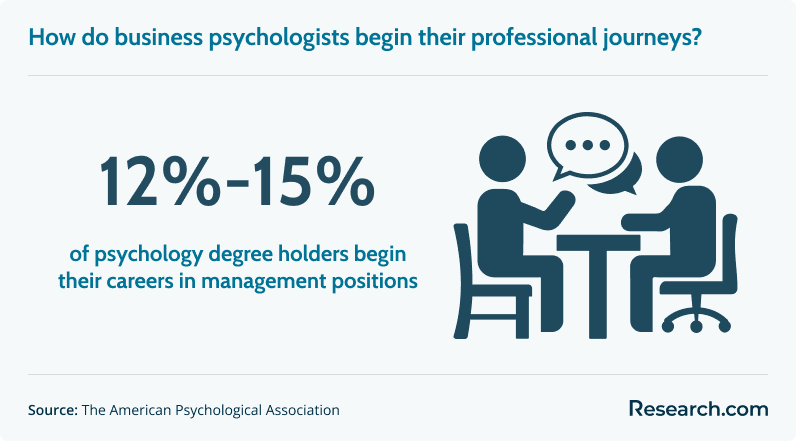
| Organizational Development Coordinator | Training logistics, change initiatives, culture assessments, leadership programs, and employee feedback projects. | Connects psychology with organizational performance and change management. The APA indicates that approximately 12%-15% of psychology degree holders begin their careers in management positions, including roles such as OD coordinators and HR specialists. |
| Consulting Analyst | Client communication, project management, data interpretation, presentation building, and recommendation development. | Can lead to senior consultant, project manager, or consulting director roles as responsibility grows. |
| Psychometric Analyst | Assessment design, test scoring, reliability, validity, and interpretation of aptitude, personality, or leadership tools. | Develops specialized expertise in employee assessment, selection, leadership evaluation, and measurement. |
How to make an entry-level role more relevant
- Volunteer for survey, assessment, training, or analytics projects.
- Ask to help with job analysis, structured interviews, competency models, or leadership development programs.
- Build a portfolio of reports, dashboards, training materials, or research summaries that show applied workplace impact.
- Learn to explain psychological concepts in business language, such as retention, productivity, risk, engagement, and performance.
Which technical and workplace skills matter most for 2027?
Business psychologists need more than an understanding of motivation, personality, and group behavior. Employers increasingly expect them to use data, digital tools, project methods, and assessment systems while still maintaining strong ethical judgment and interpersonal skill.
Students who want a deeper foundation in behavior may consider a behavioral psychology degree, especially if they are interested in motivation, learning, decision-making, and behavior change. Those who are more technology-oriented may also want to compare the business psychology path with analytics-heavy roles; Research.com covers how to become a business intelligence developer in a separate guide.
Technology fluency does not replace psychological expertise, but it does make that expertise more useful. For example, a business psychologist who can analyze engagement data, visualize turnover patterns, and explain findings to executives will usually be more valuable than one who can only describe workplace behavior in general terms. For additional perspective on technology, creativity, and adaptability in workplace skills, see this skills discussion.
Which industries employ business psychologists?
Business psychology professionals work anywhere organizations need to understand and improve human behavior at work. Industrial-organizational psychologists, the closest occupational category in many labor datasets, are found in consulting, government, corporate management, and higher education.
| Industry | How Business Psychologists Contribute | Relevant Figures Cited |
| Consulting | Advise clients on leadership, assessment, employee engagement, talent strategy, team performance, and organizational change. | As of the latest BLS report, around 3,380 industrial-organizational psychologists were employed in the United States in total, and about 24% work in consulting roles. |
| State Government | Support workforce planning, leadership programs, organizational assessment, policy implementation, and public-sector employee systems. | Approximately 9% of industrial-organizational psychologists in the U.S. are employed by state governments. |
| Private Companies and Enterprises | Work on executive leadership, talent management, culture, employee experience, assessment, and organizational effectiveness. | Approximately 8% of industrial-organizational psychologists in the U.S. are employed in the management of companies and enterprises. Professionals in this industry earn a mean annual wage of $127,950, with the top 10% earning up to $195,960 annually. |
| Colleges, Universities, and Professional Schools | Teach, conduct research, supervise students, publish studies, and prepare future professionals in the field. | Approximately 10% of industrial-organizational psychologists in the U.S. are employed by colleges, universities, and professional schools. |
Other settings to consider
- Healthcare systems that need leadership development, burnout prevention, and staff retention strategies.
- Technology companies that rely on people analytics, team design, and rapid organizational change.
- Financial services firms that need assessment, compliance training, leadership pipelines, and culture work.
- Nonprofits and mission-driven organizations that need stronger management, engagement, and change leadership.
Is a license required to work as a business psychologist?
Licensing depends on what services you provide, how you describe your work, and the state where you practice. In many internal business roles, a psychology license is not required because the work focuses on organizational behavior, HR analytics, training, leadership development, or consulting rather than clinical diagnosis or therapy.
| Work Setting | License Usually Required? | Important Notes |
| Internal corporate HR, people analytics, organizational development, or learning and development roles | No, in many cases | These roles typically involve employee data, training, workforce planning, leadership support, and organizational behavior rather than clinical practice. Many business psychologists in consulting, HR analytics, or organizational development complete 2 years of full-time study at the graduate level. |
| Independent executive coaching using non-clinical methods | Depends on state law and scope | Coaching is often unlicensed, but professionals must avoid representing coaching as therapy or regulated psychological treatment unless licensed to do so. |
| Therapy, diagnosis, clinical psychological services, or certain formal assessment services | Yes, generally | These roles usually involve a Ph.D. or Psy.D. in psychology from an APA-accredited program, supervised hours, and required exams. Full-time students entering with a bachelor’s degree may spend 5-7 years completing graduate studies. |
Questions to ask before choosing a program
- Does this degree prepare graduates for business, consulting, HR, or licensed psychology practice?
- If I want licensure, does the program meet state requirements where I plan to work?
- Is the program APA-accredited when APA accreditation is relevant to my intended path?
- How many supervised hours will I need after graduation?
- Will the program support EPPP preparation if I need licensure?
Which certifications can strengthen your profile?
Certifications are not a substitute for graduate education, but they can help business psychologists demonstrate expertise in talent development, HR strategy, assessment, coaching, or organizational effectiveness. The right credential depends on your target role.
| Credential | Best For | Career Value |
| Certified Professional in Talent Development (CPTD) | Learning and development, performance improvement, coaching, instructional design, and organizational effectiveness. | The CPTD, formerly known as the CPLP, signals expertise in talent development. Credentials such as the CPTD and Certified Training and Development Professional (CTDP), offered by the Association for Talent Development (ATD), can lead to an average annual salary increase of nearly 19%. |
| SHRM Certified Professional (SHRM-CP) or Senior Certified Professional (SHRM-SCP) | HR strategy, policy, compliance, organizational leadership, and people operations. | SHRM-certified professionals typically earn 14% to 15% more than non-certified peers, and the credential can help business psychology professionals communicate credibility in HR settings. |
| Professional in Human Resources (PHR) | Professionals responsible for day-to-day HR operations and workforce practices. | The PHR is globally recognized. As of 2027, about 65,341 people hold the PHR certification and 41,692 hold the senior PHR (SPHR). SPHR-certified professionals earn an average of $109,000 a year, about 47% more than those without the certification. |
| Society for Industrial and Organizational Psychology (SIOP) Membership | Students, researchers, consultants, and practitioners in I-O and business psychology. | SIOP is not a certification, but membership provides access to research, networking, job boards, and a professional community of over 9,000 professionals. |
How to choose a certification
- Choose CPTD if your work focuses on training, development, coaching, instructional design, or performance improvement.
- Choose SHRM-CP or SHRM-SCP if you want credibility in HR leadership, compliance, and policy-heavy roles.
- Choose PHR or SPHR if your career is closely tied to HR operations and employee management systems.
- Join SIOP if you want deeper connection to the industrial-organizational psychology community, research, and professional opportunities.
What is the job outlook for business psychology professionals?
The outlook for graduates of business psychology is generally positive but specialized. Business psychology is not the largest psychology employment category, and job titles vary widely. However, organizations continue to need help with employee engagement, assessment, leadership development, hybrid work, culture change, and evidence-based talent strategy.
According to the U.S. Bureau of Labor Statistics (BLS), business psychology is projected to see a 6% growth in job opportunities, which is on par with the national average for all occupations. That suggests steady demand rather than explosive growth.
Overall, this field offers moderate job growth and high earning potential, earning a rating of 7.5 out of 10 in the cited article framework. The trade-off is that opportunities may be more limited than broader HR or general management roles, so candidates need to build a clear specialization and strong applied skills.
Business psychology is also expanding internationally in Europe, Asia, and Australia, where employers increasingly emphasize employee well-being, psychological safety, and organizational resilience. The rise of hybrid and remote work after COVID has also increased demand for professionals who understand change management, team dynamics, leadership communication, and workplace mental health strategy.
What salary can business psychologists expect for 2027?
In 2027, the average annual pay for a business psychologist in the United States is $92,813. Reported salaries vary widely, with annual figures as high as $398,500 and as low as $11,000. Most business psychologist salaries currently fall between $66,500 at the 25th percentile and $117,000 at the 75th percentile, while the highest paying psychologist figure cited in the article is $146,000 annually across the United States.
Salary depends heavily on role, employer, location, degree level, consulting experience, and whether the professional works in internal employment, private consulting, assessment, leadership coaching, or executive advisory work. The highest-paying states for business psychologists in 2024 include New Jersey, California, Oregon, Rhode Island, and Maine, reflecting strong demand according to the sources cited in the article.
| Salary Factor | Why It Changes Earnings |
| Degree level | Doctoral training may support higher-level consulting, research, academic, or licensed roles, while many applied roles are accessible with a master’s degree. |
| Industry | Private companies and enterprises report a mean annual wage of $127,950 for professionals in the cited I-O psychology category, with the top 10% earning up to $195,960 annually. |
| Specialization | Assessment, executive coaching, leadership development, people analytics, and organizational consulting may command different pay levels. |
| Employment model | Independent consultants may earn more in strong markets but also face business development, client acquisition, and income variability. |
| Location | States such as New Jersey, California, Oregon, Rhode Island, and Maine are cited as high-paying states for business psychologists in 2024. |
Are online PsyD programs useful for business psychology careers?
Online PsyD programs can be valuable for some business psychology professionals, but they are not necessary for every role. A PsyD may make sense if your long-term goals include licensed psychological practice, advanced assessment, executive coaching with clinical depth, or consulting that benefits from doctoral-level training in diagnosis, research, and human behavior.
However, a PsyD can also be expensive and time-intensive. Before enrolling, compare accreditation, licensure alignment, supervised experience requirements, faculty expertise, dissertation or capstone expectations, and whether the curriculum actually supports business psychology goals. If you are evaluating doctoral options, Research.com’s guide to PsyD psychology programs online can help you compare programs more carefully.
What trends are changing business psychology?
Business psychology is changing because work itself is changing. Employers are trying to understand employee behavior in more complex environments: remote teams, AI-supported workflows, distributed leadership, changing employee expectations, and increased attention to workplace wellness.
Major trends to watch
- AI and people analytics: Organizations are using more data to understand engagement, productivity, turnover risk, hiring quality, and team performance. Business psychologists who understand both ethics and analytics will be better positioned.
- Hybrid and remote work: Leaders need new approaches to trust, communication, motivation, collaboration, and performance management when employees are not always in the same location.
- Employee well-being and psychological safety: Employers increasingly want strategies that reduce burnout, support inclusion, and create healthier cultures.
- Skills-based hiring: Companies are paying more attention to competencies, assessment validity, and practical job performance rather than relying only on degrees or past titles.
- Flexible graduate education: Students are comparing online, hybrid, and lower-cost options, including cheapest organizational psychology masters programs online, to gain relevant skills without unnecessary debt.
What challenges should business psychologists expect?
Business psychologists work at the intersection of human behavior and business pressure. That makes the work useful, but it also creates ethical, practical, and political challenges. A recommendation that is scientifically sound may still face resistance if leaders see it as costly, slow, or uncomfortable.
| Challenge | Why It Matters | Better Approach |
| Ethical boundaries | Employee data, assessments, coaching conversations, and psychological insights can be misused if confidentiality and consent are weak. | Set clear boundaries, use validated tools, protect privacy, and explain how data will be used. |
| Resistance from leaders | Executives may want quick fixes or may resist findings that point to leadership or culture problems. | Connect recommendations to measurable business outcomes while staying honest about evidence and limitations. |
| Translating research into action | Dense psychological language can lose business audiences. | Use clear recommendations, short reports, dashboards, and practical implementation steps. |
| Technology change | AI, analytics tools, and remote work systems change how organizations collect and interpret employee information. | Keep learning digital tools while applying strong ethical and methodological standards. |
| Interdisciplinary expectations | Employers may expect knowledge of HR, finance, operations, data, law, and psychology. | Build a broad business vocabulary and collaborate with specialists when needed. |
Some professionals also expand their understanding of employee well-being, organizational support, and social systems through adjacent programs such as online MSW programs. This route is not required for business psychology, but it may be relevant for professionals focused on workplace wellness, employee assistance, or organizational support systems.
How does business psychologist pay compare with related careers?
Business psychologists earn approximately $92,000 annually on average in the cited salary comparison, with potential earnings ranging from $55,000 to $300,000. Their pay often sits between traditional psychology roles and higher-end management consulting roles, although actual earnings depend on employer, credential level, location, and specialization.
Compared with some clinical or counseling psychology roles, business psychology may offer stronger earning potential in corporate or consulting settings. Compared with elite management consulting, however, business psychologists may earn less unless they move into senior advisory, executive coaching, or independent consulting roles with strong client demand.
| Career Path | How It Compares |
| Business Psychologist | Applies psychology to employee behavior, leadership, assessment, organizational change, and workplace performance. Average cited salary is approximately $92,000 or $92,813 depending on the section and source used. |
| Clinical or Counseling Psychologist | More focused on diagnosis, therapy, and mental health treatment. Licensure is central, and work settings differ substantially from corporate business psychology roles. |
| Human Resources Professional | Often broader and more operations-focused, covering compliance, benefits, employee relations, and policies. Business psychologists may bring deeper assessment and behavioral science expertise. |
| Management Consultant | Usually broader in business strategy and operations. High-level consultants may out-earn business psychologists, but psychology specialists can compete well in leadership, culture, and talent advisory niches. |
| Executive Coach | May overlap with business psychology, especially when coaching is grounded in assessment, leadership behavior, and organizational context. |
What do business psychology professionals say about the field?
Many people who choose business psychology are drawn to its mix of theory and practical impact. Their experiences often highlight the same themes: data matters, psychology becomes more powerful when applied to real organizations, and the strongest career growth comes from connecting people insights with business outcomes.
“Business psychology helped me see how workplace relationships, leadership behavior, and organizational systems shape performance. The training gave me a stronger foundation in psychological theory and data analysis, which I now use to improve employee engagement strategies.” – Alex
“Studying business psychology was a practical investment for my career. I use the concepts every day to help organizations improve operations and support employees more effectively.” – Laura
“The field gave me a way to understand both people and processes. After working in a general HR role, I moved into strategic consulting and now help organizations improve retention and performance.” – Daniel
How can you move faster through education and career preparation?
You can accelerate your path into business psychology by choosing the right program format, transferring credits, gaining applied experience while studying, and adding targeted credentials. The goal is not simply to finish quickly. The goal is to finish with the right skills, portfolio, and credibility for the roles you want.
Practical ways to speed up your path
- Use transfer credits from prior college coursework when possible.
- Choose programs with flexible online, hybrid, part-time, or accelerated options if you are working while studying.
- Prioritize internships, research assistantships, HR projects, and consulting practicums over purely theoretical coursework.
- Build skills in survey design, statistics, assessment, data visualization, coaching, and change management.
- Earn certifications only when they match your target role, rather than collecting credentials without a strategy.
If you need a shorter route to an undergraduate credential, compare options such as an accelerated psychology degree online. When evaluating accelerated programs, look closely at accreditation, course quality, faculty support, transfer policies, total cost, and whether graduate schools or employers will respect the credential.
Are affordable psychology master’s programs a smart choice?
Affordable master’s programs can be a smart investment for aspiring business psychologists if they provide credible training, relevant coursework, qualified faculty, and strong career alignment. A low tuition price is helpful, but it should not be the only factor. A cheap program that lacks rigor, career support, or relevant organizational psychology coursework may cost more in missed opportunities.
| What to Check | Why It Matters |
| Accreditation | Helps protect academic quality and may affect transfer credit, employer recognition, financial aid, and licensure pathways. |
| Curriculum fit | Look for courses in industrial-organizational psychology, assessment, statistics, organizational behavior, leadership, research methods, and consulting. |
| Faculty expertise | Faculty with I-O psychology, organizational consulting, HR analytics, or leadership development backgrounds can improve the practical value of the program. |
| Applied experience | Internships, capstones, consulting projects, and research opportunities help convert coursework into employable skills. |
| Total cost | Compare tuition, fees, books, technology costs, residency requirements, travel, and lost work time. |
| Career outcomes | Ask where graduates work, what roles they obtain, and whether the program supports networking or employer connections. |
Students comparing cost-conscious options can start with Research.com’s guide to the cheapest psychology masters programs. Use affordability as one part of the decision, not the entire decision.
Common mistakes to avoid when pursuing business psychology
| Mistake | Why It Can Hurt You | Better Decision |
| Choosing a program only because it is fast or cheap | You may graduate without the coursework, credibility, or applied experience employers expect. | Compare accreditation, curriculum, faculty, fieldwork, cost, and career alignment together. |
| Assuming every psychology degree leads to business psychology jobs | General psychology programs may not include I-O psychology, assessment, HR, leadership, or analytics content. | Choose electives, internships, and projects tied to organizations and workplace behavior. |
| Ignoring licensing rules | You may discover too late that your program does not meet requirements for regulated psychological services. | Check state licensure requirements before enrolling if you want to provide therapy, diagnosis, or licensed assessment services. |
| Avoiding statistics and data tools | Many business psychology roles rely on surveys, assessments, dashboards, and employee data. | Develop practical skills in statistics, visualization, people analytics, and research design. |
| Relying only on rankings | A highly ranked program may not fit your budget, schedule, specialization, or career goals. | Use rankings as one signal, then verify outcomes, costs, curriculum, support, and employer relevance. |
| Assuming salary outcomes are guaranteed | Pay varies widely by role, geography, experience, employer, and consulting success. | Review multiple salary sources and evaluate realistic entry-level, mid-career, and senior pathways. |
Key Insights
- Business psychology is best for people who want to apply psychology to workplaces, leadership, employee behavior, culture, assessment, and organizational performance rather than focus primarily on therapy.
- A master’s degree is the common entry point for many roles, while a doctorate can support advanced consulting, research, academic, licensed, or assessment-focused careers.
- Licensure is not always required. Internal corporate roles in HR analytics, organizational development, leadership development, and consulting often do not require a psychology license, but therapy, diagnosis, and certain assessment services generally do.
- The cited average salary for business psychologists is $92,813, with most salaries ranging from $66,500 to $117,000 and higher earnings possible in specialized or senior roles.
- Industrial-organizational psychology employment is specialized: the article cites around 3,380 I-O psychologists in the United States, with about 24% in consulting, 9% in state government, 8% in management of companies and enterprises, and 10% in colleges, universities, and professional schools.
- Data analysis, psychometric assessment, emotional intelligence, digital literacy, and project management are now essential skills for competitive business psychology careers.
- Affordable or accelerated programs can be worthwhile, but only if they are accredited, relevant to organizational psychology, and strong enough to support your career goals.
- The strongest candidates build a practical portfolio through internships, HR roles, research projects, consulting work, dashboards, assessment reports, or organizational development projects.
References:
Aims International. (n.d.). Forget IQ; it’s EQ: Why emotional intelligence is the leadership skill to master in 2024. Retrieved May 9, 2025, from https://www.aimsinternational.com/news/forget-iq-its-eq-why-emotional-intelligence-is-the-leadership-skill-to-master-in-2024
Bureau of Labor Statistics. (2023, May). Occupational employment and wages, May 2023: 19-3032 industrial-organizational psychologists. U.S. Bureau of Labor Statistics. Retrieved May 9, 2025, from https://www.bls.gov/oes/2023/may/oes193032.htm
Harvard Extension School. (n.d.). Industrial-organizational psychology graduate program. Harvard University. Retrieved May 9, 2025, from https://extension.harvard.edu/academics/programs/industrial-organizational-psychology-graduate-program/
Human Resources Certification Institute. (n.d.). HRCI official site. Retrieved May 9, 2025, from https://www.hrci.org/
Psychology Jobs. (n.d.). Industrial psychology careers. Retrieved May 9, 2025, from https://psychologyjobs.com/career-advice/industrial-psychology-careers/
Psychology Today. (n.d.). Emotional intelligence statistics. Retrieved May 9, 2025, from https://jobera.com/emotional-intelligence-statistics/
Society for Industrial and Organizational Psychology. (n.d.). Retrieved May 9, 2025, from https://www.siop.org
U.S. News & World Report. (n.d.). Industrial-organizational psychology doctorate degree. Retrieved May 9, 2025, from https://www.usnews.com/education/online-education/industrial-organizational-psychology-doctorate-degree
ZipRecruiter. (n.d.). Business psychologist salary. Retrieved May 9, 2025, from https://www.ziprecruiter.com/Salaries/Business-Psychologist-Salary
Other Things You Should Know About Becoming a Business Psychologist
Professional credentials in industrial-organizational psychology, human resources, or coaching can improve job prospects, especially when paired with a master’s degree. Employers also value SHRM or HRCI certifications for HR-focused roles. Many business psychologists build credibility through supervised practice, research experience, and evidence-based assessment training.
To become a business psychologist, one typically needs a master's or doctoral degree in psychology with a focus on industrial-organizational psychology. Additional requirements might include practical experience through internships and obtaining relevant certifications or licensure.


