
2027 Most Affordable Online Forensic Science Degree Programs

Co-Founder and Chief Data Scientist
Most Affordable Online Forensic Science Degree Programs for 2027: How to Choose the Right Path
Choosing an online forensic science degree is not just about finding the lowest tuition. You also need to know whether the program teaches enough lab science, whether it fits your career goal, whether employers will recognize the credential, and whether online delivery gives you enough practical training for crime scene, laboratory, digital evidence, or investigative work.
This guide is for students comparing affordable online forensic science, forensic investigation, crime science, criminal justice, cybersecurity, and related programs. It explains what you can study, how online programs differ from campus programs, what costs to expect, which careers may be available, and how to evaluate accreditation, curriculum, internships, and return on investment before enrolling.
Quick Answer: Is an Online Forensic Science Degree Worth Considering?
An online forensic science degree can be a practical option if you need flexibility and are targeting roles that value scientific analysis, evidence handling, criminal investigation, digital forensics, or public safety knowledge. However, it is especially important to confirm that the program includes strong science coursework, credible accreditation, practical labs or simulations, and career support. Students aiming for laboratory-heavy roles should pay close attention to hands-on requirements, internship access, and whether the curriculum aligns with employer expectations.
What are the benefits of getting a Forensic Science degree?
A forensic science degree prepares students to apply biology, chemistry, mathematics, technology, and legal procedure to evidence-based investigations. Online programs can make this pathway more accessible for working adults, military learners, parents, and students who cannot relocate. They may also reduce commuting and housing costs, although students should still compare tuition, fees, lab requirements, and technology expenses carefully.
The degree can support several career directions, including forensic science technician, crime scene investigator, forensic analyst, digital forensic analyst, forensic psychology assistant roles, and public safety or law enforcement support positions. The best option depends on whether you want a science-focused laboratory career, an investigation-focused role, or a technology-centered path such as digital forensics or cybersecurity.
What can I expect from a Forensic Science degree?
A forensic science degree combines scientific training with investigative procedures and legal standards. Students learn how evidence is identified, documented, preserved, tested, interpreted, and presented in criminal or civil proceedings.
| Learning Area | What You Should Gain | Why It Matters |
| Science foundation | Coursework in biology, chemistry, mathematics, and related laboratory methods | Forensic conclusions must be based on reliable scientific processes, not assumptions. |
| Evidence handling | Training in crime scene procedures, chain of custody, evidence preservation, and documentation | Mishandled evidence can weaken or compromise an investigation. |
| Forensic techniques | Exposure to DNA analysis, fingerprint analysis, ballistics, toxicology, trace evidence, digital evidence, or other specialties | Specialized skills help graduates pursue targeted roles in labs, agencies, or private organizations. |
| Critical thinking | Practice interpreting data, comparing evidence, and explaining conclusions clearly | Forensic professionals must avoid bias and support findings with defensible analysis. |
| Communication | Report writing, courtroom communication, and technical presentation skills | Findings must be understandable to investigators, attorneys, judges, juries, and supervisors. |
| Practical experience | Virtual labs, simulations, campus intensives, internships, or field-based projects, depending on the program | Employers often value applied experience, especially for laboratory and crime scene roles. |
Where can I work with a Forensic Science degree?
Forensic science graduates may work in public agencies, laboratories, medical examiner settings, law enforcement support units, cybersecurity teams, or private testing organizations. The exact job options depend on the degree level, specialization, technical training, location, and employer requirements.
- Crime laboratories: Analyze physical, biological, chemical, or digital evidence and prepare technical reports for investigative agencies.
- Law enforcement agencies: Support investigations as a crime scene investigator, forensic specialist, evidence technician, or forensic science technician.
- Medical examiner's offices: Assist with investigations involving sudden, unexplained, or unexpected deaths, often alongside pathologists and investigators.
- Government agencies: Apply forensic methods in agencies such as the FBI, DEA, or ATF, depending on qualifications and hiring requirements.
- Private laboratories: Conduct testing, consulting, or analysis for attorneys, insurers, corporate clients, or public agencies.
- Research and academia: Contribute to forensic science research or pursue teaching roles, often requiring graduate study.
How much can I make with a Forensic Science degree?
Forensic science earnings vary by role, employer, location, experience, education level, and specialization. The salary figures below come from the sources cited in the original article and should be used as benchmarks rather than guarantees.
| Source | Role | Reported Pay |
| Salary.com | Forensic Scientist | $112,284 |
| Salary.com | Forensic Science Technician | $65,376 |
| Bureau of Labor Statistics | Forensic Science Technicians | $64,940 per year |
| Payscale | Forensic Science Technician | $58,000 |
| Indeed | Forensic Scientist | $70,000 |
Students should compare salary data by job title carefully. A forensic scientist, forensic science technician, forensic analyst, digital forensic analyst, and crime scene investigator may have different responsibilities, education expectations, and pay ranges.
- What are the most affordable online forensic science degree programs for 2027?
- How long does it take to complete a forensic science degree program?
- How does an online forensic science degree compare to an on-campus program?
- What is the average cost of a forensic science degree program?
- What are the financial aid options for students enrolling in a forensic science degree program?
- What are the prerequisites for enrolling in a forensic science degree program?
- What courses are typically in a forensic science degree program?
- What types of specializations are available in forensic science degree programs?
- How are emerging technologies integrated into forensic science degree programs?
- How does one choose the best forensic science degree program?
- What career paths are available for graduates of forensic science degree programs?
- What is the job market for graduates with a forensic science degree?
- What challenges do online forensic science students face?
- What professional certifications can further elevate your forensic science career?
- Is an Advanced Degree Essential for Forensic Innovation?
- Can accelerated online programs fast-track forensic science careers?
- Is starting with the easiest bachelor's degree a smart move for aspiring forensic scientists?
- Can pursuing an advanced online degree accelerate career growth in forensic science?
- Is a Doctoral Degree Necessary to Advance Your Forensic Science Career?
- What complementary academic paths can enhance your forensic science career?
- How do online forensic science programs support career development?
- What accreditation standards should you consider for online forensic science programs?
What are the most affordable online forensic science degree programs for 2027?
The programs below represent affordable online options in forensic science and closely related fields such as crime science, forensic investigation, forensic psychology, digital forensics, criminal justice, cybersecurity, homeland security, and public safety administration. Because program titles differ, students should compare curriculum details closely instead of assuming every program leads to the same career outcome.
How do we rank schools?
Affordability matters, but it should not be separated from quality, accreditation, student outcomes, and program fit. Our methodology uses recognized education data sources, including:
- the IPEDS database
- Peterson's database, including its Distance Learning Licensed Data Set
- the College Scorecard database,
- and the National Center for Education Statistics.
Students comparing affordability should also review program reputation, transfer credit policies, graduation requirements, and whether the curriculum matches their intended role. You can also compare these options with the best colleges for a forensic science degree for 2027.
Affordable Online Forensic Science and Related Programs
| School | Online Program Focus | Program Length | Tuition Cost | Credits | Accreditation |
| Arizona State University | Forensic Science; Death Investigations | 4 years | $520-$600 per credit hour (in-state); $1,055-$1,135 per credit hour (out-of-state) | 120 | Higher Learning Commission |
| Florida International University (FIU) | Crime Science | 4 years | $235.57 per credit hour (in-state); $648.87 per credit hour (out-of-state) | 120 | Southern Association of Colleges and Schools Commission on Colleges (SACSCOC) |
| University of Florida | Forensic Medicine; Veterinary Forensic Sciences; Wildlife Forensic Sciences | Varies by program (typically 1-2 years for master's degrees) | Varies by program; generally $471.33 per credit hour (in-state); $1,285.33 per credit hour (out-of-state) | Varies by program | Southern Association of Colleges and Schools Commission on Colleges (SACSCOC) |
| Columbia Southern University | Forensic Investigation | 4 years | $270 per credit hour | 120 (maximum 90 transfer credits) | Distance Education Accrediting Commission (DEAC) |
| Maryville University | Forensic Psychology | 4 years | $525 per credit hour | 128 | Higher Learning Commission |
| Champlain College | Computer Forensics and Digital Investigations | Varies, can be completed in as few as 14 terms | $335 per credit hour ($1,005 per 3-credit course); special rates for active-duty military | 120 | New England Commission of Higher Education (NECHE) |
| Southern New Hampshire University | Criminal Justice; Public Safety Administration | Varies by program | $320 per credit hour (undergraduate); $609 per credit hour (graduate) | Varies by program (typically 60 for associate's, 120 for bachelor's, 36 for master's) | New England Commission of Higher Education (NECHE) |
| University of Arizona Global Campus | Social and Criminal Justice; Homeland Security and Emergency Management | Varies by program | $370 per credit hour (undergraduate); $525 per credit hour (graduate) | Varies by program (typically 120 for bachelor's, 36 for master's) | Distance Education Accrediting Commission (DEAC) |
| National University | Criminal Justice; Cybersecurity; Homeland Security | Varies by program | Varies by program | Varies by program | WASC Senior College and University Commission (WSCUC) |
| Grand Canyon University | Forensic Science; Cybersecurity | Varies by program | $470 per credit hour (undergraduate); $640 per credit hour (graduate) | Varies by program | Higher Learning Commission |
Arizona State University's online Bachelor of Science in forensic science is a science-centered option designed around evidence interpretation, crime investigation, criminalistics, forensic biology, forensic chemistry, and virtual lab experiences. Florida International University's online Bachelor of Science in Crime Science takes a broader interdisciplinary approach, combining forensic science, computer science, criminology, and criminal justice. The University of Florida's online offerings are more specialized and include graduate certificates and master's-level study in areas such as forensic medicine, veterinary forensic sciences, and wildlife forensic sciences.
Columbia Southern University's Bachelor of Science in Forensic Investigation emphasizes evidence recognition, collection, preservation, legal procedures, forensic techniques, and psychology-related concepts. Maryville University's Bachelor of Arts in Forensic Psychology is better suited to students interested in behavior, psychology, and the justice system rather than laboratory analysis. Champlain College's Computer Forensics and Digital Investigations program is a stronger fit for students who want to investigate cybercrime and digital evidence. Southern New Hampshire University, University of Arizona Global Campus, National University, and Grand Canyon University offer related online pathways in criminal justice, public safety, cybersecurity, homeland security, and forensic science.
How long does it take to complete a forensic science degree program?
Completion time depends on the credential level, transfer credits, course load, program calendar, and whether the student enrolls full time or part time.
| Degree or Format | Typical Time Frame | Best For |
| Bachelor's degree | Usually four years of full-time study | Students seeking entry-level forensic science, crime scene, digital evidence, or investigative support roles |
| Master's degree | Usually an additional two years after a bachelor's degree | Students seeking advanced technical, research, leadership, or specialized roles |
| Accelerated programs | Shorter than traditional formats, depending on the school | Highly organized students who can handle condensed coursework |
| Part-time enrollment | Longer than full-time study | Working adults, caregivers, military students, and learners balancing multiple commitments |
Students interested in forensic bioinformatics or evidence-related data analysis may also compare a bioinformatics master's online with traditional forensic science graduate programs.
How does an online forensic science degree compare to an on-campus program?
Online and campus-based forensic science programs can both lead to relevant careers, but they are not interchangeable. The right format depends on how much hands-on laboratory work you need, how flexible your schedule must be, and whether the program can connect you to internships or local field experiences.
| Factor | Online Forensic Science Degree | On-Campus Forensic Science Degree |
| Schedule flexibility | Often better for students who work, serve in the military, parent, or need asynchronous coursework | Usually follows fixed class and lab schedules |
| Access | Can be completed from many locations with reliable internet access | Requires commuting or relocating to campus |
| Laboratory experience | May use virtual labs, simulations, local placements, or short residencies | Typically offers more direct access to campus labs, equipment, and supervised exercises |
| Networking | Depends on virtual events, faculty access, alumni networks, and internship support | Often provides more face-to-face interaction with faculty, peers, labs, and local agencies |
| Best fit | Students who need flexibility and can verify the program's practical training quality | Students seeking intensive lab immersion and in-person mentoring |
Students comparing forensic science with related people-centered fields may also review affordable online gerontology master’s programs, although that path serves different career goals.
What is the average cost of a forensic science degree program?
Forensic science degree costs vary by school type, degree level, residency status, online fees, lab fees, technology costs, textbooks, and whether students must travel for campus intensives or internships. Tuition alone does not show the full price of a degree.
| Program Type | Reported Tuition Range | What to Watch |
| Undergraduate public universities | $235 - $600 per credit hour (in-state); $648 - $1,135 per credit hour (out-of-state) | Residency rules can substantially change total cost. |
| Private universities online | $270 - $525 per credit hour | Private schools may have fewer residency price differences but can vary widely in fees and transfer policies. |
| Graduate public universities online | $471 - $1,285 per credit hour | Specialized master's programs may cost more and require additional materials or residencies. |
| Graduate private universities | $525 - $640 per credit hour | Students should compare total credits required, not only per-credit price. |
Costs can also rise through lab kits, software, background checks, proctoring, graduation fees, and travel. Students interested in forensic health data, records, or compliance-related roles may also compare online health information management programs with forensic science programs.
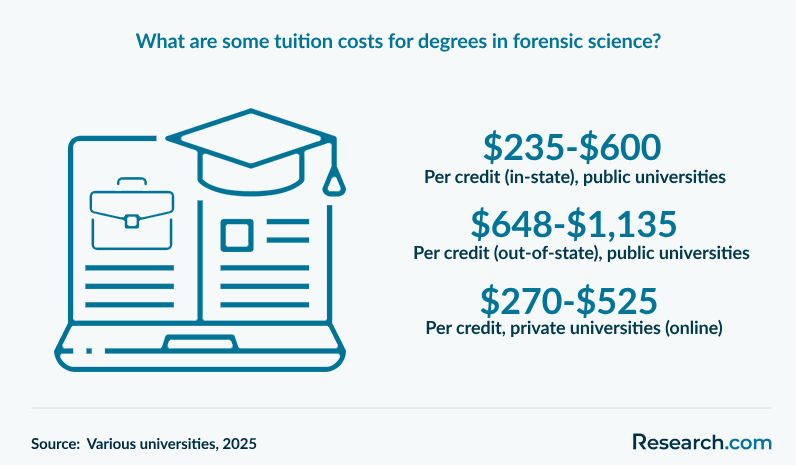
In general, public universities may be more affordable for in-state students, while private online universities sometimes offer more predictable pricing across states. Graduate study usually costs more per credit than undergraduate study, especially at public universities with separate in-state and out-of-state rates.
What are the financial aid options for students enrolling in a forensic science degree program?
Forensic science students should compare financial aid before ruling out a program based only on sticker price. The most useful approach is to calculate net cost after grants, scholarships, employer benefits, transfer credits, military benefits, and payment plans.
- Federal grants: Need-based aid, including Pell Grant funding, does not need to be repaid if eligibility rules are met.
- Federal student loans: Loans can help cover costs but must be repaid with interest, so students should borrow conservatively.
- State grants and loans: Many states provide education funding for residents attending eligible institutions.
- Scholarships: Awards may be based on academic performance, financial need, field of study, military status, public service goals, or demographic criteria.
- Work-study programs: Eligible students may earn money through part-time work while enrolled.
Completing the Free Application for Federal Student Aid (FAFSA) is usually the first step for federal, state, and institutional aid consideration. Students should also ask whether the online program qualifies for the same aid as the campus version.
Salary outcomes are another part of the affordability conversation. Salary.com data shown in the related graphic reports an average salary of $112,284 per year for Forensic Scientists. Location can change earning potential: Forensic Scientists in New York earn an average of $131,148 annually, while those in Connecticut and New Jersey earn $120,104 and $122,814, respectively. In Pennsylvania, the average salary is $111,378. Forensic Science Technicians have a national average of $65,376 per year, and New York-based technicians earn an average of $76,160.
These figures show why students should evaluate program cost against likely roles, regional hiring markets, and advancement options. Those interested in forensic technology leadership or cyber investigations may also want to understand what do you need to be a IT manager when comparing long-term career paths.
What are the prerequisites for enrolling in a forensic science degree program?
Admissions requirements vary by institution, degree level, and program focus. A science-heavy forensic science program may expect stronger preparation in lab sciences than a criminal justice or forensic psychology program.
- High school diploma or equivalent: This is typically required for bachelor's-level admission.
- Science and math background: Programs may look for coursework in biology, chemistry, physics, and mathematics.
- Minimum GPA: Some schools set GPA thresholds for admission or transfer students.
- Standardized test scores: SAT or ACT scores may be required by some institutions, depending on admissions policy.
- Letters of recommendation: Certain programs may request recommendations from teachers, counselors, supervisors, or academic references.
Applicants should ask admissions advisors whether additional requirements apply for internships, agency placements, laboratory access, background checks, or professional certification pathways.
What courses are typically in a forensic science degree program?
Forensic science curricula usually combine general education, natural sciences, criminal justice context, evidence procedures, ethics, and specialized forensic electives. The best curriculum for you depends on whether you want to work in a lab, at crime scenes, in digital investigations, in forensic psychology, or in a broader public safety role.
Core Courses
- Introduction to Forensic Science: Surveys the field, its history, major methods, and role in investigations and legal proceedings.
- Criminalistics: Covers crime scene procedures, evidence recognition, collection, preservation, and analysis.
- Forensic Biology: Applies biological science to DNA, serology, and biological evidence.
- Forensic Chemistry: Examines chemical testing related to drugs, toxicology, trace evidence, and unknown substances.
- Forensic Microscopy: Introduces microscopic analysis of hair, fibers, particles, and other trace materials.
- Legal and Ethical Issues in Forensic Science: Reviews chain of custody, expert testimony, professional responsibility, and legal standards. Students who want deeper legal procedure training may also compare affordable paralegal certificate options.
Advanced Courses
- Forensic Anthropology: Focuses on identifying and interpreting human skeletal remains.
- Forensic Entomology: Studies how insect evidence can contribute to investigations, including time-of-death estimates.
- Forensic Pathology: Examines investigation of sudden, unexpected, and violent deaths.
- Forensic Psychology: Connects psychology with criminal behavior, courts, correctional settings, and assessments. Students planning graduate study can compare cheap graduate programs in forensic psychology.
- Forensic Toxicology: Studies drugs, poisons, and their effects on the body.
- Advanced Crime Scene Investigation: Provides deeper training in scene documentation, reconstruction, and evidence processing.
Electives
- Firearms and Toolmark Examination: Covers the analysis of firearms, ammunition, and toolmarks.
- Document Examination: Introduces methods used to evaluate authenticity, alterations, and authorship.
- Fingerprint Analysis: Teaches principles of fingerprint detection, comparison, and identification.
- Forensic Photography: Explains photographic documentation for crime scenes, evidence, and reports.
- Digital Forensics: Covers recovery, preservation, and analysis of data from computers, mobile devices, and networks. Students who want deeper computing preparation may also review computer science degree online options.
According to the U.S. Bureau of Labor Statistics in 2024, California has 2,390 forensic science technician positions, Florida has 2,030 jobs, and Arizona has 860 jobs. These state-level differences can help students think strategically about internship location, relocation, and regional hiring markets.
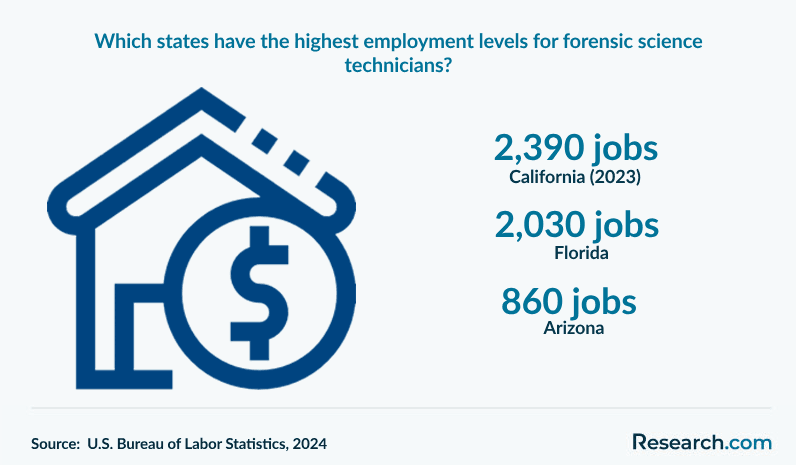
Large states may offer more positions because of population size, agency density, crime lab capacity, and public safety infrastructure. Still, students should not choose a school only because it is located in a high-employment state; online learners should ask how the program helps them access internships and employers in their own region.
What types of specializations are available in forensic science degree programs?
Specialization matters because forensic science is not one job. A student trained in forensic psychology is preparing for a different path than a student trained in DNA analysis or digital evidence. Before choosing a concentration, compare the science requirements, career fit, and whether graduate study or certification may be needed.
| Specialization | Primary Focus | Potential Work Settings |
| Forensic Biology | DNA, serology, blood, hair, and biological evidence | Crime labs, identification units, criminal investigations |
| Forensic Chemistry | Drug analysis, toxicology, trace evidence, chemical testing | Crime labs, medical examiner offices, environmental agencies |
| Forensic Anthropology | Human skeletal remains and identification | Law enforcement, human rights investigations, disaster response, research |
| Forensic Entomology | Insect evidence and investigative timelines | Medical examiner offices, law enforcement agencies, research institutions |
| Forensic Pathology | Sudden, unexpected, and violent death investigation | Medical examiner or coroner systems, death investigation settings |
| Forensic Psychology | Behavior, mental state, legal decision-making, offender assessment | Courts, correctional settings, law enforcement support, mental health organizations |
| Digital Forensics | Computers, mobile devices, networks, cybercrime, and electronic evidence | Law enforcement, cybersecurity firms, corporate investigations, private consulting |
How are emerging technologies integrated into forensic science degree programs?
Forensic education increasingly includes digital tools, virtual simulations, data analysis, and technology-supported evidence processing. Programs may use virtual laboratories, simulated crime scenes, digital evidence exercises, pattern-recognition tools, and interdisciplinary coursework connecting forensic science with cybersecurity or data analytics.
Students should look beyond marketing language and ask what tools they will actually use, how often they will practice, whether faculty have current field experience, and whether the program includes projects that resemble professional casework. Students comparing broad forensic education options can also review crime scene investigator colleges for additional program context.
How does one choose the best forensic science degree program?
The best forensic science program is the one that matches your target role, learning format, budget, and required hands-on experience. A low-cost program can be a poor investment if it lacks appropriate accreditation, weak science coursework, limited support, or no pathway to internships.
Questions to Ask Before Enrolling
| Question | Why It Matters |
| Is the institution accredited, and is the forensic program recognized by relevant bodies? | Accreditation affects credit transfer, aid eligibility, employer recognition, and sometimes certification pathways. |
| Does the curriculum match my intended job? | Crime scene, lab, digital, psychology, and criminal justice careers require different preparation. |
| How are labs handled online? | Virtual labs may be useful, but some roles benefit from in-person lab work, internships, or residencies. |
| Who teaches the courses? | Faculty with field, lab, research, or agency experience can improve career relevance. |
| Are internships or local placements available? | Applied experience can strengthen resumes and clarify career direction. |
| What is the total cost after fees and transfer credits? | The lowest per-credit tuition is not always the lowest total cost. |
| What career services are available to online students? | Remote learners need access to advising, resume help, interview prep, and employer connections. |
Accreditation should be a first filter. Programs accredited by reputable institutional accreditors, and where relevant by the Forensic Science Education Programs Accreditation Commission (FEPAC), provide stronger quality signals. Even cheap accredited online bachelor degree programs should be evaluated for curriculum depth, faculty expertise, and outcomes, not price alone. Students can also use affordable accredited bachelor's options as a starting point for comparison.
What career paths are available for graduates of forensic science degree programs?
Forensic science graduates can pursue multiple roles, but job titles are not always standardized across employers. Some positions require a bachelor's degree in a natural science, some prioritize criminal justice or investigative experience, and some require advanced education or medical training.
| Career Path | Main Responsibilities | Important Preparation |
| Forensic Science Technician | Collect, test, analyze, and interpret evidence in labs or field settings | Science coursework, lab methods, evidence procedures, report writing |
| Crime Scene Investigator | Document scenes, photograph evidence, collect materials, prepare diagrams and reports | Crime scene processing, evidence handling, photography, legal procedure |
| Forensic Biologist | Analyze biological evidence such as DNA, blood, and hair | Biology, genetics, molecular methods, laboratory quality standards |
| Forensic Chemist | Test drugs, toxins, explosives, and trace chemical evidence | Chemistry, instrumental analysis, toxicology, lab safety |
| Forensic Toxicologist | Evaluate the effects of drugs and poisons in the body | Toxicology, chemistry, biology, medical examiner or laboratory procedures |
| Forensic Anthropologist | Analyze skeletal remains for identification and investigative context | Anthropology, osteology, anatomy, research methods |
| Forensic Entomologist | Use insect evidence to support investigative timelines and case analysis | Entomology, biology, death investigation methods |
| Forensic Pathologist | Investigate sudden, unexpected, and violent deaths through autopsy and medical analysis | Medical education and specialized pathology training |
| Forensic Psychologist | Apply psychology to legal questions, assessments, testimony, and correctional issues | Psychology training; advanced education may be required for many roles |
| Digital Forensic Analyst | Recover and analyze evidence from computers, mobile devices, and networks | Digital forensics, cybersecurity, legal procedure, technical tools |
Students pursuing digital forensic roles may supplement degree study with online cybersecurity courses, especially when they need skills in networks, threat analysis, or incident response.
In 2020, local governments employed 9,970 forensic science technicians, while state governments employed 4,630. Other employment settings included architectural, engineering, and related services with 550 jobs, medical and diagnostic laboratories with 510 jobs, and colleges, universities, and professional services with 230 jobs.
What is the job market for graduates with a forensic science degree?
The job market for forensic science graduates is promising but competitive. Students should prepare for selective hiring, background checks, technical assessments, and strong competition for popular roles such as DNA analysis and crime scene investigation.
According to the Bureau of Labor Statistics (BLS), the median annual pay for forensic science technicians in 2023 was $64,940, or $31.22 per hour. A bachelor's degree is typically required for entry-level positions, and moderate-term on-the-job training is common. In 2023, there were approximately 18,600 forensic science technician jobs in the U.S. The BLS projects 14% growth from 2023 to 2033, much faster than the average for all occupations, with about 2,500 new jobs expected in the field.
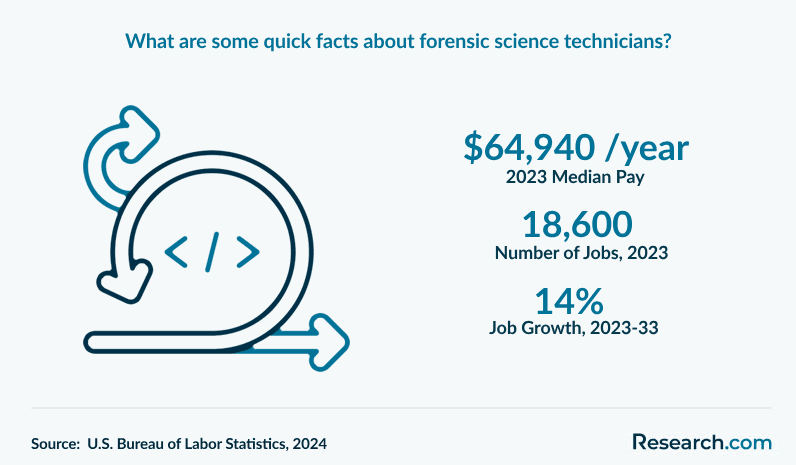
Students can improve their competitiveness by building laboratory skills, completing internships, learning digital evidence tools, developing strong technical writing, and choosing a specialization that aligns with employer demand in their region.
What challenges do online forensic science students face?
Online forensic science can be flexible, but it requires discipline and careful program selection. The biggest challenges usually involve hands-on practice, time management, technology access, and building professional networks remotely.
- Limited physical lab access: Some online programs rely heavily on simulations, which may not fully replace in-person lab work for certain roles.
- Scheduling pressure: Many online learners balance coursework with work, family, military service, or public safety shifts.
- Technology requirements: Digital labs, proctoring systems, specialized software, and stable internet access may be required.
- Networking barriers: Remote students must be proactive about faculty contact, internships, professional associations, and virtual events.
- Funding complexity: Students should confirm aid eligibility and compare programs that participate in federal aid. One place to start is reviewing online schools that accept financial aid.
What professional certifications can further elevate your forensic science career?
Professional certifications can help demonstrate specialized competence, but they are not a substitute for a credible degree, appropriate science training, or field experience. Certification requirements vary by organization and may include education, professional experience, examinations, ethics standards, and continuing education.
Before pursuing a credential, ask whether it is recognized by employers in your target field, whether you meet eligibility rules, how much preparation costs, and what recertification requires. Working professionals who need flexible continuing education may compare certification preparation with broader online degree programs for adults.
Is an Advanced Degree Essential for Forensic Innovation?
An advanced degree is not required for every forensic science career, but it can matter for research, leadership, teaching, specialized laboratory roles, policy work, and highly technical areas. A master's degree may be useful for advancement, while a doctoral degree is more relevant for research-intensive or academic careers.
Students considering doctoral study should evaluate whether the credential is necessary for their target role, whether the research focus is relevant, and whether the cost aligns with expected career benefits. Cost-conscious learners can compare cheap PhD programs online with traditional doctoral options.
Can accelerated online programs fast-track forensic science careers?
Accelerated online programs can shorten the path to a credential, but they are not automatically better. Condensed courses require strong time management, consistent study habits, and the ability to absorb technical material quickly. Forensic science students should be especially cautious if acceleration reduces lab practice, internship access, or science depth.
Accelerated formats may work well for students with transfer credits, prior professional experience, or clear career goals. Those comparing speed and career value can review quick online degrees that pay well for broader context.
Is starting with the easiest bachelor's degree a smart move for aspiring forensic scientists?
Choosing an easier bachelor's program may help some students begin college, but aspiring forensic scientists should not choose convenience at the expense of required science preparation. Laboratory and technical roles often demand coursework in biology, chemistry, mathematics, evidence analysis, and research methods.
A more accessible bachelor's degree can be reasonable if it still builds the foundation needed for graduate forensic study or related criminal justice work. Students weighing academic difficulty, flexibility, and long-term goals may review the easiest bachelor's degree to get while confirming that the curriculum supports forensic career requirements.
Can pursuing an advanced online degree accelerate career growth in forensic science?
An advanced online degree can support career growth when it adds specialized expertise, research training, leadership skills, or technical depth that employers value. It is most useful for professionals who already know the kind of forensic work they want to pursue.
Before enrolling, compare faculty expertise, lab or research expectations, employer recognition, cost, and whether the program helps you move into a specific role. Students seeking a shorter graduate route can compare options such as the fastest online masters degree with more traditional master's formats.
Is a Doctoral Degree Necessary to Advance Your Forensic Science Career?
A doctoral degree is usually not necessary for entry-level forensic science jobs. It may be valuable for professionals pursuing university teaching, advanced research, senior scientific leadership, forensic policy development, or highly specialized expert roles.
Because doctoral study requires a major commitment, students should confirm that the credential fits their career plan. Those who need a time-conscious pathway can explore the shortest doctorate degree options while carefully checking rigor, accreditation, dissertation or project requirements, and employer relevance.
What complementary academic paths can enhance your forensic science career?
Forensic science is increasingly interdisciplinary. Students can strengthen their profile by adding coursework in cybersecurity, data analytics, computer science, legal studies, psychology, biology, chemistry, statistics, public health, or information management, depending on their target role.
For example, digital forensics benefits from computing and cybersecurity, forensic psychology benefits from psychology and legal studies, and laboratory roles benefit from deeper biology or chemistry training. Students still exploring their academic direction can compare different majors in college before committing to a specialized track.
Common Mistakes When Choosing an Online Forensic Science Degree
| Mistake | Why It Can Hurt You | Better Approach |
| Choosing only by lowest tuition | A cheap program may lack labs, internships, career support, or relevant coursework. | Compare total cost, accreditation, curriculum, support, and career fit together. |
| Ignoring accreditation | Credits may not transfer, aid may be limited, and employers may question the credential. | Verify institutional accreditation and any relevant program-level recognition. |
| Assuming every forensic program is science-based | Some programs focus more on criminal justice, psychology, or cybersecurity than laboratory science. | Read the course list and match it to your intended role. |
| Overlooking hands-on requirements | Virtual-only practice may not be enough for some lab or crime scene roles. | Ask about labs, simulations, residencies, internships, and local placements. |
| Assuming salary outcomes are guaranteed | Pay depends on location, employer, experience, specialization, and job title. | Use salary data as a benchmark and research roles in your region. |
| Relying only on rankings | A highly ranked school may not offer the specialization or format you need. | Use rankings as one tool, then evaluate fit and outcomes. |
How do online forensic science programs support career development?
Strong online forensic science programs do more than deliver courses. They help students translate academic work into employable skills through advising, resume support, internship guidance, virtual career fairs, mentorship, alumni connections, and preparation for interviews or technical assessments.
Career support is especially important for online students because internships and networking may not happen automatically. Ask whether online learners receive the same services as campus students, whether the school has relationships with agencies or laboratories, and whether faculty can help identify local opportunities. Students comparing value-focused schools may start with the most affordable online colleges and then narrow the list by forensic career support.
What accreditation standards should you consider for online forensic science programs?
Accreditation is one of the most important quality checks for an online forensic science program. Institutional accreditation helps signal that a school meets recognized academic standards and can affect federal financial aid eligibility, credit transfer, graduate admissions, and employer confidence.
For forensic science specifically, students should also look for program-level quality indicators, including alignment with FEPAC standards where applicable, rigorous science coursework, qualified faculty, documented lab experiences, and clear learning outcomes. Many established programs are offered by non profit online colleges, but students should still verify accreditation directly through official accreditor or school sources.
Key Insights
- An online forensic science degree can be worthwhile if it combines flexibility with credible accreditation, strong science coursework, practical evidence training, and career support.
- Program titles matter. Forensic science, forensic investigation, crime science, forensic psychology, criminal justice, cybersecurity, and digital forensics prepare students for different roles.
- California leads the nation in jobs for forensic science technicians with 2,390 positions, followed by Florida with 2,030 jobs and Arizona with 860 jobs, according to U.S. Bureau of Labor Statistics data cited for 2024.
- Most forensic science technicians work in government settings, including 9,970 jobs in local government and 4,630 jobs in state government, based on U.S. Bureau of Labor Statistics data cited for 2020.
- The Bureau of Labor Statistics reported median annual pay of $64,940 for forensic science technicians in 2023 and projected 14% job growth from 2023 to 2033.
- Salary.com reported an average salary of $112,284 for Forensic Scientists and $65,376 for Forensic Science Technicians, with location-based differences such as $131,148 for Forensic Scientists in New York.
- Tuition varies widely: undergraduate public university rates range from $235 to $600 per credit hour for in-state students and $648 to $1,135 for out-of-state students, while private online undergraduate rates range from $270 to $525 per credit hour.
- Do not choose a program based only on price or ranking. Confirm accreditation, lab quality, transfer credit policy, total cost, internships, specialization, and whether the degree aligns with your intended forensic career.
References:
- Bureau of Labor Statistics. (2023). Forensic science technicians: Occupational outlook handbook. Bureau of Labor Statistics.
- Bureau of Labor Statistics. (2023). Forensic science technicians - Bureau of Labor Statistics. Bureau of Labor Statistics.
- Data USA. (2024). Forensic science & technology. Data USA.
- Salary.com. (2024). Forensic scientist salary in Connecticut. Salary.com.
- Salary.com. (2024). Forensic scientist salary in New Jersey. Salary.com.
- Salary.com. (2024). Forensic scientist salary in New York, NY. Salary.com.
- Salary.com. (2024). Forensic scientist salary in Pennsylvania. Salary.com.
- Salary.com. (2025). Forensic scientist salary. Salary.com.
- Salary.com. (2025). Forensic science technician salary. Salary.com.
- Statista. (2019). U.S. forensic science technician employment, by metro area 2019. Statista.
- Statista. (2020). Number of forensic science technicians by industry U.S. 2020. Statista.
- Statista. (2021). Number of forensic science technicians employed in the United States in 2020, by industry. Statista.
Other Things You Should Know About Forensic Science Degree Programs
Most online forensic science degrees require some hands-on laboratory work, usually through on-campus lab intensives, approved local lab partners, or at-home kits. Programs commonly expect 3 to 8 lab credits in biology, chemistry, or forensic methods before graduation.
Consider program accreditation, course curriculum, and tuition fees when selecting a program in 2027. Look for schools with strong industry connections for internships and job placements. Additionally, review student support services and faculty qualifications to ensure a comprehensive educational experience.
Technical skills essential for success in an online forensic science degree program in 2027 include proficiency in digital forensics software, data analysis tools, and crime scene reconstruction software. Familiarity with laboratory information management systems (LIMS) and knowledge of database management will also be highly beneficial.


