2027 How to Become an IT Manager

Co-Founder and Chief Data Scientist
How to Become an IT Manager: Practical 2026 Career Guide
Becoming an IT manager is not just about being the most technical person on a team. The role sits at the intersection of technology, business operations, cybersecurity, budgeting, vendor management, and people leadership. Organizations depend on IT managers to keep systems reliable, secure data, guide technology investments, and help employees use technology effectively.
This guide is for help desk specialists, systems administrators, network engineers, cybersecurity analysts, software professionals, and degree-seeking students who want to move into IT leadership. You will learn what IT managers do, how long the career path usually takes, which degrees and certifications can help, what skills employers look for, where the jobs are, how much IT managers earn, and what mistakes to avoid before investing time and money in this career path.
Quick Answer: How Do You Become an IT Manager?
Most IT managers build their careers through a combination of a technology-related bachelor’s degree, several years of hands-on IT experience, leadership responsibilities, and job-relevant certifications. The typical path takes 5–10 years. Some professionals move faster by taking on project leadership, earning respected credentials, and learning how to connect technology decisions to business goals.
Key Things You Should Know About Becoming an IT Manager
- An IT manager oversees an organization’s technology infrastructure and makes sure systems, networks, applications, and support functions run securely and efficiently.
- The career path commonly takes 5–10 years, depending on education, prior experience, leadership opportunities, and the size of the organization.
- 93% of IT managers and decision-makers have at least one certification, which shows how common credentials are in technology leadership roles.
- IT leaders face real operational pressure: 31% cite resource and budget constraints as a major challenge, another 31% point to heavy workloads, 27% name talent retention, and 26% identify talent recruitment as a key concern.
- Employment for IT managers in the United States is projected to grow 17% from 2023 to 2033.
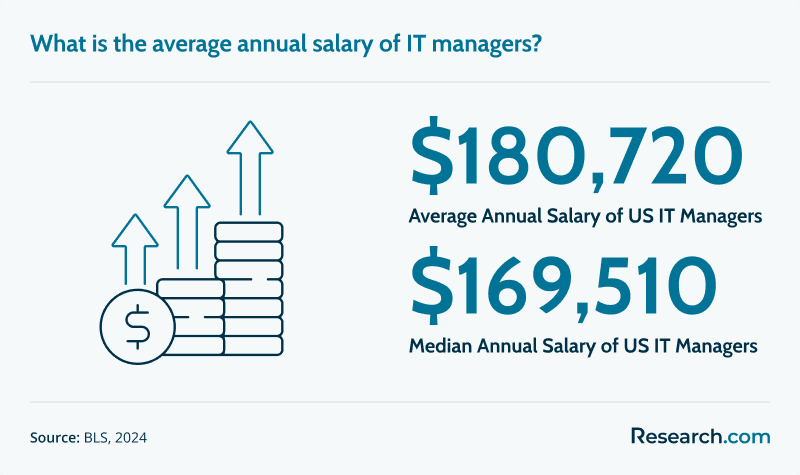
- The average annual salary for IT managers in the United States is $180,720, while the median annual salary is $169,510.
- Job satisfaction can be strong in this field: 36% of these professionals are “extremely satisfied” and 40% are “somewhat satisfied” with their jobs.
- What does an IT manager do?
- How to Become an IT Manager
- How long does it take to become an IT manager?
- Where do IT managers work?
- What are the ideal IT management certifications to obtain?
- What are the most important IT manager skills?
- What are the biggest challenges IT managers face?
- How can IT managers leverage emerging technology trends?
- How can IT managers accelerate their professional development and networking?
- Should I pursue a graduate degree to enhance my IT management career?
- How can IT managers improve their cybersecurity skills?
- Are affordable online IT degrees a viable pathway for advancing IT management careers?
- Can pursuing specialized online degrees enhance IT management skills?Related online IT degree option
- How can interdisciplinary technical degrees enhance IT management expertise?
- How can affordable online educational programs support IT management careers?
- How can IT managers effectively lead remote or hybrid teams?
- Which IT certifications lead to the highest earning potential?
- What are the best entry-level jobs for aspiring IT managers?
- What is the job outlook for IT managers?
- What is the average salary of IT managers?
- What are the best IT management software tools?
What does an IT manager do?
An IT manager, also known in federal labor data as a computer and information systems manager, leads the people, systems, processes, and policies that keep an organization’s technology environment running. The job can include infrastructure planning, cloud administration, cybersecurity coordination, vendor selection, budgeting, help desk oversight, disaster recovery planning, compliance support, and technology project delivery.
In smaller organizations, an IT manager may be deeply involved in day-to-day technical work. In larger companies, the role may focus more on strategy, team leadership, vendor management, governance, and communication with executives. Either way, the core responsibility is the same: make sure technology supports the organization’s goals without creating unnecessary risk, downtime, or cost.
Core IT Manager Responsibilities
| Responsibility Area | What It Involves | Why It Matters |
| Team leadership | Supervising IT staff, assigning work, coaching employees, setting priorities, and building team capability. | Technology performance depends heavily on how well the IT team communicates, solves problems, and executes under pressure. |
| Strategic planning | Creating IT roadmaps, preparing budgets, selecting scalable systems, and aligning technology investments with business needs. | Good IT decisions reduce waste and help organizations adopt tools that support long-term growth. |
| Cybersecurity | Coordinating security controls, monitoring risks, enforcing policies, and supporting compliance requirements. | IT managers help protect data, systems, users, and business continuity from security incidents. |
| IT operations | Overseeing hardware, software, cloud services, networks, endpoints, and support processes. | Reliable operations reduce downtime and keep employees productive. |
| Project leadership | Managing system upgrades, migrations, digital transformation efforts, security improvements, and vendor implementations. | Many IT initiatives fail when schedules, budgets, risks, and users are not managed carefully. |
| Cross-functional collaboration | Working with finance, HR, operations, legal, clinical, academic, or customer-facing departments to solve business problems through technology. | IT managers must translate technical options into practical decisions for nontechnical stakeholders. |
IT management can also intersect with specialized fields. For example, professionals who want to connect healthcare data, patient care workflows, and technology may compare the cheapest online nursing informatics degree programs as one way to prepare for roles that blend clinical knowledge and information systems.
The chart below shows the US sectors that employ the most IT managers.
How to Become an IT Manager
The path to IT management is usually gradual. Employers generally want evidence that you can solve technical problems, communicate with users and executives, manage projects, protect systems, and lead people. A degree can help open doors, but experience and leadership results are usually what move a candidate from technical contributor to manager.
Step-by-Step Path to IT Management
- Build a formal technical foundation. Many IT managers start with a bachelor’s degree in information technology, computer science, information systems, cybersecurity, or a related field. A master’s degree, such as information systems or a technology-focused MBA, can be useful for professionals targeting senior management, director, or executive-track roles. Distance learners comparing business and systems leadership options may look at online MBA management information systems programs. Those exploring technology in military or healthcare settings may also want to understand what are the requirements to be a military nurse, since military healthcare roles can involve specialized systems, compliance, and operational technology environments.
- Get practical IT experience. Early experience matters. Entry-level roles in help desk support, systems administration, networking, cloud support, cybersecurity, database administration, software development, or technical operations help you understand how systems actually behave in production environments. Internships, freelance projects, lab work, shadowing, and industry seminars can also strengthen your practical judgment.
- Take on project responsibility before seeking people management. Before managing a team, try to lead a migration, support a rollout, coordinate a security improvement, document a process, or run a small cross-functional project. These assignments show whether you can plan, communicate, manage deadlines, and handle competing priorities.
- Develop leadership skills deliberately. Technical ability alone rarely makes someone an effective IT manager. Work on delegation, coaching, conflict resolution, documentation, stakeholder communication, budget awareness, and decision-making. Seek roles that expose you to operations, project coordination, business analysis, team leadership, or vendor management.
- Consider an IT support role if you need a starting point. Help desk and support positions can be valuable because they teach troubleshooting, user communication, documentation, escalation, and service delivery. Certifications such as Microsoft Technology Associate, CompTIA A+, and Apple Certified Support Professional can support early-career credibility. Professionals interested in technology-supported services for aging populations may also explore affordable online gerontology master’s degree programs for broader healthcare, policy, and administration context.
- Update your resume around leadership outcomes. A management resume should not read like a list of tools. Show results: uptime improvements, successful deployments, reduced ticket backlogs, cost savings, compliance improvements, documentation created, teams trained, or projects delivered.
- Move from technical execution to management thinking. The transition to IT manager requires a shift from “I fix the problem” to “I build the system, team, and process that prevent or resolve the problem reliably.” You will need to manage direct reports, negotiate priorities, communicate trade-offs, and understand company culture. If you are comparing technology leadership with other professional routes, you may also ask about the requirements to be an audiologist, a healthcare path that requires a doctoral degree, clinical training, and state licensure to diagnose and treat hearing disorders.
Career Path Timeline for Aspiring IT Managers
| Career Stage | Typical Focus | Best Moves |
| Student or career changer | Learning technical fundamentals and building proof of ability. | Complete coursework, labs, internships, entry-level certifications, and small projects. |
| Entry-level IT professional | Solving user, system, network, software, or security problems. | Document accomplishments, learn ticketing systems, improve troubleshooting, and volunteer for team initiatives. |
| Mid-level technical specialist | Owning systems, leading technical improvements, and coordinating with stakeholders. | Lead projects, mentor junior staff, study project management, and develop business communication skills. |
| Team lead or project lead | Managing tasks, priorities, timelines, risk, and informal leadership responsibilities. | Build budgeting awareness, improve reporting, and learn how managers measure IT performance. |
| IT manager | Leading teams, budgets, operations, security priorities, projects, and vendor relationships. | Strengthen strategic planning, governance, executive communication, and workforce development. |
How long does it take to become an IT manager?
The path to becoming an IT manager typically takes 5-10 years. Many professionals begin with a four-year IT-related bachelor’s degree and then move through technical roles such as systems analyst, network engineer, cybersecurity analyst, systems administrator, database administrator, or IT project coordinator.
Some candidates advance faster because they work in high-growth organizations, volunteer for difficult projects, build strong internal networks, and show leadership early. Others take a longer route because they choose to deepen technical specialization before managing people. Both routes can work. The better question is not only how fast you can become a manager, but whether you have enough technical credibility, business awareness, and leadership maturity to succeed once you get there.
What Can Speed Up the Timeline?
- Leading projects that affect multiple departments.
- Earning certifications that match your target role, such as project management, cybersecurity, IT service management, cloud, or enterprise architecture credentials.
- Mentoring junior employees and documenting repeatable processes.
- Learning how budgets, vendors, risk, compliance, and service-level expectations shape IT decisions.
- Building communication skills for both technical and nontechnical audiences.
Where do IT managers work?
IT managers are needed in nearly every sector because most organizations rely on secure networks, cloud services, business applications, data systems, user support, and digital workflows. The exact role can vary by industry: a hospital IT manager may focus heavily on electronic health records and compliance, while an e-commerce IT manager may prioritize uptime, data security, inventory systems, and customer-facing platforms.
| Work Setting | Common IT Management Priorities |
| Corporate organizations | Managing internal infrastructure, user support, enterprise applications, procurement, and business continuity. |
| Technology companies | Supporting development environments, cloud operations, security, product infrastructure, and technical teams. |
| Government agencies | Maintaining secure systems, supporting public services, managing compliance, and modernizing legacy infrastructure. |
| Education | Supporting learning platforms, campus networks, student information systems, cybersecurity, and digital access. |
| Healthcare | Managing electronic health records, security, HIPAA-related requirements, clinical systems, and uptime for patient care environments. |
| Finance | Overseeing data protection, fraud prevention systems, regulatory requirements, business applications, and financial technology tools. |
| E-commerce and retail | Keeping online stores, payment systems, customer databases, inventory platforms, and analytics tools secure and available. |
| Consulting | Helping clients improve IT strategy, implement systems, strengthen cybersecurity, and optimize infrastructure. |
What are the ideal IT management certifications to obtain?
Certifications are not a substitute for leadership experience, but they can validate important skills and help employers understand your strengths. The best certification depends on the type of IT manager role you want: infrastructure, cybersecurity, project delivery, service management, enterprise architecture, or general IT leadership.
| Certification | Best For | How It Helps an IT Manager |
| Certified Associate in Project Management (CAPM) | Professionals building project management fundamentals. | Shows basic knowledge of project planning, scheduling, risk, and coordination. |
| Project Management Professional (PMP) | Experienced professionals responsible for complex projects. | Signals the ability to lead project teams and deliver initiatives across business environments. |
| Information Technology Infrastructure Library (ITIL) | IT service management and operations leaders. | Supports better incident, problem, change, and service request processes. |
| Certified Information Technology Manager (CITM) | IT professionals moving into management roles. | Focuses on team, resource, project, and technology management responsibilities. |
| Six Sigma Certification | Managers focused on process improvement. | Helps IT leaders reduce inefficiency, improve workflows, and analyze operational performance. |
| TOGAF 9 | Enterprise architecture and strategy roles. | Helps managers connect systems architecture with business objectives and cross-functional communication. |
| Certified Information Systems Security Professional (CISSP) | Security-focused IT leaders. | The CISSP certification validates knowledge of risk management, security operations, compliance, and enterprise security practices. |
| CompTIA Project+ | Early-career professionals coordinating IT projects. | Covers practical project concepts useful for IT project support and team coordination. |
| Certified Information Security Manager (CISM) | Professionals leading enterprise security programs. | Emphasizes governance, risk management, incident response, and security leadership. |
| Information Technology Management and Leadership Professional (ITMLP) | Aspiring IT leaders. | Combines leadership concepts with IT management responsibilities and business alignment. |
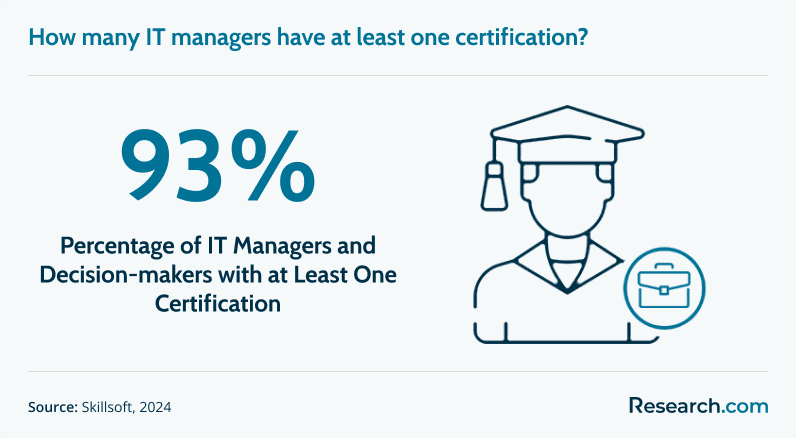
Certifications are common among IT leaders. According to Skillsoft's report, 93% of IT managers and decision-makers have at least one certification. Before choosing one, compare the credential’s relevance to your target job, the experience level expected, renewal requirements, employer recognition, and whether it supports the work you actually want to do.
What are the most important IT manager skills?
Successful IT managers combine technical credibility with the ability to lead people and make business-centered decisions. They do not need to be the deepest expert in every tool, but they must understand enough to evaluate risks, ask the right questions, support their teams, and explain technology decisions clearly.
Essential Technical Skills for IT Managers
- Networking: IT managers need a working understanding of protocols, TCP/IP, architecture, subnetting, routing, switching, monitoring, and troubleshooting so they can evaluate network reliability and security decisions.
- Cybersecurity: Managers must understand security controls, firewalls, access management, intrusion detection, encryption, user authentication, incident response, and compliance expectations. Professionals who want to specialize in security rather than broader IT operations can compare the best and easiest cybersecurity programs.
- Database management: Familiarity with systems such as MySQL, Oracle, and SQL Server helps managers oversee data storage, security, backups, performance, and access.
- Cloud computing: Knowledge of AWS, Azure, GCP, virtualization, storage, scalability, cost controls, and deployment models is increasingly important for infrastructure and operations leadership.
- Project management: IT managers often use tools and methods such as Microsoft Project, Jira, Trello, Asana, Agile, Scrum, and structured risk tracking. Students who want deeper graduate preparation in this area may consider master in project management online programs.
Important Soft Skills for IT Managers
- Leadership: Managers need to set direction, support team members, delegate effectively, coach employees, and create a work environment where technical staff can perform well.
- Communication: IT leaders must translate technical details into business language, write clearly, present options, and communicate urgency without creating confusion.
- Problem-solving: Managers need to diagnose root causes, separate symptoms from systemic issues, and guide teams toward durable fixes.
- Decision-making: IT management involves trade-offs among cost, security, speed, reliability, user experience, and business impact.
- Strategic thinking: Strong managers connect IT investments to organizational goals instead of treating technology as a disconnected support function.
According to recent data by Zippia, the most common skills on the resumes of IT managers in the United States are customer service (11.9%), project management (9.2%), database (4.3%), network infrastructure (4%), SAN (2.8%), SQL server (2.8%), and disaster recovery (2.7%).
What are the biggest challenges IT managers face?
IT management can be rewarding, but it is not a low-pressure role. According to a recent report by Skillsoft, 31% of IT managers and decision makers cite resource and budget constraints as a key challenge; another 31% report heavy workloads, 27% identify talent retention, and 26% point to talent recruitment as the largest concern.
| Challenge | Why It Creates Pressure | What Strong IT Managers Do |
| Resource and budget constraints | Limited funding can delay upgrades, training, hiring, security improvements, and modernization projects. | Prioritize risk-based investments, document business cases, negotiate vendor value, and show the cost of inaction. |
| Heavy workloads | IT teams often handle support tickets, outages, security alerts, upgrades, audits, and strategic projects at the same time. | Clarify priorities, automate repeatable work, improve escalation paths, and protect teams from avoidable burnout. |
| Talent retention | Turnover disrupts service continuity and drains institutional knowledge. | Create development plans, recognize strong work, improve documentation, and offer growth opportunities when possible. |
| Talent recruitment | Hiring qualified IT professionals can be difficult when required skills are specialized or competition is high. | Work with HR on realistic job descriptions, identify trainable candidates, and build internal upskilling paths. |
| Innovation and change management | New tools can improve performance, but rushed changes may create disruption, confusion, or security gaps. | Use change controls, pilot programs, communication plans, training, and post-implementation reviews. |
| Team development | Unclear roles, skill gaps, and weak communication can slow response times and project delivery. | Define responsibilities, cross-train staff, document processes, and build a culture of collaboration and accountability. |
| Fast execution without quality loss | Executives may want rapid delivery while security, testing, and documentation still require attention. | Use risk assessments, phased rollouts, realistic timelines, and clear reporting on trade-offs. |
Common Mistakes Aspiring IT Managers Should Avoid
- Assuming technical skill is enough. Management requires planning, coaching, prioritization, budgeting, and conflict resolution.
- Ignoring cybersecurity until there is an incident. Security should be built into operations, procurement, training, and project planning.
- Choosing a degree or certificate without checking fit. Make sure the program supports your target role, schedule, budget, and experience level.
- Focusing only on tuition. Also consider fees, books, certification exam costs, time away from work, transfer credit policies, and employer tuition support.
- Relying only on rankings. Rankings can be useful, but they do not replace accreditation checks, curriculum review, career support, faculty expertise, and employer recognition.
- Assuming salary outcomes are guaranteed. Pay varies by industry, geography, experience, company size, technical specialization, and leadership scope.
- Moving into management before learning how the business works. IT managers need to understand how technology affects revenue, operations, compliance, users, and customers.
How can IT managers leverage emerging technology trends?
IT managers can use emerging technologies by evaluating them through a business and risk lens rather than adopting tools because they are fashionable. Artificial intelligence, machine learning, automation, advanced analytics, and cloud-native systems can improve service delivery, monitoring, forecasting, resource allocation, and user support when they solve a real operational problem.
Practical adoption starts with small pilots, clear success measures, security review, user training, governance, and cost monitoring. Managers should also prepare teams for changing workflows. Professionals who want deeper academic preparation in intelligent systems may consider an online AI degree to understand how AI tools can support digital transformation, analytics, and automation initiatives.
How can IT managers accelerate their professional development and networking?
IT managers grow faster when they combine formal learning with visible leadership practice. Useful development activities include earning role-relevant certifications, attending industry conferences, joining professional communities, finding mentors, participating in cross-functional projects, and studying how senior leaders make technology investment decisions.
Networking should not be limited to job searching. It can help managers compare practices, learn from incidents in other organizations, find vendors, identify hiring trends, and build credibility in specialized areas. For a broader view of lucrative technology career options, review the highest paying computer science jobs.
Should I pursue a graduate degree to enhance my IT management career?
A graduate degree can be worthwhile if it fills a clear gap: advanced technical depth, business leadership, data strategy, cybersecurity management, enterprise systems, or executive communication. It may be especially useful for professionals targeting senior manager, director, chief information officer, consulting, or specialized technical leadership roles.
Before enrolling, compare the curriculum against your target job descriptions. Ask whether the program includes practical projects, leadership coursework, cloud or security content, analytics, and flexible scheduling for working professionals. An online master computer science can be a strong fit for managers who want advanced technical preparation while continuing to work.
How can IT managers improve their cybersecurity skills?
Cybersecurity is now a core IT management responsibility, even for managers who do not carry a security-specific title. IT leaders should understand risk assessment, access control, incident response, vulnerability management, employee training, third-party risk, backup strategy, and compliance requirements relevant to their industry.
Practical ways to improve include reviewing real incident reports, joining security communities, running tabletop exercises, partnering with security specialists, earning security certifications, and building security checkpoints into every IT project. A cyber security degree online can help professionals develop structured knowledge in threat prevention, detection, response, and governance.
Are affordable online IT degrees a viable pathway for advancing IT management careers?
Affordable online IT degrees can be a practical option for working professionals who need flexibility, want to reduce education costs, or cannot relocate for campus-based study. The key is to evaluate quality, not just price. Look for relevant coursework, qualified instructors, hands-on projects, career support, transfer credit policies, and alignment with your target role.
Programs in information technology, information systems, cybersecurity, cloud computing, and computer science can all support an IT management path when paired with experience. Comparing affordable online IT degrees can help aspiring managers find programs that strengthen technical foundations and leadership readiness without overextending their budgets.
Can pursuing specialized online degrees enhance IT management skills?
Specialized online degrees can help when they match the environment you want to manage. For example, a manager in gaming, simulation, interactive media, or entertainment technology may benefit from understanding software design, development pipelines, user experience, and digital production workflows. In that case, a program such as the best program for game development may provide targeted knowledge beyond general IT administration.
The decision should be role-driven. If your goal is general infrastructure leadership, a broader IT, information systems, cybersecurity, or computer science program may be more useful. If your target industry has specialized technology needs, a focused degree can help you communicate better with technical teams and stakeholders.
How can interdisciplinary technical degrees enhance IT management expertise?
Interdisciplinary technical study can help IT managers understand complex environments where software, hardware, networks, systems, and physical infrastructure overlap. Electrical engineering, computer engineering, industrial systems, and related fields can strengthen analytical thinking and systems-level problem-solving.
This can be useful in manufacturing, telecom, energy, embedded systems, infrastructure-heavy organizations, and advanced technology companies. Professionals who want to expand beyond traditional IT may compare options such as the cheapest online master's electrical engineering to build a broader technical management toolkit.
How can affordable online educational programs support IT management careers?
Affordable online programs can support IT management careers by allowing professionals to continue working while developing stronger technical, analytical, and leadership skills. The best programs include applied projects, current technology topics, and assignments that connect theory to workplace problems.
When comparing options, ask whether the school is transparent about total cost, whether credits can transfer, whether the schedule fits working adults, and whether the curriculum supports your next role. Programs such as the cheapest online colleges for engineering may be relevant for professionals who want a rigorous technical background alongside management growth.
How can IT managers effectively lead remote or hybrid teams?
Remote and hybrid IT teams need more than video meetings. They need clear ownership, documented processes, secure access, reliable collaboration tools, performance expectations, escalation paths, and regular communication rhythms. IT managers should define how work is assigned, how incidents are escalated, how documentation is maintained, and how employees receive feedback.
Security also becomes more complex when teams and users are distributed. Managers should coordinate endpoint protection, identity management, remote access controls, cloud permissions, and user training. These leadership practices are useful across many technology-enabled industries, including flexible fields such as jobs in biotech.
Which IT certifications lead to the highest earning potential?
Certifications tied to cybersecurity, project management, cloud technologies, architecture, and enterprise leadership can strengthen earning potential when they match employer needs and are paired with experience. A certification alone does not guarantee a higher salary, but it can improve credibility for roles with greater responsibility.
Before investing, compare exam costs, preparation time, renewal requirements, employer recognition, and how often the credential appears in job postings for your target role. For a broader comparison of credentials associated with strong career outcomes, see What certificates make the most money?.
What are the best entry-level jobs for aspiring IT managers?
The best entry-level jobs for future IT managers are roles that build both technical judgment and communication skills. Try to choose jobs that expose you to users, systems, troubleshooting, documentation, security, projects, and cross-team collaboration.
| Entry-Level Role | What You Learn | Why It Helps Future IT Managers |
| IT Support Specialist | Help desk support, troubleshooting, user training, technical documentation, communication, and problem-solving. | This role teaches how users experience technology and how service quality affects the organization. |
| Junior Systems Administrator | Server administration, system monitoring, performance tuning, security, compliance, and maintenance. | It builds infrastructure knowledge that is essential for managing IT operations. |
| Entry-Level Network Administrator | Network setup, routing, switching, security monitoring, troubleshooting, and cloud networking fundamentals. | Network knowledge is valuable for managers overseeing uptime, connectivity, and security. Candidates focused on this route may explore 1 year computer science degree online programs. |
| IT Technician | Hardware diagnostics, repairs, operating systems, software troubleshooting, and IT asset management. | Hands-on repair and support work develops practical awareness of endpoints, infrastructure, and user environments. |
| Business Analyst with an IT Focus | Requirements gathering, process improvement, data analysis, reporting, and communication between IT and business teams. | This role is useful for future managers because it connects technology decisions to business needs. Professionals interested in analytics leadership may compare online MBA business analytics programs. |
| IT Project Coordinator | Scheduling, budgeting support, task tracking, Agile, Scrum, resource allocation, and team coordination. | Project coordination is one of the clearest bridges from technical work to management. |
| Junior Cybersecurity Analyst | Security monitoring, risk assessment, incident response, compliance, network security, and access management. | Security experience is valuable because IT managers are increasingly responsible for organizational risk. |
| Entry-Level Database Administrator | Database management, SQL, data security, backups, optimization, and disaster recovery planning. | Data integrity and availability are major operational priorities for many IT departments. |
| Cloud Support Associate | Cloud fundamentals, virtualization, scalability, security, compliance, and platform support. | Cloud experience prepares future managers for hybrid and multi-cloud operations. |
| Software Developer on an IT Management Track | Agile, DevOps, coding, debugging, software development lifecycles, and team collaboration. | Development experience helps managers lead in software-heavy organizations and communicate with engineering teams. |
What is the job outlook for IT managers?
IT management remains a strong career path in the United States. Considered one of the highest paying business jobs, the occupation benefits from organizations’ continued dependence on cloud systems, cybersecurity, data infrastructure, enterprise applications, and digital operations.
According to the United States Bureau of Labor Statistics (BLS), employment of IT managers is projected to grow 17% from 2023 to 2033, which is faster than the projected growth for operations specialties managers (12%) during the same period. The number of IT managers is expected to rise from 613,500 in 2023 to 720,400 by 2033.
During that same period, job seekers can expect 54,700 openings for IT management positions each year. Indeed reports over 9,000 current job openings for IT management roles across the country.
The states employing the most IT managers are California (98,430), Texas (62,620), New York (39,190), New Jersey (27,890), and Florida (27,110).
What is the average salary of IT managers?
According to the BLS, the average annual salary for IT managers in the United States is $180,720, while the median annual salary is $169,510. Salaries can vary significantly by state, industry, organization size, leadership scope, technical specialization, and years of experience.
The highest-paying states by average annual salary are California ($217,030), New York ($213,930), Washington ($207,390), New Jersey ($205,120), and Delaware ($196,630).
The industries with the highest average yearly salaries, as shown in the chart below, are web search portals and other information services ($270,580), computer and peripheral equipment manufacturing ($250,170), taxi and limousine services ($246,010), local messengers and delivery services ($228,650), and motor vehicle manufacturing ($223,800).
What are the best IT management software tools?
IT managers use software platforms to monitor systems, manage service requests, coordinate projects, track assets, standardize configurations, secure infrastructure, and improve team communication. The best tool is not always the most feature-heavy one. It is the one that fits the organization’s size, workflows, compliance needs, budget, and staff capability.
| Software Category | Primary Purpose | Common IT Management Use |
| IT Service Management (ITSM) software | Organizes IT service delivery processes. | Incident management, problem management, change management, service requests, and service reporting. |
| Remote Monitoring and Management (RMM) software | Provides remote visibility and maintenance capabilities. | Monitoring endpoints, troubleshooting remotely, automating maintenance, and reducing downtime for distributed environments. |
| Project management software | Helps teams plan, assign, track, and report on work. | Coordinating upgrades, migrations, security projects, deadlines, risks, and resource allocation. |
| Help desk and ticketing systems | Centralizes user support requests. | Tracking issues, assigning tickets, measuring response times, prioritizing incidents, and improving support quality. |
| IT Asset Management (ITAM) software | Tracks technology assets through their lifecycle. | Managing hardware, software licenses, inventory, warranties, compliance reporting, and cost controls. |
| Network management software | Monitors and manages network health. | Tracking performance, identifying outages, managing devices, and supporting proactive security and reliability work. |
| Configuration management tools | Standardizes system and application configurations. | Automated deployments, version control, compliance enforcement, and misconfiguration prevention. |
| Cloud management platforms | Centralizes visibility and control across cloud resources. | Monitoring usage, optimizing costs, supporting compliance, automating deployments, and managing hybrid or multi-cloud environments. |
| Collaboration software | Improves communication and coordination. | Real-time messaging, document sharing, remote work coordination, project discussions, and cross-team communication. |
| Business Intelligence (BI) tools | Turns operational data into reports and dashboards. | Analyzing trends, measuring performance, identifying inefficiencies, and supporting data-driven IT decisions. |
Questions to Ask Before Choosing IT Management Software
- Does the tool solve a current operational problem or only add another platform to manage?
- Can it integrate with the systems the team already uses?
- Will it improve visibility, accountability, response time, or security?
- Is the pricing sustainable as users, devices, cloud resources, or tickets increase?
- Can the team administer it without excessive overhead?
- Does it support reporting that executives and nontechnical stakeholders can understand?
Here's What IT Managers Say About Their Jobs
"I love the fast-paced nature of IT management and the constant learning. Every day brings new problems to solve, and I get to work with cutting-edge technology while leading a team of brilliant individuals. It's a demanding role, but the intellectual stimulation and collaborative environment keep me energized." - Cory
"For me, IT management is about empowering others. Whether it's mentoring junior team members or ensuring our systems run smoothly so everyone can do their best work, I find fulfillment in enabling success. It's a privilege to contribute to both individual and organizational growth." - Anthony
"The best part of being an IT Manager is the constant evolution—there’s always something new to learn. From integrating emerging technologies to optimizing cybersecurity, I thrive on staying ahead of the curve. Knowing that my leadership helps keep businesses secure and efficient gives me a great sense of accomplishment." – Nico
Key Insights
- IT management is a leadership career, not just a technical promotion. The strongest candidates combine infrastructure knowledge, cybersecurity awareness, project execution, business communication, and people management.
- The typical path takes 5–10 years, but the timeline depends on how quickly you gain hands-on experience, lead projects, earn relevant credentials, and demonstrate management readiness.
- A bachelor’s degree can provide the foundation, while certifications and graduate study can strengthen credibility for specialized or senior roles.
- Cybersecurity, cloud computing, project management, IT service management, and data-driven decision-making are especially important for modern IT managers.
- Salary and job outlook are strong, but outcomes vary by state, industry, experience, and scope of responsibility. Do not assume a credential alone will guarantee a specific salary.
- Before choosing a degree, certification, or software tool, evaluate fit: accreditation, cost, curriculum, employer recognition, career goals, workload, and return on investment.
- The best preparation strategy is practical: solve real technical problems, document outcomes, lead small projects, mentor others, learn business priorities, and build a track record of reliable execution.
References:
- BLS (2024, April 3). 11-3021 Computer and Information Systems Managers. BLS
- BLS (2024, December 17). Computer and Information Systems Managers. BLS
- Indeed (2025, February 6). IT Manager United States. Indeed
- Skillsoft (2024). 2024 Skillsoft’s It Skills and Salary. Skillsoft
- Skillsoft (2024). The C-suite Perspective. Skillsoft
- Zippia (2025, January 8). Information Technology Manager skills for your resume and career. Zippia
Other Things You Should Know About Becoming an IT Manager
A bachelor's degree in Information Technology, Computer Science, or a related field is typically required to become an IT manager in 2027. Experience in IT roles, particularly in leadership or managerial positions, is also crucial. Some companies may require a master's degree or industry certifications like PMP or ITIL, but a doctorate is generally not necessary.
Begin by earning a bachelor's degree in information technology, computer science, or related fields. Gain experience through internships or entry-level IT positions. Consider pursuing certifications like CompTIA Project+ or ITIL. Networking and developing leadership skills will also enhance your path to becoming an IT manager in 2027.
In 2027, aspiring IT managers should focus on building a strong foundation in leadership, communication, and technical proficiency. Additionally, expertise in emerging technologies, such as AI and cloud computing, along with project management capabilities, can be vital in preparing for the evolving demands of the role.
Aspiring IT managers in 2027 should ideally have a bachelor's degree in Information Technology, Computer Science, or a related field. Further, obtaining certifications such as ITIL or PMP can enhance leadership and management skills, making candidates more competitive in the job market.