
2027 How to Become a Software Developer: Step-By-Step Guide

Co-Founder and Chief Data Scientist
Choosing a software development career means deciding how you will build technical skills, prove your ability to employers, and keep up with a field that changes quickly. Software developers design, build, test, improve, and maintain the applications and systems people use at work, at home, on mobile devices, in cloud platforms, and across nearly every industry.
This guide is for students, career changers, early-career developers, and working professionals who want a practical view of the software developer career path. You will learn what software developers do, which skills matter most, how degrees and bootcamps compare, what salaries and job growth look like, how certifications can support advancement, and which related careers may be worth considering.
Software development remains attractive because employers continue to need people who can turn business problems into reliable digital products. In a recent survey, 43% of software developers aged 18-24 said they learned coding during their studies, showing how early technical education is becoming a common entry point into the profession.
Software Developer Careers Table of Contents
- Why software development is worth considering
- Software developer job outlook and salary
- Skills software developers need
- How to become a software developer
- How to grow your software development career
- Soft skills that help developers succeed
- Other tech careers software developers can pursue
- How to move into engineering management
- Whether an artificial intelligence degree makes sense
- How to compare online degree programs
- How mentorship and networking help developers
- How data science skills can expand developer careers
- How cross-disciplinary education can help
- Affordable online MBA options for developers pursuing leadership
- Ways to gain hands-on software development experience
- Advanced education paths for software developers
- Trends changing software development
Quick Answer: Is Software Development a Good Career?
Software development can be a strong career choice for people who enjoy problem-solving, continuous learning, and building practical technology. The field offers broad employment options, strong salary potential, and pathways into specialized roles such as cloud development, cybersecurity, data science, DevOps, artificial intelligence, and engineering leadership.
It is not the right fit for everyone. Software developers must be comfortable learning new tools, debugging complex problems, working with technical and nontechnical teams, and adapting as programming languages, frameworks, security expectations, and development practices change. A degree, bootcamp, certificate, or self-study path can all work, but employers usually want evidence of real skills through projects, internships, work experience, code samples, or a portfolio.
| Best fit for | May not be ideal for | What employers usually want to see |
| People who like logic, systems, problem-solving, and building digital products | People who dislike ongoing technical learning or detailed troubleshooting | Programming ability, completed projects, teamwork, testing skills, and familiarity with development tools |
| Students interested in a STEM career path with many industry options | Applicants expecting a guaranteed job from a credential alone | A portfolio, internship experience, open-source contributions, or relevant work samples |
| Professionals who want remote-friendly or flexible technical work | People who prefer work with little ambiguity or few changing requirements | Ability to communicate clearly, learn quickly, and maintain reliable software |
What Does a Software Developer Do?
A software developer creates and maintains software that solves a user, business, or technical problem. The work may involve writing code, reviewing requirements, designing features, fixing defects, improving system performance, integrating databases, building user interfaces, automating workflows, testing applications, and collaborating with product managers, designers, security teams, and other engineers.
Software developers may work on web applications, mobile apps, enterprise systems, cloud services, internal business tools, embedded systems, financial platforms, healthcare technology, games, educational software, or artificial intelligence-enabled products. The exact role depends on the employer, industry, technology stack, and size of the engineering team.
| Developer responsibility | What it looks like in practice | Why it matters |
| Designing software features | Translating user needs and business requirements into technical plans | Good design reduces rework and makes products easier to maintain |
| Writing and reviewing code | Using programming languages, frameworks, and version control systems | Clean, reliable code helps teams build faster and reduce defects |
| Testing and debugging | Finding errors, writing automated tests, and improving reliability | Testing protects users, data, revenue, and product quality |
| Working with databases and APIs | Storing, retrieving, and exchanging data between systems | Most modern software depends on accurate and secure data movement |
| Maintaining existing systems | Updating dependencies, fixing bugs, improving performance, and adding features | Software needs ongoing care after launch |
Why pursue a career as a Software Developer?
Software development is appealing because it combines technical depth, practical creativity, and broad demand across industries. Organizations use software to manage customers, process payments, deliver healthcare, support education, analyze data, secure operations, automate logistics, and improve user experiences. Developers help make those systems work.
For many students, the career is also a way to turn interest in computers, math, design, gaming, business, science, or problem-solving into paid technical work. Readers comparing technology education options may also want to review whether a computer science degree is worth it before choosing a degree, bootcamp, or self-study route.
A software development career can offer several advantages: strong employment demand, work that changes over time, opportunities to specialize, and the possibility of flexible or remote arrangements. A structured program, such as one of the best online software engineering degree options, can also help students build a broader foundation in programming, systems design, databases, and software engineering practices.
The trade-off is that developers must keep learning. Frameworks change, security threats evolve, AI tools are becoming more common, and employers increasingly expect developers to understand how their code affects users, infrastructure, cost, privacy, and performance. The career rewards curiosity, but it can be frustrating for people who want a static skill set.
Software Developer Career Outlook
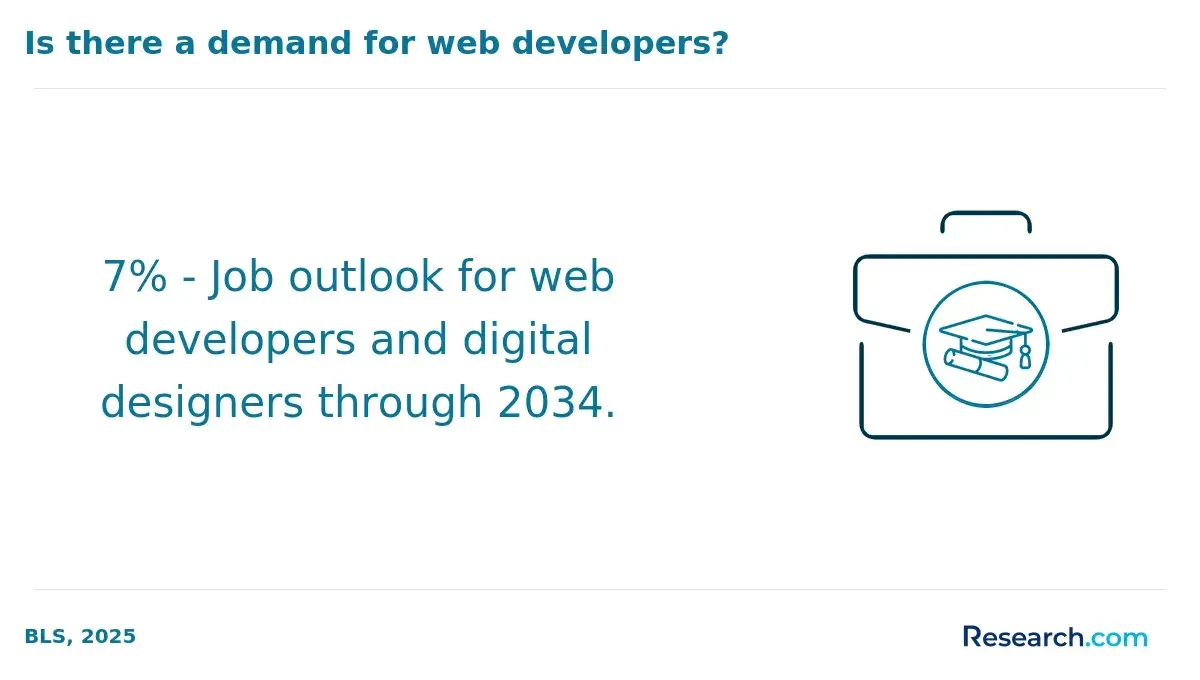
The career outlook for software developers is strong. Employment of software developers is growing at a rate of 15.8% annually, making it one of the faster-growing roles currently tracked. There are 115,200 projected job openings for software developers yearly through 2034. Web developers and digital designers are also expected to see 7% growth, or around 15,000 openings.
This demand is not limited to technology companies. Software is used in finance, healthcare, manufacturing, education, retail, entertainment, logistics, government, and professional services. Developers interested in specialized industries can explore areas such as the role of technology in healthcare, where software supports digital records, diagnostics, telehealth, patient engagement, and operational systems.
Software developers are also well compensated compared with many occupations. Our research indicates that the median annual salary for software developers is $133,080, according to the latest Bureau of Labor Statistics data. Professionals with advanced technical preparation, such as an online masters computer science, may be better positioned for specialized, senior, or research-oriented roles, although salary outcomes still depend on experience, employer, location, and technical specialization.
Annual salaries for software developers range from approximately $80,000 among the 10th percentile of earners to $211,000 among the 90th percentile of earners. A developer’s position within that range can be influenced by education, portfolio strength, years of experience, programming languages, cloud or security skills, industry, company size, geographic market, and whether the role involves leadership or architecture responsibilities.
Required Skills for a Software Developer
Software development requires both technical competence and professional judgment. New developers often focus on learning a programming language first, but long-term success usually depends on a broader toolkit: writing maintainable code, understanding data, using version control, testing work carefully, communicating with teammates, and learning new technologies without losing sight of the user problem.
Technical Skills
- Programming languages: Developers should become comfortable with at least one widely used language such as JavaScript, Python, C++, Java, or Ruby. Different employers use different types of code languages, so adaptability is valuable.
- Software development frameworks: Frameworks such as Django, React, Angular, and Spring help developers build faster by providing reusable structures and tools.
- Web technologies: HTML and CSS remain essential for web development, while tools such as Node.js and Flask help developers build modern web applications and services.
- Databases and Structured Query Language (SQL): Developers often need to store, retrieve, update, and protect data using systems such as MySQL, PostgreSQL, or MongoDB. SQL remains especially important for relational databases.
- Integrated Development Environments (IDEs): Tools such as Visual Studio Code, IntelliJ IDEA, Eclipse, and PyCharm make it easier to write, test, debug, and organize code.
- Version control systems: Git and similar tools help teams track changes, review code, collaborate safely, and manage software releases.
- Testing and debugging: Developers need to understand testing principles, unit testing frameworks such as JUnit, and debugging techniques that improve reliability and maintainability.
- Algorithms and data structures: A foundation in algorithms and data structures helps developers write efficient code and solve technical interview problems.
- Operating systems and platforms: Familiarity with Linux, Windows, AWS, Azure, or similar platforms helps developers deploy, monitor, and maintain applications.
- Agile methodologies: Agile approaches such as Scrum and Kanban organize development into iterative work cycles, support collaboration, and help teams respond to changing requirements.
Among programming languages used by software developers, JavaScript is the most-used worldwide, with 66% of software developers using the language (Stack Overflow, 2025). Developers use it for interactive websites, web applications, mobile interfaces, and server-side development.
Demand for web and application development skills remains visible in market projections as well. The web development market is projected to grow by 8.03%, reinforcing the value of strong programming, interface, and application-building skills.

The exact technical stack varies by job. A backend developer may need deep database and API knowledge, while a frontend developer may focus more on interface performance and accessibility. A cybersecurity-focused developer may benefit from coursework similar to what appears in a computer forensics degree online, especially when working with secure systems, evidence handling, or incident response tools.
General Skills
- Problem-solving: Developers must break complex problems into smaller tasks, test possible solutions, and choose approaches that work under real constraints.
- Analytical thinking: Strong developers compare options, evaluate trade-offs, interpret requirements, and make decisions based on evidence instead of guesswork.
- Attention to detail: Small mistakes in code, logic, permissions, or data handling can cause major software failures, security issues, or poor user experiences.
- Teamwork and collaboration: Most software is built by teams. Developers need to work with other engineers, designers, product leaders, clients, and stakeholders.
- Continuous learning: Programming languages, frameworks, security expectations, cloud platforms, and AI-assisted tools change frequently. Developers must keep learning throughout their careers.
- Adaptability: Requirements often shift. Developers who can adjust without losing focus are more useful to teams and employers.
| Skill area | Entry-level focus | Career-growth focus |
| Programming | Learn one language deeply and build working projects | Understand multiple languages, design patterns, and maintainable architecture |
| Databases | Write basic queries and understand data models | Optimize performance, improve reliability, and support secure data practices |
| Testing | Debug code and write basic tests | Design test strategies, automate quality checks, and reduce production defects |
| Collaboration | Use Git, accept feedback, and communicate blockers | Review code, mentor others, and coordinate across teams |
| Product thinking | Understand user requirements | Connect technical decisions to business value, cost, risk, and user outcomes |
How to Start Your Career in Software Development
The best starting path depends on your background, budget, schedule, and career goal. Some people begin with a computer science degree. Others complete a bootcamp, earn certificates, build a self-taught portfolio, or combine several approaches. What matters most is that you develop real technical ability and can show employers evidence of what you can build.
A formal degree remains a common route because it gives students structured exposure to programming, computer systems, data structures, algorithms, databases, software engineering, and math. Students who want a programming-focused pathway can compare online computer programming degrees. Those looking for a shorter academic starting point may consider an online computer science associate degree, while students who want to move faster can evaluate an accelerated computer science degree online.
Coding bootcamps can be useful for learners who want a shorter, skills-focused experience. These programs are often intensive and project-based, which can help students leave with portfolio pieces. However, bootcamps vary widely in quality, cost, career support, admissions standards, and employer recognition, so applicants should compare them carefully before enrolling.
Coding bootcamp programs usually take 20 to 30 weeks to complete and can cost five-figure sums for one module. Their biggest advantage is often the emphasis on applied projects, collaborative work, and career preparation. Their biggest risk is assuming that completion alone will guarantee employment.
| Path | When it can make sense | Important cautions |
| Associate degree | You want a lower-commitment academic entry point or plan to transfer later | Check transfer policies and whether the curriculum includes enough programming depth |
| Bachelor’s degree | You want broad preparation and access to roles that prefer a degree | Compare total cost, accreditation, internship access, and course relevance |
| Coding bootcamp | You want concentrated technical training and portfolio projects | Review outcomes carefully and avoid judging a program only by marketing claims |
| Self-study | You are disciplined, budget-conscious, and able to build projects independently | You will need a strong portfolio and may need extra networking to get interviews |
| Graduate degree | You want advanced specialization, research depth, or leadership preparation | Consider opportunity cost and whether the degree aligns with your target role |
Thinkful Software Engineering Bootcamp
The Thinkful Software Engineering Bootcamp is a five to six-month intensive program covering responsive web pages and applications, Representational State Transfer (REST), data structures and algorithms, and Agile methodologies. It is designed to help participants build practical job skills for software developer or software engineer roles.
Tuition: $16,000 (full-time), $9,975 (part-time)
Coding Dojo Online Software Development Bootcamp
The Coding Dojo Online Software Development Bootcamp is a 16 to 28-week program that starts with computer literacy fundamentals and moves into web development skills such as HTML, CSS, and Git/GitHub. It includes multi-week full-stack modules in Python and JavaScript, plus an option for either Java or C#/.Net.
Tuition: $16,996 (full-time), $9,995 (part-time)
Bloom Institute of Technology Full-Stack Web Development Bootcamp
The Bloom Institute of Technology Full-Stack Web Development Bootcamp focuses on preparing entry-level developers through guided, real-world learning situations. The program places participants in contact with working professionals so they can observe current practices in web and software development.
Tuition: $21,950
Self-study is also a real option for motivated learners. In a recent Stack Overflow survey, 58.7% of software developers said they learned coding from other online resources, including online communities and internet forums (Stack Overflow, 2025). A self-taught path works best when learners build projects, document their progress, practice interview problems, and seek feedback from experienced developers.
How can I advance my career as a Software Developer?
Career growth usually comes from a combination of deeper technical skill, stronger judgment, production experience, and proof that you can work on larger or more complex systems. Certifications can help when they match your role, but they are most useful when paired with hands-on experience.
Developers can advance by moving into senior developer, technical lead, software architect, cloud engineer, DevOps engineer, security engineer, data-focused developer, engineering manager, or product-oriented technical roles. The right next step depends on whether you want to remain deeply technical, specialize in a domain, or lead people and strategy.
Professional Software Developer Certification
The Professional Software Developer Certification is offered by the Institute of Electrical and Electronics Engineers (IEEE). It signals competency in four IEEE-recognized knowledge areas: Software Engineering Requirements, Software Engineering Construction, Software Engineering Design, and Software Engineering Testing.
Applicants need at least two years of college-level education in computer science or a related field and at least two years of industry experience.
AWS Certified Developer Associate
Amazon Web Services (AWS) is a cloud computing platform that provides services for computing, storage, databases, networking, machine learning, application deployment, and IT infrastructure management.
The AWS Certified Developer Associate credential demonstrates knowledge of core AWS services, common AWS architecture practices, and the ability to develop, deploy, and debug cloud-based applications on AWS. It can be especially relevant for developers working with organizations that rely on AWS for cloud infrastructure.
Certified Scrum Master
The Certified Scrum Master certification is administered by Scrum Alliance, a member-driven nonprofit certifying body in the Agile space. The credential shows familiarity with Scrum, an Agile framework commonly used in software and technology project management.
A Certified Scrum Master helps facilitate Scrum events, supports adherence to Scrum principles, assists development teams and stakeholders, removes obstacles, and encourages continuous improvement. This credential may be useful for developers who want to move toward team facilitation, delivery leadership, or product-facing roles.
Professional Software Engineering Master Certification
The Professional Software Engineering Master Certification is another IEEE credential and is one of the higher-level certifications available to software developers. It covers 12 IEEE-recognized knowledge areas:
- Software Engineering Requirements
- Software Engineering Design
- Software Engineering Construction
- Software Engineering Testing
- Software Engineering Maintenance
- Software Engineering Configuration Management
- Software Engineering Quality
- Software Engineering Processes
- Software Engineering Models & Methods
- Software Engineering Management
- Software Engineering
- Software Engineering Economics
Applicants for PSEM certification must have completed four years of college-level education in computer science or a related field and must have at least four years of relevant industry experience.
Certified Information Systems Security Professional
The Certified Information Systems Security Professional (CISSP) certification is overseen by the International Information System Security Certification Consortium (ISC)2. It is a respected cybersecurity credential that demonstrates knowledge of IT security and the design, implementation, and monitoring of cybersecurity programs.
To earn the CISSP, candidates need five years of cumulative, paid work experience in two or more of the eight domains of (ISC)2’s CISSP Common Body of Knowledge (CBK), and they must pass the CISSP examination. The eight domains are:
- Security and Risk Management
- Asset Security
- Security Architecture and Engineering
- Communication and Network Security
- Identity and Access Management (IAM)
- Security Assessment and Testing
- Security Operations
- Software Development Security
| Certification | Best suited for | Decision point |
| Professional Software Developer Certification | Developers who want a formal software engineering competency credential | Most useful when you already meet the education and experience requirements |
| AWS Certified Developer Associate | Developers building or maintaining cloud applications on AWS | Choose it if your target jobs mention AWS development, deployment, or debugging |
| Certified Scrum Master | Developers moving toward Agile facilitation or team coordination | Better for delivery and leadership growth than for proving coding depth |
| Professional Software Engineering Master Certification | Experienced developers seeking advanced software engineering validation | Appropriate only after substantial education and industry experience |
| CISSP | Developers moving into cybersecurity or secure software leadership | Best for those with qualifying security experience across CISSP domains |
What soft skills are important for Software Developers?
Technical ability gets developers into the field, but soft skills often determine how far they advance. Developers need to explain trade-offs, ask better questions, collaborate across functions, and build software that meets real user and business needs.
- Communication: Developers must explain technical issues clearly to teammates, managers, clients, and users who may not understand the code.
- Time management: Software projects include deadlines, dependencies, bugs, changing requirements, and competing priorities. Developers need to estimate work honestly and communicate risks early.
- Adaptability: Teams change tools, frameworks, priorities, and product direction. Adaptable developers stay productive even when plans shift.
- Creativity: Good software often requires inventive solutions, especially when constraints involve performance, usability, security, budget, or legacy systems.
- Empathy: Developers who understand user frustration, accessibility needs, and stakeholder goals can build better products and avoid unnecessary complexity.
These skills become more important as developers move into senior roles because senior developers are expected to influence decisions, mentor others, resolve ambiguity, and improve team practices.
What other tech-related careers can a software developer pursue?
Software development skills transfer well into many technology roles. Developers who understand code, systems, debugging, APIs, databases, and user workflows can move into fields that require both technical fluency and domain-specific knowledge. For example, developers interested in interactive media may build on their coding background through an online degree in designing video games, combining software engineering with storytelling, graphics, mechanics, and user experience.
How can I transition into an engineering management role?
Moving from developer to engineering manager requires a shift from personally writing most of the code to helping teams deliver better work. Developers considering management should build skills in project planning, hiring, coaching, performance feedback, prioritization, conflict resolution, budgeting, and cross-functional communication.
An engineering management degree online can help technically trained professionals develop leadership and strategy skills while staying connected to engineering practice. Practical preparation also includes mentoring junior developers, leading small projects, facilitating technical discussions, and learning how business goals shape engineering priorities.
Alternative Career Options for a Software Developer
Software developers do not have to stay in one role for their entire careers. Many use their programming background to move into adjacent fields that involve infrastructure, security, analytics, design, consulting, or leadership.
| Career option | How software development experience applies | Median Annual Salary |
| DevOps Engineer | Uses coding knowledge to automate deployment, manage CI/CD pipelines, improve infrastructure reliability, and connect development with operations | $131,698 |
| Data Scientist | Applies programming and analytical skills to interpret data, build models, and support data-driven decisions | $112,590 |
| Information Security Analyst | Uses software and systems knowledge to identify vulnerabilities, improve defenses, and protect applications and networks | $124,910 |
| UX Designer | Combines technical understanding with design thinking to create clearer, more usable digital interfaces | $110,818 |
| Technical Consultant | Advises organizations on software architecture, development practices, implementation planning, and technology decisions | $120,833 |
DevOps Engineer
DevOps engineers connect development and operations by automating workflows, improving deployment pipelines, managing infrastructure, and supporting continuous integration and continuous deployment.
Median Annual Salary: $131,698
Data Scientist
Software developers with strong analytical skills can move into data science by learning statistical analysis, predictive modeling, machine learning, and data interpretation.
Median Annual Salary: $112,590
Information Security Analyst
Developers can shift into cybersecurity roles that focus on protecting systems, identifying vulnerabilities, implementing safeguards, and building secure software solutions.
Median Annual Salary: $124,910
UX Designer
Developers who understand interface behavior and user needs may move toward UX design, where they help create products that are easier, clearer, and more useful.
Median Annual Salary: $110,818
Technical Consultant
Technical consultants use software development expertise to help clients choose tools, plan systems, improve development practices, and implement technology strategies.
Median Annual Salary: $120,833
The best alternative career depends on what you want more of: infrastructure, analytics, security, design, client strategy, or leadership. Developers should test these interests through projects, internal assignments, certifications, or short courses before making a major transition.
Is a Specialized Degree in Artificial Intelligence Worth Considering for Software Developers?
A specialized artificial intelligence degree can be worth considering if your target work involves machine learning, intelligent applications, automation, data-driven products, natural language processing, computer vision, or AI platform development. A master in AI may help developers deepen knowledge in machine learning, data analytics, and cognitive computing while preparing for roles that require more than general programming ability.
However, an AI degree is not automatically necessary for every developer. It makes the most sense when the curriculum, cost, schedule, and project work match your career goal. Developers should ask whether the program includes applied AI projects, math and statistics preparation, ethical AI coverage, cloud or deployment experience, and opportunities to build portfolio-ready work.
How can I compare online degree programs effectively?
Online programs can be convenient, but they should be evaluated carefully. Look first at accreditation, curriculum fit, faculty experience, course delivery format, student support, transfer credit rules, career services, and whether the program’s technical tools match current workplace expectations. Do not compare programs only by tuition or ranking position.
Developers interested in broader technical systems may also compare related fields, such as an electrical engineering degree online cheap, especially if their interests include hardware, embedded systems, robotics, signal processing, or connected devices.
| Question to ask | Why it matters |
| Is the institution properly accredited? | Accreditation affects transfer credit, employer recognition, and eligibility for some forms of financial aid |
| Does the curriculum match my target role? | A web-focused program, AI-focused program, and systems-focused program may prepare students for different jobs |
| How are projects, labs, and assessments handled online? | Software development requires practice, not just lectures |
| What support is available for working adults? | Advising, tutoring, flexible scheduling, and career services can affect completion |
| What is the total cost, not just tuition? | Fees, books, software, hardware, and lost work time can change affordability |
How can mentorship and networking boost my software development career?
Mentorship and networking can shorten the learning curve for software developers. Experienced mentors can review code, explain workplace expectations, suggest projects, identify skill gaps, and help developers understand which roles match their strengths. Networking can also lead to referrals, project collaborations, open-source opportunities, and early information about hiring needs.
Good networking does not require aggressive self-promotion. Developers can contribute to technical communities, attend meetups or conferences, participate in code reviews, ask thoughtful questions, share project write-ups, and maintain professional relationships. Developers pursuing AI specialization may also consider the fastest online master's degree in artificial intelligence if they need a structured way to build expertise while expanding their professional circle.
Can integrating data science skills enhance your software development career?
Data science skills can make developers more valuable in roles that involve analytics, personalization, forecasting, automation, experimentation, or intelligent applications. A developer who understands data pipelines, statistical reasoning, predictive modeling, and big data tools can build software that does more than execute commands; it can support insight and decision-making.
Formal study can help developers who want a deeper foundation in analytics and modeling. Those comparing affordable options may explore the cheapest online masters in data science programs to see whether the curriculum fits their software development goals.
Can Cross-Disciplinary Education Boost a Software Developer's Career?
Cross-disciplinary education can help developers stand out when they want to build software for a specific industry. Healthcare, finance, manufacturing, education, logistics, cybersecurity, and public-sector technology all require developers who understand both software and the context in which it is used.
For example, a developer interested in digital health products may benefit from studying health informatics. A program such as the top online health informatics bachelor's degree can help connect software skills with health data, clinical workflows, compliance expectations, and patient-centered technology.
Affordable Online MBA Programs for Software Developers Transitioning to Leadership Roles
Some experienced software developers eventually want roles such as project manager, product leader, IT director, engineering manager, or chief technology officer. For these professionals, an MBA can provide business training that technical degrees may not emphasize, including finance, strategy, operations, marketing, leadership, and organizational decision-making.
An MBA is not required for every leadership role, and developers should be careful not to pursue one only because it seems prestigious. It is most useful when the program connects directly to your career plan and when you can apply business concepts to technology decisions.
Why Pursue an MBA as a Software Developer?
- Business acumen: Developers learn how budgets, markets, operations, and strategy shape technology decisions.
- Leadership preparation: MBA coursework can strengthen communication, team management, negotiation, and decision-making skills.
- Career flexibility: Business training may support movement into management, consulting, product strategy, or executive roles.
Developers who want business training with a technology focus can review affordable online MBA in Information Technology options and compare cost, flexibility, curriculum, and leadership outcomes.
What are the best ways to gain hands-on experience as a software developer?
Employers want proof that you can build, fix, explain, and improve software. Hands-on experience helps you turn coursework or tutorials into job-ready evidence. It also helps you discover which types of development you actually enjoy.
- Internships: Internships give students and early-career developers exposure to professional tools, team workflows, code review, project deadlines, and production software. Strong internships can sometimes lead to full-time offers.
- Open-source projects: Contributing to open-source work helps developers practice collaboration, read unfamiliar code, respond to issues, and build public evidence of skill.
- Personal projects: A website, mobile app, automation tool, game, API, or desktop application can demonstrate initiative and technical range. The strongest projects solve a clear problem and include documentation.
- Coding bootcamps: Bootcamps can provide structured project work, peer collaboration, and career preparation in a shorter time frame than many degree programs.
- Freelancing: Small client projects can help developers learn requirements gathering, communication, delivery expectations, and professional accountability.
- Hackathons and coding challenges: These events help developers practice rapid problem-solving, teamwork, and technical communication under time pressure.
If application costs are a concern while comparing programs, students can review which colleges don't have an application fee to reduce upfront costs during the school search.
Exploring Advanced Education Paths for Software Developers
Advanced education can help software developers deepen expertise, move into more complex technical roles, or prepare for leadership. A master’s program in software engineering may cover advanced architecture, systems design, software quality, project management, cloud computing, artificial intelligence, data science, or security-focused development.
Online master’s programs may be especially useful for working developers who need flexibility. Cost still matters, so professionals comparing options may want to review the cheapest online master's software engineering programs and weigh tuition against curriculum strength, faculty background, project expectations, and career relevance.
A graduate degree can support roles such as software architect, technical lead, senior engineer, or specialist, but it should be paired with practical experience. Employers typically value the combination of advanced study, production-quality work, and the ability to solve real engineering problems.
What emerging trends are shaping the future of software development?
Software development is changing as AI-assisted coding, machine learning, cloud platforms, microservices, containerization, edge computing, cybersecurity practices, and automation become more common. Developers are increasingly expected to understand not only how to write code, but also how code is deployed, monitored, secured, scaled, and maintained.
Artificial intelligence and machine learning are influencing code generation, testing, documentation, data analysis, and user-facing product features. Microservices and containerization continue to support scalable deployment in complex environments. Edge computing is becoming more relevant where real-time data processing is needed. Cybersecurity is also becoming a core part of development as interconnected systems increase risk.
Developers who want a broad foundation for these shifts can explore online computer science degrees and compare whether programs include software engineering, databases, cloud computing, security, AI, and applied projects.
Common Mistakes to Avoid When Becoming a Software Developer
- Choosing a program without checking accreditation: Accreditation can affect transfer credits, employer recognition, and financial aid eligibility.
- Focusing only on tuition: The cheapest program is not always the best value if it lacks strong instruction, projects, support, or career relevance.
- Assuming a credential guarantees a job: Degrees, bootcamps, and certificates help most when paired with a portfolio, experience, and interview preparation.
- Learning too many languages too quickly: Beginners often progress faster by learning one language well before expanding.
- Ignoring debugging and testing: Employers need developers who can maintain reliable software, not just write new code.
- Building projects without documentation: A portfolio is stronger when employers can understand what the project does, what tools you used, and what problems you solved.
- Relying only on rankings: Rankings can be useful, but they should not replace checking curriculum, outcomes, support, cost, and fit.
- Neglecting communication skills: Developers who cannot explain trade-offs or collaborate effectively may struggle to advance.
Software Development Is a Strong Path for Technically Curious Problem-Solvers
Software development offers strong career potential for people who enjoy building systems, solving problems, and learning continuously. The field includes many entry routes, from associate and bachelor’s degrees to bootcamps, self-study, certifications, and graduate programs. The best route is the one that helps you build real skills, produce evidence of your work, and move toward the kind of developer role you want.
Before committing to a path, compare the cost, time requirement, curriculum, accreditation, portfolio opportunities, career support, and fit with your goals. A well-chosen program or learning plan can help you enter the field, but long-term progress depends on practice, adaptability, collaboration, and the ability to keep learning as technology changes.
Key Insights
- Software developers build and maintain the systems modern organizations depend on. Their work spans web, mobile, cloud, enterprise, data, security, healthcare, finance, gaming, and many other fields.
- The job outlook is strong. Employment of software developers is growing at a rate of 15.8% annually, with 115,200 projected job openings yearly through 2034.
- Salary potential is high but not guaranteed. The median annual salary for software developers is $133,080, and individual outcomes depend on education, experience, location, employer, skill set, and specialization.
- There is no single required path into the field. Degrees, bootcamps, self-study, certificates, internships, and project portfolios can all help when they build job-relevant skills.
- Technical skills are necessary, but not enough. Developers also need communication, teamwork, analytical thinking, adaptability, and attention to detail.
- Career growth comes from specialization and impact. Certifications, graduate education, cloud skills, AI knowledge, cybersecurity expertise, data science, or leadership training can support advancement when aligned with a clear goal.
- Hands-on proof matters. Internships, open-source work, personal projects, freelancing, hackathons, and documented portfolios help employers evaluate what you can actually do.
References
- Amazon Web Services, Inc. (n.d.). AWS Certified Developer Associate Certification. https://aws.amazon.com/certification/certified-developer-associate
- Bloom Institute of Technology. (n.d.). Full Stack Web Development Online Course. BloomTech. https://www.bloomtech.com/courses/full-stack-web-development
- Business Research Insights. (2026). Web development market size. https://www.businessresearchinsights.com/market-reports/web-development-market-109039
- Coding Dojo. (n.d.). Coding Bootcamp Comparison. Coding Dojo. https://www.codingdojo.com/software-dev-comparison
- IEEE Computer Society. (n.d.). Professional Software Developer Certification. IEEE. https://www.computer.org/product/education/professional-software-developer-certification
- IEEE Computer Society. (n.d.). Professional Software Engineering Master Certification. IEEE. https://www.computer.org/product/education/professional-software-engineering-master-certification
- Indeed Editorial Team. (2026). 12 Software Developer Skills To Learn (With Examples). Indeed.com. https://www.indeed.com/career-advice/career-development/software-developer-skills
- Indeed Editorial Team. (2026). Alternative Jobs for Software Engineers Wanting a Career Change. Indeed.com. https://www.indeed.com/career-advice/finding-a-job/change-career-from-software-engineer
- (ISC)2. (n.d.). Cybersecurity Certification | CISSP Certified Information Systems Security Professional. Isc2.org. https://www.isc2.org/Certifications/CISSP
- Stack Overflow. (2025). Stack Overflow Developer Survey 2025. https://survey.stackoverflow.co/2025/
- U.S. Bureau of Labor Statistics. (2025). Occupational projections, 2024–2034, and worker characteristics, 2024. Retrieved February 2026, from https://www.bls.gov/emp/tables/occupational-projections-and-characteristics.htm
- Zippia, Inc. (2025, January 8). Web developer jobs: How to become a web developer and career outlook. Zippia. Retrieved February 9, 2026, from https://www.zippia.com/web-developer-jobs/
- ZipRecruiter. (2026). Devops Engineer Salary. Retrieved February 9, 2026, from https://www.ziprecruiter.com/Salaries/Devops-Engineer-Salary
Other Things You Should Know About How to Become a Software Developer
A bachelor’s degree in computer science or a related field is often required to become a software developer. Additionally, coding bootcamps and self-study through online resources can provide the necessary skills. Certifications from reputable bodies can also enhance career prospects.
To become a software developer in 2027, start by learning programming languages like Python or Java. Obtain a degree in computer science or consider a coding bootcamp. Build a portfolio showcasing your work and projects. Participate in internships to gain practical experience, and engage in continuous learning to stay updated with industry trends.
Key technical skills for software developers include proficiency in programming languages (such as JavaScript, Python, C++, Java, Ruby), software development frameworks (like Django, React, Angular), web technologies (HTML, CSS), databases (MySQL, PostgreSQL, MongoDB), integrated development environments (IDEs), version control systems (Git), and knowledge of algorithms, data structures, and Agile methodologies.
Software developers can advance their careers by obtaining advanced certifications, gaining expertise in emerging technologies, pursuing leadership roles, and building a strong professional network. Continual learning through workshops and online courses can also open pathways to higher positions and specialized roles in 2027.
Coding bootcamps are intensive training programs that focus on developing technical skills and knowledge needed for software development. They typically last 20 to 30 weeks and employ project-based learning, allowing participants to build a portfolio of completed work. Bootcamps like Thinkful Software Engineering Bootcamp, Coding Dojo Online Software Development Bootcamp, and Bloom Institute of Technology Full-Stack Web Development Bootcamp are popular options.
Continuous learning is crucial in software development due to the rapidly evolving nature of technology. Developers need to stay updated with new programming languages, frameworks, tools, and industry trends to remain competitive and deliver innovative solutions. A growth mindset and a passion for learning are essential for success in this field.


