
2027 Most Affordable Online MBA in Information Technology Degree Programs

Co-Founder and Chief Data Scientist
An affordable online MBA in information technology is for professionals who want to move from technical execution into technology strategy, IT management, product leadership, cybersecurity oversight, systems planning, or executive decision-making. The degree combines the business core of an MBA with technology-focused coursework, helping students understand budgets, teams, operations, data, security, infrastructure, and digital transformation from a management perspective.
This guide is designed for working adults comparing online MBA in IT programs by cost, format, accreditation, specialization, time to completion, and career value. You will learn what these programs usually include, how much they may cost, which affordable programs stand out, what career paths are realistic, and how to decide whether this graduate degree fits your goals.
Quick answer: Is an affordable online MBA in information technology worth considering?
An affordable online MBA in information technology can be a strong choice for IT professionals, business analysts, project managers, and technically skilled workers who want management roles without pausing their careers. It is especially useful if you need a graduate business credential, want to lead technology teams, or hope to qualify for positions such as IT project manager, information systems manager, IT director, IT business relationship manager, or chief technology officer.
The value depends on the program’s accreditation, total cost, transfer credit policy, employer reputation, specialization options, and how closely the curriculum matches your target role. Computer and IT occupations have a median annual salary of $104,420, while computer and information systems managers earn a median annual salary of $169,510. These figures show the earning potential in the field, but salaries are not guaranteed and vary by experience, location, industry, employer, and responsibilities.
What are the main benefits of earning an affordable online MBA in information technology?
- It connects business leadership with technology strategy. Students study finance, operations, leadership, analytics, and IT management rather than focusing only on coding or technical administration.
- It can support advancement into management. Graduates may pursue roles such as IT project manager, information systems manager, IT business relationship manager, IT director, or chief technology officer.
- It may reduce opportunity cost. Online programs often allow working professionals to keep their jobs while completing coursework.
- It can be less expensive than many campus-based options. Online students may avoid relocation, commuting, housing, and some campus fees, although tuition and online fees vary widely.
- It can fit several industries. Employers in technology, healthcare, finance, consulting, government, manufacturing, ecommerce, and nonprofit organizations all rely on technology leaders who understand business priorities.
What can I expect from an affordable online MBA in information technology degree?
An online MBA in information technology is a graduate business degree with a technology management focus. It is usually built for working professionals who already have some professional experience and want to improve their ability to lead people, budgets, systems, vendors, and digital initiatives.
- The degree combines MBA fundamentals such as accounting, finance, marketing, operations, leadership, and strategy with coursework in IT management, cybersecurity, enterprise systems, analytics, or digital transformation.
- The online format is typically designed for adults balancing graduate study with full-time work, family responsibilities, military service, or geographic limitations.
- Tuition can differ substantially. Institutions may charge $300 to more than $1,000 per credit for this type of program.
- Many programs take up to 2 years to complete, though accelerated and part-time formats can shorten or lengthen the timeline.
- Some programs require GMAT or GRE scores, while others offer test waivers or no-test admissions policies.
| Program feature | What it means for students | What to check before applying |
| Online delivery | Courses may be asynchronous, live online, hybrid, self-paced, or cohort-based. | Ask whether classes require live attendance, campus visits, group meetings, or proctored exams. |
| IT concentration | The technology component may focus on management rather than deep technical training. | Review course titles and syllabi to confirm alignment with cybersecurity, analytics, ERP, cloud, or project management goals. |
| Business accreditation | Accreditation can signal recognized quality standards in business education. | Look for institutional accreditation and, when relevant, programmatic accreditation such as AACSB, ACBSP, or IACBE. |
| Affordability | A low per-credit price does not always equal the lowest total cost. | Compare total tuition, required credits, fees, books, residency costs, transfer credits, and employer reimbursement. |
| Career support | Online students may need virtual access to coaching, recruiting, alumni contacts, and resume support. | Ask whether career services are available to fully online graduate students and alumni. |
Where can graduates work with an online MBA in information technology?
Because technology now supports nearly every business function, MBA in IT graduates can work in many sectors. The best fit depends on prior experience, specialization, technical depth, and leadership ability.
- Technology companies. Employers such as Google, Amazon, Microsoft, and similar organizations need professionals who can connect technical teams with business goals, customer needs, product roadmaps, and operational priorities.
- Consulting firms. IT consultants help organizations evaluate systems, modernize operations, manage cybersecurity risks, and implement technology strategies.
- Financial institutions. Banks, insurers, fintech firms, and investment organizations rely on secure platforms, data analysis, compliance systems, and risk management.
- Healthcare organizations. Hospitals, health systems, and healthcare technology vendors need leaders who understand IT infrastructure, data privacy, electronic systems, and operational improvement.
- Government agencies. Public-sector organizations need IT managers for systems modernization, cybersecurity, data management, citizen services, and technology procurement.
- Manufacturing companies. Technology leaders help manage production systems, supply chain software, automation platforms, enterprise systems, and infrastructure.
- Ecommerce companies. Online retailers require reliable platforms, secure payment systems, customer data protection, analytics, and scalable infrastructure.
- Nonprofit organizations. Mission-focused organizations use technology for fundraising, outreach, data reporting, program delivery, and internal operations.
- Startups. Smaller companies may value leaders who can understand product, systems, budgets, vendors, hiring, and growth strategy at the same time.
How much can I make with an affordable online MBA in information technology degree?
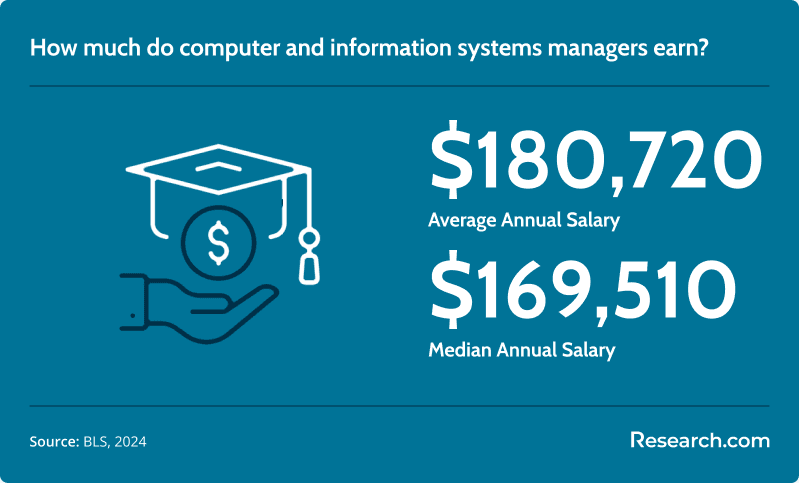
According to 2024 data from the United States Bureau of Labor Statistics (BLS), computer and information systems managers earn an average annual salary of $180,720 and a median annual salary of $169,510. Both are far above the national average of $48,060. However, an MBA alone does not guarantee a management salary. Employers also weigh your work history, technical background, leadership experience, industry knowledge, and measurable results.
Graduates of online MBA in information technology degree programs may also qualify for roles such as computer systems analyst or computer and information research scientist, depending on their technical preparation. These occupations report median annual salaries of $103,800 and $145,080, respectively.
- Most Affordable Online MBA in Information Technology Degrees for 2027
- How long does it take to complete an affordable online MBA in information technology degree?
- How does an online MBA in information technology degree compare to an on-campus program?
- What is the average cost of an affordable online MBA in information technology degree?
- What are the financial aid options for students enrolling in an affordable online MBA in information technology degree?
- What are the prerequisites for enrolling in an affordable online MBA in information technology degree?
- What courses are typically in an affordable online MBA in information technology degree?
- What types of specializations are available in affordable online MBA in information technology degrees?
- How to choose the best online MBA in information technology degree?
- How can an online MBA in information technology accelerate your career in tech?
- What are the emerging trends in online MBA in information technology education?
- How do accreditation and faculty expertise affect your online MBA in IT program?
- What career paths are available for graduates of affordable online MBA in information technology degrees?
- What is the job market for graduates with an affordable online MBA in information technology degree?
- Is an affordable online MBA in information technology degree a sound investment?
- How can accelerated online MBA programs improve learning and career momentum?
- How can project management strengthen IT leadership in an online MBA?
- How do self-paced learning options change the online MBA experience?
- How do career support services and alumni networks support online MBA in IT outcomes?
- When might a different graduate path be a better fit?
- Leveraging Data Analytics in Information Technology Leadership
Most Affordable Online MBA in Information Technology Degrees for 2027
How do we rank schools?
An online MBA in information technology can require a meaningful financial commitment, so the ranking process should rely on transparent information rather than marketing claims. For this guide, program information was evaluated using reliable sources such as the IPEDS database, Peterson's database, the College Scorecard database, and the National Center for Education Statistics (NCES).
Students who want a closer look at the ranking process can review our methodology page.
1. Lamar University Master of Business Administration in Enterprise Resource Planning Online
Lamar University offers an online MBA in Enterprise Resource Planning that develops general business capability alongside specialized preparation in ERP systems. The accelerated curriculum emphasizes technology platforms and data analytics, including SAP applications such as NetWeaver, Visual Composer, and Data Warehousing. Students complete intensive coursework and a two-week SAP ERP Academy, with preparation for roles such as ERP Business Analyst and ERP Technical Director. The program costs $13,153, can be completed in as few as 12 months, and is supported by AACSB accreditation.
- Program Length: 1 year
- Concentrations: None
- Cost per Credit: $438
- Required Credits to Graduate: 30
- Accreditation: Association to Advance Collegiate Schools of Business
2. American Public University Online Master of Business Administration, Information Technology Management Concentration
The online MBA from American Public University prepares students for business decision-making in a global environment. Its Information Technology Management concentration includes 9 semester hours focused on IT project management, SDLC models, technology evaluation, and information systems security practices. The full program requires 33 credits, costs $455 per credit, and does not require GRE or GMAT scores for admission.
- Program Length: 8 to 16 weeks
- Concentrations: None
- Cost per Credit: $455
- Required Credits to Graduate: 33
- Accreditation: Accreditation Council for Business Schools and Programs
3. Ball State University Master of Business Administration, Information Technology Leadership Concentration
Ball State offers an MBA concentration in Information Technology Leadership for students who want to lead in technology companies or technology-enabled organizations. The concentration addresses technology fundamentals, IoT, coding, cloud services, technology processes, and leadership practices relevant to modern tech-driven firms. The MBA requires 30 to 39 credits and can be completed in two years.
- Program Length: 2 years
- Concentrations: None
- Cost per Credit: $346
- Required Credits to Graduate: 30 to 39
- Accreditation: Association to Advance Collegiate Schools of Business
4. University of the Potomac Master of Business Administration, Information Technology Concentration
The online MBA from the University of Potomac is designed for students preparing for leadership responsibilities across business sectors. The Information Technology concentration focuses on innovation and the connection between business priorities and technology solutions. Students complete 36 credits, may transfer up to 15 credits, and pay $450 per credit. The MSCHE-accredited program includes IT-focused coursework in areas such as cyber law, technology entrepreneurship, and IT for executives.
- Program Length: 2 years
- Concentrations: None
- Cost per Credit: $450
- Required Credits to Graduate: 36
- Accreditation: Middle States Commission on Higher Education
5. Campbellsville University Online MBA - Information Technology
Campbellsville University offers an online MBA in IT that covers network security, database management, project management, and core business management. The two-year program includes 36 credit hours, with courses delivered in eight-week sessions. Students study IT infrastructure, security, business ethics, management, project management software, IT security, managerial accounting, and human resources. The program is accredited by IACBE and SACSCOC and prepares graduates for roles such as IT manager, IT director, project manager, and systems analyst.
- Program Length: 2 years
- Concentrations: None
- Cost per Credit: $529
- Required Credits to Graduate: 36
- Accreditation: International Accreditation Council for Business Education
6. Western Governors University Master of Business Administration Information Technology Management
The online MBA in IT Management from Western Governors University is built for professionals seeking IT leadership advancement through project management, strategic IT solutions, and financial management. The program can be completed in as little as 12 months and uses a tuition model based on six-month terms. Its curriculum includes 11 courses covering IT project management, ethical leadership, and strategic solutions. The program holds ACBSP accreditation.
- Program Length: 1 year
- Concentrations: None
- Cost per Term: $4,755
- Required Credits to Graduate: 35
- Accreditation: Accreditation Council for Business Schools and Programs
7. Wilmington University Master of Business Administration, Business Technology Management Concentrations
The MBA with a Business Technology Management concentration at Wilmington University centers on the relationship between business operations and technology-enabled solutions. Students complete core MBA work in organizational behavior, managerial decision-making, data analytics, financial analysis, global marketing, and business strategy, then add specialized study in business technology management. Concentration topics include supply chain management, business process management, data analysis, IT policy, and web and data security.
- Program Length: 1 year
- Concentrations: None
- Cost per Credit: $419
- Required Credits to Graduate: 36
- Accreditation: International Accreditation Council for Business Education
8. Southern New Hampshire University Master of Business Administration Information Technology Management
The online MBA in Information Technology Management from Southern New Hampshire University allows students to build IT management and business leadership skills without submitting GRE or GMAT scores. The curriculum combines IT concepts, business practice, and leadership methods to help students connect technology operations with organizational strategy. Learners may transfer up to 6 credits from prior college coursework, complete the degree in about two years, and prepare for technology-focused roles in a broad employment market.
- Program Length: 2 years
- Concentrations: None
- Cost per Credit: $637
- Required Credits to Graduate: 36
- Accreditation: Accreditation Council for Business Schools and Programs
9. University of North Carolina at Greensboro MBA Information Technology Concentration
The MBA with an Information Technology concentration at the University of North Carolina Greensboro uses a flexible interdisciplinary structure for students preparing for complex business environments shaped by globalization and sustainability. Coursework includes cyber security and disruptive innovation, and students can customize their studies through electives. The program blends online and in-person learning, live case studies, study abroad opportunities, and preparation for leadership roles such as Chief Operating Officer, Senior Commercial Relationship Manager, or Vice President.
- Program Length: 2.5 years
- Concentrations: None
- Cost per Credit: $533.33 (in-state), $1,300 (out-of-state)
- Required Credits to Graduate: 45
- Accreditation: Association to Advance Collegiate Schools of Business
10. University of Massachusetts-Lowell Online MBA Information Technology Concentration
The MBA from UMass Lowell offers a flexible AACSB-accredited pathway through the Manning School of Business. The Information Technology concentration combines general business coursework with IT electives in areas such as Database Management, Business Intelligence and Data Mining, Electronic Business, and Enterprise System Management.
- Program Length: 2 years
- Concentrations: None
- Cost per Credit: $655
- Required Credits to Graduate: 30
- Accreditation: Association to Advance Collegiate Schools of Business
What students say about affordable online MBA in information technology programs
-
: "
I wondered whether an online MBA could match the quality of a campus program. The IT-focused MBA surprised me. The instructors brought direct industry experience into discussions, and the online format connected me with classmates from different parts of the country, which broadened how I think about technology leadership. - Simon
"
-
: "
Finishing my MBA in Information Technology online was demanding but worthwhile. Having access to course materials, professors, and support services helped me stay organized while managing a busy schedule. The degree helped me pursue new professional opportunities. - Joel
"
-
: "
I was already working in IT, but I wanted a stronger grasp of budgeting, strategy, and management. The online MBA in IT gave me that mix of business foundations and technology leadership. The asynchronous structure let me work through classes around my job, and it helped me gain confidence for a move toward strategic IT leadership. - Kay
"
Key findings for prospective students
- Many online MBA in information technology programs can be completed in about two years of full-time study.
- The average cost of an MBA, including online MBA in information technology degree programs, is $56,850.
- Online and on-campus MBA in IT programs commonly differ in flexibility, cost structure, learning format, and networking style.
- Employment of computer and information systems managers from 2022 to 2032 is projected to grow by 15%.
- There are around 46,900 annual openings for computer and information systems managers from 2022 to 2032.
How long does it take to complete an affordable online MBA in information technology degree?
Most online MBA in information technology programs take about two years of full-time study. This timeline is similar to many other online graduate programs, including some of the cheapest online master's in cyber security options. Credit requirements often fall between 36 and 54 credit hours, depending on the program design, concentration requirements, electives, and prerequisites.
Accelerated formats may shorten the timeline by using intensive terms, year-round enrollment, or heavier course loads. Part-time and asynchronous programs may stretch completion to three to five years, which can be useful for students with demanding work schedules but may extend the time before career benefits are realized.
| Enrollment format | Typical fit | Main advantage | Main trade-off |
| Accelerated | Students with strong time management and stable schedules | Faster completion and lower opportunity cost | More intense weekly workload |
| Full-time online | Students who can dedicate consistent weekly time to graduate study | Balanced pace with a predictable timeline | May still be demanding while working full time |
| Part-time online | Working professionals, caregivers, and military students | Greater flexibility and less pressure per term | Longer completion timeline |
| Self-paced | Independent learners who can stay motivated without fixed weekly deadlines | Ability to move faster through familiar material | Requires discipline and careful planning |
How does an online MBA in information technology degree compare to an on-campus program?
Online and campus-based MBA in information technology programs may cover similar academic content, but the student experience can feel very different. The most important differences involve schedule flexibility, networking format, total cost, classroom interaction, and how much structure the learner needs.
| Factor | Online MBA in IT | On-campus MBA in IT | Best choice if... |
| Flexibility | Often allows students to study around work and personal responsibilities. | Requires set class times and physical attendance. | Choose online if you need to keep working or cannot relocate. |
| Learning style | Works well for self-directed students who can manage deadlines independently. | Provides more immediate in-person structure and classroom engagement. | Choose campus if you learn best through face-to-face discussion. |
| Networking | May use virtual events, discussion boards, team projects, and online alumni groups. | Often offers in-person events, clubs, guest speakers, and local employer access. | Choose based on whether you need local, national, or industry-specific connections. |
| Cost | May lower relocation, commuting, and housing expenses, although tuition varies. | Can involve higher living and transportation costs, especially for nonlocal students. | Compare total cost, not just tuition. |
| Career access | Can be strong if the school offers virtual career services and employer connections. | May provide easier access to campus recruiting and in-person networking. | Ask each program how online students are supported after enrollment. |
What is the average cost of an affordable online MBA in information technology degree?
According to 2024 data from the Education Data Initiative, the average cost of an MBA, including online MBA in information technology degree programs and other cheapest online MBA programs, is $56,850. Some MBA programs cost more than $200,000, while more affordable online MBA in IT programs may range from $12,000 to $27,000.
Online students should look beyond advertised tuition. Additional costs may include technology fees, learning management system fees, online proctoring fees, books, software, graduation fees, residency travel, and transcript costs. A program with a lower per-credit price can become more expensive if it requires more credits or charges substantial fees.
| Cost item | Why it matters | Question to ask |
| Tuition per credit or per term | This is usually the largest expense. | What is the total tuition for the full degree at my enrollment pace? |
| Required credits | A lower per-credit cost may not save money if the program requires more credits. | How many credits must I complete after transfer credit or prerequisite review? |
| Online fees | Technology, proctoring, and platform fees can add up. | Are all mandatory fees included in the published tuition estimate? |
| Transfer credits | Accepted graduate credits can reduce total cost and time. | How many credits can I transfer, and what documentation is required? |
| Employer reimbursement | Workplace benefits may reduce out-of-pocket expense. | Does my employer reimburse MBA tuition, and are there grade or service requirements? |
If the total cost is beyond your budget, compare financial aid, employer tuition benefits, payment plans, transfer credit policies, and lower-cost accredited programs before borrowing. Some students also use side income, such as freelance work, to reduce the amount they need to finance.
What are the financial aid options for students enrolling in an affordable online MBA in information technology degree?
Students in online MBA in information technology programs, like those in an affordable online master's in special education, may qualify for federal, institutional, employer-based, military, or private funding. According to recent statistics, a graduate student receives an average of $28,300 in financial aid. Availability depends on the school, enrollment status, citizenship or residency status, employer benefits, academic profile, and program eligibility.
- Federal Aid. Eligible graduate students can explore federal loans and other aid options by completing the FAFSA application. Students should review borrowing limits, interest rates, repayment obligations, and whether the program participates in federal aid.
- Employer and External Sponsorships. Some employers offer tuition reimbursement or sponsorship for employees whose graduate study supports business needs. Ask human resources about covered programs, required grades, annual caps, and post-completion service commitments.
- Institutional Aid. Schools may offer scholarships, grants, graduate assistantships, payment plans, transfer credit opportunities, or tuition discounts. Online students should confirm whether they are eligible for the same aid as campus students.
- Military Benefits. Active-duty service members, veterans, and eligible family members may be able to use benefits such as the G.I. Bill or tuition assistance for approved online MBA programs.
- Private Loans. Private loans may fill funding gaps, but they can have different interest rates, borrower protections, and repayment terms than federal options. Compare carefully before committing.
What are the prerequisites for enrolling in an affordable online MBA in information technology degree?
Admissions teams want evidence that applicants can handle graduate-level business and technology coursework. Requirements are similar to those found in other technical graduate programs, including the cheapest data science masters options. Most schools review academic history, work experience, career goals, recommendations, and readiness for online learning.
- Bachelor’s Degree. Applicants usually need a bachelor’s degree from an accredited institution. A business or IT major may help, but many programs admit students from other academic backgrounds.
- Minimum Work Experience. Many MBA programs prefer or require professional experience, often ranging from two to five years. Relevant experience in business, technology, analytics, operations, or project work can strengthen an application.
- GMAT or GRE Scores. Some programs require GMAT or GRE scores, as is also common in programs such as an affordable online master's degree in human resources. Others offer waivers based on GPA, professional experience, prior graduate work, or managerial background.
- Official Transcripts. Applicants must typically submit official transcripts from prior colleges so schools can verify degree completion, GPA, prerequisites, and academic preparation.
- Resume or CV. A current resume should show professional progression, technical exposure, leadership experience, certifications, project work, and measurable achievements.
- Statement of Purpose. The admissions essay should explain why the applicant wants an MBA in IT, how the degree connects to career goals, and what the applicant brings to the program.
- Letters of Recommendation. Programs often request one or two recommendations from supervisors, professors, or professional mentors who can speak to the applicant’s readiness and potential.
- Basic Technology Proficiency. Since coursework is online, students should be comfortable with learning platforms, video conferencing, file sharing, digital collaboration, and online communication.
The chart below shows the educational attainment of US IT managers.
What courses are typically in an affordable online MBA in information technology degree?
An online MBA in information technology typically includes a business core plus IT-focused electives or concentration courses. The goal is not only to understand technology, but also to make better decisions about how technology supports revenue, risk management, customer experience, operations, and long-term strategy.
| Course area | What students learn | Why it matters in IT leadership |
| Accounting and Finance | Financial statements, budgeting, cost analysis, and investment decisions | IT leaders must justify projects, manage budgets, and evaluate ROI. |
| Marketing | Consumer behavior, digital strategy, positioning, and market analysis | Technology products and services must align with customer needs. |
| Leadership and Management | Team leadership, organizational behavior, communication, and change management | Technology initiatives often fail without effective people leadership. |
| Strategic Management | Competitive analysis, business models, planning, and execution | IT decisions should support organizational goals, not operate in isolation. |
| Business Analytics | Data interpretation, dashboards, reporting, and decision support | Managers need evidence-based insights to guide technology investments. |
| Emerging Technologies in Business | AI, cloud computing, IoT, automation, and digital innovation | Leaders must understand how new tools can affect operations and competition. |
| IT Project Management | Scope, scheduling, risk, budgets, teams, and delivery methods | Most IT leadership roles involve project execution and stakeholder coordination. |
| Information Systems Security | Cyber risk, data protection, controls, policies, and security planning | Security is now a management and governance concern, not only a technical issue. |
| Data Analytics for Business | Advanced analysis, pattern identification, and business interpretation | Analytics supports forecasting, efficiency, customer insight, and performance tracking. |
| Enterprise Architecture | Systems design, infrastructure planning, and technology alignment | Organizations need scalable, secure, and coherent technology environments. |
What types of specializations are available in affordable online MBA in information technology degrees?
Specializations help students focus the MBA on a specific technology leadership path. Choosing the right concentration is one of the most important decisions because it can influence the roles you pursue after graduation.
| Specialization | Best for students interested in... | Common career direction |
| Cybersecurity | Security strategy, cyber risk, compliance, data protection, and secure systems | Information security management, IT risk, cybersecurity leadership |
| Data Analytics | Using data to guide decisions, improve operations, and support business intelligence | Analytics management, business intelligence, data strategy |
| Healthcare IT | Electronic health records, healthcare data security, systems implementation, and patient-care technology | Healthcare IT management, health informatics, hospital systems leadership |
| Enterprise Resource Planning (ERP) | ERP implementation, process integration, business systems, and operational improvement | ERP consulting, systems analysis, business process improvement |
| Project Management | Planning, risk control, Agile, Waterfall, budgets, and technology delivery | IT project manager, project coordinator, business analyst |
| Software Development | Software lifecycles, product planning, testing, development teams, and technical product management | Software development manager, IT product manager, business systems analyst |
Students who want a program focused more directly on project planning and delivery may also compare the cheapest online project management degree programs.
The chart below shows the highest-paying industries for computer and information systems managers.
How to choose the best online MBA in information technology degree?
The best online MBA in IT is not simply the cheapest or the highest-ranked. It is the program that gives you credible credentials, relevant coursework, manageable cost, realistic scheduling, and career support aligned with your goals.
| Selection factor | Why it matters | What to verify |
| Accreditation | Accreditation helps confirm that the school and program meet recognized quality standards. | Check institutional accreditation and business accreditation from organizations such as the Association to Advance Collegiate Schools of Business (AACSB), ACBSP, or IACBE when relevant. |
| Specialization fit | The concentration should support your intended role. | Match electives to cybersecurity, analytics, ERP, IT project management, cloud, product, or leadership goals. |
| Total cost | Sticker tuition can hide fees or extra credits. | Calculate total tuition, mandatory fees, books, software, travel, and lost time. |
| Format | Online programs vary widely in structure. | Ask whether courses are live, asynchronous, self-paced, cohort-based, accelerated, or hybrid. |
| Faculty background | IT leadership benefits from instructors who understand both theory and real organizations. | Review faculty biographies for industry experience, research, certifications, and executive or consulting work. |
| Career services | Online students need practical career support, not only academic advising. | Confirm access to coaching, alumni networks, employer events, resume help, and interview preparation. |
| Transfer and waiver policies | Approved credits or waived prerequisites can reduce cost and time. | Ask how prior graduate credits, certifications, or professional experience are evaluated. |
Questions to ask before enrolling
- Is the institution accredited, and does the business school hold programmatic accreditation?
- What is the full degree cost after fees, books, software, and required credits?
- Do online students receive the same career services as campus students?
- Does the IT concentration include current topics such as cybersecurity, analytics, cloud, AI, ERP, or digital transformation?
- Are there live class meetings, group projects, exams, proctoring requirements, or campus visits?
- Can I transfer graduate credits or receive credit for prior learning?
- What roles do recent graduates enter, and how does the school collect outcome data?
- Will the schedule fit my work, family, military, or travel obligations?
How can an online MBA in information technology accelerate your career in tech?
An online MBA in information technology can help professionals move from technical contribution to organizational leadership. The degree is most valuable when it builds on existing experience and helps the student demonstrate stronger judgment in strategy, finance, project delivery, governance, and people management.
- Leadership preparation for IT teams. Students learn how to manage projects, lead cross-functional teams, communicate with executives, and make decisions that connect technology to business results.
- Broader understanding of IT infrastructure. Coursework may address cloud computing, networking, security, enterprise systems, and technology planning, helping managers evaluate how systems support organizational goals.
- Adaptability in a changing technology market. Exposure to artificial intelligence, big data, automation, and digital transformation can help graduates assess emerging tools and manage change responsibly.
- Career flexibility across sectors. The MBA structure can prepare students for technology leadership in healthcare, finance, education, government, consulting, and technology companies.
- Specialized positioning. Students who choose cybersecurity, analytics, or IT project management can signal focused expertise. Those still exploring lower-cost technology education can compare the cheapest online IT degree options.
- Potential for stronger compensation over time. Technology management roles can pay well, but earning gains depend on experience, role level, market conditions, employer needs, and performance.
What are the emerging trends in online MBA in information technology education?
Online MBA in IT programs are changing because employers increasingly expect business leaders to understand data, automation, security, and digital operations. Prospective students should look for programs that update coursework regularly instead of relying only on older management models.
- Data analytics and artificial intelligence. More programs are adding analytics and AI-related coursework because leaders need to interpret data, evaluate automated tools, and make informed operational decisions.
- Cybersecurity as a leadership issue. Security is now tied to governance, compliance, privacy, vendor risk, and business continuity, so MBA programs often include cybersecurity strategy or risk management content.
- Digital transformation management. Organizations need leaders who can implement new technologies while managing budgets, resistance, training, process redesign, and measurable outcomes.
- Hybrid specializations. Some programs allow students to combine IT with entrepreneurship, supply chain management, analytics, or project management to prepare for cross-functional roles.
- Continued interest in recognized business accreditation. Students comparing quality and affordability often look for accredited programs, including cheap AACSB accredited online MBA programs.
How do accreditation and faculty expertise affect your online MBA in IT program?
Accreditation and faculty quality are two of the clearest signals of program credibility. Accreditation helps verify that a school follows recognized academic standards, while faculty expertise shapes how well students connect business theory with IT leadership practice.
Strong online MBA in IT programs usually combine academically qualified faculty with instructors who have practical experience in systems leadership, cybersecurity, analytics, operations, consulting, product management, or executive decision-making. This matters because students need more than textbook definitions; they need to practice evaluating trade-offs, budgets, stakeholders, risks, and implementation challenges.
Students considering intensive formats, including 12 month MBA programs, should be especially careful to confirm that speed does not come at the expense of academic rigor, faculty access, or meaningful applied learning.
What career paths are available for graduates of affordable online MBA in information technology degrees?
Graduates can pursue roles that combine technology knowledge, business judgment, and management responsibility. Some positions require substantial prior experience, so students should treat the degree as one part of a broader career plan rather than an automatic promotion.
| Career path | Typical responsibilities | Best preparation |
| IT Director | Oversees systems, staff, vendors, operations, budgets, and technology strategy. | IT management experience, budgeting, infrastructure knowledge, leadership skills |
| Chief Technology Officer (CTO) | Guides technology vision, innovation, architecture, product direction, and executive strategy. | Senior leadership experience, strategic planning, product or systems expertise |
| Information Systems Manager | Manages IT teams and ensures systems support user and organizational needs. | Systems administration, team leadership, operations management |
| IT Project Manager | Plans and delivers technology projects on time, within scope, and within budget. | Project management, Agile or Waterfall knowledge, stakeholder communication |
| Information Security Analyst | Identifies vulnerabilities, monitors risks, and supports security controls and response plans. | Cybersecurity coursework, risk management, technical security skills |
| Data Analyst | Interprets data, builds reports, identifies patterns, and supports business decisions. | Analytics, statistics, databases, visualization tools |
| Database Administrator | Manages databases, access, accuracy, performance, and availability. | Database systems, security, data governance, technical administration |
| Network Architect | Designs secure, scalable networks that support organizational operations. | Networking experience, architecture planning, infrastructure strategy |
| Business Systems Analyst | Translates business needs into technology requirements and process improvements. | Business analysis, systems thinking, communication, process mapping |
| IT Business Consultant | Advises organizations on systems, strategy, implementation, and operational improvement. | Consulting skills, IT strategy, change management, industry knowledge |
| Product Manager | Connects market needs, technical feasibility, business value, and product development. | Product strategy, analytics, customer research, cross-functional leadership |
An online MBA in Information Technology can be valuable, but it is not the right path for every student. If your goals are more clinical, analytics-focused, entrepreneurial, or project-specific, another affordable program may fit better. Relevant alternatives include:
- cheap online LPN to RN transition programs
- cheapest AACSB online MBA programs
- affordable online MBA in business analytics
- affordable online MBA in entrepreneurship
What is the job market for graduates with an affordable online MBA in information technology degree?
The job market for technology management professionals is strong compared with the overall labor market, but competition can still be significant for senior roles. According to 2024 BLS data, employment of computer and information systems managers from 2022 to 2032 is projected to grow by 15%, compared with the national average of 3%. During that period, there are around 46,900 annual openings for computer and information systems managers.
Related occupations also show notable projected growth during the same period, including information security analysts at 32% and computer systems analysts at 10%. This suggests solid demand for professionals who can manage technology, security, systems, and business needs. Still, hiring outcomes depend heavily on experience, technical skill, leadership record, industry, geography, and the strength of a candidate’s network.
Is an affordable online MBA in information technology degree a sound investment?
An affordable online MBA in IT can be a sound investment when the total cost is reasonable, the program is accredited, and the curriculum supports a specific career move. It is less compelling if the student has no clear target role, already has a comparable business credential, or would need to borrow heavily without a realistic plan for advancement.
| This degree may be worth it if... | Think carefully if... |
| You already work in IT, analytics, cybersecurity, systems, or technical project work and want to move into leadership. | You are seeking entry-level technical training and have little interest in management. |
| Your employer values MBAs or offers tuition reimbursement. | The program has high tuition, weak career services, or unclear accreditation. |
| You need broader business skills for budgeting, strategy, operations, and executive communication. | You would benefit more from a technical certification, coding bootcamp, or specialized master’s degree. |
| The concentration matches your target role, such as cybersecurity leadership, ERP, analytics, or IT project management. | You are choosing the program only because it is cheap, without checking outcomes or curriculum fit. |
To evaluate ROI, compare total tuition, aid, employer reimbursement, expected time to completion, current salary, target roles, and realistic advancement opportunities. Students comparing executive-focused pathways can also review our guide to the online executive MBA.
How can accelerated online MBA programs improve learning and career momentum?
Accelerated online MBA programs compress coursework into a shorter period, which can help experienced IT professionals gain a credential more quickly. The main benefit is reduced time away from advancement opportunities, but the workload can be intense.
These programs work best for students who already understand the basics of business or technology, can commit regular study time, and have reliable support at work and home. Before enrolling, ask whether the accelerated format includes the same faculty access, projects, career services, and academic expectations as the standard track. Students comparing intensive options can review the shortest online MBA programs.
How can project management strengthen IT leadership in an online MBA?
Project management is one of the most practical skill areas in an MBA in IT because many technology leaders are judged by their ability to deliver systems, migrations, security upgrades, product launches, and process improvements. Strong project management training helps students coordinate stakeholders, estimate resources, manage risk, communicate progress, and adjust plans when technical work changes.
Students who want deeper preparation in project delivery may compare MBA electives with specialized project management programs, including the cheapest online master's program in project management.
How do self-paced learning options change the online MBA experience?
Self-paced MBA formats can be useful for students who learn independently and want more control over their schedule. They may allow faster progress through familiar material and slower progress through difficult topics. This flexibility is valuable for professionals whose work demands fluctuate by quarter, project cycle, travel schedule, or military assignment.
The trade-off is that self-paced learning requires strong discipline. Students should check whether the program provides academic coaching, faculty access, progress tracking, peer interaction, and career support. For more options, compare programs described in our self paced online MBA resource.
How do career support services and alumni networks support online MBA in IT outcomes?
Career services can make a major difference, especially for online students who are not physically present for campus recruiting. Strong programs offer resume reviews, interview coaching, career planning, alumni introductions, employer events, job boards, mentoring, and support for internal promotion conversations.
Before enrolling, ask whether online MBA students have equal access to career resources, how often employers recruit from the program, and whether alumni work in the industries or roles you want. Students who prefer test-flexible admissions can also compare the most affordable online MBA programs no GMAT.
When might a different graduate path be a better fit?
An MBA in information technology is best for people who want management, strategy, and leadership responsibilities. It may not be the best choice if you want a deeply technical role in software engineering, data science, cybersecurity operations, or infrastructure architecture. In those cases, a specialized technical master’s degree, professional certification, or applied graduate certificate may offer a more direct path.
Some students also benefit from looking outside IT to understand how other industries manage budgets, schedules, vendors, risk, and large-scale execution. For example, the fastest online construction management programs can offer a useful comparison point for professionals interested in project delivery, cost control, and operational planning, although they serve a different career path than an MBA in IT.
Leveraging Data Analytics in Information Technology Leadership
Data analytics is now central to IT leadership because managers are expected to make decisions based on evidence, not assumptions. Analytics can help technology leaders evaluate system performance, monitor cybersecurity patterns, improve customer experience, forecast demand, manage costs, and identify operational bottlenecks.
An MBA in Information Technology can introduce analytics from a management perspective, showing how data supports business strategy and technology planning. Students who want deeper technical preparation may need additional coursework in statistics, databases, visualization, machine learning, or analytics tools. A focused option such as data analytics online programs can complement an MBA for students targeting analytics-heavy leadership roles.
Common mistakes to avoid when choosing an online MBA in information technology
- Choosing only by tuition. A low price is helpful, but weak accreditation, limited career support, or an irrelevant curriculum can reduce the program’s value.
- Ignoring total cost. Add fees, required credits, books, software, proctoring, travel, and interest on loans before comparing programs.
- Assuming all online MBAs are the same. Programs differ in accreditation, faculty, specializations, delivery format, career outcomes, and employer recognition.
- Overlooking schedule demands. Accelerated and self-paced formats can save time but may be difficult without strong time management.
- Expecting the degree to replace experience. Senior IT leadership roles usually require a record of project success, team leadership, technical understanding, and business judgment.
- Skipping employer research. Before enrolling, review job postings for your target roles to see whether employers prefer an MBA, technical master’s degree, certification, or specific experience.
- Not checking support for online students. Confirm that advising, faculty access, tutoring, library services, career coaching, and alumni networking are available remotely.
Key Insights
- An affordable online MBA in information technology is most useful for professionals who want to lead technology teams, manage IT projects, connect systems with business strategy, or move toward executive technology roles.
- Cost matters, but the best value comes from the right combination of accreditation, specialization fit, faculty expertise, career support, flexible scheduling, and manageable total tuition.
- Many programs take about two years, though accelerated options may be shorter and part-time formats may take three to five years.
- Computer and information systems managers earn a median annual salary of $169,510, and employment in that field is projected to grow by 15% from 2022 to 2032, but outcomes depend on experience and market conditions.
- Before enrolling, compare the full cost, required credits, online fees, transfer policy, GMAT or GRE requirements, specialization options, and whether online students receive meaningful career services.
- The degree is not always the best option for students seeking deep technical training. If your goal is hands-on software, cybersecurity operations, or data science, compare specialized programs before committing to an MBA.
References
- BLS (2024, April 3). 11-3021 Computer and information systems managers. BLS
- BLS (2024, April 17). Computer and information research scientists. BLS
- BLS (2024, April 17). Computer and information systems managers. BLS
- BLS (2024, April 17). Computer and information technology occupations. BLS
- BLS (2024, April 17). Computer systems analysts. BLS
- BLS (2024, April 17). Information security analysts. BLS
- BLS (2024, April 17). Software developers, quality assurance analysts, and testers. BLS
- College Board (2023). Trends in student aid: Highlights. College Board
- Coursera (2024, January 6). How long does it take to get an MBA? Coursera
- Hanson, M. (2024, February 27). Average cost of a master’s degree. Education Data Initiative
- Zippia (2024, April 5). Information technology manager education requirements. Zippia
Other Things You Should Know About Affordable Online MBA in Information Technology Degrees
Most affordable online MBA in Information Technology programs usually require a capstone project instead of an internship. Capstones are often 3 to 6 credits and must be completed in the final term, with deliverables such as a business case, technology strategy, or implementation plan approved by the program chair.
In 2027, students pursuing affordable online MBAs in Information Technology can access options like federal financial aid, scholarships, and employer tuition assistance. Specific opportunities vary by program, so it's crucial to explore available resources when researching each institution.
In 2027, admission requirements for affordable online MBAs in IT often include a bachelor's degree from an accredited institution, a resume highlighting professional experience, letters of recommendation, and potentially GMAT or GRE scores. Some programs might waive test scores for applicants with substantial work experience.


