2027 Most Affordable Online MBA in Business Analytics Degree Programs

Co-Founder and Chief Data Scientist
Choosing an online MBA in business analytics is usually a career and cost decision, not just an academic one. You are likely weighing whether the degree will help you move into analytics leadership, whether online learning will fit around work, and whether the tuition is justified by the roles you want. The decision matters more now because employers increasingly expect managers to understand data, translate analysis into strategy, and work with technical teams that use business intelligence, predictive modeling, and AI-supported tools.
This guide explains what an online MBA in business analytics covers, how long it usually takes, what it can cost, which affordable programs are available, and how to compare online options without relying only on rankings. You will also find career paths, salary context, admissions requirements, accreditation considerations, financial aid options, alternatives to the MBA, and practical questions to ask before enrolling.
Quick answer: Is an online MBA in business analytics worth considering?
An online MBA in business analytics can be a strong option for working professionals who want management training plus analytics skills. It is best suited for people aiming for roles such as data analyst, business intelligence manager, operations analyst, risk analyst, analytics consultant, or data-driven strategy leader. It may not be the best choice if you only need technical training in SQL, Python, data visualization, or machine learning; in that case, a certificate or focused analytics program may be faster and less expensive.
Online graduate education has become a mainstream option. Enrollment in online graduate programs reached over 1.1 million in 2020, compared with 600,000 in 2012. Online graduate programs now account for 35% of all U.S. graduate enrollments, which shows that many students and universities treat online graduate study as a serious pathway rather than a backup option.
What are the main benefits of an online MBA in business analytics?
An online MBA in business analytics combines general business leadership training with applied data analysis. The value comes from learning how to connect numbers to business decisions, not simply from learning software tools.
- Career mobility: Graduates may pursue analytics-related roles in technology, finance, healthcare, retail, consulting, operations, and supply chain management.
- Management plus analytics: The degree can help professionals move beyond reporting work into strategy, forecasting, business intelligence, and decision support.
- Flexible format: Online delivery allows many students to continue working while completing coursework from home or another location.
- Broader employer relevance: Companies such as Google, Microsoft, Amazon, Capital One, Target, Walmart, and McKinsey are examples of employers or sectors where analytics skills are used in business decisions.
- Applied learning: Many programs use projects, case studies, dashboards, data tools, and group work to connect coursework to real organizational problems.
What can I expect from an online MBA in business analytics?
An online MBA in business analytics usually includes the core MBA foundation—finance, accounting, economics, marketing, operations, leadership, and strategy—alongside analytics-focused courses. Common analytics topics include data analysis, database management, statistical methods, predictive modeling, data mining, business intelligence, visualization, and machine learning applications in business settings.
Course delivery often includes recorded lectures, live virtual sessions, discussion boards, interactive assignments, analytics software exercises, and team projects. Some programs are asynchronous, allowing students to complete weekly work on their own schedule, while others include scheduled live classes. Before enrolling, confirm whether the program requires synchronous meetings, campus residencies, proctored exams, group presentations, or capstone projects.
Where can graduates work?
Business analytics graduates can work in any organization that collects data and needs people who can turn it into operational or strategic decisions. The most common settings include:
| Industry | Possible roles | How analytics is used |
| Technology | Data analyst, business intelligence manager, product analytics specialist | Improving products, measuring user behavior, forecasting demand, and optimizing operations. At companies like Amazon, the average starting salary is over $131,000 for MSBA graduates. |
| Finance | Risk analyst, financial analyst, data scientist | Modeling risk, monitoring performance, evaluating investments, and forecasting market trends at firms such as Capital One. |
| Retail | Operations analyst, supply chain manager, marketing analytics specialist | Improving inventory decisions, customer segmentation, pricing, and logistics at companies such as Target and Walmart. |
| Consulting | Business consultant, analytics consultant, strategy analyst | Helping clients interpret data, improve performance, and make evidence-based strategic decisions at firms such as McKinsey. |
| Healthcare | Healthcare data analyst, healthcare informatics specialist | Improving patient care, staffing, operational efficiency, reporting, and resource planning. |
How much can I make with an online MBA in business analytics?
Salary outcomes depend on your industry, location, prior experience, technical skills, employer, and whether you move into a leadership role. According to ZipRecruiter, MBA jobs earn a median salary of $165,372. Washington reports the highest median salary at $200,825, followed by New York at $179,210 and Vermont at $175,826. Florida reports the lowest median salary at $121,108, followed by Arkansas at $124,272 and West Virginia at $126,768.
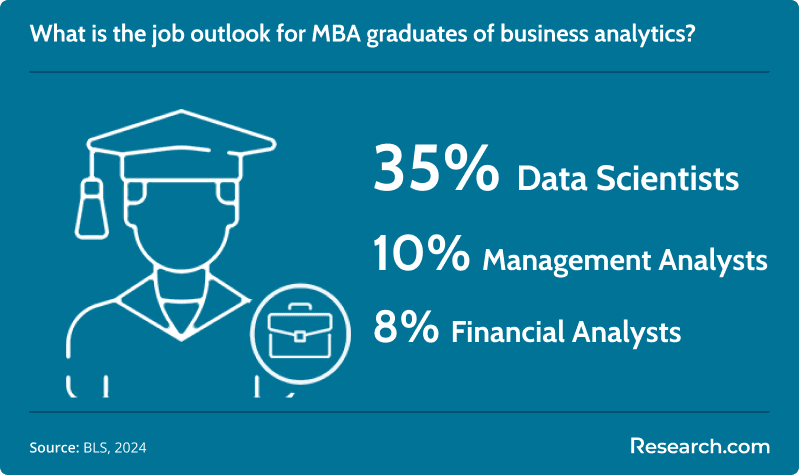
Role-specific labor market data provides additional context. The 2023 median pay for data scientists is $108,020 per year, management analysts earn $99,410 per year, and financial analysts make $99,890 per year. These figures are not guarantees for MBA graduates, but they help show the earning range for analytics-adjacent occupations.
- Affordable online MBA in business analytics programs for 2027
- How long does an online MBA in business analytics take?
- Online MBA in business analytics vs. on-campus MBA
- Average cost of an online MBA in business analytics
- Financial aid options for online MBA students
- Admissions requirements and prerequisites
- Business analytics MBA specializations
- Alternatives to an online MBA in business analytics
- Networking and mentorship in online MBA programs
- Long-term ROI of the degree
- How to choose an affordable online MBA in business analytics
- Accelerated online MBA options
- Career paths after graduation
- Challenges students should expect
- Job market outlook for graduates
- Soft skills that matter in analytics leadership
- Online MBA in business analytics vs. online Executive MBA
- How accelerated programs may support career growth
- How the degree supports data-driven businesses
Affordable online MBA in business analytics programs for 2027
How Research.com evaluates schools
Affordability matters, but a low tuition rate should not be the only reason to choose a graduate business program. Our school review process uses established education data sources, including the IPEDS database, Peterson's database, the College Scorecard database, and The National Center for Education Statistics. These sources help compare institutions using available data rather than marketing claims. You can learn more on Research.com's methodology page.
| Rank | School and program | Cost | Credits | Selected coursework |
| 1 | University of North Carolina at Pembroke — online Master of Business Administration with a concentration in Business Analytics | $$11,092.30 per year | 36 | Statistics, Economics, Accounting, Marketing, Management |
| 2 | Southeastern Oklahoma State University — online Master of Business Administration with a concentration in Data Analytics | $12,420 per year | 36 | Predictive Analytics, Data Visualization, Marketing Analytics, Analytics for Supply Chain Logistics |
| 3 | Northwest Missouri State University — online Master of Business Administration with a concentration in Business Analytics | $13,730 per year | 30 | Data Mining, Decision Support Modeling, Analytics Tools |
| 4 | Florida Gulf Coast University — online Master of Business Administration with a concentration in Data Analytics | $12,322 | 33 | Data Management, Big Data and Data Mining, BI and Visualization |
| 5 | Longwood University — online Master of Business Administration with a specialization in Data Analytics | $13,361 | 31 | Managing Data for Strategic Decision Making, Leadership and Team Building, Data Visualization |
| 6 | Louisiana State University-Shreveport — online Master of Business Administration with a concentration in Data Analytics | $479 per credit | 30 | Data Analysis, Statistics, Informatics |
| 7 | Rogers State University — accelerated online Master of Business Administration with a concentration in Business Analytics | $10,880 (est.) | 36 (business administration) + 9 (business analytics option) | Accounting and Financial Analytics, Management Analytics, Marketing Analytics, Data and Information Management, Artificial Intelligence for Business |
| 8 | Lamar University — online MBA in Business Analytics | $13,153 | 30 | Finance, Marketing, Enterprise Resource Planning (ERP) Systems, Data Mining, Data Analysis in Accounting |
| 9 | Northeastern State University — online Master of Business Administration with a concentration in Business Analytics | $12,340 | 36 | Business Analytics Survey, Structured Data Design and Querying, Business Analytic Techniques, Advanced Multi-Environment Market Analytics |
| 10 | Arkansas Tech University — online Master of Business Administration with a concentration in Business Data Analytics | $314.50 per credit | 33 | applied predictive analytics, advanced analytics, analytic strategy, big data strategies |
How to use this affordability list
Use the table as a starting point, not a final decision tool. The lowest listed tuition may not be the lowest total cost after fees, books, technology charges, transfer-credit limits, or required prerequisites. Before applying, ask each school for a full program cost estimate, confirm whether tuition differs for in-state and out-of-state students, and verify whether the business school or program has the accreditation you need.
Key findings for prospective students
- According to ZipRecruiter, MBA jobs earn a median salary of $165,372, with the highest median salaries in Washington ($200,825), New York ($179,210), and Vermont ($175,826).
- An online MBA in Business Analytics typically takes 18 months to 3 years to complete, depending on the structure, course load, enrollment status, start dates, and transfer credits.
- Online graduate programs now account for 35% of all U.S. graduate enrollments, which supports the broader acceptance of online graduate study.
- The average cost of an on-campus MBA in the U.S. is $232,985, including tuition fees, living expenses, and other costs such as campus facilities.
- The average cost of an online MBA in the U.S. is approximately $630 per credit, although individual program costs vary widely.
How long does it take to complete an online MBA in business analytics?
An online MBA in Business Analytics degree program typically takes 18 months to 3 years to complete. That is a different timeline than many other graduate or professional programs, including the cheapest BCBA online program, so students should compare time commitments carefully rather than assuming all online degrees move at the same pace.
| Factor | How it affects completion time |
| Program structure | Accelerated formats may allow completion in as little as 18 months, while more traditional formats may take up to 3 years. |
| Course load | Taking more courses each term can shorten the timeline; taking fewer courses can make the workload more manageable but extend the program. |
| Part-time or full-time enrollment | Full-time students usually finish sooner, while part-time students often balance the MBA with employment and family responsibilities. |
| Start dates | Programs with multiple start dates let students begin sooner instead of waiting for a fall or spring semester. |
| Transfer credits | Prior graduate coursework or approved professional learning may reduce the number of required credits if the school allows transfer credit. |
How does an online MBA in business analytics compare to an on-campus program?
An online MBA in Business Analytics can provide similar academic content to an on-campus MBA, but the student experience is different. The better choice depends on your schedule, learning style, networking goals, budget, and access to local campuses.
| Comparison point | Online MBA in business analytics | On-campus MBA in business analytics |
| Schedule | Often more flexible, especially for working professionals who need evening, weekend, or asynchronous coursework. | Usually follows a more fixed class schedule and may require regular campus attendance. |
| Location | Students can usually study from anywhere with reliable internet access. | Students may need to commute or relocate. |
| Cost considerations | May reduce commuting, housing, and some campus-related expenses. | May involve additional costs for relocation, transportation, housing, and campus services. |
| Networking | Networking happens through virtual events, online group projects, alumni platforms, and video meetings. | Networking may feel more immediate through in-person classes, campus events, and local employer visits. |
| Learning demands | Requires strong self-discipline, time management, and comfort with digital tools. | Provides more face-to-face structure, which some students prefer. |
| Technology exposure | Students often use online collaboration platforms, dashboards, analytics tools, and virtual project environments. | Students may use the same tools but with more in-person instruction and support. |
What is the average cost of an online MBA in business analytics?
The average cost of an online MBA in the U.S. is approximately $630 per credit. By comparison, some other online healthcare and counseling pathways, such as an MA to LPN bridge program online or the cheapest online LPC programs, may cost around $9,000 to $12,000 only. MBA pricing varies by school, residency status, credit requirements, and fees.
- Tuition: Tuition is the largest cost, and online rates may differ from campus-based rates.
- Living expenses: Online students often avoid relocation and commuting costs. For example, living expenses for a Stanford MBA student in the San Francisco Bay Area are estimated at $72,396 over the two-year program, while Duke Fuqua students in Durham, North Carolina, have living expenses of around $35,000 per year.
- Fees and materials: Technology fees, books, software subscriptions, proctoring charges, graduation fees, and prerequisite courses can change the total cost.
- Time away from work: If you reduce work hours to study, that lost income should be included in your personal ROI calculation.
What financial aid options are available for online MBA students?
Students in online MBA programs may be able to use several funding sources. Similar aid options may also apply to students comparing an online MBA under 10k or the cheapest online bachelor's degree in education, although eligibility rules differ by program and student status.
- Federal financial aid: Eligible graduate students can complete the Free Application for Federal Student Aid (FAFSA) and may qualify for Direct Unsubsidized Loans and Grad PLUS Loans.
- Scholarships: Schools, professional associations, employers, and private organizations may offer MBA scholarships based on merit, need, identity, industry, military status, or career goals.
- Employer tuition reimbursement: Some employers help pay for graduate education, often with grade requirements, annual limits, or post-graduation service commitments.
- Private loans: Banks and private lenders may help cover funding gaps, but rates and repayment terms can be less favorable than federal options.
- Military benefits: Veterans and active-duty service members may be able to use GI Bill benefits or other military education benefits.
What are the prerequisites for enrolling in an online MBA in business analytics?
Admissions requirements vary, but most online MBA in Business Analytics programs look for evidence that applicants can handle graduate-level business and quantitative coursework. Some requirements resemble those used in other graduate business or management fields, including an affordable online master's degree in human resources.
- Bachelor's degree: Most programs require a bachelor's degree from an accredited institution. Some accept applicants from many majors, while others prefer business, economics, engineering, computer science, or related backgrounds.
- Professional experience: Some schools prefer or require one to several years of work experience, especially for programs that rely heavily on case discussions and applied projects.
- GMAT or GRE: Many programs request GMAT or GRE scores, although some schools waive testing based on professional experience, prior graduate work, or academic performance.
- Recommendation letters: Applicants may need letters from supervisors, professors, or professional contacts who can speak to leadership potential, analytical ability, and readiness for graduate study.
- Statement of purpose: A personal essay usually explains career goals, reasons for pursuing the MBA, and why the program fits the applicant's plans.
- English proficiency: International applicants may need TOEFL or IELTS scores if English is not their first language.
Why accreditation matters when choosing an online MBA
Accreditation should be one of the first filters in your program search. Accredited programs have gone through external review, which can affect employer confidence, transferability, financial aid eligibility, and the credibility of your degree. The major business-school accreditors commonly associated with MBA programs include the Association to Advance Collegiate Schools of Business (AACSB), Accreditation Council for Business Schools and Programs (ACBSP), and International Accreditation Council for Business Education (IACBE).
AACSB accreditation is often viewed as especially rigorous in business education. Students looking for a lower-cost AACSB pathway can compare the cheapest AACSB online MBA options as part of a broader affordability and quality review.
Accreditation checklist
- Institutional accreditation: Confirm that the university itself is accredited by a recognized institutional accreditor.
- Business accreditation: Check whether the business school or MBA program holds AACSB, ACBSP, or IACBE accreditation.
- Employer recognition: Ask whether graduates from the program are hired by employers in your target industry or region.
- Financial aid eligibility: Verify that the program is eligible for the aid sources you plan to use.
- Program transparency: Look for clear information on total cost, curriculum, faculty, student services, and outcomes.
What courses are typically included in an online MBA in business analytics?
The strongest programs do more than teach students to read dashboards. They teach students to ask better business questions, evaluate data quality, communicate findings, and recommend action. Common courses include:
- Data Analytics: Methods for collecting, cleaning, analyzing, and interpreting data for business use.
- Business Intelligence: Techniques for turning organizational data into reports, dashboards, and strategy-supporting insights.
- Predictive Analytics: Models used to forecast trends, demand, risk, customer behavior, or operational outcomes.
- Data Mining: Approaches for identifying patterns, relationships, and useful signals in large datasets.
- Quantitative Methods: Statistical and mathematical tools for solving business problems.
- Strategic Management: Frameworks for connecting analytics with competitive positioning, growth, and leadership decisions.
- Marketing Analytics: Data-driven methods for customer segmentation, campaign analysis, and marketing performance.
- Financial Analytics: Use of data to assess financial performance, risk, forecasting, and investment decisions.
Online MBA programs are commonly designed for working professionals. According to a survey, 83% of online graduate students report satisfaction with their educational experience, which suggests that many students find the format workable when the program is well structured and supported.
What specializations are available in an online MBA in business analytics?
Specializations let students align their analytics training with a target industry or function. The right choice depends on where you want to work after graduation.
| Specialization | Best fit for students interested in | Typical focus |
| Marketing Analytics | Brand management, digital marketing, customer insights, campaign strategy | Customer behavior, campaign ROI, segmentation, and marketing performance. |
| Financial Analytics | Corporate finance, investment analysis, risk management, banking | Financial modeling, forecasting, risk analysis, and data-supported financial decisions. |
| Healthcare Analytics | Hospitals, health systems, insurance, healthcare operations | Patient outcomes, resource use, reporting, operations, and care delivery efficiency. |
| Supply Chain Analytics | Logistics, procurement, manufacturing, retail operations | Inventory, demand planning, transportation, supplier performance, and process improvement. |
| Business Intelligence | Reporting, dashboard development, strategy support, operations management | Data gathering, visualization, KPI tracking, and actionable reporting. |
| Predictive Analytics | Forecasting, machine learning applications, risk modeling, strategic planning | Statistical models and machine learning algorithms used to anticipate future outcomes. |
Graduates of online master's programs, including those specializing in Business Analytics, report an average salary increase of 20%. Individual results vary, so treat that figure as context rather than a promise.
What are the alternatives to an online MBA in business analytics?
An online MBA is not the only route into analytics-related business work. If you do not need a full management degree, a shorter or more technical option may be more efficient.
| Alternative | When it may make sense | Trade-off |
| Accelerated business degree | You want a faster business credential and do not need the full MBA experience. | May be broader and less specialized than a graduate analytics MBA. |
| Business analytics certificate | You already have a degree and need focused skills in SQL, dashboards, analytics tools, or data interpretation. | Usually less comprehensive for leadership, finance, strategy, and operations topics. |
| Data science or analytics bootcamp | You want hands-on technical skill development and project work. | May not carry the same graduate-degree recognition as an MBA. |
| MOOCs from platforms like Coursera or edX | You need affordable, flexible, self-paced upskilling in a specific tool or concept. | Often requires more self-direction and may not provide structured career support. |
| Postgraduate diploma in analytics or data science | You want a middle ground between a certificate and a full MBA, often completed within one to two years. | May be less recognized by some employers than an MBA, depending on the institution and market. |
| Online business degree | You want a broader business foundation before specializing in analytics. | May not provide advanced analytics depth unless the curriculum includes data-focused coursework. |
How do networking and mentorship opportunities enhance career success in an online MBA in business analytics program?
Networking can be one of the biggest differences between a basic online program and a career-building MBA experience. Strong online programs create structured ways for students to meet faculty, alumni, classmates, career coaches, and industry speakers. These connections can lead to project collaboration, referrals, interview preparation, mentorship, and insight into how analytics work is actually organized inside companies.
Before enrolling, ask whether the program offers alumni networking platforms, virtual employer events, mentorship matching, analytics competitions, live group projects, career advising, and access to business school job boards. A program with weak networking may still teach useful skills, but it may place more of the career-search burden on the student.
What is the long-term return on investment of an online MBA in business analytics?
The ROI of an online MBA in business analytics should be measured across several years, not only by first-year salary. A strong return may come from promotion eligibility, a move into analytics management, stronger strategic decision-making skills, employer-paid tuition support, or access to a better professional network. Students focused on keeping debt low can compare the cheapest online MBA program options while still checking accreditation, curriculum quality, and career support.
Questions to ask before calculating ROI
- What is the total program cost after fees, books, software, and interest on loans?
- Will I keep working while enrolled, or will I reduce income to study?
- Does my employer offer tuition reimbursement or promotion opportunities after completion?
- What job title am I realistically targeting after graduation?
- Do graduates from this program work in my target industry or region?
- Will the degree add leadership credibility, technical credibility, or both?
How should I choose the most affordable online MBA in business analytics?
The best affordable program is not always the cheapest one. It is the program that offers the right mix of cost, accreditation, curriculum, flexibility, support, and career relevance for your goals.
- Confirm accreditation first. Do not compare tuition until you verify institutional accreditation and, when possible, business-school accreditation.
- Calculate total cost. Include tuition, fees, books, technology charges, software, travel, prerequisites, and loan interest.
- Review the analytics curriculum. Look for business intelligence, statistics, predictive analytics, data visualization, data management, and applied projects.
- Check flexibility. Confirm whether the program is asynchronous, synchronous, accelerated, part-time, full-time, or cohort-based.
- Evaluate faculty and industry relevance. Look for instructors with analytics, management, consulting, or industry experience.
- Assess student support. Career services, technical support, academic advising, tutoring, and library access matter more in online learning than many students expect.
- Ask about outcomes. Request available information on graduation rates, placement support, employer partnerships, and alumni roles.
Is an accelerated online MBA in business analytics a viable option?
Accelerated online MBA programs in business analytics can work well for students who already have strong time-management skills, employer support, and enough weekly availability for intensive coursework. They can shorten the time to completion, but the faster pace may make group projects, quantitative assignments, and exam preparation more demanding.
If speed is a priority, compare 12 month MBA programs online with standard 18 months to 3 years options. A shorter program is only beneficial if you can complete it without sacrificing learning quality, work performance, or personal commitments.
What career paths are available after an online MBA in business analytics?
Graduates may move into technical, managerial, consulting, or strategy roles, depending on their previous experience. The MBA is especially useful when paired with domain knowledge in finance, healthcare, technology, retail, operations, or supply chain management.
| Career path | Typical responsibilities | Useful preparation |
| Data analyst | Analyze datasets, build reports, identify patterns, and support business decisions. | Statistics, SQL, visualization, communication, business context. |
| Business intelligence manager | Lead reporting teams, manage dashboards, define KPIs, and communicate insights to executives. | Business intelligence tools, leadership, stakeholder management, data governance. |
| Operations analyst | Use data to improve processes, reduce waste, forecast needs, and support operational decisions. | Operations management, predictive analytics, process improvement. |
| Financial analyst | Evaluate financial performance, build models, assess risk, and support investment or budgeting decisions. | Financial analytics, modeling, accounting, data interpretation. |
| Management analyst | Advise organizations on efficiency, strategy, and performance improvement. | Consulting skills, analytics, strategy, presentation skills. |
| Analytics consultant | Help clients use data to solve business problems, improve profitability, or guide transformation projects. | Client communication, problem-solving, data storytelling, project management. |
In the technology industry, roles may involve using data to improve products, enhance user experiences, and optimize operations. Salaries typically range from $90,000 to over $110,000 annually. Finance, healthcare, consulting, and advisory services also rely heavily on analytics professionals who can connect data findings to business decisions.
If you are still comparing graduate pathways outside business analytics, you may also want to review cheap online RN to FNP courses, cheap online MBA information systems programs, affordable online BSN to DNP programs, or affordable online creative writing degrees.
What challenges might arise during an online MBA in business analytics?
The main challenges are workload, quantitative difficulty, isolation, technology demands, and balancing school with work. Analytics courses can be demanding for students who have been away from statistics or data tools for several years. Online group projects can also be challenging when teammates work across time zones or have different schedules.
- Time pressure: Plan weekly study blocks before classes begin rather than fitting coursework into leftover time.
- Quantitative gaps: Review statistics, spreadsheets, and basic data concepts before the first analytics course.
- Online isolation: Join discussion groups, attend live sessions when available, and contact faculty early.
- Group-project friction: Set deadlines, roles, and communication expectations at the start of each project.
- Accelerated pacing: Consider whether an MBA fast track fits your schedule before choosing speed over sustainability.
What is the job market for graduates with an online MBA in business analytics?
The job market for online MBA in Business Analytics graduates is tied to a broad shift toward data-informed management. Organizations in technology, finance, healthcare, retail, consulting, and operations use data to improve forecasting, pricing, customer experience, risk management, staffing, and strategic planning. This creates opportunities for professionals who understand both business priorities and analytical methods.
The strongest candidates usually have more than the degree. They can explain business problems clearly, use data tools, interpret results responsibly, present findings to nontechnical leaders, and recommend practical next steps. Employers may also value project portfolios, industry experience, internships, certifications, and demonstrated software skills.
What soft skills are important for success in an online MBA in business analytics?
Technical ability is only part of analytics leadership. Business analytics professionals must also persuade stakeholders, manage ambiguity, and translate technical findings into decisions.
- Critical thinking: Students need to question assumptions, evaluate data quality, and avoid drawing conclusions from weak evidence.
- Problem-solving: Employers value professionals who can break down messy business problems and identify realistic data-supported solutions.
- Teamwork and collaboration: Online MBA programs often use virtual group projects, which require clear communication and shared accountability.
- Time management: Students who work full time need disciplined planning to meet deadlines and complete projects consistently.
- Adaptability: Analytics tools and business needs change quickly, so students must be willing to learn new methods and revise their approach.
- Data storytelling: A useful insight has limited value if decision-makers cannot understand it. Strong graduates can explain findings in plain language.
What distinguishes an online MBA in business analytics from an online Executive MBA?
An online MBA in business analytics is usually designed for early-career or mid-career professionals who want broad business training plus analytical depth. An online Executive MBA is typically aimed at experienced leaders who already have significant management responsibility and want to sharpen executive decision-making.
| Program type | Typical student | Main emphasis |
| Online MBA in business analytics | Early-career or mid-career professionals seeking analytics, management, and strategic business skills. | Business foundations, data interpretation, analytics tools, predictive modeling, and applied decision-making. |
| Online Executive MBA | Experienced executives and senior managers with substantial professional experience. | Executive leadership, strategy, organizational change, and high-level decision-making based on real-world leadership challenges. |
If your main goal is executive-level leadership rather than analytics specialization, compare the most affordable executive MBA programs before deciding.
How can accelerated online MBA programs support career growth in business analytics?
Accelerated online MBA programs can help professionals earn a graduate business credential faster, apply analytics concepts sooner, and pursue promotions or career changes on a shorter timeline. The benefit is speed, but the risk is overload. Students should confirm that the curriculum still includes meaningful analytics work, faculty access, career support, and applied projects.
Professionals who want a condensed pathway can compare the best accelerated MBA programs while checking whether the format fits their work schedule and learning style.
How does an online MBA in business analytics support data-driven businesses?
Data-driven organizations need professionals who can do more than produce reports. They need managers who can ask the right questions, evaluate evidence, connect data to strategy, and guide teams through decisions. An online MBA in Business Analytics is designed to build that bridge between technical analysis and business leadership.
- It supports evidence-based strategy. Students learn to interpret data and use it to guide marketing, operations, finance, and competitive decisions.
- It helps organizations innovate. Analytics can reveal new customer needs, product opportunities, process improvements, and market shifts.
- It improves operations. Analytics can be used to identify inefficiencies, reduce costs, improve productivity, and support supply chain or inventory decisions.
- It strengthens customer understanding. Customer data can help organizations personalize services, improve user experiences, and evaluate engagement.
- It builds cross-functional leadership. Graduates can serve as translators between technical teams and executives, helping both sides make better decisions.
Students who want a closely related technology-focused route may also compare an affordable online MBA in information technology in USA, especially if they want more emphasis on IT systems, digital transformation, and technology management.
Common mistakes to avoid when choosing a program
| Mistake | Why it can hurt you | Better approach |
| Choosing only by tuition | A low sticker price may hide fees, limited support, weak networking, or fewer analytics electives. | Compare total cost, accreditation, curriculum, faculty, support, and outcomes together. |
| Ignoring accreditation | Some employers and aid programs may not recognize weak or unaccredited credentials. | Verify institutional accreditation and check for AACSB, ACBSP, or IACBE business accreditation. |
| Assuming online means self-paced | Some programs require live classes, group meetings, fixed deadlines, or residencies. | Ask for a sample schedule and confirm synchronous requirements before applying. |
| Overestimating salary gains | An MBA does not guarantee a specific salary or job title. | Use salary data as context and evaluate your experience, target role, location, and employer market. |
| Skipping technical preparation | Analytics coursework can be difficult without comfort in statistics, spreadsheets, databases, or visualization. | Refresh quantitative skills before the first term. |
| Relying only on rankings | A highly ranked program may not fit your budget, schedule, specialization, or career goals. | Use rankings as one input, then compare fit and ROI. |
Key Insights
- An online MBA in business analytics is most useful for professionals who want to combine management responsibility with data-informed decision-making.
- The typical completion timeline is 18 months to 3 years, but accelerated formats require careful planning and strong time management.
- Affordability should be evaluated by total program cost, not tuition alone. Fees, software, books, prerequisites, and lost work time can change the real price.
- Accreditation is a major quality signal. Check institutional accreditation and look for business accreditors such as AACSB, ACBSP, or IACBE.
- Salary data can help frame potential outcomes, but earnings depend on experience, industry, location, role, and technical skill level.
- Students who only need technical analytics skills may be better served by certificates, bootcamps, MOOCs, or postgraduate diplomas instead of a full MBA.
- The strongest programs provide applied projects, career support, networking, mentorship, and a curriculum that connects analytics tools to real business decisions.
References:
- Branch, T. (2024, June 19). How much does an MBA cost? NerdWallet. https://www.nerdwallet.com/article/loans/student-loans/how-much-does-an-mba-cost
- Highest Paying Business Analytics Jobs. (2024, June). Northwest Executive Education. Retrieved July 11, 2024, from https://northwest.education/insights/career-growth/highest-paying-business-analytics-jobs/
- Occupational Outlook Handbook - Data Scientists. (2024, July). Bureau of Labor Statistics. Retrieved July 11, 2024, from https://www.bls.gov/ooh/math/data-scientists.htm
- Occupational Outlook Handbook - Financial Analysts. (2024, June). Bureau of Labor Statistics. Retrieved July 11, 2024, from https://www.bls.gov/ooh/business-and-financial/financial-analysts.htm
- Occupational Outlook Handbook - Management Analysts. (2024, July). Bureau of Labor Statistics. Retrieved July 11, 2024, from https://www.bls.gov/ooh/business-and-financial/management-analysts.htm
- Record-Breaking career placement for MSBA Class of 2022. (2024, July 10). UC Davis Graduate School of Management. https://gsm.ucdavis.edu/blog/record-breaking-career-placement-msba-class-2022
- What Is the Average Mba Salary by State. (2024). ZipRecruiter. Retrieved July 11, 2024, from https://www.ziprecruiter.com/Salaries/What-Is-the-Average-MBA-Salary-by-State
Other Things You Should Know About Affordable Online MBA in Business Analytics Degree Programs
Most affordable online MBA in Business Analytics programs require 30 to 36 credit hours. Programs on the lower end often accept prior graduate business coursework or waivers for introductory classes, while standard MBA structures include core business courses plus analytics electives or a concentration.
Typical admission requirements include a bachelor's degree, a minimum GPA of 3.0, and submission of GRE or GMAT scores. Some programs might waive these tests if applicants have relevant work experience or an advanced degree. Check specific program requirements for details.