
2027 Most Affordable Online Master's in Artificial Intelligence Degree Programs

Co-Founder and Chief Data Scientist
Artificial intelligence has been revolutionizing industries worldwide by optimizing workflows and leveraging its computing speed to produce complex outcomes in a matter of seconds. As such, the adoption of AI has grown from 50% of organizations in 2022 to 72% in 2024. Many students want to be part of this revolution, but which graduate degree should they take?
Upon earning a tech-related undergraduate degree like data science or computer science, they can take masters in artificial intelligence degrees, which are the subjects of this guide. Drawing from my experience as a seasoned career planner, I discussed pertinent details surrounding the degree, including the cost, job outlook, and possible career paths. I identified some of the most affordable high-quality degrees on the market.
What are the benefits of getting masters in artificial intelligence degrees?
- By earning masters in artificial intelligence degrees, graduates can become, among others, data scientists, AI research scientists and product managers, and machine learning engineers.
- Computer and information research scientists, possible occupations of artificial intelligence graduates, earn an average annual salary of $157,160 and a median annual salary of $145,080.
- Online masters in artificial intelligence degrees are usually cheaper, more accessible, and more flexible than their campus-based counterparts.
What can I expect from masters in artificial intelligence degrees?
- Advanced Coursework: In-depth study of machine learning, neural networks, natural language processing, robotics, and AI ethics, often with a strong emphasis on mathematics, statistics, and programming.
- Hands-On Experience: Practical experience through projects, labs, and internships that involve real-world AI applications, such as developing models, working with large datasets, and deploying AI systems.
- Research Opportunities: Opportunities to engage in cutting-edge research, contributing to advancements in AI technologies, algorithms, and applications, often culminating in a thesis or capstone project.
- Interdisciplinary Learning: Exposure to related fields like data science, cognitive science, and software engineering, fostering a holistic understanding of AI and its applications across various industries.
- Industry Connections: Access to industry partnerships, networking events, and guest lectures from AI professionals, which can lead to internships, collaborations, and job opportunities post-graduation.
- Flexibility in Learning: Many programs offer online or hybrid learning options, providing flexibility for working professionals or those balancing other commitments.
Where can I work with a masters in artificial intelligence degree?
Artificial intelligence is used in nearly every industry these days, which is why graduates of AI programs have numerous options for employment. The sectors in which they would most likely find prestigious jobs include the following:
- Technology Companies: Major tech firms like Google, Amazon, Microsoft, and Apple are at the forefront of AI development, offering roles in machine learning, data science, and AI research.
- Healthcare: AI is transforming healthcare through applications in medical imaging, drug discovery, and personalized medicine. Graduates can work in hospitals, pharmaceutical companies, or health tech startups.
- Finance: The finance sector utilizes AI for algorithmic trading, fraud detection, and risk management. Banks, financial institutions, and fintech companies are key employers.
- Manufacturing: AI-driven automation and robotics are revolutionizing manufacturing processes, offering opportunities in industrial AI and smart factories.
- Automotive Industry: Companies like Tesla and traditional automakers are developing AI for autonomous vehicles and smart transportation systems.
- Government and Defense: AI is increasingly used in cybersecurity, intelligence analysis, and national defense, creating a variety of roles within government agencies and defense contractors. For those interested in a cyber security career path, opportunities in these sectors offer a chance to work on advanced security initiatives and protect critical national infrastructure.
- Retail and E-commerce: AI is used for personalized shopping experiences, inventory management, and customer service, with opportunities in companies like Amazon, Walmart, and various online retailers.
- Education: AI is being integrated into educational technology for personalized learning, offering roles in edtech companies or academic institutions.
How much can I make with masters in artificial intelligence degrees?
According to 2024 data from the United States Bureau of Labor Statistics (BLS), computer and information research scientists, popular occupations among AI graduates, earn an average annual salary of $157,160 and a median annual salary of $145,080.
Another popular occupation is that of a data scientist and cybersecurity analyst. These professionals earn an average annual salary of $119,040 and a median annual salary of $108,020.
Graduates who aim to produce digital solutions can become software developers, who earn an average annual salary of $138,110 and a median annual salary of $132,270.
Since AI can be used in many areas of operations, graduates with masters in artificial intelligence degrees can enter a variety of computer and information technology occupations. Collectively, these jobs earn a median annual salary of $104,420, much higher than the national average.
- Most Affordable Online Master's in Artificial Intelligence Degree Programs for 2027 List of Programs
- How long does it take to complete a masters in artificial intelligence degree? How long does it take to complete a masters in artificial intelligence degree?
- How does an online masters in artificial intelligence degree compare to an on-campus program? How does an online masters in artificial intelligence degree compare to an on-campus program?
- What is the average cost of masters in artificial intelligence degrees? Program Cost
- What are the financial aid options for students enrolling in a masters in artificial intelligence degree? Financial Aid Options
- What are the prerequisites for enrolling in a masters in artificial intelligence degree? What are the prerequisites for enrolling in a masters in artificial intelligence degree?
- What courses are typically in a masters in artificial intelligence degree? What courses are typically in a masters in artificial intelligence degree?
- What types of specializations are available in masters in artificial intelligence degrees? What types of specializations are available in masters in artificial intelligence degrees?
- How to Choose the Best Masters in Artificial Intelligence Degree How to Choose the Best Masters in Artificial Intelligence Degree
- How can students manage the financial challenges of pursuing a master’s in artificial intelligence? How can students manage the financial challenges of pursuing a master’s in artificial intelligence?
- What complementary certifications can further boost AI career prospects? What complementary certifications can further boost AI career prospects?
- What career paths are available for graduates of masters in artificial intelligence degrees? What career paths are available for graduates of masters in artificial intelligence degrees?
- How do AI master's programs provide hands-on learning and research opportunities? How do AI master's programs provide hands-on learning and research opportunities?
- What is the job market for graduates with a masters in artificial intelligence degree? Job Market
- What key skills are developed through a master’s in AI program? What key skills are developed through a master’s in AI program?
- What is the ROI of a masters in AI degree? What is the ROI of a masters in AI degree?
- Are AI master’s programs fostering entrepreneurship and innovation? Are AI master’s programs fostering entrepreneurship and innovation?
- How are cybersecurity concerns addressed in AI master’s programs? How are cybersecurity concerns addressed in AI master’s programs?
- Can accelerated AI master’s programs fast track career success? Can accelerated AI master’s programs fast track career success?
- How do faculty expertise and research collaborations influence success in AI master’s programs? How do faculty expertise and research collaborations influence success in AI master’s programs?
- What challenges do online AI master’s students encounter and how are they supported? What challenges do online AI master’s students encounter and how are they supported?
- How do online AI master’s programs support career advancement through industry connections? How do online AI master’s programs support career advancement through industry connections?
- Are AI master’s programs equipping students to tackle ethical and regulatory challenges? Are AI master’s programs equipping students to tackle ethical and regulatory challenges?
- What are the key industries revolutionized by artificial intelligence? What are the key industries revolutionized by artificial intelligence?
- How does program accreditation affect the credibility of a masters in AI degree? How does program accreditation affect the credibility of a masters in AI degree?
- What are the current trends in artificial intelligence and how do they impact the job market? What are the current trends in artificial intelligence and how do they impact the job market?
- How does your undergraduate background influence success in an AI master's program? How does your undergraduate background influence success in an AI master's program?
- How can engineering expertise elevate AI master’s programs? How can engineering expertise elevate AI master’s programs?
- Can biotechnology and AI converge to unlock innovative career paths? Can biotechnology and AI converge to unlock innovative career paths?
- Can completing an accelerated bachelor's degree enhance preparation for an AI master's program? Can completing an accelerated bachelor's degree enhance preparation for an AI master's program?
- What certification pays the most? What certification pays the most?
Most Affordable Online Master's in Artificial Intelligence Degree Programs for 2027
Choosing an online master’s in artificial intelligence is a high-stakes decision. Tuition can be substantial, the coursework is technical, and the degree should connect clearly to the roles you want after graduation. The best program is not simply the cheapest one; it is the affordable program that matches your background, schedule, career goals, and need for hands-on AI experience.
This guide compares affordable online and flexible master’s programs in artificial intelligence, machine learning, data science, and related applied computing fields. You will find program costs, completion timelines, credit requirements, accreditation details, admissions considerations, career paths, financial aid options, and practical questions to ask before enrolling.
The goal is to help you build a shortlist with confidence instead of relying only on rankings, tuition claims, or generic program descriptions.
Quick Answer: What is the most affordable online master’s in artificial intelligence?
Based on the programs listed in this guide, the University of Texas at Austin offers one of the lowest advertised costs among online AI master’s options, with a 30-credit Master’s of Artificial Intelligence program costing around $10,000 and a cost per credit of $333.33. However, the best choice depends on more than tuition. Students should also compare curriculum depth, admissions requirements, capstone or thesis options, accreditation, faculty expertise, and whether the program supports their intended career path.
| School | Program | Credits | Cost per Credit | Typical Length |
| University of Texas at Austin | Master’s of Artificial Intelligence | 30 | $333.33 | 18-36 months |
| University of the Cumberlands | Online Master's in Artificial Intelligence | 31 | $355 | 20 months |
| Kennesaw State University | Master of Science in Artificial Intelligence | 30 | $393 | 1 to 2 years |
| Campbellsville University | Master of Science in Data Science and Artificial Intelligence | 36 | $445 | 1 year |
| University of Central Missouri | Data Science and Artificial Intelligence, MS | 30 | $477 | 1 to 2 years |
How we ranked and reviewed schools
Graduate AI programs require a meaningful investment of time, money, and technical effort, so our ranking process emphasizes reliable education data and practical program value. Research.com reviewed information from the IPEDS database, the College Scorecard database, Peterson's Database, and the National Center for Education Statistics (NCES), along with school-published program information.
Our methodology page explains how Research.com evaluates programs and develops rankings. Readers should use this list as a starting point, then verify tuition, fees, admissions standards, and course availability directly with each university before applying.
1. University of Texas at Austin Master’s of Artificial Intelligence
The University of Texas at Austin offers a fully online Master’s in Artificial Intelligence built for students who want rigorous AI training without relocating. The 30-credit curriculum includes required study in areas such as Ethics in AI and Deep Learning, while electives including AI in Healthcare and Natural Language Processing allow students to shape the degree around specific professional interests. With a total program cost of around $10,000, it is a strong option for cost-conscious students who want a recognized public university credential.
- Program Length: 18-36 months
- Cost per Credit: $333.33
- Required Units to Graduate: 30
- Accreditation: Southern Association of Colleges and Schools, Commission on Colleges
2. University of the Cumberlands Online Master's in Artificial Intelligence
The University of Cumberlands offers an online AI master’s program designed for professionals who want to apply artificial intelligence in business and technology settings. The 31-credit curriculum addresses AI use in manufacturing, healthcare, financial services, and organizational transformation. Students can expect a practical orientation that combines advanced AI concepts, implementation strategies, and ethical decision-making for workplace use.
- Program Length: 20 months
- Cost per Credit Hour: $355
- Required Units to Graduate: 31
- Accreditation: Southern Association of Colleges and Schools Commission on Colleges
3. Kennesaw State University Master of Science in Artificial Intelligence
Kennesaw State University provides a 30-credit Master of Science in Artificial Intelligence with an interdisciplinary and applied structure. Students study areas such as deep learning, natural language processing, and machine learning, then demonstrate their capabilities through a thesis or capstone project. The program offers both online and in-person options and does not require the GMAT for admission, which may appeal to working professionals and recent graduates alike.
- Program Length: 1 to 2 years
- Cost per Credit Hour: $393
- Required Units to Graduate: 30
- Accreditation: Southern Association of Colleges and Schools Commission on Colleges
4. University of Central Missouri Data Science and Artificial Intelligence, MS
The University of Central Missouri offers a Master of Science in Data Science and Artificial Intelligence for students who want AI training grounded in analytics. The program is available through online, in-person, and hybrid formats and includes coursework in machine learning, deep learning, data visualization, and big data analytics. Students may also gain applied experience through internships at the Missouri Innovation Campus, hackathons, and faculty-led research collaborations.
- Program Length: 1 to 2 years
- Cost per Credit Hour: $477
- Required Units to Graduate: 30
- Accreditation: Accreditation Board for Engineering and Technology
5. Campbellsville University Master of Science in Data Science and Artificial Intelligence
Campbellsville University offers a 36-credit Master of Science in Data Science and Artificial Intelligence that can be completed in one year. The program focuses on using AI and machine learning to address applied organizational problems and prepare students for roles such as data scientist, AI engineer, and solutions architect. Its flexible schedule and SACSCOC accreditation make it a practical option for students seeking an accelerated path.
- Program Length: 1 year
- Cost per Credit Hour: $445
- Required Units to Graduate: 36
- Accreditation: Southern Association of Colleges and Schools Commission on Colleges
6. Dakota State University Master of Science in Artificial Intelligence
Dakota State University offers a 30-credit Master of Science in Artificial Intelligence in both online and campus-based formats. The curriculum covers machine learning, neural networks, computer vision, and natural language processing. Students who want a flexible program with a direct AI focus may complete the degree in as little as two years.
- Program Length: 2 years
- Cost per Credit Hour: $580.60
- Required Units to Graduate: 30
- Accreditation: Higher Learning Commission
7. University of Maine Online M.S. in Data Science and Engineering
The University of Maine offers a 30-credit online Master of Science in Data Science and Engineering that can be completed in one to two years. While broader than a standalone AI degree, the program covers data acquisition, processing, machine learning, security, visualization, and ethical considerations. Rolling admissions and no GRE/GMAT requirement may make it accessible to students with varied academic and professional backgrounds.
- Program Length: 1 to 2 years
- Cost per Credit Hour: $608
- Required Units to Graduate: 30
- Accreditation: New England Commission of Higher Education
8. Capitol Technology University Online Master of Research in Artificial Intelligence
Capitol Technology University offers an online Master of Research in Artificial Intelligence for students who want a research-centered graduate pathway. The program culminates in a master’s dissertation and may suit professionals considering doctoral study, research leadership, or advanced AI innovation roles. Coursework emphasizes advanced AI concepts alongside ethical issues in the field.
- Program Length: 1 to 2 years
- Cost per Credit Hour: $630
- Required Units to Graduate: 30
- Accreditation: Middle States Commission on Higher Education
9. Colorado State University Global Online Master's in Artificial Intelligence & Machine Learning
CSU Global offers a 30-credit online Master of Science in Artificial Intelligence and Machine Learning. The program is designed around applied technical skills in programming, software development, AI, computer vision, and machine learning. Its 8-week course format may work well for students who need shorter academic terms while balancing professional responsibilities.
- Program Length: 1 to 2 years
- Cost per Credit Hour: $675
- Required Units to Graduate: 30
- Accreditation: Higher Learning Commission
10. Columbus State University Master of Science in Applied Computer Science
Columbus State University offers a Master of Science in Applied Computer Science with multiple concentration options, including machine learning, cybersecurity, and software development. The 100% online option gives students flexibility, while the TSYS School of Computer Science’s regional business partnerships help keep the curriculum connected to applied computing needs. This program may be a fit for students who want AI-adjacent training within a broader applied computer science degree.
- Program Length: 1 to 2 years
- Cost per Credit Hour: $732
- Required Units to Graduate: 30
- Accreditation: Southern Association of Colleges and Schools Commission on Colleges
How to Use This Ranking Without Choosing the Wrong Program
A low tuition rate is helpful, but it should not be the only reason you apply. AI master’s programs differ in academic emphasis, technical prerequisites, research access, and career support. Before selecting a school, decide whether you want to become a machine learning engineer, data scientist, AI product leader, researcher, or applied AI specialist in a field such as healthcare, finance, manufacturing, or cybersecurity.
| If your goal is... | Look for programs with... | Be cautious if... |
| Machine learning engineering | Deep learning, model deployment, programming, and capstone projects | The curriculum is mostly theoretical and has few applied coding assignments |
| Data science or analytics | Statistics, big data, visualization, machine learning, and data engineering | The program uses “AI” language but has limited quantitative depth |
| AI research or doctoral study | Thesis, dissertation, faculty research, and advanced theory | The program is designed only for applied workplace projects |
| AI leadership or consulting | Ethics, business transformation, project management, and domain electives | There is little connection between technical coursework and business use cases |
How long does it take to complete a masters in artificial intelligence degree?
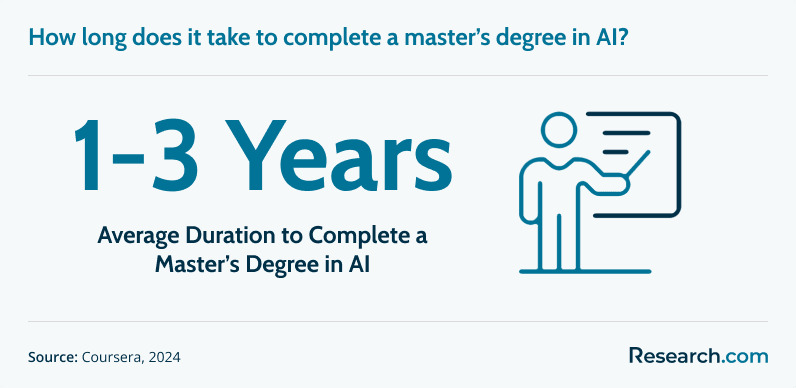
According to a 2024 Coursera report, students commonly complete masters in artificial intelligence degrees in around one to three years. Accelerated options can fall at the shorter end of that range, while more extensive or part-time programs may take longer. Similar timing patterns can also appear in some affordable online master’s in computer science programs.
AI graduate degrees are still evolving, so program structures vary. Some schools offer a dedicated AI master’s degree, while others combine AI with data science, machine learning, business intelligence, data analytics, or engineering. A broader curriculum can be valuable, but it may also affect the number of required credits and the time needed to graduate.
| Program Pace | Typical Student Profile | Trade-Off |
| Accelerated | Students who can study intensively and already have strong technical preparation | Faster completion, but less room for a lighter workload |
| Standard full-time | Students who want steady progress without compressing every course | Balanced pace, but may require careful work-life planning |
| Part-time | Working professionals or caregivers who need flexibility | Easier scheduling, but delayed graduation |
How does an online masters in artificial intelligence degree compare to an on-campus program?
Online and on-campus AI master’s programs often cover similar technical topics, but the learning experience can be very different. Online programs usually offer more scheduling flexibility and may reduce relocation or housing costs. Campus programs can provide more direct access to labs, faculty, peer groups, and in-person recruiting. Students comparing AI options may also want to review related online analytics pathways, including affordable online master’s in data science programs.
| Factor | Online Master’s in AI | On-Campus Master’s in AI |
| Schedule | Better for working professionals and students who need location flexibility | Better for students who prefer fixed class times and in-person accountability |
| Networking | Often depends on virtual events, group projects, and alumni networks | More opportunities for face-to-face interaction with faculty, peers, and employers |
| Cost considerations | May reduce housing, commuting, and relocation expenses | May involve higher living and campus-related expenses |
| Learning style | Requires strong time management and self-direction | Provides more structured daily academic routines |
| Research and labs | May use cloud-based tools, virtual labs, and remote collaboration | May offer easier access to physical labs and faculty research groups |
Choose an online AI master’s if...
- You need to keep working while enrolled.
- You cannot relocate for graduate school.
- You are comfortable learning through video lectures, coding platforms, discussion boards, and virtual teamwork.
- You want to reduce indirect costs such as commuting or housing.
Consider an on-campus AI master’s if...
- You want direct access to research labs, campus events, and in-person recruiting.
- You learn best through live classroom discussion and immediate faculty feedback.
- You are pursuing a research-heavy path and want more frequent faculty interaction.
- You can manage relocation, housing, and campus-based scheduling requirements.
What is the average cost of masters in artificial intelligence degrees?
Most AI master’s programs are science-oriented graduate degrees. According to 2024 Education Data Initiative data, the average cost of a master's degree in science in the United States is $57,770, while the average cost of a master's degree in general is $59,684.
AI program costs can vary because students may need access to specialized software, cloud computing resources, advanced computing tools, and technically intensive coursework. Similar cost questions often arise for related technical programs, including an accelerated software engineering degree online.
When comparing costs, do not stop at tuition. Ask each school for a full estimate that includes fees, books, software, technology charges, graduation fees, and any travel or residency requirements.
| Cost Item | Why It Matters | Question to Ask |
| Tuition per credit | This is the easiest cost to compare across programs | Is the rate the same for online, in-state, and out-of-state students? |
| Required credits | A lower per-credit rate may still cost more if the program requires more credits | How many credits are required for graduation? |
| Technology and course fees | AI courses may require specialized platforms or computing access | Are software, cloud, or lab fees included in tuition? |
| Time to completion | Longer enrollment can increase total costs and delay career benefits | Can I complete the program part-time or on an accelerated schedule? |
What are the financial aid options for students enrolling in a masters in artificial intelligence degree?
AI master’s programs, like many online cybersecurity programs, can be expensive even when they are labeled affordable. Students should compare aid options early, because some scholarships, assistantships, and employer benefits have separate deadlines from admission.
- Federal Student Loans: Students can submit the FAFSA application to determine eligibility for federal aid programs.
- Federal Work-Study: Eligible students may be able to earn income through approved part-time work while enrolled.
- Scholarships: Universities may offer graduate scholarships based on merit, financial need, academic field, or professional background.
- Graduate Assistantships: Some programs provide tuition support, stipends, or research and teaching opportunities.
- Tuition Waivers: Institutions may reduce tuition for qualified students based on academic, employment, military, or financial criteria.
- Private Scholarships: STEM-focused organizations and foundations may fund graduate students pursuing technical degrees.
- Industry Scholarships: Technology companies may support students preparing for AI-related careers.
- Employer Tuition Assistance: Working professionals should ask whether their employer reimburses graduate coursework tied to job duties.
- Personal Savings and Loans: Savings or private loans can fill gaps, but borrowers should compare interest rates and repayment terms carefully.
Students who need strong aid support should also research online colleges that accept FAFSA and offer financial aid, then confirm that graduate AI students are eligible for the same funding resources.
What are the prerequisites for enrolling in a masters in artificial intelligence degree?
Most AI master’s programs expect applicants to show readiness for graduate-level programming, mathematics, and analytical work. Schools may ask for transcripts, a resume, recommendation letters, a statement of purpose, and evidence of technical preparation. Applicants who need a related foundation may compare pathways such as affordable online software engineering degrees before applying to graduate school.
- Bachelor's Degree: Many programs prefer applicants with a background in computer science, computer engineering, mathematics, statistics, or a closely related field. Students still choosing an undergraduate pathway can review options such as the easiest online college degrees and majors, but they should not sacrifice technical preparation if an AI master’s is the goal.
- Programming Proficiency: Python and related programming skills are commonly expected.
- Mathematical Background: Calculus, linear algebra, statistics, and probability are important for machine learning and deep learning coursework.
- Data Science Fundamentals: Familiarity with algorithms, data structures, and data analysis can make the transition easier.
- Specific Coursework: Some programs require prior study in artificial intelligence, machine learning, data mining, or similar subjects.
- GPA: Schools often set a minimum GPA for admission.
- GRE or GMAT: Some programs require standardized tests, while others waive them or do not use them.
- Letters of Recommendation: Academic or professional references can help demonstrate readiness for advanced technical study.
- Statement of Purpose: Applicants should clearly connect the degree to their AI interests, preparation, and career objectives.
What courses are typically in a masters in artificial intelligence degree?
A strong AI master’s curriculum should teach students how to build, evaluate, and responsibly apply intelligent systems. While course names differ by university, many programs include the following areas:
- Machine Learning: Covers supervised learning, unsupervised learning, reinforcement learning, model selection, and methods for teaching systems to improve through data.
- Artificial Intelligence Fundamentals: Introduces core AI methods such as search, reasoning, knowledge representation, and intelligent decision-making.
- Neural Networks and Deep Learning: Examines multi-layer neural network architectures used in image recognition, speech processing, language tasks, and other complex applications.
- Natural Language Processing: Focuses on computational methods for analyzing, interpreting, and generating human language.
- Computer Vision: Covers image processing, object detection, visual recognition, and machine interpretation of visual inputs.
- Robotics and Autonomous Systems: Explores sensors, control systems, robotic decision-making, and AI-driven automation.
- Data Science and Big Data: Teaches methods for collecting, cleaning, managing, analyzing, and interpreting large datasets.
- Ethics in AI: Examines bias, fairness, transparency, privacy, accountability, and the broader social effects of AI systems.
What types of specializations are available in masters in artificial intelligence degrees?
Specializations help students align an AI master’s degree with a specific industry or technical role. Some programs offer formal tracks, while others allow students to build a focus through electives, projects, or research.
- Machine Learning: Prepares students to design algorithms that learn from historical and real-time data.
- Natural Language Processing: Supports work on chatbots, language translation, voice assistants, document analysis, and text mining.
- Robotics: Combines AI, automation, perception, and control systems for intelligent machines.
- Computer Vision: Focuses on AI systems that identify, classify, and interpret images or video.
- Deep Learning: Emphasizes neural networks used in high-complexity tasks such as speech, image, and autonomous driving applications.
- AI Ethics and Policy: Trains students to evaluate fairness, transparency, regulation, privacy, and responsible AI deployment.
- Data Science: Blends AI methods with statistical analysis, predictive modeling, and big data tools.
- Autonomous Systems: Centers on drones, self-driving vehicles, smart robotics, and systems that operate with limited human intervention.
- Healthcare AI: Applies AI to diagnostics, medical imaging, personalized medicine, and healthcare operations.
- AI in Business: Uses AI for forecasting, marketing, operations, financial modeling, and business process improvement.
How to Choose the Best Masters in Artificial Intelligence Degree
The best AI master’s program is the one that fits your technical level, budget, schedule, and career direction. Schools known for computer science, engineering, data science, or online artificial intelligence programs may be natural places to start, but reputation alone is not enough. Review the actual curriculum and student outcomes before applying.
- Core Courses: Confirm that the program covers machine learning, neural networks, natural language processing, computer vision, AI fundamentals, and responsible AI.
- Electives and Specializations: Look for electives that match your target role, such as healthcare AI, autonomous systems, deep learning, data science, or AI ethics.
- University Reputation: Consider the school’s strength in AI, computer science, engineering, and applied research.
- Accreditation: Verify institutional accreditation and, when relevant, programmatic recognition. Some technical programs may reference organizations such as the Accreditation Board for Engineering and Technology (ABET) or regional accrediting bodies.
- Faculty Credentials: Review whether faculty publish in AI, lead research labs, have industry experience, or supervise applied projects.
- Hands-On Work: Prioritize programs with projects, capstones, research, internships, or portfolio-building assignments.
- Career Services: Ask whether online students receive access to advising, employer events, alumni networks, and technical interview preparation.
Questions to ask before applying
- What programming languages and math skills should I have before the first course?
- Are courses asynchronous, live, or a mix of both?
- Is there a thesis, dissertation, practicum, or capstone?
- Do online students have the same access to faculty and career support as campus students?
- Are tuition rates locked, or can they increase while I am enrolled?
- What percentage of students complete the program within the advertised timeframe?
- Does the curriculum include responsible AI, data privacy, and algorithmic bias?
How can students manage the financial challenges of pursuing a master’s in artificial intelligence?
Managing the cost of an AI master’s degree starts before enrollment. Build a full budget that includes tuition, fees, software, hardware, books, and the opportunity cost of study time. Then compare each program’s total cost against its curriculum quality, completion timeline, and relevance to your target role.
Working professionals should ask employers about tuition reimbursement before applying. Students should also contact financial aid offices, ask about graduate scholarships, and request a written cost estimate. Schools with strong online student support may help applicants navigate aid options, payment plans, and FAFSA-related documentation.
Affordability also depends on pacing. A part-time schedule can reduce short-term financial pressure, while an accelerated format may reduce time away from higher-level opportunities. The right choice depends on your workload, savings, family responsibilities, and career timeline.
What complementary certifications can further boost AI career prospects?
An AI master’s degree can provide advanced academic preparation, but certifications may help validate practical skills in adjacent areas such as cloud computing, cybersecurity, data analytics, or project management. The best certification depends on your target job. For example, a future AI security specialist may benefit from cybersecurity training, while an AI engineer working with large models may need cloud and data engineering credentials.
Students who want a stronger security foundation may compare options such as an online associate degree in cyber security. Professionals focused on short-term credential ROI can also review Research.com’s guide to certifications that pay well.
What career paths are available for graduates of masters in artificial intelligence degrees?
AI graduates can work in technical, analytical, research, product, consulting, and governance roles. Job titles vary because employers use AI in different ways, but common pathways include:
- Machine Learning Engineer: Designs, trains, tests, and improves machine learning systems for business, healthcare, finance, and technology applications.
- Data Scientist: Uses statistical modeling, machine learning, and data analysis to generate insights from complex datasets.
- AI Research Scientist: Develops new AI models, methods, and algorithms in academic, corporate, or research lab settings.
- AI Consultant: Helps organizations identify, implement, and manage AI solutions aligned with business goals.
- Natural Language Processing Engineer: Builds systems that analyze and generate human language for chatbots, search tools, translation, and voice interfaces.
- Robotics Engineer: Integrates AI with mechanical, electrical, and control systems to build intelligent machines.
- AI Product Manager: Guides AI-enabled products from concept through development, launch, improvement, and governance.
- Business Intelligence Analyst: Uses data tools and AI-supported methods to support organizational decision-making.
- Cybersecurity Analyst: Applies AI-supported methods to detect, analyze, and respond to digital threats. Research.com’s cyber security salary guide notes an average of around $120,360 annually.
- AI Ethics Specialist: Evaluates AI systems for fairness, transparency, accountability, and responsible use.
How do AI master's programs provide hands-on learning and research opportunities?
Strong AI master’s programs move beyond lectures by requiring students to build, test, and evaluate AI systems. Common applied experiences include capstone projects, research collaborations, lab-based courses, industry-sponsored projects, simulations, and portfolio assignments using real or realistic datasets.
When comparing programs, ask whether projects are individual or team-based, whether students can work with faculty researchers, and whether final work can be shown to employers. Students comparing broader computing options may also review the cheapest online computer science degree pathways to understand how undergraduate preparation can support later AI study.
What is the job market for graduates with a masters in artificial intelligence degree?
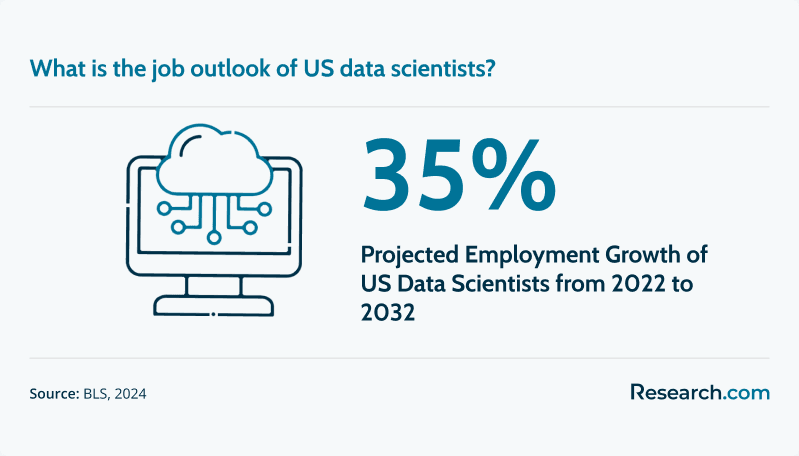
AI skills connect to several fast-growing computer and data occupations. According to 2024 BLS data, employment of data scientists from 2022 to 2032 will grow by 35%. Over the same period, employment of software developers will increase by 25%, and employment of computer and information research scientists will grow by 23%.
BLS data also shows that computer and information technology occupations will have 377,500 annual openings from 2022 to 2032. More specifically, software developers, quality assurance analysts, and testers will have 153,900 annual openings, data scientists will have 17,700, and computer and information research scientists will have 3,400.
These projections suggest strong opportunity, but they do not guarantee employment or salary outcomes for every graduate. Results depend on prior experience, portfolio quality, technical depth, location, industry, and how well the degree matches the role. Students comparing career potential can also review Research.com’s guide to the highest paying computer science jobs.
How are cybersecurity concerns addressed in AI master’s programs?
AI systems can introduce security risks, especially when they rely on sensitive data, automated decision-making, or models exposed to adversarial attacks. Many AI master’s programs now include topics such as secure model design, risk management, data protection, adversarial machine learning, and responsible deployment.
Students interested in the overlap between AI and security should look for courses or projects involving threat detection, anomaly detection, secure data pipelines, and AI governance. They may also compare related education costs through Research.com’s guide, How much does it cost to get a degree in cyber security?.
What key skills are developed through a master’s in AI program?
A master’s in AI should develop both technical ability and professional judgment. The strongest programs help students write code, understand models, explain results, and evaluate the risks of using AI in real organizations.
- Programming: Writing efficient code for data processing, model training, testing, and deployment.
- Machine Learning: Selecting algorithms, tuning models, evaluating performance, and avoiding common modeling errors.
- Mathematics and Statistics: Applying linear algebra, calculus, probability, and statistical reasoning to AI problems.
- Data Interpretation: Cleaning data, identifying patterns, communicating findings, and recognizing limitations.
- Ethical Decision-Making: Evaluating fairness, transparency, privacy, accountability, and social impact.
- Communication: Explaining technical findings to business leaders, engineers, clients, and nontechnical stakeholders.
- Project Management: Planning, documenting, testing, and delivering AI projects responsibly.
Students looking for less technical graduate options can review easy master's degrees, but anyone planning to enter AI should expect substantial work in math, programming, and applied problem-solving.
What is the ROI of a masters in AI degree?
The return on investment of an AI master’s degree depends on total cost, career goals, prior experience, and the quality of the program. A lower-cost degree can improve ROI, but only if it helps students build marketable skills and complete the program without excessive debt.
When evaluating ROI, compare tuition and fees against realistic outcomes: the roles you qualify for, the portfolio you will build, the employers you can access, and the time required to finish. Students uncertain about committing to a graduate degree may also compare shorter or lower-cost academic routes such as two year online degrees, although these typically prepare learners for different levels of work.
| ROI Factor | Why It Matters |
| Total program cost | Lower debt can make the degree easier to justify financially |
| Career alignment | A technically strong AI program should connect directly to target roles |
| Portfolio value | Employers often want evidence of applied skills, not just coursework |
| Time to completion | Longer programs may delay career advancement or increase opportunity costs |
| Employer support | Tuition assistance can significantly change the financial equation |
Are AI master’s programs fostering entrepreneurship and innovation?
Some AI master’s programs support entrepreneurship through applied projects, innovation labs, startup incubators, mentorship, and cross-disciplinary collaboration. This can be valuable for students who want to commercialize AI tools, launch a product, or apply AI in a niche industry.
Entrepreneurial AI students should look for programs that teach not only modeling and coding but also product development, market validation, responsible deployment, and collaboration across technical and creative fields. Students interested in creative technology may also explore online game development degree programs as a related example of applied digital innovation.
Can accelerated AI master’s programs fast track career success?
Accelerated AI master’s programs can help prepared students finish faster and apply new skills sooner. They are best suited for learners who already have strong programming, math, and time-management skills. The shorter schedule can be efficient, but it may also reduce time for internships, extended research, or slower skill development.
Before choosing an accelerated program, confirm the weekly workload, course sequencing, and whether you can balance study with work. Students interested in faster academic pathways can also compare broader fast track college degree options.
How do faculty expertise and research collaborations influence success in AI master’s programs?
Faculty quality can strongly affect the value of an AI master’s program. Professors who publish research, lead applied projects, or have industry experience can expose students to current problems in machine learning, data science, robotics, natural language processing, and responsible AI.
Research collaborations also matter. Students who want advanced technical roles should ask whether online learners can join research groups, work on faculty projects, complete a thesis, or use university lab resources remotely. Those comparing timelines across academic pathways may also review Research.com’s guide, How fast can you get an associate's degree?.
What challenges do online AI master’s students encounter and how are they supported?
Online AI students often face three challenges: staying motivated, managing time, and mastering difficult technical material without daily in-person support. The best online programs address these issues through academic advising, tutoring, faculty office hours, technical support, virtual labs, peer forums, and career services.
Before enrolling, ask how quickly faculty respond, whether tutoring is available for quantitative courses, and what happens if you fall behind. Students comparing remote technical study in other fields may also find useful context in Research.com’s guide to an electrical degree online.
How do online AI master’s programs support career advancement through industry connections?
Industry access is especially important in AI because employers often look for applied experience, current technical skills, and evidence that graduates can solve real problems. Online students should confirm whether they receive the same career support as campus students.
- Guest Lectures and Webinars: Sessions with AI professionals can help students understand current applications, employer expectations, and emerging roles.
- Industry Partnerships: Partnerships with technology companies, research labs, or consulting firms may create access to projects, workshops, or internships.
- Virtual Career Fairs and Networking Events: Online recruiting events can help remote students meet employers and learn about available roles.
- Project-Based Learning: Industry-aligned projects allow students to demonstrate practical skills in portfolios and interviews.
- Mentorship and Alumni Networks: Alumni in AI roles can provide career advice, referrals, and insight into hiring expectations.
Are AI master’s programs equipping students to tackle ethical and regulatory challenges?
Responsible AI is no longer optional. Graduate programs should help students recognize and manage issues involving privacy, bias, transparency, accountability, and data governance. Strong curricula use case studies, technical audits, policy discussions, and applied projects to show how ethical choices affect real systems.
Students entering data-intensive fields should pay close attention to responsible data use. Related programs, such as a bioinformatics degree online, can also show how technical decisions intersect with sensitive data, research integrity, and regulatory expectations.
What are the key industries revolutionized by artificial intelligence?
AI is reshaping work across technical and nontechnical sectors. Because of this broad impact, an AI master’s degree may lead to opportunities in several industries, though outcomes depend on experience, specialization, and employer needs. Students comparing graduate-level earning potential can also review Research.com’s guide to the highest paying master's degrees.
- Healthcare: AI supports medical imaging, diagnostic assistance, treatment planning, predictive analytics, and personalized medicine.
- Finance: AI is used for fraud detection, algorithmic trading, risk analysis, customer insights, and investment modeling.
- Manufacturing: AI can improve predictive maintenance, quality control, automation, and supply chain operations.
- Retail and E-commerce: AI powers recommendation systems, inventory prediction, pricing support, customer service tools, and personalization.
- Automotive: AI contributes to autonomous vehicle systems, driver assistance, real-time decision-making, and safety features.
- Cybersecurity: AI supports anomaly detection, threat monitoring, vulnerability analysis, and automated incident response.
How does program accreditation affect the credibility of a masters in AI degree?
Accreditation helps verify that an institution meets recognized academic standards. For students, it can affect credit transfer, employer confidence, eligibility for some forms of financial aid, and long-term degree credibility. Before enrolling, confirm the institution’s accreditation status through official accreditor or government-recognized sources rather than relying only on marketing copy.
Programmatic accreditation may also matter for some computing, engineering, or technical programs. Students interested in broader technology careers can compare related pathways such as an online degree in information technology.
What are the current trends in artificial intelligence and how do they impact the job market?
AI is changing quickly, and graduate programs must keep pace with both technical advances and employer expectations. Current trends affecting AI education and hiring include generative AI, automation, responsible AI governance, AI-enabled cybersecurity, and domain-specific AI applications.
- AI in healthcare: Machine learning and natural language processing are being used in diagnosis, treatment planning, and personalized medicine.
- AI-driven automation: Organizations use AI to streamline routine tasks, support operations, and improve efficiency in areas such as manufacturing, logistics, and customer service.
- Ethics and AI governance: Employers increasingly need professionals who can address bias, fairness, privacy, accountability, and responsible AI use.
- Cybersecurity and AI: AI is becoming more relevant to threat detection and response. Students who want security-focused roles may compare the cheapest online cyber security degree options as a complementary pathway.
- AI in finance: Financial institutions use AI in fraud detection, risk management, algorithmic trading, and forecasting.
For students, these trends mean curriculum currency matters. Ask schools how often they update courses, whether they cover generative AI and responsible AI, and how applied projects reflect current industry use cases.
How does your undergraduate background influence success in an AI master's program?
Your undergraduate preparation can affect both admission and performance. Students with prior coursework in computer science, mathematics, statistics, engineering, or data science may find the transition smoother. Students from other fields can still be competitive, but they may need bridge coursework, self-study, or professional experience in programming and analytics.
If you are still completing a bachelor’s degree and want to keep costs down, compare cheap accredited online bachelor degree programs while making sure your coursework builds the quantitative and technical foundation AI programs expect.
How can engineering expertise elevate AI master’s programs?
Engineering experience can strengthen AI study because it trains students to design systems, test assumptions, optimize performance, and solve applied problems under constraints. This background is especially useful in robotics, autonomous systems, computer vision, manufacturing AI, and AI-enabled hardware or infrastructure.
Students who want to combine AI with engineering can compare graduate AI requirements with preparation available through the most affordable engineering online colleges.
Can biotechnology and AI converge to unlock innovative career paths?
Biotechnology and AI increasingly overlap in areas such as healthcare analytics, pharmaceuticals, genome analysis, agricultural technology, and personalized medicine. Students interested in this interdisciplinary path should seek AI programs with bioinformatics, healthcare AI, statistics, data ethics, and domain-specific research opportunities.
Graduates who combine AI skills with life sciences knowledge may pursue specialized roles connected to jobs in biotechnology, especially when they can demonstrate both technical modeling ability and understanding of scientific data.
Can completing an accelerated bachelor's degree enhance preparation for an AI master's program?
An accelerated bachelor’s degree can help motivated students reach graduate study sooner, but speed should not come at the expense of preparation. AI master’s programs require strong coding, math, data structures, algorithms, and analytical reasoning. If an accelerated program includes rigorous technical coursework and applied projects, it can be a useful foundation.
Students considering a faster undergraduate route can review Research.com’s guide to accelerated bachelors degrees and compare whether those programs include the prerequisites needed for graduate AI admission.
What certification pays the most?
The highest-paying certification for an AI professional depends on role, industry, experience, and employer requirements. A cloud credential may help an AI engineer who deploys models at scale, while a cybersecurity certification may help someone focused on AI-enabled threat detection. Data analytics and project management credentials can also support career mobility when paired with a technical graduate degree.
Instead of choosing a certification only because it is popular, identify the job descriptions you want to qualify for and note which credentials appear repeatedly. Then compare cost, exam requirements, renewal rules, and employer recognition using Research.com’s guide to what certification pays the most.
Common Mistakes to Avoid When Choosing an Online AI Master’s Program
- Choosing only by tuition: A low-cost program is not a good value if the curriculum is outdated or too shallow for your target role.
- Ignoring accreditation: Always verify institutional accreditation before applying.
- Underestimating prerequisites: AI coursework can be difficult without programming, statistics, and linear algebra preparation.
- Assuming every “AI” degree has the same focus: Some programs are research-heavy, while others emphasize business applications, data science, or software development.
- Overlooking hands-on learning: Employers often want projects, portfolios, and applied experience, not just completed courses.
- Forgetting fees and indirect costs: Technology fees, books, software, and extended enrollment can change the total price.
- Relying only on rankings: Rankings can help you start, but your final choice should reflect your goals, background, and budget.
- Assuming salary outcomes are guaranteed: Job market data is useful, but individual results depend on skill, experience, location, and employer demand.
Key Insights
- The most affordable AI master’s program in this list is not automatically the best choice for every student; curriculum fit, accreditation, hands-on work, and career support matter just as much as cost.
- AI master’s programs commonly take around one to three years, with accelerated, full-time, and part-time formats serving different types of learners.
- According to 2024 Education Data Initiative data, the average cost of a master's degree in science in the United States is $57,770, so students should compare total program costs carefully.
- Online AI programs can reduce relocation and commuting costs, but they require self-discipline and proactive networking.
- Strong AI programs should include machine learning, deep learning, NLP, computer vision, data science, ethics, and applied projects.
- BLS data points to strong growth in related occupations, including 35% growth for data scientists from 2022 to 2032, but career outcomes still depend on skills, experience, and portfolio quality.
- Before enrolling, ask schools about prerequisites, faculty access, capstones or theses, career services for online students, software costs, and whether the curriculum reflects current AI trends.
References:
- BLS (2024, April 3). 15-1221 Computer and Information Research Scientists. BLS
- BLS (2024, April 3). 15-1252 Software Developers. BLS
- BLS (2024, April 3). 15-2051 Data Scientists. BLS
- BLS (2024, April 17). Computer and Information Technology Occupations. BLS
- BLS (2024, April 17). Data Scientists. BLS
- BLS (2024, April 17). Software Developers, Quality Assurance Analysts, and Testers. BLS
- Coursera (2024, March 26). Your Guide to Artificial Intelligence (AI) Degrees. Coursera
- Fore, P. (2024, July 15). Looking to break into A.I.? These 6 schools offer master’s in artificial intelligence programs. Fortune
- Hanson, M. (2024, February 27). Average Cost of a Master’s Degree. Education Data Initiative
- McKinsey (2024, May 30). The state of AI in early 2024: Gen AI adoption spikes and starts to generate value. McKinsey
Other Things You Should Know About Masters in Artificial Intelligence Degrees
When choosing an affordable AI Master's program in 2027, consider accreditation, faculty expertise, coursework relevance, flexibility in scheduling, technological support, and financial aid options. These criteria ensure a valuable education without excessive cost.
In 2027, affordable online AI Master's programs typically require about 30-36 credit hours for completion. Students often take 2-3 courses per term. Proper planning is essential to balance the workload while meeting program requirements within the recommended timeframe.
Yes. Many accredited programs accept up to 9 transfer credits, usually only from regionally accredited graduate courses with a grade of B or better. Schools often require an official transcript and a faculty review before approval. Some programs also set a five-year limit on old coursework.






