2027 Average Cyber Security Salary by State

Co-Founder and Chief Data Scientist
Cybersecurity salary research is difficult because “cybersecurity professional” can mean many different jobs: analyst, engineer, penetration tester, architect, incident responder, cloud security specialist, or executive leader. Pay also changes sharply by state, city, experience level, certification, industry, and whether the role is hands-on technical, advisory, or managerial. This guide helps students, career changers, and working IT professionals understand how cybersecurity salaries are reported, what factors drive higher compensation, and how to choose an education or certification path that supports long-term career growth without overspending.
Quick answer: how much do cybersecurity professionals make?
Across the United States, the average salary for cybersecurity professionals is approximately $120,360 per year, based on the salary sources cited in this guide. State averages vary widely: New York is reported at $147,514 per year, California at $135,250, Virginia at $131,340, Washington at $132,820, Texas at $116,850, and Rhode Island at $44,000. Role matters just as much as geography. Cybersecurity analysts commonly fall between $70,000 and $100,000, engineers between $90,000 and $130,000, architects between $120,000 and $160,000, and CISOs from $150,000 to over $250,000 annually.
What are the benefits of getting a cybersecurity degree?
- Faster entry into a high-demand technical field: Some cybersecurity degrees or certificates can be completed in as little as two years, which may help learners move into entry-level security or IT roles sooner.
- Strong earning potential: Reported cybersecurity salaries range from $44,000 to $147,514 per year across the state data discussed in this article, while senior leadership and specialized technical roles can pay more.
- Flexible study options: Online cybersecurity programs can reduce commuting, relocation, and campus-related expenses while allowing working adults to build skills on a more manageable schedule.
- Clearer career direction: A structured program can help students build foundations in networking, systems, risk management, incident response, and security tools instead of piecing together unrelated courses.
- Preparation for certifications: Many cybersecurity programs align coursework with credentials such as CISSP, CEH, CISM, CISA, CCSP, or Security+-style foundational training.
- Cybersecurity salary by U.S. state
- Cybersecurity pay by job title
- Salary differences by experience level
- How cities, regions, and cost of living affect pay
- Cybersecurity career paths to compare
- Certifications that may improve salary potential
- Technical and workplace skills employers expect
- Salary trends and future outlook
- The current cybersecurity landscape in the United States
- Ethical responsibilities in cybersecurity
- Ways to broaden cybersecurity career options
- How to study cybersecurity on a budget
- How to select a cybersecurity program that fits your goals and budget
- How online master's programs can support advancement
- Common cybersecurity myths to avoid
- How online computer science master's programs can strengthen cybersecurity knowledge
- Whether an accelerated computer science degree is a good route into cybersecurity
- Typical cybersecurity degree requirements
- How online computer science degree cost affects cybersecurity ROI
- How online information technology programs support cybersecurity skill building
- How game design can improve cybersecurity simulations
- How non-cybersecurity STEM degrees can add value
- How interdisciplinary technical degrees support stronger defenses
- Whether a cybersecurity degree can pay off financially
- How engineering knowledge can improve cybersecurity work
- Why projects and internships matter
- How interdisciplinary thinking can support cybersecurity innovation
- How health informatics can strengthen security resilience
- Long-term career growth in cybersecurity
- How an online MS in AI can influence cybersecurity strategy
- How beginners can break into cybersecurity
What are the salaries for cybersecurity professionals in different U.S. states?
Cybersecurity salaries vary substantially by state because local industry concentration, employer demand, cost of living, government contracting, financial services, technology hubs, and available talent all influence compensation. A state average is useful for comparison, but it should not be treated as a guaranteed salary for a specific job offer.
Based on the salary sources cited in this article, New York is reported as the highest-paying state among the examples listed, with an average cybersecurity salary of $147,514 per year. California follows at $135,250, Washington at $132,820, Virginia at $131,340, and Texas at $116,850. Florida, Georgia, Colorado, Nevada, and Rhode Island are reported within a broader range from $91,180 to $132,820, while Rhode Island is listed at $44,000.
The national average cited for cybersecurity professionals is approximately $120,360 per year. That figure helps show why cybersecurity is often compared with other high-paying computer science careers, but role, seniority, specialization, and location still determine actual compensation.
| State | Reported average cybersecurity salary | How to interpret the figure |
| New York | $147,514 per year | Highest reported state average in the cited comparison; often influenced by finance, enterprise technology, and metropolitan demand. |
| California | $135,250 per year | Strong salaries are commonly associated with technology employers and high-cost metro areas. |
| Washington | $132,820 per year | Competitive salaries are supported by technology and cloud-related employers. |
| Virginia | $131,340 per year | Government, defense, and contracting work can influence local cybersecurity demand. |
| Texas | $116,850 per year | A major market with technology, energy, finance, and enterprise security roles. |
| Rhode Island | $44,000 per year | Listed as the lowest reported average in the cited state comparison, showing how much location can affect salary expectations. |
When comparing cybersecurity career salary data, use state averages as a starting point, then compare job titles, employer type, required certifications, remote-work options, and local housing costs.
What else affects cybersecurity salary by state?
- Employer concentration: States with large technology, finance, healthcare, government, or defense sectors often create stronger competition for security talent.
- Role mix: A state with many security architect, cloud security, or CISO openings may show higher average pay than a state with mostly entry-level analyst roles.
- Certifications and clearance requirements: Credentials such as CISSP, CEH, and CISM, or roles requiring specialized eligibility, can shift compensation upward.
- Cost of living: Higher pay in New York, San Francisco, Washington, D.C., and similar markets may be offset by higher housing, commuting, and tax costs.
- Remote work: Remote cybersecurity jobs can expand opportunity, but some employers adjust pay by location.
How do cybersecurity salaries vary by job role?
The job title is one of the strongest salary drivers in cybersecurity. An analyst monitoring alerts, an engineer building security controls, an architect designing enterprise defenses, and a CISO managing risk at the executive level may all work in cybersecurity, but they are paid for different levels of responsibility.
| Cybersecurity role | Reported salary range | Typical responsibility | Best fit for |
| Cybersecurity analyst | $70,000 to $100,000 | Monitors systems, investigates alerts, supports incident response, and helps protect networks. | Entry- to mid-level professionals who want a broad security operations foundation. |
| Cybersecurity engineer | $90,000 to $130,000 | Builds, configures, and maintains security systems, controls, and infrastructure. | Professionals with strong networking, systems, scripting, and implementation skills. |
| Cybersecurity architect | $120,000 to $160,000 | Designs secure enterprise frameworks and guides security architecture decisions. | Experienced professionals who can connect business needs with technical design. |
| Penetration tester | $80,000 to $110,000 | Tests systems by simulating attacks and documenting exploitable weaknesses. | Hands-on technical learners who enjoy offensive security, reporting, and lab practice. |
| Ethical hacker | Can earn significantly more depending on skills, role, and demand | Uses offensive techniques for authorized defensive purposes. | Specialists with advanced exploitation, tool development, or red-team capabilities. |
| Chief Information Security Officer | $150,000 to over $250,000 | Leads organizational cybersecurity strategy, risk governance, teams, budgets, and executive reporting. | Senior leaders with security, risk, communication, and business-management experience. |
If you are deciding between a cybersecurity degree and a broader computer science pathway, compare the technical depth, electives, and career services of each option. Some learners also strengthen their credentials through affordable online master's in computer science programs when they want a wider software, systems, or data foundation.
How do cybersecurity salaries vary by experience level?
Cybersecurity pay generally rises as professionals move from task execution to system ownership, then to strategic decision-making. Years of experience matter, but employers also look for evidence that a candidate can handle incidents, communicate risk, secure complex environments, and adapt to new threats.
| Experience level | Reported salary range | What employers usually expect |
| Junior cybersecurity professional | $60,000 to $80,000 | Foundational networking, operating systems, alert triage, documentation, and willingness to learn tools quickly. |
| Mid-level cybersecurity professional | $80,000 to $120,000 | Independent investigation, control implementation, incident support, scripting, and one or more role-relevant certifications. |
| Senior cybersecurity professional | $130,000 or more | Security leadership, architecture judgment, risk prioritization, mentoring, and decisions in high-impact environments. |
| Ph.D.-level professional | May receive a salary boost in research or academic roles | Advanced research, specialized technical depth, publication or lab experience, and expertise in a defined problem area. |
A Ph.D. is not required for most corporate cybersecurity jobs. In many private-sector roles, practical experience, incident history, cloud knowledge, and certifications weigh more heavily than doctoral study. However, advanced research training can be valuable for academia, government labs, cryptography, AI security, or highly specialized technical work.
Cybersecurity also overlaps with analytics. Professionals who can use data to detect anomalies, investigate incidents, and support threat intelligence may benefit from related preparation, including affordable online master's in data science programs.
The annual number of malware attacks worldwide changed noticeably from 2015 to 2023. The figure was approximately 8.20 billion in 2015, decreased to 7.90 billion in 2016, increased to 8.60 billion in 2017, and peaked at 10.50 billion in 2018. It then declined to 9.90 billion in 2019, fell to 5.60 billion in 2020 and 5.40 billion in 2021, rose slightly to 5.50 billion in 2022, and reached approximately 6.06 billion in 2023.
The long-term takeaway is not that cybersecurity risk has disappeared. The data shows fluctuation, a major peak in 2018, a later decline, and a renewed rise in 2023, which reinforces the need for continuous monitoring, better defenses, and skilled professionals who can respond as attack methods change.
How do cybersecurity salaries vary by location?
Location affects cybersecurity pay in two ways: employers in certain markets pay more because demand is high, and workers in expensive regions may need higher compensation to maintain the same standard of living. A larger salary does not automatically mean a better financial outcome.
- High-paying metro areas: San Francisco, Washington, D.C., and New York commonly offer some of the strongest salaries, with mid- to senior-level roles often exceeding $130,000 annually.
- Coastal versus Midwestern markets: Coastal technology and finance centers often pay more, while some Midwestern markets may show lower salaries but also lower living costs.
- State-level differences: California, Texas, Virginia, and Washington reflect how local industries can raise demand for security professionals.
- Technology hubs: Silicon Valley, Seattle, and Austin can offer premium compensation because employers compete for cloud, engineering, and security talent.
- Cost-of-living trade-off: A lower salary in a lower-cost region may leave a professional with comparable or better disposable income than a higher salary in a costly metro area.
Questions to ask before relocating for a cybersecurity role
- Is the salary adjusted for local housing, taxes, commuting, and insurance costs?
- Does the job require on-site work, hybrid attendance, or full remote availability?
- Are there enough cybersecurity employers in the area if you need to change jobs later?
- Will the role build transferable skills in cloud security, incident response, risk, engineering, or leadership?
- Are bonuses, equity, clearance requirements, or shift differentials part of the total compensation package?
What are the different career paths for cybersecurity professionals?
Cybersecurity is not one career ladder. It is a group of related paths that reward different strengths: investigation, engineering, governance, testing, compliance, leadership, or specialized technical depth. Learners interested in secure digital product experiences may also explore adjacent programs such as affordable online UX/UI degree programs, especially if they want to work where security, usability, and product design intersect.
| Path | Examples of roles | When this path makes sense |
| Security operations and response | Security analyst, incident responder, threat intelligence analyst | You enjoy investigating alerts, analyzing evidence, and responding quickly to security events. |
| Security engineering | Security engineer, cloud security engineer, application security analyst | You like building, automating, hardening, and maintaining technical controls. |
| Offensive security | Penetration tester, ethical hacker, red-team specialist | You want authorized hands-on testing and are comfortable documenting weaknesses responsibly. |
| Architecture and strategy | Security architect, enterprise security strategist | You have broad experience and want to design secure systems at organizational scale. |
| Governance, risk, and compliance | Security auditor, cyber risk consultant, compliance specialist | You are interested in controls, regulations, risk reporting, audits, and policy implementation. |
| Leadership | Security manager, CISO | You want to manage teams, budgets, executive communication, and enterprise security direction. |
| Forensics and investigation | Digital forensics investigator, malware analyst | You are drawn to evidence handling, incident reconstruction, and technical investigation. |
Business knowledge can also help cybersecurity professionals move into management, consulting, or executive roles. Some learners combine technical security preparation with business training through options such as an accelerated online business degree.
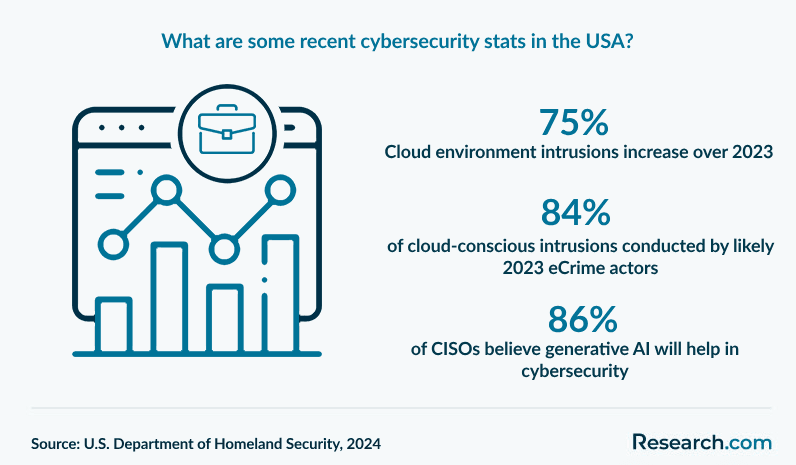
Recent cybersecurity data also shows why specialized skills matter. Cloud environment intrusions increased by 75% compared to 2023. In addition, 84% of cloud-conscious intrusions are believed to involve the same eCrime actors active in 2023, while 86% of CISOs are optimistic that generative AI can improve cybersecurity efforts.
What cybersecurity certifications can I get to increase my salary?
Certifications can improve salary potential when they match the job you want. They are most useful when paired with hands-on experience, a portfolio of projects, lab practice, internships, or work history. If you are still building foundational knowledge, online cybersecurity courses with certificates can be a lower-commitment way to test the field before entering a full degree program.
| Certification | Best for | Scope | Typical requirement stated in source text |
| CISSP | Experienced security professionals and future leaders | Governance, risk management, compliance, architecture, operations, and communication | Typically requires five years of professional information security experience or a combination of education and experience. |
| CEH | Ethical hacking and penetration-testing-oriented roles | Penetration testing, vulnerability assessment, social engineering, and offensive security methods | Typically requires at least one year of professional experience in information security or related fields. |
| CISM | Security managers and governance-focused professionals | Information security governance, risk management, incident management, and compliance | Typically requires five years of professional information security experience or a combination of education and experience. |
| CISA | Audit, assurance, and control roles | Auditing, control, and assurance of information systems | Useful for professionals moving toward IT audit or compliance work. |
| CCSP | Cloud security roles | Cloud security principles, practices, and technologies | Best aligned with cloud-focused security responsibilities. |
| CCNA Security | Network-security-oriented professionals | Cisco networking and security concepts | Useful where secure network infrastructure is central to the role. |
The cited article data states that certifications such as CISSP, CEH, or CISM can lead to salary increases of 10% or more. It also states that CISSP may increase salary by $10,000 to $20,000 annually, depending on role and experience. Treat these figures as general indicators, not guarantees; employers still evaluate performance, experience, job scope, and market conditions.
If you want a deeper academic credential rather than a stand-alone certificate, compare tuition, accreditation, and outcomes among affordable online cybersecurity degree programs.
What skills are expected of those with cybersecurity degrees?
Cybersecurity degree holders are expected to understand both technical systems and human risk. A strong program should help students learn how networks function, how operating systems are secured, how attacks are investigated, and how security recommendations are communicated to nontechnical stakeholders. Related degrees, including affordable online BS in Computer Information Systems programs, may also provide a useful technical base for security roles.
Technical skills employers often value
- Networking and systems administration: Understanding protocols, routing, identity, permissions, endpoints, and infrastructure is essential for most security roles.
- Operating systems and virtualization: Professionals should be comfortable with Windows, Linux, macOS, virtual machines, and system logs.
- Network security controls: Firewalls, intrusion detection systems, segmentation, monitoring, and access controls are core defensive tools.
- Programming and scripting: Python, Java, C++, or similar languages can help with automation, data analysis, and security-tool development.
- Cloud security: Familiarity with AWS, Azure, and GCP security models is increasingly important as organizations move workloads to cloud environments.
- Blockchain security: Knowledge of blockchain risks can be useful in roles involving digital assets, distributed systems, or transaction integrity.
- IoT security: Connected devices introduce hardware, firmware, network, and identity risks that require specialized attention.
- AI and machine learning: Understanding AI can support threat detection, anomaly analysis, and automated response strategies.
Soft skills that affect career growth
- Problem-solving: Security work often involves incomplete information, time pressure, and complex technical dependencies.
- Analytical thinking: Professionals must recognize patterns, assess risk, and separate real incidents from false positives.
- Communication: Security teams need clear reports, executive summaries, user guidance, and cross-functional collaboration.
- Adaptability: Tools, threat actors, regulations, and employer expectations change quickly.
- Ethical judgment: Cybersecurity professionals handle sensitive systems and data, so trustworthiness is nonnegotiable.
Students who want stronger software-building skills may also compare security-focused programs with affordable online software engineering degree options.
What are the current trends and future outlook for cybersecurity salaries?
Cybersecurity salaries are shaped by threat volume, employer investment, specialization, and the shortage of professionals who can defend complex environments. The strongest opportunities are likely to favor people who combine fundamentals with current skills in cloud security, automation, AI-assisted defense, incident response, and risk communication.
- Demand-supported compensation: Organizations continue to invest in security because breaches, ransomware, phishing, and cloud intrusions create operational and financial risk.
- Specialization premiums: Cloud security, AI security, application security, IoT security, and architecture roles may command higher pay when talent is scarce.
- Leadership value: Senior professionals who can translate technical risk into business decisions are positioned for management and CISO-track roles.
- Certification and experience alignment: Credentials are most valuable when they reinforce demonstrated work experience and role-specific skills.
- AI impact: AI can assist detection and response, but it also changes attacker behavior and raises the bar for defenders.
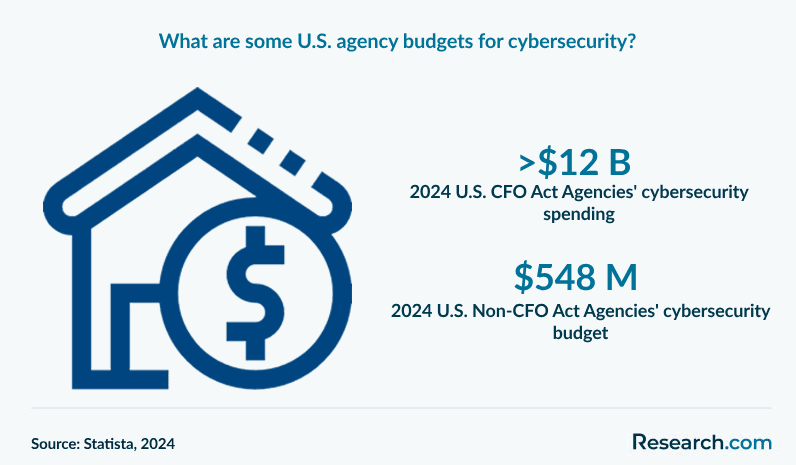
Cybersecurity spending supports this labor-market pressure. According to Statista's 2024 data cited in the original source material, U.S. government agencies subject to the Chief Financial Officers Act have a combined cybersecurity budget of $12 billion, while non-CFO Act agencies have a cybersecurity budget of $548 million for the same year.
What is the current state of cybersecurity in the USA?
The U.S. cybersecurity environment combines rising threat complexity, persistent ransomware and phishing risk, and a shortage of qualified professionals. The figures below should be read as a snapshot of the cited 2024 sources rather than a complete picture of all cyber risk.
Major indicators from cited sources
- More than 450,000 new malicious programs were detected daily in 2024.
- Ransomware and phishing remained leading threats for industries such as healthcare and education.
- 70% of malware-related breaches were due to ransomware.
- Global downtime costs from ransomware attacks in the education sector reached over $53 billion.
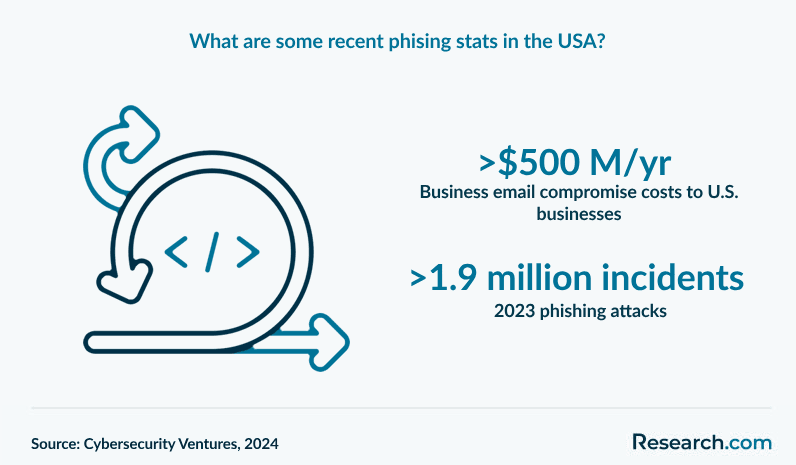
- Phishing attacks rose to over 1.9 million incidents in 2023, with nearly 50,000 new attacks recorded.
- Business email compromise, often connected to phishing, costs U.S. businesses over $500 million annually.
Workforce and organizational readiness concerns
- As of 2024, more than 660,000 cybersecurity jobs remain unfilled in the U.S.
- 43% of small and medium-sized businesses lack a formal cybersecurity plan.
- 30% of SMBs rank phishing as their top cybersecurity threat.
- Global cybercrime damage is expected to exceed $10 trillion annually by 2025.
These figures help explain why cybersecurity remains a significant career field, but they also show why employers want candidates who can move beyond theory and demonstrate practical defense, investigation, communication, and risk-management skills.
What are the ethical considerations in cybersecurity?
Cybersecurity professionals are trusted with access to sensitive systems, personal information, vulnerabilities, and investigative data. Ethical failures can harm individuals, organizations, and public trust. Strong technical ability must be matched with responsible conduct.
- Data privacy: Security work should protect sensitive information and comply with applicable rules, including frameworks such as GDPR or HIPAA when relevant.
- Responsible disclosure: When a vulnerability is found, ethical professionals notify affected parties and give them reasonable time to remediate before public release.
- Integrity: Authorized testing must stay within scope. Using access for personal gain, unauthorized exploration, or malicious activity is unethical and may be illegal.
- Security versus civil liberties: Monitoring and defensive controls should be balanced against privacy, transparency, and user rights.
- Ongoing ethics education: AI, surveillance, data collection, and offensive tooling create new dilemmas that require continuous learning.
- Social responsibility: Cybersecurity work protects hospitals, schools, small businesses, governments, and individuals who may not be able to recover easily from cyber harm.
How can cybersecurity professionals diversify their skills for broader career opportunities?
Cybersecurity careers become more resilient when professionals add adjacent skills. A security analyst who understands cloud infrastructure, risk consulting, data privacy, and project coordination can pursue more roles than someone who knows only one tool. This is especially important for people building a long-term cybersecurity career path across changing technologies.
| Skill expansion area | Why it helps | Possible career direction |
| Cloud computing | Organizations need professionals who understand AWS, Azure, Google Cloud, identity, configuration, and shared responsibility models. | Cloud security engineer, cloud risk analyst, security architect |
| AI-driven security | Machine learning and automation can support threat detection, triage, and anomaly analysis. | Detection engineer, AI security analyst, security automation specialist |
| Data privacy and compliance | Regulated industries need security professionals who understand GDPR, HIPAA, controls, and audits. | GRC analyst, IT auditor, privacy security specialist |
| Project management | Security initiatives often require coordination across IT, legal, operations, vendors, and executives. | Security project manager, program manager, consultant |
| Digital forensics | Incident investigation requires evidence handling, timelines, logs, and technical reconstruction. | Forensics investigator, incident responder, malware analyst |
What are the best ways to choose a cybersecurity program that fits my needs and budget?
Choosing a cybersecurity program should begin with your target role, not with marketing claims. A student who wants an entry-level analyst role may need a different curriculum than a working IT professional aiming for cloud security engineering or management. If you want a lower-barrier option, compare programs such as easier cybersecurity degree programs, but still verify academic quality, support, and employer relevance.
Program selection checklist
- Accreditation: Confirm institutional accreditation before enrolling, especially if you plan to use financial aid, transfer credits, or pursue graduate study.
- Curriculum fit: Look for networking, operating systems, security operations, cloud security, secure coding, risk management, and hands-on labs.
- Hands-on learning: Prioritize programs with labs, simulations, capstone projects, competitions, internships, or applied security exercises.
- Cost transparency: Compare tuition, fees, textbooks, software, certification exam costs, technology requirements, and time away from work.
- Transfer policy: Ask how many credits you can transfer and whether professional certifications can count toward credit.
- Career support: Review internship placement, employer partnerships, resume help, interview preparation, and alumni outcomes.
- Schedule format: Decide whether asynchronous, synchronous, part-time, accelerated, or cohort-based study fits your life.
How do online master's programs in cybersecurity enhance career advancement?
An online master's program can help experienced professionals move from operational roles into advanced technical, architecture, management, or consulting positions. The best programs do more than repeat undergraduate fundamentals; they should develop higher-level judgment in risk, governance, cloud security, incident leadership, secure architecture, and emerging threats. Compare curriculum depth, faculty experience, capstone requirements, and employer alignment when reviewing online master's in cybersecurity programs.
What are some common myths and misconceptions about cybersecurity?
Misunderstandings about cybersecurity can lead students to choose the wrong program, underestimate the work, or assume technology alone solves security problems. These are the myths worth correcting early.
| Myth | Reality |
| “Only large corporations are targeted.” | Individuals and small businesses can also be attacked because personal data, credentials, payment information, and business records have value. |
| “A strong password is enough.” | Strong passwords help, but multi-factor authentication, updates, phishing awareness, and secure configuration are also necessary. |
| “Antivirus software provides complete protection.” | Antivirus tools are useful, but modern threats can bypass traditional detection, especially when users are tricked into granting access. |
| “Public Wi-Fi is always safe.” | Unsecured networks can expose users to interception, malicious hotspots, or credential theft. |
| “There is nothing you can do about ransomware.” | Backups, patching, access controls, employee training, and incident planning can reduce risk and improve recovery. |
| “Cybersecurity is only technical.” | Human behavior, policies, communication, governance, and ethics are central to effective security. |
| “Cybersecurity is too complex to learn.” | The field is complex, but beginners can start with networking, operating systems, basic risk concepts, and guided labs. |
| “Cybersecurity is a new problem.” | Security risks have existed for decades, but tools, attackers, infrastructure, and regulations continue to evolve. |
How can I pursue a cybersecurity degree on a budget?
A cybersecurity degree can be financially worthwhile, but only if the cost fits your career stage and expected return. The goal is to reduce unnecessary debt while still choosing a program with credible instruction, relevant labs, and employer-recognized preparation.
- Compare affordable online programs: Online study may reduce commuting and relocation costs. Start by reviewing options such as the most affordable online cybersecurity degrees.
- Use community college strategically: An associate degree or transfer pathway can lower the total cost of a bachelor's degree if credits transfer cleanly.
- Apply for scholarships and grants: Search for awards from schools, technology organizations, employers, professional associations, and local foundations.
- Ask about employer tuition assistance: Current IT workers may be able to use reimbursement benefits for job-related cybersecurity study.
- Choose certifications carefully: Do not pay for every credential at once. Select the certification that fits your next role.
- Limit hidden costs: Include exam fees, lab subscriptions, proctoring charges, software, books, and required hardware in your budget.
How should you evaluate graduate outcomes and testimonials?
Graduate stories can be useful, but they should not replace evidence. When a school highlights alumni success, ask for context: the graduate's prior IT experience, the time it took to find a role, the exact job title, whether the position required relocation, and whether salary figures are independently reported. Testimonials are strongest when supported by transparent placement data, employer partnerships, internship access, and clear career-service support.
How Does the Cost of an Online Computer Science Degree Affect Your Cybersecurity Career ROI?
Cybersecurity ROI depends on the relationship between program cost, time to completion, current income, target role, and realistic salary growth. A broad computer science program can be valuable for security engineering, application security, AI security, and systems work, but students should compare online computer science degree cost with cybersecurity-specific alternatives before enrolling.
Can online information technology programs effectively support cybersecurity skill development?
Yes, an accredited IT program can provide a practical foundation for cybersecurity because many entry-level security jobs rely on systems administration, networking, troubleshooting, identity management, and infrastructure knowledge. Learners who want this broader technical base can compare online information technology programs with dedicated cybersecurity degrees.
Can game design principles enhance cybersecurity training and simulation?
Game design can improve cybersecurity training when it is used for realistic scenarios, feedback loops, role-based exercises, and simulated attack environments. Capture-the-flag competitions, tabletop exercises, and incident-response simulations often rely on game-like structure to help learners practice under pressure. Students interested in interactive simulation design may also review online game design schools.
Can non-cybersecurity STEM degrees, such as electrical engineering, enhance cybersecurity expertise?
Yes. STEM backgrounds can strengthen cybersecurity work when they add systems thinking, hardware knowledge, signal analysis, mathematics, or engineering design experience. Electrical engineering is especially relevant for cyber-physical systems, embedded devices, hardware vulnerabilities, and industrial environments. Learners interested in that route can compare the most affordable online electrical engineering degree programs.
How can interdisciplinary technical degrees bolster cybersecurity defenses?
Interdisciplinary training helps security professionals understand how digital systems interact with physical infrastructure, users, data, and business processes. Engineering-based study can be useful for securing hardware, networks, and connected systems, which is why some students explore the cheapest online electrical engineering degree options alongside cybersecurity training.
Is investing in a cybersecurity degree financially rewarding?
A cybersecurity degree can be financially rewarding when it leads to relevant skills, credible credentials, career support, and access to roles with salary growth. It may be less rewarding if the program is expensive, weak on hands-on learning, poorly aligned with your target job, or chosen without checking accreditation and outcomes. For a broader decision framework, review whether a cybersecurity degree is worth it.
Can a foundation in engineering improve cybersecurity defenses?
Engineering knowledge can improve cybersecurity by helping professionals understand design trade-offs, system dependencies, hardware vulnerabilities, safety constraints, and resilience. This is useful in manufacturing, energy, healthcare devices, transportation, and other environments where physical and digital systems overlap. Students looking for broader technical preparation may compare affordable online engineering schools.
How can practical projects and internships boost cybersecurity careers?
Projects and internships are often what turn coursework into employable evidence. Strong examples include home labs, secure cloud deployments, vulnerability reports, incident-response writeups, malware-analysis exercises, SIEM dashboards, open-source contributions, and supervised internships. Students interested in advanced technical projects may also explore related pathways such as online artificial intelligence degrees.
Can interdisciplinary approaches boost cybersecurity innovation?
Cybersecurity innovation often comes from applying ideas from other fields. Bioinformatics, for example, uses computational methods to identify patterns in complex biological data, and similar analytical thinking can support anomaly detection, risk modeling, and threat analysis. Learners interested in this cross-domain approach may review online master's in bioinformatics programs.
Can integrating health informatics insights strengthen cybersecurity resilience?
Health informatics can strengthen cybersecurity thinking because healthcare environments involve sensitive records, regulated data, interoperability challenges, identity controls, and high-stakes availability requirements. Students who want to work in healthcare security can pair cybersecurity training with knowledge from a health informatics online bachelor's degree.
What are the long-term career growth prospects in cybersecurity?
Long-term growth in cybersecurity favors professionals who keep adapting. Entry-level analysts can progress into incident response, engineering, cloud security, architecture, risk, consulting, or management. Sector knowledge also matters. For example, healthcare security professionals who understand informatics and compliance may benefit from related preparation such as a health informatics online bachelor's degree.
Can an online MS in AI transform cybersecurity strategies?
An online MS in AI can support cybersecurity strategy when it builds practical knowledge in machine learning, predictive analytics, anomaly detection, automation, and data-driven decision-making. AI is not a replacement for security fundamentals, but it can improve detection and response when professionals understand both the technology and its limitations. Learners seeking that combination can compare online MS in AI programs.
Can computer science masters online programs enhance cybersecurity expertise?
Online computer science master's programs can strengthen cybersecurity expertise by deepening knowledge in algorithms, systems, software engineering, data structures, distributed computing, and emerging technologies. This pathway may be especially useful for security engineering, application security, cryptography-adjacent work, and technical leadership. Explore online master's in computer science programs if you want a broader technical base than a cybersecurity-only curriculum.
Is an accelerated computer science degree the best pathway to cybersecurity?
An accelerated computer science degree can be a good cybersecurity pathway for learners who want a faster route into programming, systems, networking, and technical problem-solving. It is not automatically better than a cybersecurity degree; the right choice depends on your target job. Review an accelerated computer science degree if you want broad computing preparation with a shorter timeline.
What are the cyber security degree requirements?
Cybersecurity degree requirements commonly include coursework in computer science, mathematics, networking, operating systems, risk management, security fundamentals, and hands-on labs. Strong programs should also assess analytical thinking, secure configuration, incident response, and communication. For a detailed breakdown of program expectations, review cyber security degree requirements.
How can entry-level professionals break into cybersecurity?
Beginners can enter cybersecurity, but they need a realistic plan. Most employers want evidence that you understand basic IT, can troubleshoot systems, can document findings, and can learn security tools responsibly. You do not need to start as a hacker; many professionals begin in help desk, network support, systems administration, compliance support, or security operations.
- Build IT fundamentals first: Learn networking, operating systems, identity, permissions, command-line basics, and troubleshooting.
- Complete beginner-friendly training: Affordable online certificate programs can help you test the field and document foundational learning.
- Practice in labs: Use safe, legal environments to practice scanning, log analysis, incident response, Linux, scripting, and vulnerability reporting.
- Earn one relevant certification: Choose a credential aligned with your target entry role instead of collecting unrelated certificates.
- Create a portfolio: Include lab writeups, scripts, security documentation, dashboards, or cloud hardening projects.
- Apply broadly to adjacent roles: IT support, junior SOC analyst, GRC assistant, network technician, and systems roles can all lead toward cybersecurity.
- Network intentionally: Join professional groups, local security meetups, online communities, and alumni networks to learn how hiring works.
Key Insights
- Cybersecurity salary depends heavily on role, experience, location, and specialization. The U.S. average cited here is approximately $120,360 per year, but state figures range from $44,000 in Rhode Island to $147,514 in New York.
- Job title is a major pay driver. Analysts are reported at $70,000 to $100,000, engineers at $90,000 to $130,000, architects at $120,000 to $160,000, penetration testers at $80,000 to $110,000, and CISOs at $150,000 to over $250,000 annually.
- Experience changes earning power. Junior professionals are reported at $60,000 to $80,000, mid-level professionals at $80,000 to $120,000, and senior professionals at $130,000 or more.
- Certifications can help, but they are not magic. CISSP, CEH, and CISM may lead to salary increases of 10% or more, and CISSP is associated with a $10,000 to $20,000 annual increase depending on role and experience.
- Threat activity continues to justify demand. Malware attacks reached approximately 6.06 billion in 2023 after fluctuating from 2015 to 2023, and cloud environment intrusions increased by 75% compared to 2023.
- Cybersecurity is not only technical. Ethics, communication, risk judgment, privacy, and responsible disclosure are essential because professionals work with sensitive systems and data.
- Program choice should be tied to career goals. A future analyst, cloud security engineer, penetration tester, architect, and CISO do not need the same exact preparation.
- Budget matters. Compare accreditation, transfer credit, tuition, fees, certification costs, career support, and hands-on learning before committing to a cybersecurity degree.
- Beginners should start with IT fundamentals, labs, one targeted credential, and a portfolio instead of assuming they can jump directly into advanced security roles.
References:
- All Criminal Justice Schools. (2024). Cybersecurity Salary by State. All Criminal Justice Schools cybersecurity salary data.
- Cybersecurity Ventures. (2023). Cybercrime costs global economy $10.5 trillion annually by 2025. Cybersecurity Ventures.
- Cybersecurity Ventures. (2024). 2024 Cybersecurity Almanac: 100 Facts, Figures, Predictions And Statistics. Cybersecurity Ventures 2024 Almanac.
- Terranova Security. (2024). Cybersecurity Awareness Report. https://www.terranovasecurity.com/blog/cybersecurity-awareness-report/
- FBI. (2022). Internet Crime Complaint Center 2021 Report. FBI IC3 Report.
- Indeed. (2024). Cyber security salary jobs in New York, NY. Indeed cybersecurity salary listings.
- New England Institute of Technology. (2024). 7 Highest-Paid Cyber Security Jobs & Salaries. New England Institute of Technology cybersecurity salary guide.
- Payscale. (2024). Salary for skill: Cyber security. Payscale cybersecurity skill salary data.
- Salary.com. (2024). Cybersecurity analyst salary. Salary.com cybersecurity analyst salary.
- Salary.com. (2024). Cybersecurity expert salary in the United States. Salary.com cybersecurity expert salary.
- Salary.com. (2024). Entry level cyber security analyst salary. Salary.com entry-level cyber security analyst salary.
- Salary.com. (2024). Information systems and cyber security salary. Salary.com information systems and cyber security salary.
- Statista. (2024). Estimated cost of cybercrime worldwide from 2024 to 2029. Statista cybercrime cost forecast.
- Statista. (2024). U.S. government and cybercrime - Statistics & Facts. Statista U.S. government and cybercrime data.
- Talent.com. (2024). Cyber security: Average salary in New York in 2024. Talent.com New York cyber security salary.
- Terranova Security. (2024). 2024 Cybersecurity Awareness Report. Terranova Security awareness report.
- U.S. Bureau of Labor Statistics. (2024). Cyber Security Salary (Senior, Mid & Entry-Level Pay 2024). CybersecurityEducation.org salary summary.
- U.S. Department of Homeland Security, Office of Homeland Security Statistics. (2024). Cybersecurity. U.S. Department of Homeland Security cybersecurity topic page.
- ZipRecruiter. (2024). Salary: Cyber Security in New York (May, 2024). ZipRecruiter New York cyber security salary.
Other Things You Should Know About Cybersecurity Salaries
CISSP, CISM, and GIAC certifications most often add the largest salary premium in 2027, with employers using them for senior analyst, architect, and manager roles. Many job postings also prefer CompTIA Security+ for entry-level screening, but it usually brings a smaller pay increase.
In 2027, states like California, Virginia, and Texas offer the highest average salaries for cybersecurity professionals. These states benefit from a high concentration of tech companies and government agencies, which helps drive up salary levels in the cybersecurity field.
Certifications, such as CISSP or CEH, can significantly boost cybersecurity salaries, often resulting in a 10-15% increase. States like California and Virginia see higher impacts due to demand. While not uniform, credentials typically enhance earning potential in 2027.