
2027 Computer Information Systems vs. Computer Science – Which Is Right for You?

Co-Founder and Chief Data Scientist
Choosing between Computer Information Systems (CIS) and Computer Science (CS) is not just a choice between two technology majors. It is a choice between two different ways of working with technology: applying systems to solve business problems or building the computational foundations, software, and algorithms behind digital products.
This decision matters because technology hiring remains broad, competitive, and increasingly specialized. Based on a recent report, U.S. tech talent employment grew by 64,140 jobs in 2024. At the same time, employers are looking for graduates who can connect technical ability with cybersecurity, data, cloud computing, automation, and business value.
This guide compares CIS vs. CS from a practical student and career-planning perspective. You will learn how the majors differ, what each program usually teaches, which careers they can lead to, how salaries and work environments compare, what certifications may help, and how to decide which path fits your strengths. If you are still exploring the broader field, you may also want to compare these options with a computer science major and related technology degrees.
CIS vs. CS Table of Contents
- What is Computer Information Systems?
- What is Computer Science?
- How to choose between CIS and CS
- Useful certifications for CIS and CS careers
- Technology trends affecting both majors
- Work environment and flexibility comparison
- Financial aid options for CIS and CS students
- Advanced degrees and career growth in technology
- Accelerated online technology degrees
- Affordable online cybersecurity degree options
- Data science pathways for technology professionals
- Common challenges in CIS and CS careers
- Biotechnology and interdisciplinary technology careers
- Artificial intelligence and the future of tech careers
- AI degree programs for CIS and CS professionals
Quick Answer: CIS vs. CS
Choose Computer Information Systems if you want to use technology to improve business operations, manage information systems, support cybersecurity, analyze organizational needs, or move toward IT leadership. Choose Computer Science if you want deeper training in programming, algorithms, software engineering, artificial intelligence, systems design, or computational research.
| Question | Computer Information Systems | Computer Science |
| Best fit for | Students who like technology, business processes, systems, and organizational problem-solving | Students who like programming, math, algorithms, software design, and technical problem-solving |
| Typical focus | Applying and managing information technology in organizations | Designing, building, and analyzing software and computing systems |
| Common courses | Databases, systems analysis, networking, IT project management, cybersecurity, business intelligence | Programming, data structures, algorithms, operating systems, computer architecture, AI, machine learning |
| Common careers | Systems analyst, IT consultant, database administrator, business analyst, IT project manager, information systems manager | Software engineer, data scientist, web developer, cybersecurity analyst, research scientist, systems developer |
| Decision rule | Pick CIS if you want to connect technology with business outcomes | Pick CS if you want to build technology at a deeper technical level |
Understanding Computer Information Systems (CIS)
Computer Information Systems is the study of how organizations use technology to collect, store, protect, analyze, and act on information. CIS sits between business, information technology, and applied computing. Instead of focusing only on how software works internally, CIS asks how technology can make an organization more efficient, secure, profitable, compliant, and data-driven.
A CIS graduate may help a hospital improve electronic health record workflows, a retailer upgrade an inventory platform, a bank strengthen data security, or a government agency modernize public-service systems. The work is technical, but it is also people-centered. CIS professionals often translate business needs into technology requirements and explain technical risks to nontechnical decision-makers.
What you usually learn in a CIS program
A CIS curriculum often resembles an applied information technology degree with added business and management coursework. Students commonly study databases, systems analysis and design, networking, programming fundamentals, cybersecurity, project management, enterprise systems, business analytics, and IT governance.
CIS programs also build communication, documentation, teamwork, ethical reasoning, and stakeholder-management skills. These skills matter because many CIS roles require collaboration with executives, department managers, software teams, vendors, compliance officers, and end users.
Common CIS career paths
CIS graduates can pursue roles that involve implementing, managing, improving, or securing information systems. Typical job titles include systems analyst, IT consultant, business analyst, database administrator, cybersecurity specialist, project manager, and information systems manager. Students interested in database-focused roles can also review database administrator certifications to understand credential options after graduation.
Demand for CIS professionals is tied to how deeply organizations depend on digital systems. The need for CIS talent is especially visible in industries that manage sensitive data, regulated workflows, customer platforms, supply chains, and large internal systems. According to a recent report, employees working in the tech industry across the United States make an average annual salary of $112,500.
Industries that commonly hire CIS graduates
| Industry | Why CIS skills matter | Example work |
| Healthcare | Healthcare organizations rely on secure, interoperable systems for patient records, scheduling, billing, compliance, and analytics. | Maintaining electronic health record systems, improving data workflows, supporting privacy and security controls |
| Financial services | Banks, insurers, and fintech companies need reliable platforms for transactions, customer data, compliance, fraud prevention, and risk management. | Supporting secure data systems, improving reporting tools, helping deploy fintech or blockchain-related solutions |
| Government | Public agencies use information systems to deliver services, manage resources, analyze policy data, and protect sensitive records. | Modernizing citizen-service systems, supporting transportation or public-safety data platforms, improving internal IT processes |
| Retail and e-commerce | Retailers depend on integrated systems for sales, inventory, supply chains, customer behavior, and digital commerce. | Optimizing customer relationship management systems, tracking sales data, improving online platform performance |
| Manufacturing and logistics | Manufacturers use information systems to coordinate production, quality control, inventory, procurement, and distribution. | Supporting ERP systems, improving supply-chain visibility, analyzing operational performance |
| Consulting and IT services | Consulting firms need professionals who can assess business needs, recommend systems, and guide technology implementation. | Writing requirements, advising clients, managing system rollouts, training users |
Exploring Computer Science (CS)
Computer Science studies the principles and methods used to design software, algorithms, computer systems, and computational solutions. Compared with CIS, CS is usually more technical and theory-driven. It asks how computers solve problems, how programs can be made faster or more reliable, and how new software systems can be created from the ground up.
CS is a strong fit for students who enjoy coding, abstract reasoning, mathematics, engineering-style problem-solving, and building products or systems. Students comparing CS with software application degrees should look closely at each curriculum: CS often includes more theory and systems coursework, while software engineering programs may emphasize the software development lifecycle and applied engineering practices.
Core skills taught in CS programs
Computer Science programs commonly cover computer science principles, programming languages such as Java, C++, and Python, data structures, algorithms, operating systems, computer networks, database systems, artificial intelligence, machine learning, and software engineering.
Students also develop analytical thinking, debugging ability, algorithmic design, abstraction, software testing, and technical documentation skills. If your goal is a programming-heavy role, it is useful to understand common coding job skills and proficiency requirements before choosing electives or internships.
Common CS career paths
CS graduates can move into a wide range of technical roles. According to the latest report of the U.S. Bureau of Labor Statistics, a computer and information research scientist makes a median wage of $140,910 per year.
Many CS careers can be performed on site, hybrid, or remotely, depending on the employer, security requirements, team structure, and project type. Students asking whether you can work from home with a computer science degree should compare specific roles rather than assume every CS job is remote.
- Software engineer or developer: Designs, builds, tests, and maintains software applications, platforms, systems, or developer tools.
- Data scientist or analyst: Uses statistics, programming, machine learning, and visualization to turn large datasets into useful insights.
- Web developer: Builds websites and web applications using front-end and back-end technologies such as HTML, CSS, JavaScript, frameworks, databases, and APIs.
- Systems analyst: Studies existing systems and recommends technical improvements, often working across software, operations, and business teams.
- Cybersecurity analyst: Protects systems, monitors risks, investigates incidents, and strengthens defenses. Some professionals prepare through graduate study, including an online cybersecurity master’s degree.
Factors to Consider When Choosing Between CIS and CS
The right major depends on how you want to use technology, not just whether you like computers. In a span of a decade, the number of degrees awarded in computer and information sciences more than doubled, from 51,696 to 112,720 degrees, based on the latest data by the National Student Clearinghouse Research Center. That growth gives students more options, but it also makes careful program selection more important.
Start with your preferred type of problem-solving
If you enjoy writing code, studying algorithms, working through mathematical logic, and solving technical problems at a deep level, CS is usually the better match. CS programs often require more advanced technical coursework and may feel more demanding for students who do not enjoy programming or discrete mathematics.
If you are more interested in how organizations use technology, how systems support business operations, and how technical teams communicate with users and leaders, CIS may fit better. CIS still includes technical coursework, but it usually places more emphasis on applied systems, business processes, project coordination, and organizational decision-making.
Compare career goals before comparing course titles
Students often ask whether computer information systems is the same as computer science. It is not. The overlap is real, but the career direction is different. CS commonly leads toward software engineering, data science, cybersecurity engineering, artificial intelligence, and research-oriented technical roles. The demand for CS expertise is linked to software development, digital transformation, automation, and emerging technologies.
CIS commonly leads toward systems analysis, IT management, business systems, database administration, consulting, cybersecurity operations, and technology project leadership. CIS can be more flexible for students who want technical credibility but do not want their entire career centered on writing production code.
Salary can also influence the decision, but students should be careful not to treat any degree as a salary guarantee. At the base level, the median annual wage for computer and information systems research scientists was around $140,910 compared with computer programmers at $98,670. Furthermore, because many of them end up in management roles, CIS professionals tend to have higher salaries, with a typical CIS manager earning $171,200.
Academic requirements: what the coursework usually signals
CIS programs tend to combine computing, systems, databases, networking, cybersecurity, business analysis, and project management. CS programs usually go deeper into programming, algorithms, data structures, computer architecture, operating systems, and mathematics.
For example, some courses offered in the bachelor’s degree in computer information systems at Arizona State University include Business Information System Development, Web Technologies for the Enterprise, and Principles of Management and Leadership (Arizona State University, n.d.-a).
By comparison, a bachelor’s degree in computer science from the same university features courses such as Principles of Programming, Digital Design Fundamentals, and Computing Ethics (Arizona State University, n.d.-b).
| If you want... | Consider CIS if... | Consider CS if... |
| A business-facing technology role | You want to gather requirements, improve systems, support users, or manage technology projects. | You want to build the software or platforms those business teams use. |
| A coding-heavy career | You are comfortable with coding but prefer applied systems and business context. | You want programming, software design, algorithms, and technical depth to be central to your work. |
| Cybersecurity | You are interested in governance, risk, compliance, security operations, or systems administration. | You are interested in secure software, cryptography, security engineering, or technical vulnerability research. |
| Leadership potential | You want to move toward IT management, consulting, or enterprise systems leadership. | You want to advance toward senior engineering, research, architecture, or technical executive roles. |
| Data-related work | You want to manage databases, reporting systems, business intelligence, or analytics platforms. | You want to build models, pipelines, algorithms, or machine learning systems. |
What are the best certifications for CIS and CS professionals?
Certifications are not a substitute for a strong degree, portfolio, internship, or work experience. However, they can help signal specific skills in cybersecurity, cloud computing, project management, systems architecture, and ethical hacking. The best certification depends on your target role.
| Certification | Best aligned with | Why it may help |
| Certified Information Systems Security Professional (CISSP) | CIS professionals moving into cybersecurity, risk management, consulting, or security leadership | Shows knowledge of security management, governance, and enterprise-level information security practices |
| Project Management Professional (PMP) | CIS graduates interested in IT project management or technology leadership | Demonstrates formal project-management knowledge for planning, coordinating, and delivering complex initiatives |
| Certified Ethical Hacker (CEH) | CIS or CS professionals pursuing cybersecurity roles | Focuses on identifying vulnerabilities and understanding attacker techniques in order to strengthen defenses |
| Microsoft Certified: Azure Solutions Architect Expert | CS professionals and cloud-focused technologists | Signals ability to design and implement cloud solutions using Microsoft Azure |
| AWS Certified Solutions Architect | CIS or CS professionals pursuing cloud architecture, infrastructure, or platform roles | Validates knowledge of designing systems on Amazon Web Services |
Before paying for a certification, review job postings in your target market. If employers repeatedly request a credential for the roles you want, it may be worth pursuing. If not, a portfolio project, internship, open-source contribution, or hands-on lab may deliver more value.
Future Trends and Industry Outlook
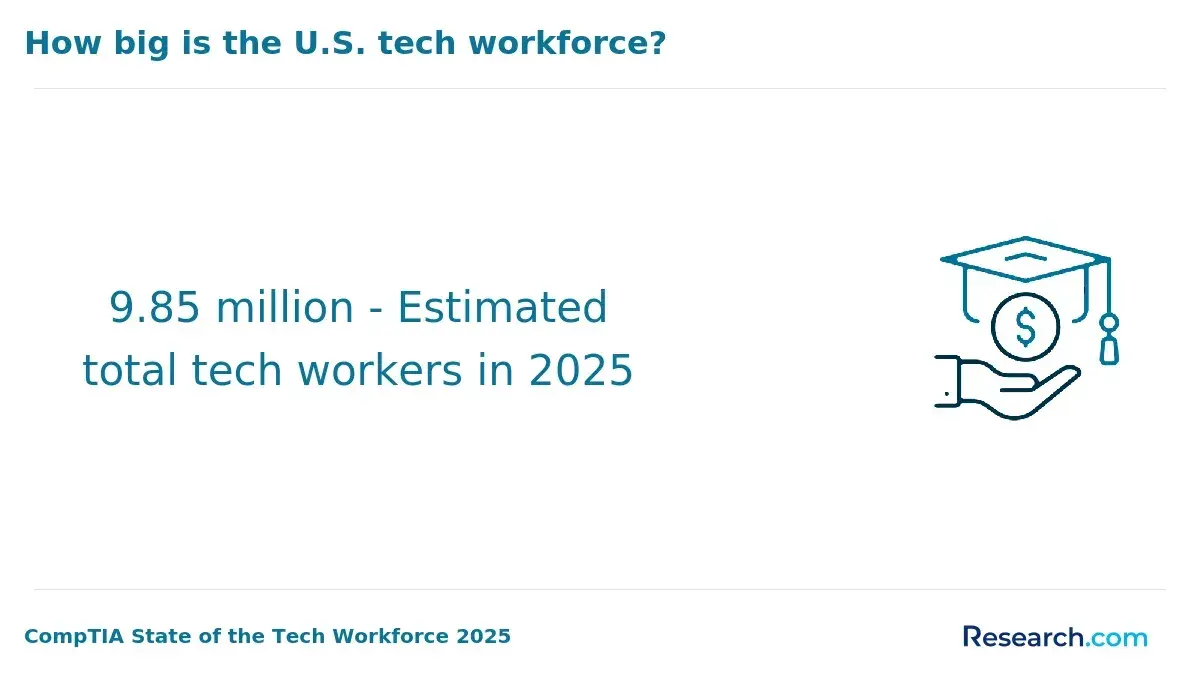
Technology careers are being reshaped by AI, cloud infrastructure, cybersecurity threats, data privacy, automation, and employer demand for job-ready skills. In the tech industry, software developers, computer programmers, and computer and information systems managers remain among the most common career options. Based on a recent report, there are around 1.69 million people in the workforce working as software developers, making it one of the most common occupations for graduates of a computer and tech-related discipline.
CIS graduates are well positioned for roles that require technology implementation, compliance awareness, cybersecurity coordination, business process improvement, and data-informed decision-making. As organizations adopt more cloud platforms, AI tools, and integrated business systems, the ability to manage change and align systems with organizational needs becomes more valuable.
CS graduates are likely to see continued opportunities in software development, artificial intelligence, machine learning, distributed systems, cybersecurity engineering, and data-intensive products. Emerging technologies such as machine learning, the Internet of Things (IoT), and blockchain can create new technical problems that require deeper computing knowledge.
What are the key differences in work environment and job flexibility for CIS vs. CS professionals?
Both CIS and CS can lead to flexible work, but the nature of flexibility differs. CIS roles often depend on organizational systems, business meetings, users, vendors, and compliance needs. CS roles may offer more remote-friendly development work, but some positions require close collaboration, secure environments, lab access, or production support.
| Work factor | CIS professionals | CS professionals |
| Typical setting | Business units, IT departments, consulting firms, healthcare systems, financial institutions, public agencies | Software companies, startups, research groups, product teams, engineering departments, data or AI teams |
| Collaboration style | Frequent interaction with managers, users, vendors, analysts, compliance teams, and executives | Frequent interaction with engineers, product managers, designers, researchers, testers, and data teams |
| Remote work potential | Often possible, especially for analysts, database administrators, and IT planning roles; client-facing work may require travel | Often strong for software, data, and web roles; some security, hardware, or research roles may be less flexible |
| Advancement pattern | Often moves toward project leadership, systems management, consulting, IT governance, or executive technology roles | Often moves toward senior developer, architect, data scientist, research scientist, engineering manager, or CTO pathways |
| High-income specialization | IT management, cybersecurity leadership, cloud systems, enterprise architecture, consulting | Software engineering, data science, AI, machine learning, security engineering, research roles, and other high-paying computer science careers |
What financial aid options are available for CIS and CS students?
CIS and CS students can reduce education costs by combining federal aid, state aid, institutional scholarships, employer tuition assistance, transfer credits, work-study, internships, and lower-cost online programs. Students comparing online technology degrees may use resources such as the cheapest online IT degree options as a starting point, but cost should never be the only criterion.
Before enrolling, confirm the school’s accreditation status, total program cost, transfer-credit policy, technology fees, software or hardware requirements, internship access, and career-services support. Also ask whether online students receive the same advising and employer connections as campus students.
How Can an Advanced Degree Accelerate Career Growth in Technology?
An advanced degree can help experienced technology professionals move into specialized technical roles, research-focused positions, architecture roles, or leadership tracks. For CS professionals, graduate study may deepen expertise in algorithms, AI, machine learning, software systems, or research methods. For CIS professionals, graduate education may support advancement in IT management, cybersecurity leadership, enterprise systems, analytics, or technology strategy.
An online master of computer science can be especially useful for working professionals who need scheduling flexibility. The decision should be based on role requirements, employer expectations, cost, time commitment, and whether the curriculum matches your target specialization.
How Can Accelerated Online Degree Programs Boost Career Opportunities in Tech?
Accelerated online programs can help students and career changers finish a degree faster, but speed should be weighed against academic workload and learning depth. A compressed schedule may work well for students who already have transfer credits, prior technical experience, strong time-management skills, or a clear career goal.
Before choosing an accelerated option such as a 2 year bachelor degree online, ask how many credits are required, whether courses are asynchronous or live, how programming labs are handled, and whether the program includes portfolio projects or internship opportunities.
How Can Affordable Online Cybersecurity Degrees Empower Your Tech Career?
Cybersecurity is a practical specialization for both CIS and CS students. CIS students may be drawn to governance, risk, compliance, security operations, and systems protection. CS students may be more interested in secure coding, vulnerability research, cryptography, security engineering, or threat detection tools.
Affordable online programs can make cybersecurity training more accessible, but students should check accreditation, hands-on lab access, faculty background, certification alignment, and employer recognition. Reviewing the cheapest cyber security degree online options can help narrow costs, but the strongest choice is the program that balances price with credible outcomes and relevant technical practice.
How can data science elevate career trajectories in tech?
Data science can expand both CIS and CS career options. CIS professionals can use analytics to improve reporting, business intelligence, operations, customer insights, and decision support. CS professionals can use data science to build predictive models, machine learning systems, recommendation engines, and large-scale data products.
Professionals who want to move into analytics leadership or advanced data roles may consider targeted graduate study, including an affordable online data science masters. Before enrolling, compare prerequisites carefully; some programs expect strong programming, statistics, and mathematics preparation.
What are the challenges faced by CIS and CS professionals?
Technology careers can be rewarding, but they are not effortless. Both CIS and CS professionals must keep learning, manage complex projects, communicate clearly, and adapt as tools and employer expectations change.
Challenges CIS professionals often face
- Complex system environments: CIS roles may involve legacy platforms, cloud systems, databases, vendor tools, compliance systems, and business applications that must work together.
- Cybersecurity and privacy pressure: Organizations expect CIS professionals to help protect sensitive information and respond to changing security risks.
- Business-technology translation: CIS professionals often explain technical limitations, risks, costs, and trade-offs to nontechnical stakeholders.
Challenges CS professionals often face
- Competitive technical hiring: Software engineering, data science, and AI roles can attract many qualified applicants, especially at high-profile employers.
- Rapid technical change: Programming frameworks, AI tools, cloud services, and software practices change quickly, making continuous learning essential.
- Deadline pressure and burnout risk: Product launches, production incidents, complex debugging, and fast development cycles can affect work-life balance.
Students trying to lower education costs while preparing for technical roles may compare options such as the cheapest computer science degree online, but affordability should be evaluated alongside curriculum quality, support services, and employer relevance.
Which One Should You Choose: CIS or CS?
Choose CIS if you want a technology career connected to business systems, users, operations, management, cybersecurity coordination, consulting, or IT leadership. Choose CS if you want deeper preparation in programming, algorithms, software development, AI, data systems, or computational research.
| Your priority | Better fit | Why |
| You want to manage or improve enterprise systems | CIS | CIS emphasizes systems, users, business processes, and organizational needs. |
| You want to build software products | CS | CS provides deeper preparation in programming, algorithms, and software design. |
| You want a path into IT leadership | CIS | CIS blends technical knowledge with management, project, and business context. |
| You want a path into AI or machine learning engineering | CS | CS usually offers stronger foundations in math, algorithms, data structures, and computing theory. |
| You are unsure but like both business and coding | Compare curricula closely | Some CIS programs are highly technical, and some CS programs offer business, data, or cybersecurity electives. |
If you remain undecided, review degree plans course by course rather than relying only on the major title. Speak with advisors, ask for graduate outcome data, compare internship opportunities, and look at job postings for roles you want after graduation. Many professionals move between CIS and computer science careers over time, especially if they continue learning and build practical experience.
Common Mistakes to Avoid When Choosing CIS or CS
- Choosing only by salary: Salary varies by role, employer, location, experience, portfolio, and specialization. A degree title alone does not guarantee earnings.
- Ignoring accreditation: Always verify institutional accreditation before enrolling, especially for online programs.
- Assuming all CS programs are the same: Some are theory-heavy, while others emphasize software development, AI, cybersecurity, or data science.
- Assuming CIS is “less technical” everywhere: Some CIS programs require substantial programming, networking, database, and cybersecurity work.
- Overlooking internships and projects: Employers often value evidence that you can apply what you learned.
- Focusing only on tuition: Include fees, books, technology requirements, commuting, housing, lost work time, and time to completion.
- Skipping prerequisite checks: CS programs may require stronger math and programming preparation; cybersecurity, data science, and AI electives may also have prerequisites.
Could Biotechnology Integration Enhance Your Technology Career?
Technology skills can become more valuable when paired with another domain. Biotechnology is one example. Professionals who understand computing, data analysis, and biological systems may contribute to areas such as computational biology, personalized medicine, laboratory automation, bioinformatics, and research analytics.
If this interdisciplinary direction interests you, exploring biotechnology masters jobs can help you see how technical training may connect with life sciences careers. This path is usually best for students who are genuinely interested in biology as well as technology.
Exploring Interdisciplinary Opportunities in Technology Careers
CIS and CS do not have to lead only to traditional IT or software roles. Technology professionals increasingly work with design, healthcare, finance, marketing, education, manufacturing, media, and public policy teams. Interdisciplinary skills can make you more adaptable and help you communicate across departments.
For example, students interested in web development, user experience, digital product management, or front-end design may benefit from studying visual communication. An online graphic design degree may complement CIS or CS skills for students who want to work at the intersection of technology and design.
Other useful combinations include CIS with business analytics, CS with data science, cybersecurity with public policy, and software engineering with healthcare or biotechnology. The strongest interdisciplinary path is the one connected to specific roles you can identify in the job market.
Is Artificial Intelligence the Catalyst for Future Technology Careers?
Artificial intelligence is affecting both CIS and CS, but in different ways. CIS professionals may use AI to automate workflows, improve analytics, support decision-making, monitor systems, or evaluate risk. CS professionals may build machine learning models, AI-enabled software, data pipelines, and intelligent applications.
Students who want structured AI training may compare affordable online artificial intelligence degree programs. Before enrolling, check whether the curriculum includes programming, statistics, machine learning, ethics, data management, and hands-on projects.
How Can an AI Degree Program Enhance Your Technology Career?
An AI degree program can strengthen a CIS or CS background by adding focused preparation in machine learning, deep learning, data analytics, and AI applications. For CS students, AI training may support technical roles in model development, software engineering, or research. For CIS students, AI training may support roles in analytics strategy, business intelligence, automation, risk management, and AI implementation.
The best AI program is not necessarily the most advanced-sounding one. Look for practical projects, strong prerequisites, responsible AI coverage, relevant tools, and clear alignment with the jobs you want.
Questions to Ask Before Enrolling in a CIS or CS Program
- Is the institution properly accredited?
- How much programming is required in the first year?
- What math courses are required, especially for CS?
- Does the curriculum include cybersecurity, cloud computing, data analytics, or AI electives?
- Are internships, capstones, labs, or portfolio projects built into the program?
- What career services are available to online and campus students?
- How many credits can transfer, and how will transfer credits affect time to graduation?
- What is the full cost after tuition, fees, technology requirements, books, and living expenses?
- Do graduates work in the roles and industries you are targeting?
- Will the program prepare you for certifications that matter in your chosen field?
Key Insights
- CIS and CS overlap, but they are not the same major. CIS focuses on applying technology inside organizations, while CS focuses more on software, algorithms, systems, and computational problem-solving.
- Choose CIS if you want to connect technology with business operations. It is a strong path for systems analysis, IT consulting, databases, cybersecurity operations, business intelligence, and technology management.
- Choose CS if you want deeper technical preparation. It is usually the better fit for software engineering, AI, data science, systems development, and research-oriented computing roles.
- Coursework tells you more than the degree name. Compare required courses, math expectations, programming depth, electives, labs, and capstone projects before choosing a program.
- Salary data should guide, not decide, your choice. Reported wages such as $140,910, $98,670, $171,200, and $112,500 vary by role, experience, employer, and specialization.
- Certifications can help when they match your career goal. CISSP, PMP, CEH, Azure Solutions Architect Expert, and AWS Certified Solutions Architect can be useful, but only when employers in your target roles value them.
- AI, cybersecurity, cloud computing, and data analytics affect both paths. CIS professionals often implement and manage these technologies; CS professionals often build and optimize them.
- The best choice is the one connected to your preferred work. If you want to manage systems and solve organizational problems, choose CIS. If you want to build software and solve computational problems, choose CS.
References:
- CBRE (2025, September 9). Scoring Tech Talent 2025. CBRE
- Data USA. (n.d.). Computer and Information Sciences and Support Services | Data USA. Data USA.
- National Center for Education Statistics. (2024, May). Undergraduate Degree Fields. NCES.
- National Student Clearinghouse (2024, May 27). Computer Science Has Highest Increase in Bachelor’s Earners. National Student Clearinghouse
- Torres, J. (2025, January 14). Tech salaries barely inched up in 2024. CIODive
- U.S. Bureau of Labor Statistics. (2025, August 28). Computer and Information Systems Managers: Occupational Outlook Handbook: U.S. Bureau of Labor Statistics. BLS.
- U.S. Bureau of Labor Statistics. (2025, August 28). Computer and Information Research Scientists: Occupational Outlook Handbook: U.S. Bureau of Labor Statistics. BLS.
- U.S. Bureau of Labor Statistics. (2025, August 28). Computer Programmers: Occupational Outlook Handbook: U.S. Bureau of Labor Statistics. BLS.
- U.S. Bureau of Labor Statistics. (2025, August 28). Software Developers, Quality Assurance Analysts, and Testers: Occupational Outlook Handbook: U.S. Bureau of Labor Statistics. BLS.
- Zippia. (2025, December 15). Computer Scientist Salary. Zippia.
Other Things You Should Know About Computer Information Systems vs. Computer Science
A CIS degree focuses on the practical application of technology within organizational settings. It combines elements of business management, computer science, and information technology to design, implement, and manage systems that enhance efficiency and decision-making.
A CS program delves into theoretical foundations such as algorithms, data structures, programming languages, computer networks, operating systems, database systems, artificial intelligence, and software engineering.
In 2027, typical job roles for Computer Information Systems graduates include IT manager, systems analyst, database administrator, and network architect. These positions typically involve managing information systems, analyzing organizational needs, and ensuring the alignment of technology with business goals.
Computer Science programs usually require calculus I and II, discrete mathematics, and sometimes linear algebra or statistics. Many CIS programs ask for only one business-focused math course, such as college algebra or applied statistics, because the curriculum emphasizes systems, databases, and business applications instead of theory.
In 2027, job prospects for CIS graduates often lean towards roles like systems analyst or IT manager, focusing on IT and business alignment. CS graduates typically find opportunities in software development or research, emphasizing programming and algorithms. Salaries and demand may differ based on industry needs.


