
2027 Most Affordable Online CompTIA A+ Training Bootcamps

Co-Founder and Chief Data Scientist
Choosing an online CompTIA A+ bootcamp is usually a budget decision, but price alone can be misleading. A low-cost course may not include exam vouchers, labs, practice tests, instructor access, or career support, while a higher-priced program may be worthwhile if it shortens your study time and gives you better preparation for both A+ exams. This guide is for career changers, students, working adults, veterans, and entry-level tech learners comparing affordable CompTIA A+ online training options in the USA.
You will learn what CompTIA A+ bootcamps typically include, how much they cost, which affordable programs are available, how online training compares with in-person training, what jobs the credential can support, and how to avoid common mistakes when choosing a provider.
Quick answer: Are online CompTIA A+ bootcamps worth it?
An online CompTIA A+ bootcamp can be worth it if you want structured, job-focused preparation for entry-level IT support roles and do not want to commit to a full degree program before testing the field. The best programs cover Core 1 and Core 2 exam objectives, include hands-on labs, provide practice exams, clarify whether exam vouchers are included, and offer enough support to keep you on track. However, a bootcamp is not a guaranteed job offer, and some learners may do well with lower-cost self-study materials instead.
What are the benefits of getting an online CompTIA A+ training bootcamp qualification?
- Faster entry into IT support: CompTIA A+ is commonly used as a starting credential for roles such as IT Support Specialist, Help Desk Technician, and Field Service Technician.
- Practical earning potential: A+ certified professionals in the United States often see median salaries in the range of $50,000 to $60,000 annually, depending on experience, employer, and location.
- Flexible study format: Online bootcamps can fit around work, family, military service, or school schedules, especially when programs include self-paced modules or recorded lessons.
What can I expect from an online CompTIA A+ training bootcamp?
A strong online CompTIA A+ bootcamp is designed to prepare you for certification exams while building the troubleshooting habits needed in real IT support work. Most programs are more compressed than college courses and more structured than independent study.
- Focused exam preparation: Expect coverage of hardware, operating systems, networking, mobile devices, security fundamentals, troubleshooting, and operational procedures.
- Organized learning path: Programs may combine live instruction, recorded videos, readings, quizzes, and guided study plans.
- Hands-on practice: Better bootcamps include virtual labs, simulations, troubleshooting exercises, and practice tests rather than relying only on lectures.
- Shorter timeline: Bootcamps are built to move learners toward certification faster than many traditional courses, although the pace can be demanding.
- Study resources: Many providers include e-books, exam objectives, lab access, flashcards, instructor office hours, or discussion forums.
Where can I work with an online CompTIA A+ training bootcamp qualification?
CompTIA A+ is most relevant for entry-level and early-career technical support jobs. Employers in many industries need staff who can resolve user issues, set up devices, document tickets, support operating systems, and escalate more complex problems.
- Corporate IT departments: Businesses of all sizes hire technicians to support employees, hardware, software, accounts, and devices.
- Managed service providers: MSPs support multiple client environments, which can help new technicians gain broad troubleshooting experience quickly.
- Government and education: Public agencies, schools, colleges, and universities often need desktop support and help desk staff.
- Healthcare and retail: Organizations with large device networks, point-of-sale systems, electronic records, or user-facing systems need reliable IT support.
- Remote and field support settings: Some roles are remote help desk positions, while others require on-site repair, deployment, or customer service work.
- Future specialization: A+ can provide a base for later training in networking, cybersecurity, cloud support, or systems administration.
How much can I make with an online CompTIA A+ training bootcamp qualification?
- Compensation varies by region, employer, prior experience, and job title. In the United States, entry-level roles such as Help Desk Technician typically range from $40,000 to $55,000 annually. With experience, salaries can rise to $55,000-$70,000, and specialized positions may exceed $70,000.
- Most Affordable Online CompTIA A+ Training Bootcamps for 2027
- Benefits of online CompTIA A+ training bootcamps
- How to choose the right online CompTIA A+ bootcamp
- Prerequisites and application process
- Skills taught in CompTIA A+ bootcamps
- Career options after CompTIA A+ training
- Bootcamp costs and financing options
- Salary expectations after CompTIA A+ training
- Online versus in-person CompTIA A+ bootcamps
- Subspecialties and career paths after A+
- How A+ can lead to advanced IT specializations
- Online CompTIA A+ bootcamps versus college degrees
- Post-certification career support
- Advanced education after CompTIA A+
- Job market for CompTIA A+ bootcamp graduates
- Industry trends affecting A+ careers
Most Affordable Online CompTIA A+ Training Bootcamps for 2027
The programs below represent affordable or commonly considered online CompTIA A+ training options. Use the list as a starting point, then verify the current curriculum, exam version, voucher policy, refund terms, schedule, and eligibility requirements directly with each provider before enrolling.
| Provider | Program length | Listed or estimated cost | Best fit |
| Arizona Western College | 7–16 weeks | $1,450 | Learners who want a college-based, lower-cost online option |
| Baylor University | One week to several months, self-paced | $3,995.00 | Learners who want university-branded training with vouchers and labs |
| CertificationCamps.com | 5 days | $2,995 | Learners who want intensive live online instruction |
| Climb Hire | Self-paced | Free | Eligible low-income and underrepresented learners |
| Infosec Institute | 5 days | ~$2,995 | Learners who want accelerated training with lab access |
| Tech 901 | Not specified | $30 to $282 | Memphis-based learners seeking very low-cost training |
| University of Arizona Continuing Education | 12 months, self-paced | Not explicitly listed; bundles offered | Learners who need a longer self-paced window |
| University of North Carolina Wilmington | 5 days | Estimated $2,500–$3,000 | Learners who prefer a short, instructor-led bootcamp |
| Virginia Western Community College | 7–16 weeks | $3,420; $1,140 for eligible FastForward students | Learners who may qualify for grant-supported training |
1. Arizona Western College
Arizona Western College provides an online CompTIA A+ certification program that emphasizes troubleshooting, networking, security, device setup, operating system administration, hardware configuration, and data backup. Its training includes hands-on labs, virtual simulations, and preparation for Core 1 (220-1001) and Core 2 (220-1002).
- Program Length: 7–16 weeks
- Tracks/Concentrations: CompTIA A+ Certification.
- Tuition Cost: $1,450 (in-state and out-of-state).
- Requirements: Open enrollment; no prerequisites listed.
- Accreditation: Accredited by the Higher Learning Commission (HLC).
2. Baylor University
Baylor University offers online certification training aligned with CompTIA A+, Network+, and Security+ exams. The A+ course includes exam vouchers and virtual labs, with content centered on hardware, operating systems, and security concepts.
- Program Length: One week to several months, self-paced.
- Tracks/Concentrations: CompTIA A+ Certification.
- Tuition Cost: $3,995.00
- Requirements: Open enrollment; basic knowledge of computer hardware and operating systems
- Accreditation: Regionally accredited by the Southern Association of Colleges and Schools Commission on Colleges (SACSCOC).
3. CertificationCamps.com
CertificationCamps.com runs a 5-day live online boot camp using CompTIA Official Courses (220-1201 and 220-1202). The program covers PC hardware and software installation, troubleshooting, peripheral configuration, and networking basics. Students receive exam vouchers, retake vouchers, and study lab access.
- Program Length: 5 days.
- Tracks/Concentrations: CompTIA A+ Certification; others like CompTIA Cloud+, CompTIA CySA+ (Cyber Security Analyst+), etc.
- Tuition Cost: $2,995.
- Requirements: No prerequisites.
- Accreditation: CompTIA Authorized Partner.
4. Climb Hire
Climb Hire offers free CompTIA A+ certification training and exam vouchers for eligible low-income and underrepresented learners. The program covers the core areas of A+ preparation, including hardware, software, networking, and security, while also emphasizing readiness for IT support jobs.
- Program Length: Self-paced (duration varies).
- Tracks/Concentrations: CompTIA A+ Certification.
- Tuition Cost: Free (exam fees covered).
- Requirements: Eligibility for nonprofit-supported enrollment.
- Accreditation: Nonprofit organization partnered with CompTIA.
5. Infosec Institute
Infosec Institute offers a CompTIA A+ Boot Camp with live online training, 90-day lab access, and exam vouchers. The course addresses hardware, operating systems, virtualization, and troubleshooting, and it includes an exam success guarantee or free retakes.
- Program Length: 5 days (accelerated).
- Tracks/Concentrations: CompTIA A+ Certification.
- Tuition Cost: ~$2,995 (estimated based on comparable programs).
- Requirements: No prerequisites.
- Accreditation: CompTIA Authorized Partner.
6. Tech 901
Tech 901 provides discounted CompTIA A+ training starting from $30 to $262, with coursework in IT fundamentals, hardware and software troubleshooting, and certification preparation. The program includes lab work and career support for Memphis-based learners.
- Program Length: Not specified.
- Tracks/Concentrations: CompTIA A+ Certification.
- Tuition Cost: $30 to $282 depending on the course.
- Requirements: Open enrollment.
- Accreditation: Nonprofit organization.
7. University of Arizona Continuing Education
The University of Arizona Continuing Education offers a self-paced online CompTIA training option using CertMaster Learn modules, virtual labs, and exam vouchers. The program aligns with CompTIA A+ 220-1101/1102 objectives and covers hardware, networking, mobile devices, and security.
- Program Length: 12 months (self-paced).
- Tracks/Concentrations: CompTIA A+ Certification.
- Tuition Cost: Not explicitly listed; bundles offered
- Requirements: Open enrollment.
- Accreditation: CompTIA Authorized.
8. University of North Carolina Wilmington (UNCW)
The University of North Carolina Wilmington provides a 5-day boot camp with live instruction and hands-on exercises. Topics include hardware and software configuration, troubleshooting, and operational procedures. The program includes exam vouchers and a free retake guarantee.
- Program Length: 5 days.
- Tracks/Concentrations: CompTIA A+ Certification.
- Tuition Cost: Estimated $2,500–$3,000.
- Requirements: General understanding of Windows OS and experience with Microsoft products and technologies.
- Accreditation: Regionally accredited by the Southern Association of Colleges and Schools Commission on Colleges (SACSCOC).
9. Virginia Western Community College
Virginia Western Community College offers a 7- or 16-week CompTIA A+ option with e-books, virtual labs, and exam vouchers. The program prepares students for Core 1 and Core 2 through topics such as hardware fundamentals, system management, networking, and security.
- Program Length: 7–16 weeks.
- Tracks/Concentrations: CompTIA A+ Certification.
- Tuition Cost: $3,420 (in-state); FastForward grant reduces cost to $1,140 for eligible students.
- Requirements: High school diploma/GED; computer skills assessment.
- Accreditation: Accredited by the Southern Association of Colleges and Schools (SACS).
Additional affordable options
- Local community colleges: Many local institutions, including examples such as Pima Community College and Austin Community College, may offer CompTIA A+ programs under $2,000 for in-state students. Always confirm regional accreditation, exam voucher inclusion, lab access, and whether the course prepares for the current exam version.
Note: Tuition, vouchers, schedules, eligibility rules, and exam versions can change. Confirm all details directly with the provider before paying a deposit or enrolling.
What are the benefits of attending online CompTIA A+ training bootcamps?
Online CompTIA A+ training can be a practical route into IT because it focuses on job-ready technical support skills without requiring learners to complete a full academic program first. For some students, a bootcamp is enough to begin applying for help desk or desktop support roles; others may later stack the credential with an accelerated online computer science degree or another technology program.
- Schedule control: Online formats can be easier to manage for learners balancing work, caregiving, military obligations, or school.
- Lower total expenses: Online training may reduce commuting, relocation, parking, and housing costs compared with campus-based instruction.
- More provider choice: You can compare programs across states instead of being limited to options near your home.
- Self-paced options: Some courses allow you to move faster through familiar material and spend more time on difficult areas.
- Multiple learning tools: Videos, virtual labs, simulations, quizzes, communities, and instructor support can reinforce the same concept in different ways.
CompTIA data shows that many credential holders reported career movement within their organizations. Specifically, 73% of CompTIA A+ certified individuals, 75% of CompTIA Network+ certified individuals, and 78% of CompTIA Security+ certified individuals reported at least one job title change while working at the same company. By comparison, 61% of the benchmark group without those specific CompTIA certifications reported similar title movement.
This does not mean certification alone guarantees promotion. It does suggest that CompTIA credentials can support internal mobility when paired with job performance, experience, and employer demand. The graphic below illustrates the reported differences across credential groups.
The biggest advantage of a good online bootcamp is structure. Instead of guessing what to study, learners follow a sequence tied to exam objectives and common workplace tasks. The trade-off is that online success depends heavily on discipline, reliable technology, and consistent practice.
Students comparing tech-adjacent career paths may also want to look at how technical skills connect with data roles, including career options in business analytics.
How do I choose the best online CompTIA A+ training bootcamp for my needs and career goals?
The best bootcamp is not automatically the cheapest or the most recognizable. It is the program that matches your learning style, timeline, budget, current skill level, and target job. Before enrolling, compare what is included rather than only comparing tuition.
| Factor to check | Why it matters | Question to ask before enrolling |
| Exam alignment | The course must prepare you for the current Core 1 and Core 2 objectives. | Which CompTIA A+ exam version does this program teach? |
| Hands-on labs | IT support hiring often rewards practical troubleshooting ability. | Are labs, simulations, or virtual machines included? |
| Exam vouchers | Vouchers can materially change the total cost. | Are both exam vouchers included in tuition? |
| Instructor access | Beginners often need help when troubleshooting concepts do not click. | Can I ask questions live, by email, in office hours, or through a discussion board? |
| Practice tests | Mock exams help identify weak areas before paying for the real test. | How many practice exams are included? |
| Schedule | A 5-day bootcamp may be too fast for new learners, while a long self-paced course requires persistence. | How many hours per week should I expect to study? |
| Career support | Resume help and interview practice can be useful for first-time IT applicants. | Does the program include career coaching, portfolio guidance, or job search support? |
- Match the curriculum to the exam: Confirm the program covers all current CompTIA A+ Core 1 and Core 2 domains.
- Check instructor credentials: Look for trainers with current certifications and actual IT support, networking, systems, or security experience.
- Choose the right format: Live online courses work well if you need accountability; self-paced courses work better if your schedule changes frequently.
- Look beyond tuition: Ask whether books, labs, retake vouchers, exam vouchers, practice tests, and career services are included.
- Read reviews carefully: Prioritize detailed reviews that discuss instruction quality, support responsiveness, exam readiness, and job search help.
- Be realistic about outcomes: No bootcamp can guarantee a job or a salary, especially for learners without prior technical or customer service experience.
If your long-term interests are outside standard IT support, compare alternative academic paths before committing. For example, learners interested in public safety technology or security-related policy roles may want to review affordable online bachelor's in homeland security degree options.
What are the prerequisites and application process for online CompTIA A+ training bootcamps?
Most CompTIA A+ bootcamps are designed for beginners, so admissions requirements are usually lighter than degree program requirements. Still, “beginner-friendly” does not mean effortless. You should be comfortable using a computer, managing files, navigating the internet, and following technical instructions.
- Basic computer literacy: You should know how to use common software, browse the web, manage files, and troubleshoot simple device issues.
- High school diploma or equivalent: Some providers prefer or require a high school diploma or GED, although requirements vary.
- Limited prior IT experience: Many programs do not require previous IT work, but any exposure to computer hardware, Windows, or customer support can help.
- Study discipline: Learners need enough motivation to practice regularly, review weak areas, and complete labs outside class time.
The application process is often simple: complete an online form, speak with an admissions or enrollment representative if required, confirm eligibility for any discounts or grants, review the payment agreement, and enroll. Before paying, ask for the syllabus, refund policy, voucher policy, and expected weekly time commitment in writing.
If you decide that you want a broader academic foundation in addition to certification, a 2 year computer science degree online pathway may be worth comparing with bootcamp-only training.
What essential skills will I learn in a top online CompTIA A+ training bootcamp?
A quality CompTIA A+ bootcamp should teach both exam knowledge and workplace troubleshooting. The goal is not just to memorize terms, but to understand how devices, networks, operating systems, security practices, and users interact in real environments.
- Hardware diagnosis: Identify and troubleshoot issues involving CPUs, RAM, motherboards, storage, power, printers, and peripherals.
- Operating system support: Install, configure, maintain, and troubleshoot Windows, macOS, and Linux environments at a foundational level.
- Networking basics: Understand TCP/IP, DNS, DHCP, wireless connectivity, network devices, and common connectivity problems.
- Mobile device support: Configure and troubleshoot smartphones, tablets, and related workplace device issues.
- Security fundamentals: Apply basic security practices, recognize malware risks, support authentication, and follow safe operational procedures.
- Software setup and troubleshooting: Install, configure, update, and repair common software applications.
- Customer service communication: Explain technical issues clearly, document tickets, de-escalate frustrated users, and ask good diagnostic questions. These communication skills also matter in non-IT leadership roles, including a restaurant manager career, where service recovery and problem solving are part of daily work.
What are some career prospects after completing an online CompTIA A+ training bootcamp?
CompTIA A+ is most useful for entry-level IT support positions. It can help demonstrate foundational knowledge, but employers will still evaluate communication skills, troubleshooting ability, professionalism, and any hands-on experience you can show.
| Role | Typical focus | Good fit for |
| IT Support Specialist | User support, tickets, device issues, software problems | Learners who like solving varied technical problems |
| Help Desk Technician | Remote or in-person support for employees or customers | Strong communicators and patient troubleshooters |
| Field Service Technician | On-site installation, maintenance, and repair | Learners comfortable with travel and hands-on work |
| Technical Support Analyst | Issue analysis, documentation, escalation, and customer support | Learners who like structured problem solving |
| Associate Network Engineer | Assisting with basic network setup and maintenance | Learners planning to pursue networking credentials |
| Desktop Support Administrator | Managing workplace computers, accounts, and desktop systems | Learners interested in internal IT operations |
Many A+ holders later pursue more specialized credentials or degrees. For example, after gaining support experience, some professionals consider a low-cost online master's in computer science if they want a deeper academic credential for software, systems, or advanced technical roles.
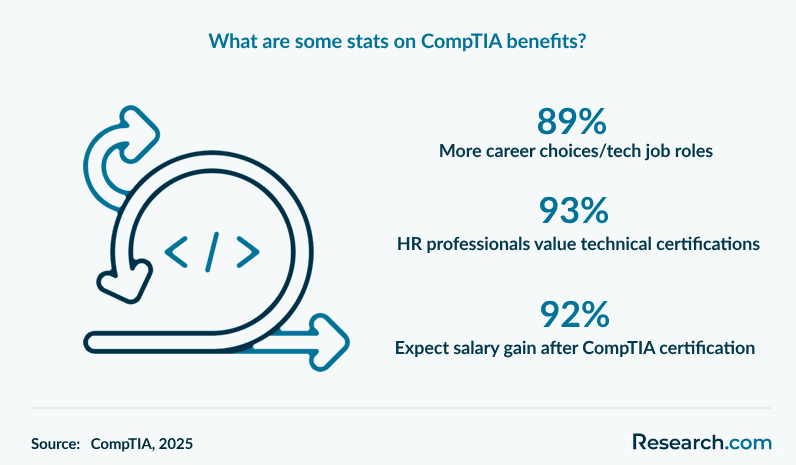
CompTIA data from 2025 reported that 89% of individuals accessed more career choices and tech job roles with potential employers after earning a CompTIA certification, while 93% of training and academic partners said CompTIA unlocks potential and expands opportunity. The same data also reported that 89% of CompTIA-certified professionals remained working in the tech industry after five years. The graphic below summarizes those outcomes.
How much do online CompTIA A+ training bootcamps cost and what financing options are available?
Online CompTIA A+ training ranges from very low-cost self-study to multi-thousand-dollar bootcamps. The correct comparison is total cost, not advertised tuition. A $200 course without vouchers, labs, support, or practice tests may be less complete than a higher-priced program that includes those items.
- Tuition differences: Prices vary based on provider reputation, course length, instructor access, lab quality, and included materials.
- Included resources: Ask whether tuition includes exam vouchers, retake vouchers, books, CertMaster tools, labs, practice exams, and career support.
- Payment plans: Some providers allow installment payments instead of one upfront payment.
- Financing options: Certain bootcamps work with financing companies, although loans should be reviewed carefully before signing.
- Discounts and grants: Veterans, underrepresented learners, low-income students, unemployed workers, and early enrollees may qualify for discounts or subsidized training. Saving on entry-level credentials can leave room for later education, including options such as the cheapest online master's programs in computer science.
CompTIA A+ training costs vary widely by format. Self-study materials from CompTIA range from $49 to $499. Subscription-based models are offered by CBT Nuggets at around $59/month or $599/year, ITProTV starting around $49/month or $499/year, and Cybrary starting at $59/month, while StormWind Studios and Skillsoft use subscription models with varying prices requiring contact. Course-based platforms such as Udemy offer options between $20 and $200, and TestOut charges around $199 per course. More comprehensive training from New Horizons and Global Knowledge typically ranges from $2,000 to $3,500, depending on location and format.
Common cost mistakes to avoid
- Assuming vouchers are included: Some programs advertise training only, while exams cost extra.
- Ignoring retake policies: A free retake guarantee can matter if you are new to IT.
- Choosing only by brand name: A well-known provider is not automatically the best value for your learning style.
- Using loans without comparing cheaper options: Self-study or community college programs may be enough for disciplined learners.
- Forgetting opportunity cost: A 5-day bootcamp may require time off work, while a slower course may delay job applications.
Training should be treated as an investment only after you understand the likely return, the total cost, and your commitment level. The same logic applies to broader career education decisions, such as asking why get a master's in social work before paying for graduate school.
How much can you earn after obtaining online CompTIA A+ training bootcamp qualifications?
Salary outcomes after CompTIA A+ training depend on the role, employer, region, prior work history, customer service experience, and whether you continue building technical skills. A+ can help you qualify for entry-level interviews, but it does not guarantee a specific income.
- Entry-level pay: Starting salaries for A+ certified professionals in roles such as Help Desk Technician often range from $40,000 to $55,000 annually in the US.
- Experience effect: With proven workplace experience, earnings can increase to the range of $55,000 to $70,000 or more.
- Location differences: Compensation can shift based on cost of living, local demand, and whether the job is remote, hybrid, or on-site.
- Specialization: Larger organizations or more specialized technical roles may offer higher pay.
- Further credentials: Additional certifications, degrees, and job experience can improve advancement potential. Some professionals later consider one year master's programs when a graduate credential fits their career plan.
According to Payscale.com data from 2025, average salaries for several IT support and related roles in the United States vary by job function. Business analysts have the highest average salary listed at $92,846. Help desk technicians average $43,032, while IT support technician and support technician roles both show $46,634. Computer hardware technicians average $50,249, IT support specialists average $50,454, technical support specialists average $51,122, and field service technicians average $61,908.
The pattern in the graphic below shows that business-focused roles such as business analyst sit above many hands-on support roles, while several entry-level support jobs cluster around the $46,000 to $51,000 range.
For many learners, A+ is a first step rather than a final credential. To increase earning potential over time, build a record of solved tickets, customer satisfaction, systems knowledge, documentation skills, and additional training in networking, security, cloud, or systems administration.
What are the key differences, benefits, and drawbacks of online versus in-person CompTIA A+ training bootcamps?
Both online and in-person CompTIA A+ bootcamps can work. The better option depends on how you learn, how much structure you need, and how much flexibility your schedule requires.
| Format | Best advantages | Main drawbacks | Choose this if... |
| Online bootcamp | Flexible location, more provider options, often lower total cost | Requires self-discipline, reliable internet, and proactive communication | You work irregular hours, live far from training centers, or prefer studying at home |
| In-person bootcamp | Direct interaction, fixed structure, easier peer networking | Less flexible, may cost more, limited by geography | You learn better in a classroom and need external accountability |
Key differences
- Location and schedule: Online courses allow learners to study from almost anywhere, while in-person courses require attendance at fixed times and locations.
- Interaction: Classroom bootcamps make spontaneous conversations easier, but live online programs can still offer strong instructor access when designed well.
- Learning environment: Online study depends on your home setup and habits; in-person study provides a dedicated space.
- Cost structure: Online options may reduce travel and facility-related costs, though premium online bootcamps can still be expensive.
Benefits of online CompTIA A+ training bootcamps
- Flexible scheduling: Many programs support learners with jobs or family responsibilities.
- Broader access: You can compare programs across regions instead of relying only on local providers.
- Potential savings: Online learning can reduce commuting and relocation expenses.
- Comfortable study setting: Some learners focus better in a familiar environment.
Drawbacks of online CompTIA A+ training bootcamps
- Self-management required: You must keep up with readings, labs, and practice tests without a physical classroom routine.
- Less informal networking: Online courses may offer fewer casual peer connections unless the provider builds community features.
- Technology dependence: A weak internet connection or outdated personal computer can interrupt learning.
Benefits of in-person CompTIA A+ training bootcamps
- Immersive environment: A classroom can reduce distractions and create a focused training routine.
- Immediate feedback: It may be easier to ask questions and demonstrate hardware or troubleshooting issues in person.
- Peer relationships: Cohort-based programs can support networking and accountability.
- Predictable schedule: Fixed class times can help learners who struggle with self-paced study.
Drawbacks of in-person CompTIA A+ training bootcamps
- Higher total cost: Travel, parking, meals, and facility fees can add to tuition.
- Less flexibility: Missing class can be costly in an accelerated format.
- Geographic limits: Your options depend on where you live or whether you can travel.
What subspecialties and career paths are available for online CompTIA A+ training bootcamp graduates?
CompTIA A+ is broad by design. After the credential, you can move toward a specialty based on what you enjoy most: devices, networks, users, security, systems, cloud platforms, or leadership.
- Networking: Learners who enjoy routers, switches, IP addressing, and connectivity may pursue CompTIA Network+ or Cisco CCNA and target Network Technician or Administrator roles.
- Cybersecurity: Those interested in threat detection, access controls, and risk reduction may pursue CompTIA Security+ or CySA+ and move toward Security Analyst or Cybersecurity Technician roles.
- Server administration: Support technicians who enjoy operating systems and infrastructure may work toward Server Administrator or System Administrator responsibilities.
- Cloud computing: Learners interested in AWS, Azure, or cloud support can build from A+ into cloud administration or cloud support pathways.
- IT support leadership: Experienced technicians may later manage help desk teams, service desks, or support operations.
- Specialized hardware repair: Some technicians focus on deeper diagnostics and repair for specific devices or equipment categories.
- Project coordination: If you enjoy organizing people, timelines, and technology rollouts, an online project management degree can complement IT support experience.
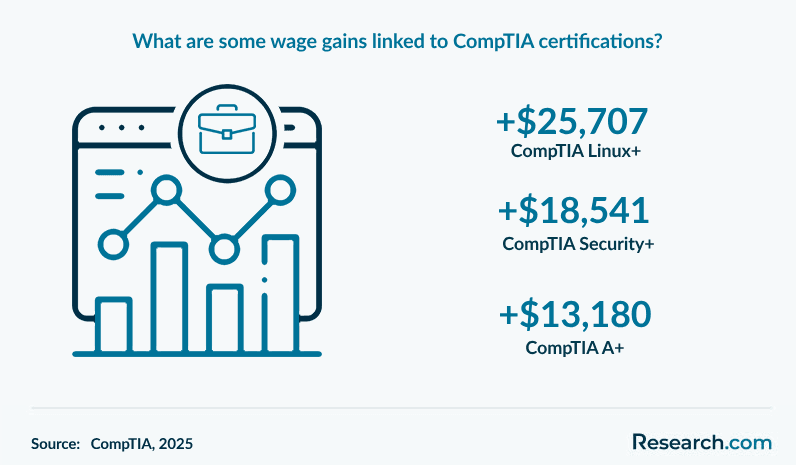
According to the Northern Virginia FastForward Program wage assessment by the Virginia Community College System (VCCS), different CompTIA certification paths are associated with different wage gains. The assessment links CompTIA Linux+ with +$25,707, CompTIA Network+ with +$21,519, CompTIA Security+ with +$18,541, and CompTIA A+ with +$13,180. The graphic below presents these reported wage differences.
Use A+ as a diagnostic tool for your own career interests. If you like networking labs, move toward Network+. If security topics stand out, consider Security+. If operating systems and command-line work interest you, Linux+ or systems administration may be a logical next step.
How can online CompTIA A+ training bootcamps open doors to advanced IT specializations?
Online CompTIA A+ training gives learners a technical base that can make later specialization easier. Once you understand devices, operating systems, troubleshooting, and basic security, it becomes easier to choose a focused path such as networking, cybersecurity, cloud support, systems administration, or data infrastructure.
Some professionals eventually combine IT support experience with analytics or data-focused education. For example, learners interested in deeper quantitative and technical work may compare affordable online master's in data science programs after gaining foundational IT experience.
How do online CompTIA A+ bootcamps compare to college degree programs?
Online CompTIA A+ bootcamps and college degrees serve different purposes. A bootcamp is narrower, faster, and focused on certification readiness. A degree is broader, usually longer, and may cover programming, systems, databases, mathematics, theory, communication, and general education.
| Option | Main purpose | Typical strength | Potential limitation |
| CompTIA A+ bootcamp | Prepare for entry-level IT support certification | Fast, practical, exam-focused | Less broad than a degree |
| College technology degree | Build a wider academic and technical foundation | Broader career flexibility and academic depth | More time and cost commitment |
| Self-study | Prepare independently using books, videos, and practice exams | Lowest cost for disciplined learners | Less structure and support |
If your goal is to start applying for help desk roles quickly, an A+ bootcamp may be enough. If you want broader advancement into software development, IT management, systems design, or technical leadership, compare certification training with the fastest online information technology degree programs.
What post-certification career support do online CompTIA A+ bootcamps offer?
Career support varies widely. Some providers focus almost entirely on exam preparation, while others include job search services. Before enrolling, ask whether support continues after the course ends and whether it is included in tuition.
- Resume and LinkedIn review: Helpful for translating non-IT work into relevant technical and customer support language.
- Interview coaching: Useful for practicing troubleshooting scenarios, behavioral questions, and help desk communication.
- Job search guidance: Some programs teach learners how to target entry-level postings and avoid unrealistic job requirements.
- Employer connections: A few providers may host networking events, career fairs, or employer introductions.
- Skill gap planning: Strong programs help graduates decide whether Network+, Security+, cloud training, or another credential should come next.
Career paths do not always stay inside traditional IT. Some learners later connect technology skills with science, healthcare, or data fields; for an interdisciplinary example, review jobs you can get with a bioinformatics degree.
What advanced educational pathways complement a CompTIA A+ certification?
After A+, the best next credential depends on your target role. Do not collect certifications randomly. Choose the next step based on job postings in your region, the systems you want to work with, and the skills you enjoyed during A+ training.
- Networking pathway: CompTIA Network+ or Cisco CCNA can support movement toward network support and administration.
- Cybersecurity pathway: CompTIA Security+ or CySA+ can help learners move toward security-focused support and analyst roles.
- Systems pathway: Linux+, server administration training, or cloud fundamentals can strengthen infrastructure skills.
- Degree pathway: An associate, bachelor's, or master's degree may help if your target employers prefer formal education.
- Healthcare technology pathway: Learners interested in IT, data, and healthcare operations may consider an online master's in health informatics.
What is the job market like for online CompTIA A+ training bootcamp graduates?
The job market for A+ bootcamp graduates is strongest in entry-level technical support, especially for candidates who can combine certification with customer service, documentation, communication, and hands-on troubleshooting practice. The credential can help you get noticed, but job search results depend on local demand and how well you present your skills.
- Steady need for support: Organizations need people who can keep devices, accounts, software, and users working.
- Entry-level relevance: A+ is widely recognized for foundational IT support knowledge.
- Cross-industry use: Healthcare, finance, education, public sector, retail, and technology employers all rely on IT support.
- Remote support options: Some help desk and technical support roles can be performed remotely, widening the job search area.
- Growth platform: A+ can lead to networking, security, cloud, systems, or support leadership pathways when paired with experience.
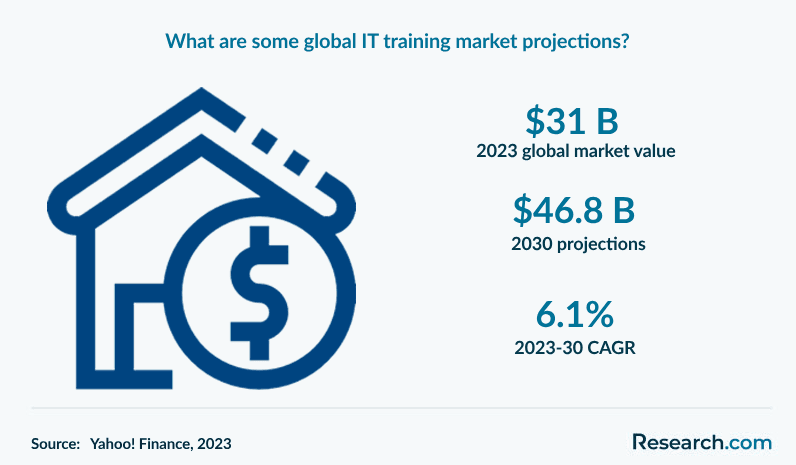
In 2023, the worldwide market for IT training was valued at approximately $31 billion. Forecasts project growth to $46.8 billion by 2030, reflecting an annual growth rate of 6.1% between 2023 and 2030, as shown in the graphic below. This broader training market growth reflects continued demand for technical skill development across organizations.
For job seekers, the practical takeaway is simple: certification is only one part of the application. Build a small evidence base around it, such as lab notes, troubleshooting examples, home lab projects, volunteer support experience, or documented practice tickets.
What are the current industry trends and future outlook for online CompTIA A+ careers?
Entry-level IT support is changing, but it is not disappearing. Employers still need technicians who can communicate with users, interpret vague problem reports, secure devices, escalate issues properly, and support hybrid environments.
- Remote and hybrid work support: Technicians increasingly help users across home networks, VPNs, collaboration tools, cloud applications, and managed devices.
- Security expectations for all IT roles: Even entry-level support staff need to understand malware prevention, account security, patching, and safe handling of user systems.
- Cloud-connected workplaces: While A+ is foundational, basic familiarity with cloud services can help support technicians work in modern environments.
- Mobile device management: Smartphones, tablets, laptops, and bring-your-own-device policies continue to create support needs.
- Automation of routine tasks: Automation can reduce repetitive work, but human technicians are still needed for judgment, escalation, user communication, and nonstandard issues.
- Continuous learning: A+ should be treated as a first credential. To remain competitive, learners need to keep updating skills as tools and employer expectations change.
Common mistakes when choosing an online CompTIA A+ bootcamp
- Choosing the cheapest course without checking what is included: Low tuition may not include vouchers, labs, books, practice exams, or instructor help.
- Ignoring the exam version: A course aligned to outdated objectives can waste study time.
- Assuming a bootcamp guarantees employment: Certification can support a job search, but employers still evaluate skills, experience, communication, and fit.
- Underestimating the pace: A 5-day program can be difficult for beginners without pre-study.
- Skipping hands-on practice: Memorizing definitions is not enough for troubleshooting-based work.
- Not asking about refunds: Review cancellation, refund, retake, and voucher policies before payment.
- Relying only on rankings: A highly ranked or well-known provider may not match your schedule, budget, or learning style.
Questions to ask before enrolling
- Which CompTIA A+ exam version does the program currently cover?
- Are both Core 1 and Core 2 exam vouchers included?
- Does tuition include retake vouchers or a retake guarantee?
- How much lab time is included, and what tools are used?
- Can I contact instructors outside scheduled sessions?
- What happens if I fall behind?
- How long will I have access to videos, labs, and practice tests?
- What career services are included after completion?
- Are there eligibility requirements for grants, nonprofit support, or discounted tuition?
- What is the total cost after materials, vouchers, fees, and financing charges?
Here's what graduates say about their online CompTIA A+ training bootcamps
-
: "
“I chose one of the most affordable online CompTIA A+ bootcamps in the U.S., and the structure helped me stay consistent. The self-paced lessons worked with my schedule, and I passed both exams on my first attempt.” Zack
"
-
: "
“I was changing careers, so I needed a course that did not assume years of IT experience. The labs and real examples helped me understand troubleshooting instead of just memorizing terms.” Katherine
"
-
: "
“The bootcamp gave me instructor guidance, practical study resources, and a price I could manage. After certification, I was able to move into an entry-level IT role.” Elias
"
Key Insights
- Best value is not always the lowest price: Compare total cost, including vouchers, retakes, labs, books, practice exams, and career support.
- A+ is a strong entry-level credential: It is most useful for help desk, desktop support, technical support, field service, and junior IT roles.
- Salary varies by role: Payscale.com data from 2025 lists help desk technicians at around $43,032 annually, IT and support technicians at approximately $46,634, computer hardware technicians at $50,249, IT support specialists at $50,454, technical support specialists at $51,122, field service technicians at $61,908, and business analysts at $92,846.
- CompTIA certification can support career movement: CompTIA data indicates that 73% of A+ certified professionals experienced job title changes within their company.
- Career outcomes are not automatic: Certification works best when paired with hands-on practice, customer service ability, documentation skills, and targeted job applications.
- Advanced certifications can increase opportunity: VCCS data links CompTIA A+ with a +$13,180 wage gain, Network+ with +$21,519, Security+ with +$18,541, and Linux+ with +$25,707.
- Training costs vary widely: Options range from $20 individual courses on platforms such as Udemy to $3,500 comprehensive programs from providers such as Global Knowledge, with self-study and subscription options also available.
- Choose based on your learning style: Self-paced online courses are flexible but require discipline; live bootcamps add accountability but can move quickly; in-person training offers structure but may cost more.
References:
- CompTIA. (2025). Assessing outcomes, efficacy, and value: Q1 2025 release [PDF]. CompTIA.
- Coursera. (2024). Your CompTIA A+ Salary Guide. Coursera.
- Payscale.com. (2025). CompTIA A+ Certification Salary. Payscale.
- Payscale.com. (2024). Desktop Support Technician Salary in Ireland. Payscale.
- Payscale.com. (2025). Technical Support Specialist Salary. Payscale.
- Yahoo Finance. (2023, September 20). IT training market worth $46.8 billion by 2030. Yahoo Finance.
Other Things You Should Know About Online CompTIA A+ Training Bootcamps
Yes, many affordable online CompTIA A+ bootcamps in 2027 are designed for complete beginners, providing foundational IT knowledge. No prior IT experience is required, and these bootcamps offer structured learning paths, covering essential topics like hardware troubleshooting, networking basics, and operating systems.
Many affordable online CompTIA A+ bootcamps include exam vouchers for Core 1 and Core 2, while others charge them separately. CompTIA’s A+ certification requires passing 220-1101 and 220-1102, and each exam voucher is purchased through CompTIA or an authorized reseller.


