

University of North Carolina Wilmington
- Type:
- Public
- Programs:
- 4 years or more

Cost
- Cost / year
- $28,004
- Tuition & fees
- $7,266
- Avg. aid
- $7,448
- Receiving aid
- 73%
Admissions
- Acceptance rate
- 64%
- SAT range
- 1230–1340
- ACT range
- 24–29
Outcomes
- Graduation rate
- 71%
- Median salary
- $48,499
- 1 yr after graduation
What is the history of University of North Carolina Wilmington?
The University of North Carolina Wilmington (UNCW) began in 1947 as Wilmington College, a junior college established to expand local access to higher education after World War II. Its present identity reflects a transition from a community-oriented college to a public university with undergraduate and graduate programs.
Wilmington College became a four-year institution in the 1960s, took the name University of North Carolina Wilmington in 1969, and joined the University of North Carolina System in 1972. As the university expanded, it developed programs in business, education, health, the arts, and the sciences. Its coastal location has also shaped academic work in marine science and environmental studies.
What are the faculties and departments at University of North Carolina Wilmington?
UNCW organizes its academic programs across colleges and schools rather than a single undergraduate faculty. Its principal academic units include the College of Humanities, Social Sciences, and the Arts; the College of Science and Engineering; Cameron School of Business; Watson College of Education; and the College of Health and Human Services. The Graduate School oversees graduate education.
The range includes undergraduate study in fields such as biology, computer science, film studies, psychology, business, education, public health, and nursing, alongside master's and doctoral programs. Marine science is a notable area of study and research, but students considering it should distinguish among undergraduate majors, graduate degrees, and research opportunities: they have different admission routes and requirements.
Some programs have separate progression or clinical-placement requirements after university admission. Applicants to nursing, education, and other professionally oriented fields should check the requirements for their intended major, not just UNCW's general admissions criteria.
What is the location of University of North Carolina Wilmington?
UNCW's main campus is in Wilmington, North Carolina, a coastal city in the southeastern part of the state. The university is part of the Wilmington community rather than a self-contained rural campus.
Wilmington offers access to health care organizations, schools, businesses, arts venues, and coastal environments that may be relevant to internships or coursework. Availability of placements depends on the program and employer; proximity alone does not secure an opportunity. Wilmington International Airport serves the area and may be useful to students traveling from outside the region.
Transportation deserves attention when comparing living arrangements. Some students live on campus, while many commute. First-year students are permitted to register a car, but they should budget for parking and verify current permit rules. Students planning to live off campus should also check how their route and class schedule fit available transportation.
What is the mission and vision of University of North Carolina Wilmington?
UNCW describes its mission as providing teaching, research, and service as a public university within the University of North Carolina System. Its stated priorities connect student learning with scholarly work and engagement beyond campus.
The university's strategic direction emphasizes student success, research and creative activity, and contributions to the region and wider community. Those are institutional aims, not a guarantee of any individual student's experience or outcome. Applicants can assess how the aims translate into their field by looking at course offerings, access to advising, undergraduate research, and required experiential learning.
UNCW is a public, nonsectarian institution. Its mission does not impose a religious affiliation on students.
University of North Carolina Wilmington Rankings
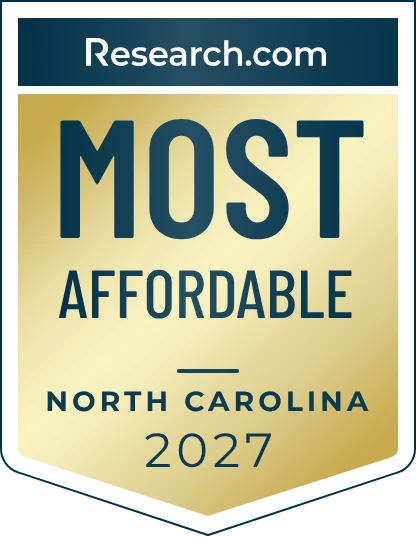
Research.com Awards

University of North Carolina Wilmington Profile - Basic Information
Name of the institution
University of North Carolina WilmingtonLevel of institution
Four or more yearsControl of institution
PublicSetting type
City: MidsizeInstitutional Category
Degree - granting, primarily baccalaureate or aboveInstitution size category
10,000 - 19,999School type
UniversityMain student body
CoeducationalCalendar system
SemestersFoundation year
1947University of North Carolina Wilmington Accreditation
University of North Carolina Wilmington is institutionally accredited by the Southern Association of Colleges and Schools Commission on Colleges, an accrediting agency recognized by the U.S. Department of Education. Accreditation confirms that the school meets quality standards and is required for students to receive federal financial aid.
University of North Carolina Wilmington Programs and Degrees
 Certificate of less than 1 yearBachelor's degreePostbaccalaureate certificateMaster's degreePost-master's certificateDoctor's degree - research/scholarshipDoctor's degree - professional practice
Data last updated on November 5, 2026
Data sources: IPEDS 2024-25, Peterson 2026, College Scorecard 10/2026, Clery 2024 (2023-24), OpenAlex 2026
Figures on this profile come from federal and third-party datasets in the editions listed above and are refreshed periodically, so they may differ from what the institution currently reports. Confirm costs, deadlines and requirements with the school before making decisions.


