
2027 How to Become a Full-Stack Developer

Co-Founder and Chief Data Scientist
Becoming a full-stack developer means preparing to build both the visible parts of a web application and the systems that run behind it. For beginners, career changers, bootcamp students, and computer science learners, the main decision is not only “What should I learn?” but also “Is full-stack the right path compared with front-end, back-end, software engineering, data, or security roles?”
This guide explains what full-stack developers do, which skills matter most, how to learn the field in 2026, how to build experience, and how to turn projects into a credible job application. It also covers salary context, learning paths, portfolio expectations, AI tools, common mistakes, and questions to ask before investing in a bootcamp, degree, or self-study plan.
Quick answer: How do you become a full-stack developer?
To become a full-stack developer, learn front-end development with HTML, CSS, JavaScript, and a major framework such as React, then learn back-end programming, databases, APIs, Git, deployment, testing, and basic cloud workflows. Build several complete projects, publish your code on GitHub, deploy live demos, and use your portfolio to apply for junior developer, web developer, apprenticeship, internship, or software engineer roles.
The career can be a strong option for people who enjoy solving end-to-end product problems. Software developer jobs are projected to grow 17% from 2023 to 2033, which is much faster than the average for all occupations. However, full-stack development requires continuous learning, and some employers still prefer specialists for complex front-end, back-end, cloud, or security work.
Key things you should know about becoming a full-stack developer
- Software developer employment is projected to grow 17% from 2023 to 2033, making software development a high-growth career category.
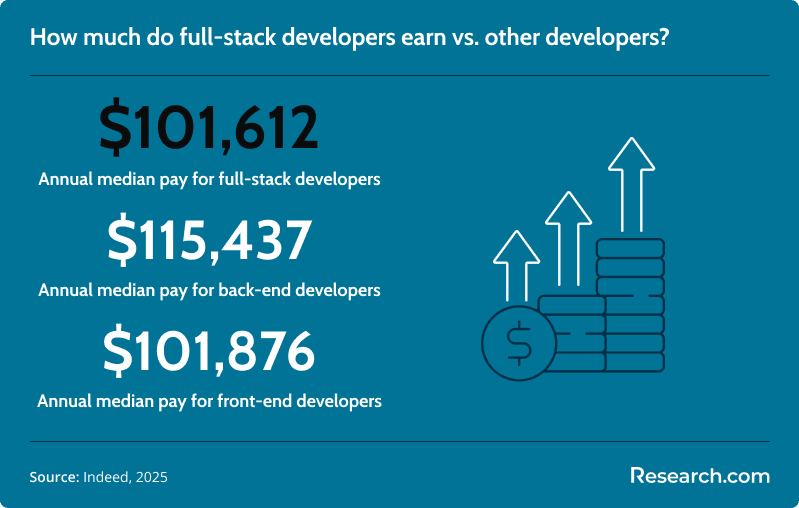
- Full-stack developers earn an average salary of $101,612, close to front-end developers at $101,876 and below back-end developers at $115,437.
- JavaScript remains a core language for the web, with 62% of developers using it, followed by HTML/CSS at 53%.
- Coding bootcamps can prepare learners in about 14 weeks, while self-study learners may take around 33 weeks to gain practical proficiency.
- A portfolio matters: 59% of hiring managers prefer work portfolios over traditional text-based resumes.
- What does a full-stack developer do?
- Which skills do full-stack developers need?
- What steps should you follow to become a full-stack developer in 2026?
- How can you learn full-stack development from zero?
- Which programming languages should full-stack developers learn?
- Which tools and frameworks are most useful?
- How do you get real full-stack experience?
- How can full-stack developers move into senior roles?
- What should a full-stack portfolio include?
- Which advanced education options can support a full-stack career?
- Should full-stack developers earn advanced academic credentials?
- Can online engineering degrees help full-stack developers?
- How can full-stack developers use AI responsibly?
- When do interdisciplinary online degrees make sense?
- How do you land your first full-stack developer job?
- How do you keep your skills current?
- What challenges should full-stack developers expect?
- Which soft skills matter most for full-stack developers?
What is a full-stack developer?
A full-stack developer is a software professional who can work across the front end, back end, and often the deployment layer of a web application. In practical terms, this means they can build the user interface, connect it to server-side logic, store and retrieve data, work with APIs, and help move the application into a production environment.
The front end is the part users see and interact with. It usually includes HTML, CSS, JavaScript, responsive design, accessibility, browser behavior, and frameworks such as React or Vue. The back end handles the application’s business logic, authentication, permissions, databases, APIs, performance, and server-side workflows. Common back-end choices include Node.js, Python, Java, PHP, MySQL, PostgreSQL, and MongoDB.
Full-stack does not mean knowing every technology. It means being able to understand the complete application flow: how a user action in the browser becomes an API request, how the server processes it, how the database responds, and how the result appears back in the interface.
| Role | Main focus | Typical responsibilities | Salary context stated in this guide |
| Front-end developer | User interface and user experience | Build pages, components, forms, responsive layouts, and client-side interactions | $101,876 |
| Back-end developer | Server-side systems and data | Create APIs, manage databases, handle authentication, optimize server logic | $115,437 |
| Full-stack developer | End-to-end web applications | Work across the interface, application logic, data layer, and deployment process | $101,612 |
Startups, agencies, small product teams, and early-stage companies often value full-stack developers because one person can contribute across several parts of the application. Larger organizations may still hire full-stack developers, but they may divide work among specialists when systems become large, regulated, or highly complex.
What skills do you need to become a full-stack developer?
A job-ready full-stack developer needs more than a list of programming languages. Employers look for people who can build, debug, explain, test, and ship working software. The strongest candidates understand how the front end, back end, database, and deployment process fit together.
Core front-end skills
- HTML, CSS, and JavaScript: These form the foundation of web development. JavaScript is used by 62% of developers, while HTML/CSS is used by 53%.
- Component-based frameworks: React, Angular, or Vue help developers build interactive, maintainable interfaces.
- Responsive and accessible design: A full-stack developer should understand how to create pages that work across screen sizes and can be used by people with different accessibility needs.
- Browser debugging: Knowing how to inspect network requests, console errors, layout problems, and performance issues saves time in real projects.
Core back-end skills
- Server-side programming: Node.js, Python, Java, or PHP can be used to create application logic and services.
- Databases: SQL databases such as PostgreSQL and MySQL are used for structured data, while NoSQL options such as MongoDB support flexible document-based storage.
- APIs: REST and GraphQL help the front end communicate with the back end and with third-party services.
- Authentication and authorization: Developers should understand secure login, session handling, permissions, and common security risks.
Workflow, deployment, and professional skills
- Git and GitHub: Version control is essential for tracking changes, reviewing code, and collaborating with teams.
- Deployment basics: Developers should know how to publish applications using platforms such as AWS, Vercel, Firebase, or similar tools.
- Testing and debugging: Unit tests, integration tests, logs, and error monitoring help keep applications reliable.
- Problem-solving: Full-stack work often involves tracing issues across the browser, server, database, and infrastructure.
Some full-stack skills also transfer into specialized technical fields. For example, students interested in interactive systems and real-time application logic can compare this path with a game programming degree. Developers who enjoy Python, data workflows, and algorithmic problem-solving may also want to understand the machine learning engineer career path.
What are the steps to become a full-stack developer for 2026?
The best path is to learn in layers. Do not try to master every framework at once. Build a foundation, connect the pieces, and then create projects that prove you can solve real problems.
Step 1: Learn how the web works
Start with the basics: browsers, HTTP requests, URLs, HTML structure, CSS styling, JavaScript behavior, forms, APIs, and client-server communication. This foundation makes frameworks easier to understand later.
Step 2: Build front-end projects with JavaScript
Create simple applications before moving into a framework. Examples include a calculator, weather app, form validator, budget tracker, or searchable list. Then learn React, Vue, or Angular to understand components, state, routing, and reusable interface patterns.
Step 3: Choose one back-end stack
Pick a practical back-end language and framework. Node.js is popular because it lets you use JavaScript on both the client and server. Python, Java, and PHP are also widely used. Learn how to create routes, validate input, handle errors, connect to a database, and return API responses.
Step 4: Learn databases and data modeling
Practice creating tables or collections, storing user data, writing queries, and designing relationships. A full-stack developer should be able to explain why they chose SQL or NoSQL for a project.
Step 5: Use Git, testing, and deployment from the beginning
Employers want candidates who can work like developers, not just complete tutorials. Use Git for every project, write clear README files, test key features, and deploy live versions so reviewers can use your applications.
Step 6: Build a portfolio around complete products
Three complete, well-documented applications are usually more useful than ten unfinished tutorial clones. A portfolio should show authentication, data storage, API calls, error handling, responsive design, and deployment.
Step 7: Keep learning beyond code
As developers move toward lead, product, or management roles, business and leadership knowledge can become useful. Some professionals explore programs such as a 1 year executive MBA online when they want to combine technical work with strategy, operations, or team leadership.
How do you learn full-stack development from scratch?
You can learn full-stack development through self-study, a coding bootcamp, a college degree, or a hybrid plan. The right choice depends on your budget, schedule, learning style, need for credentials, and ability to stay consistent without external structure.
| Learning path | Best for | Typical advantage | Possible drawback |
| Self-study | Disciplined learners who need flexibility | Low cost and customizable pacing; self-learners may take around 33 weeks to build proficiency | No built-in accountability, feedback, or career support unless you create it yourself |
| Coding bootcamp | Learners who want structure and faster career preparation | Bootcamps can prepare students in about 14 weeks with projects, mentorship, and job-focused practice | Quality varies widely, and short programs can feel intense |
| Computer science degree | Students who want broader theory, credentials, and long-term flexibility | Covers programming plus algorithms, systems, databases, and computing fundamentals | Usually takes longer and may cost more than self-study or bootcamp options |
| Hybrid approach | Career changers balancing speed, cost, and credibility | Combines free or low-cost learning with structured projects, certificates, or selected courses | Requires careful planning to avoid gaps and duplicated content |
A strong beginner roadmap starts with HTML, CSS, and JavaScript; moves into one front-end framework; adds one back-end language; then introduces databases, APIs, authentication, deployment, and testing. Avoid jumping between too many tutorials. Build one project at a time and improve it until it works, looks presentable, and can be explained in an interview.
If you are comparing education options, ask whether the program includes real projects, code reviews, career services, portfolio preparation, and support for Git, deployment, testing, and databases. A program that only covers syntax without helping you build complete applications may leave you underprepared for the job search.
What programming languages should you learn for full-stack development?
Most beginners should prioritize depth over breadth. Learn the core web languages first, then choose a back-end language that matches your goals and local job market. You do not need to learn every language listed below to become employable.
Front-end languages
- JavaScript: The main programming language of the browser and a practical choice for interactive web applications.
- TypeScript: A typed extension of JavaScript that helps reduce errors and makes large projects easier to maintain.
- HTML and CSS: Essential for page structure, layout, styling, forms, and responsive design.
Back-end languages
- Node.js: Allows developers to use JavaScript on the server, which can simplify learning for beginners already studying JavaScript.
- Python: Popular for readable syntax and frameworks such as Django and Flask.
- Java: Common in enterprise environments, especially with frameworks such as Spring Boot.
- PHP: Still important in content-heavy environments and systems built around WordPress.
Database query languages and data tools
- SQL: Used with relational databases such as MySQL and PostgreSQL for structured data storage and retrieval.
- NoSQL tools: MongoDB and Firebase can be useful when projects need flexible data structures or real-time features.
Learners who want a structured academic route into programming, software design, and computing fundamentals can compare self-study or bootcamp training with an accelerated computer science degree.
What tools and frameworks should full-stack developers master?
Frameworks and tools help developers move faster, but they should not replace fundamentals. Learn what the tool is doing underneath: routing, rendering, state management, database access, environment configuration, testing, and deployment.
Front-end frameworks and libraries
- React: Listed at 39.5%, React is widely used for building interactive user interfaces and component-based applications.
- Angular: Listed at 17.1%, Angular is a TypeScript-based framework often used in larger enterprise applications.
- Vue.js: Listed at 15.4%, Vue is known for flexibility and a lower barrier to entry.
- Svelte and Solid.js: Listed at 6.5% and 1.2%, these options are newer alternatives that emphasize performance and leaner code.
Back-end frameworks
- Node.js ecosystem: Useful for JavaScript-based server-side development and scalable web applications.
- Django and Flask: Python frameworks that support fast development of APIs and web applications.
- Spring Boot: A Java framework often used for larger, structured, enterprise-grade systems.
Development, testing, and deployment tools
- Git and GitHub: Required for collaboration, version history, pull requests, and open-source contribution.
- Docker: Helps create consistent application environments across local development and deployment.
- CI/CD tools: Jenkins and GitHub Actions can automate testing, builds, and deployments.
- Cloud and hosting platforms: Developers should understand the basics of deploying applications, managing environment variables, and reading logs.
| If your goal is... | Prioritize these tools | Why it matters |
| Junior web developer role | HTML, CSS, JavaScript, React, Git, GitHub, basic APIs | These skills appear frequently in entry-level web development work |
| Full-stack JavaScript role | React, Node.js, SQL or MongoDB, authentication, deployment | One language across the stack can simplify learning and portfolio building |
| Enterprise software role | Angular, TypeScript, Java, Spring Boot, SQL, testing | Larger organizations often use structured frameworks and typed languages |
| Startup or freelance work | React or Vue, Node.js or Python, payment APIs, deployment, analytics | Small teams need developers who can ship usable features quickly |
How do you gain practical experience as a full-stack developer?
The fastest way to become credible is to build software that other people can inspect, use, and understand. Practical experience does not have to come only from a paid job. Personal projects, open-source work, internships, freelance assignments, hackathons, and volunteer projects can all strengthen your profile.
Build complete personal projects
Start small, then add complexity. A to-do app can teach state and CRUD operations, but a stronger portfolio project might include authentication, database persistence, search, filters, role-based permissions, and deployment. Examples include an inventory tracker, booking app, personal finance dashboard, learning platform, event registration tool, or e-commerce prototype.
Contribute to open-source projects
Open-source work shows that you can read existing code, follow contribution guidelines, communicate with maintainers, and improve software you did not originally write. Start with documentation, bug fixes, tests, or small UI improvements before attempting major features.
Use freelance or volunteer work carefully
Small client projects can build confidence, but beginners should avoid promising features they do not yet know how to deliver securely. Choose manageable projects, define scope clearly, and document what you built.
Apply for internships, apprenticeships, and trainee roles
Structured early-career roles can provide mentorship, code review, and exposure to team workflows. These roles may be more realistic than applying only to standard software engineer postings when you are new.
Experience also helps you evaluate compensation and career direction. If you want to compare earnings across related technology paths, review broader computer science salary expectations while remembering that pay varies by role, location, employer, experience, and specialization.
How do you advance your career as a full-stack developer?
Career growth usually comes from moving beyond “I can code this feature” to “I can design, improve, and lead reliable software systems.” Senior full-stack developers often take ownership of architecture decisions, mentor junior developers, improve developer workflows, reduce technical debt, and collaborate closely with product, design, security, data, and operations teams.
To progress, focus on system design, testing strategy, performance optimization, security, cloud services, observability, and communication. You can also deepen your formal education if your target roles value advanced credentials. For example, an online masters computer science program may be useful for developers who want stronger foundations in algorithms, distributed systems, databases, artificial intelligence, or software engineering theory.
| Career stage | What to prove | Helpful actions |
| Beginner | You can build and explain working applications | Create portfolio projects, learn Git, deploy apps, practice interviews |
| Junior developer | You can contribute to a team codebase | Ask for code reviews, improve debugging, write tests, document decisions |
| Mid-level developer | You can own features from planning to release | Improve architecture knowledge, handle production issues, mentor newer teammates |
| Senior or lead developer | You can guide technical direction and reduce risk | Lead design discussions, improve systems, coach others, align technical work with business goals |
How do you build a strong portfolio as a full-stack developer?
A strong portfolio should make it easy for an employer to answer three questions: Can this candidate build working software? Can they explain their decisions? Can they solve problems without copying a tutorial line by line?
Because 59% of hiring managers prefer work portfolios over traditional text-based resumes, your portfolio should be more than a gallery of screenshots. Include live links, GitHub repositories, project summaries, technology choices, setup instructions, known limitations, and short explanations of what you would improve next.
What to include in a full-stack portfolio
- At least three polished projects: Choose projects that show both front-end and back-end ability.
- Live demos: Deploy applications so hiring teams can test them without installing anything.
- Clean repositories: Use meaningful commit messages, organized folders, readable code, and helpful README files.
- Project case studies: Explain the problem, users, features, architecture, database design, trade-offs, and challenges.
- Security and reliability basics: Show that you understand validation, authentication, environment variables, error handling, and basic testing.
| Portfolio mistake | Why it weakens your application | Better approach |
| Only showing tutorial clones | Employers may not see independent problem-solving | Customize the project, add original features, and explain your decisions |
| No live demo | Reviewers may skip projects that are hard to run | Deploy the application and include a clear demo link |
| Poor documentation | Hiring teams cannot understand your process | Add setup steps, architecture notes, screenshots, and limitations |
| Too many unfinished projects | It suggests weak follow-through | Show fewer projects, but make each one complete and reliable |
If you want academic structure and portfolio-ready assignments, an online computer science degree may help you combine project work with a recognized credential. Compare programs carefully for cost, accreditation, transfer credit policies, curriculum quality, and career support.
What advanced educational opportunities can boost your full-stack career?
Advanced education is not required for every full-stack developer, but it can help when your goals involve specialized industries, technical leadership, research-heavy work, or roles that ask for deeper theory. The key is to choose education that solves a real career problem rather than collecting credentials without a plan.
For example, developers interested in health technology, computational biology, or data-heavy research systems may compare software roles with online bioinformatics masters pathways. This kind of interdisciplinary study can be useful when the work involves scientific data, domain-specific systems, or collaboration with researchers.
Should full-stack developers pursue advanced academic qualifications?
Advanced academic credentials can be valuable when they align with a specific destination: senior engineering, data-intensive systems, academic research support, regulated industries, health technology, AI, or management. They are less useful if you expect a degree alone to replace practical coding ability.
Before enrolling, ask whether the program will strengthen your portfolio, deepen your technical base, improve your job options, or qualify you for roles that currently feel out of reach. Developers drawn to biological data platforms or research computing can also evaluate a bioinformatics masters as a way to combine software development with domain knowledge.
How can accredited online engineering degrees enhance your full-stack career?
Accredited online engineering programs can support full-stack developers who want a stronger grounding in systems thinking, software design, problem-solving, and technical analysis. This can be especially helpful for developers moving from tutorial-based learning into more rigorous engineering work.
Cost and quality vary, so compare accreditation, curriculum, faculty background, project requirements, transfer policies, student support, and total cost before applying. If affordability is a major factor, research affordable accredited engineering online colleges and verify that the program structure fits your work schedule and career goals.
How can full-stack developers integrate AI into their workflow?
AI is changing how developers write, review, test, document, and maintain software. Full-stack developers can use AI coding assistants, automated test generation, log analysis, documentation helpers, and API-based AI services to speed up routine work. However, AI output still needs human review for security, correctness, licensing concerns, performance, privacy, and maintainability.
Practical AI use for full-stack work may include generating boilerplate code, drafting test cases, summarizing unfamiliar codebases, improving error messages, creating chat interfaces, adding recommendation features, or integrating machine learning APIs into applications. Developers who want deeper formal training can compare short courses with AI degree programs online, especially if they want to understand neural networks, data mining, and algorithm design beyond tool-level usage.
Should full-stack developers consider interdisciplinary online degrees?
Interdisciplinary education can make sense when you want to build software for a specialized field. Health care, finance, logistics, education, bioinformatics, cybersecurity, and public sector technology all require more than general coding knowledge. Developers who understand the domain can communicate better with stakeholders and design more useful systems.
For example, someone interested in clinical data, health records, and digital health tools may explore a bachelors in health informatics online. This type of path can help developers understand data governance, health workflows, and user needs in health-related software environments.
How do you get your first job as a full-stack developer?
To land your first full-stack role, combine a focused skills roadmap with proof of work. Entry-level hiring is competitive, so your application needs to show more than course completion. Employers want evidence that you can build, debug, communicate, and keep learning.
Practical job-search steps
- Choose a target role: Search for junior full-stack developer, junior web developer, front-end developer, back-end developer, software developer, apprenticeship, internship, and trainee roles.
- Match your portfolio to job descriptions: If postings ask for React, Node.js, SQL, APIs, and Git, make sure your projects demonstrate those skills clearly.
- Improve your resume and LinkedIn profile: Lead with projects, technologies, outcomes, GitHub links, live demos, internships, freelance work, or open-source contributions.
- Network where developers actually work: Participate on GitHub, attend meetups, join coding communities, contribute to discussions, and ask for feedback.
- Prepare for interviews: Practice JavaScript fundamentals, data structures, debugging, API design, databases, Git workflows, and project walkthroughs.
- Track applications and iterate: If you are not getting interviews, improve your resume and portfolio. If you are getting interviews but no offers, focus on technical interview practice and communication.
Compensation expectations should be realistic, especially for entry-level roles and career changers. Reviewing a broader computer engineer salary guide can help you understand how pay varies across related technical careers, but your actual offer will depend on role, location, employer, experience, and negotiation.
How do you stay updated as a full-stack developer?
Full-stack development changes quickly because it sits at the intersection of front-end frameworks, back-end platforms, databases, cloud tooling, DevOps practices, security, and AI-assisted workflows. The goal is not to chase every new library. The goal is to maintain strong fundamentals while selectively learning tools that improve your work.
Use a sustainable learning system
- Follow trusted technical blogs, framework documentation, release notes, and developer newsletters.
- Schedule time for small experiments with new tools before using them in serious projects.
- Review job postings every few months to see which skills employers repeatedly request.
- Join developer communities on GitHub, Stack Overflow, Reddit, LinkedIn, and local or virtual meetups.
- Contribute to open-source projects to learn team workflows and real-world codebases.
Full-stack developers often overlap with both software developer and software engineer responsibilities. If you are trying to understand career titles and expectations, review this software developer and software engineer career comparison. It can help you interpret job descriptions more accurately.
What are the common challenges full-stack developers face?
Full-stack development offers flexibility, but it can also create pressure. Developers are expected to understand many layers of an application, communicate with different teams, and solve problems that cross technical boundaries.
Challenge 1: Keeping up without burning out
New libraries, frameworks, cloud services, and AI tools appear constantly. A common mistake is trying to learn everything at once. Instead, focus on fundamentals and learn new tools only when they support your current projects or target roles.
Challenge 2: Managing security risks
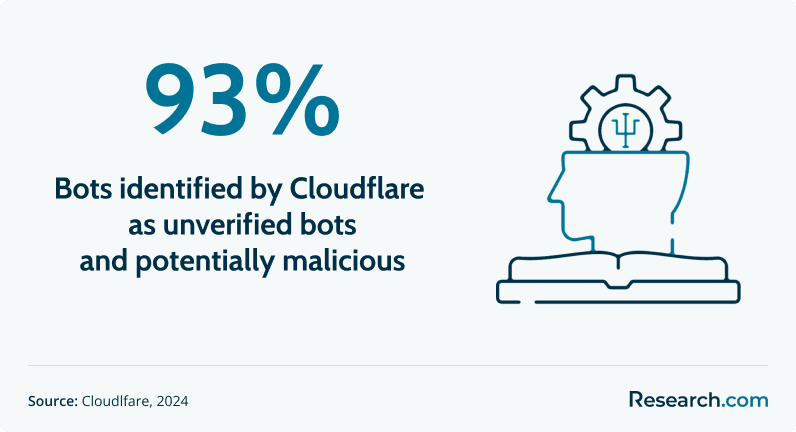
Security is a serious responsibility for full-stack developers because they often handle user input, authentication, APIs, databases, and deployment settings. A Cloudflare study found that organizations had 33% more public-facing API endpoints than they realized, increasing exposure to potential threats. Developers should understand input validation, authentication, authorization, encryption, secure environment variables, dependency updates, and safe API design.
If security becomes your main interest, you may want to compare full-stack development with how to start a career in information security analysis, which focuses more directly on protecting systems, networks, applications, and data.
Challenge 3: Debugging across the whole stack
A bug may come from a browser issue, a broken API request, a database query, a server configuration, a permission problem, or a deployment environment. Full-stack developers need systematic debugging habits: reproduce the issue, isolate the layer, inspect logs, check requests and responses, test assumptions, and document the fix.
Challenge 4: Balancing breadth and depth
Full-stack developers can become spread too thin. To stay competitive, build broad understanding across the stack while developing deeper strength in one or two areas, such as React, Node.js, databases, cloud deployment, security, or system design.
Common mistakes to avoid
| Mistake | Why it causes problems | What to do instead |
| Learning too many frameworks too soon | You may memorize syntax without understanding the web | Master HTML, CSS, JavaScript, APIs, and one main stack first |
| Ignoring Git and deployment | Your work may look unfinished to employers | Use version control and deploy every serious project |
| Choosing education based only on speed | Fast programs may not provide enough practice or support | Compare curriculum, projects, mentorship, cost, and outcomes |
| Assuming a certificate guarantees a job | Hiring depends on skills, projects, interviews, market conditions, and fit | Use credentials to support, not replace, a strong portfolio |
| Skipping security basics | Full-stack apps handle data, accounts, and APIs | Learn authentication, validation, permissions, and secure configuration |
What soft skills are essential for full-stack developers?
Full-stack developers need strong communication because they often translate between design, product, front-end, back-end, operations, and business stakeholders. They must explain technical trade-offs clearly, ask good questions, and document decisions so other people can maintain the work.
- Communication: Explaining architecture, bugs, timelines, and constraints in plain language.
- Collaboration: Working with designers, product managers, QA testers, security teams, and other engineers.
- Time management: Breaking large features into manageable tasks and avoiding scope creep.
- Adaptability: Learning new tools without losing sight of fundamentals.
- Problem-solving: Diagnosing issues across the browser, server, database, and deployment environment.
- Ownership: Taking responsibility for quality, maintainability, documentation, and user impact.
These soft skills also matter in cross-disciplinary technical fields. For example, professionals comparing software-heavy health data roles may review how a master in health informatics salary discussion reflects the value of combining technical knowledge with domain communication and collaboration.
What do full-stack developers say about the career?
-
: "
Working as a full-stack developer has given me the flexibility to solve both interface and server-side problems. I like being able to follow an idea from the first screen design to the final deployed feature, and the constant learning keeps the work engaging. – Pam
"
-
: "
Full-stack development has exposed me to many types of projects, from improving user experiences to making server logic faster and more reliable. Building complete applications has made me more confident because I understand how the pieces connect. – Milo
"
-
: "
One of the most rewarding parts of the job is collaboration. I work with designers, back-end engineers, clients, and product teams, so the work rarely feels repetitive. Seeing users benefit from something I helped build is a major motivator. – Joey
"
Questions to ask before choosing the full-stack developer path
- Do I enjoy both visual interface work and logical back-end problem-solving?
- Am I willing to keep learning after I get hired?
- Would I rather become broad across the stack or specialize deeply in front-end, back-end, security, data, or cloud work?
- Can I build and finish projects without relying only on tutorials?
- Does my chosen bootcamp, degree, or self-study plan include portfolio work, Git, deployment, databases, testing, and interview preparation?
- Have I checked total cost, time commitment, accreditation, career support, and realistic job outcomes before enrolling in a program?
- Can I explain my projects clearly to both technical and non-technical audiences?
Key Insights
- Full-stack development is best for people who want to understand and build complete web applications, not just one layer of the product.
- The strongest 2026 learning path is focused: master web fundamentals, choose one front-end framework, learn one back-end stack, practice databases and APIs, then deploy complete projects.
- Salary data shows full-stack developers at $101,612 on average, close to front-end developers at $101,876 and below back-end developers at $115,437.
- Job growth for software developers is strong, with employment projected to grow 17% from 2023 to 2033, but hiring still depends on skills, portfolio quality, interview performance, and market conditions.
- A portfolio is often more persuasive than a credential alone. Include live demos, GitHub links, documentation, architecture notes, and projects that solve real problems.
- AI can make full-stack developers faster, but it does not remove the need to understand code, security, architecture, testing, privacy, and maintainability.
- Advanced degrees, bootcamps, and certifications can help when they match a clear goal. Do not choose a program based only on speed, popularity, or marketing claims.
References:
- A Guide to Front-End vs. Back-End vs. Full-Stack Development. (2025, March). Indeed. Retrieved March 21, 2025, from https://www.indeed.com/career-advice/finding-a-job/back-end-vs-front-end-vs-full-stack-development
- Application Security report: 2024 update. (2024, October 9). The Cloudflare Blog. https://blog.cloudflare.com/application-security-report-2024-update/
- Coding Bootcamps vs. Self-Study in Switzerland: Pros and Cons. (n.d.). Nucamp. https://www.nucamp.co/blog/coding-bootcamp-switzerland-che-coding-bootcamps-vs-selfstudy-in-switzerland-pros-and-cons
- Front-end frameworks popularity (React, Vue, Angular and Svelte). (n.d.). Gist. https://gist.github.com/tkrotoff/b1caa4c3a185629299ec234d2314e190
- Software developers, quality assurance analysts, and testers. (2024, August 29). Bureau of Labor Statistics. https://www.bls.gov/ooh/computer-and-information-technology/software-developers.htm
- Statista. (2025, February 6). Most used programming languages among developers worldwide 2024. https://www.statista.com/statistics/793628/worldwide-developer-survey-most-used-languages/#statisticContainer
- Vervoe. (2023, March 27). Do work portfolios really showcase true talent? https://vervoe.com/do-work-portfolios-really-showcase-true-talent/
Other Things You Should Know about Being a Full-Stack Developer
In 2027, top programming languages for full-stack developers include JavaScript, Python, and Java. JavaScript is crucial for front-end development, while Python and Java offer versatility and are widely used for back-end development. Familiarity with frameworks like React and Django also enhances employability.
In 2027, top resources include platforms like Udemy, Coursera, and freeCodeCamp offering comprehensive courses. GitHub is essential for practice and collaboration. Books such as "Eloquent JavaScript" continue to be helpful, coupled with community forums like Stack Overflow for support and up-to-date industry trends.
In 2027, essential skills for a full-stack developer include proficiency in JavaScript, knowledge of front-end frameworks like React or Angular, and back-end technologies such as Node.js or Django. Familiarity with cloud services, database management, and an understanding of DevOps practices are also crucial.





