
2027 Competency-Based Degrees and Programs

Co-Founder and Chief Data Scientist
Competency-based degree programs are built for students who already know something from work, military training, prior college, industry certifications, or independent learning—and want credit for proving what they can do. Instead of moving through courses on a fixed semester calendar, students advance after demonstrating mastery of required skills and knowledge.
For working adults, career changers, military learners, and students trying to reduce time in school, this model can be a practical alternative to traditional online or campus-based degrees. It can also be risky if you choose a poorly matched program, misunderstand the tuition model, or enroll in a field where licensure or hands-on training requirements limit flexibility.
This guide explains how competency-based education works, which fields commonly offer it, how it compares with traditional degrees, what it may cost, how employers view it, and how to choose a program that fits your schedule, budget, and career goals.
Quick Answer: Are Competency-Based Degrees Worth Considering?
Competency-based degrees can be worth considering if you are self-motivated, have relevant experience, and want a flexible way to complete a degree online. The strongest candidates are students who can study independently, finish assessments quickly, and use prior knowledge to move faster through the curriculum. However, competency-based education is not automatically cheaper or easier. The value depends on accreditation, program fit, pacing, transfer policies, financial aid rules, employer recognition, and whether the program meets any licensure or certification requirements in your field.
| Best fit for competency-based education | May not be the best fit |
| Working adults with relevant job experience | Students who need frequent live instruction and fixed deadlines |
| Self-directed learners who can manage their time | Learners who struggle without classroom structure |
| Students seeking flexible online study | Students in fields requiring extensive labs, clinical rotations, or supervised practice |
| Degree completers with transfer credits or prior learning | Students who have not checked accreditation, licensure, or employer recognition |
Affordable Quick Online Degree Programs With High Acceptance Rates for 2027
Students searching for affordable, flexible online degrees often compare competency-based programs with other fast online options. The fields below are common choices because they tend to have broad career applications, online availability, and pathways for adult learners. Use this section as a starting point, not as a guarantee that every program in the field will be low-cost, accelerated, or open-admission.
1. Business Administration
Business administration is one of the most common competency-based fields because many working adults already have exposure to teams, customers, budgets, operations, or project workflows. These programs usually cover management, marketing, finance, operations, strategy, and organizational leadership. They can be useful for students pursuing supervisory roles, business support positions, entrepreneurship, or graduate business study.
2. Psychology
Psychology programs introduce students to human behavior, development, cognition, social interaction, research methods, and mental health concepts. A bachelor’s degree in psychology may support roles in human services, human resources, case support, healthcare administration, and community organizations. Students who want to become licensed psychologists, counselors, or therapists should plan for graduate education and must verify state requirements before enrolling.
3. Computer Science
Computer science programs focus on programming, algorithms, data structures, software design, databases, systems, and problem-solving. A competency-based format can work well for learners who already code, have IT experience, or have completed technical certificates. Graduates may pursue roles in software development, cybersecurity, data analysis, systems support, and related technology fields, depending on their skills and portfolio.
4. Counseling
Counseling-related programs teach communication, helping skills, psychological theory, ethics, assessment concepts, and mental health foundations. These degrees may support entry-level human services or behavioral health support roles. Students seeking licensed counseling roles should be especially careful: licensure usually depends on the degree level, accreditation, supervised clinical hours, state approval, and exam requirements.
5. Nursing
Nursing programs combine healthcare knowledge, patient care, clinical reasoning, ethics, and evidence-based practice. Some competency-based nursing options are designed for registered nurses advancing from an RN credential to a bachelor’s degree or pursuing graduate nursing education. Because nursing is regulated, students should confirm that the program satisfies state board, clinical, and licensure expectations before enrolling.
6. Accounting
Accounting degrees develop skills in financial reporting, auditing, taxation, budgeting, compliance, and financial analysis. The competency-based model can be practical for bookkeepers, payroll professionals, office managers, and finance staff who already use accounting concepts at work. Students pursuing CPA eligibility should verify credit-hour, accounting-course, and state board requirements.
7. Social Work
Social work programs prepare students to understand individuals, families, communities, social systems, advocacy, case management, policy, and ethics. Because professional social work practice is often licensed, prospective students should check whether the program’s accreditation and fieldwork structure meet requirements in the state where they plan to work.
8. Healthcare Administration
Healthcare administration programs focus on the business and management side of healthcare, including operations, policy, finance, compliance, health information, and quality improvement. This field can be a strong fit for healthcare workers who want to move into supervisory, administrative, or health services management roles without leaving the workforce.
9. Management
Management programs emphasize leadership, organizational behavior, project coordination, human resources, ethics, strategy, and decision-making. They are often selected by students who already supervise teams or want to qualify for broader business roles. The best programs connect assignments to workplace scenarios, such as staffing plans, process improvements, and operational proposals.
10. Management Information Systems
Management information systems programs sit between business and technology. Students learn how organizations use information systems, databases, analytics, IT projects, cybersecurity concepts, and systems analysis to support decisions. This option may fit learners interested in IT management, business analysis, technology consulting, or operations roles that require both technical and business fluency.
- Competency-based degree programs to compare for 2027
- Competency-based degrees vs. traditional degrees
- Skills gained in competency-based education
- Fields commonly available in competency-based programs
- Cost and affordability of competency-based degrees
- How real-world projects are used
- How progress is measured
- How prior work experience may help
- Working full-time while enrolled
- Career and salary outcomes
- Employer recognition
- Using CBE to accelerate a master’s degree
- Future trends in competency-based education
- Return on investment
- Doctoral competency-based options
- Disciplines where CBE works best
- Certifications that can strengthen a CBE degree
- Accreditation for competency-based programs
- How to choose the right program
- CBE compared with traditional bachelor’s degrees
- Dual graduate degree options
- Financial aid for competency-based education
List of Competency-based Degrees and Programs for 2027
How this list was developed
This guide uses a decision-focused review of competency-based programs offered by U.S. institutions. The school and program information below was organized using Research.com’s research methodology and data sources such as the IPEDS database, Peterson's database, the College Scorecard database, and the National Center for Education Statistics. Students should verify all current tuition, program availability, admissions rules, transfer policies, and licensure information directly with each institution before applying.
| School | Competency-based format | Best for | Accreditation listed |
| Western Governors University | Flexible six-month term model | Students seeking broad online options in business, technology, healthcare, and education | Northwest Commission on Colleges and Universities (NWCCU) |
| Southern New Hampshire University | Flexible online and competency-based options | Students comparing many online majors across undergraduate and graduate levels | New England Commission of Higher Education, Inc. (NECHE) |
| Purdue University Global | ExcelTrack competency-based pathway | Working adults interested in accelerated online study | Higher Learning Commission (HLC) |
| Walden University | Tempo Learning® programs | Adults seeking competency-based options in selected professional fields | HLC |
| University of Phoenix | Competency-based graduate and RN to BS in Nursing options | Students seeking short, focused competency-based programs | HLC |
1. Western Governors University
Western Governors University is an online university known for competency-based education. Its programs are organized around business, technology, healthcare, and education, with undergraduate degrees, graduate degrees, and selected certificate options.
- Program Length: Flexible
- Tracks or Concentrations:
- BS in Business Administration
- BS in Healthcare Administration
- BS in Finance
- Master of Business Administration (MBA)
- MS in Accounting
- BA in Education
- MS in Education
- BS in Computer Science
- BS in Software Engineering
- MS in Information Technology Management
- MS in Data Analytics
- BS in Nursing
- BS in Psychology
- MS in Nursing
- Certificate in Business Leadership
- Certificate in Full Stack Engineering
- Tuition: WGU charges tuition by six-month term. Students should contact the university for current program-specific details.
- Required Competency Units to Graduate:
- Undergraduate Degree Programs: 120 competency units
- Graduate Degree Programs: 30 to 36 competency units
- Accreditation: Northwest Commission on Colleges and Universities (NWCCU)
2. Southern New Hampshire University
Founded in 1932, Southern New Hampshire University offers campus-based and online programs. Its competency-based and online offerings span areas such as accounting, business, communication, computer science, healthcare, psychology, counseling, and social science, with associate, bachelor’s, master’s, and certificate pathways.
- Program Length: Flexible
- Tracks or Concentrations:
- Accounting and Finance
- Art and Design
- Business
- Criminal Justice
- Education
- Engineering
- Health
- Liberal Arts
- Math and Science
- Nursing
- Psychology and Counseling
- Social Science
- Technology
- Cost per Credit:
- Undergraduate Degree Programs: $330 per credit
- Graduate Degree Programs: $637 per credit
- Required Credits to Graduate:
- Undergraduate Degree Programs: 120 credits
- Graduate Degree Programs: 36 credits
- Accreditation: New England Commission of Higher Education, Inc. (NECHE)
3. Purdue University Global
Purdue University Global is a public online institution serving many adult learners. Its ExcelTrack option is a competency-based pathway within selected programs. Students comparing flexible completion models may also want to review other online accelerated degree programs.
- Program Length: Flexible
- Tracks or Concentrations:
- Analytics
- Business Administration
- Cloud Computing and Solutions
- Criminal Justice
- Cybersecurity
- Healthcare Administration
- Information Technology
- Nursing
- Tuition:
- Undergraduate Degree Programs: $2,500 per term
- MBA Degree Program: $2,833 per term
- MS in Nursing Degree Program: $3,200
- Required Credits to Graduate: Requirements vary by academic field and degree level.
- Accreditation: Higher Learning Commission (HLC)
4. Walden University
Established in 1970, Walden University is a private online university based in Minnesota. Its competency-based Tempo Learning® programs are designed for adult learners in selected areas such as business, criminal justice, education, nursing, and psychology.
- Program Length: Flexible
- Tracks or Concentrations:
- Business
- Criminal Justice
- Education
- Nursing
- Psychology
- Cost per Credit: Tuition varies by program. Students should request current pricing from the university.
- Required Credits to Graduate: Credit requirements differ by program.
- Accreditation: HLC
5. University of Phoenix
Founded in 1976, the University of Phoenix offers competency-based options for working adults. Its listed competency-based programs allow students to complete four courses in around four months, with faculty mentorship supporting preparation for assessments.
- Program Length: Less than one year
- Tracks or Concentrations:
- MBA
- Master of Health Administration
- Master of Information Systems
- RN to BS in Nursing
- Cost per Credit: $300 per credit
- Required Credits to Graduate:
- MBA: 33 credits
- Master of Health Administration: 36 credits
- Master of Information Systems: 36 credits
- RN to BS in Nursing: 33 credits
- Accreditation: HLC
What Students Often Like About Competency-Based Programs
- Students who already have workplace knowledge often appreciate that they can move more quickly through familiar material instead of waiting for a semester schedule to end.
- Online access can make it easier to fit coursework around shifts, family responsibilities, deployments, or travel.
- Project-based assessments may feel more relevant than exams when assignments mirror workplace tasks, reports, plans, presentations, or technical outputs.
Key Findings
- Competency-based education focuses on demonstrated mastery, not simply time spent in class.
- Common CBE fields include business administration, healthcare, education, criminal justice, and technology.
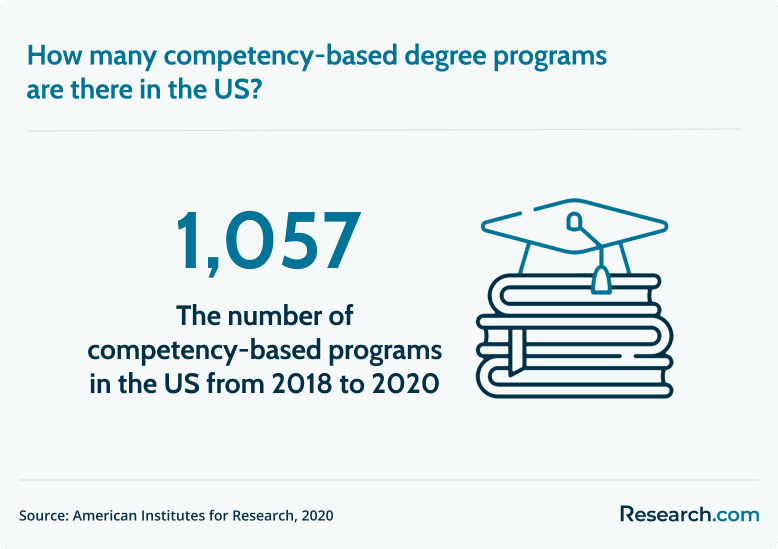
- Between 2018 and 2020, 128 schools, colleges, and universities reported having at least one competency-based program, and the U.S. had 1,057 competency-based programs during that period (American Institutes for Research, 2020).
- Many programs use real-world assessments to help students show job-relevant skills.
- Accreditation remains one of the most important quality checks. Relevant organizations may include the Distance Education Accrediting Commission (DEAC), the Council for Higher Education Accreditation (CHEA), the Accrediting Commission for Community and Junior Colleges (ACCJC), the Higher Learning Commission (HLC), and the Southern Association of Colleges and Schools Commission on Colleges (SACSCOC).
How do competency-based degrees differ from traditional degrees?
Traditional degree programs usually organize progress around semesters, credit hours, scheduled classes, and course completion. Competency-based programs organize progress around learning outcomes and assessments. Students move forward when they can prove mastery of the required competencies.
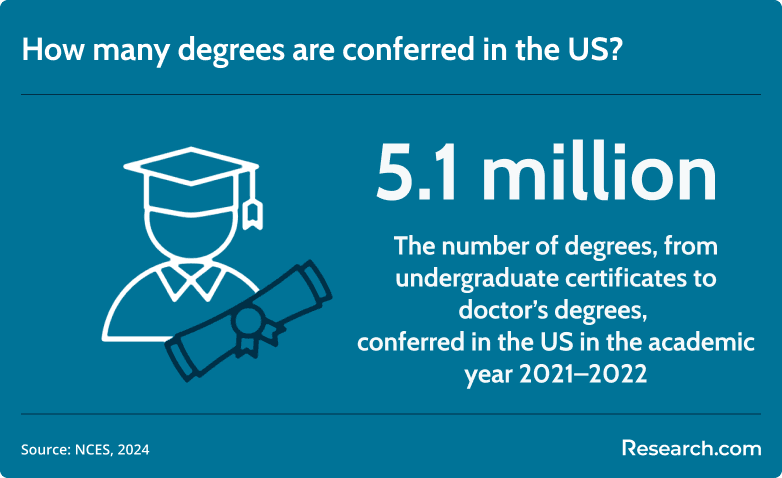
The distinction matters because U.S. higher education includes many degree formats. In the academic year 2021–2022, postsecondary institutions awarded 5.1 million degrees, ranging from undergraduate certificates to doctor’s degrees [National Center for Education Statistics (NCES), 2024]. Competency-based programs are one option within that broader system.
| Factor | Competency-based degree | Traditional degree |
| Pace | Students may move ahead after proving mastery. | Students usually follow a fixed academic calendar. |
| Assessment | Progress is often measured through projects, performance tasks, papers, portfolios, or exams tied to competencies. | Progress is commonly measured through exams, assignments, participation, and course grades. |
| Best learner fit | Independent students with strong time management and relevant prior experience. | Students who prefer live instruction, scheduled meetings, peer interaction, and structured deadlines. |
| Cost structure | May use term-based tuition, allowing faster students to complete more work in one payment period. | Often charges by credit or semester, with costs tied more closely to enrollment load and duration. |
| Flexibility | Often designed for online adult learners and working students. Competency-based education is often designed for working adults. | May require scheduled classes, synchronous sessions, campus attendance, or term-based course progression. |
What are the key skills and knowledge gained from competency-based education?
Competency-based education is intended to make learning outcomes explicit. Instead of finishing a course only because the term ended, students must show that they can apply the required knowledge or skill. The exact competencies depend on the major, but several skill areas commonly appear across programs.
- Applied problem-solving: Students often complete assignments that require analysis, recommendations, designs, plans, or decisions based on realistic scenarios.
- Self-management: Because many programs are self-paced, students practice planning, scheduling, persistence, and accountability.
- Workplace communication: Written reports, presentations, team projects, and professional documentation may be used to demonstrate communication skills.
- Job-relevant technical knowledge: Programs frequently align outcomes with industry expectations, especially in business, technology, healthcare, and education.
- Mastery before advancement: Students generally need to meet defined performance standards before moving to the next competency.
Students who want a shorter pathway may also compare CBE with fast track degrees. Both models can reduce time to completion, but they are not identical: accelerated programs usually compress the calendar, while competency-based programs let students advance based on demonstrated mastery.
What fields of study are available through competency-based degree programs?
Competency-based education is most common in fields where skills can be clearly defined, assessed, and connected to workplace expectations. Availability varies by institution, degree level, and state requirements.
| Field | Common competencies | Important caution |
| Business Administration | Management, finance, marketing, operations, strategy, leadership | Compare concentrations carefully; a general business degree may not replace specialized credentials. |
| Healthcare | Healthcare operations, ethics, policy, patient systems, compliance | Clinical and licensed roles may require specific approvals, supervised hours, or exams. |
| Education | Instructional planning, curriculum design, assessment, classroom strategies | Teacher licensure requirements vary by state and program type. |
| Criminal Justice | Law enforcement systems, courts, corrections, public safety, policy | Some roles require academy training, background checks, or agency-specific requirements. |
| Technology | Programming, cybersecurity, systems, databases, analytics, IT project work | Employers may expect a portfolio, certifications, or demonstrated technical projects in addition to the degree. |
Healthcare and mental health pathways require extra attention because degree choice may affect licensure eligibility. Students interested in counseling can compare the cheapest masters in counseling programs and online psychology masters degrees. Students considering education pathways can review cheap education degrees online, including online degree for elementary education options, or explore the best higher education administration programs for administrative careers.
Competency-based programs may also appeal to service members and veterans comparing online colleges for military learners because the format can align with prior training, discipline, and flexible scheduling needs. Students exploring veterinary careers should not assume that every science-related degree is the right prerequisite path; if you are asking what degree does a vet need, review veterinary school prerequisites before choosing any online or competency-based program.
The chart below shows the 2023 median annual wages of selected roles that may be connected to competency-based degree pathways, based on 2024 data from the U.S. BLS. Salary outcomes are not guaranteed and vary by occupation, region, industry, experience, credentials, and employer.
Are competency-based degree programs more affordable than traditional programs?
Competency-based programs can cost less than traditional programs, but only under the right conditions. The biggest savings usually come from completing more competencies in fewer terms, transferring previous credits, avoiding commuting costs, or using employer tuition assistance. Students who move slowly through a term-based program may not save money.
- Speed matters: If tuition is charged by term, faster completion can reduce total cost.
- Flat-rate pricing can help: Some programs let students complete multiple courses or competencies during one tuition period.
- Online delivery may reduce indirect costs: Students may spend less on transportation, relocation, parking, and campus fees.
- Financial aid rules matter: Aid eligibility, satisfactory academic progress, and disbursement timing may work differently in competency-based formats.
If competency-based education is not the right fit, students who already have college credits may want to compare online degree completion programs. A degree-completion pathway can sometimes be more straightforward for students who need a conventional credit-based structure.
The chart below summarizes tuition information from selected U.S. institutions offering competency-based degrees and programs, based on current university data provided in this guide.
How do competency-based programs integrate real-world applications?
Strong competency-based programs use assessments that resemble professional tasks. Instead of only testing recall, they may ask students to analyze a case, build a proposal, create a project plan, evaluate data, develop a lesson, write a policy memo, design a technical solution, or explain a decision to a professional audience.
For example, a business student might prepare a marketing plan, a healthcare administration student might evaluate a compliance scenario, and a technology student might create or troubleshoot a software-related solution. The goal is to connect academic learning with work that employers can recognize and evaluate.
How do competency-based programs measure student progress?
Progress in CBE is measured by whether the student meets defined competency standards. The format varies by school, but the assessment process usually includes several elements.
- Competency maps: Programs define the knowledge, skills, or behaviors students must demonstrate.
- Performance assessments: Students may complete papers, projects, exams, presentations, portfolios, simulations, or practical tasks.
- Rubrics: Evaluators use criteria to determine whether the work meets the required level of mastery.
- Feedback and revision: Many programs allow students to revise work after receiving feedback, which reinforces mastery rather than one-time testing.
- Faculty or mentor support: Although self-paced, reputable programs still provide academic guidance, coaching, and feedback.
Can prior work experience count towards competency-based assessments?
Prior work experience can help students succeed in competency-based assessments, but it does not always translate into automatic credit. In many programs, experience helps because students already understand the concepts being assessed and can complete assignments more efficiently. Some institutions may also have formal prior learning assessment processes, transfer credit policies, or portfolio review options.
For example, someone already working in a mental health support role may be more prepared for graduate-level counseling coursework than a student with no exposure to the field. Students exploring this route can compare competency-based or flexible online graduate programs in counseling, while verifying licensure rules in the state where they intend to practice.
Competency-based education also fits the broader movement toward skills-based hiring. Between 2018 and 2020, 128 schools, colleges, and universities reported having at least one competency-based program, creating 1,057 competency-based programs in the U.S. during that period (American Institutes for Research, 2020).
Can I work full-time while pursuing a competency-based degree?
Yes, many students work full-time while enrolled in competency-based programs. These programs are often online, flexible, and designed for adults who cannot attend classes at set times. However, “self-paced” does not mean “low effort.” Students still need consistent weekly study time, reliable technology, strong organization, and the discipline to submit assessments without frequent reminders.
| If you work full-time | What to plan before enrolling |
| Your schedule may change week to week. | Ask whether assessments are asynchronous or require scheduled meetings. |
| You may have strong workplace experience. | Ask whether prior learning, transfer credits, or certifications can reduce requirements. |
| You may need predictable costs. | Compare term-based tuition with credit-based tuition and estimate your realistic pace. |
| You may need support after business hours. | Ask when faculty, advisors, tutoring, and technical support are available. |
What are the career and salary outcomes for competency-based graduates?
Career outcomes depend on the field, degree level, employer, location, experience, licensure, and whether the student can demonstrate practical skills. Competency-based programs may be especially helpful when assessments produce work samples, portfolios, or measurable competencies that can be discussed in interviews.
Students should not choose a degree based only on broad salary claims. Instead, compare the specific occupation you want, the required credential, the program’s career services, alumni outcomes, and whether additional certification is expected. For example, students seeking a focused healthcare credential may compare an online pharmacy technician course with a broader healthcare administration degree, depending on whether they want a direct technical role or an administrative pathway.
Are competency-based degrees recognized by employers?
Employers are most likely to recognize a competency-based degree when it comes from an accredited institution, matches the job field, and is supported by clear evidence of skills. Many employers care less about the instructional format and more about whether the candidate can perform the work, communicate effectively, and meet credential requirements.
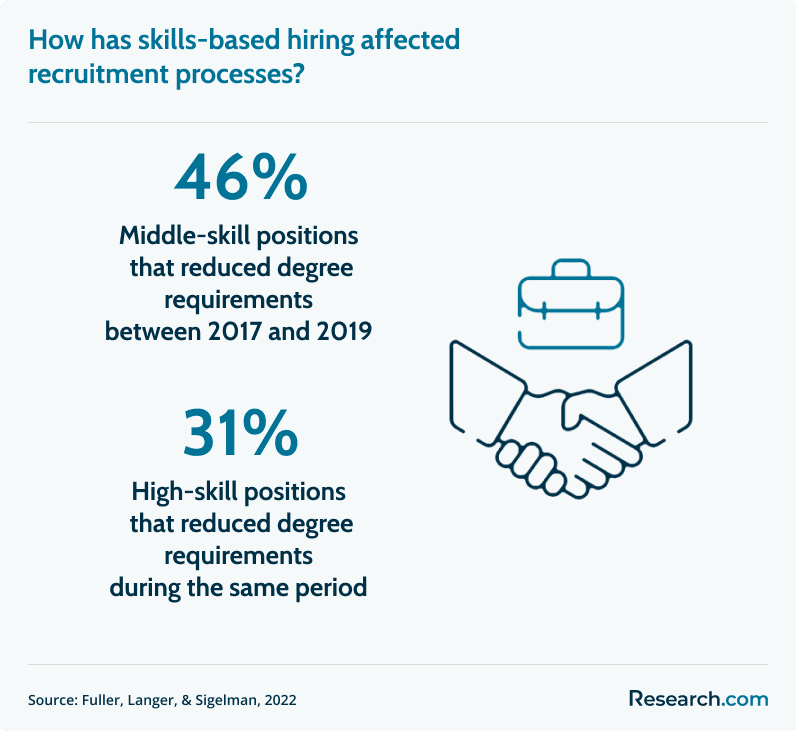
The growth of skills-based hiring supports this shift. Fuller, Langer, and Sigelman (2022) reported that companies reduced degree requirements for middle-skill roles (46%) and high-skill roles (31%) between 2017 and 2019, affecting many IT and management positions. That does not mean degrees no longer matter. It means students should be prepared to show both the credential and the competencies behind it.
Can competency-based education fast-track a master’s degree?
Competency-based education can shorten a master’s degree for students who already have relevant professional knowledge and can complete assessments quickly. This is most realistic in applied fields where work experience aligns closely with graduate competencies, such as business, healthcare administration, information systems, education, nursing, and data-focused programs.
Students comparing accelerated graduate study should also review one year master degree programs. A one-year master’s program may be calendar-accelerated rather than competency-based, so compare workload, admissions standards, tuition model, support, and capstone or practicum requirements.
What does the future hold for competency-based education?
Competency-based education is likely to keep evolving as employers, colleges, and students place more emphasis on demonstrable skills. Several trends are shaping the model: online learning growth, employer demand for evidence of skills, stackable certificates, micro-credentials, digital badges, and more sophisticated assessment tools. Some institutions are also exploring adaptive learning technologies and AI-supported feedback systems, though students should evaluate whether these tools improve learning rather than simply automate instruction.
Students focused on speed can compare competency-based programs with other accelerated pathways, including guides that explain what is the fastest degree to get online. The fastest option is not always the best option; the stronger choice is the one that meets accreditation, career, licensure, and affordability requirements.
Does competency-based education offer a strong return on investment?
CBE can offer a strong return on investment when it reduces time to completion, lowers total tuition, supports career advancement, and leads to a recognized credential. It may offer weaker ROI if a student needs many terms, receives little transfer credit, chooses a degree that does not match the target occupation, or enrolls in a program that does not satisfy licensing or employer expectations.
| ROI question | Why it matters |
| How many terms will I realistically need? | Term-based tuition saves money only if you complete enough work each term. |
| Will my credits or experience reduce requirements? | Transfer credit and prior learning can shorten the path. |
| Does the degree match my target job? | A flexible degree is less valuable if it does not qualify you for the role you want. |
| Will I need certifications or licensure? | Additional requirements affect both cost and timeline. |
| What are realistic salary outcomes? | Use occupation-specific data and local employer expectations, not promotional promises. |
Graduate students should also compare degree type and earnings potential carefully. For some careers, high paying masters degrees may improve marketability, but only when the degree aligns with employer demand and the student’s career path.
Are there affordable doctoral competency-based programs?
Some doctoral programs are experimenting with competency-based or practice-focused structures, but doctoral education requires careful evaluation. Advanced degrees often include research, dissertations, residencies, applied projects, practicums, or professional preparation that may not fit a fully self-paced model.
Before choosing a doctoral competency-based program, verify accreditation, dissertation or capstone expectations, faculty access, residency requirements, total cost, funding options, and whether the degree is accepted in your profession. Students prioritizing cost can compare cheap PhD programs, while remembering that the least expensive program is not always the best professional investment.
Is competency-based learning effective for every academic discipline?
No. Competency-based learning works best when outcomes can be clearly defined and assessed. Applied fields such as business, technology, healthcare administration, education, management, counseling foundations, and criminal justice often fit the model well. Fields requiring extensive lab work, studio critique, supervised clinical practice, original research, or deep theoretical mentoring may need more structured traditional elements.
Students starting with lower-division coursework can explore foundational pathways such as the easiest associates degree options, but should still choose based on transferability, accreditation, and long-term goals rather than perceived difficulty alone.
Can additional certifications complement my competency-based degree?
Yes. Industry certifications can strengthen a competency-based degree when they validate specialized skills employers already recognize. This is especially common in IT, cybersecurity, project management, human resources, accounting, healthcare support, and business analytics. Certifications can also help students show current technical skills while a degree demonstrates broader academic preparation.
The best certification depends on the target role. Students comparing credential options may find it useful to review certifications that pay well and then confirm which credentials appear in job postings for their desired occupation.
Are there specific accrediting bodies for competency-based education?
Competency-based education is not accredited by one single CBE-only accreditor. Instead, programs are usually reviewed through institutional and, when relevant, programmatic accreditation. Accreditation helps confirm that a school meets quality standards and that its degrees are more likely to be accepted by employers, graduate schools, licensing boards, and financial aid systems.
- Distance Education Accrediting Commission (DEAC): DEAC accredits distance education institutions and programs that meet its standards for online and distance learning quality.
- Council for Higher Education Accreditation (CHEA): CHEA recognizes accrediting organizations and provides information students can use to understand accreditation status.
- Accrediting Commission for Community and Junior Colleges (ACCJC): ACCJC accredits community and junior colleges, including institutions that may offer competency-based options.
- Higher Learning Commission (HLC): HLC accredits degree-granting postsecondary institutions in its region and is listed by several institutions in this guide.
- Southern Association of Colleges and Schools Commission on Colleges (SACSCOC): SACSCOC accredits institutions in the southern U.S., including institutions that may offer flexible or competency-based programs.
How do I choose the right competency-based degree program?
The right competency-based program is not simply the fastest or cheapest. It is the program that meets your academic needs, fits your learning style, supports your career goal, and carries recognized accreditation.
- Start with the job you want. Identify the role, required degree, preferred certifications, licensure rules, and common employer expectations.
- Verify accreditation. Check institutional accreditation and any required programmatic accreditation for your field.
- Confirm licensure alignment. For nursing, teaching, counseling, social work, accounting, and healthcare roles, ask whether the program meets state-specific requirements.
- Estimate your real pace. Do not assume you will finish faster just because the program is self-paced. Compare your work schedule, family responsibilities, and study habits.
- Calculate total cost. Include tuition, fees, books, technology, exams, background checks, clinical costs, and extra terms if you slow down.
- Review transfer and prior learning policies. Ask how previous credits, military training, certifications, and work experience are evaluated.
- Evaluate support. Look for faculty access, academic coaching, tutoring, career advising, library services, and technical support.
- Ask about assessment rules. Find out whether assessments can be revised, how grading works, and what happens if you do not complete enough competencies in a term.
- Check graduate school acceptance if needed. If you plan to pursue another degree later, ask whether graduates have successfully moved into relevant graduate programs.
Common mistakes to avoid
| Mistake | Better approach |
| Choosing a program because it sounds fast | Ask how long students with your background typically take to finish. |
| Looking only at tuition | Estimate total cost, including fees, books, extra terms, and required exams. |
| Ignoring accreditation | Verify accreditation before applying or using financial aid. |
| Assuming online means licensure-ready | Confirm state board, clinical, practicum, and exam requirements. |
| Relying only on rankings or ads | Compare curriculum, support, outcomes, transfer policy, and employer relevance. |
| Underestimating self-paced workload | Create a weekly study plan before enrolling. |
How do competency-based programs compare to traditional bachelor degrees?
At the bachelor’s level, competency-based programs can be attractive to students who want flexibility, already have credits, or have work experience related to the major. Traditional bachelor’s degrees may be better for students who want a more structured academic schedule, campus life, live discussions, labs, or close faculty interaction throughout the term.
Students sometimes compare CBE with easy bachelor degrees, but the better question is not which degree is easiest. The better question is which degree you can complete successfully, affordably, and credibly while meeting your career goals.
- Choose CBE if: you are organized, independent, experienced in the field, and motivated to move quickly through material you already understand.
- Choose a traditional bachelor’s if: you need structure, regular deadlines, live instruction, hands-on labs, campus resources, or a program with strict licensure sequencing.
- Compare both if: you have transfer credits but are unsure whether a self-paced model fits your learning habits.
What are the dual graduate degree options in competency-based education?
Dual graduate degrees allow students to study two related disciplines in one coordinated pathway. Competency-based dual options may appeal to professionals who want broader preparation and can manage a heavier workload. However, dual degrees can also increase cost, complexity, and time if the programs are not well aligned.
- MBA + Master of Healthcare Administration: This pairing combines general business leadership with healthcare systems, policy, operations, and administration.
- Master of Education + Master of Technology Management: This combination may fit educators interested in digital learning, instructional innovation, or academic technology leadership.
- MS in Data Analytics + MBA: This pathway blends analytics, data-informed decision-making, and business strategy.
Before choosing a dual graduate pathway, confirm accreditation, total credits, tuition model, sequencing, transfer rules, career value, and whether both degrees are necessary for your goal. Students comparing interdisciplinary graduate options can review dual graduate degree programs.
Can I get financial aid for competency-based education?
Many competency-based programs may be eligible for federal aid, state grants, scholarships, employer tuition assistance, military education benefits, and institutional aid, but eligibility depends on the school, program structure, enrollment status, and financial aid rules. Students should speak with the financial aid office before enrolling and ask how aid is disbursed in a self-paced or term-based model.
Students comparing flexible formats may also want to review self paced online college options. Before using loans, ask the school for a written cost estimate based on your expected pace, transfer credits, and number of terms.
Questions to ask before enrolling
- Is the institution regionally or nationally accredited by a recognized accreditor?
- Does the program meet licensure or certification requirements in my state?
- How is tuition charged: per credit, per course, per term, or another model?
- What happens financially if I complete fewer competencies than expected in a term?
- How many credits or competencies will transfer from my previous college work?
- Can certifications, military training, or work experience reduce my requirements?
- What support is available if I get stuck?
- Are assessments exams, papers, projects, portfolios, simulations, or a mix?
- What career services are available to online or competency-based students?
- Will graduate schools or licensing boards accept this degree for my next step?
Key Insights
- Competency-based degrees reward demonstrated mastery, making them strongest for experienced, self-directed students.
- The format can reduce time and cost, but only if you complete competencies quickly enough and understand the tuition model.
- Accreditation and licensure alignment are non-negotiable, especially in nursing, counseling, teaching, accounting, and social work.
- Employers are more likely to value a CBE degree when it comes from an accredited institution and is supported by clear, job-relevant skills.
- Do not choose a program based only on speed. Compare outcomes, support, transfer credit, financial aid, assessment design, and career fit.
- Certifications, portfolios, and work samples can make a competency-based degree more useful in fields where employers expect proof of applied skills.
References
- American Institutes for Research. (2020). State of the Field: Findings from the 2020 National Survey of Postsecondary Competency-based Education. https://www.air.org/sites/default/files/2021-07/State-of-the-Field-Findings-from-2020-Postsecondary-CBE-Survey-July-2021.pdf
- Fuller, J., Langer, C., & Sigelman, M. (2022, February 11). Skills-Based Hiring Is on the Rise. Harvard Business Review. https://hbr.org/2022/02/skills-based-hiring-is-on-the-rise
- National Center for Education Statistics. (2024, May). Postsecondary Certificates and Degrees Conferred. https://nces.ed.gov/programs/coe/indicator/cts
- US Bureau of Labor Statistics. (2024, April 17). Instructional Coordinators. Occupational Outlook Handbook. https://bls.gov/ooh/education-training-and-library/instructional-coordinators.htm
- US Bureau of Labor Statistics. (2024, April 17). Medical and Health Services Managers. Occupational Outlook Handbook. https://www.bls.gov/ooh/management/medical-and-health-services-managers.htm
- US Bureau of Labor Statistics. (2024, April 3). Occupational Employment and Wages, May 2023, 13-1082 Project Management Specialists. Occupational Employment and Wage Statistics. https://www.bls.gov/oes/current/oes131082.htm
- US Bureau of Labor Statistics. (2024, April 3). Occupational Employment and Wages, May 2023, 13-1161 Market Research Analysts and Marketing Specialists. Occupational Employment and Wage Statistics. https://www.bls.gov/oes/current/oes131161.htm
- US Bureau of Labor Statistics. (2024, April 3). Occupational Employment and Wages, May 2023, 15-1252 Software Developers. Occupational Employment and Wage Statistics. https://www.bls.gov/oes/current/oes151252.htm
Other Things You Should Know About The Best Word Cloud Generator Tools for School and Work
Prior learning assessment can count if the school accepts it and a faculty evaluator verifies mastery. Common evidence includes military training, industry certifications, employer records, portfolios, and standardized exams such as CLEP or DSST. Many programs cap transfer and prior-learning credit at 75 percent of the degree.
Competency-based programs in 2027 use various assessment methods, including portfolio reviews, real-world project evaluations, and skill demonstration exams. These methods evaluate a student's ability to apply knowledge practically, aligning with industry standards and ensuring proficiency in specific competencies.


