
2027 Best Higher Education Administration Programs

Co-Founder and Chief Data Scientist
Choosing a higher education administration program is a career decision as much as an academic one. The right degree can help you move into leadership roles in admissions, student affairs, academic affairs, institutional research, advancement, policy, or executive administration. The wrong fit can leave you with debt, limited networking value, or training that does not match the roles you want.
This guide is for working professionals, educators, student affairs staff, policy analysts, and career changers comparing higher education administration programs for 2027. You will learn what these programs teach, how online and campus formats differ, how long they take, what they cost, which specializations matter, and how to evaluate whether the degree is financially and professionally worth it.
Quick Answer: Is a Higher Education Administration Program Worth Considering?
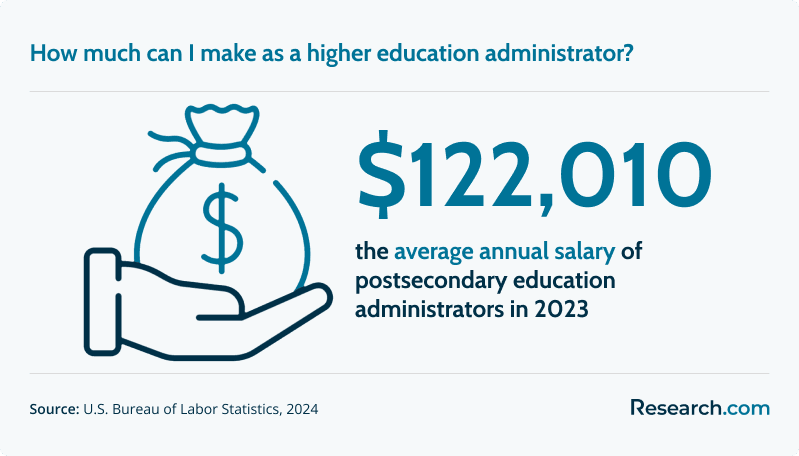
A higher education administration degree can be a strong option if you want to lead people, programs, budgets, student services, enrollment strategy, or institutional policy within colleges and universities. According to cited Bureau of Labor Statistics data, postsecondary education administrators earned an average annual salary of $122,010, though pay varies by role, institution type, location, and experience.
The degree is most useful for professionals who already have education, student support, operations, nonprofit, policy, or administrative experience and want to move into more strategic roles. It may be less useful if you are seeking classroom teaching licensure, a purely corporate management career, or a low-cost credential with an immediate guaranteed salary increase.
What are the benefits of getting a degree from the best education administration programs?
- A graduate degree in higher education administration can prepare you for leadership positions across colleges, universities, community colleges, policy organizations, and student services offices.
- The field offers meaningful work for professionals who want to improve student outcomes, campus operations, access, equity, and institutional strategy.
- Salary potential can be competitive. The cited average annual salary for postsecondary education administrators is $122,010, but individual outcomes depend on job title, institution, geography, and experience.
- Online higher education administration programs can make graduate study more manageable for working adults who cannot pause their careers or relocate.
What can I expect from the best higher education administration programs for 2027?
The best higher education administration programs for 2027 should prepare you to understand how colleges and universities actually operate. Expect coursework in student success, enrollment management, finance, budgeting, governance, law, institutional policy, diversity and inclusion, research methods, assessment, and organizational leadership.
Strong programs do more than teach theory. They help students interpret institutional data, communicate with faculty and staff, manage competing priorities, understand compliance obligations, and make decisions under budget pressure. Many programs also include internships, assistantships, capstone projects, research experiences, or applied projects that allow students to connect coursework to real administrative problems.
What skills should a strong program help you build?
| Skill area | Why it matters in higher education administration |
| Budget and resource management | Administrators often make or support decisions about staffing, programs, tuition, grants, facilities, and student services. |
| Student success strategy | Leaders need to understand retention, advising, belonging, engagement, and barriers that affect completion. |
| Policy and compliance | Colleges operate within complex federal, state, accreditation, and institutional rules. |
| Data-informed decision-making | Enrollment trends, program outcomes, student demographics, and financial data increasingly shape administrative choices. |
| Communication and collaboration | Higher education leaders work across faculty governance, student services, executive leadership, boards, and external partners. |
Where can I work with a degree from the best higher education administration programs?
Graduates can work in public universities, private colleges, community colleges, technical and trade schools, professional schools, government agencies, nonprofits, and organizations that support higher education. Common areas include admissions, financial aid, student affairs, registrar operations, academic affairs, institutional research, advancement, residence life, advising, compliance, international programs, and policy analysis.
The cited data notes that job growth is slightly higher than the average of all occupations, which is 3%. That does not mean every graduate will secure a leadership role immediately, but it does suggest that institutions continue to need professionals who can manage student services, enrollment, records, programs, budgets, and institutional change.
How much can I make with a degree from the best higher education administration programs?
The cited average salary for postsecondary education administrators is $122,010. Pay can be lower or higher depending on your seniority, department, institution type, region, and whether the role is entry-level, mid-level, or executive. Some leadership roles in hospitals or universities may offer higher salary ranges, while smaller institutions or early-career roles may pay less.
Use salary data as one part of your decision, not as a promise. A degree can improve your qualifications, but salary growth also depends on experience, institutional budgets, internal promotion pathways, and your professional network.
- Best higher education administration programs for 2027
- How long does it take to finish a higher education administration program?
- Online vs. on-campus higher education administration programs
- Average cost of higher education administration programs
- Financial aid options for higher education administration students
- Admissions requirements and prerequisites
- Common courses in higher education administration programs
- Specializations in higher education administration
- How this degree complements other education careers
- How to choose the right program
- Trends and challenges affecting higher education administrators
- Career paths for graduates
- Why accreditation matters for career outcomes
- Job market outlook for graduates
- Global opportunities in higher education administration
- Advanced degree opportunities
- Accelerated advanced degree options
- Using interdisciplinary expertise for strategic leadership
- Financial return on investment
- Mentorship and alumni networks
- Early childhood development insights and higher education leadership
- Professional certifications for higher education administrators
15 Best Higher Education Administration Programs for 2027
How do we rank schools?
This list of higher education administration programs for 2027 is based on research and data review using Research.com's methodology. Program and institutional information were evaluated with sources such as the National Center for Education Statistics' IPEDS database, Peterson's database and its Distance Learning Licensed Data Set, and the College Scorecard for cost and outcomes context.
Rankings are a starting point, not a final answer. Before applying, compare each program's curriculum, format, total cost, accreditation, assistantship options, alumni network, internship access, and fit with your intended career path.
Program comparison at a glance
| Rank | Institution and program | Length | Credits or units | Listed cost | Accreditation |
| 1 | Michigan State University — Online Master's in Higher, Adult, and Lifelong Education | ~2 to 3 years | 30 credits | $933 per credit | Higher Learning Commission (HLC) |
| 2 | Harvard University — ME in Higher Education | 1 to 2 years | 42 credits | $1,431 per credit | New England Commission of Higher Education (NECHE) |
| 3 | Stanford University — Social Sciences, Humanities, and Interdisciplinary Policy Studies in Education | 3 years | 135 units | $12,720 per 8 to 10 units | Western Association of Schools and Colleges Senior College and University Commission (WSCUC) |
| 4 | University of Pennsylvania — MSEd in Higher Education | 1 year | 10 course units | $55,000 estimated tuition | Middle States Commission on Higher Education (MSCHE) |
| 5 | Columbia University — Higher and Postsecondary Education Program | 1 to 4 years | 32 course units | $1,970 per credit | Middle States Commission on Higher Education (MSCHE) |
| 6 | University of Michigan Ann Arbor — MA in Higher Education | 1 to 2 years | 30 credits | $1,694 in-state; $3,256 out-of-state per credit | Higher Learning Commission (HLC) |
| 7 | Pennsylvania State University — MEd in Higher Education | 2 years | 36 credits | $1,061 per credit | Middle States Commission on Higher Education (MSCHE) |
| 8 | University of California, Los Angeles — MA in Higher Education and Organizational Change | ~2 years (7 quarters) | 36 units | $12,264 annual tuition | WASC Senior College and University Commission (WSCUC) |
| 9 | Vanderbilt University — Higher Education Administration (MEd) | 2 years | 36 units | $2,245 per credit | Southern Association of Colleges and Schools Commission on Colleges (SACSCOC) |
| 10 | University of Georgia — Master of Education in Higher Education Administration | 2 years | 33 units | $417 in-state; $1,082 out-of-state per credit | Southern Association of Colleges and Schools Commission on Colleges (SACSCOC) |
| 11 | University of Southern California — MEd in Postsecondary Administration and Student Affairs | 1 to 2 years | 30 units | $2,354 per credit | WASC Senior College and University Commission (WSCUC) |
| 12 | Indiana University Bloomington — MSEd in Higher Education and Student Affairs | 1 to 2 years | 41 units | $469.20 per credit | Higher Learning Commission (HLC) |
| 13 | Ohio State University — MA in Educational Studies, Higher Education and Student Affairs | 1 to 2 years | 36 non-thesis; 39 thesis units | $782.19 in-state; $1,733.13 out-of-state per credit | Higher Learning Commission (HLC) |
| 14 | University of Maryland, College Park — MA in Higher Education, Student Affairs, and International Education Policy | ~2 years | 36 units | $828 in-state; $1,805 out-of-state per credit | Middle States Commission on Higher Education (MSCHE) |
| 15 | New York University — EdD in Higher Education Administration | 3 years | 42 units | $2,185 per credit | Middle States Commission on Higher Education (MSCHE) |
1. Michigan State University - Online Master's in Higher, Adult, and Lifelong Education
Michigan State University's online Master's in Higher, Adult, and Lifelong Education is built for professionals working across higher education, adult education, and lifelong learning environments. The 30-credit curriculum covers organizational leadership, curriculum development, finance and budgeting, and program evaluation, making it a flexible option for students who want administrative advancement without leaving the workforce.
- Program length: ~2 to 3 years
- Required Credits to Graduate: 30
- Cost per Credit: $933
- Accreditation: Higher Learning Commission (HLC)
2. Harvard University - ME in Higher Education
Harvard University's Master's in Education with a Higher Education concentration is designed for students preparing for leadership, policy, research, administrative, or direct-service roles in postsecondary education. The program draws on the Harvard Graduate School of Education's faculty and research base and can support career goals in universities, government agencies, nonprofits, student transition organizations, and education-related businesses.
- Program length: 1 to 2 years
- Required Credits to Graduate: 42
- Cost per Credit: $1,431
- Accreditation: New England Commission of Higher Education (NECHE)
3. Stanford University - Social Sciences, Humanities, and Interdisciplinary Policy Studies in Education (SHIPS)
Stanford University's SHIPS doctoral pathway includes a higher education focus for students preparing for research-heavy careers as faculty members, policy analysts, researchers, or senior administrators. The program emphasizes social science theory, rigorous research methods, close mentoring, small classes, and advanced scholarly preparation. Students commonly pursue full-time study and may include a related minor or concurrent master's degree.
- Program length: 3 years
- Required Units to Graduate: 135
- Tuition Cost: $12,720 (per 8 to 10 units)
- Accreditation: Western Association of Schools and Colleges Senior College and University Commission (WSCUC)
4. University of Pennsylvania - MSEd in Higher Education
The University of Pennsylvania's master's program examines higher education through administrative, equity, policy, student development, financial, and global lenses. Students study how institutions are shaped by federal, state, and international forces while also learning about access, management, pedagogy, and organizational strategy.
- Program length: 1 year
- Required Course Units to Graduate: 10
- Estimated Tuition: $55,000
- Accreditation: Middle States Commission on Higher Education (MSCHE)
5. Columbia University - Higher and Postsecondary Education Program
Columbia University's higher and postsecondary education program prepares practitioners and scholars to analyze, design, and improve the systems that shape colleges and universities. The curriculum addresses institutional structures, policy, technology, civic engagement, social context, and the relationship between campuses and the communities around them.
- Program length: 1 to 4 years
- Required Course Units to Graduate: 32
- Cost per Credit: $1,970
- Accreditation: Middle States Commission on Higher Education (MSCHE)
6. University of Michigan Ann Arbor - MA in Higher Education
The University of Michigan Ann Arbor's MA in Higher Education provides broad preparation in postsecondary education while allowing students to shape their studies around specific interests. Students learn alongside a diverse group that may include doctoral students, creating opportunities to engage with multiple perspectives on institutional leadership and decision-making.
- Program length: 1 to 2 years
- Required Credits to Graduate: 30
- Cost per Credit: $1,694 (in-state); $3,256 (out-of-state)
- Accreditation: Higher Learning Commission (HLC)
7. Pennsylvania State University - MEd in Higher Education
Pennsylvania State University's MEd in Higher Education offers tracks that let students focus on areas such as student affairs, enrollment management, or institutional research. This structure is useful for students who want a broad foundation in higher education while developing skills for a specific administrative function.
- Program length: 2 years
- Required Credits to Graduate: 36
- Cost per Credit: $1,061
- Accreditation: Middle States Commission on Higher Education (MSCHE)
8. University of California, Los Angeles - MA in Higher Education and Organizational Change
UCLA's MA in Higher Education and Organizational Change prepares students to understand higher education through historical, political, social, and philosophical perspectives. It is relevant for students interested in research, teaching, student affairs, academic affairs, administration, college leadership, or policy roles in research institutes.
- Program length: ~2 years (7 quarters)
- Required Units to Graduate: 36
- Tuition (Annual): $12,264
- Accreditation: WASC Senior College and University Commission (WSCUC)
9. Vanderbilt University - Higher Education Administration (MEd)
Vanderbilt University's MEd in Higher Education Administration combines theory and applied preparation for students interested in areas such as student affairs, enrollment, policy, and institutional leadership. The program emphasizes strategic decision-making and often connects students with higher education organizations through applied learning opportunities.
- Program length: 2 years
- Required Units to Graduate: 36
- Cost per Credit: $2,245
- Accreditation: Southern Association of Colleges and Schools Commission on Colleges (SACSCOC)
10. University of Georgia - Master of Education in Higher Education Administration
The University of Georgia's MEd in Higher Education Administration prepares students for administrative and research-oriented roles in colleges, policy organizations, government, and nonprofit settings. The program includes a broad foundation, specialization opportunities, a recommended internship, and a capstone project that helps students demonstrate applied competence.
- Program length: 2 years
- Required Units to Graduate: 33
- Cost per Credit: $417 (in-state); $1,082 (out-of-state)
- Accreditation: Southern Association of Colleges and Schools Commission on Colleges (SACSCOC)
11. University of Southern California - MEd in Postsecondary Administration and Student Affairs
USC's MEd in Postsecondary Administration and Student Affairs prepares students for leadership in student affairs and related postsecondary roles. The curriculum includes student development, legal issues, diversity and inclusion, and higher education history. Students also choose three focus courses to align the program with their interests, with a strong emphasis on educational equity for underserved student populations.
- Program length: 1 to 2 years
- Required Units to Graduate: 30
- Cost per Credit: $2,354
- Accreditation: WASC Senior College and University Commission (WSCUC)
12. Indiana University Bloomington - MSEd in Higher Education and Student Affairs
Indiana University Bloomington's MSEd in Higher Education and Student Affairs blends academic study with required graduate assistantships. Students learn from faculty and practitioners while applying theory to real campus work, making it especially relevant for those targeting student affairs and related administrative roles.
- Program length: 1 to 2 years
- Required Units to Graduate: 41
- Cost per Credit: $469.20
- Accreditation: Higher Learning Commission (HLC)
13. Ohio State University - MA in Educational Studies, Higher Education and Student Affairs
Ohio State University's MA in Higher Education and Student Affairs focuses on student-centered leadership, organizational dynamics, leadership education, and student development theory. The program incorporates a social justice perspective and is a fit for students who want to support more inclusive campus environments.
- Program length: 1 to 2 years
- Required Units to Graduate: 36 (non-thesis); 39 (thesis)
- Cost per Credit: $782.19 (in-state); $1,733.13 (out-of-state)
- Accreditation: Higher Learning Commission (HLC)
14. University of Maryland College Park - MA in Higher Education, Student Affairs, & International Education Policy
The University of Maryland, College Park's MA in Higher Education, Student Affairs, and International Education Policy gives students a broad view of education systems, including university operations, K-18 policy, non-formal education, organizational processes, diversity, social justice, and systemic change. Students can select from Higher Education, International Education Policy, and Student Affairs concentrations while using electives to customize their path.
- Program length: ~2 years
- Required Units to Graduate: 36
- Cost per Credit: $828 (in-state); $1,805 (out-of-state)
- Accreditation: Middle States Commission on Higher Education (MSCHE)
15. New York University - EdD in Higher Education Administration
NYU's EdD in Higher Education Administration is a practice-focused doctoral program for working professionals who want terminal-degree preparation for leadership in community colleges, four-year institutions, corporate education, and government agencies. The curriculum combines leadership, organizations, policy, research, skill development, and applied problem-solving, ending with a project connected to the student's professional environment.
- Program length: 3 years
- Required Units to Graduate: 42
- Cost per Credit: $2,185
- Accreditation: Middle States Commission on Higher Education (MSCHE)
What Graduates Often Value in Higher Education Administration Programs
- The online structure made it possible for me to keep my full-time role while studying. The workload was demanding, but every course pushed me to think more strategically about campus culture, equity, and institutional change. I now use that training as the director of a university center for diversity and inclusion. -Omar
- I was unsure whether an online program would keep me engaged, but the discussions, course materials, and faculty support made the experience more interactive than I expected. The degree helped me move from teaching into academic affairs leadership. -Mabel
- As a working parent, I needed flexibility. Asynchronous coursework, strong digital resources, and peer connections made the program manageable. The degree helped me shift toward higher education policy analysis. -July
Key Findings
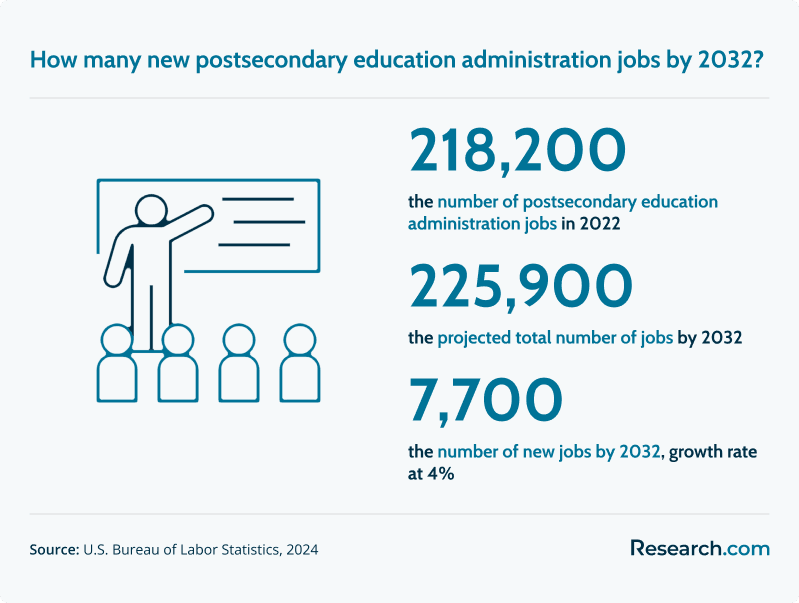
- The cited job market data projects 4% growth for postsecondary education administrators from 2022 to 2032, compared with 3% overall job growth and 5% for other management occupations. The same finding states that this equals an estimated 7,700 new jobs by 2032.
- Postsecondary education administrators earned an average annual salary of $122,010 as of 2023. The cited industry figures range from $95,200 in technical and trade schools to $175,030 in general medical and surgical hospitals.
- Many higher education administration programs are available online, which can help working professionals continue earning income while completing graduate coursework.
- The cited degree-conferral projection indicates that the number of higher education degrees earned is expected to rise by over 9,920 degrees from the 2021-2022 school year to the 2032-2034 school year, suggesting continued administrative needs across institutions.
- Graduates are not limited to four-year colleges. They may also find opportunities in junior colleges, technical and trade schools, state governments, hospitals, and organizations connected to postsecondary education.
How long does it take to complete the best higher education administration programs for 2027?
Most master's programs in higher education administration take one to two years of full-time study. Part-time students may take longer, especially if they are balancing work, family responsibilities, assistantships, or field placements. Doctoral programs generally require a longer commitment, often four to five years, though some listed programs use shorter or more structured formats.
Accelerated options may reduce time to completion, but they usually require a heavier course load. Working professionals should compare not only the calendar length, but also weekly workload, synchronous meeting requirements, internship expectations, and whether courses are offered year-round.
| Program type | Typical student profile | Time commitment noted in this guide | Best for |
| Master's degree | Early- to mid-career professionals | Often one to two years full-time | Student affairs, admissions, advising, registrar, policy, or academic administration roles |
| Online master's degree | Working adults and career changers | Varies by full-time or part-time enrollment | Students who need schedule flexibility |
| Doctoral degree | Experienced professionals or aspiring researchers | Typically longer than a master's; doctoral programs often require four to five years | Senior leadership, research, policy, or academic careers |
| Accelerated advanced degree | Experienced professionals with clear goals | Condensed formats may be available | Students who can handle an intensive pace |
How do online education administration programs compare to an on-campus program?
Online and campus-based programs can both be worthwhile, but they serve different students. Online programs are often better for professionals who need flexibility, live far from a preferred institution, or want to continue working while enrolled. Campus programs may be better for students who want in-person networking, assistantship access, close faculty interaction, and a traditional graduate school environment.
| Factor | Online program | On-campus program |
| Schedule flexibility | Usually stronger, especially with asynchronous coursework | Less flexible because classes and events occur at set times |
| Networking | Can be strong if the program intentionally supports online community-building | Often easier through campus jobs, assistantships, events, and informal interaction |
| Best fit | Working professionals, parents, remote students, and career changers | Students who can relocate or attend in person regularly |
| Learning style | Requires self-direction, time management, and comfort with digital tools | Offers face-to-face discussion, campus immersion, and immediate classroom interaction |
| Career support | Varies widely; ask about virtual career coaching and alumni access | May offer easier access to campus-based internships and assistantships |
What is the average cost of the best higher education administration programs?
Program costs vary by institution, residency status, degree level, format, and required credits. The cited averages show in-state students paying around $3,270 per credit hour and about $54,848 in total tuition for a master's program. Out-of-state students face an average of $3,474 per credit hour and about $67,088 in total tuition.
These averages hide a wide range. Some programs may cost as little as $13,761 for in-state students, while out-of-state costs can reach $171,720. Higher education administration programs also tend to cost more than the cheapest teaching degree options, so applicants should compare total program cost rather than tuition alone.
When evaluating affordability, include fees, books, technology costs, travel, residency requirements, internship expenses, and lost income if you reduce work hours. Some students comparing graduate leadership pathways may also review options such as the best online MBA under 15k, especially if they want a broader management credential.
What are the financial aid options for students enrolling in the best higher education administration programs?
Graduate education can be expensive, but students may reduce costs through a combination of federal aid, institutional funding, employer support, scholarships, and paid campus roles. Start by asking each program for a full cost-of-attendance estimate and a list of aid opportunities available specifically to graduate education students.
- Federal Stafford Loans. Graduate students may use unsubsidized loans, though interest accrues while enrolled. Repayment options vary.
- PLUS Loans. Graduate PLUS Loans may help cover remaining cost of attendance after other aid is applied, including for some affordable online master's programs.
- TEACH Grant. This may be relevant only if the program prepares you for qualifying teaching roles and you meet service obligations.
- Scholarships. Check university financial aid offices, professional associations, diversity-focused scholarships, and department-level awards for higher education administration students.
- Work-Study. Federal Work-Study is less common at the graduate level, but some institutions may offer part-time work opportunities. Students comparing professional graduate formats may also look at funding strategies used in an affordable executive MBA program.
- Employer Assistance. If you already work at a college or university, ask about tuition remission, reimbursement, release time, or internal professional development funds.
- Assistantships. Graduate assistantships can be especially valuable because they may combine tuition support, income, and relevant work experience.
What are the prerequisites for enrolling in the best higher education administration programs?
Admissions requirements vary, but most programs look for evidence that you can succeed in graduate study and contribute meaningfully to the field. Competitive applicants often show a clear connection between their prior experience, career goals, and the program's strengths.
- Academic Background. A bachelor's degree is typically required. Education, business, public policy, psychology, sociology, or related experience can be helpful but is not always mandatory.
- Strong GPA. Many programs list a minimum GPA, often between 3.0 and 3.5. More selective programs may expect stronger academic records.
- Standardized Tests. Some programs may require the GRE or GMAT, while others waive testing. If you want test-flexible graduate options, you may also compare policies with online MBA no GMAT programs.
- Relevant Experience. Work in higher education, student services, teaching, nonprofit administration, advising, residence life, admissions, or operations can strengthen your application.
- Statement of Purpose. A focused essay should explain why you want the degree, what roles you are targeting, and why the specific program fits your goals.
- Letters of Recommendation. Strong letters from supervisors, faculty, or mentors can show leadership potential, writing ability, professionalism, and readiness for graduate study.
- Resume or CV. Your resume should highlight administrative responsibilities, student-facing work, leadership, data skills, policy exposure, or project management experience.
What courses are typically in the best higher education administration programs?
Higher education administration programs usually combine leadership training, policy analysis, finance, student development, and institutional operations. Some topics overlap with business-oriented programs, including areas students might also see in a 1 year DBA program online.
- Higher Education Finance and Budgeting. Students learn how institutions allocate resources, set tuition, manage revenue streams, and make budget decisions.
- Higher Education Law and Policy. Coursework may address student rights, faculty governance, compliance, tenure, federal regulations, and institutional risk.
- Curriculum Development and Assessment. Students examine program design, learning outcomes, academic assessment, and continuous improvement.
- Leadership and Governance in Higher Education. This area covers organizational leadership, strategic planning, board relationships, shared governance, and institutional decision-making.
- Diversity, Equity, and Inclusion in Higher Education. Students explore strategies for improving campus climate, reducing barriers, addressing bias, and supporting diverse learners.
These courses support work across many institutional settings. Cited data reports that higher education administrators in the US earned an average annual salary of $122,010 in 2023, compared with $110,680 per year for graduates associated with the best 1-year master's in healthcare administration.
What types of specializations are available in the best higher education administration programs?
Specializations help you align your degree with the jobs you want. A general higher education administration degree can be useful, but a concentration can make your coursework, internships, assistantships, and capstone more targeted.
| Specialization | Best for students interested in | Potential roles |
| Student Affairs Administration | Student support, campus life, belonging, housing, conduct, and cocurricular learning | Student affairs director, residence life leader, student support manager |
| Enrollment Management | Admissions, financial aid, recruitment, retention, and marketing strategy | Admissions director, enrollment analyst, financial aid administrator |
| Curriculum and Instruction | Academic program design, assessment, and instructional improvement | Academic affairs coordinator, curriculum specialist, program director |
| Higher Education Policy and Advocacy | Government relations, accreditation, compliance, regulation, and institutional policy | Policy analyst, compliance officer, government relations specialist |
| Community College Leadership | Open access, workforce education, transfer pathways, and regional partnerships | Community college administrator, workforce program leader, academic dean |
- Student Affairs Administration. This path prepares students for leadership in departments that support student life, wellness, engagement, housing, conduct, and cocurricular development.
- Enrollment Management. This concentration focuses on admissions, financial aid, recruitment strategy, student yield, and enrollment planning.
- Curriculum and Instruction. This option emphasizes program design, assessment, academic quality, and instructional leadership, including skills relevant to developing programs such as affordable online project management degree offerings.
- Higher Education Policy and Advocacy. Students study the rules, regulations, and policy decisions that shape institutions and student access.
- Community College Leadership. This specialization focuses on the mission, financing, workforce role, transfer function, and student demographics of community colleges.
Specialization also affects where you may be most competitive. The cited 2023 employment data shows that colleges, universities, and professional schools were the top industry employing higher education administrators in the US, with 133,900 workers. Junior colleges were a distant second at 25,120.
How can higher education administration programs complement other educational careers?
A higher education administration degree can be a practical next step for teachers, advisors, trainers, student support professionals, curriculum specialists, nonprofit staff, and education policy professionals who want broader institutional influence. Instead of working only with one classroom or program, administrators shape systems that affect student access, advising, retention, academic quality, and campus operations.
If you are weighing teaching against administrative work, Research.com's guide to what can you do with an education degree can help you compare classroom, leadership, policy, and student support pathways. The strongest candidates often connect their prior education experience to a clear administrative goal, such as advising leadership, academic program management, enrollment strategy, or student success.
This degree can broaden your career options, but it should not be treated as a generic credential. Choose coursework, fieldwork, and electives that match the type of institutional role you want.
How do you choose the best higher education administration programs?
The best program is not always the highest-ranked program. It is the program that matches your career goal, budget, schedule, learning style, and professional network needs. Use the checklist below before applying.
- Start with the job you want. Decide whether you are aiming for student affairs, enrollment, policy, academic affairs, institutional research, advancement, executive leadership, or community college administration.
- Match specialization to career direction. A student affairs-focused program may not be ideal if you want institutional research, and a policy-heavy program may not be the best fit for residence life leadership.
- Review faculty expertise. Look for faculty whose research, professional background, or advising interests align with your goals.
- Compare total cost. Include tuition, fees, travel, technology, books, residency sessions, and the cost of reducing work hours.
- Ask about assistantships and internships. Practical experience can matter as much as coursework, especially for career changers.
- Evaluate format honestly. Online programs require self-direction; campus programs require time and location flexibility.
- Confirm accreditation. Make sure the institution is accredited by a recognized accreditor and that the credential will be accepted by employers or future doctoral programs.
- Study admissions requirements early. Track deadlines, GPA expectations, test requirements, essays, recommendations, and interview requirements.
- Speak with current students and alumni. Ask what roles graduates actually secure, how responsive faculty are, and whether career services understand higher education administration careers.
Questions to ask before enrolling
| Question | Why it matters |
| What jobs do recent graduates obtain? | Career outcomes reveal whether the program's network matches your goals. |
| Are assistantships available to master's students? | Assistantships can reduce costs and provide directly relevant experience. |
| How much synchronous participation is required? | This affects working professionals and students in different time zones. |
| Does the curriculum include data, finance, law, and policy? | These areas are central to modern higher education leadership. |
| Is the institution accredited? | Accreditation affects transferability, employer recognition, and future study. |
| What is the full cost after fees? | Sticker tuition rarely captures the real cost of attendance. |
What are the emerging trends and challenges in higher education administration?
Higher education administrators are working in an environment shaped by digital transformation, data analytics, shifting enrollment patterns, budget pressure, regulatory complexity, and growing expectations for inclusive student support. Leaders are expected to improve efficiency while also protecting student experience, academic quality, and institutional mission.
Technology is changing daily administrative work. Data systems, online student services, learning platforms, and automation tools can support faster decisions, but they also require careful governance, privacy awareness, staff training, and ethical use. Administrators who can translate data into action without losing sight of student needs will be better positioned for leadership.
Professionals who want deeper preparation in organizational change may consider related leadership pathways, including an online PhD organizational leadership, especially if their goals extend beyond higher education into broader institutional strategy.
What career paths are available for graduates of the best higher education administration programs?
Graduates can pursue roles that manage students, systems, academic programs, records, fundraising, policies, and institutional strategy. Entry points vary: some graduates begin in coordinator or assistant director roles, while experienced professionals may move into director-level positions.
- Student Affairs Director. Oversees services such as housing, career support, student engagement, conduct, wellness, or student success programs.
- Director of Admissions. Leads recruitment, application review, enrollment strategy, yield efforts, and admissions operations.
- Dean of Academic Affairs. Supports academic departments, faculty development, curriculum quality, program review, and alignment with institutional goals.
- Registrar. Manages academic records, registration, transcripts, course scheduling, degree audits, and related compliance processes.
- Development Officer. Builds donor relationships, supports fundraising campaigns, and helps secure resources for institutional priorities.
In 2023, the number of higher education administrators working across industries and educational institutions in the US reached 218,200. By 2032, the number of jobs is expected to increase by 7,700.
How does accreditation influence career outcomes in higher education administration?
Accreditation matters because it signals that an institution meets recognized quality standards. For students, it can affect financial aid eligibility, credit transfer, admission to future degree programs, and employer confidence. For higher education administration careers, graduating from an accredited institution is especially important because you are preparing to work inside a sector that relies heavily on quality assurance and institutional legitimacy.
Accreditation alone does not guarantee a job, but lack of recognized accreditation can create unnecessary risk. Before enrolling, verify the institution's accreditation status and ask whether graduates are accepted into doctoral programs, hired by colleges and universities, and supported by active alumni networks. If you are considering broader education leadership outcomes, Research.com's guide to what can I do with a masters in education can help compare related career options.
What is the job market for graduates of the best higher education administration programs?
The cited Bureau of Labor Statistics outlook projects a 5% growth rate for postsecondary education administration jobs from 2022 to 2032. The same section states that this translates to an estimated 218,200 new jobs by 2032, bringing the total number of jobs in the field to 444,100. Because labor market figures can be interpreted differently depending on the source table and category, applicants should review the original BLS occupational profile before making decisions based on job projections.
In practical terms, demand is likely to be strongest for professionals who combine administrative experience with skills in data analysis, budgeting, student success, compliance, enrollment, and change management. Competition may be higher for prestigious institutions, senior leadership roles, and positions in desirable geographic areas.
What are the global opportunities in higher education administration?
Higher education is increasingly international. Universities recruit globally, operate exchange programs, build international partnerships, manage branch campuses, and support students navigating cross-border education systems. Administrators with intercultural communication skills, policy knowledge, and global program experience may find opportunities beyond domestic campus roles.
- International Recruitment and Admissions. These roles require knowledge of foreign education systems, credential evaluation, visa processes, communication across cultures, and international student support.
- Global Higher Education Consulting. Consultants may help institutions improve operations, academic programs, partnerships, and strategy across countries.
- Program Development for International Campuses. Administrators may support curriculum adaptation, staffing, compliance, partnerships, and campus launch operations.
- Cross-Cultural Leadership Development. As campuses become more globally diverse, institutions need leaders who can design inclusive programs for students and faculty from many backgrounds.
- Policy Analysis and Implementation. International organizations and nonprofits may need professionals who understand quality assurance, academic standards, access, and cross-border collaboration.
- Case Study. Anna, a higher education administration graduate, works as Director of International Programs at a European university. She coordinates exchange programs and has developed partnerships with institutions in over 30 countries, strengthening the university's global presence and expanding student learning opportunities.
Students interested in international administration may also benefit from complementary sector knowledge. For example, a healthcare administration degree with an international systems focus may be useful for professionals working with universities, hospitals, research centers, or global health education partnerships.
What are the opportunities for advanced degrees in higher education administration?
Professionals who want senior leadership, research, policy, or faculty-oriented roles may consider doctoral study after earning a master's degree. An online PHD in higher education can deepen preparation in research, governance, organizational change, institutional policy, and advanced leadership.
Advanced degrees are most valuable when they match a clear career goal. A doctorate may be appropriate for aspiring deans, vice presidents, provosts, researchers, faculty members, or policy leaders. It may be unnecessary for some mid-level administrative roles where experience and institutional knowledge matter more than terminal credentials.
Can accelerated advanced degree programs fast-track leadership careers?
Accelerated advanced degree programs can shorten the path to a credential, but they are not automatically easier or better. They usually require focused time management, strong academic readiness, and a clear reason for needing the faster timeline. For experienced professionals, a condensed option such as a 2 year EdD may help build credentials while continuing to work.
The best accelerated programs connect coursework to real institutional problems, including strategy, finance, policy, leadership, and organizational change. Before enrolling, ask whether the faster format affects dissertation or capstone support, faculty access, networking, and workload sustainability.
How can interdisciplinary expertise, including library science insights, drive strategic leadership in higher education?
Higher education leaders rarely solve problems through one discipline alone. Skills from library science, data analytics, technology management, public policy, finance, and student development can help administrators make better decisions about academic support, information access, resource allocation, and institutional planning.
For example, understanding the cost of library science degree can help leaders think more strategically about academic resources, library services, staffing models, digital access, and cross-department budgeting. Interdisciplinary knowledge becomes especially useful when institutions are evaluating student support services, research infrastructure, and technology investments.
Is a higher education administration degree worth the investment financially?
A higher education administration degree may be financially worthwhile if it helps you qualify for roles with greater responsibility, stronger salary potential, or clearer advancement paths. The decision depends on your current income, tuition cost, employer support, career target, geographic flexibility, and whether you can gain relevant experience while studying.
Do not evaluate return on investment using tuition alone. Compare total debt, repayment timeline, opportunity cost, expected career mobility, and the value of internships or assistantships. Flexible formats and shorter pathways, including an accelerated education degree, may reduce time away from the workforce, but only if the program is reputable and aligned with your goals.
Common ROI mistakes to avoid
| Mistake | Better approach |
| Assuming the average salary applies to every graduate | Research salaries for the exact roles, locations, and institution types you are targeting. |
| Looking only at tuition | Include fees, books, travel, technology, interest, and lost income. |
| Choosing a program without relevant field experience | Prioritize internships, assistantships, applied projects, or current workplace projects. |
| Ignoring accreditation | Verify institutional accreditation before applying. |
| Relying only on rankings | Compare curriculum, outcomes, faculty access, alumni roles, and career support. |
How do mentorship and alumni networks impact career success in higher education administration?
Mentorship and alumni access can strongly affect your graduate school experience. Higher education administration is a relationship-driven field, and many opportunities come through professional associations, campus networks, assistantships, referrals, and trusted mentors.
Before choosing a program, ask whether students are paired with mentors, whether alumni work in your target roles, and how often students interact with senior administrators. Programs that connect students across disciplines may also broaden career options; for example, exposure to information services and academic resource management can complement knowledge from areas such as the cheapest masters in library science online.
How can early childhood development insights inform effective higher education leadership?
Early childhood development may seem distant from higher education, but developmental thinking can help administrators design better student support systems. Leaders who understand development, belonging, motivation, and learning transitions can create policies that support students through academic, social, and personal challenges.
This perspective is useful for first-year experience programs, advising models, student engagement, wellness initiatives, and inclusive curriculum planning. Professionals interested in development across the lifespan may explore related academic paths such as masters child development online programs.
What are the professional certifications that enhance a career in higher education administration?
Certifications can strengthen a higher education administration career when they match your job function. They are not substitutes for experience or a strong degree program, but they can demonstrate specialized expertise in admissions, student affairs, project management, planning, or institutional leadership.
- Certified Higher Education Professional (CHEP). This credential, associated with the American Association of Collegiate Registrars and Admissions Officers (AACRAO), recognizes knowledge of higher education systems, administration, advising, and student services.
- Certified College Planning Specialist (CCPS). This can be relevant for professionals working in admissions, financial aid, college planning, or student support.
- Project Management Professional (PMP). Administrators who lead curriculum projects, systems implementations, facilities work, or student program initiatives may benefit from formal project management training through the Project Management Institute (PMI).
- Doctorate in Educational Leadership (Online). Professionals aiming for top administrative roles may consider a doctorate in educational leadership online for advanced study in leadership, policy, and organizational change.
- Student Affairs Certification. Student affairs professionals may use credentials such as the Certified Student Affairs Educator (CSAE) to demonstrate focused expertise in student engagement, retention, and leadership development.
Key Insights
- A higher education administration degree is best for people who want to lead college and university functions such as student affairs, admissions, academic affairs, records, policy, advancement, or institutional strategy.
- The cited average salary for postsecondary education administrators is $122,010, but salary outcomes vary widely by role, experience, institution type, and location.
- Online programs are often the best fit for working adults, while campus programs may provide stronger in-person networking, assistantship access, and immersion.
- Accreditation, total cost, assistantship availability, curriculum fit, and alumni outcomes matter more than ranking alone.
- Specialization matters. Student affairs, enrollment management, policy, curriculum, and community college leadership lead to different career paths.
- Before enrolling, ask programs for graduate job outcomes, full cost estimates, accreditation details, internship options, assistantship availability, and alumni connections.
- The strongest ROI usually comes when the degree builds on relevant experience and leads to a specific role, not when it is treated as a general leadership credential.
References:
- Statista. (2022, December 31). Number of higher education degrees earned in the United States from 1950 to 2032. Statista.
- U.S. Bureau of Labor Statistics. (2024). Postsecondary education administrators. Retrieved May 31, 2024, from BLS.
- U.S. Bureau of Labor Statistics. (2024). Occupational employment and wages, May 2023 - 11-9033 Education administrators, postsecondary. Retrieved May 31, 2024, from BLS.
Other Things You Should Know About Higher Education Administration Programs
The ranking of top higher education administration programs in 2027 is typically assessed by evaluating faculty credentials, research output, alumni success, program accreditation, and peer reviews. Institutions such as U.S. News & World Report often publish these rankings annually, providing valuable insights for prospective students.
When selecting a top higher education administration program in 2027, consider factors like faculty reputation, curriculum relevance, alumni network strength, and opportunities for hands-on learning experiences. Additionally, evaluate program flexibility, particularly if you need to balance work and study, and the success rate of graduates in securing leadership roles.


