2027 Best Online EdD Programs with No GRE/GMAT Requirement

Co-Founder and Chief Data Scientist
With average GRE scores for top programs pushing past 151 for verbal and 158 for quantitative reasoning, many proven education leaders see the test as an unnecessary roadblock. After years of building real-world expertise, the thought of facing a high-stakes exam that doesn't measure your practical leadership skills can be a significant source of stress.
This guide is built on a different and, frankly, more modern premise: your professional experience is the true entrance exam. More than just a list, this is a comprehensive roadmap from career planning experts. We’ll show you how to find high-quality online EdD programs with no GRE that value your background and will launch the next stage of your career.
What are the benefits of getting an online EdD program with no GRE/GMAT requirement?
- You can pursue top-tier leadership roles like superintendent, provost, or curriculum director, allowing you to shape educational systems and policy.
- The degree significantly increases your earning potential, as top educational administrators earn a median salary of more than $102,000 annually.
- You gain the flexibility to earn your doctorate from anywhere, advancing your career without needing to relocate or put your current job on hold.
What can I expect from an online EdD program with no GRE/GMAT requirement?
You can expect a demanding, practitioner-focused curriculum delivered through a dynamic virtual campus. Let’s be clear: this isn't a passive experience where you just watch recorded lectures. The best online EdD programs with no GRE are built around interactive seminars, collaborative projects with peers across the country, and direct engagement with faculty.
These programs are designed for disciplined, self-motivated professionals. With over 95% of students reporting reliable access to their university's learning systems and digital libraries, the technology is built to support your success. The focus is always on applied learning, meaning you'll be expected to use your current job as a real-time lab for the leadership skills you're developing.
Where can I work with an online EdD program with no GRE/GMAT requirement?
Graduates from these programs step into top leadership positions across the educational landscape. The most common path, taken by about 65-70% of EdD holders, is within K-12 systems in roles like superintendent, principal, or curriculum director. Many others pursue administrative leadership in higher education as deans, provosts, or department chairs.
It's important to be strategic here. An EdD is a practitioner's degree, designed to prepare you for hands-on system leadership. It's distinct from a Ph.D., which is focused on training academic researchers.
When it comes to getting hired, what matters to employers is the quality of your institution, its accreditation, and the skills you can prove. The diploma you earn doesn't specify whether your program was online or on-campus.
How much can I make with an online EdD program with no GRE/GMAT requirement?
This is a key question, and the answer is encouraging. While salaries depend on your location and specific role, the top leadership positions unlocked by an EdD frequently command salaries well over $100,000.
For example, a school superintendent has a median salary of around $149,000, and a provost in higher education can earn about $169,000.
It’s important to frame this correctly: the degree itself doesn’t guarantee an immediate raise. The financial return comes when you leverage your new credential to step into one of these higher-impact, higher-paying leadership roles.
Best Online EdD Programs with No GRE/GMAT Requirement for 2027
If you are an experienced educator, administrator, instructional designer, or training leader, a Doctor of Education can help you move from program-level work into system-level leadership. The challenge is choosing a credible online EdD program that fits your schedule, budget, career target, and admissions profile—especially if you do not want to spend time preparing for the GRE or GMAT.
Online EdD programs with no GRE/GMAT requirement are designed for working professionals who can show readiness through graduate coursework, leadership experience, recommendations, and a strong statement of purpose. This guide explains how these programs compare, what they cost, how long they take, what admissions committees look for, and how to decide whether an EdD is the right next step compared with other graduate degrees in education.
Quick Answer: Are No-GRE Online EdD Programs Legitimate?
Yes. A no-GRE or no-GMAT online EdD can be a legitimate doctoral pathway when the university is properly accredited, the curriculum matches your leadership goals, faculty are qualified, and the final project is rigorous. The absence of a test requirement does not automatically make a program easier; it usually means the school uses a more holistic review of your master’s degree, professional experience, writing ability, recommendations, and leadership goals.
The most important checks are accreditation, total cost, completion format, specialization fit, licensure alignment if needed, and whether the program’s dissertation or applied capstone supports the kind of role you want after graduation.
How we evaluate schools
Because doctoral study is a major financial and time commitment, program comparisons should be based on transparent, verifiable information rather than advertising claims. Research.com reviews institutional and program data from sources such as the IPEDS database, Peterson's database, the College Scorecard database, and The National Center for Education Statistics.
These sources help support comparisons across cost, institutional characteristics, student outcomes, and program availability. You can learn more about the evaluation process on Research.com’s methodology page.
Online EdD Programs with No GRE/GMAT Requirement to Compare
The programs below are designed for education and organizational leaders who want an online doctoral option without a GRE or GMAT barrier. Use the details as a starting point, then confirm admissions rules, tuition, residency expectations, transfer credit policies, and final project requirements directly with each university before applying.
| School | Program | Length | Credits | Cost per Credit | Accreditation |
| Auburn University at Montgomery | Doctor of Education in Instructional Systems and Learning Sciences | As few as 2.5 years | 66 credit hours | $421 | Southern Association of Colleges and Schools Commission on Colleges (SACSCOC) |
| Marymount University | Online Doctor of Education in Educational Leadership and Organizational Innovation | As few as 3 years | 48 credits | $1,050 | Southern Association of Colleges and Schools Commission on Colleges (SACSCOC) |
| Purdue University Global | Doctor of Education in Leadership and Innovation | As few as 2 years | 90 quarter credits | $700 | The Higher Learning Commission (HLC) |
| Spalding University | Online Doctor of Education (EdD) in Leadership | As few as 2 years | 54-60 credit hours | $825 | Southern Association of Colleges and Schools Commission on Colleges (SACSCOC) |
| Arkansas State University | Online Doctor of Education in Educational Leadership | As few as 36 months | 60 credit hours | $340 | The Higher Learning Commission (HLC) |
| Grand Canyon University | Online Doctor of Education (EdD) | 3- to 5-year program | 60 credits | $730 | The Higher Learning Commission (HLC) |
| St. Thomas University | Online Doctor of Education in Leadership and Innovation | 3 years | 60 credits | $950 | Southern Association of Colleges and Schools Commission on Colleges (SACSCOC) |
| University of West Alabama | Online Doctorate in Education (Ed.D.) | As few as 3 years | 60 credit hours | $549 | Southern Association of Colleges and Schools Commission on Colleges (SACSCOC) |
1. Auburn University at Montgomery – Doctor of Education in Instructional Systems and Learning Sciences
Auburn University at Montgomery offers a practice-oriented doctoral program for professionals who want to improve learning systems, instructional performance, and organizational training. The program is especially relevant for educators and workplace learning leaders who want to use research to solve operational learning challenges rather than pursue a purely theoretical doctorate.
- Program Length: As few as 2.5 years
- Required Credits to Graduate: 66 credit hours
- Cost per Credit: $421
- Accreditation: Southern Association of Colleges and Schools Commission on Colleges (SACSCOC)
2. Marymount University – Online Doctor of Education in Educational Leadership and Organizational Innovation
Marymount University structures its online EdD around leadership, organizational improvement, and equity-focused change. Its cohort format may appeal to students who want peer interaction and a guided progression through doctoral work while preparing for leadership roles in schools, colleges, nonprofits, or mission-driven organizations.
- Program Length: As few as 3 years
- Required Credits to Graduate: 48 credits
- Cost per Credit: $1,050
- Accreditation: Southern Association of Colleges and Schools Commission on Colleges (SACSCOC)
3. Purdue University Global – Doctor of Education in Leadership and Innovation
Purdue University Global emphasizes leadership, applied research, and innovation in complex organizations. The program is built for professionals who want to use data, policy knowledge, and strategic planning to lead change in education, business, government, or nonprofit settings.
- Program Length: As few as 2 years
- Required Quarter Credits to Graduate: 90 quarter credits
- Cost per Credit: $700
- Accreditation: The Higher Learning Commission (HLC)
4. Spalding University – Online Doctor of Education (EdD) in Leadership
Spalding University offers an online EdD for professionals who want to move into senior leadership while grounding their work in ethical decision-making and social justice. The program may be a strong fit for students who want leadership training that applies beyond traditional school administration.
- Program Length: As few as 2 years
- Required Credits to Graduate: 54-60 credit hours
- Cost per Credit Hour: $825
- Accreditation: Southern Association of Colleges and Schools Commission on Colleges (SACSCOC)
5. Arkansas State University – Online Doctor of Education in Educational Leadership
Arkansas State University is designed for educators pursuing advanced leadership roles in K-12 systems. Its concentration options help students align doctoral study with specific administrative goals, including district leadership, curriculum leadership, and school-level administration.
- Program Length: As few as 36 months
- Concentrations: School Superintendent ; Curriculum Director ; and Principal
- Required Credits to Graduate: 60 credit hours
- Cost per Credit Hour: $340
- Accreditation: The Higher Learning Commission (HLC)
6. Grand Canyon University – Online Doctor of Education (EdD)
Grand Canyon University provides an online EdD structure for educators who want to connect applied research with professional practice. Its emphasis options allow students to focus their doctoral work on the leadership environment most relevant to their goals.
- Program Length: 3- to 5-year program
- Emphases: K-12 Leadership ; Higher Education Leadership ; Organizational Leadership ; and Special Education
- Required Credits to Graduate: 60 credits
- Cost per Credit: $730
- Accreditation: The Higher Learning Commission (HLC)
7. St. Thomas University – Online Doctor of Education in Leadership and Innovation
St. Thomas University focuses on leadership, innovation, and organizational improvement. The program may suit educators, nonprofit leaders, and other professionals who want a practical doctorate focused on change management and ethical leadership.
- Program Length: 3 years
- Required Credits to Graduate: 60 credits
- Cost per Credit Hour: $950
- Accreditation: Southern Association of Colleges and Schools Commission on Colleges (SACSCOC)
8. University of West Alabama – Online Doctorate in Education (Ed.D.)
The University of West Alabama offers doctoral tracks that speak directly to rural education and higher education administration. The degree is designed for professionals who want to use data and applied research to address institutional and community-specific education challenges.
- Program Length: As few as 3 years
- Tracks: Rural Education ; and Higher Education Administration
- Required Credits to Graduate: 60 credit hours
- Cost per Credit Hour: $549
- Accreditation: Southern Association of Colleges and Schools Commission on Colleges (SACSCOC)
How Long Does It Take to Complete an Online EdD with No GRE/GMAT Requirement?
Most online EdD programs for working professionals take about three to four years, although individual program formats vary. Some listed options advertise completion in as few as 2 years, as few as 2.5 years, or as few as 36 months, while others are structured as a 3- to 5-year program.
One reason planning matters: on average, it takes an education professional 15.6 years to move from a bachelor's degree to a doctorate. The doctoral portion itself is still a major commitment, so students should evaluate pacing, dissertation expectations, and workload before enrolling.
What affects your completion timeline?
The biggest time factors are enrollment pace, transfer credit availability, the sequence of required courses, residency or practicum obligations, and the final doctoral project. A dissertation in practice or applied capstone may feel more directly connected to workplace improvement than a traditional dissertation, but it still requires sustained research, writing, and faculty review.
Program structure also varies widely by discipline. For comparison, some shorter online philosophy degree programs follow very different academic models. In education, the data indicates that although the full path from bachelor’s degree to doctorate can be lengthy, the focused time in the doctoral program is 5.5 years.
Online EdD vs. On-Campus EdD: What Is Actually Different?
An online EdD and an on-campus EdD can carry the same academic value when they come from an accredited institution and use comparable curriculum, faculty standards, assessments, and doctoral project requirements. The main difference is how students interact with faculty, peers, coursework, and campus resources.
Distance education is now common at the graduate level. According to NCES, 58% of all students pursuing a post-baccalaureate credential participate in distance education. That does not mean every online program is strong, but it does mean online learning is no longer unusual for advanced study.
| Factor | Online EdD | On-Campus EdD |
| Best for | Working professionals who need schedule flexibility and want to remain employed while studying | Students who prefer in-person classes, campus networking, and direct access to local facilities |
| Academic rigor | Depends on accreditation, faculty quality, curriculum, and doctoral project expectations | Depends on the same quality markers: accreditation, faculty, curriculum, and research standards |
| Networking | Often cohort-based, virtual, and spread across regions | Often local or campus-centered, with more face-to-face interaction |
| Cost considerations | May reduce relocation and commuting costs but can include technology fees or residency travel | May involve commuting, relocation, parking, housing, or campus-based fees |
| Discipline required | High; students must manage independent study, deadlines, and online participation | High; students must attend scheduled sessions and meet campus-based requirements |
Quality depends on accreditation, not delivery format
Accreditation is the first standard to verify. It helps indicate that the institution meets recognized academic and administrative expectations and that the degree is more likely to be understood by employers, licensing agencies, and other universities.
Faculty qualifications also matter. In high-quality EdD programs, over 90% of the faculty members hold a doctorate themselves. That matters because doctoral students need instructors and committee members who understand advanced research, professional practice, and the leadership problems students are trying to solve.
When comparing the cost of online education vs traditional education, look beyond tuition alone. Flexibility, travel costs, lost income, required residencies, technology fees, and time-to-completion all affect the real cost of earning the degree.
What Is the Average Cost of an Online EdD with No GRE/GMAT Requirement?
Online EdD tuition can vary significantly by institution. Some programs may cost around $30,000 in total tuition, while others can exceed $100,000. The listed programs show cost-per-credit differences ranging from $340 to $1,050, before considering fees, books, travel, and other expenses.
To understand affordability, calculate the full program cost rather than relying only on the advertised per-credit price. Ask whether the school charges doctoral fees, online learning fees, graduation fees, dissertation continuation fees, or residency travel costs.
How to think about ROI
The return on investment depends on your current salary, target role, promotion timeline, employer support, and whether the credential is required or strongly preferred in your field. For example, if a program's total cost is $70,000 and you move from a position earning $85,000 to a postsecondary administrator role with a median salary of over $102,000, the degree may make financial sense over time.
That said, salary gains are not guaranteed. Before enrolling, compare realistic job postings in your area, talk with supervisors or mentors, and ask the program for graduate outcome information. Also consider how long it takes to earn a doctoral degree, because a longer program can increase both direct costs and opportunity costs.
Financial Aid Options for Online EdD Students
Online doctoral students may have access to several funding sources if they enroll in an eligible accredited program. The best approach is to combine university aid, federal options, employer support, and careful cost control.
- Federal Loans: Doctoral students may be able to use federal loan programs, including Stafford and Grad PLUS loans, when the institution and program meet eligibility requirements.
- Scholarships and Grants: Check institutional scholarships, education leadership grants, professional association awards, and scholarships tied to your specialization or service area.
- Employer Tuition Assistance: School districts, colleges, universities, nonprofits, and corporations may offer professional development support. When requesting assistance, explain how the EdD will help solve leadership, retention, training, curriculum, or student success challenges for the organization.
Institution type is also worth reviewing. Understanding the difference between for-profit vs. nonprofit colleges can help you evaluate institutional priorities, student support, and how tuition revenue may be used. This is not the only factor in quality, but it belongs in your due diligence process.
Admissions Requirements for Online EdD Programs with No GRE/GMAT
Most online EdD programs without GRE or GMAT requirements still use selective admissions. Common requirements include a master's degree from an accredited institution, a minimum GPA of 3.0, professional experience, letters of recommendation, a resume or CV, official transcripts, and a statement of purpose that connects your background to your doctoral goals.
Why are more schools waiving standardized tests?
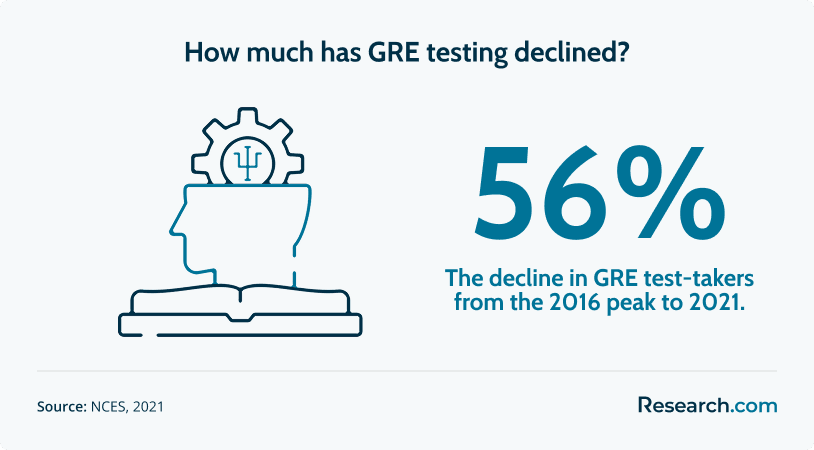
Many education doctoral programs now use holistic admissions because experienced professionals often have stronger evidence of readiness than a test score can show. Leadership history, graduate academic performance, writing ability, workplace impact, and clarity of purpose can be more relevant for a practitioner-focused doctorate. This shift also aligns with a 56% decline in GRE test-takers in recent years.
Do you need a master’s degree first?
For virtually all EdD programs, a master’s degree is expected. It provides the graduate-level foundation for doctoral research, policy analysis, leadership theory, and applied organizational improvement.
If you do not yet have a master’s degree, that should be your first planning step. Students aiming for educational leadership may want to compare options such as the shortest master's degree in educational leadership online before preparing an EdD application.
Typical Courses in an Online EdD Program with No GRE/GMAT Requirement
An EdD curriculum usually centers on applied leadership rather than abstract theory alone. Students learn to interpret research, evaluate programs, improve organizations, use data responsibly, and lead change across educational or training systems.
Common course areas include organizational leadership, education policy, research methods for practitioners, data-informed decision-making, ethics, equity, finance, strategic planning, curriculum leadership, and specialization-specific seminars. Many programs also connect assignments to the student’s current workplace, making the doctorate a structured way to investigate and improve real organizational problems.
| Course Area | What You Learn | Why It Matters |
| Leadership and organizational change | How institutions operate, respond to pressure, and implement improvement plans | Useful for principals, superintendents, deans, nonprofit leaders, and training executives |
| Research methods | How to design, evaluate, and apply practitioner-focused research | Essential for the dissertation in practice, capstone, or applied doctoral project |
| Data-driven decision-making | How to interpret evidence, assess outcomes, and make informed leadership decisions | Important for accountability, program evaluation, and strategic planning |
| Education policy and systems | How policy, governance, funding, and regulation shape institutions | Critical for leaders influencing district, institutional, or organizational strategy |
| Specialization coursework | Advanced study in areas such as K-12 leadership, higher education, special education, or organizational leadership | Helps align doctoral work with your target role |
How coursework connects to career readiness
The strongest EdD programs help students build transferable leadership skills: interpreting data, leading teams, managing change, understanding policy, and communicating evidence-based recommendations. These skills can support advancement in multiple education and training settings. For example, demand for postsecondary health specialties teachers is projected to grow by 17%, showing how advanced expertise and teaching leadership can matter in specialized education fields.
Students with specific population-focused goals may build on earlier credentials before doctoral study. For example, someone working with multilingual learners might begin with accelerated online master's in multilingual learner education programs before pursuing broader system-level leadership through an EdD.
Common Specializations in No-GRE Online EdD Programs
Specializations help you tailor the EdD to a defined leadership path. Educational Leadership is one of the most common tracks and accounts for about 31% of degrees. Other areas include Elementary Education (25%), Special Needs Education (6%), and Early Childhood Education (5%).
Choosing a specialization should be a career decision, not just an academic preference. A K-12 administrator, higher education professional, instructional designer, special education leader, and nonprofit executive may all benefit from different doctoral coursework and final projects.
| Specialization | Best Fit | Potential Focus of Doctoral Work |
| Educational Leadership | Principals, district leaders, curriculum leaders, and aspiring superintendents | School improvement, district strategy, leadership development, policy implementation |
| Higher Education Leadership | College administrators, student affairs leaders, deans, and department leaders | Student success, enrollment strategy, academic governance, institutional effectiveness |
| Organizational Leadership | Corporate training, nonprofit, government, and education-adjacent professionals | Change management, workforce learning, leadership systems, organizational innovation |
| Special Education | Special education coordinators, administrators, and policy-focused educators | Program design, compliance, inclusive systems, specialized instructional support |
| Early Childhood Education | Early learning administrators, policy advocates, and program directors | Program quality, family engagement, early intervention, leadership in early learning systems |
When an Ed.S. may be a better choice than an EdD
An EdD is not the only advanced option after a master’s degree. Some educators may be better served by an Education Specialist degree, especially if they want focused expertise without completing a full doctorate.
The Ed.S. is a post-master’s credential built for specialization and advanced practice. If your goal is deep technical expertise in an area such as special education rather than executive-level research and leadership, a top online specialist degree in special education may be more efficient.
How to Choose the Best Online EdD Program with No GRE/GMAT Requirement
The best program is not automatically the fastest, cheapest, or most recognizable. It is the one that fits your professional goal, offers credible academic quality, and gives you a realistic path to completion without unnecessary debt or disruption.
- Confirm institutional accreditation first. Accreditation should be non-negotiable. It affects employer recognition, transferability, financial aid eligibility, and the credibility of the degree.
- Match the specialization to your target role. Do not choose a general leadership track if your career requires a specific credential, concentration, or licensure-related preparation.
- Review the final doctoral project. Ask whether the program requires a traditional dissertation, dissertation in practice, capstone, or applied project. This will shape your workload and professional portfolio.
- Compare total cost, not tuition alone. Include fees, books, required travel, dissertation continuation charges, and the cost of reducing work hours if needed.
- Evaluate faculty experience. Look for faculty with relevant doctoral credentials, applied leadership backgrounds, and research interests that align with your topic.
- Ask about student support. Doctoral students need writing support, research guidance, library access, advising, technology help, and clear dissertation milestones.
- Check licensure relevance. If you want a superintendent, principal, or other licensed administrative role, verify whether the program meets your state’s requirements.
Questions to ask before applying
| Question | Why It Matters |
| Is the institution regionally accredited or otherwise properly accredited? | Accreditation affects credibility, aid eligibility, and employer acceptance. |
| Does the program require any campus visits or residencies? | Residencies can add travel costs and scheduling challenges. |
| What percentage of students finish the dissertation or capstone on time? | Completion support is one of the biggest factors in doctoral success. |
| Can I transfer graduate credits? | Transfer policies can reduce cost and time, but limits vary by school. |
| Does the program support my intended licensure or leadership role? | Not every EdD prepares students for state-regulated administrative credentials. |
| How often are courses offered? | Course rotation can affect whether “accelerated” timelines are realistic. |
| What support is available for working adults? | Advising, writing help, flexible scheduling, and clear milestones can prevent delays. |
Career Paths for Online EdD Graduates
An EdD is typically designed for leadership, administration, policy, and organizational improvement roles. It is not limited to classroom teaching; many graduates use the degree to move into district leadership, higher education administration, curriculum strategy, nonprofit leadership, education consulting, or corporate learning and development.
- K-12 Leadership: Possible roles include School Superintendent, Assistant Superintendent, Principal, or district-level administrator.
- Higher Education Administration: Graduates may pursue roles such as Provost, Dean, Department Chair, or senior student success leader.
- Curriculum and Instruction: Career options may include Chief Academic Officer, Director of Curriculum, instructional leader, or assessment director.
- Corporate and Nonprofit Leadership: EdD graduates may apply leadership and learning expertise as Training and Development Managers, Non-Profit Executive Directors, or Educational Technology Consultants.
Why the doctorate can matter for leadership advancement
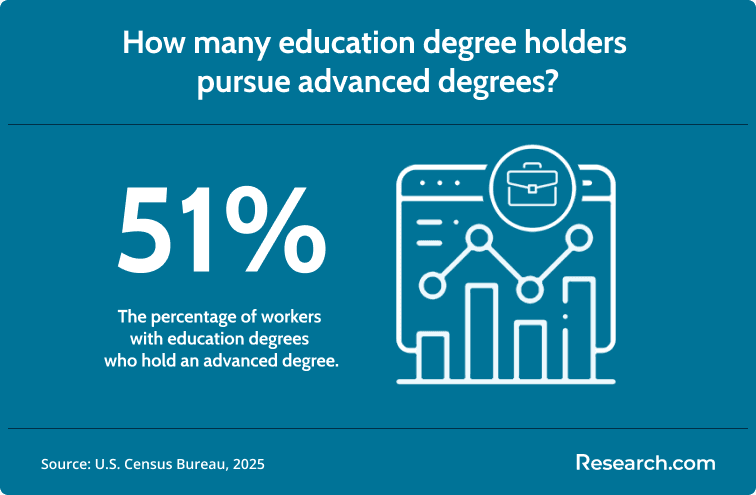
In the education workforce, 51% of individuals hold an advanced degree. A doctorate can help distinguish candidates for senior roles where employers expect advanced knowledge of leadership, policy, research, and systems improvement.
The value of the degree depends on fit. For example, someone interested in early childhood systems might first ask, what jobs can you get with an early childhood education certificate? A certificate may support entry or specialization, while an EdD may support broader policy, leadership, or system-wide influence later in the career path.
Job Market Outlook for Online EdD Graduates
The labor market for education leaders is more nuanced than the market for classroom teaching roles. An EdD may improve competitiveness for senior administrative positions, but it does not guarantee a promotion or salary increase. Location, experience, licensure, institutional budgets, and leadership openings all matter.
Still, doctoral education is associated with strong employment stability. The unemployment rate for individuals with a doctoral degree is just 2.6%. For candidates pursuing executive education roles, a no-GRE online EdD can be a practical way to gain the terminal credential while continuing to work.
Where the EdD is most useful
The EdD is most valuable when the target position requires advanced leadership, research literacy, policy understanding, and organizational decision-making. It can be especially relevant for roles that involve strategic planning, accreditation, institutional improvement, curriculum systems, student outcomes, and large-scale change.
Among postsecondary administrators, 18.2% hold a doctoral degree. That does not mean every administrator needs one, but it shows that doctoral preparation is common enough in senior higher education leadership to influence competitiveness for advanced roles.
What Graduates Say About Online EdD Programs with No GRE/GMAT Requirement
- Jeremy: "I was not looking for a title change alone. I wanted the depth to rethink curriculum across an entire school. My EdD helped me turn a dissertation in practice into a literacy framework we could actually use, and the faculty pushed me to make the work stronger than I would have on my own."
- Solomon: "The cost made me pause, so I treated the degree like a business decision. The program helped me build stronger planning, budgeting, and leadership skills, and after graduation I was able to move into a senior administrative position where the investment made sense for my long-term goals."
- Kristine: "Not having to submit GRE scores let me focus my application on my experience, writing, and vision for education. The program taught me how to turn that vision into policy and program design. I now work in an educational nonprofit where those skills affect students at scale."
How Can You Accelerate an Online EdD Without Sacrificing Quality?
To finish faster, look for programs with clearly structured course sequences, accelerated terms, transfer credit opportunities, strong dissertation support, and applied doctoral projects that begin early in the program. Speed only helps if the program remains accredited, academically rigorous, and realistic for your work schedule.
Be cautious with any program that promises a fast doctorate without explaining faculty support, research expectations, or final project requirements. For a focused comparison of shorter pathways, review Research.com’s guide to the fastest online EdD programs.
Common Mistakes to Avoid When Choosing a No-GRE Online EdD
- Choosing only by speed. A fast program can be useful, but not if it lacks dissertation support, career relevance, or academic credibility.
- Ignoring accreditation. Accreditation should be verified before you invest time in the application.
- Comparing tuition without fees. Per-credit cost does not show the full price of books, technology fees, residencies, and dissertation continuation charges.
- Assuming no GRE means easy admission. Strong programs still expect graduate readiness, leadership experience, writing ability, and a clear purpose.
- Overlooking licensure requirements. If your goal is a state-regulated administrative role, confirm alignment before enrolling.
- Picking a specialization too broadly. Your concentration should support the job you want, not just sound interesting.
- Underestimating the final project. The dissertation or capstone often determines whether students finish on time.
- Relying only on rankings. Rankings can help you create a shortlist, but your best fit depends on cost, format, support, and career alignment.
Current Trends Affecting Online EdD Students
Several trends are shaping how professionals choose EdD programs. First, holistic admissions continue to make doctoral study more accessible for experienced applicants who can demonstrate leadership without standardized test scores. Second, online graduate education has become mainstream, making flexibility a key expectation rather than a special feature.
Third, education leaders are increasingly expected to use data, learning analytics, technology, and evidence-based decision-making. AI tools may help with administrative analysis, instructional design, and student support, but they also create new responsibilities around ethics, privacy, equity, and academic integrity. Strong EdD programs should help students lead responsibly in technology-rich environments rather than simply react to them.
Finally, affordability and completion support are becoming more important as doctoral costs rise. Students should ask hard questions about total cost, time-to-completion, advising, and dissertation support before committing.
References
- Educational Testing Service. Interpret scores. ETS. Retrieved October 11, 2025, from https://www.ets.org/gre/score-users/scores/interpret-scores.html#accordion-0b9e4689be-item-3e585eb2f6
- Federal Reserve Bank of St. Louis. Continued G.I. Bill (Post-9/11) Doctor's Degree, 25 and Over [Data set]. FRED, Federal Reserve Bank of St. Louis. Retrieved October 11, 2025, from https://fred.stlouisfed.org/series/CGDD25O
- Indeed Editorial Team. How much can you make with a doctorate in education? Indeed. Retrieved October 11, 2025, from https://www.indeed.com/career-advice/pay-salary/how-much-can-you-make-with-doctorate-in-education
- National Center for Education Statistics. Digest of Education Statistics, 2022. U.S. Department of Education, Institute of Education Sciences. Retrieved October 11, 2025, from https://nces.ed.gov/programs/digest/d22/tables/dt22_327.10.asp
- National Center for Education Statistics. Fast Facts: Distance learning. U.S. Department of Education, Institute of Education Sciences. Retrieved October 11, 2025, from https://nces.ed.gov/fastfacts/display.asp?id=80
- National Center for Science and Engineering Statistics. Doctorate recipients from U.S. universities: 2021. National Science Foundation. Retrieved October 11, 2025, from https://ncses.nsf.gov/pubs/nsf23300/technical-notes
- PayScale, Inc. Doctor of Education (EdD) Degree Salary. PayScale. Retrieved October 11, 2025, from https://www.payscale.com/research/US/Degree=Doctor_of_Education_(EdD)/Salary
- U.S. Bureau of Labor Statistics. Field of degree: Education. Occupational Outlook Handbook. Retrieved October 11, 2025, from https://www.bls.gov/ooh/field-of-degree/education/education-field-of-degree.htm
- University of St. Augustine for Health Sciences. Doctorate in education salary and career outlook. USA.edu. Retrieved October 11, 2025, from https://www.usa.edu/blog/doctorate-in-education-salary-and-career-outlook/
Key Insights
- A no-GRE or no-GMAT online EdD can be credible when the institution is accredited and the program has rigorous coursework, qualified faculty, and a meaningful final doctoral project.
- The right EdD depends on your career target. K-12 leadership, higher education administration, organizational leadership, special education, and instructional systems require different program strengths.
- Program cost varies widely. Compare total cost, including fees and residencies, not just cost per credit.
- Most online EdD students should expect about three to four years of study, although some programs advertise faster completion and others may take longer depending on dissertation progress.
- Admissions without GRE or GMAT scores still require evidence of readiness, including a master’s degree, professional experience, recommendations, and a focused statement of purpose.
- Online and on-campus EdD programs can carry comparable value when academic quality is equivalent; delivery format matters less than accreditation, support, curriculum, and outcomes.
- Before applying, confirm whether the program supports any licensure or administrative credential you may need in your state or career setting.
- The best EdD investment is one that connects directly to a realistic leadership role, offers strong doctoral support, and fits your schedule without creating unmanageable debt.
Other Things You Should Know About Online EdD Programs with No GRE/GMAT Requirement
In 2027, top online EdD programs without GRE/GMAT requirements typically require a master's degree, a minimum GPA, professional experience, recommendation letters, a statement of purpose, and sometimes an interview. Examples include programs from prestigious universities that prioritize experience and commitment to educational leadership over standardized test scores.
No. Most online EdD programs do not require a master’s thesis. Instead, they require a doctoral capstone, dissertation-in-practice, or applied research project, often completed after 45 to 60 credit hours. Applicants usually need a master’s degree, a minimum GPA, a résumé, and recommendation letters.