
2027 Fastest Online Master’s in Special Education Programs

Co-Founder and Chief Data Scientist
Choosing a fast online master’s in special education is usually a trade-off between speed, licensure requirements, cost, and workload. Some programs can move you through graduate coursework in about one year, but the best choice depends on whether you already hold a teaching license, whether you need special education certification, and how much weekly study time you can realistically sustain.
This guide is designed for licensed teachers, career changers, paraprofessionals, school support staff, and education professionals who want to specialize in supporting students with disabilities without stepping away from work. You will learn how accelerated online programs are structured, how they compare by timeline and tuition, what to check before applying, and which career paths may fit your goals.
Quick answer: What is the fastest online master’s in special education?
The fastest online master’s in special education programs can be completed in as few as 10 to 12 months, usually through 7-week or similarly accelerated course formats. These programs often require 30 to 36 credit hours and are best suited for students who can handle a compressed academic schedule while managing fieldwork, teaching responsibilities, or other professional obligations.
If you need initial teacher certification, additional licensure, student teaching, or a practicum, your timeline may be longer. If you already have a teaching license and only need advanced special education training, an accelerated non-licensure or endorsement-focused program may be the quickest option.
What are the benefits of getting a fast online master’s degree in special education?
- You may reach your credential goal sooner. Finishing in as little as 12 months can help educators move toward specialized teaching assignments, leadership responsibilities, or district salary-lane advancement faster than a longer program.
- You may reduce indirect costs. A shorter timeline can limit the number of terms you pay fees, buy materials, or adjust work schedules, although total tuition still depends on credit requirements and institutional pricing.
- You can apply new strategies immediately. Working educators often use coursework on IEPs, behavior supports, assessment, inclusive instruction, and assistive technology in their current classrooms while enrolled.
- You can choose a path that matches your licensure status. Some online programs are built for licensed teachers seeking advanced expertise, while others include certification pathways for career changers or teachers adding special education credentials.
What can I expect from a fast online master’s in special education degree program?
A fast online master’s in special education is a graduate program that compresses advanced educator preparation into a shorter schedule, commonly 12 to 18 months. Students study instructional design, disability categories, assessment, behavior intervention, special education law, collaboration with families and school teams, and inclusive teaching practices.
Many accelerated programs use 5- to 8-week courses and offer several start dates per year. That structure can be convenient, but it also means assignments, readings, discussion posts, projects, and field-based tasks arrive quickly. Students who succeed in these programs usually set a consistent weekly study schedule before the first course begins.
Program requirements vary by track. A non-licensure master’s may emphasize advanced classroom practice, leadership, and research. A licensure or certification route may require supervised field experiences, student teaching, state exams, or documentation that must align with state education agency rules.
| Program feature | What it usually means for students | Why it matters before enrolling |
| Accelerated courses | Classes may run in 5- to 8-week blocks rather than a traditional semester. | The pace is faster, so falling behind can be difficult to recover from. |
| Online delivery | Coursework is often asynchronous, though some programs include live sessions. | Working students should check whether class meetings conflict with school or family schedules. |
| Licensure track | The program may include fieldwork, student teaching, or certification requirements. | Licensure rules are state-specific; an online program does not automatically qualify graduates in every state. |
| Practicum or capstone | Students may complete applied projects, supervised practice, or classroom-based research. | These requirements can affect both completion time and placement logistics. |
Where can I work with an online master’s degree in special education?
An online master’s in special education can support work in classrooms, district offices, early intervention programs, nonprofit agencies, and education service organizations. The right setting depends heavily on your license, specialization, prior experience, and whether your program prepares you for direct teaching, consulting, behavior support, or leadership.
Common employers include public school districts, private schools, charter schools, alternative education programs, early childhood centers, disability service organizations, and education agencies. Some graduates continue teaching students with disabilities, while others move into IEP coordination, behavior intervention, instructional coaching, transition services, or program administration.
Before choosing a program, identify the role you want after graduation. A teacher seeking a mild-to-moderate special education credential has different needs from a licensed educator pursuing autism specialization, a paraprofessional seeking initial certification, or an experienced teacher aiming for curriculum leadership.
How much can I make with an online master’s degree in special education?
Pay depends on district salary schedules, state funding formulas, union agreements, licensure level, years of experience, and job title. In many school systems, a master’s degree can place teachers on a higher salary lane, but the exact increase is not universal.
Some educators with a master’s degree in special education earn $5,000 to $15,000 more annually than peers with only a bachelor’s degree, depending on the state, school district, and years of experience. However, this should not be treated as a guaranteed outcome. Always check your district’s salary schedule, state licensure incentives, and whether the degree must be in a specific field to qualify for additional compensation.
Graduates may also pursue roles such as instructional coordinator, behavior specialist, special education consultant, or special education administrator. These positions may offer higher pay than classroom teaching in some locations, but they often require teaching experience, additional credentials, administrative preparation, or specialized certification.
- Fastest Online Master’s in Special Education Programs for 2027
- How long does it take to complete an online master’s degree in special education?
- How does an online master’s degree in special education compare to an on-campus program?
- What is the average cost of an online master’s degree in a special education program?
- What are the financial aid options for students enrolling in an online master’s degree in special education program?
- What are the prerequisites for enrolling in an online master’s degree in special education program?
- What courses are typically in an online master’s degree in special education program?
- What types of specializations are available in an online master’s degree in special education program?
- How do I choose the best online master’s degree in special education program?
- What career paths are available for graduates of an online master’s degree in special education?
- What is the job market for graduates with an online master’s degree in special education?
- Does an online master’s degree in special education pave the way for accelerated doctoral studies?
- What support systems and quality assurance measures are in place for online special education programs?
- How can interdisciplinary insights enhance your online master’s in special education?
- Are there potential challenges when pursuing an accelerated online master’s in special education? Related planning sections include interdisciplinary options, online program quality checks, doctoral pathways, and job market considerations.
Fastest Online Master’s in Special Education Programs for 2027
The programs below are built for students who want graduate-level special education preparation with online flexibility and shorter completion timelines. If you are not ready for a full master’s degree, you may also compare fast-track special education graduate programs online, which can be a narrower credential option for some educators.
How do we rank schools?
Research.com evaluates online programs with a focus on academic quality, affordability, flexibility, institutional credibility, and student decision-making value. Our rankings are guided by our methodology and informed by recognized education data sources, including:
- IPEDS database
- Peterson's database, including their Distance Learning Licensed Data Set
- College Scorecard database
- National Center for Education Statistics
| School | Online special education program | Program length | Credits | Cost information | Accreditation listed |
| University of Texas Rio Grande Valley | M.Ed. in Special Education | As fast as 10 months | 30 credit hours | $458 per credit | CAEP |
| University of Southern Maine | M.S. in Special Education: Inclusive Instruction for All Students | As fast as 12 months | 30 credit hours | USM e‑tuition rate applies; exact per-credit cost not listed on source | CAEP |
| Florida Gulf Coast University | Master of Education in Special Education | 12 months | 36 credit hours | $373 per credit hour; estimated total tuition ~$13,428 | CAEP |
| Ball State University | M.A. in Special Education | Self-paced | 30 credit hours | $589 per credit | CAEP |
| Webster University | M.A. in Special Education | Two to three years | 33 to 36 credit hours | $710 per credit | CAEP |
| Arizona State University | M.Ed. in Special Education | 24 months | 31 credit hours | $12,158 per year | CAEP |
| University of Cincinnati Online | M.Ed. in Special Education | 30 credits or 33 credits | 30 credits (M.Ed.) or 33 credits (MAT with student teaching) | Estimated total around $22,380–$22,830 ($746–$761 per credit for out‑of‑state students) | NCATE |
| Penn State World Campus | M.Ed. in Special Education | One to two years | 32 to 33 credit hours | approx. $26,300 total for 30 credits | CAEP |
| Capella University | M.S. in Education: Special Education Teaching | Two years | 46 quarter credits | $261 per quarter credit (46 credits) | NCATE |
| Western Governors University | M.A.T. in Special Education (K–12) | 21 to 22 months | around 30 courses | $4,325 per six months | CAEP |
1. University of Texas Rio Grande Valley – M.Ed. in Special Education (Online)
The University of Texas Rio Grande Valley offers a 100% online Master of Education in Special Education that uses consecutive 7-week modules and can be finished in as few as 10 months. The 30-credit program is designed for current educators and career changers who want focused preparation in high- and low-incidence disabilities, applied behavior analysis, assessment, legal foundations, multicultural instruction, and professional collaboration.
- Program Length: As fast as 10 months (30 credit hours)
- Tracks/concentrations: No formal sub‑tracks
- Cost per Credit/Tuition: $458 per credit
- Accreditation: Council for the Accreditation of Educator Preparation (CAEP)
2. University of Southern Maine – M.S. in Special Education: Inclusive Instruction for All Students (Accelerated Online)
The University of Southern Maine provides a fully online, accelerated Master of Science in Special Education—Inclusive Instruction for All Students. Delivered in 7-week courses, the 30-credit curriculum is built for education professionals who support multilingual learners and students with disabilities through inclusive instruction, culturally responsive teaching, behavior support, and collaborative practice.
- Program Length: As fast as 12 months (30 credit hours)
- Tracks/concentrations: N/A
- Cost per Credit/Tuition: USM e‑tuition rate applies; exact per-credit cost not listed on source
- Accreditation: CAEP
3. Florida Gulf Coast University - Master of Education in Special Education
Florida Gulf Coast University offers a fully online Master of Education in Special Education for licensed teachers, career changers, and professionals serving individuals with disabilities. The 36-credit curriculum focuses on research-based instruction, behavior management, assessment, assistive technologies, inclusive education, and special education law and policy.
- Program Length: 12 months (36 credit hours)
- Tracks/concentrations: Core M.Ed. in Special Education (no formal tracks)
- Cost per Credit/Tuition: $373 per credit hour; estimated total tuition ~$13,428
- Accreditation: Council for the Accreditation of Educator Preparation (CAEP)
4. Ball State University – M.A. in Special Education
Ball State University offers a 100% online Master of Arts in Special Education for working professionals who want advanced expertise across disability services for children and adults. The 30-credit structure includes 21 core credits and 9 elective or concentration credits, giving students flexibility to focus on areas such as autism, early childhood, deaf education, emotional and behavioral disorders, mild or intense interventions, administration, or applied behavior analysis.
- Program Length: Self-paced (30 credit hours)
- Tracks/concentrations: Administration, Autism, Deaf Education, Early Childhood Special Education, Emotional & Behavioral Disorders, Mild Intervention, Intense Intervention, Multi‑Tier/RTI, Disabilities in Post‑Secondary Settings (autism emphasis), Applied Behavior Analysis.
- Cost per Credit/Tuition: $589 per credit
- Accreditation: CAEP
5. Webster University – M.A. in Special Education (Online)
Webster University offers a fully asynchronous online MA in special education that can be completed in two to three years. The program is intended for professionals who want to design inclusive curricula, support collaborative school teams, and advocate for students with disabilities in educational, community, or vocational environments.
- Program Length: Two to three years (33 to 36 credit hours)
- Tracks/concentrations: Trauma‑Informed & Inclusive Practices; (2) Severe Developmental Disabilities & Autism.
- Cost per Credit/Tuition: $710 per credit
- Accreditation: CAEP
6. Arizona State University – M.Ed. in Special Education (Online)
The online MEd in Special Education from Arizona State University prepares educators to work with students with mild-to-moderate disabilities in K–12 schools. Students may choose a non-certification option or certification pathways, including traditional or alternative routes and dual certification in elementary education and mild/moderate special education. Coursework includes instructional methods, assessment, special education law, literacy, collaboration, and educational technology.
- Program Length: 24 months (31 credit hours)
- Tracks/concentrations: Certification M.Ed. with two pathways (traditional or alternative) dual K–8 elementary and K–12 special education certification.
- Cost per Credit/Tuition: $12,158 per year
- Accreditation: CAEP
7. University of Cincinnati Online – M.Ed. in Special Education
The University of Cincinnati’s online Master of Education in Special Education serves licensed teachers and career changers who plan to support children and adults with disabilities. Students complete 18 credits of core work in legal frameworks and evidence-based practice, then select 12 credits from Licensure & Reading Endorsement, Supporting Students with Complex Needs, or Transition to Work & Leadership.
- Program Length: 30 credits (M.Ed.) or 33 credits (MAT with student teaching)
- Tracks/concentrations: Licensure & Reading Endorsement; Supporting Students with Complex Needs; Transition to Work & Leadership
- Cost per Credit/Tuition: Estimated total around $22,380–$22,830 ($746–$761 per credit for out‑of‑state students).
- Accreditation: NCATE
8. Penn State World Campus – M.Ed. in Special Education (Online)
Penn State World Campus’ Master of Education in Special Education is an online program for working professionals who want deeper training in inclusive instruction, behavioral support, and instructional planning for students with disabilities. Students choose from Academic & Behavioral Supports, Applied Behavior Analysis (ABA), or Autism based on their career direction.
- Program Length: One to two years (32 to 33 credit hours)
- Tracks/concentrations: Academic & Behavioral Supports, Applied Behavior Analysis (with BACB sequence), Autism
- Cost per Credit/Tuition: approx. $26,300 total for 30 credits
- Accreditation: CAEP
9. Capella University – M.S. in Education: Special Education Teaching (Online)
Capella University’s online Master of Science in Education with a specialization in Special Education Teaching uses a quarter-based format totaling 46 credits, or approximately 11–12 courses. The program is designed for P–12 educators and emphasizes data-informed instruction, individualized evaluation plans, collaboration with stakeholders, and legal frameworks such as IDEA and ADA.
- Program Length: Two years (46 quarter credits)
- Tracks/concentrations: N/A
- Cost per Credit/Tuition: $261 per quarter credit (46 credits)
- Accreditation: National Council for Accreditation of Teacher Education (NCATE)
10. Western Governors University – M.A.T. in Special Education (K–12)
Western Governors University offers a Master of Arts in Teaching – Special Education (K–12) for aspiring and licensed educators preparing to work with students with mild-to-moderate disabilities from elementary through high school. Its competency-based, self-paced model includes around 30 courses and covers literacy, behavior management, assessment, assistive technologies, and instructional science.
- Program Length: 21 to 22 months
- Tracks/concentrations: Single K–12 Special Education pathway (no formal sub‑tracks)
- Cost per Credit/Tuition: $4,325 per six months
- Accreditation: Council for the Accreditation of Educator Preparation (CAEP)
How long does it take to complete an online master’s degree in special education?
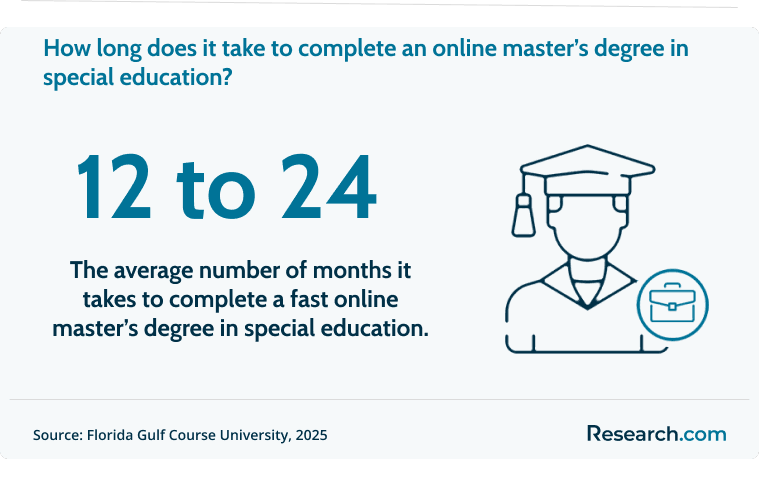
Most online master’s programs in special education take about 12 to 24 months, depending on pacing, course length, credit requirements, and whether the program includes licensure. Many degrees require around 30 to 36 credit hours, which commonly equals about 10 courses.
Students who enroll full-time and take multiple courses per term may finish in roughly one year. Students who teach full-time, have family responsibilities, or need a more manageable workload often take closer to two years. Licensure pathways may also take longer because of practicum, student teaching, testing, or state documentation requirements.
Online programs frequently offer multiple start dates and asynchronous coursework, which can make scheduling easier. However, asynchronous does not mean low effort. Accelerated terms require steady reading, writing, lesson design, case analysis, and collaboration within short deadlines.
If you are comparing adjacent graduate fields, review how educational psychology vs school psychology differs from special education in licensure, scope of practice, and student support roles.
| Student situation | Likely timeline | Best-fit program type |
| Licensed teacher seeking advanced expertise | As fast as 10 to 12 months in some programs | Accelerated M.Ed. or M.A. without added initial certification |
| Career changer seeking teaching licensure | Often longer than non-licensure tracks | MAT or certification pathway with field placement |
| Working educator with limited weekly study time | Closer to 18 to 24 months | Part-time or self-paced online program |
| Student pursuing ABA, autism, or leadership focus | Varies by concentration and supervised requirements | Specialized track with clear credential alignment |
How does an online master’s degree in special education compare to an on-campus program?
An online master’s in special education can offer the same graduate-level content as an on-campus program, but the learning experience is different. Online formats are often better for working teachers who need scheduling flexibility, similar to the appeal of a fast-track early childhood education master's degree online. Campus-based programs may be stronger for students who prefer face-to-face interaction, local school partnerships, and structured weekly class meetings.
| Comparison factor | Online master’s in special education | On-campus master’s in special education |
| Schedule | Often asynchronous or partially synchronous, with more control over study time. | Usually follows set class times and campus attendance expectations. |
| Field experience | May allow local placements if approved by the program and state requirements. | May use established placement relationships near the university. |
| Peer interaction | Discussion boards, video meetings, group projects, and virtual advising. | In-person seminars, campus events, and direct faculty interaction. |
| Cost considerations | May reduce relocation, commuting, and housing costs. | May include more campus-based fees or relocation expenses, depending on location. |
| Best for | Working educators, rural students, military-connected learners, and students needing flexible access. | Students who want in-person mentoring, local networks, and a traditional graduate school environment. |
Neither format is automatically better. The more important question is whether the program is accredited, matches your state licensure needs, provides strong fieldwork support, and fits your weekly availability.
What is the average cost of an online master’s degree in a special education program?
Based on the program examples in this guide, tuition for an online M.Ed. in Special Education often falls between $13,000 and $18,000 total, though some programs cost more depending on credit count, residency policy, tuition model, and fees. Pricing structures differ: some schools charge per credit, while others use flat-rate or term-based tuition. Students comparing accelerated pricing across fields can also look at how cost models appear in programs such as a fast-track online sustainability bachelor's degree.
Examples of listed tuition figures include:
- Florida Gulf Coast University (Full-Time): $13,428 total for 36 credit hours.
- Western Governors University (Standard 2-Year Track): $17,300 total for two years.
- Ball State University (Standard Full-Time): $17,670 total for 30 credit hours.
- University of Texas Rio Grande Valley (Accelerated Full-Time): $13,740 total for 30 credit hours.
When comparing costs, do not rely only on advertised tuition. Ask whether the school charges online course fees, practicum fees, graduation fees, technology fees, testing costs, background check costs, or out-of-state tuition. Also confirm whether financial aid applies to accelerated terms and whether your district reimburses graduate credits.
| Cost item | Why it matters | Question to ask |
| Tuition per credit or per term | This is the largest expense and varies by pricing model. | Is tuition charged by credit, course, semester, or six-month term? |
| Required credits | A lower per-credit price can still cost more if the program requires more credits. | How many total credits are required for my exact track? |
| Licensure expenses | Certification tracks may require exams, background checks, or field placement costs. | Which licensure-related expenses are not included in tuition? |
| Transfer or prior credits | Accepted credits can reduce both time and cost. | Can graduate credits, certificates, or endorsements transfer into the program? |
| Employer reimbursement | District benefits may reduce out-of-pocket cost. | Does my employer reimburse this degree and this institution? |
What are the financial aid options for students enrolling in an online master’s degree in special education program?
Online graduate students in accredited special education programs may qualify for several types of aid. Funding rules can vary by school, enrollment intensity, and program eligibility. Students in other accelerated graduate fields, such as a fast track online cybersecurity master's degree, often face similar questions about aid eligibility in compressed formats.
- Federal financial aid: Eligible graduate students may use Direct Unsubsidized Loans or Graduate PLUS Loans. The first step is completing the FAFSA (Free Application for Federal Student Aid).
- Scholarships and grants: Universities, education associations, nonprofits, and local organizations may offer awards for graduate students in teaching or special education. These funds usually do not require repayment.
- State and local teacher support: Some states and districts provide grants, tuition reimbursement, or service-based incentives for educators entering shortage areas such as special education.
- Employer tuition assistance: Teachers and school staff may receive tuition reimbursement, professional development funds, or partner-school discounts through their districts or employers.
- Loan forgiveness programs: Graduates working in qualifying public service or teaching roles may explore Teacher Loan Forgiveness or Public Service Loan Forgiveness (PSLF), subject to program rules and repayment requirements.
- Institutional aid and payment plans: Many universities offer scholarships, installment plans, or residency-neutral online tuition rates that can help students manage cash flow.
What are the prerequisites for enrolling in an online master’s degree in special education program?
Admission requirements vary by school and track, but most online master’s in special education programs look for evidence that applicants can handle graduate coursework and work responsibly with diverse learners. Some requirements are academic, while others relate to licensure or professional background.
- Bachelor’s degree from an accredited institution: Most programs require a completed undergraduate degree. Education majors are common, but some schools admit applicants from related or unrelated fields, especially in career-changer pathways. Students comparing education-related graduate admissions may also review fast track educational counseling master's programs online.
- Minimum undergraduate GPA: Many programs set a GPA requirement, often 2.75 or higher, and some tracks may require a stronger academic record.
- Teaching license or certification: Some programs require a valid teaching credential, particularly if the degree is designed for currently licensed educators or advanced licensure.
- Relevant professional experience: Schools may value classroom experience, paraprofessional work, tutoring, disability services experience, or other work with children and families.
- Recommendations: Applicants commonly submit one to three letters from supervisors, faculty, or professional references. Similar documentation may be needed in other education roles, including those explained in this guide to physical education teacher requirements.
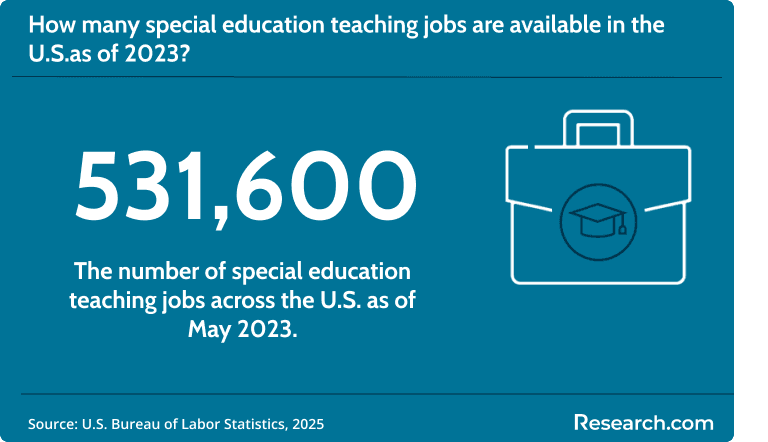
Demand for qualified special education professionals remains an important context for admissions. In 2023, there were approximately 531,600 special education teaching jobs across the U.S. Graduate programs use prerequisites to help ensure students are prepared for the academic, legal, instructional, and ethical responsibilities tied to the field.
What courses are typically in an online master’s degree in special education program?
Online master’s programs in special education usually combine legal foundations, instructional practice, assessment, behavior support, collaboration, and research. The curriculum is career-focused, much like the structured professional preparation found in fast-track online masters in school counseling, but the focus is on disability services, inclusive teaching, and special education compliance.
| Typical course | What students learn | How it applies in practice |
| Foundations of Special Education | History, disability categories, service models, equity issues, and the role of special education in schools. | Helps educators understand why services are structured the way they are. |
| Behavior Management and Intervention | Behavior assessment, positive supports, intervention planning, and sometimes applied behavior analysis concepts. | Supports students with emotional, behavioral, or self-regulation needs. |
| Assessment in Special Education | Selection, administration, and interpretation of tools used to identify needs and monitor progress. | Informs IEP goals, instructional planning, and student support decisions. |
| Instructional Strategies for Diverse Learners | Differentiation, accommodations, modifications, assistive technology, and inclusive lesson design. | Helps teachers adapt instruction without lowering meaningful expectations. |
| Legal and Ethical Issues in Special Education | IDEA, Section 504, ADA, student rights, educator responsibilities, and ethical decision-making. | Reduces compliance risk and strengthens advocacy for students and families. |
| Research in Special Education | Qualitative and quantitative methods, research evaluation, and evidence-based practice. | Helps educators judge whether interventions are supported by credible evidence. |
What types of specializations are available in an online master’s degree in special education program?
Specializations allow students to focus on a disability area, age group, instructional method, or leadership goal. If you need a shorter credential before committing to a full degree, fast track special education graduate programs online may offer a focused alternative.
Common concentrations include Autism Spectrum Disorders (ASD), Applied Behavior Analysis (ABA), Emotional and Behavioral Disorders, Learning Disabilities, Early Childhood Special Education, Deaf and Hard of Hearing, Visual Impairments, Gifted and Talented Education, Inclusive Practices, Transition Services, and Special Education Leadership. If you are comparing degree types, this explanation of MEd meaning in education can help clarify how a Master of Education differs from other graduate education pathways.
| Specialization | Best for students who want to... | Important check before enrolling |
| Autism Spectrum Disorders | Support communication, social skills, sensory needs, and structured interventions for students on the spectrum. | Confirm whether the curriculum matches your state endorsement or district expectations. |
| Applied Behavior Analysis | Use behavior science to design and evaluate interventions. | Ask whether the program aligns with BCBA preparation and supervised experience requirements. |
| Early Childhood Special Education | Work with young children with developmental delays or disabilities. | Check field placement and state early childhood credential rules. |
| Transition Services | Help adolescents with disabilities move toward employment, postsecondary education, or independent living. | Look for coursework in community partnerships, vocational planning, and family collaboration. |
| Special Education Leadership | Move into coordination, coaching, consulting, or administrative support roles. | Determine whether administrative licensure is separate from the master’s degree. |
How do I choose the best online master’s degree in special education program?
The best program is the one that matches your licensure status, career goal, budget, schedule, and state requirements. A fast program is only useful if it leads to the outcome you actually need.
- Start with accreditation: Look for institutional accreditation and, when relevant, educator preparation accreditation such as CAEP (Council for the Accreditation of Educator Preparation). Accreditation affects credibility, aid eligibility, and licensure review.
- Verify licensure fit: If you need initial, additional, or advanced certification, contact your state education agency and the university before applying. Online programs may not meet every state’s requirements.
- Match the format to your life: Ask whether courses are asynchronous, synchronous, self-paced, or cohort-based. Accelerated courses are convenient only if your weekly schedule can support them.
- Compare concentrations carefully: Choose a specialization because it aligns with your students or career goal, not because it sounds impressive. If you are focused on gifted services and cost, compare options such as the most affordable online master's in gifted education.
- Calculate total cost, not just tuition: Include fees, exams, books, software, travel for placements if required, and lost income if you reduce work hours.
- Ask about field placement support: For licensure tracks, confirm who finds the placement, whether your current school can qualify, and what happens if your location does not have an approved site.
Questions to ask before applying
- Does this program lead to the exact license, endorsement, or certification I need in my state?
- How many hours per week do successful students usually spend on coursework?
- Are courses fully online, or are there live meetings, campus visits, or local field requirements?
- Can I complete practicum or student teaching where I currently work?
- What is the total estimated program cost after fees?
- Can prior graduate credits, certificates, or endorsements reduce my timeline?
- What academic, technical, and career support is available to online students?
What career paths are available for graduates of an online master’s degree in special education?
Graduates may work directly with students, support teachers, coordinate services, or move into specialized intervention roles. If you want a detailed view of the classroom role, this guide explains what does a SPED teacher do?
| Career path | Typical focus | What may be required |
| Special Education Teacher | Teach and support students with disabilities in public or private K–12 settings. | State teaching license and special education certification or endorsement. |
| Behavior Intervention Specialist | Create and monitor behavior plans for students with emotional or behavioral needs. | Specialized behavior training; some roles prefer ABA background. |
| Instructional Coordinator | Develop curriculum, coach teachers, and improve instructional practices across schools or districts. | Teaching experience and strong knowledge of evidence-based instruction. |
| Early Intervention Specialist | Support infants and toddlers with developmental delays or disabilities. | Early childhood and special education preparation; requirements vary by state and employer. |
| Special Education Consultant | Advise schools, districts, or agencies on compliance, services, and instructional improvement. | Advanced expertise, field experience, and often strong knowledge of law and policy. |
| Board Certified Behavior Analyst (BCBA) | Provide behavior analysis services for individuals with autism and other behavioral needs. | A master’s degree with ABA preparation and supervised experience is required for certification. |
Educators who work with students who are both multilingual learners and students with disabilities may strengthen their preparation through a low cost master's in multilingual learner education online.
What is the job market for graduates with an online master’s degree in special education?
The job market for special education graduates is shaped by retirements, school staffing needs, disability service requirements, and local district budgets. While demand continues in many communities, employment projections vary by grade level and location.
Some accelerated programs, including a fast track master of arts in teaching online, may help qualified graduates move into schools sooner, but employment still depends on state licensure, hiring cycles, and local vacancies.
According to U.S. Bureau of Labor Statistics data cited in this guide, special education teachers in kindergarten and elementary schools can expect 211,200 jobs in 2033. Special education teachers in secondary school can expect 158,600 jobs over the next decade.
Current trends affecting special education graduate students
- Assistive technology is becoming more central. Programs increasingly emphasize tools that support communication, accessibility, reading, writing, and student independence.
- Schools expect stronger collaboration skills. Special educators regularly work with general education teachers, families, therapists, administrators, and service providers.
- Legal and compliance knowledge remains essential. IEP processes, accommodations, eligibility decisions, and family communication require careful documentation and ethical practice.
- Online learning is more accepted, but licensure scrutiny remains. Employers may accept accredited online degrees, but state certification offices still determine whether a program meets credential requirements.
- AI tools are entering education cautiously. Educators may use AI-supported planning, accessibility, or documentation tools, but student privacy, accuracy, bias, and district policy must guide use.
What do graduates often value in fast online master’s in special education programs?
Students who complete accelerated online special education programs often point to three benefits: they can keep working while studying, they can apply coursework quickly in real classrooms, and they can build professional connections with educators outside their local district.
At the same time, graduates commonly note that the workload is intense. A 12-month program can be manageable, but it requires advance planning, reliable technology, consistent communication with faculty, and support from family or employers during heavy course periods.
Does an online master’s degree in special education pave the way for accelerated doctoral studies?
An online master’s in special education can support future doctoral study, especially for educators interested in research, district leadership, teacher preparation, policy, or higher education. Graduate coursework in assessment, law, intervention, research, and inclusive practice can provide a foundation for doctoral-level work.
Students considering this path should ask whether master’s credits can transfer into a doctorate, whether the program includes a thesis or research sequence, and whether faculty can provide doctoral recommendations. Educators seeking a faster doctoral option may compare programs such as a 2 year EdD, while recognizing that doctoral admissions and credit transfer policies vary by institution.
What support systems and quality assurance measures are in place for online special education programs?
Strong online special education programs do more than post lectures online. They provide academic advising, licensure guidance, field placement coordination, library access, technical support, disability services, writing help, and career resources for distance learners.
Quality assurance also matters. Look for regular curriculum review, accreditation status, qualified faculty, clear practicum supervision, transparent outcomes, and responsive student support. If your long-term goal is administration or systems-level leadership, you may eventually compare an affordable online doctoral degree in educational leadership.
How can interdisciplinary insights enhance your online master’s in special education?
Special education overlaps with psychology, counseling, language development, behavior science, disability studies, educational technology, public policy, and ethics. Students who understand these connections are often better prepared to design supports for complex student needs.
Interdisciplinary study can also sharpen problem-solving. For example, coursework connected to ethics, reasoning, and argumentation in an accelerated online degree in philosophy may strengthen how educators analyze dilemmas involving inclusion, autonomy, equity, and family-school decision-making.
Are there potential challenges when pursuing an accelerated online master’s in special education?
Accelerated online programs can be highly efficient, but they are not easy. Students may struggle with compressed deadlines, limited real-time interaction, field placement logistics, technology issues, and the challenge of completing graduate work while teaching or working full-time.
The most common mistake is choosing the fastest program without confirming licensure fit. Another is assuming online means flexible enough for any schedule. In reality, a 7-week course can require substantial reading, writing, and applied work every week.
| Common mistake | Why it causes problems | Better approach |
| Choosing based only on speed | The fastest option may not meet your state licensure or career requirements. | Start with your required credential, then compare timelines. |
| Ignoring accreditation | Unaccredited or poorly aligned programs can create problems for aid, licensure, or employer recognition. | Verify institutional and educator preparation accreditation before applying. |
| Looking only at tuition | Fees, exams, fieldwork costs, and books can change the real price. | Request a full cost estimate for your exact track. |
| Assuming online fieldwork is simple | Some placements require approved supervisors, school agreements, or state-specific documentation. | Ask how placements are approved in your location. |
| Underestimating weekly workload | Accelerated courses move quickly and may overlap with teaching responsibilities. | Block study time before the term starts and reduce optional commitments during heavy sessions. |
| Picking a specialization too early | A concentration may narrow your focus without helping your immediate job goal. | Choose a specialization based on students served, credential value, and employer needs. |
Some educators broaden their preparation by exploring related service fields, such as online speech pathology programs, but these paths have distinct clinical and licensure expectations.
Key Insights
- The fastest online master’s in special education programs can be completed in as few as 10 to 12 months, but licensure tracks, practicum requirements, and student teaching can extend the timeline.
- Most programs in this guide require 30 to 36 credit hours, though some use quarter credits or competency-based pacing.
- Tuition examples range from about $13,000 to $18,000 for several listed programs, but total cost should include fees, exams, books, and fieldwork expenses.
- Accreditation and state licensure alignment are more important than speed. Always verify whether the program meets your state’s requirements before enrolling.
- Online programs can be a strong fit for working educators, but accelerated formats require disciplined time management and reliable support systems.
- Career options include special education teacher, behavior intervention specialist, instructional coordinator, early intervention specialist, consultant, and BCBA-related pathways.
- The strongest program choice is the one that matches your current license, career goal, specialization interest, budget, and realistic weekly study capacity.
References:
- Ball State University. (2025). Online Graduate Tuition. BSU
- Florida Gulf Coast University. (2025). Master of Education in Special Education online. FGCU
- U.S. Bureau of Labor Statistics. (2025). Occupational Outlook Handbook: Special Education Teachers. U.S. BLS
- University of Texas at Rio Grande Valley. (2025). Master of Education in Special Education. UTRGV
- Western Governors University. (2025). Special Education (K-12). WGU
Other Things You Should Know About Online Master's in Special Education Programs
A fast online master’s in special education can lead to endorsements in areas such as mild/moderate disabilities, moderate/severe disabilities, or K–12 special education, depending on state rules. Most programs require a state-approved practicum or student-teaching placement and alignment with the licensure standards of the state education agency.
The fastest online master's in special education programs can typically be completed in 12 to 18 months. Factors like course load per term and any prior credits can affect the exact time commitment.


