2027 Physical Education Teacher Certification and Requirements

Co-Founder and Chief Data Scientist
Physical education teacher certification is the credential that allows you to teach PE in K–12 schools, especially in public school systems. It is not enough to be athletic, experienced in coaching, or interested in fitness. Most states expect candidates to complete a bachelor’s degree, an approved educator preparation program, supervised teaching, certification exams, background checks, and a state licensure application.
The decision matters because certification rules affect your college major, program choice, timeline, costs, job eligibility, and ability to move between states. This guide explains how PE teacher certification works for 2027, including traditional and alternative pathways, testing, salary, job outlook, license renewal, career advancement, and common mistakes to avoid. It is written for high school students planning ahead, college students choosing a major, career changers from sports or fitness fields, substitute teachers, and licensed educators who want to add physical education to their credentials. Qualified PE instruction also remains a public health concern: only 1 in 3 secondary school students worldwide met the recommended 180 minutes of PE per week in 2024.
Quick Answer: What Is the Fastest Way to Become a Certified PE Teacher?
The typical route is to earn a bachelor’s degree in physical education, kinesiology, exercise science, or a closely related field; complete a state-approved teacher preparation program; finish student teaching; pass required certification exams; and apply for a state teaching license. Most candidates need 4 to 6 years. Career changers who already hold a bachelor’s degree may qualify through an alternative certification program, but the rules depend on the state and school district.
What to Know Before You Start PE Teacher Certification
- Certification usually takes 4 to 6 years. The timeline normally includes undergraduate study, educator preparation, field experience, testing, and state review.
- Alternative routes may work for bachelor’s degree holders. Candidates with backgrounds in kinesiology, exercise science, coaching, sports management, or fitness may be able to complete a nontraditional certification pathway.
- State rules control your eligibility. Exams, student teaching hours, approved majors, renewal periods, and fees differ by state.
- Pay varies widely by district. PE teachers earn an average salary of $49,652 annually, but location, school type, graduate credits, years of experience, and coaching stipends can change earnings.
- Demand is local, not uniform. The overall teaching outlook shows a 1% decline, yet many public schools still report open PE roles and difficulty filling positions.
- Your license will usually need renewal. Most states require PE teachers to renew certification every 3 to 5 years through professional development, coursework, exams, or other approved activities.
- Steps to earn PE teacher certification
- Certification timeline for PE teachers
- Alternative routes into PE teaching
- PE certification exam study resources
- PE teacher salary expectations
- PE teacher job outlook
- Advancement options for PE teachers
- State-by-state certification rules
- Graduate programs for PE career growth
- How an EdD can support PE educators
- Leadership development for PE teachers and doctoral leadership options
- Trends changing physical education
- PE teacher certification renewal
- Advantages of becoming a PE teacher
- Inclusive PE program design
- Major challenges in PE teaching
- Teaching strategies by student age
- Alternative careers for PE teachers
- Whether interdisciplinary study helps PE teachers and developmental teaching strategies
What are the steps to become a certified physical education teacher for 2027?
Becoming a certified physical education teacher is a structured process. You must show that you understand physical education content, student development, safety, classroom management, assessment, and inclusive instruction. The pathway is especially important because, in 2024, 71% of public middle schools and 66% of high schools struggled to fill PE teaching positions.
The standard certification route usually includes these steps:
- Select a licensure-aligned major. Common choices include physical education, kinesiology, exercise science, or a related field. If flexibility matters, compare programs carefully and confirm whether an online exercise science degree can support your state’s teacher certification requirements.
- Complete a state-approved educator preparation program. This is the teaching component of your training. It typically covers lesson design, assessment, student behavior, instructional methods, health education, safety, and adapted PE.
- Finish supervised student teaching. Most candidates spend about one semester teaching in a school under the guidance of an experienced teacher and university supervisor.
- Pass required certification exams. Many states use the Praxis Physical Education: Content Knowledge exam, while others require state-specific tests or additional pedagogy exams.
- Apply for state licensure. You usually submit transcripts, exam scores, background check results, fingerprinting documentation, and application fees to the state education agency.
- Prepare for renewal from the start. Certification is not usually permanent. Track professional development and continuing education early so you are not rushing before your renewal deadline.
| Certification Stage | What You Complete | Why It Matters |
| Degree | Earn a bachelor’s degree in PE, kinesiology, exercise science, or another approved related field. | Most states require a bachelor’s degree before issuing full teacher licensure. |
| Teacher preparation | Take approved education courses and complete field-based training. | The state needs evidence that you can teach safely, assess learning, and manage students. |
| Student teaching | Teach in a real school setting with supervision from a mentor teacher. | Licensing agencies and districts value documented classroom experience. |
| Exams | Pass the PE content test and any pedagogy or basic skills exams your state requires. | Exam scores verify content knowledge and readiness for classroom instruction. |
| Licensure | Submit your application to the state education department. | Certification does not automatically transfer everywhere, so state approval is essential. |
The chart below shows the share of public schools that filled vacancies in selected subjects for the 2024-25 school year, according to the NCES.
How long does it take to get certified as a PE teacher?
Most candidates need four to six years to become fully certified PE teachers. A traditional bachelor’s degree that already includes teacher preparation is usually the most direct path. The timeline can stretch if you attend part time, transfer schools, change majors, wait to take exams, fail an exam and need a retake, or move to a state with different licensure requirements. Students who need a flexible route may compare an online teaching degree, but they should verify that the program is approved for licensure in their state.
A typical timeline includes:
- Bachelor’s Degree: 4 years. Most aspiring PE teachers complete a four-year program in physical education, kinesiology, exercise science, or a similar area.
- Teacher Preparation Program: concurrent or 1 year. Many undergraduate PE education degrees build this into the curriculum, while post-baccalaureate candidates may need an additional year.
- Student Teaching: 1 semester or 4-6 months. This supervised placement gives candidates practice planning lessons, managing groups, assessing students, and adapting activities.
- Certification Exams: 1-6 months, depending on the state and candidate. Scheduling, preparation, testing windows, score reporting, and retake policies can affect timing.
- State Licensure Processing: 1-3 months. The final review may include transcript checks, background screening, fingerprinting, and agency processing time.
| Certification Path | Best Match | Main Benefit | Risk to Check |
| Traditional bachelor’s in PE education | First-time college students who already want to teach PE | Teacher preparation and student teaching may be included in the degree plan | If you relocate, another state may require extra tests or coursework |
| Related bachelor’s plus certification program | Students interested in kinesiology, exercise science, health, or fitness careers | Can preserve options in teaching, coaching, wellness, and fitness fields | A related degree does not always satisfy teacher licensure requirements by itself |
| Alternative certification | Career changers who already have a bachelor’s degree | May let qualified candidates begin teaching while completing requirements | Eligibility, supervision, and approval rules vary widely by state and district |
What are alternative certification programs for PE teachers?
Alternative certification programs give bachelor’s degree holders a route into teaching when they did not complete a traditional undergraduate teacher education program. These pathways often serve career changers, emergency-licensed teachers, substitute teachers, school paraprofessionals, coaches, and graduates from related majors. In 2024, nearly all states employed a total of 365,044 teachers who were not fully certified, which helps explain why nontraditional pathways remain important.
Alternative PE certification may be worth considering if you fit one of these profiles:
- You have career experience in a related field. Fitness trainers, coaches, sports managers, kinesiology graduates, and exercise science professionals may already understand movement and conditioning but still need formal teacher training.
- You are already working in schools. Some candidates first meet the requirements to work as a substitute teacher, then use that school experience as a bridge toward full PE certification.
- You hold a bachelor’s degree outside education. A non-teaching degree may still qualify you for an alternative program if you complete approved coursework, supervised teaching, and exams.
Most alternative certification routes require candidates to:
- Check eligibility before applying. States often require a bachelor’s degree, and some expect prior coursework in physical education, health, exercise science, or human movement.
- Enroll with an approved alternative provider. Coursework usually focuses on teaching methods, classroom management, assessment, student safety, legal obligations, and professional responsibilities.
- Complete supervised teaching. Instead of traditional student teaching before employment, some candidates work under a provisional license while receiving mentoring and evaluation.
- Pass required exams. PE content exams are common, and some states also require pedagogy or basic skills testing.
- Convert provisional credentials to full licensure. Temporary, emergency, or provisional status usually ends after the candidate completes all outstanding requirements.
| Traditional Certification | Alternative Certification |
| Usually begins while the student is completing an undergraduate teacher preparation program | Usually begins after the candidate has already earned a bachelor’s degree |
| Student teaching is commonly completed before full-time employment | Teaching may occur during the program with mentoring and supervision |
| Best for students who plan early for a PE teaching career | Best for career changers, substitute teachers, or school employees moving into teaching |
| Often easier to plan when completed in the state where you intend to teach | Can be faster, but candidates must confirm state approval and district acceptance |
What are the best study resources for PE teacher exams?
The best PE exam preparation plan starts with the official test blueprint, then adds practice questions, content review, and focused study on weak areas. If you still need coursework to qualify for certification, compare options through the most accredited online colleges and confirm that any credits will be accepted by your state licensing agency.
- Official testing materials. ETS resources for Praxis exams explain the test format, covered content, sample questions, and scoring expectations. Use these before relying on commercial study guides.
- Practice exams and flashcards. Full-length tests from ETS, Mometrix, and Study.com can show where you need more review. Flashcard tools, including Quizlet sets, may help with vocabulary, standards, and terminology.
- Online lessons and webinars. Courses in exercise science, health education, pedagogy, coaching, anatomy, and fitness concepts from platforms such as Khan Academy, Coursera, and edX can strengthen subject knowledge.
- Foundational PE texts. Books such as "Dynamic Physical Education for Elementary School Children" by Robert P. Pangrazi can help candidates review developmentally appropriate instruction and core PE concepts.
A strong study sequence is simple: take a diagnostic practice test, map weak areas to the official test blueprint, set weekly topic goals, complete timed practice questions, review missed items, and verify your state’s score deadlines before applying for licensure. Do not assume a passing score in one state automatically satisfies another state’s certification process.
Common PE Exam Prep Mistakes
- Reviewing only fitness topics. Certification exams may also cover pedagogy, motor development, assessment, adapted PE, safety, and legal responsibilities.
- Skipping the official blueprint. Third-party materials can help, but the official guide should determine what you study first.
- Scheduling too late. Limited test dates, retake rules, and delayed score reports can slow your license application.
- Assuming teaching experience is enough. Classroom practice is valuable, but exams often require precise terminology, standards knowledge, and content breadth.
How much do PE teachers make for 2027?
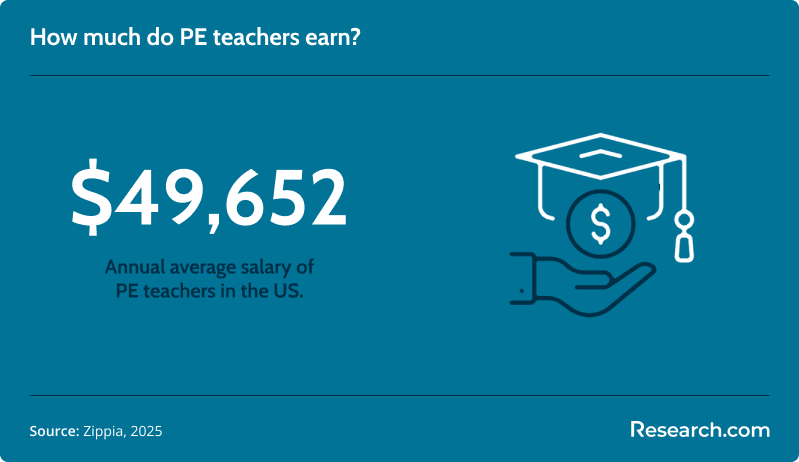
According to Zippia, PE teachers earn an average annual salary of $49,652 in 2025. Your actual salary may be higher or lower depending on the district salary schedule, state funding, cost of living, union contract, years of experience, degree level, school type, and whether you take on coaching or extracurricular duties.
- Where you teach matters. PE teachers in New York and California can earn $60,000 or more, while teachers in lower-cost states such as Mississippi or Arkansas may earn closer to $40,000.
- Experience typically raises earnings. Entry-level PE teachers often start around $40,000, while teachers with 10+ years of experience can earn between $55,000 and $70,000.
- Graduate credits can affect salary lanes. A bachelor’s degree is the minimum in many states, but a master’s degree can add $5,000–$10,000 more annually in some settings.
- Public and private schools may pay differently. Public school PE teachers often earn more than private school teachers. High school PE teachers may earn $2,000–$5,000 more than elementary PE teachers.
- Coaching stipends can supplement income. Many PE teachers coach sports, which may add $2,000–$10,000 per year depending on the sport and district.
If you are comparing education careers across grade levels, the kindergarten teacher career guide can help you see how responsibilities, pay structures, and certification requirements differ.
| Salary Factor | How It Influences PE Teacher Pay |
| State and district | Local salary schedules, funding levels, and cost of living create major pay differences. |
| Experience | Teachers often move up salary steps as they gain years of service. |
| Degree level | Graduate coursework or a master’s degree may place teachers in higher salary lanes. |
| Grade level | Some districts pay high school PE roles more than elementary roles. |
| Coaching or extracurricular work | Stipends can increase annual income but usually require evening, weekend, or after-school hours. |
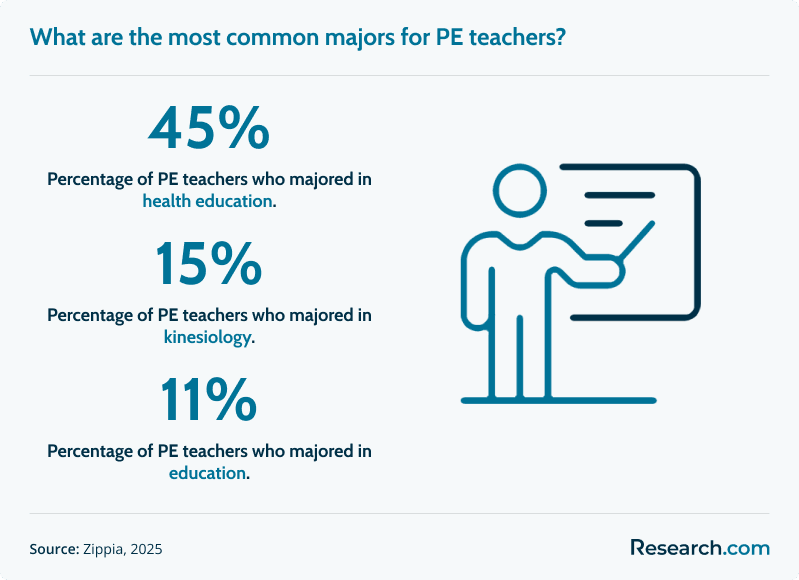
The chart below shows the most common education levels of PE teachers in the US, as reported by Zippia in 2025.
What is the job outlook for PE teachers in the next 10 years?
The employment picture for PE teachers is uneven. The BLS projects a 1% decline in teaching positions from 2023 to 2033, but NCES reports that 16% of public schools still have open PE teacher positions. That means the real question is not simply whether PE teaching is growing nationally; it is whether the state, district, and grade level you want to teach in have vacancies and funding.
Several forces affect PE hiring:
- Local shortages. Some districts, particularly in underserved areas, have more difficulty finding fully certified teachers.
- Retirements and turnover. Even in a slow-growth field, openings appear when teachers retire, relocate, or leave education.
- Student wellness concerns. Schools focused on physical activity, health, and sedentary behavior may continue to prioritize PE programs.
- District budgets. Hiring depends on staffing formulas, state funding, enrollment patterns, and local policy choices.
- Alternative certification use. Some states expand nontraditional routes when certified applicants are scarce.
If your long-term plans include research, higher education, curriculum leadership, or administration, it may be useful to compare a doctor of education vs doctor of philosophy before choosing a graduate pathway.
How can physical education teachers advance their careers?
PE teachers can advance by building skills that extend beyond daily gym instruction. Common growth paths include coaching, athletic administration, health education, department leadership, district wellness coordination, curriculum development, and school administration. Teachers whose districts reward graduate study may consider online education master’s degrees, especially if they want to strengthen leadership skills or qualify for additional responsibilities.
| Career Goal | Practical Next Step | How It Helps |
| Athletic coach | Build sport-specific coaching experience and maintain safety credentials | Coaching develops leadership skills and may provide stipend income. |
| Athletic director | Learn budgeting, scheduling, compliance, event operations, and personnel management | Athletic directors manage programs, not just teams or PE classes. |
| District PE coordinator | Develop curriculum design, assessment, and standards-alignment expertise | District roles require consistency across multiple schools and grade levels. |
| School administrator | Complete state-required leadership coursework and licensure steps | Administrative roles require credentials beyond PE certification in many states. |
| Higher education or research | Explore advanced graduate study | College teaching and research positions may require doctoral preparation. |
What are the state-specific certification requirements for PE teachers?
PE certification is issued at the state level, so requirements are not identical nationwide. A state may require an approved degree, educator preparation, content exams, pedagogy exams, student teaching, background checks, CPR training, health education coursework, adapted PE preparation, and renewal credits. Before enrolling in any program, review the teacher certification requirements by state and confirm that your chosen school is approved for the state where you plan to teach.
Questions to Ask Before Choosing a PE Teacher Preparation Program
- Is this program approved for teacher licensure in the state where I want to work?
- Does student teaching come with the program, or must I arrange placements separately?
- Which PE certification exams does the curriculum prepare students to take?
- If I move, will this degree meet another state’s certification requirements?
- Does the program train candidates in adapted PE, safety procedures, assessment, and classroom management?
- What are the student teaching completion and exam pass outcomes for candidates?
- Will my state licensing agency accept the program’s online courses and field placements?
Can advanced academic programs accelerate career growth in physical education?
Graduate study can support career growth, but it should connect to a clear goal. A master’s, EdD, or PhD may help PE teachers move toward athletic administration, district leadership, curriculum design, policy, principal roles, higher education, or research. It is less useful if the program does not improve your qualifications, salary placement, or leadership options. Teachers looking for a faster doctoral route may compare 2 year Ed D programs online, but they should verify accreditation, workload, dissertation or capstone expectations, and whether the degree fits their intended role.
How can pursuing an EdD degree benefit my career as a PE teacher?
An EdD may benefit PE teachers who want to influence programs at the school, district, or policy level. Doctoral coursework can build skills in applied research, curriculum evaluation, educational leadership, school improvement, and decision-making. It may be especially useful for educators pursuing district wellness leadership, program design, administrative roles, or higher-level curriculum work. Teachers comparing flexible doctoral options can review affordable online EdD programs, but they should avoid enrolling only for the title; the credential should solve a real career problem.
How can physical education teachers enhance their leadership skills?
Leadership growth often starts inside the school. PE teachers can mentor new educators, coordinate wellness events, lead professional development, manage athletic activities, serve on curriculum committees, supervise coaches, or help align PE standards across grade levels. Some educators pursue deeper leadership training, including a PhD in leadership, when they want to study organizational change, strategic management, administration, or systems-level decision-making.
What are the emerging trends in physical education?
Physical education is shifting toward whole-student wellness, inclusion, data-informed instruction, and lifelong activity. Many schools expect PE teachers to support fitness, mental health, social-emotional learning, accessibility, and healthy habits rather than focusing only on competitive sports. Wearable fitness trackers, mobile apps, and digital assessment tools can help teachers monitor participation and personalize goals, but they should be used carefully with attention to student privacy, equity, and instructional purpose. Teachers who want to lead broader curriculum change may consider online educational leadership master’s programs if they plan to move into schoolwide or districtwide roles.
Do physical education teachers need to renew their certification?
Yes. Most PE teachers renew certification every 3 to 5 years, although the exact period depends on state rules. Renewal requirements are designed to keep teachers current in safety practices, instructional methods, health education standards, student support, and professional expectations. Always verify renewal rules directly with your state education agency because acceptable activities and deadlines vary.
- Professional development hours. Many states require 50–150 hours through workshops, district training, approved online courses, or conferences.
- Graduate coursework. Some states allow or require graduate credits as part of renewal. Compare costs before enrolling so renewal does not become unnecessarily expensive.
- Recertification exams. Certain states may require teachers to retest or demonstrate updated knowledge.
- Teaching experience. Some renewal systems require active teaching for a set period, often 3–5 years.
- CPR and first aid. Because PE involves physical activity and injury risk, some states expect current CPR and first aid certification.
To reduce renewal costs, look first for district-paid professional development, state-approved free training, tuition reimbursement, and flexible programs such as the cheapest online education degree programs. The best strategy is to track credits and hours from your first year of licensure rather than waiting until renewal is due.
What are the benefits of becoming a PE teacher?
PE teaching can be a strong fit for people who enjoy movement, youth development, coaching, health education, and school community involvement. The role combines instruction, mentoring, safety planning, motivation, and wellness education. A 2024 study found that structured fitness programs improve children's agility, cardiorespiratory fitness, lower limb power, and speed, showing why effective PE instruction can matter beyond the gym.
- You help students build lifelong habits. PE teachers teach movement skills, confidence, coordination, fitness knowledge, teamwork, and positive attitudes toward activity.
- Certified teachers remain needed in many schools. Although the overall outlook is mixed, 16% of public schools still have open PE teacher positions.
- The daily work is active. PE teachers teach through movement, games, fitness planning, teamwork, safety routines, and skill practice rather than sitting at a desk all day.
- The career can expand in several directions. PE teachers may become coaches, athletic directors, health educators, curriculum leaders, or district coordinators. Some teachers also add credentials outside PE, such as by reviewing reading specialist certification requirements, although that path is most relevant for educators interested in literacy support or broader school roles.
- Public school jobs may include structured benefits. Many public school teachers receive health insurance, retirement plans, paid leave, and salary schedules tied to experience and education.
How can PE teachers create inclusive physical education programs?
Inclusive PE gives every student a meaningful way to participate, learn movement skills, and experience success. That includes students with disabilities, medical needs, low confidence, different cultural backgrounds, varied athletic experience, and different learning preferences. Teachers can use modified equipment, visual directions, flexible grouping, peer support, adapted rules, student choice, alternative assessments, and collaboration with special education staff. Students planning their undergraduate path may also explore an interdisciplinary studies bachelor degree if they want broader preparation in education, health, technology, psychology, or inclusive instruction.
Common Mistakes to Avoid When Pursuing PE Certification
- Enrolling before checking state approval. A degree may be legitimate but still not lead to teacher licensure in your state.
- Comparing only tuition prices. Certification costs may also include testing fees, background checks, fingerprinting, field placement travel, textbooks, and reduced work hours during student teaching.
- Assuming every online program is licensure-ready. Online courses may be acceptable, but student teaching, state approval, and field placements must be verified.
- Ignoring transfer rules. Transfer students and career changers should confirm how previous credits apply before committing to a program.
- Relying too heavily on rankings. A well-ranked school is not the right choice if it does not meet your state’s PE certification requirements.
- Waiting to learn renewal requirements. Continuing education begins after initial licensure, so document professional development from the beginning.
What are the biggest challenges PE teachers face?
PE teachers handle more than games and fitness activities. They must manage safety, large groups, student motivation, limited facilities, diverse abilities, and state standards while keeping students engaged. Certification provides the foundation, but effective teaching also requires quick adaptation, clear communication, organization, and strong classroom management.
- Limited space, equipment, and budgets. Some schools operate with shared gyms, outdated equipment, small facilities, or restricted outdoor space.
- Different levels of student motivation. Students may hesitate because of embarrassment, disability, medical concerns, low confidence, prior negative experiences, or preference for sedentary activities.
- Large classes. High student-to-teacher ratios make feedback, supervision, safety monitoring, and individualized support more difficult.
- Changing standards and license rules. PE teachers must keep up with state expectations and renewal requirements. Aspiring educators comparing degree options may review a bachelor of education online while planning a licensure pathway.
- Health and safety responsibility. Teachers must plan warm-ups, adapt activities, monitor injury risks, and accommodate students with medical needs.
The chart below shows how much of the national education budget is invested into PE globally, as published by UNESCO in 2024.
What are the best teaching strategies for different age groups?
Effective PE instruction changes with student development. Younger children need exploration, repetition, and basic movement patterns. Adolescents often need choice, confidence-building, and meaningful fitness goals. Older students benefit from health literacy, leadership opportunities, and activities they can continue after graduation. Certification programs introduce these developmental differences, but teachers refine them through practice.
| Age Group | Effective PE Strategies | Main Teacher Priority |
| Elementary School Ages 5–10 | Use stories, stations, obstacle courses, relays, simple games, and cooperative movement tasks. | Develop motor skills, confidence, safety habits, coordination, and social interaction. |
| Middle School Ages 11–13 | Teach sport basics, fitness challenges, goal-setting, and participation options that reduce embarrassment. | Support students through physical changes while building competence and motivation. |
| High School Ages 14–18 | Offer lifetime fitness, strength training, dance, yoga, cardio activities, individual sports, and team activities. | Build independence, health literacy, leadership, and sustainable fitness habits. |
| College and Adult Learners | Use fitness apps, personalized goals, self-paced plans, applied skill practice, and safe technique instruction. | Encourage autonomy, practical application, and long-term wellness planning. |
- Elementary students: Keep directions brief, make activities playful, and emphasize broad movement rather than early sport specialization.
- Middle school students: Provide choices, protect student dignity, and avoid public comparisons that can reduce participation.
- High school students: Connect PE to stress management, adult fitness, injury prevention, and activities students can continue independently.
- Adult learners: Focus on personal goals, safe movement, self-management, and real-world fitness planning.
Are there alternative career trajectories for PE teachers with multidisciplinary skills?
Yes. PE teachers who combine classroom experience with skills in coaching, health promotion, administration, adaptive education, curriculum design, data use, or community programming may move into careers beyond traditional PE instruction. Options may include athletic administration, youth fitness programming, recreation management, health education, wellness coordination, instructional design, district curriculum work, or community wellness roles. Less direct fields, such as jobs in library science, may make sense only for educators who want to pivot toward school library services, educational resource management, or information literacy.
Should I pursue interdisciplinary studies alongside my PE teaching certification?
Interdisciplinary study can help if it strengthens a specific career plan. Useful combinations may include PE with health education, special education, psychology, coaching, nutrition, educational technology, leadership, or adapted physical education. However, adding another field can increase tuition, time to graduation, and course load, so it should not interfere with state licensure requirements. If you are considering a broader education-related pivot, resources explaining what you can do with a degree in library science can help you evaluate whether information management or school library work matches your long-term goals.
What Graduates Say About Becoming Physical Education Teachers
“I did not realize how much impact PE could have. The job lets me combine fitness, teaching, and confidence-building. When students see themselves getting stronger and more capable, I know the work matters.” – Jin
“I wanted a career that felt purposeful and stable. Certification opened the door to school jobs, and I heard from employers before graduation. Now I teach skills students can use long after they leave my class.” – Amina
“No two school days feel the same. Some students start out nervous, then later volunteer to lead warm-ups or support classmates. Watching that change happen is one of the best parts of teaching PE.” – Ravi
Key Insights
- PE teacher certification is controlled by each state. Confirm degree, exam, student teaching, background check, and renewal rules where you plan to teach.
- The traditional path usually takes 4 to 6 years. A bachelor’s degree with teacher preparation is the most common route, while alternative certification may work for career changers with a bachelor’s degree.
- Program approval matters more than convenience. Online, low-cost, or flexible programs must still meet state licensure requirements and include approved field experience.
- Salary depends on more than the job title. PE teachers earn an average annual salary of $49,652, but district schedules, location, experience, graduate credits, grade level, and coaching stipends affect pay.
- The job market varies by location. Even with a projected 1% decline in teaching positions, public schools continue to report open PE roles, especially in shortage areas.
- Renewal is part of the profession. Most PE teachers renew every 3 to 5 years through professional development, coursework, exams, teaching experience, or state-approved activities.
- Career growth requires planning. Coaching, athletic administration, curriculum leadership, school administration, educational leadership, and advanced degrees can expand opportunities beyond daily PE instruction.
References:
- Bureau of Labor Statistics (BLS). (2024a). High School Teachers. Occupational Outlook Handbook. BLS.
- Bureau of Labor Statistics (BLS). (2024b). Kindergarten and Elementary School Teachers. Occupational Outlook Handbook. BLS.
- Bureau of Labor Statistics (BLS). (2024c). Middle School Teachers. Occupational Outlook Handbook. BLS.
- National Center for Education Statistics (NCES). (2024). Most U.S. public elementary and secondary schools faced hiring challenges for the start of the 2024–25 academic year. Press Releases. NCES.
- Reis, L. N., Reuter, C. P., Burns, R. D., Martins, C. M. D. L., Mota, J., Gaya, A. C. A., ... & Gaya, A. R. (2024). Effects of a physical education intervention on children’s physical activity and fitness: The PROFIT pilot study. BMC Pediatrics, 24(1). BMC Pediatrics.
- Tan, T. S., Arellano, I., & Patrick, S. K. (2024). State Teacher Shortages 2024 Update. Resources. Learning Policy Institute.
- United Nations Educational, Scientific and Cultural Organization (UNESCO). (2024). The Global State of Play. UNESCO.
- Zippia. (2025a). Physical Education Teacher Education Requirements. Zippia.
- Zippia. (2025b). Physical Education Teacher Salary. Zippia.
Other Things You Should Know About the Physical Education Teacher Certification and Requirements
In 2027, prospective Physical Education teachers must pass the Praxis Physical Education: Content Knowledge exam to obtain certification. This standardized test assesses candidates' understanding and skills needed to effectively teach physical education at various educational levels.
Yes. Many states require Physical Education teachers to hold current CPR and first aid certification before licensure or employment, and school districts often expect it to stay valid throughout employment. Training is usually completed through the American Red Cross, American Heart Association, or a state-approved provider.