
2027 Cheapest Way to Get a Teaching Credential in Florida: Requirements & Certification

Co-Founder and Chief Data Scientist
Choosing the cheapest way to get a teaching credential in Florida is not just about finding the lowest tuition. The real decision is which certification path lets you become eligible to teach legally, meet Florida Department of Education requirements, control exam and application costs, and avoid paying for coursework you may not need. This guide is for career changers, recent graduates, out-of-state teachers, international applicants, online learners, and current educators who want a lower-cost route into Florida classrooms without taking unnecessary risks with accreditation or certification eligibility.
You will learn how Florida’s Temporary and Professional teaching certificates work, what fees to expect, when online or alternative certification makes sense, how reciprocity works for out-of-state teachers, what happens if a certificate expires, and which questions to ask before enrolling in a teacher preparation program. The goal is practical: help you compare options before spending money.
Quick Answer: What is the cheapest way to get a teaching credential in Florida?
For many candidates, the lowest-cost path is to use Florida’s Temporary Certificate route. If you already have a bachelor’s degree, you may be able to begin teaching after meeting eligibility requirements, securing a Florida teaching position, and completing the remaining steps toward a Professional Certificate while employed. Candidates may qualify by passing the Florida Subject Area Examination or by holding certification from the American Board for Certification of Teacher Excellence. The Temporary Certificate is valid for five years, which gives teachers time to complete professional certification requirements while earning income.
The cheapest route depends on your starting point. A recent graduate, a career changer, an out-of-state certified teacher, and an international applicant may have different required costs. Before choosing a program, confirm whether it is accepted by the Florida Department of Education, whether it prepares you for the Florida Teacher Certification Examinations, and whether it helps you satisfy all certificate requirements.
Key Things You Should Know About the Cheapest Way to Get a Teaching Credential in Florida
- A Temporary Certificate can reduce upfront cost because eligible bachelor’s degree holders may teach while completing remaining certification requirements.
- Florida candidates may qualify for the Temporary Certificate by passing the Florida Subject Area Examination or by holding American Board for Certification of Teacher Excellence certification.
- The Temporary Certificate lasts five years, giving new educators a defined window to complete requirements for the Professional Certificate.
- You generally need a teaching position in a Florida school before the Temporary Certificate can be issued, so job search timing matters.
- Florida recognizes valid teaching certificates from other states when the certificate and subject area meet state rules.
- Application fees are only one part of the budget. Fingerprinting, background checks, tests, transcripts, evaluations, and coursework can add to the total cost.
- Online and alternative routes can be affordable, but only if they are recognized for Florida certification and match the subject or grade level you plan to teach.
- How much does it cost to become a teacher in Florida?
- Can a foreigner get a Florida teaching license?
- Can I get my teaching credential online in Florida?
- Can I teach in Florida with an out of state credential?
- How many years do you have to teach in Florida to retire?
- What happens if my Florida teaching credential expires?
- How many units is a Florida teaching credential?
- How much do teachers in Florida make?
- What is the job outlook of teachers in Florida?
- What is the career path of a teacher in Florida?
- What challenges might educators encounter during the credentialing process in Florida?
- What alternative careers can teachers in Florida pursue with their teaching credential?
- What are the benefits and differences of teaching in private vs. public schools in Florida?
- How can I verify the accreditation and quality of online teacher certification programs in Florida?
- What are the complete Florida teacher certification requirements?
- What are the key steps to become a preschool teacher in Florida?
- How can specialized teaching credentials boost my career in Florida?
- What are the subject-specific teaching specializations available in Florida?
- Can teaching credentials open doors to educational leadership positions?
- What are the music teacher education requirements in Florida?
- What financial aid options are available to reduce teaching credential costs in Florida?
How much does it cost to become a teacher in Florida?
The least expensive teaching credential path in Florida usually starts with understanding which costs are required by the state and which costs depend on the program you choose. The Florida teaching certificate application fee is $75 per subject for first-time applicants and for applicants whose prior certificates have been expired for more than one year.
If you are moving from a Temporary Certificate to a Professional Certificate, the fee is also $75 when the Temporary Certificate is still valid or expired within the past year. Adding another subject area costs $75 per subject. Removing a subject is less expensive at $20 per subject.
Renewing a Professional Educator Certificate costs $75. If the certificate expired within the previous year, the renewal cost rises to $105 because of the late application fee. Reinstating an expired certificate costs $75 per subject.
Certification fees are not the full cost. Most candidates should also budget for fingerprinting and background checks, which vary by service provider and school district. Depending on your route, you may also pay for transcripts, exam registration, credential evaluations, coursework, test preparation, or a teacher preparation program.
| Cost item | Stated amount | When it applies |
| Initial Florida teaching certificate application | $75 per subject | First-time applicants and applicants whose previous certificate lapsed for more than one year |
| Temporary to Professional Certificate application | $75 | When the Temporary Certificate is valid or expired within the last year |
| Add a subject | $75 per subject | When expanding certification areas |
| Remove a subject | $20 per subject | When deleting a subject from an existing certificate |
| Professional Certificate renewal | $75 | Standard renewal |
| Late renewal after expiration within the last year | $105 | Renewal plus late application penalty |
| Reinstatement of an expired certificate | $75 per subject | When reinstating a lapsed certificate |
Low-cost strategies to consider
- Use the Temporary Certificate route when eligible: This can let you work while completing remaining requirements instead of paying for a full traditional route upfront.
- Start with community college coursework: If you need prerequisite or general education credits, community colleges may lower the total cost before transfer to a four-year institution.
- Compare online options carefully: Online programs may reduce commuting and housing costs, but they must align with Florida certification requirements.
- Ask districts about reimbursement: Some employers may help with certification expenses, exam preparation, mentoring, or required coursework.
- Avoid paying for duplicate coursework: Request a clear review of your transcripts and certification status before enrolling in additional classes.
If you are considering long-term specialization, also compare how additional credentials could affect advancement. For example, educators interested in serving students with disabilities may want to review special education career options before choosing a certification area.
Can a foreigner get a Florida teaching license?
Yes. Foreign nationals can pursue a Florida teaching license, but applicants educated outside the United States usually need additional documentation before the Florida Department of Education can evaluate eligibility. The central requirement is a credential evaluation report that explains the U.S. equivalency of the applicant’s academic record and provides a detailed course-by-course review. The report must be in English, and original reports are required because copies are not accepted.
International applicants should treat the evaluation as an early step, not an afterthought. Delays in document translation, institutional records, course equivalency, or mailing can slow the certification timeline.
Credential evaluation options for internationally educated applicants
- Use an accredited four-year college or university in the United States that provides accepted evaluation services.
- Choose an agency that belongs to the National Association of Credential Evaluation Services.
- Consider an agency affiliated with the Association of International Credential Evaluators.
- Use an evaluation provider approved by the Bureau of Educator Certification.
Noncitizens must also address immigration status. Before seeking employment, applicants should confirm the appropriate status through United States Citizenship and Immigration Services. Once a Florida school hires the applicant, the employer verifies immigration status with the Bureau of Educator Certification as part of the certificate process.
International educators who want to strengthen their preparation for multilingual classrooms may also compare graduate options such as online master’s programs in ESL, especially if they plan to work with English learners.
Can I get my teaching credential online in Florida?
Yes, parts of the Florida teaching credential process can be completed online, and many teacher preparation programs now offer online or hybrid formats. However, “online” does not automatically mean “approved,” “cheapest,” or “sufficient for certification.” The key question is whether the program satisfies Florida’s requirements for the certificate, subject, and grade level you want.
Online programs can be useful for working adults, career changers, parents, and rural applicants who need flexibility. They may also reduce transportation and relocation costs. Still, candidates must confirm how the program handles field experience, student teaching, mentoring, exam preparation, and documentation required by the state.
| Online credential option | Best for | Cost risk to check |
| Online education degree | Students who still need a bachelor’s degree or a formal teacher preparation program | Paying for a degree that does not match the intended certification area |
| Online alternative certification coursework | Career changers with a bachelor’s degree outside education | Assuming all alternative programs are accepted for Florida certification |
| Online exam preparation | Candidates preparing for the Florida Teacher Certification Examinations | Spending on prep materials before knowing which exams are required |
| Online professional development | Certified teachers maintaining or expanding credentials | Taking courses that do not count toward renewal or reinstatement requirements |
After completing an approved route, candidates must pass the required Florida Teacher Certification Examinations. Online programs may provide study tools, but passing exams remains the candidate’s responsibility.
Technology will continue to influence teacher preparation through online coursework, hybrid field supervision, digital portfolios, and remote professional development. Teachers who later want to move into broader school or policy roles can also explore career paths in education beyond the classroom.
Florida has consistently ranked among the top 10 states with the highest number of unfilled teaching positions in recent years. For candidates, that demand may create opportunity, but it does not remove certification requirements.
Can I teach in Florida with an out of state credential?
Yes, Florida provides a route for educators who already hold valid out-of-state teaching credentials. If your certificate is comparable to Florida’s Professional Certificate, current, and aligned with a subject recognized by Florida, you may be able to apply for a Florida Professional Certificate without starting over.
Out-of-state reciprocity can be one of the most cost-effective options because it may reduce repeated coursework. The important step is to apply in the same subject area as your existing credential and provide complete documentation.
What Florida looks for in an out-of-state credential
- Comparable certificate type: The credential should be a standard educator certificate similar to Florida’s Professional Certificate.
- Subject match: The certificate area must correspond to a Florida-recognized subject area.
- Equivalent preparation: The training behind the certificate must meet or exceed Florida’s expectations.
- Current status: The certificate must be valid and cannot be expired or revoked.
Teachers with valid National Board for Professional Teaching Standards certification may also apply for a Florida Professional Certificate. If you do not hold a valid out-of-state certificate, the Temporary Certificate may still be an option if your bachelor’s degree or teacher education program supports eligibility.
If you need additional coursework, compare approved and affordable options before enrolling. Research.com’s guide to online teaching degree programs can help you evaluate program formats and next steps.
How many years do you have to teach in Florida to retire?
Teacher retirement eligibility is separate from teacher certification. A Florida teaching credential allows you to teach when all state and employer requirements are met, but retirement rules depend on the retirement system, employment type, years of service, age, plan selection, and employer participation.
The provided certification information does not specify a single number of years required to retire. Before making career or financial decisions, teachers should verify their retirement plan details directly with the appropriate Florida retirement authority or employer human resources office.
What to ask before relying on a retirement estimate
- Am I enrolled in the correct retirement plan for my position?
- How is creditable service calculated for teachers in my district?
- Does prior public employment, out-of-state teaching, or military service count?
- What happens if I move from public school to private school employment?
- How do breaks in service affect eligibility?
From a credentialing standpoint, a low-cost entry route such as alternative certification may help candidates begin earning sooner. However, retirement planning should be handled separately from certification planning. Educators interested in expanding long-term options may also review online special education programs and related education pathways.
Florida has consistently been recognized as one of the states with the highest number of teachers who have completed a teacher preparation program, reinforcing the importance of formal preparation even when candidates enter through alternative pathways.
What happens if my Florida teaching credential expires?
If your Florida Professional Certificate expires, you cannot assume you are still eligible to teach under that credential. You may need to renew, reinstate, or pursue another eligible route depending on how long the certificate has been expired and whether you hold other valid credentials, such as an out-of-state certificate or National Board for Professional Teaching Standards certification.
Reinstatement can involve fees, coursework or in-service points, exams, and fingerprint-based background checks. Because the application is valid for one year, candidates should begin early enough to complete all requirements before the deadline.
Common reinstatement requirements
- Submit an online application: The application must include the required processing fee and remains valid for one year.
- Complete education requirements: Candidates must earn six semester hours of college credit, including at least one hour focused on teaching students with disabilities. These credits must be earned within five years before applying.
- Use in-service points when eligible: Educators may be able to use points from an approved Florida master in-service program, where 60 points equal three semester hours of college credit.
- Pass required exams: A passing score on the Florida Subject Area Examination is required for each subject on the expired certificate, and scores must be from the last five years.
- Complete background checks: Fingerprinting is required for checks by the Florida Department of Law Enforcement and the FBI. Disclosed criminal offenses may trigger additional review.
The biggest mistake is waiting until the school year is about to begin. Expiration can create employment, scheduling, and income problems. Teachers should track certificate dates, keep professional development records, and confirm renewal requirements well before the credential lapses.
How many units is a Florida teaching credential?
Florida does not describe a teaching credential only in “units” the way some other states or institutions may. For Professional Certificate preparation, candidates typically need a bachelor’s degree, which usually includes 120 to 130 credit hours. That degree combines general education, major coursework, subject preparation, and teacher training when completed through an education route.
If your goal is to reduce cost, focus less on the total credit number and more on which credits you actually still need. Candidates who already hold a bachelor’s degree may not need a second degree if they qualify for a Temporary Certificate or an alternative certification route.
Lower-cost ways to complete required credits
- Begin at a community college: Completing lower-division coursework before transferring may reduce total tuition.
- Use online courses strategically: Online study may help working adults avoid commuting and scheduling costs.
- Apply for aid early: Scholarships, grants, and federal or state aid may reduce the out-of-pocket cost of education coursework.
- Use the Temporary Certificate when eligible: This option may allow candidates to teach for five years while completing remaining requirements.
Before enrolling in additional classes, request written guidance on whether each course will satisfy certification, renewal, reinstatement, or endorsement requirements. Paying for the wrong credits is one of the most expensive mistakes aspiring teachers make.
How much do teachers in Florida make?
Teacher salary in Florida varies by district, experience, education level, subject area, and school type. The average annual salary for public school educators in Florida is around $67,921. New teachers may earn between $38,108 and $45,000 depending on the district.
Experience typically affects salary progression. A teacher with five years of experience might earn approximately $55,000, while teachers with more than two decades in the profession can earn $70,000 or more. Teachers who earn a master’s degree or higher may earn an additional $5,000 to $10,000 annually compared with teachers who hold only a bachelor’s degree. Specializations in areas such as STEM or special education may also affect compensation where districts have strong hiring needs.
| Salary factor | How it may affect pay | Decision point for credential seekers |
| District | Starting pay and salary schedules differ by location | Compare district salary schedules before accepting a position |
| Experience | Pay often rises with years in the classroom | Ask how prior teaching or related experience is credited |
| Graduate education | A master’s degree or higher may add $5,000 to $10,000 annually | Compare tuition cost against realistic salary increases |
| Subject specialization | High-need fields may offer stronger opportunities in some districts | Choose a specialization that matches both demand and your strengths |
Florida districts have been working to improve teacher pay, and performance-based bonuses are becoming more common in some high-need subjects. Still, no salary is guaranteed by earning a credential. Candidates should compare certification costs against likely pay in the districts where they plan to work.
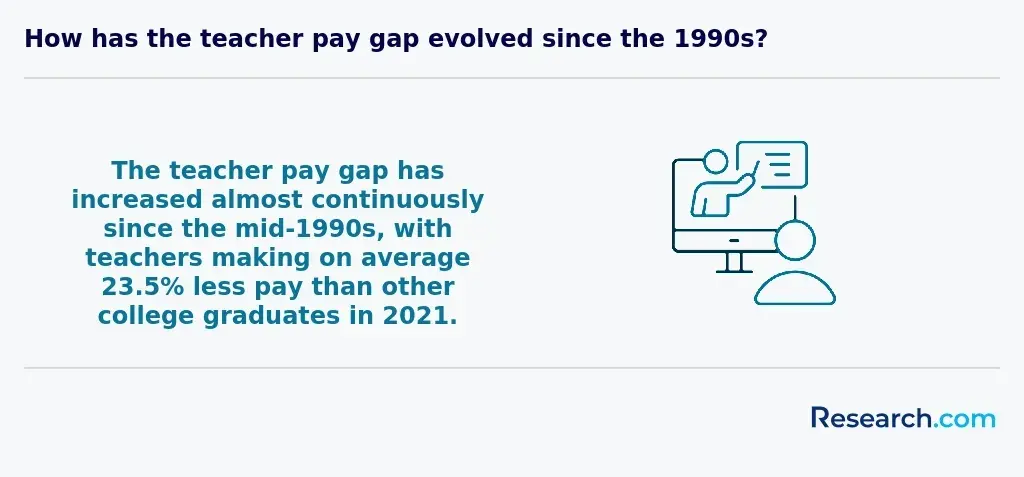
The teacher pay gap in the United States remains a major issue, with educators often earning less than workers in other fields with similar education and experience. That makes upfront cost control especially important for aspiring teachers.
What is the job outlook of teachers in Florida?
Florida’s teacher job outlook is stronger than the national projection for some roles, based on the figures provided. The number of elementary school teachers in Florida is projected to increase from approximately 72,700 in 2020 to around 79,890 by 2030, representing about 10% growth over the decade.
Florida is expected to have approximately 6,120 annual openings for elementary school teachers over the next ten years. These openings are expected to come from both growth and replacement needs, including retirements and career changes.
Nationally, teacher employment growth is projected at 1% from 2022 to 2032. Compared with that national figure, Florida’s projected elementary teacher growth suggests a more active hiring environment in the state.
| Job outlook measure | Florida figure stated | What it means for candidates |
| Elementary teacher employment in 2020 | Approximately 72,700 | Florida already has a large elementary teaching workforce |
| Projected elementary teacher employment by 2030 | Around 79,890 | More positions are expected over the decade |
| Projected Florida growth | About 10% | Demand may support entry opportunities for qualified candidates |
| Expected annual openings | Approximately 6,120 | Openings include both new and replacement positions |
| National teacher employment growth | 1% from 2022 to 2032 | Florida’s stated projection is stronger than the national comparison |
A strong outlook does not mean every subject or district hires equally. Candidates should research local vacancies, shortage areas, commute distance, pay, mentorship support, and working conditions before choosing where to apply.
What is the career path of a teacher in Florida?
A Florida teaching credential can lead to more than one classroom assignment. Many teachers begin in entry-level classroom roles, gain experience, add endorsements or subject areas, and then move into leadership, mentoring, curriculum, or administration.
Common career directions for Florida teachers
- Classroom teacher: Most educators begin by teaching a grade level or subject area aligned with their certification.
- Lead teacher or mentor: Experienced teachers may support new educators, model instruction, and help improve teaching practices.
- Specialized teacher: Additional credentials can open roles in areas such as STEM, special education, history, music, early childhood, or English learner support.
- School administrator: Teachers who pursue leadership preparation may later become assistant principals or principals.
- District role: Curriculum coordinators, instructional specialists, and district administrators influence instruction across multiple schools.
- Policy, advocacy, or research: Educators with classroom experience may contribute to education policy, program evaluation, or nonprofit work.
- Education entrepreneurship: Some teachers create learning materials, tutoring services, curriculum products, or educational technology tools.
The best career path depends on your certificate area, performance, additional training, leadership interest, and willingness to pursue further credentials. When comparing low-cost certification routes, also ask whether the pathway will support your longer-term goals, not only your first teaching job.
What challenges might educators encounter during the credentialing process in Florida?
The Florida credentialing process can be affordable, but it is not always simple. Candidates may run into processing delays, missing documents, exam scheduling problems, incomplete transcripts, or confusion about which requirements apply to their route. International applicants may face added issues with credential evaluation, translations, document verification, and academic equivalency.
The best way to reduce delays is to keep records organized, use state-approved or recognized providers, monitor Florida Department of Education updates, and request written confirmation when an advisor or program representative explains requirements. Educators who want broader options outside traditional K-12 teaching may also consider advanced study such as an online adult education degree.
What alternative careers can teachers in Florida pursue with their teaching credential?
A Florida teaching credential can support career mobility, especially when paired with additional training, graduate study, or licensure. Teachers often move into instructional design, tutoring, curriculum development, education consulting, corporate training, school administration, education nonprofit work, or student support roles.
One related path is speech-language pathology, where professionals work with students who have communication or swallowing disorders. Teachers interested in that transition must understand that it requires separate preparation and licensure. Research.com’s guide to the SLP license in Florida explains that route in more detail.
What are the benefits and differences of teaching in private vs. public schools in Florida?
Public and private school teaching in Florida can feel very different. Public schools operate under state and federal requirements and typically use district salary schedules, formal certification expectations, and public accountability systems. Private schools may have more flexibility in curriculum, teaching methods, class structure, and school culture.
| Factor | Public schools | Private schools |
| Certification expectations | Usually tied closely to Florida public school certification rules | Requirements may differ by school, role, and accrediting body |
| Curriculum | More structured by state and district requirements | Often more flexible depending on the school mission |
| Class size | Varies by district, grade, and funding | May be smaller in some schools |
| Pay and benefits | Often based on district salary schedules and public benefits systems | May offer different salary structures, tuition discounts, or community-based benefits |
| Best fit | Teachers who want public system stability and clear certification alignment | Teachers who prefer mission-specific schools or more curricular flexibility |
Private school teaching may appeal to educators who want smaller learning communities or more instructional freedom. Public school teaching may be a better fit for those who want state-aligned certification, public-sector benefits, and district advancement structures. Before deciding, review private school teacher requirements in Florida and compare them with public school expectations.
What are the music teacher education requirements in Florida?
Florida music teachers need both subject knowledge and teacher preparation. Candidates typically complete an undergraduate degree with a music concentration, including music theory, performance studies, and music pedagogy. They also need preparation aligned with Florida educator standards and practical classroom experience.
Because music teaching combines performance, instruction, and classroom management, aspiring teachers should verify that their program prepares them for both certification exams and real teaching responsibilities. Mentorship, workshops, master classes, and supervised teaching experiences can strengthen readiness. For a focused overview, review the music teacher education requirements in Florida.
What financial aid options are available to reduce teaching credential costs in Florida?
Financial aid can make a major difference, especially for candidates who need coursework before certification. Options may include scholarships, grants, federal aid, state aid, community-based funding, tuition assistance, and district reimbursement programs. Some awards target future teachers in high-need fields, underrepresented groups, or early childhood education.
Ways to lower your out-of-pocket cost
- Submit financial aid forms early so you do not miss priority deadlines.
- Ask programs whether scholarships are available specifically for education majors or certification candidates.
- Check whether your district reimburses application fees, exam costs, or required coursework.
- Compare total program cost, not just tuition per credit.
- Look for grants or scholarships connected to shortage areas or early childhood education.
If you are considering early grades, Research.com’s guide on how to become a kindergarten teacher in Florida can help you compare requirements and possible pathways.
How can I meet middle school math teacher requirements in Florida?
Middle school math candidates should confirm both subject knowledge and pedagogy requirements. Strong preparation usually includes mathematics coursework, classroom management training, assessment strategies, and experience teaching adolescent learners. Because math is a subject-specific pathway, candidates should not assume that a general education route automatically covers all expectations.
Before paying for coursework, compare your transcript with the stated requirements and identify any gaps. For detailed guidance, review middle school math teacher requirements in Florida.
Here’s What Teachers Have to Say About the Cheapest Ways to Get a Teaching Credential in Florida
-
: "
“The alternative certification route helped me control costs because I could keep working while completing online coursework. The flexibility mattered as much as the price because I did not have to pause my income to prepare for teaching.” – Erin
"
-
: "
“For me, the affordable route was about speed and access. I was changing careers, and the process helped me move into education without starting over with an entirely new degree.” – Gerry
"
-
: "
“I thought becoming a teacher would be financially out of reach. Finding a lower-cost credential pathway, along with support from other candidates, made the goal realistic.” – Amanda
"
How can I verify the accreditation and quality of online teacher certification programs in Florida?
Accreditation and state recognition should be checked before you enroll, not after you pay tuition. A program can be legitimate as an academic offering but still fail to meet your specific Florida certification needs. The safest approach is to verify both institutional accreditation and Florida certification alignment.
Program quality checklist
- Confirm the institution is properly accredited.
- Verify that the program is accepted for Florida teacher certification in your intended subject or grade level.
- Ask how field experiences, internships, or student teaching are arranged.
- Check whether the program prepares students for the Florida Teacher Certification Examinations.
- Request written confirmation of costs, fees, transfer credit policies, and completion requirements.
- Ask whether graduates have successfully used the program for Florida certification.
For a route-specific overview, review Research.com’s guide on how to become a teacher in Florida through online options.
What are the complete Florida teacher certification requirements?
Florida teacher certification requirements depend on the certificate type, subject area, prior education, exam results, background clearance, and whether the candidate is applying through a traditional, alternative, out-of-state, or international route. At minimum, candidates should expect to document an accredited degree or evaluated equivalent, satisfy subject area requirements, complete required pedagogy or professional preparation, pass required exams, and complete fingerprint-based background checks.
Because requirements can change and vary by pathway, candidates should not rely only on a school’s marketing page. Use official guidance and verify details before committing to a program. Research.com’s overview of Florida teacher certification requirements can help you compare certificate types and requirements.
What are the key steps to become a preschool teacher in Florida?
Preschool teaching requirements depend on the employer, setting, and role. Candidates often need early childhood education coursework, supervised experience, a background check, and training in developmentally appropriate practices. Some positions may require a degree in early childhood education or a related field, while others may have different minimum qualifications.
Because preschool roles can exist in public schools, private schools, childcare centers, and early learning programs, candidates should confirm the exact requirements for the workplace they want. For a step-by-step explanation, see how to become a preschool teacher in Florida.
How can specialized teaching credentials boost my career in Florida?
Specialized credentials can help teachers qualify for specific roles, stand out in hiring, and move toward leadership or curriculum responsibilities. Specialization is most useful when it aligns with student needs, district hiring demand, and the teacher’s long-term interests.
For example, a teacher interested in social studies may pursue focused preparation in history. Research.com’s guide on how to become a history teacher in Florida explains that subject-specific direction. The key is to choose credentials strategically rather than adding subjects only because they are available.
What are the subject-specific teaching specializations available in Florida?
Florida supports many subject-specific teaching areas, allowing educators to target the grade level and content area they want to teach. These may include elementary education, middle school subjects, high school subjects, special education, music, early childhood, history, mathematics, and other academic or career-focused fields.
Subject-specific certification can improve fit between teacher preparation and classroom assignment. It may also support advancement into department leadership, curriculum design, or specialized instruction. Candidates interested in secondary history can review how to become a high school history teacher in Florida.
Can teaching credentials open doors to educational leadership positions?
Yes. A teaching credential can be the starting point for educational leadership, although leadership roles usually require experience, additional preparation, and demonstrated effectiveness. Teachers often build leadership credibility by mentoring colleagues, leading curriculum projects, supporting school improvement efforts, and taking on instructional coaching responsibilities.
Over time, educators may pursue roles such as lead teacher, department chair, instructional coach, assistant principal, principal, district coordinator, or curriculum specialist. If your long-term goal is administration or systems-level work, compare certification routes that will not limit future study. Research.com’s guide to educational leadership positions outlines possible advancement paths.
Common mistakes to avoid when choosing the cheapest Florida teaching credential route
- Choosing the lowest tuition without checking approval: A cheap program is expensive if it does not satisfy Florida certification requirements.
- Ignoring exam costs: The Florida Teacher Certification Examinations charge approximately $97 for each of the three subtests on the initial attempt, so retakes can add up.
- Assuming all online programs qualify: Online format does not guarantee state acceptance or subject-area alignment.
- Forgetting fingerprinting and background checks: These required steps can add costs and time.
- Waiting too long to renew: Expired credentials can trigger reinstatement requirements, added coursework, exams, and delays.
- Paying for unnecessary credits: Always compare your transcript and current credentials against official requirements before enrolling.
- Relying only on rankings or marketing claims: Ask for written answers about certification outcomes, field placement, and total program cost.
Questions to ask before enrolling in a Florida teacher certification program
- Is this program accepted for the Florida certificate and subject area I want?
- Will I qualify for a Temporary Certificate, or do I need more coursework first?
- What exams will I need, and does the program prepare me for them?
- What is the total cost, including tuition, fees, testing, transcripts, background checks, and materials?
- Can I complete requirements while working?
- How are field experiences or internships arranged?
- Does the program accept transfer credits?
- Are scholarships, grants, employer reimbursements, or payment plans available?
- What happens if I do not pass a required exam on the first attempt?
- Can graduates verify that they successfully used this program for Florida certification?
Key Insights
- The cheapest Florida teaching credential route is often the Temporary Certificate pathway for eligible bachelor’s degree holders because it may allow candidates to teach while completing Professional Certificate requirements.
- Florida certification costs begin with state application fees, including $75 per subject for many certificate applications, but total expenses may also include exams, fingerprinting, background checks, evaluations, and coursework.
- Online and alternative certification options can lower costs, but only if they are recognized for Florida certification and match the intended subject or grade level.
- Out-of-state certified teachers should investigate reciprocity before paying for a new program because a valid comparable credential may shorten the process.
- International applicants should start early with credential evaluation and immigration-status planning, since documentation delays can affect hiring and certification timelines.
- Salary and job outlook matter when evaluating return on investment. Florida public school educators average around $67,921 annually, while new teachers may earn between $38,108 and $45,000 depending on district.
- Florida’s projected growth for elementary teachers, from approximately 72,700 in 2020 to around 79,890 by 2030, suggests opportunity for qualified candidates, but certification requirements still apply.
- The safest low-cost strategy is to verify requirements first, compare total cost second, and enroll only after you know the program supports your Florida certification goal.
Related Articles for Nearby States
- 2027 Cheapest Way to Get a Teaching Credential in Georgia: Requirements & Certification
- 2027 Cheapest Way to Get a Teaching Credential in Alabama: Requirements & Certification
- 2027 Cheapest Way to Get a Teaching Credential in South Carolina: Requirements & Certification
- 2027 Cheapest Way to Get a Teaching Credential in Mississippi: Requirements & Certification
- 2027 Cheapest Way to Get a Teaching Credential in Tennessee: Requirements & Certification
- 2027 Cheapest Way to Get a Teaching Credential in North Carolina: Requirements & Certification
- 2027 Cheapest Way to Get a Teaching Credential in Louisiana: Requirements & Certification
- 2027 Cheapest Way to Get a Teaching Credential in Kentucky: Requirements & Certification
- 2027 Cheapest Way to Get a Teaching Credential in Arkansas: Requirements & Certification
- 2027 Cheapest Way to Get a Teaching Credential in Virginia: Requirements & Certification
References:
- Accreditedschoolsonline.org (14 Jun 2024). How to Become a Teacher in Florida. https://www.accreditedschoolsonline.org/education/certification/florida/
- Fldoe.org (N.D.). Certificate Types and Requirements. Florida Department of Education certificate requirements https://www.fldoe.org/teaching/certification/general-cert-requirements/
- Onetonline.org (2024). Florida Employment Trends 25-2021.00 - Elementary School Teachers, Except Special Education. O*NET Florida employment trends
- Salary.com (2024). Public School Teacher Salary in Florida. https://www.salary.com/research/salary/benchmark/public-school-teacher-salary/fl
Other Things You Should Know About Getting a Teaching Credential in Florida
The Florida Department of Education, through the Bureau of Educator Certification, issues Florida teaching certificates and evaluates educator eligibility. Applicants submit transcripts, exam scores, and fingerprint clearance through the state certification system, and the bureau decides whether requirements for a Temporary or Professional Certificate are met.
To get a teaching credential in Florida, you must pass the Florida Teacher Certification Examinations (FTCE), which commonly include the General Knowledge Test, Professional Education Test, and a Subject Area Examination. Each test is essential to demonstrate competency in teaching standards.


