
2027 Early Childhood Education Careers: Guide to Career Paths, Options & Salary

Co-Founder and Chief Data Scientist
Choosing an early childhood education career is not just a question of whether you enjoy working with young children. It is also a decision about credentials, licensing, pay, work setting, advancement, and long-term fit. Early childhood education professionals support children during the years when language, social skills, emotional regulation, and early academic habits begin to form, but the field includes far more than preschool classrooms.
This guide is for students, career changers, teaching assistants, childcare workers, and education professionals who want to understand where an early childhood education degree can lead. You will learn which jobs are available, how salaries compare, what education or certification may be required, how long the path can take, and when an online or advanced degree may make sense.
Quick answer: Is early childhood education a good career path?
Early childhood education can be a strong fit if you want meaningful work with young children and are comfortable with a role that requires patience, communication, planning, and emotional resilience. The field offers classroom, administrative, special education, curriculum, nonprofit, healthcare, and consulting paths. Pay varies widely by role, employer, state, and credentials. Kindergarten and elementary school teachers earn a median salary of $63,670 per year, while preschool teachers earn about $37,130. Leadership and curriculum roles may pay more but usually require experience, additional credentials, or graduate education.
Key things you should know about early childhood education careers:
- Early childhood education includes teaching, childcare administration, curriculum design, family support, nonprofit work, special education, and education consulting.
- Salary depends heavily on job title, setting, location, education level, and licensing; kindergarten and elementary school teachers earn a median of $63,670 per year.
- Online early childhood education programs can help working adults complete degrees or credentials, but students should verify accreditation, practicum requirements, and state licensure alignment before enrolling.
- What early childhood education careers can you pursue in 2027?
- How do you earn an early childhood education degree?
- How much do early childhood education careers pay?
- How long does it take to become an early childhood educator?
- What skills do early childhood educators need?
- What are the advantages of an early childhood education career?
- What are the drawbacks of working in early childhood education?
- How is technology changing early childhood education?
- Can a graduate degree help you move up in early childhood education?
- What is the job outlook for early childhood educators in 2027?
- What jobs outside the classroom can you get with an early childhood education degree?
- Which certifications can strengthen an early childhood education career?
- How can related advanced degrees expand early childhood education opportunities?
- How should you choose an online early childhood education program?
- How can networking and professional development support career growth?
- How can policy advocacy and leadership training improve career options?
- Why do diversity and inclusion skills matter in early childhood education?
- How can affordable graduate degrees support leadership goals?
- Can interdisciplinary skills, including library science, help early childhood educators advance?
- Can mentorship and coaching speed up early childhood education career advancement?
What early childhood education careers can you pursue in 2027?
An early childhood education background can lead to roles in preschools, childcare centers, public schools, Head Start programs, private schools, special education settings, nonprofits, curriculum companies, and family service organizations. The right path depends on whether you prefer direct classroom work, program management, specialized child development support, or education leadership.
If your long-term interest is education administration, public systems, or policy, reviewing the best online public administration degree programs can help you understand how policy and management training may connect with early learning systems.
Early childhood education career comparison
| Career path | Main focus | Typical work setting | Average salary | Best fit for |
| Preschool Teacher | Early literacy, numeracy, play-based learning, and social development for children ages 3-5 | Preschools, childcare centers, public or private early learning programs | $37,130 | People who want daily classroom interaction with young children |
| Kindergarten Teacher | Formal early instruction in reading, math, science, routines, and social skills | Public and private elementary schools | $63,670 | Students who want a licensed teaching role in school-based education |
| Childcare Center Director | Staff supervision, licensing compliance, parent communication, budgeting, and program operations | Childcare centers and early learning facilities | $52,327 | Experienced educators who want a management role |
| Early Childhood Special Education Teacher | Individualized instruction and developmental support for young children with delays or disabilities | Public schools, specialized programs, private centers | $52,647 | Educators interested in intervention, inclusion, and individualized support |
| Montessori Teacher | Child-led, hands-on learning using Montessori methods | Montessori schools and private learning centers | $62,966 | Teachers who prefer a structured but child-centered educational philosophy |
| Head Start Program Coordinator | Program coordination, staff oversight, family engagement, and standards compliance | Head Start and community-based early education programs | $55,240 | Professionals interested in early education access and community service |
| Curriculum Developer for Early Childhood Education | Lesson design, instructional materials, teacher training, and curriculum evaluation | School systems, publishers, education companies, nonprofits | $77,461 | Experienced educators who want to influence instruction beyond one classroom |
Preschool Teacher
Preschool teachers introduce children ages 3-5 to routines, language, early math concepts, social interaction, fine motor activities, and creative learning. Their work often uses songs, stories, sensory activities, centers, movement, and guided play rather than lecture-style instruction. Requirements vary by employer and state, but many positions prefer or require early childhood coursework, a degree, state credentials, or childcare certifications.
Average Salary: $37,130
Kindergarten Teacher
Kindergarten teachers help children transition into formal schooling. They teach early reading, writing, mathematics, science, classroom routines, peer interaction, and self-management. Public school kindergarten teachers usually need a bachelor’s degree and a state teaching license. Private schools may set different requirements.
Average Salary: $63,670
Educators who enjoy data, assessment, and program improvement may also find it useful to understand business analytics career paths, especially if they want to work in school data, education research, or policy evaluation.
Childcare Center Director
Childcare center directors manage the business and educational operations of early learning programs. Their responsibilities may include hiring staff, monitoring classroom quality, communicating with families, meeting licensing standards, managing budgets, maintaining records, and responding to safety concerns. This path usually requires experience in early childhood settings and may require a degree in early childhood education, administration, or a related field.
Average Salary: $52,327
Early Childhood Special Education Teacher
Early childhood special education teachers support young children who have disabilities, developmental delays, speech and language needs, behavioral challenges, or other learning differences. They may create individualized learning plans, collaborate with therapists, adapt activities, document progress, and work closely with families. Public school roles commonly require teacher certification plus special education preparation.
Average Salary: $52,647
Montessori Teacher
Montessori teachers use carefully prepared environments, hands-on materials, observation, and child-directed activity to encourage independence and concentration. Rather than leading every activity from the front of the room, they guide children through choices within a structured learning environment. Many Montessori schools expect teachers to complete Montessori-specific training.
Average Salary: $62,966
Some educators want their work to connect with school sustainability, facilities, environmental learning, or organizational strategy. In that case, exploring career options with an online MBA in sustainability may help clarify how sustainability knowledge can apply to education organizations.
Head Start Program Coordinator
Head Start program coordinators help manage early childhood programs designed to serve children and families with economic need. Their work can include compliance monitoring, staff coordination, parent engagement, community outreach, and reporting. This role is often best for professionals who understand early childhood education, family services, and program administration.
Average Salary: $55,240
Curriculum Developer for Early Childhood Education
Curriculum developers create instructional resources, learning sequences, classroom activities, assessment tools, and teacher guides for young learners. Many enter this work after several years of classroom experience because strong curriculum design requires an understanding of child development, classroom realities, and teacher needs. A master’s degree or specialized training may improve competitiveness for these roles.
Average Salary: $77,461
If your interest is child behavior, emotional development, counseling, or research, you may also want to compare education careers with psychology pathways. Researching whether a master's degree in psychology is right for you can help you decide if a clinical, counseling, or research-focused route better matches your goals.
How do you earn an early childhood education degree?
The best degree path depends on the job you want. A childcare assistant may need less formal education than a licensed public school teacher, while directors, curriculum specialists, and policy leaders often benefit from advanced training. Before choosing a program, confirm the credential required in the state and setting where you plan to work.
Step-by-step path to an early childhood education degree
- Start with your target role. Decide whether you want to work as a preschool teacher, licensed kindergarten teacher, childcare director, special education teacher, curriculum specialist, or education administrator. Your target role determines the degree level and licensing path.
- Choose an accredited college. Look for regional accreditation and review whether the program aligns with professional standards from organizations such as the National Association for the Education of Young Children (NAEYC).
- Select the appropriate degree level. An associate degree can support entry-level childcare and preschool roles, a bachelor’s degree is commonly needed for licensed teaching positions, and a master’s degree may support leadership, specialization, or curriculum roles.
- Complete child development and teaching coursework. Early childhood education programs usually cover child growth, early literacy, family engagement, classroom management, assessment, inclusion, and special education foundations.
- Finish fieldwork or student teaching. Hands-on experience matters in this field. Practicum, observation, and student teaching placements help you learn classroom routines, family communication, behavior support, and developmentally appropriate instruction.
- Meet licensing requirements if needed. Public school teaching roles generally require state licensure, which may include exams, supervised teaching, background checks, and continuing education.
- Consider flexible online or accelerated options carefully. Online study can work well for adults balancing employment and family responsibilities, but practicum and student teaching must still meet state or employer requirements. A master's in early childhood education online may be useful for educators seeking administrative, curriculum, or specialized positions.
- Add credentials that match your niche. Certifications such as the Child Development Associate (CDA), special education training, Montessori preparation, First Aid, or CPR may strengthen your qualifications depending on the role.
Degree options in early childhood education
| Degree level | Typical time commitment | Possible outcomes | Important decision point |
| Associate degree | Typically two years | Childcare assistant, preschool support roles, entry-level early learning positions | Confirm whether credits can transfer into a bachelor’s program |
| Bachelor’s degree | Four years of full-time study | Preschool teacher, kindergarten teacher, licensed teaching roles where applicable | Make sure the program matches state teacher licensure requirements if you want public school employment |
| Master’s degree | One to two additional years | Curriculum development, leadership, specialized teaching, program administration | Compare cost, practicum expectations, specialization options, and career return |
| Doctoral degree | Varies by program | Senior leadership, policy work, research, higher education, district-level or organizational roles | Choose this route only if advanced leadership, scholarship, or systems-level work is your goal |
How much do early childhood education careers pay?
Based on our research, early childhood educators in the U.S. earn an average salary of $41,954. However, that number should not be treated as a guarantee. Pay can change significantly by state, school type, funding model, union coverage, licensure, years of experience, degree level, and whether the role is classroom-based or administrative.
Preschool teachers earn around $37,130, while kindergarten teachers in public school settings typically earn $63,670 annually. Childcare center directors earn about $52,327, and early childhood special education teachers earn around $52,647. Curriculum development roles may reach about $77,461, but those jobs often require classroom experience, strong writing skills, and sometimes graduate preparation. Head Start program coordinators earn an average salary of $55,240.
If you are comparing early childhood education with child development work in healthcare, you may also want to review how to become a child life specialist, since education, psychology, and child support careers can overlap but have different credential requirements and salary patterns.
How to interpret salary data before choosing a path
- Look beyond the average. Entry-level, rural, private childcare, public school, and leadership roles may pay very differently.
- Check whether benefits are included. Public school roles may offer different benefits than private childcare settings, even when salaries look similar.
- Consider the cost of credentials. A graduate degree can help in some roles, but the return depends on your employer, state salary schedule, and career goal.
- Review local openings. Salary averages are useful, but job postings in your area are more practical for planning.
How long does it take to become an early childhood educator?
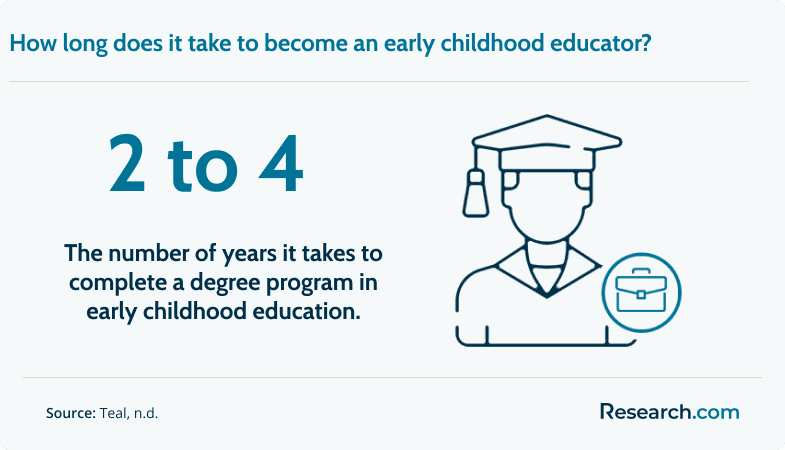
The timeline depends on the credential required for your target job. An associate degree in early childhood education usually takes two years and can prepare graduates for entry-level childcare or preschool roles. Some 1-year associate degree programs online may help students finish more quickly, especially if they have transfer credits or can handle a heavier course load.
A bachelor’s degree generally takes four years of full-time study and is commonly required for public school teaching roles. Students planning to teach in public schools should also account for student teaching, certification exams, background checks, and state licensing steps. For leadership, specialized instruction, curriculum development, or advanced education roles, a master’s degree can add one to two additional years. Some accelerated or online programs may shorten completion time to as little as 12 to 18 months for qualified candidates.
Typical early childhood education timeline
| Goal | Common preparation | Estimated timeline | What to verify |
| Entry-level childcare or preschool support | Certificate, CDA, or associate-level coursework | Varies; associate degree typically takes two years | Employer requirements and state childcare regulations |
| Preschool teacher | Associate or bachelor’s degree, depending on setting | Often two to four years | Whether the employer requires a specific credential |
| Public school kindergarten teacher | Bachelor’s degree plus state licensure | Four years of full-time study, plus licensing steps | State-approved educator preparation and testing requirements |
| Director, specialist, or curriculum role | Bachelor’s degree, experience, and sometimes a master’s degree | Four years plus one to two additional years for graduate study | Experience requirements and whether a graduate degree is preferred |
What skills do early childhood educators need?
Early childhood educators need more than warmth and enthusiasm. The work requires developmentally appropriate teaching, safety awareness, behavior support, communication with families, documentation, and the ability to respond calmly when children are tired, upset, overstimulated, or learning a new skill.
- Child development knowledge: Educators need to understand how young children develop language, motor skills, executive function, social awareness, and emotional regulation so they can design age-appropriate learning experiences.
- Classroom management: Young children need routines, predictable expectations, engaging activities, and positive behavior support. Strong classroom management helps reduce chaos and creates a safer learning environment.
- Communication skills: Teachers must explain ideas clearly to children, document progress for administrators, and discuss concerns with parents or caregivers in a respectful and practical way.
- Patience and flexibility: Children progress at different speeds. Effective educators adjust activities, repeat instructions, manage transitions, and stay calm when plans change.
- Creativity: Stories, songs, art, play, movement, and hands-on exploration help young learners stay engaged and make abstract ideas concrete.
- Collaboration: Early childhood professionals often work with families, aides, directors, therapists, special educators, and community agencies. Teamwork is especially important when children need additional support.
- Observation and assessment: Teachers need to notice developmental patterns, document progress, identify possible concerns, and plan interventions. These skills are also important in child psychology careers, where professionals evaluate children’s emotional, cognitive, and behavioral needs.
Skills employers often value most
| Skill | Why it matters | How to build it |
| Family communication | Parents and caregivers need clear updates, trust, and practical guidance | Practice parent conference scripts, written updates, and strengths-based communication |
| Behavior support | Early childhood classrooms involve big emotions and developing self-control | Study positive guidance, trauma-informed practices, and classroom routines |
| Assessment | Progress monitoring helps educators adjust instruction and recommend support | Learn observation notes, developmental checklists, and age-appropriate assessment tools |
| Inclusive teaching | Children differ in language, ability, culture, and learning needs | Take coursework in special education, multilingual learning, and culturally responsive practice |
What are the advantages of an early childhood education career?
Early childhood education can be deeply meaningful for people who want their work to affect children and families directly. It can also offer several career directions, from classroom teaching to administration, training, curriculum, and support services.
- Direct impact on children: Early educators help children build confidence, language, curiosity, social skills, and learning routines during a formative stage of life.
- Multiple work settings: Graduates can work in preschools, childcare centers, public schools, private schools, Head Start programs, nonprofits, healthcare-adjacent child support roles, and educational companies.
- Room for advancement: With experience, certifications, or graduate study, educators may move into director, coordinator, specialist, curriculum, consulting, or policy roles.
- Meaningful daily work: Many educators value seeing children master new words, build friendships, regulate emotions, and grow more independent.
- Transferable child development expertise: Some professionals use early childhood experience to move into counseling, behavioral health, family support, or social service pathways. If that interests you, reviewing how to become a behavioral health counselor can help you compare requirements.
For those who want to become kindergarten and elementary school teachers, industry setting can affect earnings. Teachers working in local elementary and secondary schools have a median wage of $63,980, while those working in private schools earn around $50,840. Professionals in child daycare services earn an average salary of $40,120. These differences show why students should compare employer type, benefits, licensing requirements, and advancement potential before choosing a path.
What are the drawbacks of working in early childhood education?
Early childhood education is rewarding, but it can also be demanding. Students should understand the challenges before investing in a degree or credential.
- Physical and emotional intensity: Educators spend long periods standing, moving, supervising, redirecting behavior, supporting children through distress, and maintaining safety.
- Different developmental needs in one room: A single classroom may include children with different language levels, motor skills, social skills, disabilities, trauma histories, or behavioral needs.
- Planning and documentation workload: Teaching is only part of the job. Lesson planning, assessment, parent communication, compliance paperwork, and meetings can add pressure.
- Salary limitations in some settings: Pay can be lower in childcare and preschool settings than in licensed public school teaching or administrative roles.
- Licensing complexity: Requirements vary by state, school type, age group, and position. An online degree that works for one role may not qualify you for another.
Common mistakes to avoid
| Mistake | Why it can hurt you | Better approach |
| Choosing a program without checking accreditation | Credits, financial aid, licensure, or employer recognition may be affected | Verify institutional accreditation and program alignment before applying |
| Looking only at tuition | Fees, books, travel for fieldwork, lost work time, and testing costs can change the real price | Compare total cost of attendance and ask about hidden expenses |
| Assuming every online degree leads to licensure | Teacher licensing is state-specific and may require approved placements and exams | Ask the program directly whether it meets your state’s requirements |
| Ignoring field experience | Early childhood employers value hands-on classroom experience | Choose programs with supervised practicum or student teaching opportunities |
| Relying only on rankings | A highly ranked program may not fit your state, schedule, budget, or career goal | Use rankings as one factor, not the final decision tool |
How is technology changing early childhood education?
Technology is influencing early childhood education through digital portfolios, parent communication platforms, interactive learning tools, assessment systems, assistive technology, and teacher planning resources. In early childhood settings, technology should support developmentally appropriate instruction rather than replace play, conversation, movement, and hands-on exploration.
Educators who understand both child development and education technology may be well positioned for roles in curriculum design, instructional support, program management, or teacher training. Professionals interested in higher-level education roles can compare options connected to master's in education jobs, especially if they want to combine classroom expertise with leadership, curriculum, or digital learning responsibilities.
Technology trends to watch in early childhood education
- Digital documentation: Teachers increasingly use platforms to track observations, share updates with families, and monitor developmental progress.
- Assistive tools: Technology can help children with communication, sensory, mobility, or learning needs participate more fully.
- Data-informed instruction: Assessment systems can help identify patterns, but teachers still need professional judgment to interpret child behavior and development.
- Family engagement platforms: Messaging and portfolio tools can improve communication when used thoughtfully and consistently.
- AI caution: AI may support planning or administrative tasks, but early childhood education still depends on human relationships, observation, ethical judgment, and responsive interaction.
Can a graduate degree help you move up in early childhood education?
A graduate degree can help if your goal is leadership, curriculum design, special education, policy, research, coaching, or program administration. It is less useful if your target employer does not reward advanced credentials with higher pay or expanded responsibility. Before enrolling, compare tuition, time, licensing impact, salary schedules, and job postings for the roles you want.
Educators considering senior leadership or research-focused roles may explore doctoral options such as 2 year Ed D programs online. These programs may appeal to professionals who want to move into advanced administrative or systems-level education work while limiting time away from employment.
When an advanced degree may be worth it
- You want to become a director, coordinator, curriculum specialist, consultant, professor, or policy leader.
- Your district, state, or employer offers higher pay for graduate credits or advanced degrees.
- You already have classroom experience and want to move into coaching, supervision, or program design.
- You need specialized training in special education, literacy, leadership, research, or early intervention.
When a graduate degree may not be the best next step
- You are unsure whether you want to stay in education.
- Your target jobs value licensure or experience more than graduate study.
- You would need to borrow heavily without a clear salary or advancement plan.
- You have not yet completed the credential required for your desired entry-level role.
What is the job outlook for early childhood educators in 2027?
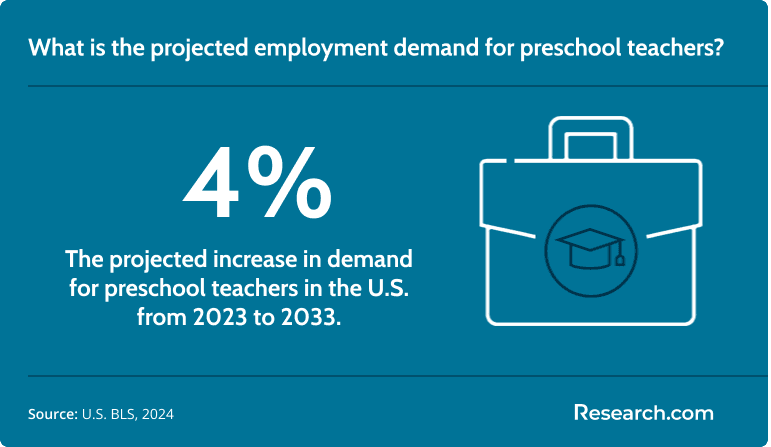
The outlook depends on the specific role. According to the U.S. Bureau of Labor Statistics (BLS), employment of preschool teachers is projected to grow 4 percent from 2023 to 2033, which is in line with the average for all occupations. That growth is expected to create about 61,400 openings each year, largely because workers retire, change occupations, or leave the labor force.
For kindergarten and elementary school teachers, employment is projected to decline by 1 percent during the same period. Even with that projected decline, about 106,500 openings are expected each year, mostly due to replacement needs. The practical takeaway is that early childhood education opportunities will not be identical across roles or regions. Students should review state-level demand, local school budgets, childcare availability, and employer requirements before choosing a path.
What jobs outside the classroom can you get with an early childhood education degree?
Many education degree types can prepare graduates for work beyond traditional teaching. Early childhood education is especially transferable because it builds knowledge of child development, family engagement, assessment, learning design, and communication.
- Education Consultant: Helps schools, childcare centers, nonprofits, or education companies improve curriculum, classroom practices, training, or program quality.
- Child Life Specialist: Supports children and families in healthcare settings by using education, play, and emotional support to help children cope with illness, procedures, or hospitalization.
- Corporate Trainer for Early Childhood Programs: Creates and delivers training for companies that serve childcare providers, educators, or families.
- Online Course Developer for Early Learning: Designs digital lessons, parent education courses, professional development modules, or early childhood training materials.
- Family Support Specialist: Works with families through nonprofits, social service agencies, early intervention programs, or community organizations.
- Educational Content Writer: Creates books, articles, classroom resources, scripts, or activity guides for young children, parents, or teachers.
How to decide between classroom and non-classroom roles
| If you prefer... | Consider... | Why |
| Daily interaction with young children | Preschool teacher, kindergarten teacher, Montessori teacher | These roles keep you closest to classroom learning and child development |
| Program operations and staff leadership | Childcare center director, Head Start program coordinator | These paths combine early education knowledge with management responsibilities |
| Designing lessons and materials | Curriculum developer, education content writer, online course developer | These roles use classroom expertise to shape resources used by others |
| Supporting children and families beyond school | Family support specialist, child life specialist | These careers apply child development knowledge in social service or healthcare settings |
Which certifications can strengthen an early childhood education career?
Certifications can help demonstrate specialized preparation, but they should match your job goal. Some credentials are required by employers or state regulations, while others are optional ways to improve credibility or qualify for niche roles.
- Child Development Associate (CDA): The CDA is a widely recognized early childhood credential focused on demonstrating competence in supporting young children’s development, learning, safety, and family relationships.
- Certified Early Childhood Educator (CECE): This credential may support candidates seeking preschool or childcare positions by signaling preparation in developmentally appropriate learning environments.
- First Aid and CPR Certification: Many childcare and early learning employers require this training so staff can respond to injuries, medical concerns, or emergencies.
- Special Education Certification: Educators who want to support children with disabilities may need training in accommodations, inclusive instruction, behavior support, and individualized education plans.
- Play Therapy Certification: This option may interest professionals working with children who need emotional or behavioral support, though clinical use may require additional mental health credentials depending on the role and state.
Questions to ask before paying for a certification
- Is this credential required for the job I want?
- Is it recognized by employers in my state or region?
- Does it require supervised experience, exams, renewal fees, or continuing education?
- Will it help me earn more, qualify for promotion, or move into a specialized role?
- Can the credits or training apply toward a degree later?
How can related advanced degrees expand early childhood education opportunities?
Some early childhood educators improve their career options by combining education expertise with another field. For example, library science can strengthen skills in resource curation, children’s literature, digital literacy, research, and information access. An educator considering this route may compare options such as an MLIS online to determine whether the degree supports school library, literacy, curriculum, or educational resource roles.
Related graduate study can be useful, but only when it connects to a clear career outcome. Before enrolling, review job descriptions, required credentials, expected salary, and whether employers prefer experience over an additional degree.
How should you choose an online early childhood education program?
An online early childhood education program can be convenient, but convenience should not be the only reason to enroll. The most important question is whether the program fits your state, credential goal, schedule, budget, and need for supervised field experience.
Students comparing lower-cost options may want to review the cheapest online bachelor's degree in education, but affordability should be weighed alongside accreditation, licensure alignment, student teaching support, and transfer policies.
Online early childhood education program checklist
| Factor | Why it matters | What to ask |
| Accreditation | Accreditation can affect financial aid, transfer credits, employer recognition, and graduate school eligibility | Is the institution regionally accredited, and does the program meet relevant professional standards? |
| Licensure alignment | Not every online program prepares students for teacher certification in every state | Does this program meet requirements in the state where I plan to teach? |
| Field placement | Early childhood education requires supervised practice with children | Will the school help arrange practicum or student teaching near me? |
| Cost | Tuition is only one part of the total investment | What are the fees, books, testing costs, travel costs, and technology requirements? |
| Transfer credit | Transfer policies can shorten or lengthen your degree timeline | How many credits will transfer, and will they apply to major requirements? |
| Student support | Online students need advising, tutoring, career guidance, and technical help | What support is available outside normal business hours? |
How can networking and professional development support career growth?
Networking can help early childhood educators find mentors, learn about job openings, understand licensing changes, and discover leadership opportunities. Professional development also keeps educators current on child development research, family engagement, classroom inclusion, assessment, and technology tools.
Educators seeking advanced leadership preparation may compare programs such as the best online EdD, especially if they want doctoral-level training while continuing to work. However, professional development does not always require a degree. Workshops, conferences, coaching, and association involvement can also build useful skills.
Practical networking steps
- Join local or national early childhood education associations.
- Attend workshops on special education, literacy, trauma-informed care, or classroom management.
- Ask directors or senior teachers for feedback on your lesson planning and family communication.
- Build a portfolio with sample lesson plans, assessment examples, parent communication tools, and professional development records.
- Volunteer for curriculum committees, mentoring roles, or program improvement projects when available.
How can policy advocacy and leadership training improve career options?
Early childhood education is shaped by licensing rules, public funding, family access, workforce requirements, inclusion policies, and program quality standards. Educators who understand policy can contribute to better systems and may qualify for roles in administration, advocacy, nonprofit leadership, or government-affiliated programs.
Leadership training can also help experienced educators manage teams, budgets, compliance, and organizational change. Programs such as leadership doctoral programs online may be relevant for professionals who want to move beyond classroom or center-level responsibilities into broader organizational leadership.
Why do diversity and inclusion skills matter in early childhood education?
Early childhood classrooms often include children from different cultures, languages, family structures, income levels, abilities, and life experiences. Educators who use inclusive and culturally responsive practices can build stronger family relationships, reduce bias, support belonging, and adapt instruction more effectively.
Diversity and inclusion expertise can also support leadership growth because administrators and program coordinators must serve varied communities. Some educators build broader cultural or historical knowledge through related study; for example, reviewing the cheapest online master's in history may be useful for professionals interested in curriculum, social context, or interdisciplinary education.
How can affordable graduate degrees support leadership goals?
Graduate education can support leadership success when it is affordable, accredited, relevant, and tied to a specific career plan. Early childhood educators considering director, coordinator, policy, or instructional leadership roles should compare total cost, curriculum, faculty expertise, field requirements, and graduate outcomes.
For educators interested in school or program leadership, exploring the cheapest educational leadership programs can help identify options that balance cost with practical leadership preparation. The goal is not simply to earn another credential; it is to choose training that helps you manage people, improve programs, and make better decisions for children and families.
Can interdisciplinary skills, including library science, help early childhood educators advance?
Interdisciplinary skills can make early childhood educators more versatile. Library science, for example, can strengthen knowledge of children’s literature, information organization, family literacy, digital resources, and community learning programs. Those skills may support work in school libraries, literacy initiatives, curriculum development, educational publishing, or resource coordination.
If you are considering this direction, review possible jobs with a library science degree and compare them with your early childhood education goals. The strongest interdisciplinary path is one where both fields clearly reinforce the same career outcome.
Can mentorship and coaching speed up early childhood education career advancement?
Mentorship can shorten the learning curve for early childhood educators by providing honest feedback, practical classroom strategies, career advice, and guidance on credentials. A good mentor can help you decide whether to pursue licensure, apply for director roles, specialize in special education, move into curriculum, or consider graduate study.
Career coaching may also help if you are switching fields or trying to translate classroom experience into non-classroom roles. For educators exploring resource management, literacy, or research-related paths, reviewing the master's in library science job outlook may help clarify how another graduate credential could fit a broader career plan.
How to get more value from mentorship
- Ask specific questions about roles, credentials, salary expectations, and daily work.
- Request feedback on your resume, portfolio, lesson plans, or leadership goals.
- Shadow professionals in roles you are considering before committing to a degree.
- Set a short-term goal, such as improving family communication or applying for a lead teacher position.
- Use mentorship to test assumptions, not just to receive encouragement.
What graduates say about early childhood education degrees
Maria described early childhood education as a meaningful career because it allowed her to help young children develop confidence, curiosity, and a positive relationship with learning.
James said the field gave him a way to combine psychology interests with practical classroom work, especially through supporting emotional growth and social skill development.
Pauline emphasized that early education requires effort and patience, but she found the work worthwhile because the early years are so important for cognitive and emotional development.
Key Insights
- Early childhood education is not one career. It includes preschool teaching, kindergarten teaching, special education, childcare administration, Head Start coordination, curriculum development, consulting, family support, and related child development roles.
- The degree you need depends on the job. Associate degrees may support entry-level childcare work, bachelor’s degrees are often needed for licensed teaching, and graduate degrees can help with leadership, curriculum, policy, or specialization.
- Salary varies by role and setting. The average salary for early childhood educators in the U.S. is around $41,954 per year, while the listed roles range from $37,130 for preschool teachers to $77,461 for curriculum developers.
- Job outlook differs by occupation. Preschool teacher employment is projected to grow 4 percent from 2023 to 2033, while kindergarten and elementary school teacher employment is projected to decline by 1 percent, though replacement openings remain substantial.
- Online programs can be useful, but only if they are accredited, affordable, and aligned with your state’s practicum and licensure requirements.
- Certifications such as CDA, First Aid and CPR, Montessori training, and special education credentials can improve job fit when they match the role you want.
- The best career decision starts with the target job, not the degree. Review local postings, licensing rules, salary schedules, and fieldwork requirements before enrolling.
Resources:
- Glassdoor. (2025). Salary: Montessori Teacher in United States 2025. https://www.glassdoor.com/Salaries/montessori-teacher-salary-SRCH_KO0,18.htm
- Teal. (n.d.). How to Become an Early Childhood Educator. https://www.tealhq.com/how-to-become/early-childhood-educator
- Salary.com. (2025). Early Childhood Educator Salary. https://www.salary.com/research/salary/listing/early-childhood-educator-salary
- U.S. Bureau of Labor Statistics. (2024). Occupational Outlook Handbook: Kindergarten and elementary school teachers. https://www.bls.gov/ooh/education-training-and-library/kindergarten-and-elementary-school-teachers.htm
- ZipRecruiter. (2025). Salary: Child Care Director United States. https://www.ziprecruiter.com/Salaries/Child-Care-Director-Salary
Other things you should know about early childhood education careers
Yes. Most early childhood employers require a criminal background check before hiring, and many states also require fingerprinting and child abuse registry screening. Programs that receive federal Head Start funds must meet these safety checks under U.S. Department of Health and Human Services rules.
Early Childhood Education professionals in 2027 must complete a minimum of 10 credit hours annually to maintain certification, with courses covering new teaching methodologies and technology integration. These requirements are overseen by the National Association for the Education of Young Children (NAEYC).
To pursue a career in Early Childhood Education in 2027, a bachelor's degree in education or a related field is often required. Additional qualifications may include certifications like Child Development Associate (CDA) and passing state-specific teaching exams approved by local education boards.


