2027 How to Become a Middle School Math Teacher in Ohio: Requirements & Certification

Co-Founder and Chief Data Scientist
Becoming a middle school math teacher in Ohio means choosing a licensure path, completing approved preparation, passing required assessments, and learning how to teach mathematics to students in grades 4-9. The decision matters because math remains a high-need instructional area, Ohio schools continue to monitor teacher certification gaps, and middle school is a critical stage when students either build confidence in math or begin to disengage from it.
This guide is designed for prospective teachers, career changers, substitute teachers considering full licensure, education majors, and current educators who want to add or strengthen a math credential. You will learn the Ohio education and licensing requirements, how student teaching works, what salaries and job prospects look like, how to compare preparation routes, and what classroom realities new math teachers should expect.
Quick Answer: How do you become a middle school math teacher in Ohio?
To teach middle school math in Ohio, you generally need a bachelor’s degree, completion of a state-approved educator preparation program, passing scores on the required Ohio Assessments for Educators, background checks, and a Middle Childhood License through the Ohio Department of Education (ODE). The license prepares teachers to work with grades 4-9 in specific subject areas, including mathematics. Candidates should also plan for student teaching, licensure fees, ongoing professional learning, and possible graduate study if they want higher-level instructional or leadership roles.
Key Things You Should Know About Becoming a Middle School Math Teacher in Ohio
- Ohio continues to need qualified middle school math teachers, and as of 2023, many districts were still having difficulty filling math teaching positions.
- Reported salary figures vary by source and context. One estimate places the average salary for middle school math teachers in Ohio at approximately $56,000 annually, while another source reports an average annual salary of approximately $66,407 and possible total compensation of around $78,603.
- The U.S. Bureau of Labor Statistics reported that the annual median pay for middle school teachers in 2023 was $64,290. In 2022, there were approximately 625,500 middle school teacher jobs in the United States.
- Ohio’s relatively affordable cost of living may help teacher salaries go further, particularly compared with higher-cost metropolitan areas outside the state.
- Technology, personalized learning, STEM integration, and data-informed instruction are changing what middle school math teachers do each day. New teachers should expect to use digital tools, assessment data, and differentiated instruction regularly.
- Education requirements for Ohio middle school math teachers
- Ohio certification and licensing process
- Student teaching, internships, and field experience
- Ohio math standards and curriculum expectations
- Job market, salary, and employment outlook
- Professional development and continuing education
- Classroom management and teaching methods
- Career advancement and specializations
- Legal and ethical responsibilities
- Resources for new Ohio math teachers
- Common challenges and practical solutions
- Current trends in Ohio middle school math education
- Using advanced programs for leadership
- Interdisciplinary teaching options
- Diversity, equity, and inclusion in math classrooms
- Alternative Ohio teaching paths
- Supporting students with special needs
- Using education research to improve instruction
- Policy and advocacy opportunities
- Keeping up with certificate changes
- Advanced academic programs for career growth
- Community and industry partnerships
- Funding your preparation and credential
- Parent and family engagement in middle school math
The path is manageable when you break it into decisions: choose the right degree or licensure route, verify state approval, complete clinical practice, pass the required assessments, and apply for the correct Ohio license. Candidates who already hold a bachelor’s degree may need a different route than first-time college students, so it is important to compare options before enrolling.
| Step | What you need to do | Why it matters |
| 1. Earn a bachelor’s degree | Complete an education, mathematics, or related degree that includes the required teacher preparation sequence. | Ohio licensure depends on both academic preparation and teacher training. |
| 2. Complete approved preparation | Enroll in a state-approved educator preparation program with coursework, fieldwork, and student teaching. | Programs that are not approved may not lead to the license you need. |
| 3. Pass required exams | Take the required Ohio Assessments for Educators, including content and pedagogy assessments. | Licensure requires proof that you understand both mathematics and teaching practice. |
| 4. Complete background checks | Submit required fingerprinting and checks through the appropriate state and federal systems. | Schools must verify that candidates meet student safety requirements. |
| 5. Apply for the Ohio license | Submit transcripts, scores, background check documentation, and fees through the state process. | The Middle Childhood License authorizes teaching in grades 4-9 subject areas such as math. |
| 6. Keep learning after licensure | Use professional development, graduate study, endorsements, or leadership training to grow. | Teacher responsibilities, standards, technology, and student needs continue to change. |
A bachelor’s degree is enough for initial licensure, but some teachers later pursue graduate education to expand their career options. Education is not always grouped with the highest paying degrees, but advanced credentials, additional endorsements, instructional leadership roles, and administrative positions can change long-term earning potential.
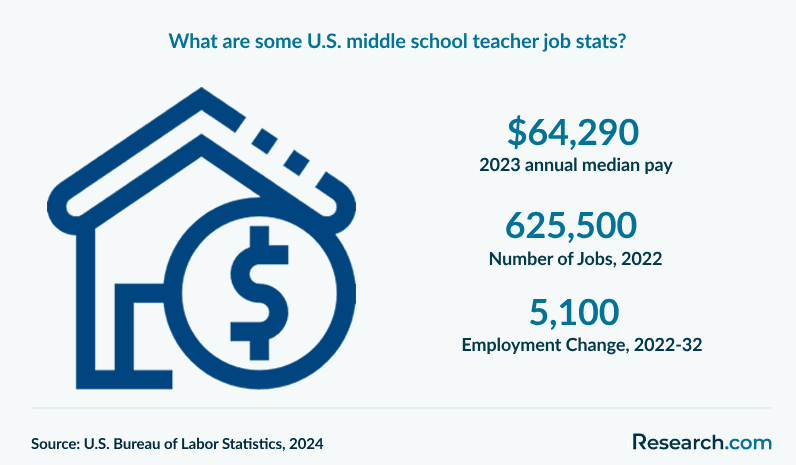
At the national level, according to the U.S. Bureau of Labor Statistics, the annual median pay for middle school teachers in 2023 was $64,290. In 2022, there were approximately 625,500 middle school teacher jobs in the United States. From 2022 to 2032, employment in this field is projected to grow by 5,100 jobs, as shown below.
What are the educational requirements for becoming a middle school math teacher in Ohio?
Ohio middle school math teachers need college-level preparation in mathematics, adolescent learning, instructional design, classroom management, and assessment. The goal is not only to know math, but to help students in grades 4-9 understand ratios, expressions, equations, geometry, statistics, and mathematical reasoning at an age when abstract thinking is still developing.
- Bachelor’s degree: Candidates usually complete a bachelor’s degree in education, mathematics education, mathematics, or a closely related field that includes an approved educator preparation program.
- Mathematics coursework: Programs should build strong content knowledge in the math concepts taught before and during middle school, along with deeper mathematical reasoning that helps teachers explain why procedures work.
- Pedagogy and child development: Coursework typically includes lesson planning, assessment, differentiated instruction, literacy across the curriculum, adolescent development, and classroom management.
- State-approved teacher preparation: The preparation program should include field experiences and a student teaching placement supervised by experienced educators.
- Accreditation and state approval: Before enrolling, confirm that the institution and program meet Ohio licensure requirements. Students considering online study should also understand the difference between institutional accreditation and state educator preparation approval. Research.com’s guide to nationally accredited online colleges can help you understand accreditation terminology, but licensure candidates must still verify Ohio approval.
| Question to ask before enrolling | Why it matters for Ohio licensure |
| Is the program approved for Ohio educator licensure? | A degree alone may not qualify you for a teaching license if the preparation program is not recognized for Ohio licensure. |
| Does the program prepare candidates for middle childhood math? | Middle school licensure is not the same as elementary or high school licensure. |
| Where will I complete student teaching? | Clinical placement access can affect your timeline, schedule, and ability to graduate on time. |
| Does the online option include in-person fieldwork? | Online coursework may be flexible, but teaching practice usually requires school-based experience. |
| What exam preparation support is available? | Licensure exams are a required step, so preparation resources can reduce delays. |
Online and hybrid coursework can make teacher preparation more accessible, especially for working adults. However, candidates should not assume that every online education degree leads to Ohio licensure. Always check program approval, placement requirements, transfer credit policies, and whether the program aligns with the Middle Childhood License.
What is the certification and licensing process for a middle school math teacher in Ohio?
Ohio’s licensure process is designed to confirm that teachers have completed appropriate academic training, demonstrated subject-matter competence, met professional teaching standards, and passed background checks. For middle school math, the relevant pathway is typically the Middle Childhood License for grades 4-9 with the appropriate subject area.
- Complete the required education: Finish a bachelor’s degree and an approved educator preparation program with the required mathematics and pedagogy components.
- Meet clinical practice requirements: Complete supervised fieldwork and student teaching so your preparation includes real classroom experience.
- Pass licensure assessments: Candidates must pass the required Ohio Assessments for Educators, including assessments that address mathematics content knowledge and professional teaching knowledge.
- Complete background checks: Fingerprinting and background screening are required before licensure and employment.
- Submit the license application: Provide transcripts, test scores, background check documentation, and other required materials through the state licensure system.
- Pay required fees: Budget for exam costs, application costs, background checks, and any program-specific expenses.
Career changers should ask schools or licensure offices whether alternative or post-baccalaureate routes are available. Some candidates also explore adjacent fields, such as the advantages of online TESOL programs, when they want to strengthen instruction for multilingual learners or broaden future teaching options.
| Licensure item | What to verify | Common mistake |
| Program approval | That the program is recognized for Ohio teacher licensure. | Choosing a general education program that does not lead to the needed license. |
| Grade band | That the license matches grades 4-9, not only elementary or secondary levels. | Assuming all math education programs prepare candidates for middle school. |
| Subject area | That math is included in your licensure preparation. | Completing a program without the required math concentration or assessment preparation. |
| Clinical placement | That fieldwork and student teaching can be completed in an appropriate classroom. | Waiting too long to confirm placement availability. |
| Background checks | That you complete all state and federal screening requirements on time. | Submitting the license application before required checks are complete. |
Ohio’s certification landscape has faced pressure. The chart below shows the statewide trend in courses taught by teachers without proper certification in Ohio from 2015 to 2022. The number rose from 17,421 in 2015 to 32,333 in 2017, then fell to 19,157 in 2018 and reached 9,621 in 2021 before increasing again to 20,776 in 2022.
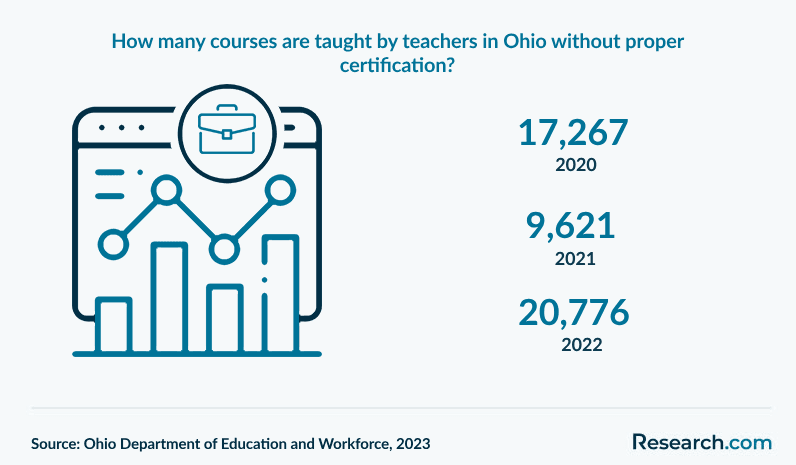
Those swings show why licensure preparation and teacher retention remain important issues. Faster or more flexible graduate routes, including 1 year master’s programs online, may help some educators complete credentials, but candidates must still verify that any route satisfies Ohio requirements.
How important is teaching experience and what are the internship opportunities for middle school math teachers in Ohio?
Teaching experience is essential because middle school math classrooms require more than content knowledge. New teachers must learn how to explain concepts in multiple ways, redirect off-task behavior, assess misconceptions quickly, and support students who may be anxious or behind in math.
- Student teaching: Ohio candidates must complete a minimum of 12 weeks of student teaching. This experience typically includes lesson planning, instruction, assessment, classroom routines, and reflection with a mentor teacher.
- Field observations: Many programs introduce classroom exposure before student teaching so candidates can observe different grade levels, school settings, and instructional approaches.
- Internship-style opportunities: Prospective teachers can look for district partnerships, university placement offices, tutoring programs, after-school math support, summer learning programs, and education nonprofits.
- Alternative experience: Substitute teaching, tutoring, academic coaching, math intervention work, and youth programming can help candidates build confidence, although these experiences do not replace required student teaching unless approved by the licensure pathway.
To get the most from student teaching, keep a teaching journal, ask for specific feedback, collect examples of student work, practice parent communication, and request opportunities to teach both small groups and full-class lessons. Your goal is to leave the placement with evidence of growth, not just completed hours.
What are the Ohio standards and curriculum requirements for teaching middle school math?
Ohio middle school math teachers are expected to align instruction with the Ohio Learning Standards for Mathematics, updated in 2017. These standards emphasize conceptual understanding, procedural skill, fluency, application, mathematical reasoning, and communication.
- Standards-based planning: Lessons should connect daily objectives to the required grade-level standards and mathematical practices.
- Local curriculum decisions: Ohio standards define what students should learn, while districts generally select curriculum materials, pacing, and instructional resources.
- Mathematical practices: Students should learn to reason, model, critique arguments, use tools strategically, and explain solutions rather than only memorize formulas.
- Support and enrichment: Teachers need strategies for students who require intervention as well as students ready for more advanced work.
- Inclusive instruction: Standards-based math instruction should be accessible to students with disabilities, English learners, and students from varied academic backgrounds.
Useful planning resources may include state guidance, district curriculum maps, professional learning sessions, gap-analysis tools, and graduate coursework. Some educators build broader instructional foundations through programs such as an elementary education degree online, especially when comparing how math learning develops across grade levels.
The 2022 Mathematics State Snapshot Report for grade 8 public schools gives important context. In Ohio, 36% of students scored below the NAEP Basic level, 35% reached NAEP Basic, 22% scored at NAEP Proficient, and 7% achieved NAEP Advanced. Nationally, 40% scored below NAEP Basic, 35% reached NAEP Basic, 19% scored at NAEP Proficient, and 7% reached NAEP Advanced.
Ohio’s grade 8 results show stronger Proficient performance than the national average, but the percentage below NAEP Basic still points to a need for targeted intervention, stronger transitions from elementary math, and instruction that builds confidence before students enter high school algebra pathways.
What is the job market like and what are the salary expectations for middle school math teachers in Ohio?
The Ohio job market for middle school math teachers is generally favorable because math is a core subject, STEM learning is a state and national priority, and districts must replace teachers who retire, transfer, or leave the profession. Openings vary by region, district budget, student enrollment, and local staffing needs.
Salary expectations should be interpreted carefully because sources use different job titles, reporting methods, and compensation definitions. One cited figure places the average salary for middle school math teachers in Ohio at approximately $56,000 annually. Another estimate reports an average annual salary of approximately $66,407, with total compensation potentially reaching around $78,603 when additional pay is included. Reported salaries typically fall between $59,000 and $106,000 per year.
| Salary or labor-market figure | What it means for candidates |
| Approximately $56,000 annually | A commonly cited Ohio average for middle school math teachers, though individual pay depends on district, experience, and education. |
| Approximately $66,407 | Another reported Ohio average annual salary figure for middle school math teachers. |
| Around $78,603 total compensation | An estimate that may include additional forms of pay beyond base salary. |
| $59,000 to $106,000 per year | A reported salary range showing how much pay can vary by district, credentials, and experience. |
| $64,290 | The U.S. Bureau of Labor Statistics annual median pay for middle school teachers in 2023. |
Urban districts may offer higher pay or stronger recruitment incentives, while rural districts may offer smaller schools, closer community ties, or different workload expectations. Benefits such as health insurance, retirement plans, paid time off, tuition support, and professional development funding should be part of any compensation comparison. Teachers who want to improve advancement opportunities may consider an online master's in education after gaining classroom experience.
Retention is also part of the job-market picture. The chart below shows the statewide trend in annual attrition among early-career teachers with five or fewer years of experience.
The attrition rate was 8.3% in 2012 and 8.6% in 2013. It rose to 12.6% in 2014, then shifted to 8.9% in 2015, 9.3% in 2016, 9.8% in 2017, 9.6% in 2018, 9.9% in 2019, 9.0% in 2020, and 11.2% in 2021. For new teachers, this means mentoring, manageable workloads, supportive administrators, and strong induction programs are not “nice to have” benefits—they can affect whether teachers stay.
What professional development and continuing education opportunities are available for middle school math teachers in Ohio?
Professional learning helps Ohio middle school math teachers maintain licensure, improve instruction, respond to changing standards, and address student learning gaps. It is also a practical way to build leadership potential without immediately leaving the classroom.
- Webinars and online sessions: The Ohio Department of Education and the Ohio ESC Association offer professional learning connected to Ohio’s mathematics standards and instructional practice.
- Workshops and conferences: Math education organizations, districts, ESCs, and universities often provide sessions on differentiation, assessment, math discourse, intervention, and technology use.
- Continuing education credits: Teachers must complete ongoing learning to maintain credentials, so it is important to track approved activities and renewal requirements.
- Professional organizations: Groups such as state and national math teacher associations can help teachers find lesson resources, peer networks, research updates, and leadership opportunities.
- Graduate study: Master’s degrees, endorsements, and leadership programs can support specialization in curriculum, STEM, educational technology, intervention, or administration.
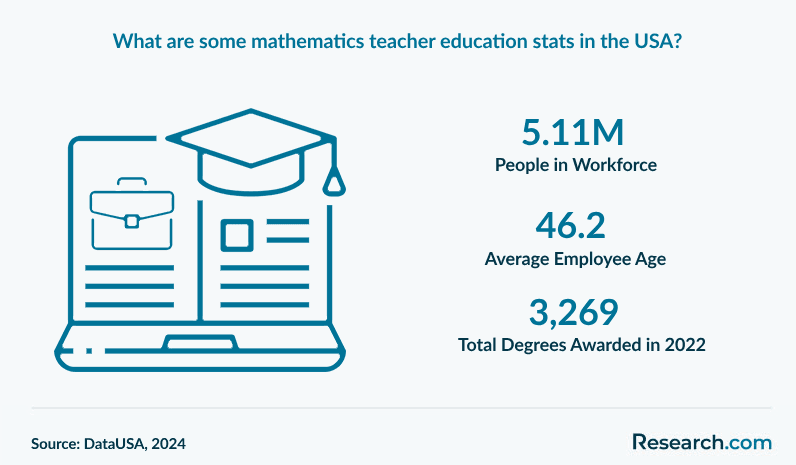
According to DataUSA, in 2024, there were approximately 5.11 million people in the workforce. The average age of employees was 46.2 years old. In 2022, a total of 3,269 degrees were awarded, as shown below.
Professional development is increasingly focused on equity, technology integration, assessment literacy, and evidence-based intervention. Teachers considering graduate school should compare program outcomes, licensure relevance, tuition, employer reimbursement, and whether the degree supports classroom goals or a move into leadership.
What are effective classroom management strategies and teaching methods for middle school math teachers in Ohio?
Middle school math classrooms work best when structure and curiosity coexist. Students need predictable routines, clear expectations, and emotionally safe opportunities to struggle with challenging concepts. Effective teachers combine strong management with instruction that makes math visible, discussable, and relevant.
| Strategy | How to use it in middle school math | Why it helps |
| Clear routines | Use consistent warm-ups, transitions, materials procedures, and exit tickets. | Students spend less time guessing what to do and more time learning. |
| Math talk norms | Teach students how to explain reasoning, disagree respectfully, and ask clarifying questions. | Discussion reveals misconceptions that worksheets may hide. |
| Differentiated instruction | Use small groups, tiered tasks, manipulatives, visuals, and targeted practice. | Students enter middle school with different levels of readiness. |
| Real-world applications | Connect ratios, data, geometry, and equations to budgeting, sports, design, maps, and science. | Students are more likely to engage when math has visible purpose. |
| Frequent formative assessment | Use quick checks, error analysis, whiteboards, polls, and exit slips. | Teachers can adjust instruction before misunderstandings become long-term gaps. |
| Technology with purpose | Use tools such as graphing platforms, simulations, and adaptive practice when they improve understanding. | Technology supports learning best when it is tied to a clear instructional goal. |
New teachers should avoid building every lesson around lecture and independent practice. Middle school students often need visual models, guided discussion, collaborative problem-solving, and repeated opportunities to explain their thinking in words, diagrams, tables, graphs, and equations.
What are the career advancement opportunities and specializations for middle school math teachers in Ohio?
Middle school math teaching can lead to several career paths. Some teachers stay in the classroom and become expert instructional leaders, while others move into curriculum design, coaching, administration, policy, or teacher preparation.
- Instructional leadership: Experienced teachers may become grade-level leads, department chairs, mentor teachers, or professional learning facilitators.
- Specialized instruction: Teachers can build expertise in intervention, gifted education, special education collaboration, STEM integration, educational technology, or data-driven instruction.
- Administration: A teacher who wants to become an assistant principal, principal, or district leader may need graduate preparation in educational leadership.
- Curriculum and assessment: Math teachers with strong standards knowledge may help write curriculum maps, select materials, design assessments, or support district math initiatives.
- Advanced certification: Additional endorsements or National Board Certification may strengthen professional credibility and, depending on district policy, may support salary advancement.
| Career goal | Useful next step | Best fit for |
| Stay in the classroom but increase impact | Mentor new teachers, lead professional learning, or specialize in intervention. | Teachers who enjoy direct student contact. |
| Move into coaching | Develop expertise in curriculum, data analysis, and adult learning. | Teachers who like helping colleagues improve instruction. |
| Enter administration | Consider graduate study in educational leadership. | Teachers interested in schoolwide systems and policy implementation. |
| Work in curriculum development | Build deep knowledge of standards, assessment design, and instructional materials. | Teachers who enjoy planning, analysis, and resource creation. |
What legal and ethical considerations must Ohio middle school math teachers follow?
Ohio teachers work within legal, ethical, and professional expectations that protect students and define responsible practice. These responsibilities begin before licensure and continue throughout a teacher’s career.
- Valid licensure: Teachers must hold the correct Ohio teaching license for the grade band and subject they teach.
- Background checks: Candidates and educators must complete required screening to help protect student safety.
- Mandatory reporting: Ohio teachers are required to report suspected child abuse or neglect according to state law and district procedures.
- Student privacy: Teachers must handle grades, records, accommodations, and family information carefully and professionally.
- Equitable treatment: Ethical practice requires fair access, respectful communication, and instruction that does not exclude students based on disability, language, race, gender, income, or background.
- Professional boundaries: Teachers should follow district policies for communication, social media, supervision, discipline, and one-on-one interactions with students.
Ethical math teaching also means using assessment honestly, avoiding bias in expectations, giving students meaningful opportunities to improve, and communicating clearly with families about progress and concerns.
What resources and support are available for new middle school math teachers in Ohio?
New teachers should not try to build everything alone. Strong support systems can reduce burnout, improve instruction, and help early-career teachers understand district expectations more quickly.
- District mentors: Many schools pair new teachers with experienced educators who can help with pacing, grading, parent communication, classroom routines, and school culture.
- Professional organizations: Math teacher associations can provide conferences, communities of practice, lesson ideas, and updates on instructional trends.
- Ohio Department of Education resources: State resources can help teachers understand standards, licensure, data, and professional learning opportunities.
- Online teaching communities: Digital resource libraries and teacher forums can provide activity ideas, but teachers should evaluate quality and alignment before using materials.
- School-based teams: Intervention specialists, counselors, instructional coaches, English learner specialists, and grade-level teams can help teachers support students more effectively.
A practical first-year strategy is to identify three people early: one mentor for math instruction, one colleague who understands school operations, and one administrator or coach who can clarify evaluation expectations.
What challenges do middle school math teachers in Ohio face, and how can they overcome them?
Middle school math teachers in Ohio often face a mix of academic, behavioral, staffing, and resource challenges. The most effective teachers plan for these issues instead of reacting to them midyear.
| Challenge | What it looks like | Better response |
| Wide skill gaps | Some students are ready for advanced work while others struggle with prerequisite skills. | Use diagnostic checks, flexible groups, scaffolded tasks, and targeted intervention. |
| Math anxiety | Students shut down, avoid participation, or say they are “bad at math.” | Normalize mistakes, use low-stakes practice, and praise reasoning rather than speed alone. |
| Curriculum pressure | Teachers feel rushed to cover standards before assessments. | Prioritize essential standards, spiral review, and use formative assessment to guide pacing. |
| Technology access issues | Digital tools are available but student access or skill levels vary. | Choose tools with clear instructional value and provide non-digital alternatives when needed. |
| Early-career burnout | Planning, grading, behavior, and meetings become overwhelming. | Use mentor support, shared planning, reusable routines, and realistic boundaries. |
| Student disengagement | Students see math as irrelevant or too difficult. | Use real-world problems, collaborative tasks, games, data projects, and student choice. |
Teachers who need a stronger foundation in curriculum and instruction may compare degree pathways, including a bachelor of education online degree, but they should always verify whether a program satisfies Ohio licensure requirements before enrolling.
What are the current trends in middle school math education in Ohio?
Ohio middle school math education is being shaped by changes in technology, student support needs, STEM priorities, and expectations for measurable learning progress.
- STEM integration: Schools are connecting math to science, technology, engineering, and real-world problem-solving so students understand how math functions outside worksheets.
- Technology-supported instruction: Teachers increasingly use digital platforms, interactive tools, graphing applications, and online practice systems to support modeling and feedback.
- Data-informed teaching: Assessment results, exit tickets, benchmark data, and intervention records help teachers adjust instruction and identify students who need support.
- Math literacy: Teachers are emphasizing vocabulary, reasoning, explanations, and problem interpretation in addition to computation.
- Social-emotional learning: Because confidence and persistence affect math performance, teachers are addressing productive struggle, collaboration, and math anxiety.
- Competency-based learning: Some schools are exploring models that allow students to progress based on mastery rather than simply time spent in class.
These shifts require teachers to be flexible. A strong math teacher is no longer only a content presenter; the role includes coach, diagnostician, facilitator, technology user, and advocate for equitable access. Those comparing shorter or lower-cost academic routes can also review options such as easy associate degrees online, although associate programs do not replace the bachelor’s-level and licensure preparation required to become a licensed teacher.
How can middle school math teachers leverage advanced academic programs for leadership?
Advanced academic programs can help experienced Ohio math teachers move into leadership roles, especially if they want to influence curriculum, mentor colleagues, conduct applied education research, or become administrators. A master’s degree may support instructional specialization, while doctoral study may fit teachers interested in systems-level leadership, policy, or districtwide improvement.
Teachers who want a faster doctoral route can compare accelerated Ed.D. programs, but they should evaluate workload, dissertation or capstone expectations, accreditation, cost, and whether the degree aligns with Ohio leadership requirements or district advancement policies.
Can interdisciplinary teaching expand career opportunities in Ohio?
Interdisciplinary teaching can make a math teacher more versatile. Middle school math connects naturally with science labs, technology projects, financial literacy, career exploration, music patterns, art and geometry, and data analysis in social studies. Teachers who can collaborate across subjects may be more useful in STEM initiatives, project-based learning, enrichment programs, and curriculum design.
Some educators also add credentials in other subject areas or grade levels. For example, a teacher comparing cross-certification options may look at what it takes to become a high school history teacher in Ohio. This does not replace math licensure, but it shows how additional credentials can broaden career flexibility.
How does diversity and inclusion shape middle school math education in Ohio?
Diversity and inclusion affect how Ohio middle school math teachers design lessons, build classroom culture, assess learning, and communicate with families. Students bring different languages, prior school experiences, cultural references, income levels, disabilities, confidence levels, and access to technology. Effective math instruction must account for those differences without lowering expectations.
- Culturally responsive examples: Use data sets, word problems, and projects that connect to students’ communities and interests.
- Language support: Teach math vocabulary explicitly and allow students to show reasoning through visuals, diagrams, models, and oral explanation.
- Access to materials: Avoid assigning technology-dependent work without checking whether students can complete it outside school.
- Gender equity: Encourage all students to participate in advanced math, STEM clubs, competitions, and leadership roles.
- Bias awareness: Review grading, participation patterns, discipline referrals, and grouping practices to ensure that opportunities are distributed fairly.
Teachers interested in inclusive early learning models may also compare broader teaching requirements, such as the guide to elementary school teacher requirements in Oregon, but Ohio middle school math candidates should rely on Ohio-specific licensure rules for credential decisions.
What alternatives are available for those who want to teach at a different level in Ohio?
If you like teaching but are unsure about middle school math, compare age groups before committing to a degree or licensure pathway. Preschool, elementary, middle school, and high school teaching require different training, temperament, content depth, and classroom management styles.
| Teaching level | Best fit for | Important consideration |
| Preschool | Educators who enjoy early childhood development, play-based learning, and foundational skills. | Requirements differ from middle childhood math licensure. |
| Elementary school | Teachers who want to teach multiple subjects and build early literacy and numeracy. | Math depth is different from middle school specialization. |
| Middle school math | Teachers who enjoy adolescents, core math concepts, and helping students transition to abstract reasoning. | Requires preparation for grades 4-9 and math content. |
| High school math | Educators who prefer advanced math, algebra, geometry, statistics, or calculus pathways. | Licensure requirements and content expectations differ from middle school. |
Those drawn to younger children can review how to become a preschool teacher in Ohio. Comparing levels early can prevent wasted credits, delayed licensure, or a mismatch between your strengths and the classroom environment.
How can middle school math teachers support students with special needs in Ohio?
Middle school math teachers support students with special needs by combining high expectations with appropriate accommodations, collaboration, and evidence-based instruction. The math teacher does not work alone; intervention specialists, school psychologists, counselors, families, and administrators may all contribute to student support plans.
- Read and follow each student’s IEP or 504 plan carefully.
- Use multiple representations, including manipulatives, diagrams, number lines, tables, graphs, and verbal explanations.
- Break multi-step problems into smaller tasks without removing the core learning goal.
- Provide structured notes, guided practice, extended time, or alternative ways to demonstrate understanding when required.
- Coordinate with special education staff before major assessments or unit changes.
- Track progress consistently so supports are based on evidence rather than assumptions.
Teachers who want to specialize in this area can explore how to become a special education teacher in Ohio. Even without becoming a special education teacher, every math teacher needs practical skill in inclusive instruction.
How can emerging educational research shape my classroom innovation?
Educational research can help math teachers choose strategies that are more likely to improve learning, but research must be translated carefully into classroom practice. Teachers should look for evidence on formative assessment, worked examples, math discourse, retrieval practice, visual models, feedback, intervention design, and student motivation.
A practical approach is to test one research-based strategy at a time, gather student work and assessment evidence, reflect with colleagues, and adjust. Teachers interested in how math instruction changes at the secondary level can also compare career expectations in how to become a high school math teacher in Ohio.
How can educational policy and advocacy initiatives drive classroom innovation in Ohio?
Teachers can influence education policy by participating in curriculum committees, district advisory groups, professional associations, school board conversations, and state-level feedback opportunities. Math teachers bring important classroom evidence to discussions about standards, assessment, staffing, technology access, intervention funding, and professional learning.
Policy awareness also helps teachers understand how credential rules differ across subject areas. For a related comparison, review Ohio English teacher certification requirements. Seeing how another subject area is regulated can help educators understand broader licensure and workforce patterns.
How can I navigate recent changes in teaching certificate requirements in Ohio?
Licensure requirements can change, so candidates should not rely on old program pages, informal advice, or outdated checklists. Before making a major decision, confirm requirements directly with the state, your educator preparation provider, and any district where you plan to work.
- Check the current Ohio licensure category for middle childhood math.
- Confirm required exams and passing score expectations with your program advisor.
- Ask whether your program has recent licensure pass-rate or completion information.
- Keep copies of transcripts, background check records, test scores, and field placement documentation.
- Review renewal and continuing education requirements before your first license period ends.
For a broader overview, use Research.com’s guide to teaching certificate requirements in Ohio as a starting point, then verify current details with official Ohio sources.
What advanced academic programs can further enhance my career as a middle school math teacher in Ohio?
Advanced education can help teachers deepen math pedagogy, move into leadership, specialize in intervention, or prepare for roles outside a single classroom. The right program depends on the career goal.
| Program type | Possible value | Best question to ask |
| Graduate certificate | Focused training in a specific area such as technology, STEM, assessment, or intervention. | Will this credential be recognized by my district or support an endorsement? |
| Master’s degree | Deeper preparation in teaching, curriculum, leadership, or math education. | Does the program improve my classroom practice or advancement options? |
| Educational leadership program | Preparation for department, school, or district leadership roles. | Does it align with Ohio administrative requirements if I want to become an administrator? |
| Doctoral program | Advanced study in research, policy, leadership, or systems improvement. | Is the time and cost justified by my long-term career plan? |
Teachers comparing credentials can use the guide to types of degrees in education to understand how education degrees differ by level, purpose, and career outcome.
How can local community and industry partnerships enhance my effectiveness as a middle school math teacher in Ohio?
Community partnerships can make math more concrete. Local businesses, colleges, museums, libraries, nonprofits, and STEM organizations can support guest speakers, data projects, field experiences, mentoring, competitions, and real-world problem-solving tasks.
- Ask local employers how they use measurement, data, budgeting, design, coding, or logistics.
- Partner with universities for tutoring, math circles, STEM days, or teacher learning events.
- Use community data to build statistics, graphing, and proportional reasoning projects.
- Invite professionals to explain how math appears in healthcare, manufacturing, music, construction, finance, and technology.
Cross-disciplinary thinking can also come from comparing other teaching fields. For example, music teacher education requirements in Ohio can help educators think about performance, practice, feedback, and creativity in ways that may enrich math instruction.
How can I fund my journey to becoming a middle school math teacher in Ohio?
Teacher preparation costs can include tuition, books, exam fees, background checks, transportation to field placements, technology, and lost work hours during student teaching. A low-tuition program is not always the cheapest option if it delays licensure, lacks placement support, or does not accept transfer credits.
| Cost factor | How to reduce risk |
| Tuition | Compare total program cost, not only per-credit price. |
| Transfer credits | Ask for a written transfer evaluation before enrolling. |
| Licensure exams | Budget for registration fees and possible retake costs. |
| Student teaching | Plan for transportation, schedule changes, and reduced work availability. |
| Financial aid | Ask about scholarships, grants, loan options, district support, and employer tuition assistance. |
| Program approval | Avoid paying for a program that does not lead to the Ohio license you need. |
For cost-focused planning, review the cheapest way to get a teaching credential in Ohio. Use that information alongside official financial aid guidance and program-specific cost estimates.
How can parent and family engagement boost classroom outcomes in Ohio middle school math?
Family engagement can improve student accountability, confidence, and follow-through in math. Middle school students are becoming more independent, but families still need clear information about what students are learning, how progress is measured, and how to help without turning homework into a nightly conflict.
- Send short, understandable updates about current units and major assessments.
- Explain grading policies, retake options, missing-work procedures, and intervention supports early.
- Share examples of helpful questions families can ask, such as “How did you know that strategy worked?”
- Offer resources for practice that do not require families to reteach the entire lesson.
- Contact families about improvement and effort, not only problems.
Teachers who want to understand family engagement across earlier grades can compare strategies in Research.com’s guide on how to become an elementary teacher in Ohio.
Common mistakes to avoid when preparing to become an Ohio middle school math teacher
| Mistake | Why it can hurt you | Better choice |
| Choosing a program only because it is online or inexpensive | It may not lead to the Ohio license you need. | Verify state approval, placement support, and licensure alignment first. |
| Assuming elementary, middle, and high school math licenses are interchangeable | Different grade bands require different preparation. | Choose the license that matches the students you want to teach. |
| Ignoring student teaching logistics | Field placement can affect work, transportation, and graduation timing. | Ask about placement expectations before enrolling. |
| Underestimating exam preparation | Licensure can be delayed if required assessments are not passed. | Use program resources, practice tests, and a study schedule. |
| Looking only at salary | Workload, mentoring, benefits, and school culture affect long-term satisfaction. | Compare full compensation and support systems. |
| Assuming salary outcomes are guaranteed | Pay varies by district, experience, education, and local contracts. | Review district salary schedules and ask about advancement policies. |
Key Insights
- Ohio middle school math teachers generally need a bachelor’s degree, a state-approved educator preparation program, required Ohio Assessments for Educators, background checks, and the appropriate Middle Childhood License.
- Student teaching is not a formality. Ohio candidates must complete a minimum of 12 weeks of student teaching, and that experience is where many future teachers build the classroom judgment they cannot gain from coursework alone.
- Salary figures should be compared carefully. Reported Ohio figures include approximately $56,000 annually, approximately $66,407, around $78,603 in possible total compensation, and a range typically falling between $59,000 and $106,000 per year.
- Nationally, the U.S. Bureau of Labor Statistics reported that the annual median pay for middle school teachers in 2023 was $64,290. In 2022, there were approximately 625,500 middle school teacher jobs in the United States, and from 2022 to 2032 employment is projected to grow by 5,100 jobs.
- Ohio has faced continuing certification challenges. Courses taught by improperly certified teachers increased from 17,421 in 2015 to 32,333 in 2017, declined to 9,621 in 2021, and rose again to 20,776 in 2022.
- Ohio’s 2022 grade 8 math results were stronger than national averages at the NAEP Proficient level, with 22% of Ohio students reaching NAEP Proficient compared with 19% nationally, but 36% of Ohio students still scored below NAEP Basic.
- Early-career teacher attrition remains a concern. Ohio’s early-career attrition rate was 8.3% in 2012, reached 12.6% in 2014, and rose again to 11.2% in 2021.
- The Ohio Department of Education reported that as of 2023, there is a growing demand for middle school math teachers, with a projected 10% increase in job openings over the next five years, driven by retirements and a focus on STEM education.
- In 2023, the average salary for a middle school math teacher in Ohio was reported at around $55,000 annually, with potential for growth as teachers gain experience and pursue advanced degrees or additional certifications.
- According to DataUSA, in 2024, there were approximately 5.11 million people in the workforce. The average age of employees was 46.2 years old. In 2022, a total of 3,269 degrees were awarded in math teaching education.
- The best preparation route is the one that is state-approved, affordable for your situation, realistic for your schedule, and directly aligned with the grade level and subject you want to teach.
Related Articles for Nearby States
- 2027 How to Become a Middle School Math Teacher in Indiana: Requirements & Certification
- 2027 How to Become a Middle School Math Teacher in Kentucky: Requirements & Certification
- 2027 How to Become a Middle School Math Teacher in West Virginia: Requirements & Certification
- 2027 How to Become a Middle School Math Teacher in Michigan: Requirements & Certification
- 2027 How to Become a Middle School Math Teacher in Illinois: Requirements & Certification
- 2027 How to Become a Middle School Math Teacher in Virginia: Requirements & Certification
- 2027 How to Become a Middle School Math Teacher in Tennessee: Requirements & Certification
- 2027 How to Become a Middle School Math Teacher in North Carolina: Requirements & Certification
- 2027 How to Become a Middle School Math Teacher in Missouri: Requirements & Certification
- 2027 How to Become a Middle School Math Teacher in Maryland: Requirements & Certification
References:
- Bureau of Labor Statistics. (2024). Middle school teachers. Bureau of Labor Statistics.
- Bureau of Labor Statistics. (2024). Occupational employment and wages, May 2023: Teachers and instructors, all other. Bureau of Labor Statistics.
- Data USA. (2024). Mathematics teacher education. Data USA.
- Education Ohio. (2024, July 31). Professional learning for mathematics. Education Ohio.
- Glassdoor. (2024, June 6). Middle school mathematics teacher salaries in Ohio. Glassdoor.
- Math Teacher Edu. (2014, July 23). Certification requirements to become a math teacher in Ohio. Math Teacher Edu.
- National Center for Education Statistics. (2022). The nation’s report card: Ohio state report card. National Center for Education Statistics.
- Ohio State Board of Education. (2024). Educator licensure. Ohio State Board of Education.
- Ohio Department of Education. (2024). Ohio’s teacher workforce. Ohio Department of Education.
Other Things You Should Know About Becoming a Middle School Math Teacher in Ohio
Ohio requires a Bureau of Criminal Investigation and FBI background check for teacher licensure. Applicants must submit fingerprints through an approved provider, and the results are sent to the Ohio Department of Education and Workforce before a license is issued or renewed.
To become a middle school math teacher in Ohio in 2027, you need a bachelor's degree in education with a focus on mathematics. Additionally, completing a teacher preparation program and passing the Ohio Assessments for Educators (OAE) are required for licensure.
To become certified in Ohio by 2026, you must complete a bachelor's degree in education with a focus on mathematics, pass the Ohio Assessment for Educators exams, and apply for a Resident Educator License. Continuing education is essential for license renewal.
To become a middle school math teacher in Ohio, candidates must pass the Ohio Assessments for Educators (OAE), specifically the Assessment of Professional Knowledge and the Middle Grades Mathematics content exam, in order to qualify for certification in 2027.