2027 How to Become an Elementary School Teacher in New Jersey: Requirements & Certification

Co-Founder and Chief Data Scientist
Becoming an elementary school teacher in New Jersey requires more than earning a degree and applying for jobs. The state uses a structured certification system that includes approved educator preparation, testing, background clearance, supervised classroom experience, and ongoing professional development. For future teachers, career changers, and online students, the biggest challenge is often knowing which credential route fits their background and whether a program will actually qualify them for licensure.
This guide explains the New Jersey elementary teacher pathway in practical terms: education requirements, traditional and alternative certification, online program acceptance, costs, timelines, renewal rules, specializations, job market considerations, and career options beyond the elementary classroom. Use it to compare programs, avoid licensing mistakes, and plan a route that matches your goals, budget, and schedule.
Quick Answer: How Do You Become an Elementary School Teacher in New Jersey?
To become an elementary school teacher in New Jersey, you generally need a bachelor’s degree, completion of a state-approved teacher preparation program, required certification exams, a criminal history background check, and classroom-based student teaching or supervised teaching experience. New teachers typically begin with an initial or provisional credential before progressing toward a standard teaching certificate after meeting state requirements.
- The initial application for a New Jersey elementary school teaching license typically takes about 6 to 12 months to complete, depending on exams, documentation, background checks, and program completion.
- As of the 2022-2023 academic year, New Jersey issued approximately 8,000 new teaching licenses, indicating continued need for qualified educators in elementary schools.
- Applicants should plan for about $200 for the application fee, plus background check and testing costs that can bring total certification-related expenses up to $500.
- Candidates must hold at least a bachelor’s degree and complete a state-approved teacher preparation program that includes hands-on student teaching.
- Teaching licenses are renewed every five years, and educators must complete 100 hours of professional development during that cycle.
- Education requirements for New Jersey elementary teachers
- Licensure application and renewal process
- Traditional vs. alternative teacher certification in New Jersey
- Timeline to become an elementary teacher
- Are online teacher education programs accepted?
- Online vs. on-campus elementary education programs
- Average cost of elementary education programs
- How to choose the right elementary education program
- Other teaching options in New Jersey
- Elementary education specializations
- Interdisciplinary certifications for teachers
- Subject-specific certification options such as art
- Trends shaping elementary education
- Speech therapy certification considerations
- Preschool teaching certification considerations
- Private school teaching as an alternative
- Lower-cost paths to a teaching credential
- Additional subject-specific certifications
- Types of teaching certificates in New Jersey
- Common challenges for elementary teachers
- Career paths for elementary teachers
- New Jersey elementary teacher job market
- Support resources for teachers
- How special education certification can affect career prospects
What are the educational requirements for elementary school teachers in New Jersey?
New Jersey elementary teacher candidates need a bachelor’s degree and a teacher preparation pathway that satisfies state certification rules. Many students major in elementary education, but a non-education major may still qualify if the candidate completes an approved educator preparation program and meets testing and field-experience requirements.
The most important requirement is that your preparation program must align with New Jersey Department of Education expectations. A degree alone is not enough if the program does not include the required certification components.
| Requirement | What it means for applicants | Why it matters |
| Bachelor’s degree | You must complete an undergraduate degree from an acceptable institution. | This is the baseline academic requirement for elementary teacher certification. |
| Approved teacher preparation | Your program should include pedagogy, classroom management, child development, instructional planning, and student teaching. | New Jersey expects candidates to demonstrate both academic preparation and practical classroom readiness. |
| Student teaching or supervised fieldwork | You complete teaching practice in a real classroom under supervision. | This experience helps prove you can plan lessons, manage students, and adapt instruction. |
| Certification exams | Candidates must pass required exams, including Praxis Core Academic Skills for Educators and applicable Praxis Subject Assessments. | Testing verifies basic academic skills and subject-area readiness. |
| Criminal history background check | Applicants must complete the state’s required screening process. | Schools must confirm that candidates meet student safety requirements before classroom placement or employment. |
After completing the required education, field experience, exams, and background screening, candidates can move into the certification application process. The exact credential depends on the candidate’s route, preparation history, and employment status.
New Jersey continues to need qualified elementary educators, particularly in districts affected by turnover, staffing gaps, or hard-to-fill roles. Candidates who are flexible about location, student population, and specialization may find more opportunities.
What is the licensure application and renewal process for elementary school teachers in New Jersey?
Teacher certification applications are handled through the New Jersey Department of Education. Candidates submit documentation showing they completed degree requirements, educator preparation, required testing, and background clearance. Because New Jersey uses a staged credentialing system, many new teachers begin with an initial or provisional credential before qualifying for a standard certificate.
To move toward a standard license, new educators must satisfy additional state requirements, which may include successful teaching experience and a mentoring period during the first year of teaching. This transition is important because the standard certificate represents long-term professional eligibility rather than entry-level permission to teach.
| Licensure step | What to prepare | Practical advice |
| Before applying | Degree transcripts, teacher preparation documentation, exam scores, and background check materials. | Create a checklist before graduation so missing paperwork does not delay your application. |
| Initial application | Application form, fees, official records, and proof of eligibility. | Applicants should budget around $200 for the application fee and additional costs for exams and background checks. |
| Early-career teaching | Mentoring, district support, and evidence of satisfactory teaching progress. | Use the first year to document professional growth and ask mentors for feedback early. |
| Standard certification | Completion of required provisional-stage expectations. | Confirm deadlines with your district or state certification office so you do not miss conversion requirements. |
| Renewal | 100 hours of professional development every five years. | Track hours continuously instead of waiting until the end of the renewal cycle. |
If you are still comparing education paths, Research.com’s guide to affordable online teaching degrees may help you evaluate flexible graduate options, especially if you plan to advance later in your career.
What is the difference between traditional and alternative teacher certification programs in New Jersey?
New Jersey offers more than one route into teaching. The traditional route is usually best for students who know early that they want to become teachers and want certification built into their bachelor’s program. The alternative route is designed for people who already hold a bachelor’s degree in another field and want to transition into teaching without completing a second undergraduate degree.
| Pathway | Best for | Main features | Trade-offs |
| Traditional teacher preparation | Undergraduate students or graduate students who want structured preparation before becoming the teacher of record. | Includes education coursework, student teaching, methods courses, and certification exam preparation. | Usually takes longer upfront, but provides more supervised preparation before full classroom responsibility. |
| Alternative certification | Career changers and degree holders from non-education fields. | Allows eligible candidates to enter teaching while completing certification requirements. | Can be faster, but the transition into classroom management and lesson planning may feel more intense. |
Traditional teacher certification programs
Traditional programs combine academic coursework with supervised teaching practice. Students typically study instructional design, child development, classroom assessment, classroom management, and subject-specific teaching methods. Programs at institutions such as Rutgers University and The College of New Jersey are examples of traditional preparation options in the state.
Alternative teacher certification programs
Alternative certification is often the better fit for applicants who already completed a bachelor’s degree and do not want to restart with another full undergraduate program. New Jersey’s Alternate Route to Teacher Certification and programs such as Teach for America can help qualified candidates enter classrooms while completing required training and support.
Both routes can lead to teacher certification, but they serve different learners. Choose the traditional path if you want more preparation before employment. Consider an alternative route if you already have a degree, can manage a steep learning curve, and want to begin teaching sooner.
How long does it take to become an elementary school teacher in New Jersey?
For many candidates, becoming fully licensed as an elementary school teacher in New Jersey takes about five to six years. The timeline depends on whether teacher preparation is built into the bachelor’s degree, whether exams are passed on the first attempt, and how quickly the candidate completes application requirements.
| Stage | Typical length | What happens during this stage |
| Bachelor’s degree | 4 years | Candidates complete undergraduate coursework. Those who graduated after September 2016 should aim for at least a 3.0 GPA, while those who graduated earlier should note the 2.75 benchmark. |
| Teacher preparation program | 1 year if completed separately | Students complete teaching methods, classroom management, field experience, and student teaching. Some candidates finish this during the bachelor’s program. |
| Certification exams | Several months | Many applicants spend time preparing for Praxis exams before submitting scores. |
| Application processing | Varies | Processing depends on transcripts, exam score reporting, background checks, and application completeness. |
If you are comparing certification rules across states, Research.com also explains the Nevada teacher licensure process, which can help mobile students understand how requirements differ by location.
Are online education programs accepted for teacher licensure in New Jersey?
Online teacher education programs can be accepted for New Jersey licensure if they are properly accredited and meet state certification requirements. The delivery format is less important than whether the program includes the correct coursework, supervised field experience, student teaching, and certification alignment.
Before enrolling, ask the school directly whether its online elementary education program is designed to lead to New Jersey teacher certification. Do not assume that an online education degree automatically qualifies you for licensure.
- Check accreditation first: Look for institutional accreditation and educator preparation recognition, such as alignment with the Council for the Accreditation of Educator Preparation (CAEP), when applicable.
- Confirm state approval: Ask whether the program meets New Jersey Department of Education requirements for elementary certification.
- Verify student teaching arrangements: Online coursework still requires in-person fieldwork or student teaching in an approved classroom setting.
- Review exam preparation: A strong program should prepare candidates for Praxis Core Academic Skills for Educators and relevant Praxis Subject Assessments.
- Plan for renewal: After licensure, teachers must continue professional learning and complete 100 hours of professional development every five years.
How does an online elementary education program in New Jersey compare to an on-campus program?
Online and on-campus elementary education programs can both prepare students for New Jersey licensure when they meet state requirements. The better choice depends on your schedule, learning style, budget, and need for in-person support.
| Factor | Online program | On-campus program |
| Scheduling | Often better for working adults, parents, and students who need flexible coursework. | Better for students who prefer fixed class times and face-to-face accountability. |
| Field experience | May allow local placements, but students must confirm how placements are arranged. | Often uses established relationships with nearby schools for observations and student teaching. |
| Networking | Can include virtual advising, online cohorts, and remote faculty access. | Provides easier in-person access to professors, classmates, campus events, and local hiring networks. |
| Technology use | Usually builds comfort with digital tools used in modern classrooms. | May offer more immediate in-person modeling of classroom techniques. |
| Cost factors | May reduce commuting and housing costs, depending on the institution. | May involve campus fees, transportation, and housing, but can offer direct campus resources. |
| Best fit | Self-directed students who can manage deadlines and arrange required fieldwork. | Students who want a structured environment and frequent face-to-face interaction. |
The most important question is not whether the program is online or on campus. It is whether the program is accredited, certification-aligned, affordable for your situation, and able to place you in approved classroom experiences.
What is the average cost of elementary education programs in New Jersey?
The cost of becoming an elementary teacher in New Jersey can be substantial because students must account for tuition, housing, books, supplies, testing, and certification fees. Tuition alone does not show the full price of preparation.
| Expense category | Estimated amount stated | Planning note |
| Tuition | $19,000 to $25,000 per year | Costs vary by public or private institution. New Jersey City University has a net price of around $19,252, while Caldwell University is about $20,612. |
| Room and board | $12,000 to $15,000 annually | Students living on campus should include housing, meals, and related living expenses. |
| Books and supplies | $1,000 to $1,500 each year | Course materials can vary by class, program, and whether students buy used or digital resources. |
| Credentialing fees | $100 to $200 | Certification expenses are separate from tuition and should be included in the final budget. |
| Total annual planning range | $32,000 to $42,000 per year | This range combines major education-related and living costs for many students. |
Students who plan to continue beyond initial teacher preparation can compare programs such as an online master's degree in education, but graduate study should be evaluated against career goals, licensure needs, and expected salary advancement rather than chosen only for convenience.
How to choose the best elementary education program in New Jersey?
The best elementary education program is the one that qualifies you for New Jersey certification, fits your financial situation, provides strong classroom preparation, and supports your job search. Rankings can be useful, but they should not replace verification of licensure alignment.
| Question to ask | Why it matters | Red flag |
| Is the program accredited and accepted for New Jersey certification? | Licensure depends on meeting state requirements, not just earning credits. | The school cannot clearly explain certification outcomes. |
| How much student teaching is included? | Field experience is critical for classroom readiness and certification eligibility. | Placement responsibility is unclear or left entirely to the student. |
| What are recent pass rates or support options for certification exams? | Exam preparation affects your timeline and total cost. | The program provides little Praxis preparation or advising. |
| What is the full cost after aid? | Net price, fees, transportation, books, and living costs determine affordability. | The school highlights tuition but avoids discussing fees and placement costs. |
| Does the program support job placement? | District partnerships, career advising, and mentor networks can help with employment. | Career support is generic or not education-specific. |
| Can credits transfer or apply to graduate study? | Transfer and articulation policies can affect cost and time to completion. | Credits are difficult to transfer or not clearly documented. |
Common mistakes to avoid when choosing a program
- Choosing only by tuition: A cheaper program may cost more if it lacks strong advising, exam support, or field placement help.
- Assuming online means license-ready: Online programs must still meet New Jersey certification requirements and include approved fieldwork.
- Ignoring accreditation: An unrecognized program can delay or prevent certification.
- Waiting to ask about student teaching: Placement logistics can affect work schedules, commuting, and graduation timing.
- Relying only on rankings: A highly ranked school is not automatically the best fit for your budget, location, or certification area.
What other teaching options are available in New Jersey besides elementary education?
Elementary education is only one route into New Jersey classrooms. If you enjoy working with older students or have strength in a specific subject, middle school, high school, preschool, special education, ESL, arts, or private school teaching may be a better fit. For example, candidates who enjoy math instruction and early adolescent development can review Research.com’s guide on becoming a middle school math teacher in New Jersey.
Before switching paths, compare grade-level certification rules, subject testing requirements, field placements, and job expectations. Teaching kindergarten students is very different from teaching middle school algebra or high school literature, even when the certification process shares some similar steps.
What types of specializations are available within elementary education in New Jersey?
Specializations can make an elementary teacher more versatile and better prepared for the needs of New Jersey classrooms. They may also help teachers move into high-need roles, leadership responsibilities, or targeted instructional positions.
| Specialization | Who it fits | How it can support career goals |
| Special education | Teachers who want to support students with disabilities and diverse learning needs. | Builds skills in individualized instruction, accommodations, intervention, and inclusive classroom practice. |
| Bilingual education | Educators interested in multilingual learners and culturally responsive instruction. | Can be valuable in districts serving students who are developing English proficiency. |
| STEM education | Teachers who enjoy science, technology, engineering, and math integration. | Helps teachers design inquiry-based and problem-solving lessons for young learners. |
| Literacy education | Educators focused on reading, writing, phonics, comprehension, and language development. | Supports foundational academic growth and may lead to reading intervention roles. |
| Early childhood education | Teachers who want to work with children from birth to age 8. | Provides deeper preparation in early development, play-based learning, and primary-grade instruction. |
Elementary and middle school teaching remains one of the common education majors, as shown in the chart below.
How can interdisciplinary certifications boost your teaching career?
Interdisciplinary credentials can help teachers respond to student needs that extend beyond standard academic instruction. Skills connected to counseling, family systems, mental health awareness, and student support may be useful for educators who work closely with school counselors, social workers, and intervention teams.
Teachers considering broader student-support training can explore options such as the fastest online MFT program. However, candidates should carefully distinguish between credentials that enhance classroom practice and credentials that lead to separate licensed professions. Additional education may improve your perspective, but it does not automatically authorize you to work outside the scope of your teaching license.
Could subject-specific certifications like art elevate your teaching career in New Jersey?
Subject-specific certification can be useful for elementary teachers who want to specialize, teach in a dedicated subject area, or move into roles that emphasize arts integration. Art certification, for example, can support creative lesson design, project-based learning, visual literacy, and interdisciplinary instruction.
If art education aligns with your long-term goals, review the requirements for becoming an art teacher in New Jersey. The right credential can expand your options, but it should match the grade levels and subjects you actually want to teach.
What emerging trends are shaping elementary education in New Jersey?
Elementary education in New Jersey is being shaped by technology integration, hybrid learning tools, data-informed instruction, inclusive curriculum design, and greater attention to social-emotional learning. Teachers are increasingly expected to use digital platforms thoughtfully while still maintaining strong classroom relationships and age-appropriate instruction.
These shifts do not mean technology replaces teaching skill. They mean new teachers should be comfortable using assessment data, adapting lessons for diverse learners, supporting student well-being, and communicating with families across digital and in-person formats. Educators who want to strengthen literacy and communication skills may compare resources such as the most affordable online bachelor's in English degree programs, especially if they are considering broader language arts preparation.
Should I consider a speech therapy certification to expand my teaching career in New Jersey?
Speech and language expertise can help teachers better understand communication development, classroom participation barriers, and referral processes. However, speech-language pathology is a distinct professional field with its own education, clinical, and licensure requirements. Teachers should not assume that a short course or certificate will qualify them to practice as speech-language pathologists.
If your goal is to move toward communication intervention roles, start by reviewing what it takes to become a specialist. Research.com’s guide on how to be a speech therapist in New Jersey can help you compare that path with classroom teaching.
Should I consider obtaining a preschool teaching certification to diversify my career options?
Preschool certification can be a strong complement to elementary education for teachers who enjoy early childhood development and want more flexibility across age groups. It can deepen your understanding of early literacy, play-based learning, social development, and classroom routines for younger learners.
This route makes the most sense if you want to work with children before kindergarten or in early primary settings. For a focused overview, see how to become a preschool teacher in New Jersey.
Can private school teaching offer a rewarding alternative in New Jersey?
Private school teaching can appeal to educators who want a different school culture, smaller communities, mission-based education, or more flexible hiring structures. Requirements may differ from public school rules, but private schools still expect strong subject knowledge, classroom management, and the ability to support student growth.
Before choosing this route, compare pay structures, benefits, class size, curriculum expectations, professional development, and long-term mobility. Research.com’s guide to becoming a private school teacher in New Jersey can help you evaluate whether private education fits your goals.
Is there a cost-effective pathway to obtaining your teaching credential in New Jersey?
Yes, but the lowest-cost path depends on your starting point. A high school graduate, a college student, and a career changer will not have the same cheapest route. The most cost-effective option is usually the one that uses existing credits, avoids unnecessary degrees, qualifies for certification, and minimizes delays caused by missing requirements.
Alternative and accelerated options may reduce time and cost for eligible candidates, especially those who already have a bachelor’s degree. Research.com’s guide to the cheapest way to get a teaching credential in New Jersey can help you compare lower-cost routes while still checking state requirements.
Can additional subject-specific certifications enhance my teaching career in New Jersey?
Additional subject credentials can broaden your teaching options, especially if you want to move beyond general elementary instruction. A teacher with strengths in mathematics, science, literacy, or the arts may use subject-specific certification to pursue departmentalized teaching, middle or high school roles, intervention positions, or curriculum work.
For example, teachers with strong quantitative skills can review high school math teacher qualifications in New Jersey. Before adding a credential, confirm that the extra certification supports a real career goal rather than simply adding coursework and cost.
What types of teaching certificates are available in New Jersey?
New Jersey uses multiple certificate types to recognize candidates at different points in the teaching pathway. The exact certificate depends on whether you completed a traditional preparation program, entered through an alternative route, or are moving from early-career status to full certification.
| Certificate type | General purpose | What candidates should know |
| Certificate of Eligibility | Allows eligible candidates to pursue teaching through a qualifying route. | Often relevant for candidates who have met academic and testing requirements but still need employment-based preparation. |
| Provisional certificate | Supports new teachers while they complete required mentoring, training, or early-career obligations. | This is a transitional credential, not the final long-term certificate. |
| Standard certificate | Represents full professional certification after required conditions are satisfied. | Teachers must continue meeting renewal and professional development expectations. |
| Alternative route credentials | Provide a path for qualified nontraditional candidates to enter teaching. | Useful for career changers, but candidates should be ready for classroom responsibilities while completing requirements. |
For a deeper breakdown, see Research.com’s guide to teaching certificate requirements in New Jersey.
What are the primary challenges faced by elementary school teachers in New Jersey?
Elementary teachers in New Jersey manage academic, behavioral, administrative, and emotional demands every day. Strong preparation matters because the work involves far more than delivering lessons from a textbook.
- Meeting diverse learning needs: Classrooms may include students with different academic levels, language backgrounds, disabilities, and social-emotional needs.
- Managing time and workload: Lesson planning, grading, family communication, meetings, and documentation can extend beyond school hours.
- Adapting to policy and curriculum changes: Teachers must stay current with state expectations, district initiatives, assessment practices, and professional development requirements.
- Using technology effectively: Digital tools can support learning, but they require thoughtful planning and classroom management.
- Maintaining resilience: New teachers must learn how to seek support, set boundaries, and keep improving without burning out.
Understanding the pathway before you begin can reduce frustration. Research.com’s overview of how long it takes to become a teacher in New Jersey can help you plan realistic expectations for preparation and early-career development.
What career paths are available for elementary school teachers in New Jersey?
An elementary teaching certificate can lead to more than one career direction. Some educators spend their careers in K-5 classrooms, while others move into specialized instruction, curriculum design, administration, or student support roles.
| Career path | Typical responsibilities | Good fit for |
| Elementary classroom teacher | Teaches core subjects such as reading, math, science, and social studies in grades K-5. | Educators who enjoy broad instruction and daily relationships with young learners. |
| Special education teacher | Provides individualized instruction and accommodations for students with disabilities. | Teachers who are patient, collaborative, and skilled at adapting instruction. |
| ESL teacher | Supports English Language Learners with language development and academic access. | Educators interested in language, culture, and inclusive instruction. |
| Curriculum developer | Designs lessons, units, instructional materials, and assessments aligned with standards. | Teachers who enjoy planning, instructional strategy, and behind-the-scenes education work. |
| Educational administrator | Leads school operations, teacher support, curriculum implementation, and student achievement efforts. | Experienced teachers who want leadership responsibility and are willing to complete additional preparation. |
| After-school program coordinator | Organizes enrichment programs, supervises staff, and supports student activities outside regular hours. | Educators who enjoy youth development, programming, and community engagement. |
If your interests lean toward younger learners, you may also compare online early childhood education graduate programs to see whether early childhood specialization fits your long-term plans.
What is the job market for elementary school teachers in New Jersey?
The job market for elementary teachers in New Jersey is shaped by retirements, teacher turnover, district budgets, student enrollment patterns, and demand in particular communities. Nationally, the job outlook for kindergarten and elementary school teachers is projected to show little to no change from 2022 to 2032, but openings still occur when educators retire, relocate, or leave the profession.
- Across the United States, about 109,000 openings for kindergarten and elementary school teachers are anticipated each year on average, mainly because schools need to replace workers who exit the occupation.
- In New Jersey, job availability can vary by district, grade level, specialization, and location.
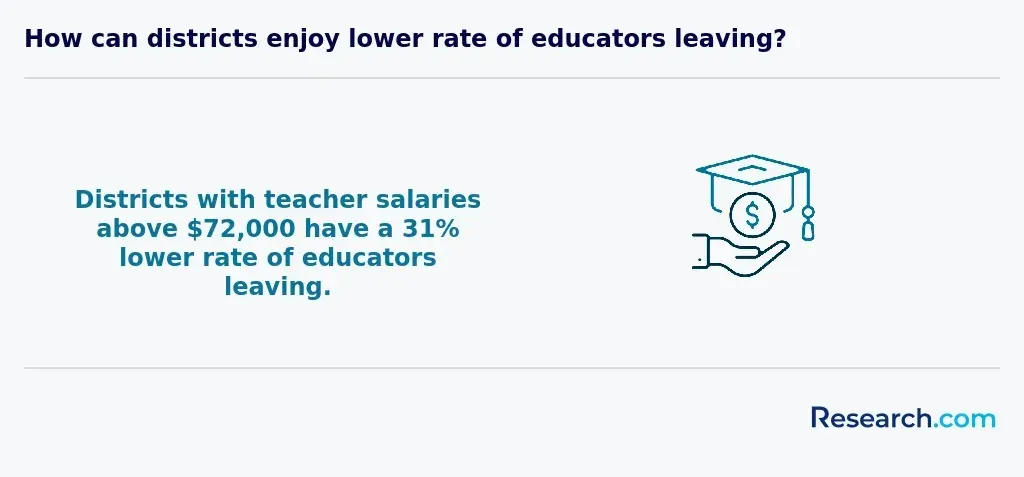
- The median annual salary for elementary school teachers in New Jersey is around $63,680, though pay depends on experience, education level, district contract, and location.
- Trenton, Newark, and Jersey City are among the higher-paying areas noted for elementary teachers in the state.
Teachers who plan to move into research, district leadership, higher education, or advanced administration may compare flexible online doctorate degrees in education. Advanced degrees should be evaluated based on career goals, cost, and district salary policies.
A teacher’s compensation can vary by credentials, as reflected in the chart below.
What support resources are available for elementary school teachers in New Jersey?
New Jersey teachers can draw on mentoring, professional development, educator associations, district resources, wellness supports, technology programs, and scholarship opportunities. These resources matter most during the first few years, when new educators are building classroom routines and learning how to manage competing demands.
Mentoring for new teachers
Teachers working under a provisional credential participate in a mentoring process during the first year. A strong mentor can help with lesson planning, parent communication, classroom management, assessment practices, and school culture.
Professional development
New Jersey requires continuing professional learning as part of license maintenance. Teachers must complete 100 hours of professional development every five years, so it is wise to document training as it happens.
Professional associations and educator networks
Organizations such as the New Jersey Education Association and the New Jersey Principals and Supervisors Association provide professional learning, advocacy, networking, and resources for educators at different career stages.
Wellness and mental health support
Teaching can be demanding. Many districts provide employee assistance programs, wellness initiatives, stress management resources, or counseling referrals. New teachers should use these supports early rather than waiting until burnout becomes severe.
Technology and classroom resources
Districts may provide classroom platforms, digital curriculum tools, training, and initiatives such as Future Ready Schools Program participation. Effective use of technology requires both access and training.
Grants, scholarships, and advancement support
Teachers pursuing graduate education, endorsements, or specialized training may find state, district, or institutional funding options. These can reduce the cost of moving into areas such as STEM, special education, literacy, or leadership.
For a broader overview of the full teaching pathway, see Research.com’s guide on how to become a teacher in New Jersey.
How can obtaining a special education certification impact your career prospects in New Jersey?
Special education certification can strengthen an elementary teacher’s career options by preparing them to work with students who need individualized instruction, accommodations, behavioral support, and collaborative services. It can also make a teacher more useful to schools that need inclusive classroom expertise.
This credential is best for educators who are comfortable with documentation, collaboration with families and specialists, and adapting lessons to meet specific learning needs. To understand the route in detail, review Research.com’s guide on how to become a special education teacher in New Jersey.
Is becoming an elementary school teacher in New Jersey worth it?
Becoming an elementary teacher in New Jersey can be worth it if you want a stable education career, enjoy working with children, and are prepared for a rigorous certification process. It is not the right choice for someone who wants a quick credential, dislikes structured state requirements, or is unwilling to complete fieldwork, exams, mentoring, and ongoing professional development.
| Choose this path if... | Consider another path if... |
| You want to teach young learners across multiple subjects. | You prefer working only with one subject or older students. |
| You can commit to degree completion, exams, and supervised teaching. | You need the fastest possible career entry with minimal licensing steps. |
| You value public service, child development, and classroom relationships. | You want a role with less emotional labor or fewer administrative responsibilities. |
| You are open to professional development and long-term skill growth. | You do not want continuing education or renewal requirements. |
Key Insights
- New Jersey elementary teacher certification requires a bachelor’s degree, approved teacher preparation, certification exams, background clearance, and supervised teaching experience.
- The process commonly takes five to six years from the start of college through full preparation, though career changers may qualify for alternative routes.
- Online programs can work for licensure only if they are accredited, certification-aligned, and include approved in-person fieldwork or student teaching.
- Applicants should budget beyond tuition because testing, background checks, credentialing fees, books, housing, and transportation can significantly affect total cost.
- Traditional certification offers more structured preparation, while alternative certification can help qualified degree holders enter the classroom sooner.
- Specializations such as special education, bilingual education, STEM, literacy, and early childhood education can improve career flexibility and classroom effectiveness.
- Do not choose a program based only on price or convenience. Confirm accreditation, New Jersey certification eligibility, student teaching support, exam preparation, and total net cost before enrolling.
- Teaching in New Jersey can be rewarding, but candidates should enter with realistic expectations about workload, professional development, classroom diversity, and long-term renewal requirements.
Related Articles for Nearby States
- 2027 How to Become an Elementary School Teacher in Delaware: Requirements & Certification
- 2027 How to Become an Elementary School Teacher in Pennsylvania: Requirements & Certification
- 2027 How to Become an Elementary School Teacher in New York: Requirements & Certification
- 2027 How to Become an Elementary School Teacher in Maryland: Requirements & Certification
- 2027 How to Become an Elementary School Teacher in Connecticut: Requirements & Certification
- 2027 How to Become an Elementary School Teacher in Rhode Island
- 2027 How to Become an Elementary School Teacher in Virginia: Requirements & Certification
- 2027 How to Become an Elementary School Teacher in Massachusetts: Requirements & Certification
- 2027 How to Become an Elementary School Teacher in West Virginia: Requirements & Certification
- 2027 How to Become an Elementary School Teacher in Ohio: Requirements & Certification
References:
- BLS. (17 Apr 2024). Kindergarten and Elementary School Teachers. BLS.
- Indeed (2024, Aug 18). How to Become a Teacher in New Jersey in 5 Steps. Indeed.
- nj.gov. (n.d.). Education Employment Opportunities in New Jersey. nj.gov.
- teachersoftomorrow.org. (13 Nov 2023). How to Become a Teacher in New Jersey in 2023. teachersoftomorrow.org
Other Things You Should Know About Becoming an Elementary School Teacher in New Jersey
The New Jersey Certificate of Eligibility (CE) is the first credential that lets a candidate seek a teaching position, while the standard instructional certificate is issued after a candidate completes a state-approved teacher preparation program and all certification requirements. The CE is not a full teaching license.
In 2027, aspiring elementary teachers in New Jersey can pursue certification through traditional and alternate pathways. Traditional pathways involve a bachelor's degree in education and student teaching, while alternate routes require a bachelor's degree in another field and enrollment in a state-approved educator preparation program.
To become a certified elementary school teacher in New Jersey in 2027, you must pass the Praxis Core Academic Skills for Educators tests and the Praxis Subject Assessments relevant to elementary education, as mandated by the New Jersey Department of Education.