2027 Best Online Master’s in Early Childhood Education Programs

Co-Founder and Chief Data Scientist
Choosing an online master’s in early childhood education is usually a career decision, not just an academic one. You may be trying to move from classroom teaching into leadership, qualify for a licensure pathway, specialize in early childhood special education, or strengthen your work with children from birth through age eight. This guide explains what online master’s programs in early childhood education typically include, how much they cost, how long they take, what careers they can support, and how to compare programs before enrolling.
Quick Answer: Is an Online Master’s in Early Childhood Education Worth It?
An online master’s in early childhood education can be worth it if you want advanced training in child development, curriculum design, assessment, early intervention, administration, or advocacy while continuing to work. Professionals with a master of education (MEd) in early childhood education earn an average salary of $53,000, though pay varies by role, employer, experience, location, and licensure status. The degree is most useful when it is accredited, aligned with your state’s teaching or endorsement requirements, and connected to the career path you want.
What are the benefits of getting an online master’s in early childhood education degree?
- More career options: A graduate degree can support advancement into curriculum, leadership, advocacy, family support, early intervention, or administrative roles in education and child development settings.
- Potential salary growth: Those who hold a master of education (MEd) degree in early childhood education can earn an average salary of $53,000.
- Stronger professional preparation: Graduate coursework can deepen your understanding of developmentally appropriate practice, assessment, inclusion, family engagement, and research-based teaching.
What can I expect from an online master’s in early childhood education degree?
An online master’s in early childhood education focuses on the learning, development, and care of young children, usually from birth through age eight. Coursework commonly covers child development theories, curriculum planning, assessment, educational psychology, family partnerships, inclusive education, and leadership in early childhood settings.
Many programs also examine play-based learning, inquiry-based instruction, differentiated teaching, classroom technology, social-emotional development, and culturally responsive practice. Some programs are designed for licensed teachers seeking professional growth, while others include initial licensure or endorsement pathways. Because licensure rules vary by state, students should confirm whether an online program meets the requirements where they plan to teach.
Where can I work with an online master’s in early childhood education degree?
Graduates may work in schools, childcare organizations, community programs, advocacy groups, higher education, or family support agencies. Common employment settings include:
- Preschools and early childhood education centers
- Public and private schools
- Childcare centers and family daycare homes
- Nonprofit organizations and advocacy groups
- Higher education and professional development programs
How much can I make with an online master’s in early childhood education degree?
The average salary of MECEd degree holders is around $53,000, but earnings depend on the role, employer, location, credentials, and years of experience. For example, elementary school teachers earn a median wage of $62,340, while preschool teachers earn about $37,120. With additional experience or credentials, graduates may pursue roles such as instructional coordinator, which earns $74,720, or director of a child care institution, which earns $56,270.
| Role | Reported wage or salary | What to consider |
| MECEd degree holder | $53,000 average salary | Broad estimate that may include several education and leadership roles |
| Elementary school teacher | $62,340 median wage | Usually requires state teaching licensure |
| Preschool teacher | $37,120 | Requirements vary by state, setting, and employer |
| Instructional coordinator | $74,720 | Often requires teaching experience and curriculum expertise |
| Director of a child care institution | $56,270 | May require leadership experience and state-specific credentials |
- Best Online Master’s in Early Childhood Education Programs for 2027
- How long does an online master’s in early childhood education take?
- Online vs. on-campus master’s in early childhood education
- Average cost of an online master’s in early childhood education
- Financial aid options for online early childhood education graduate students
- Admission requirements for an online master’s in early childhood education
- Common courses in an online master’s in early childhood education
- Specializations in online early childhood education master’s programs
- How to choose the best online master’s in early childhood education program
- Career paths for online master’s in early childhood education graduates
- Alternative careers outside traditional early childhood classrooms
- Challenges students may face in online graduate study
- Accreditation and quality assurance for online programs
- Job market for early childhood education master’s graduates
- How interdisciplinary study can strengthen early childhood education
- Using research and resource management to improve classroom practiceInterdisciplinary studyJob market
- Using a master’s in early childhood education for policy and advocacy
- How a doctorate in educational leadership can expand career options
- Professional development support in online programs
- Diversity, equity, and inclusion in online early childhood education programsProfessional development
- Collaboration and networking in online programs
- How an online master’s improves teaching practiceCareer supportDoctoral pathwaysTeaching practice outcomes
Best Online Master’s in Early Childhood Education Programs for 2027
How do we rank schools?
Research.com evaluates online programs using our methodology, with attention to factors such as cost, accreditation, program format, and credit requirements. To support program comparisons, our research process uses sources such as:
- IPEDS database
- Peterson's database, including their Distance Learning Licensed Data Set
- College Scorecard database
- National Center for Education Statistics
| School | Program details | Cost and credits | Accreditation |
| Concordia University | Online master’s in child education program; program length: Two Years; tracks/concentrations include theories of play, language and literacy development, educational research, and more. | $395 per credit; 30 required credits to graduate | Council for Accreditation of Educator Preparation (CAEP)] |
| Liberty University | Online master’s in early childhood education degree; program length: One and a half years; track/concentration: teaching adults in the early childhood education field | $415 per credit; 36 required credits to graduate | Southern Association of Colleges and Schools Commission on Colleges (SACSCOC) |
| Portland State University | Master’s in early childhood inclusive education program at PSU; program length: Two Years; tracks/concentrations include infant toddler mental health, constructivism, and early childhood special education. | $534 per credit; 45 required credits to graduate | Northwest Commission on Colleges and Universities (NWCCU) |
| University of Colorado | Flexible master's degree in early childhood education online program ; program length: Two to three years; track/concentration: early childhood special education | $429 per credit; 30 to 42 required credits to graduate | Higher Learning Commission (HLC) |
| Arizona State University | Online early childhood education MA degree; program length: 18 to 24 months; tracks/concentrations include instructional methodologies for young children, decision-making and action, emergent literacy, and more. | $565 to $692 per credit; 30 required credits to graduate | HLC |
| Walden University | MA in early childhood education online; program length: 20 months; track/concentration: early childhood public policy and advocacy | $785 per credit; 30 required credits to graduate | National Council for Accreditation of Teacher Education (NCATE) |
| University of North Dakota | Online master’s in early childhood education degree program; program length: Two Years; track/concentration: teaching adults in the early childhood education field | $451 per credit; 32 required credits to graduate | Council for Accreditation of Educator Preparation (CAEP) |
| University of West Alabama | Online MEd in early childhood development; program length: One Year; track/concentration: early childhood development | $429 per credit; 34 required credits to graduate | Southern Association of Colleges and Schools Commission on Colleges (SACSCOC) |
| University of Toledo | Licensure and master’s program (LAMP); program length: Two Years; tracks/concentrations include art, early childhood, foreign languages, special education, and more. | $639 per credit; 30 required credits to graduate | HLC |
| Capella University | MSEd in early childhood education; program length: Two to three years; tracks/concentrations include literacy instruction, child development, early childhood learning environment, and more. | $470 per credit; 45 required credits to graduate | CAEP |
Program notes for prospective students
Before choosing among these programs, compare more than tuition. Look closely at whether the degree is licensure-focused or non-licensure, whether fieldwork is required, whether your state accepts the program for certification or endorsement, and whether courses match your intended career path.
Key Findings
- Professionals with a master’s in early childhood education earn an average annual salary of $53,000.
- The cost of an MEd in early childhood education varies by school, program length, credit load, and specialization.
- Accredited online master’s in early childhood education programs are more preferred by employers all over the country.
- You need a teaching license in order to become an early childhood educator.
- Most online master’s programs require at least 30 credit hours to be completed.
How long does it take to complete an online master’s in early childhood education?
Most online master’s programs in early childhood education take about one and a half to two years of full-time study. Completion time depends on the number of required credits, term length, course load, transfer policies, fieldwork requirements, and whether you enroll full time or part time.
Accelerated programs may allow students to finish faster by taking more courses per term or using shorter academic sessions. Part-time programs usually take longer but may be more realistic for working teachers, childcare professionals, and parents balancing school with employment and family responsibilities.
How does an online master’s in early childhood education degree program compare to an on-campus program?
A masters in early childhood education online degree program is usually best for students who need scheduling flexibility, live far from campus, or want to continue working while enrolled. Online courses may include recorded lectures, virtual discussions, digital assignments, and remote advising. Some programs still require field experiences, practicums, or in-person components.
Campus-based programs may be a better fit for students who prefer scheduled classroom meetings, face-to-face discussion, local school partnerships, and direct access to campus resources. However, on-campus study may also involve commuting, housing, and less schedule flexibility.
| Factor | Online master’s program | On-campus master’s program |
| Schedule | Often more flexible for working adults | Usually tied to set class meeting times |
| Interaction | Uses video meetings, forums, email, and virtual advising | Offers in-person discussion and campus-based networking |
| Cost considerations | May reduce commuting or relocation expenses; students can compare affordable colleges for early childhood education | May include campus fees, transportation, and housing expenses |
| Fieldwork | May be completed locally if approved by the program | Often arranged through nearby partner schools or centers |
| Best fit | Self-directed learners who need flexibility | Students who want more structured in-person learning |
What is the average cost of an online master’s in early childhood education?
The cost of an online master’s in early childhood education varies by institution, degree type, residency rules, credit requirements, and fees. For example, an M.A. in early childhood education can cost around $11,850, while an M.S. in early childhood education can cost around $16,390. An MEd in early childhood development costs about $14,586. These figures may not include textbooks, technology fees, background checks, licensure testing, or travel for any required in-person experiences.
| Cost factor | Why it matters |
| Tuition per credit | A lower per-credit price may not mean a lower total cost if the program requires more credits. |
| Required credits | Many programs require at least 30 credit hours, but some require more. |
| Licensure expenses | Students in licensure tracks may need to budget for exams, background checks, and field placement requirements. |
| Fees and materials | Technology fees, books, software, and assessment tools can add to the final price. |
| Time to completion | Finishing faster can reduce opportunity costs, but heavier course loads may be difficult for working students. |
What are the financial aid options for students enrolling in an online master’s in early childhood education?
Graduate students should compare federal aid, scholarships, employer benefits, and school-based funding before deciding how to pay for a program. Research.com also provides a guide to financial aid and scholarships for future teachers.
- Federal Financial Aid: Graduate students may use federal aid programs such as the Pell Grant, Federal Direct Subsidized and Unsubsidized Loans, and the Federal Work-Study Program, depending on eligibility and program rules.
- Scholarships and Grants: Universities, professional associations, and private organizations may offer awards for graduate students in early childhood education. The TEACH Grant Program offers financial support to individuals willing to teach in high-need fields, providing up to $4,000 a year for post-graduation services in schools serving low-income students.
- Graduate Assistantships: Some programs provide assistantships that may include tuition waivers, stipends, or compensation for teaching, research, or administrative work.
- Employer Tuition Assistance: Childcare centers, school districts, nonprofits, and education employers may offer tuition reimbursement or tuition assistance for employees pursuing relevant graduate study.
Questions to ask about affordability
- What is the total program cost, not just the tuition rate?
- Are there separate fees for online learning, technology, fieldwork, or graduation?
- Can I use transfer credits or prior graduate coursework?
- Does my employer offer tuition reimbursement?
- Will the degree qualify me for a salary lane increase, endorsement, or promotion in my current workplace?
What are the prerequisites for enrolling in an online master’s in early childhood education?
Admission requirements vary by school and program type. Students comparing a master’s degree in elementary education with an early childhood education master’s should pay special attention to licensure requirements, since the age range and certification rules may differ.
- Bachelor’s Degree: Most programs require an accredited bachelor’s degree before admission to graduate-level coursework.
- Initial Teaching Certification: Some programs require applicants to already hold teaching certification in childhood education or early childhood development, especially if the program is designed for licensed teachers.
- Resume and Clinical Practice: Programs may request a resume to review prior teaching, childcare, clinical, leadership, or related professional experience.
- GPA and Transcripts: Many applicants to a graduate degree in education program must submit official transcripts and meet a minimum GPA requirement, typically around 2.75.
What courses are typically in an online master’s in early childhood education program?
Although course titles differ by school, most programs build advanced knowledge in child development, instructional planning, assessment, family partnerships, and leadership. Common courses include:
- Child Development and Learning: Students examine cognitive, emotional, social, physical, and behavioral development and apply developmental theory to instructional decisions.
- Curriculum Design and Assessment: This course focuses on learning objectives, instructional materials, assessment methods, and developmentally appropriate curriculum planning.
- Early Childhood Education Policy and Advocacy: Students study policies that affect access, funding, program quality, and teacher preparation. This can also be relevant for learners exploring child welfare social work careers.
- Family and Community Engagement: This course prepares educators to collaborate with families, schools, and communities to support children’s learning and development.
- Leadership and Administration in Early Childhood Education: Students learn about program management, budgeting, staffing, supervision, compliance, and quality improvement.
What types of specializations are available in an online master’s in early childhood education program?
Specializations help students align the degree with a specific career goal. Common options include:
- Special Education: This concentration prepares educators to support children with disabilities, developmental delays, and diverse learning needs through inclusive instruction, behavior support, assistive technology, and individualized education plans (IEPs).
- Curriculum and Instruction: Students focus on curriculum theory, standards alignment, instructional strategies, assessment, and classroom improvement.
- Infant and Toddler Education: This path emphasizes development and care from birth to age three, including relationships, routines, family partnerships, and early learning environments.
- Language and Literacy: Coursework addresses oral language, emergent literacy, phonics, early literacy assessment, multicultural literature, and family literacy. Students interested in resource organization and literacy may also compare this area with a master’s in library science online program.
- Social-Emotional Learning and Behavior Support: This specialization prepares educators to promote positive relationships, self-regulation, classroom community, and behavior intervention strategies.
How do I choose the best online master’s in early childhood education program?
The best program is not automatically the cheapest, fastest, or highest-ranked option. It is the program that fits your licensure needs, budget, schedule, and career plan.
- Verify accreditation: Choose an accredited institution and confirm whether the program has relevant educator preparation accreditation when applicable. Accreditation affects credibility, transferability, financial aid eligibility, and employer recognition.
- Confirm licensure alignment: If you need a teaching license, endorsement, or certification, ask the school and your state education agency whether the program satisfies those requirements.
- Calculate total cost: Compare tuition, fees, books, technology requirements, travel, fieldwork expenses, and licensure testing costs.
- Review faculty expertise and support: Look for faculty with experience in early childhood education, research, inclusion, curriculum, policy, or leadership.
- Examine the curriculum: Make sure the program covers the areas you need, such as child development, assessment, curriculum design, family engagement, special education, or administration.
- Ask about field placements: If practicum or student teaching is required, confirm whether placements can be completed near your home.
Common mistakes to avoid when choosing a program
| Mistake | Better approach |
| Choosing a program based only on tuition | Compare total cost, completion time, fees, and career outcomes. |
| Assuming every online program leads to licensure | Ask the program and your state agency for written confirmation. |
| Ignoring accreditation | Check institutional accreditation and educator preparation approval when relevant. |
| Overlooking fieldwork requirements | Confirm practicum, student teaching, or observation expectations before enrolling. |
| Relying only on rankings | Use rankings as a starting point, then evaluate fit, cost, curriculum, and support. |
What career paths are available for graduates of online master’s in early childhood education programs?
Graduates can pursue classroom, leadership, curriculum, support, and advocacy roles. Common career paths include:
- Child Development Specialist: These professionals may work as child life specialists, early intervention specialists, or developmental therapists supporting children and families facing developmental concerns or disabilities.
- Preschool Teacher: Graduates may teach in childcare centers, preschools, prekindergarten programs, or Head Start settings, creating developmentally appropriate lessons and activities.
- Early Childhood Education Administrator: Administrators may oversee programs, manage staff, develop policies, support compliance, and advocate for quality improvement.
- Curriculum Specialist: Curriculum specialists or instructional coordinators develop materials, evaluate instruction, lead professional development, and align curriculum with standards.
- Family Support Specialist: These professionals connect families with resources, parent education, child welfare services, and community-based support.
According to statistics, some of the most common job roles for graduates in this field also include elementary school teachers, preschool teachers, special education teachers, and childcare workers.
Can early childhood education graduates explore alternative career roles beyond traditional settings?
Yes. A master’s in early childhood education can support non-classroom roles in hospitals, nonprofits, community agencies, early intervention programs, research teams, and family services. For example, child life specialists use knowledge of child development to help children and families cope with medical experiences. Students interested in that path can review Research.com’s guide on how much do child life specialists make. Other alternatives may require additional credentials, supervised experience, or state-specific certification.
What challenges might I encounter in an online master’s in early childhood education program?
Online graduate study can be demanding, especially for students who are also working in schools or childcare settings. Common challenges include managing weekly deadlines, staying motivated without frequent in-person meetings, coordinating fieldwork, navigating online platforms, and maintaining communication with instructors and classmates. Students comparing related programs, such as a master's degree in child development, should review support services, orientation resources, advising access, and technical help before enrolling.
What are the accreditation and quality assurance measures for online early childhood education programs?
Accreditation helps confirm that an institution meets recognized academic standards. For early childhood education students, quality assurance should also include state approval for licensure tracks, qualified faculty, clear fieldwork policies, student support services, transparent tuition information, and evidence that the curriculum aligns with professional expectations. Students planning long-term leadership roles may later compare doctoral options, including the best online EdD, but master’s-level accreditation and licensure alignment should come first.
What is the job market for graduates with an online master’s in early childhood education degree?
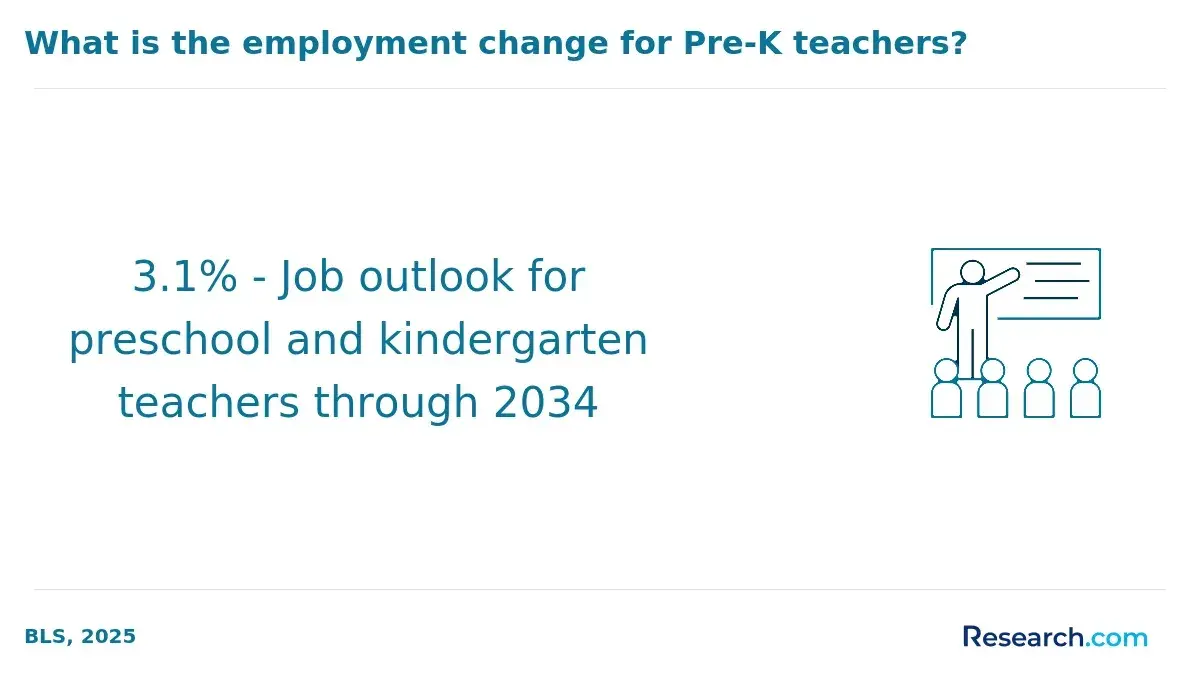
The job market for graduates with an online master’s in early childhood education degree remains stable, but demand is not identical across occupations. Public awareness of the importance of early childhood education continues to support the need for trained educators, specialists, and program leaders. The overall demand for preschool and kindergarten teachers is expected to increase by 3.1% percent through 2034, which is slower than the average demand for all occupations. This provides around 78,200 annual new openings.
The outlook differs by role. Preschool teacher employment alone will grow by 4.1%, while demand for childcare workers and kindergarten teachers will decline by -2.9% and -1.6%, respectively. Because the market is mixed, students should choose a program that prepares them for more than one role, especially if they want flexibility across teaching, administration, curriculum, intervention, or advocacy work.
What emerging trends are shaping online early childhood education?
Online early childhood education programs are increasingly using digital learning platforms, virtual collaboration tools, simulation-style activities, and data-informed assignments to help students connect theory with practice. At the same time, many educators are looking for flexible pathways that allow them to study without leaving the workforce. Students who need a faster route into education may also compare options to fast track teaching degree online, while still confirming licensure rules and fieldwork expectations.
Can integrating interdisciplinary studies, such as library science, enhance early childhood education?
Interdisciplinary study can strengthen early childhood practice when it helps educators organize resources, evaluate evidence, support literacy, and teach children and families how to use information effectively. Library science, for example, can add useful skills in digital resource management, children’s literature, information literacy, and research evaluation. Students curious about that pathway can review How much is a library science degree? to understand how library-related training may complement education work.
How can integrated research and resource management skills drive innovative classroom practices?
Graduate-level research skills help early childhood educators judge the quality of instructional resources, adapt curriculum for diverse learners, and use evidence rather than habit alone when making classroom decisions. Skills in resource management also matter as more classrooms rely on digital tools, family communication platforms, and multimedia materials. Educators interested in developing these abilities through another graduate field can compare the most affordable master of library science online programs.
How can I use my master’s in early childhood education to influence policy and advocacy?
A master’s in early childhood education can prepare graduates to advocate for better access, funding, curriculum quality, family support, and teacher preparation. Advocacy work may happen through schools, nonprofits, professional associations, state agencies, or community coalitions.
- Join professional organizations. Groups such as the National Association for the Education of Young Children (NAEYC) and local education associations can help educators track policy issues and participate in advocacy efforts.
- Educate families and communities. Workshops, parent events, and community presentations can build support for early learning programs and resources.
- Communicate with policymakers. Graduates can share field experience, research findings, and program needs with school boards, local officials, and state representatives.
- Create policy briefs and reports. Graduate research skills can be used to summarize problems, evaluate evidence, and recommend practical solutions.
- Advocate for funding and resources. Educators can support grant applications, partnerships, and public funding initiatives that improve access to quality early childhood education.
How can a doctorate in educational leadership advance your career in early childhood education?
A doctorate in educational leadership may be useful for early childhood professionals who want to move into senior administration, higher education, policy, research, or systems-level leadership. Doctoral study can prepare graduates to lead programs, influence curriculum standards, evaluate education initiatives, and address structural challenges in early childhood education.
Students who want to continue beyond the master’s level can compare the cheapest online doctorate in educational leadership programs. Before enrolling, they should evaluate cost, dissertation or capstone requirements, faculty expertise, and whether the degree aligns with leadership goals.
How do online early childhood education programs support students' professional development?
Strong online programs do more than deliver coursework. They also help students build professional networks, prepare for career transitions, and apply learning in real educational settings.
- Networking Opportunities: Students may connect with peers, alumni, faculty, and education professionals through webinars, virtual events, discussion boards, and group projects.
- Mentorship and Guidance: Some programs provide faculty mentors, career advisors, or field supervisors who help students plan next steps.
- Professional Development Resources: Workshops, training sessions, and optional certifications can help students stay current in early childhood education.
- Career Services: Resume support, interview preparation, job search guidance, and career counseling can be valuable for students changing roles.
- Opportunities for Advanced Certifications: Some programs allow students to pursue endorsements or specialized credentials in areas such as special education or bilingual education.
If you are looking for an affordable early childhood education degree online, compare academic quality and professional support together. A low-cost program is more valuable when it also offers advising, field placement help, and career-relevant coursework.
How Do Online Programs Foster Diversity, Equity, and Inclusion in Early Childhood Education?
Many online early childhood education programs now include coursework on culturally responsive teaching, inclusive curriculum design, anti-bias education, family engagement, and support for multilingual learners. These topics help educators build classrooms where children’s identities, languages, abilities, and family structures are respected. Graduates interested in broader education career options can also review what can I do with a masters in education.
How can online early childhood education programs enhance collaboration and networking?
Online programs can create meaningful professional connections when they use interactive tools intentionally. Discussion forums, video meetings, group assignments, virtual conferences, and peer feedback can connect students working in different communities and educational settings. These networks can expose educators to new strategies, research, and career paths. Students exploring related undergraduate or graduate pathways may also compare the best early childhood development online degree programs.
How an Online Master’s in Early Childhood Education Enhances Teaching Practices
An online master’s in early childhood education can improve teaching by helping educators understand developmental milestones, design stronger learning experiences, assess children more effectively, and build inclusive environments. The strongest programs connect theory to practice, allowing working educators to apply new strategies immediately in classrooms, childcare centers, family engagement programs, or early intervention settings.
Students seeking the cheapest online master's degree in early childhood education should still evaluate quality carefully. Affordability matters, but the program should also offer relevant coursework, qualified faculty, accreditation, licensure alignment if needed, and support for field experiences. When these pieces are in place, the degree can strengthen day-to-day teaching and create pathways into leadership, curriculum, advocacy, and administration.
Key Insights
- An online master’s in early childhood education is best for educators and child development professionals who need flexibility but still want advanced preparation for teaching, leadership, curriculum, advocacy, or family support roles.
- Licensure alignment is the most important decision point. If you want to teach in a public school or earn an endorsement, confirm state requirements before enrolling.
- Cost comparisons should include total tuition, fees, required credits, books, technology, fieldwork, and licensure exams—not only the advertised per-credit rate.
- Career outcomes vary. The average salary for MECEd degree holders is around $53,000, but role, location, employer, certification, and experience strongly influence pay.
- The job outlook is mixed across early childhood roles, so students should choose programs that build transferable skills in instruction, assessment, leadership, inclusion, and family engagement.
- Accreditation, field placement support, faculty expertise, and professional development services can make an online program more valuable than speed or price alone.
Resources:
- Kurtz, H. & Baker, L. (2025, March 4). What Teacher Morale Looks Like in Every State. EdWeek. https://www.edweek.org/the-state-of-teaching/teaching-learning/what-teacher-morale-looks-like-in-every-state/2025/03
- National Student Clearinghouse Research Center. (2026, January 15). Final Fall Enrollment Trends. https://nscresearchcenter.org/final-fall-enrollment-trends
- Payscale. (2026). Master of Education (MEd), Early Childhood Education Degree. https://www.payscale.com/research/US/Degree=Master_of_Education_(MEd)%2C_Early_Childhood_Education/Salary
- U.S. Bureau of Labor Statistics. (2025, August 28). Occupational projections, 2024–2034, and worker characteristics. Retrieved February 2026, from https://www.bls.gov/emp/tables/occupational-projections-and-characteristics.htm and preschool teachers occupational outlook
Other things you should know about online master’s in early childhood education programs
Many programs require 100 to 300 supervised field hours, even online. Placements are often completed in approved preschool, pre-K, or kindergarten settings, and schools may require background checks, site supervisor approval, and documentation aligned with state licensure standards.
In 2027, typical capstone projects in online master's programs in early childhood education often require students to complete a research-based project or comprehensive portfolio, demonstrating mastery in curriculum design or educational leadership. Projects usually span the final semester and must align with state education standards.
Students should expect to need a stable internet connection, a computer with updated software, and access to virtual collaboration tools like Zoom or Microsoft Teams. Some programs may require specific educational software or platforms for coursework and interactive learning exercises.