
2027 Early Childhood Education Certificate vs. Degree: Which Path Should You Pursue

Co-Founder and Chief Data Scientist
Educators are increasingly choosing between certificate and degree pathways as they plan for long-term career growth in early childhood education (ECE). Workforce data shows that 18% of practitioners, administrators, and trainers hold a Child Development Associate (CDA) credential, a common ECE certificate. Meanwhile, 30% of center-based ECE teaching staff nationwide hold a bachelor’s degree or higher.
Aspiring educators can make better career decisions by understanding how early childhood education certificate and early childhood education degree programs differ. In this article, we’ll compare both pathways, covering their duration, cost, curriculum, and career outcomes, to help you decide which fits your goals best.
Key Things to Know About Early Childhood Education Certificate Vs. Degree
- ECE certificates require fewer courses than degrees, making them less expensive. In contrast, degrees cost more due to longer programs and additional coursework.
- Certificates like the CDA provide recognized qualifications for assistant roles. Degrees are often needed for state licensing, lead teacher positions, and public school employment.
- Preschool teachers holding a bachelor’s degree earn a median hourly wage of about $16.60 compared to $14.85 for those with only a certificate.
- What’s the difference between an early childhood education certificate and a degree program? ECE Certificate vs. Degree
- What entry requirements are needed for certificate programs versus degree programs in early childhood education? Requirements
- What are the typical course components of an ECE certificate vs. a degree program? Courses
- How long does a certificate in ECE take compared to an associate or bachelor’s degree in ECE? Program Length
- What are the opportunity costs of pursuing a degree instead of a certificate? What are the opportunity costs of pursuing a degree instead of a certificate?
- What kinds of jobs can you get with an ECE certificate versus with an ECE degree in 2027? Jobs
- What is the difference in salary potential between an ECE certificate and an ECE degree? Salary
- How do employers view candidates with an ECE certificate compared to those with an ECE degree? How do employers view candidates with an ECE certificate compared to those with an ECE degree?
- How do certificate-to-degree pathways work in early childhood education? How do certificate-to-degree pathways work in early childhood education?
- When should a student choose an ECE certificate over a degree? When should a student choose an ECE certificate over a degree?
- Do ECE Credentials Deliver a Strong Return on Investment? Do ECE Credentials Deliver a Strong Return on Investment?
Early Childhood Education Certificate vs. Degree: Which Path Should You Choose?
Choosing between an early childhood education certificate and a degree is really a decision about speed, cost, job eligibility, and long-term mobility. A certificate can help you start working with young children sooner, while a degree usually gives you broader preparation for lead teaching, public pre-K, program administration, and specialized roles.
This guide is for career changers, current childcare workers, recent high school graduates, and working educators deciding whether a short credential is enough or whether an associate or bachelor’s degree is worth the extra time. You will learn how certificates and degrees differ in admissions, coursework, timelines, costs, salaries, employer expectations, and career options so you can choose the path that fits your goals.
Quick answer: certificate or degree?
An early childhood education certificate is usually the better first step if you want a faster, lower-cost route into entry-level childcare or assistant teaching. An early childhood education degree is usually the stronger choice if you want lead teacher roles, public school pre-K eligibility, administrative opportunities, or a clearer path to advancement.
| Factor | ECE Certificate | ECE Degree |
| Best for | Entry-level childcare workers, teacher aides, career explorers, and working adults who need a quick credential | Future lead teachers, public pre-K educators, administrators, and professionals seeking long-term advancement |
| Typical length | 8 to 12 months of full-time study | About two years for an associate degree and around four years for a bachelor’s degree |
| Primary value | Fast workforce entry and foundational training | Broader academic preparation, fieldwork, and stronger advancement potential |
| Common roles | Childcare worker, preschool assistant teacher, teacher’s aide, home-based childcare provider | Preschool or pre-K teacher, program administrator, early intervention specialist, public school teacher |
| Main trade-off | Lower cost and faster entry, but fewer leadership options | More time and expense, but wider career eligibility |
Short credentials such as the CDA are designed to help educators qualify for or support early childhood programs. They are especially useful for people seeking assistant, aide, or childcare roles where foundational knowledge and supervised classroom experience matter most.
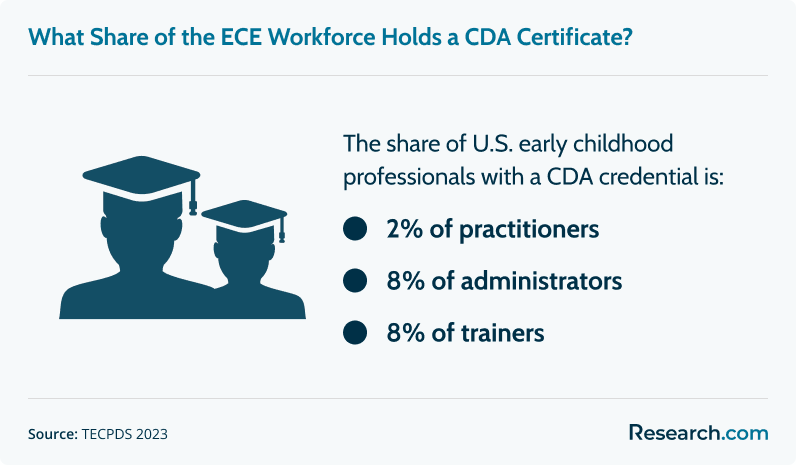
According to TECPDS, 2% of practitioners, 8% of administrators, and 8% of trainers hold the CDA credential. That does not mean the CDA lacks value; rather, it shows that higher-level roles often involve additional education beyond the initial certificate.
An early childhood education degree provides more extensive preparation in child development, curriculum planning, classroom management, assessment, family partnerships, and professional leadership. National data show that 30% of center-based ECE staff hold a bachelor’s degree or higher, while another 18% hold an associate degree.
If you are still deciding whether the field itself fits you, it may help to review why early childhood education can be a meaningful career path before choosing a credential level.
What Entry Requirements Are Needed for ECE Certificate and Degree Programs?
Admissions requirements depend on the credential level. Certificate programs are usually designed for beginners who want to qualify for childcare work quickly. Degree programs require broader college admission preparation and include more academic and field-based requirements. Students comparing flexible options can also review online early childhood education programs when deciding how to balance school, work, and family responsibilities.
| Requirement | Certificate Program | Degree Program |
| Prior education | Usually requires a high school diploma or GED | Requires a high school diploma or GED plus college admission requirements |
| Academic screening | Often minimal, though requirements vary by provider | May include placement tests, minimum GPA rules, or admission to the education major |
| Safety checks | Background checks or child-safety clearances are commonly required before practicum or observation | Background checks and field-placement clearances are commonly required for classroom experience |
| Health and safety training | Some programs require CPR or First Aid certification during enrollment or before completion | CPR, First Aid, and mandated training may be required depending on the college and state |
| Completion requirements | Core ECE courses, practicum or observation hours, and program assessments | General education courses, ECE major courses, fieldwork, and often student teaching or practicum |
Certificate programs
- Most applicants need a high school diploma or equivalent credential such as a GED.
- Programs that include classroom observation or practicum hours often require a background check or child-safety clearance.
- CPR or First Aid certification may be required for enrollment, practicum participation, or graduation.
Degree programs
- Applicants must meet the college’s general admission standards in addition to any early childhood education major requirements.
- Some colleges use placement tests, GPA thresholds, or prerequisite courses before students enter the professional education sequence.
- Graduation usually requires general education coursework, major-specific ECE courses, supervised field experience, and sometimes student teaching.
What Courses Do ECE Certificate and Degree Programs Usually Include?
The biggest academic difference is depth. Certificate programs focus on immediate classroom readiness: safety, child development basics, behavior guidance, and observation. Degree programs go further by adding curriculum theory, assessment systems, family and community partnerships, leadership, inclusion, and professional practice.
Students who want a detailed look at bachelor’s-level study can compare this overview with common courses in a bachelor’s degree in early childhood education.
| Course area | Certificate-level focus | Degree-level focus |
| Child development | Basic developmental milestones from birth to age eight | Deeper study of developmental theory, learning differences, and classroom application |
| Health and safety | Safe supervision, nutrition, sanitation, and emergency readiness | Program-level policies, child wellness, risk management, and regulatory expectations |
| Curriculum | Using prepared activities and supporting daily routines | Designing, implementing, and evaluating developmentally appropriate curriculum |
| Assessment | Observing children and recording developmental progress | Using documentation and evidence-based assessment to guide instruction |
| Behavior guidance | Positive discipline and classroom management basics | Advanced strategies for inclusive, culturally responsive, and trauma-aware environments |
| Leadership | Usually limited or introductory | Program administration, staff supervision, advocacy, and quality improvement |
Common certificate courses
- Child Growth and Development: Introduces physical, social, emotional, language, and cognitive development from birth through age eight.
- Health, Safety, and Nutrition: Covers safe environments, wellness practices, nutrition basics, and daily care routines.
- Observation and Assessment: Teaches students how to document child behavior, track progress, and notice developmental needs.
- Guiding Children’s Behavior: Focuses on positive behavior support, routines, transitions, and age-appropriate discipline.
- Introduction to Early Childhood Education: Explains the field’s major philosophies, ethical expectations, and professional practices.
Common degree courses
- Early Childhood Curriculum Design: Prepares students to plan, deliver, and evaluate learning activities for young children.
- Child, Family, and Community Relations: Examines how educators work with families, caregivers, and community professionals.
- Assessment and Documentation in ECE: Builds skill in using evidence to understand learning progress and inform instruction.
- Diversity and Inclusion in Early Childhood Settings: Addresses equitable teaching, cultural responsiveness, and support for diverse learners.
- ECE Leadership and Program Administration: Introduces supervision, center operations, compliance, and quality improvement.
Program emphasis varies. At least 55% of associate-degree ECE programs include courses on mentoring and assessing program quality. Meanwhile, only about 36% of bachelor’s programs report offering courses specifically for professional development services. This means students should compare curricula carefully instead of assuming every degree covers the same professional skills.
How Long Does an ECE Certificate Take Compared With an Associate or Bachelor’s Degree?
An ECE certificate is usually the fastest route into the field. It typically takes 8 to 12 months of full-time study. CDI College’s early childhood education certificate, for example, lasts about 44 weeks and includes practicum hours connected to childcare licensing preparation.
Degree programs require a longer academic commitment. An associate degree usually takes about two years, while a bachelor’s degree takes around four years of full-time study. Bachelor’s programs may include up to 120 credits plus significant fieldwork or student teaching.
| Credential | Typical full-time timeline | What the timeline usually includes | Best fit |
| ECE certificate | 8 to 12 months | Core ECE courses, safety training, observation, and practicum hours | Students who want faster workforce entry |
| Associate degree in ECE | About two years | General education, child development, curriculum, family engagement, and fieldwork | Students seeking lead teacher eligibility in some settings or transfer options |
| Bachelor’s degree in ECE | Around four years | Up to 120 credits, advanced coursework, field experience, and broader professional preparation | Students targeting public pre-K, leadership, or long-term advancement |
When comparing timelines across fields, students sometimes look at guides such as how long it takes to earn a healthcare management degree. The useful lesson is the same: program length matters, but required fieldwork, licensing rules, transfer credits, and part-time enrollment can change the real completion timeline.
What Are the Opportunity Costs of Choosing a Degree Instead of a Certificate?
The main cost of choosing a degree is not only tuition. It is also the time spent in school before reaching full-time employment or higher-level roles. A certificate can help you start earning sooner, while a degree may delay workforce entry by two to four years depending on the program and enrollment pace.
Degree programs also tend to require a larger financial commitment. Certificate programs are generally more affordable, while associate and bachelor’s programs may involve higher tuition, fees, books, transportation, and possible student debt.
The payoff is not always immediate. The wage gap between early childhood educators with a bachelor's degree and those without is approximately $1.75 per hour. For some students, that difference may not justify a four-year degree right away. For others, the degree is necessary because their target role requires it.
| Cost factor | Why it matters | Question to ask before enrolling |
| Time out of the workforce | Longer programs can delay full-time earnings | Can I work in childcare while completing the credential? |
| Tuition and fees | Degree programs usually require more courses and higher total cost | What is the total program cost after aid, not just tuition per credit? |
| Transfer credit | Certificate credits may reduce the time needed for an associate degree | Will this certificate transfer to a college degree later? |
| Role eligibility | Some jobs require a degree or state credential regardless of experience | Does my target job require an associate degree, bachelor’s degree, or license? |
| Long-term mobility | Degrees can support advancement into lead, public school, or administrative roles | Do I want classroom support work, lead teaching, or program leadership? |
This decision resembles other education-versus-credential choices. For example, professionals comparing an MBA certificate vs. MBA degree often weigh short-term affordability against long-term advancement, just as ECE students must do.
What Jobs Can You Get With an ECE Certificate Versus an ECE Degree in 2027?
Credential level strongly affects the types of roles you can pursue. Certificates usually prepare students for entry-level support positions. Degrees expand eligibility for lead teaching, specialized services, public programs, and administrative roles.
| Credential | Possible job | Typical responsibilities | Salary or wage information stated |
| ECE certificate | Childcare worker | Supervise children, support routines, assist with play-based activities, and maintain safety | The median hourly wage for childcare workers in the U.S. is $15.41 |
| ECE certificate | Preschool assistant teacher | Help lead teachers prepare activities, guide children, and manage classroom routines | Varies by employer and state requirements |
| ECE certificate | Home-based childcare provider | Operate or support childcare in a home setting, often under state licensing rules | Home childcare providers average about $13.87 per hour |
| ECE certificate | Teacher’s aide | Assist in early learning classrooms, Head Start settings, or childcare centers | Varies by setting and funding source |
| ECE degree | Preschool or pre-K teacher | Plan lessons, assess children’s progress, communicate with families, and lead classroom learning | The median annual wage for preschool teachers is $37,120 |
| ECE degree | Early childhood program administrator | Oversee staffing, compliance, family communication, budgeting, and program quality | Directors in childcare centers earn a median of $56,770 |
| ECE degree | Early intervention specialist | Support children with developmental delays or disabilities in coordination with families and service providers | The average annual salary for these jobs is about $49,567 |
| ECE degree | Public school teacher | Teach in public pre-K, Head Start, or related early learning classrooms where degree and licensure rules apply | These roles have an average of $48,190 per year |
Jobs commonly aligned with an ECE certificate
- Childcare Worker: Certificate holders often begin in daycare centers, family childcare homes, or community-based programs.
- Preschool Assistant Teacher: Assistants support the lead teacher, help children through daily routines, and prepare learning materials.
- Home-Based Childcare Provider: A certificate may help meet minimum state training expectations, though licensing rules vary by location.
- Teacher’s Aide: Aides support supervision, activities, transitions, and classroom preparation in early learning settings.
Jobs commonly aligned with an ECE degree
- Preschool or Pre-K Teacher: Degree holders are often better positioned for lead teacher roles in public or private settings. Some educators also build language-support expertise through programs such as online master’s programs in multilingual learner education.
- Early Childhood Program Administrator: Bachelor’s graduates may move into director, coordinator, or supervisory roles in childcare centers and early learning programs.
- Early Intervention Specialist: Some ECE degree pathways prepare graduates to work with children who have developmental delays or disabilities.
- Public School Teacher: Public pre-K and Head Start roles often require at least a bachelor’s degree in ECE or a related field, depending on state and program rules.
How Much More Can You Earn With an ECE Degree Than With a Certificate?
Higher credentials can improve salary potential, but early childhood education remains a field where pay varies widely by employer, funding source, state rules, and role. A certificate can help you qualify for paid work sooner. A degree may improve access to lead teaching, public program, and administrative positions.
| Credential or role level | Salary information stated | What it suggests |
| Certificate or CDA credential | Usually around $25,000-$31,000 per year | Typical of entry-level or support roles in childcare settings |
| Bachelor’s degree or state teaching license | Closer to $37,000 annually | Often associated with lead teaching or more formal instructional roles |
| Master’s-trained educators | Often earn $40,000 or more each year | May support specialization, leadership, or advanced instructional roles |
ECE professionals who want higher-paying roles can move from a certificate into an early childhood education degree, pursue state teaching credentials, or specialize in areas such as special education, early intervention, curriculum development, or multilingual learner support.
Employment setting also matters. Public or federally funded programs, including Head Start and state pre-K, may provide stronger compensation and benefits than some private childcare centers. Educators comparing credential-based pay differences may also find it useful to review alternative teacher certification salary information.
How Do Employers View ECE Certificates Compared With ECE Degrees?
Employers generally see an early childhood education certificate as evidence that a candidate has basic preparation for entry-level work with young children. That can be enough for childcare workers, preschool assistants, classroom aides, and some home-based childcare roles, especially when the applicant also has strong references and hands-on experience.
A degree sends a different signal. It suggests more extensive preparation in child development, curriculum planning, assessment, family engagement, and professional decision-making. Employers are more likely to associate degree holders with lead teaching, coordination, supervision, and program improvement responsibilities.
In a recent survey by the American Association of Colleges and Universities, 83% of employers agreed that recent college graduates are prepared for entry-level roles compared to those without degrees. While that finding is not limited to ECE, it reflects why many employers view degrees as a broader indicator of career readiness.
| Employer concern | How a certificate may be viewed | How a degree may be viewed |
| Immediate classroom support | Strong fit for supervised assistant or aide roles | Also qualified, though the candidate may expect more responsibility |
| Lead teaching readiness | May be limited depending on state and employer rules | Usually stronger preparation for planning, assessment, and classroom leadership |
| Regulatory compliance | May meet minimum requirements for some childcare roles | More likely to meet requirements for public or advanced early learning roles |
| Advancement potential | Often depends on work experience and additional credentials | More closely tied to leadership, administration, and specialization |
The same credential logic appears in other fields. In comparisons such as HR certificate vs. degree, certificates often demonstrate focused job skills, while degrees tend to signal deeper preparation and broader promotion potential.
Current trends affecting ECE hiring
- Credential requirements are becoming more role-specific: Entry-level childcare roles may accept certificates, but public pre-K, Head Start, and administrative positions often require more formal education.
- Employers value practical experience: Fieldwork, practicum hours, and supervised classroom experience can matter as much as the credential name.
- Technology is changing documentation: ECE workers increasingly use digital tools for family communication, child observation, and assessment records, but the core work remains relationship-based and hands-on.
- Specialized skills can improve mobility: Training in inclusion, early intervention, multilingual learners, and family engagement can make candidates more competitive.
How Do Certificate-to-Degree Pathways Work in Early Childhood Education?
Many early childhood educators do not choose between a certificate and a degree forever. They start with a CDA or ECE certificate, work in the field, and later apply that learning toward an associate or bachelor’s degree. This pathway can reduce risk because students gain experience before committing to a longer program.
- Earn a CDA or ECE certificate: Many students begin with a CDA or comparable certificate that takes a few months to one year and prepares them for roles such as childcare aide or teacher assistant.
- Work in a licensed early childhood setting: After earning the credential, many educators gain experience in preschools, daycare centers, or Head Start programs.
- Ask colleges about certificate credit: Some institutions award transfer credit for CDA or ECE certificate coursework, which can reduce the number of courses needed for an associate degree.
- Complete an associate degree in early childhood education: An associate degree strengthens knowledge in child development, learning environments, family engagement, and classroom practice.
- Transfer into a bachelor’s program: Associate degree graduates may be able to transfer credits into a bachelor’s degree in ECE or a related field.
- Pursue licensure or advanced credentials if required: In some states, a bachelor’s degree must be paired with teacher certification or licensure for public school roles.
| Pathway step | What to verify before moving forward |
| Certificate to associate degree | Whether the college accepts CDA or certificate coursework for credit |
| Associate to bachelor’s degree | Whether credits transfer into the major, not only as electives |
| Bachelor’s to licensure | Whether the program meets your state’s teacher certification requirements |
| Degree to leadership role | Whether your target employer requires administration coursework or director credentials |
When Should You Choose an ECE Certificate Instead of a Degree?
An ECE certificate is a practical choice when you need a faster, less expensive way to enter the workforce, test your interest in early childhood education, or meet minimum training requirements for an entry-level role. Many certificate programs take six months to one year, which can be a better fit for working adults, parents, and career changers. Students who need flexible formats may also want to review options at institutions serving non-traditional and flexible learners.
A degree is usually the better option if your goal is long-term advancement, lead teaching, public pre-K, early intervention, or program leadership. Data from the National Survey of Early Care and Education (NSECE) show that educators with degrees are twice as likely to hold lead teacher or administrative roles compared to those with only certificates.
| Choose this path | When it makes sense | When it may not be enough |
| ECE certificate | You want to enter childcare quickly, build experience, and avoid a large upfront investment | You want public school teaching, director roles, or higher-level specialization |
| Associate degree in ECE | You want stronger preparation than a certificate and may later transfer into a bachelor’s program | Your target job requires a bachelor’s degree or state teaching license |
| Bachelor’s degree in ECE | You want lead teaching, public pre-K options, administration, or a stronger advancement path | You need immediate employment and cannot manage the time or cost yet |
Who should start with a certificate?
- You are new to the field and want to confirm that early childhood education is the right career.
- You need a credential quickly for assistant teacher, childcare worker, or teacher’s aide roles.
- You want to work while gradually building toward a degree.
- You are cost-sensitive and want to avoid committing to a multi-year program before gaining experience.
Who should choose a degree sooner?
- You want to become a lead preschool, pre-K, or public school early childhood teacher.
- You plan to work in programs that require an associate or bachelor’s degree.
- You are interested in administration, curriculum leadership, early intervention, or policy work.
- You want a credential with stronger transferability across employers and states.
What Early Childhood Education Graduates Say About Their Career Paths
- : "Earning my CDA in nine months helped me move from interest to employment quickly. The training on observation and lesson planning made my first daycare role feel less overwhelming, especially when I had to respond calmly to difficult classroom behavior. — Kaye"
- : "My associate degree practicum at a Head Start center changed how I understood teaching. After we adjusted the classroom environment, a quiet three-year-old began joining group activities, and I saw how small instructional choices can make a real difference. — Miller"
- : "The bachelor’s program pushed me beyond daily classroom routines. Designing a full-day preschool curriculum with classmates taught me how to connect theory, planning, implementation, and leadership in a real early learning setting. — Anita"
Do ECE Credentials Deliver a Strong Return on Investment?
The ROI of an early childhood education credential depends on your starting point, target role, state requirements, employer type, and willingness to continue your education. A certificate may produce faster short-term value because it costs less and can lead to employment sooner. A degree may produce stronger long-term value if it qualifies you for lead teaching, public programs, administration, or specialized roles.
The important question is not simply “Which credential pays more?” It is “Which credential is required for the job I actually want, and can I earn it without taking on costs that outweigh the likely benefit?”
| Goal | Likely best starting credential | Why |
| Enter childcare quickly | Certificate | Shorter timeline and lower upfront commitment |
| Become a lead teacher in many early learning settings | Associate or bachelor’s degree | Stronger preparation and broader employer acceptance |
| Work in public pre-K or public school settings | Bachelor’s degree plus required state credential | Public roles often have stricter education and licensure expectations |
| Move into administration or senior leadership | Bachelor’s degree or graduate education | Leadership roles often require deeper training in supervision, compliance, and program quality |
| Pursue advanced education leadership | Graduate or doctoral study | Some professionals later consider advanced options such as 2 year Ed.D programs online for senior leadership, policy, or systems-level work |
How to Choose the Right ECE Program
Before enrolling, compare programs based on job eligibility, accreditation, fieldwork, transfer options, and total cost. A program that looks convenient may not be the best choice if it does not meet employer or state requirements.
- Start with your target role: Identify whether you want childcare work, assistant teaching, lead teaching, public pre-K, early intervention, or administration.
- Check state and employer requirements: Requirements vary, especially for licensed childcare centers, Head Start, and public school programs.
- Confirm accreditation and recognition: Make sure the school or provider is recognized by employers and, if relevant, accepted for transfer credit.
- Review fieldwork requirements: Practicum and observation hours can help you build experience, but they also affect your schedule.
- Ask about transfer pathways: If you start with a certificate, find out whether those credits can count toward an associate or bachelor’s degree.
- Calculate total cost: Include tuition, fees, books, background checks, transportation, childcare, and lost work hours.
- Compare support services: Look for advising, placement support, licensure guidance, tutoring, and help arranging practicum sites.
Common Mistakes to Avoid
| Mistake | Why it can hurt you | Better approach |
| Choosing the shortest program without checking recognition | The credential may not satisfy employer, state, or transfer requirements | Ask employers and colleges whether they accept the certificate or degree |
| Looking only at tuition | Fees, books, background checks, practicum costs, and lost wages can change affordability | Compare total cost from enrollment through completion |
| Assuming online programs always meet fieldwork rules | ECE programs often require in-person observation, practicum, or student teaching | Confirm how placements are arranged in your area |
| Ignoring state licensing requirements | A credential may not qualify you for public school or licensed roles in your state | Check state rules before enrolling, especially if you may move |
| Stopping at a certificate when your goal requires a degree | You may have to return to school sooner than expected | Build a certificate-to-degree plan from the start |
| Assuming salary outcomes are guaranteed | Pay depends on role, employer, funding source, location, and experience | Use salary data as a guide, not a promise |
Questions to Ask Before Enrolling
- Does this program meet the requirements for the specific ECE job I want?
- Will I need a state license or teaching certification after graduation?
- Are practicum, observation, or student teaching hours required?
- Can I complete fieldwork near where I live or work?
- Will certificate credits transfer into an associate or bachelor’s degree?
- What is the total cost after fees, materials, background checks, and transportation?
- What jobs have recent graduates entered, and were they certificate or degree graduates?
- Does the program offer advising for licensure, transfer, or career placement?
- If I study online, how does the school support hands-on classroom requirements?
References
- American Association of Colleges and Universities. (2023). The career-ready graduate: What employers say about the difference college makes. AAC&U employer report
- Bureau of Labor Statistics. (2025). Preschool teachers. Occupational Outlook Handbook. BLS preschool teachers profile
- Children’s Learning Institute. (2024). State of the Texas Early Childhood Education Workforce Report 2023. TECPDS workforce report
- Center for the Study of Child Care Employment. (2024). National profile – Early childhood workforce index 2024. University of California, Berkeley. CSCCE national workforce profile
- D’Amico, L. K., Fan, X., Rao, V., Perkins, K., & Bottoms, B. (2023). Early childhood education program and workforce needs assessment: Preliminary synopsis, April 2023. University of South Carolina. ECE workforce needs assessment
- Ivy Tech Community College. (n.d.). Education – Early childhood. Ivy Tech early childhood education program
Key Insights
- An ECE certificate is the faster, lower-cost option for entering childcare and assistant teaching roles, especially if you want to start working before committing to a degree.
- An ECE degree offers broader preparation and is usually the better fit for lead teaching, public pre-K, administration, early intervention, and long-term advancement.
- Time matters: certificates typically take 8 to 12 months, associate degrees about two years, and bachelor’s degrees around four years of full-time study.
- Salary gains are real but not automatic. The wage gap between early childhood educators with a bachelor's degree and those without is approximately $1.75 per hour, so ROI depends heavily on role, employer, and state requirements.
- Certificate-to-degree pathways can be a smart compromise if you want to work now and continue progressing later.
- Before enrolling, verify accreditation, transfer credit, practicum requirements, state licensure rules, and the credential required for your target job.
Other Things You Should Know About Pursuing an Early Childhood Education Certificate Vs. Degree
In 2027, financial aid options for ECE programs include federal Pell Grants, state-level scholarships, and work-study programs. Certificate programs may have fewer options compared to degree programs, which often qualify for more extensive federal student loans and institutional support.
An ECE certificate usually requires about 12 to 30 credit hours, while an associate degree in early childhood education typically requires 60 semester credit hours. Many associate programs also include general education courses plus supervised practicum or fieldwork approved by the program.
To enroll in a 2027 Early Childhood Education certificate program, you typically need a high school diploma or equivalent. Some programs may also require a background check or relevant work experience, though this can vary by institution and location.


